Motivation
Lightweighting is a topic of great importance to the automotive industry.Reference Modi, Stevens and Chess1 In some instances, incremental improvements to existing designs are insufficient to achieve compliance with Corporate Average Fuel Economy standards.2 New system-level and component designs need to be developed in concert with associated manufacturing processes and materials to achieve lightweighting requirements and cost targets.Reference Modi, Stevens and Chess1 Lightweighting is also an important consideration for military vehiclesReference Polsen, Krogsrud, Carter, Oberle, Haines and Littlefield3 and portable structures, such as shelters and bridges. For combat vehicles, lightweighting results in improved range, mobility, and agility. For portable structures, lightweighting enables improved mobility and reduction in personnel and equipment requirements for assembly.
In both the commercial automotive and military sectors, new lightweight system-level designs are mandating aggressive component design specifications. In many cases, a single material cannot meet the cost and performance targets demanded. Multimaterial design studies are therefore executed to identify suitable material combinations. Unfortunately, design engineers typically soon discover that appropriate joining methods do not exist for their identified materials combinations. Developing joining techniques to enable multimaterial design is a thus a challenge of great importance for both commercialReference Modi, Stevens and Chess1 and militaryReference Polsen, Krogsrud, Carter, Oberle, Haines and Littlefield3 vehicles.
The joining of aluminum to steel is an example of a material combination that is desirable for component design. Steel is used where increased strength is required and the remainder of the part is lightweight aluminum. However, it is challenging to join these using traditional joining processes, such as fusion welding, because their material properties are dramatically different. Relevant material properties affecting welding processes include density, melting temperature, coefficient of thermal expansion, and flow stress. Another challenge is that brittle intermetallic compounds (IMCs) can form at the Al-steel interface at an elevated temperature;Reference Kimapong and Watanabe4–Reference Wei, Li, Xiong and Zhang6 these reduce the joint strength. These challenges are further amplified by the high heat input and melting associated with traditional fusion welding. Researchers are solving these issues for dissimilar material joining with two approaches—developing improved fusion welding processesReference Kang, Chen, Sigler, Carlson and Wilkinson7 and using solid-phase joining processes, which require low energy input and do not involve melting.
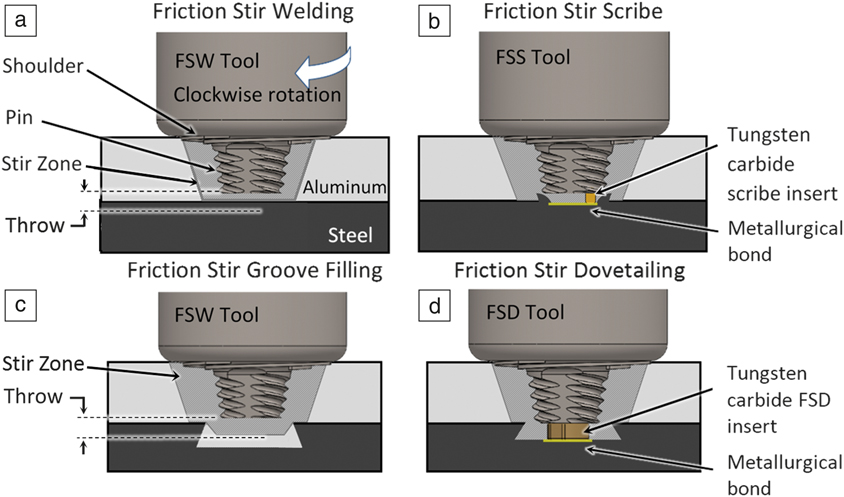
This article provides an overview of friction stir welding (FSW), solid-phase processes, and FSW variants used for dissimilar metals joining (Figure 1). Friction stir dovetailing (FSD) is a new process, developed by the Pacific Northwest National Laboratory (PNNL) and the US Army Combat Capabilities Development Command’s Ground Vehicle Systems Center, which has advanced the state of the art for thick-section Al-steel joining by achieving unmatched load-carrying capacity normalized with respect to weld length compared to published data for competing processes, such as friction stir scribe and friction stir groove filling. This article shows how understanding of the process physics and temperature control algorithms were used to develop and improve FSD. While this article is focused on Al-steel joining, the techniques described can be applied to other dissimilar materials systems as well.
Friction stir welding (FSW) and its variants. (a) FSW butt weld, (b) friction stir scribe (FSS) lap weld, (c) friction stir groove filling lap weld, and (d) friction stir dovetailing (FSD) lap weld.

FSW and variants
FSW is a solid-phase process.Reference Mishra, De and Kumar8 A diagram of a similar material FSW Al butt weld with a steel backing plate is shown in Figure 1a. FSW starts with a rotating tool plunging into a workpiece. Frictional heating at the tool/workpiece interface and plastic deformation heating softens the metal, which begins to flow around the tool. The region of material flowing around the tool is called the “stir zone.” Once the tool has reached the plunge depth, the tool traverses the joint line, producing a weld. Weld “throw” is the distance below the pin to which the stir zone could extend if the backing plate were not present. It is important that the throw extends beyond the Al-steel interface to ensure sufficient mixing at the weld root, preventing defects. Typically, throw is established using bead-on-plate welds in material thicker than the intended weld thickness.
The FSW variants described next are used for dissimilar materials joining. Friction stir scribe (FSS) (Figure 1b) is a process where a “scribe insert” is placed in an FSW tool that lightly machines, or scribes, the top surface of the underlying steel plate. When executed properly, interaction between the scribe and the steel during FSS produces metallurgical bonding and mechanical interlocking at the dissimilar material interface.
Friction stir groove filling (FSGF) (Figure 1c) is a process where grooves are cut into the steel beneath the stir zone and Al fills the groove during processing, creating a mechanical interlock. Several researchers have explored variants of FSGF.Reference Evans, Gibson, Reynolds, Strauss and Cook9,Reference Kandasamy and Schultz10 Typically, the stir zone itself only partially enters the dovetail, and material beneath the stir zone is extruded into the groove.
FSDReference Ross, Reza-E-Rabby, McDonnell and Whalen11 (Figure 1d) is a process for thick-section dissimilar metals joining developed by PNNL and the Ground Vehicle Systems Center. For the purpose of this article, thick is considered greater than 10 mm. FSD uses two separate mechanisms for joining—mechanical interlocking and metallurgical bonding. In a woodworking dovetail joint, wood glue is used to adhere the two surfaces. Similarly, FSD adheres the two materials by creating a metallurgical bond at the dissimilar material interface within the dovetail, wherein a wear-resistant insert presses and rubs against the dissimilar material interface. The interaction between the insert and the steel results in heat, pressure, and shearing at the dissimilar material interface. This results in mechanical interlocking and metallurgical bonding between the steel and Al. The metallurgical bonding allows loads to be distributed across a larger area, resulting in improved load-carrying capacity as shown in (Figure 2). Metallurgical bonding between the dissimilar materials during processing distinguishes FSD from FSGF. For many high-strength materials, high heat input degrades the microstructure, resulting in reduced performance.Reference Mishra, De and Kumar8 Some FSW variants, including FSS and FSD, use the interaction between the tool or tool inserts and steel at the Al-steel interface to promote metallurgical bonding at the dissimilar interface. The IMC layer is affected by process parameters. For example, if the weld is too hot, the intermetallic layer grows too thick and becomes brittle and weak.Reference Kimapong and Watanabe4,Reference Wei, Li, Xiong and Zhang6 If the temperature is too low, metallurgical bonding may not occur. At the proper temperature and contact condition, metallurgical bonding occurs without the formation of a thick detrimental IMC layer.
Metallurgical bonding within the dovetail improves strength. (a) Friction stir groove filling does not produce metallurgical bonding, therefore reaction forces are concentrated at one corner. (b) Friction stir dovetailing produces metallurgical bonding that allows forces to act over a larger area.

Temperature-control method for FSW
To improve process control during joining, PNNL developed temperature control technology for FSW that can command and maintain temperatures measured by thermocouples embedded in an FSW tool. The temperature regulation software uses a dual-loop control scheme that consists of an outer loop and an inner loop. The slower outer loop is the temperature-control loop and contains a proportional-integral-derivative (PID) algorithm to control temperature by commanding spindle power. The PID control uses the magnitude, integral, and derivative of the error to control processes.Reference Aström and Murray12 In this case, the outer loop uses a PID algorithm to define a spindle power command based on temperature feedback to maintain a user defined temperature setpoint.
The faster inner loop is the power control loop. Torque modulation of the rotating toolReference Ross, Sorensen, Mishra, Mahoney, Sato, Hovanski and Verma13,Reference Ross14 is used to produce the commanded spindle power defined by the slower outer loop. The commanded torque can be calculated by dividing the commanded power by the angular velocity of the rotating tool.
This approach enables the temperature to be controlled within a few degrees Celsius at a given thermocouple location. Use of temperature control is described in detail for various similar material FSW applications elsewhere.Reference Ross15–Reference Ross, Sorensen, Mishra, Mahoney, Sato, Hovanski and Verma17 This article describes the use of temperature control in dissimilar Al-steel joining using FSD.
Effect of IMC layer thickness in FSD
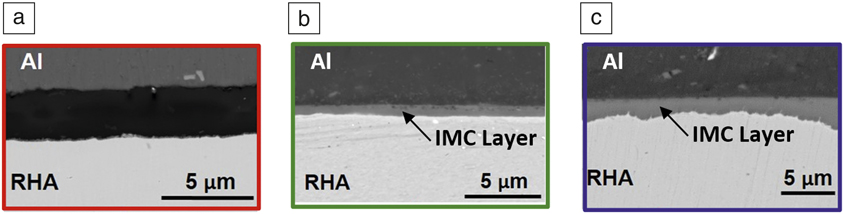
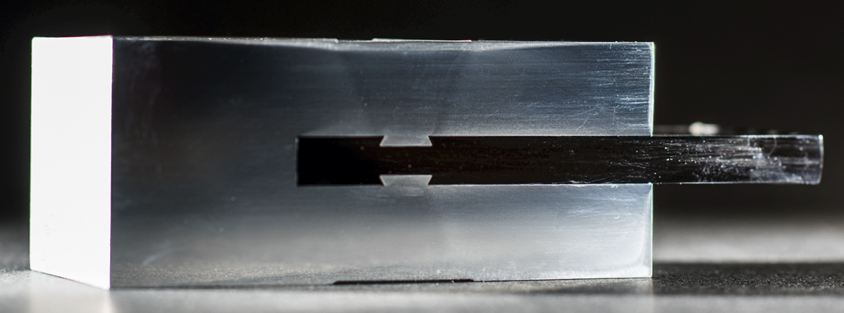
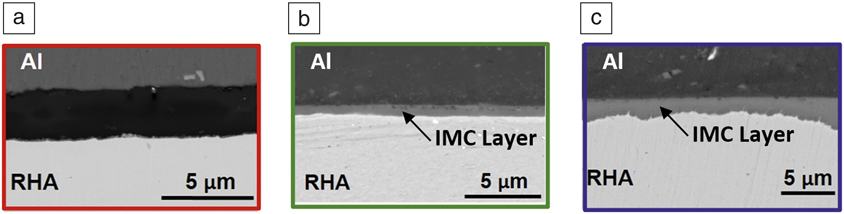
FSD was used to join 12.70-mm-thick Al 6061, a precipitation hardened Al-Mg-Si alloy, to 12.70-mm-thick rolled homogeneous armor steelReference Reza-E-Rabby, Ross, Whalen, Hovanski, McDonnell, Hovanski, Mishra, Sato, Upadhyay and Yan18 (RHA), a Ni-Cr-Mo steel. Through-holes were drilled in the FSD tool, and thermocouples were mounted and exposed to the stir zone, on the tool shoulder, and to the dissimilar material interface, at the tip of the tungsten carbide insert. FSD welds with processing conditions A, B, and C were run to produce measured temperatures at the insert tip of 475°C, 490°C, and 570°C, respectively. Condition A produced no IMC layer. Condition B produced an IMC layer with a thickness of 0.8 µm or less at the bottom of the dovetail. Condition C produced an IMC layer with a thickness that varied from 1 to 3 µm at the bottom of the dovetail. Scanning electron microscope images of each interface are shown in Figure 3. Test coupons were fabricated 13-mm wide (Figure 4), and lap shear tensile testing was used to evaluate maximum normalized load-carrying capacity of the joints. Details on the weld parameters and test procedures used are reported elsewhere.Reference Ross, Reza-E-Rabby, McDonnell and Whalen11,Reference Reza-E-Rabby, Ross, Whalen, Hovanski, McDonnell, Hovanski, Mishra, Sato, Upadhyay and Yan18
Scanning electron microscope images of dissimilar Al-steel (rolled homogeneous armor, RHA) interface for friction stir dovetailing under different parameters.Reference Ross, Reza-E-Rabby, McDonnell and Whalen11,Reference Reza-E-Rabby, Ross, Whalen, Hovanski, McDonnell, Hovanski, Mishra, Sato, Upadhyay and Yan18 (a) Shallow plunge with no intermetallic compound (IMC) interlayer; tungsten carbide tip at 475°C, (b) interlayer less than 0.8 µm and tungsten carbide tip at 490°C, and (c) 1–3 µm interlayer with the tungsten carbide tip at 570°C.
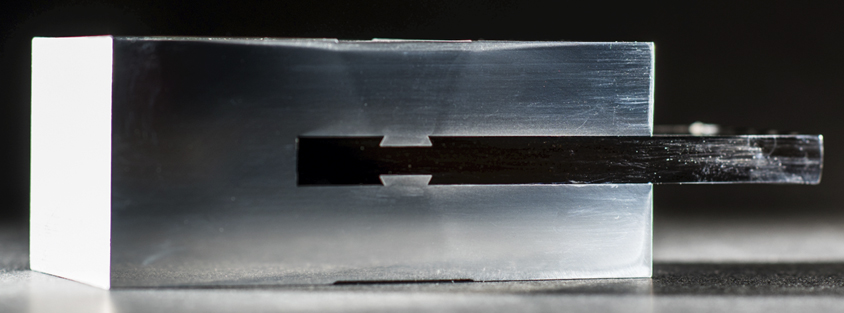
Lap shear tensile test specimen of an Al-steel (rolled homogeneous armor [RHA]) joint fabricated with friction stir dovetailing. Specimen width is 13 mm. Al and RHA are each 12.7-mm thick.Reference Ross, Reza-E-Rabby, McDonnell and Whalen11,Reference Reza-E-Rabby, Ross, Whalen, Hovanski, McDonnell, Hovanski, Mishra, Sato, Upadhyay and Yan18

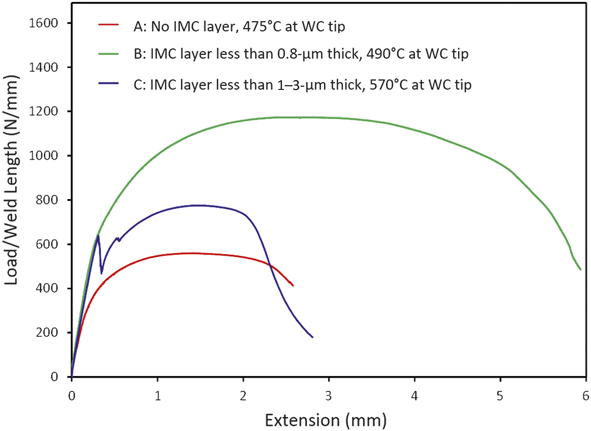
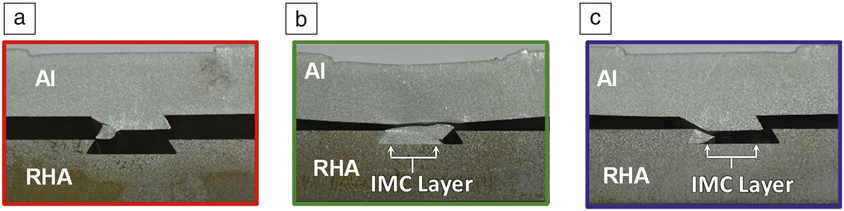
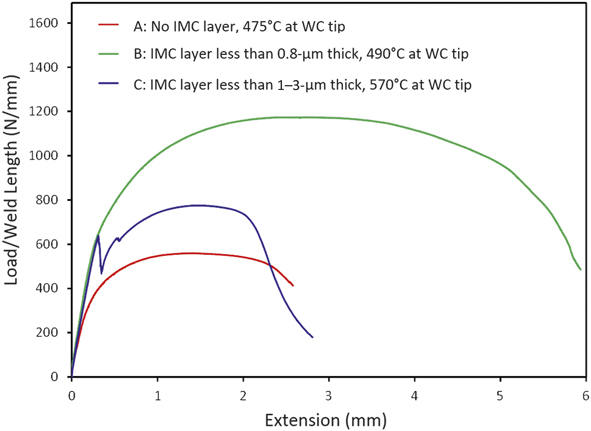
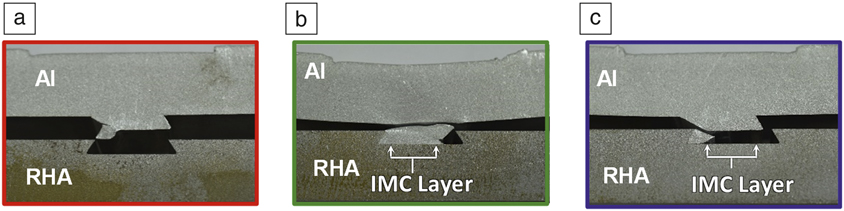
The load (normalized with respect to the weld length)–displacement curves for the three conditions are shown in Figure 5, and the failed interfaces are shown in Figure 6. Condition A (measured temperature at the insert tip was 475°C) had no intermetallic layer and is the weakest because the load is concentrated at a single bottom corner within the dovetail. Condition B had metallurgical bonding at the bottom of the dovetail, allowing the load to be distributed across the dovetail. For Condition B, temperature was controlled to 490°C at the insert tip during the weld. The material failed in shear at the top of the dovetail but showed improved performance relative to the other two conditions. Condition C had metallurgical bonding with a thicker IMC layer growth than observed for Condition B. For Condition C, the temperature at the tip of the tungsten carbide insert was controlled to 570°C. This condition allowed the IMC layer to become thick and brittle.Reference Kimapong and Watanabe4,Reference Wei, Li, Xiong and Zhang6 The load–displacement curve (Figure 5) shows the thick brittle IMC layer failing suddenly at approximately 600 N/mm, then the corner of the dovetail carried the load through the rest of the curve.
Load–displacement curves for single dovetail Al-steel joints created under different processing conditions:Reference Ross, Reza-E-Rabby, McDonnell and Whalen11,Reference Reza-E-Rabby, Ross, Whalen, Hovanski, McDonnell, Hovanski, Mishra, Sato, Upadhyay and Yan18 Condition A: Shallow plunge with no intermetallic compound (IMC) interlayer; tungsten carbide tip at 475°C. Condition B: Interlayer less than 0.8 µm and tungsten carbide tip at 490°C. Condition C: 1–3 µm interlayer with the tungsten carbide tip at 570°C. Condition B is has the highest load-carrying capacity normalized by weld length. Note: WC, tungsten carbide.
Photographs showing failure of friction stir dovetailing (FSD) single dovetail Al-steel (rolled homogeneous armor [RHA]) joints formed using different parameters.Reference Ross, Reza-E-Rabby, McDonnell and Whalen11,Reference Reza-E-Rabby, Ross, Whalen, Hovanski, McDonnell, Hovanski, Mishra, Sato, Upadhyay and Yan18 (a) Shallow plunge with no interlayer with tungsten carbide tip at 475°C, (b) intermetallic compound (IMC) interlayer less than 0.8 µm with tungsten carbide tip controlled to 490°C, and (c) IMC interlayer 1–3 µm and tungsten carbide tip controlled to 570°C.
FSD allows stronger and thicker Al-steel joints
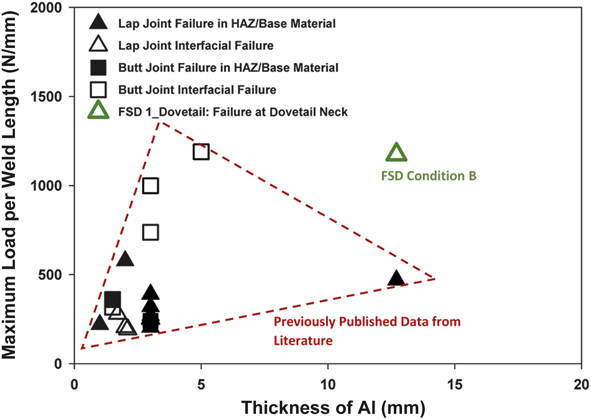
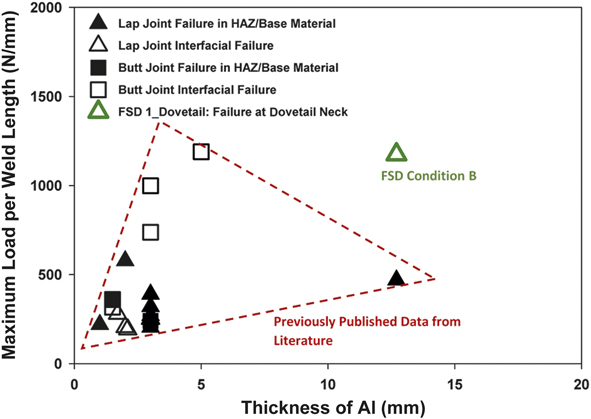
FSD represents a significant improvement in maximum load for thicker Al-steel joints. Condition B represents FSD with thermal and pressure conditions at the Al-steel interface that produced the best results among the three conditions described herein. Figure 7Reference Kimapong and Watanabe4–Reference Wei, Li, Xiong and Zhang6,Reference Evans, Gibson, Reynolds, Strauss and Cook9,Reference Ross, Reza-E-Rabby, McDonnell and Whalen11,Reference Chen and Nakata19–Reference Zheng, Feng, Shen, Huang and Zhao34 shows maximum strength for Condition B normalized by weld length as a function of Al thickness compared to published data for Al-steel joints from literature. The green unfilled triangle represents the FSD Condition B, which failed at the dovetail neck. FSD Condition B has improved normalized load-carrying capacity relative to all Al-steel joints produced by FSW or FSW variants, excluding other FSD joints that have been reported in known literature. Few reports exist presenting thick-section Al-steel joining, while many exist for thin-section Al-steel joining, as observed in Figure 7. Filled black triangles and squares represent lap and butt welds, respectively, where failure occurred in the heat-affected zone, where heat input from welding affects properties of the surrounding material, or base metal. Unfilled black triangles and squares represent lap and butt welds that failed at the dissimilar material interface.
Summary of published maximum strength normalized by weld length for Al-steel joints produced by friction stir welding and friction stir welding variants.Reference Kimapong and Watanabe4–Reference Wei, Li, Xiong and Zhang6,Reference Evans, Gibson, Reynolds, Strauss and Cook9,Reference Ross, Reza-E-Rabby, McDonnell and Whalen11,Reference Chen and Nakata19–Reference Zheng, Feng, Shen, Huang and Zhao34 Friction stir dovetailing (FSD) has the highest normalized strength reported in literature. Only one other thick section joint (10 mm or greater) was found in the literature. Note: HAZ, heat-affected zone.
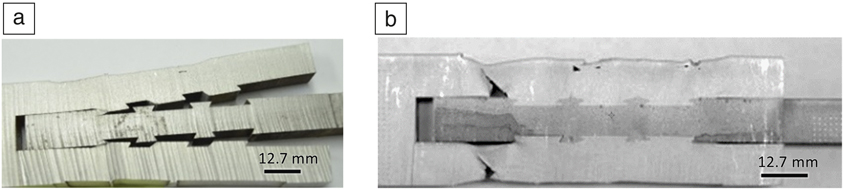
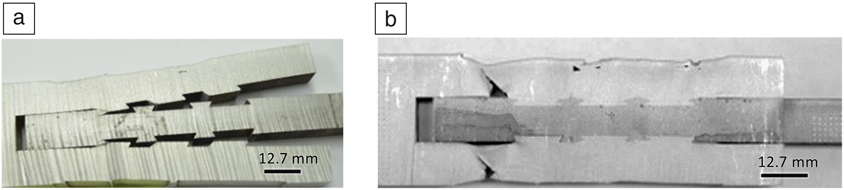
Multiple dovetail passes increase the maximum normalized load-carrying capacity, and failure is driven into the weld heat-affected zone. Figure 8b shows a sample with multiple dovetail grooves that achieved a maximum normalized load-carrying capacity of approximately 3500 N/mm.Reference Reza-E-Rabby, Ross, Whalen, Hovanski, McDonnell, Hovanski, Mishra, Sato, Upadhyay and Yan18
Photographs showing tensile tests with multiple dovetail grooves. (a) No metallurgical bonding, and (b) metallurgical bonding and failure in heat-affected zone.Reference Reza-E-Rabby, Ross, Whalen, Hovanski, McDonnell, Hovanski, Mishra, Sato, Upadhyay and Yan18
Temperature-controlled FSD
The normalized load per unit weld length of FSD welds is dramatically improved when metallurgical bonding occurs and thickness of the IMC layer is suppressed. This was accomplished when the interaction between the FSD tool insert and steel measured 490°C, at a welding speed of 75 mm/min and a tool axial force of 57 kN. Measured temperature, tool axial force, and weld speed should be maintained at values known to produce good welds during fabrication or repair despite process variations. A subset of anticipated process variations that affect tool axial force and temperature include changing thermal boundary conditions, lack of parallelism between machine and part, part distortion, material variability, part fixture, and setup variability.
Temperature control in combination with force control or advanced position control algorithms is currently in use at PNNL for FSD. These control algorithms are improving robustness and repeatability of FSD welds within a part and from part to part. Use of temperature-control algorithms are also accelerating the speed of FSD process development for new geometries and alloy systems. Figure 9 shows a FSD weld of 12.70-mm-thick RHA into 63.5-mm-thick Al 6061 and is an example of new geometries being investigated.
Friction stir dovetailing (FSD) weld of 12.70-mm-thick rolled homogeneous armor steel into 63.5-mm-thick Al 6061 (Al-Mg-Si). In previous work for this joint configuration, thickness of aluminum was limited to 38.1 mm.Reference Reza-E-Rabby, Ross, Whalen, Hovanski, McDonnell, Hovanski, Mishra, Sato, Upadhyay and Yan18
Closed-loop feedback of temperature and force play an important role in quality assurance by maintaining temperature and force conditions required for metallurgical bonding and IMC layer suppression throughout a weld and from weld to weld. In preparation for the industrial application of FSD, disturbance rejection and weld trails studies are needed to advance the technical readiness of FSD and determine if additional process controls development is needed.
Summary
Al-steel joining is an area of interest for automotive and military vehicles and portable structures. FSD, in combination with temperature control, advances the state of the art for joining of Al-steel thick sections, with superior load-carrying capacity per unit weld length compared to other FSW techniques. Metallurgical bonding with suppressed IMC layers are critical to obtain the maximum load-carrying capacity per unit weld length. Process temperature and tool axial force/position control can maintain conditions needed for metallurgical bonding with suppressed IMC layer thickness across a weld and from weld to weld. Continued process control development for FSD is needed to accelerate commercial readiness.
Acknowledgments
This work was supported by the US Army Combat Capabilities Development Command’s Ground Vehicle Systems Center (Military Interdepartmental Purchase Request 10834736, 11008837, and 11079043). Pacific Northwest National Laboratory is operated by the Battelle for the US Department of Energy under Contract No. DE-AC05–76L01830.

Ken Ross is a materials research engineer at Pacific Northwest National Laboratory (PNNL). He earned his BS and MS degrees in mechanical engineering from Brigham Young University. Prior to joining PNNL, he was a R&D engineer at Manufacturing Technology, Inc. His research focuses on various solid-phase processing research projects in hydropower, defense, nuclear power, and automotive sectors for government and industrial clients. He serves as the Industrial Advisory Board Chair for the National Science Foundation I/UCRC Center for Friction Stir Processing and as task lead of the Repair Task Group within the EPRI ESCP program. Ross can be reached by email at kenneth.ross@pnnl.gov.

Md. Reza-E-Rabby is a research engineer at Pacific Northwest National Laboratory. He obtained his PhD degree in mechanical engineering from the University of South Carolina in 2015. His research focuses on the process development of friction stir welding (FSW) and its derivative technologies, as well as novel die design for shear-assisted processing and extrusion. He has authored several journal articles on FSW tool design aspects and process development. Reza-E-Rabby can be reached by email at md.reza-e-rabby@pnnl.gov.

Martin McDonnell is an experimental mechanical engineer at the US Army Combat Capabilities Development Command’s Ground Vehicle Systems Center. He received his BS degree in mechanical engineering from The Pennsylvania State University, Behrend, through the Science, Mathematics, and Research for Transformation Scholarship, and is pursuing his MS degree in weld engineering at The Ohio State University. He leads multiple research efforts in advanced joining with a particular focus on friction stir welding and dissimilar material joining. He serves on the Industrial Advisory Board for the National Science Foundation I/UCRC Manufacturing and Materials Joining Innovation Center Trust Area Materials, Microstructure, and Weldability and multiple US Department of Defense working groups for joining. McDonnell can be reached by email at martin.m.mcdonnell3.civ@mail.mil.

Scott Whalen is a senior scientist at Pacific Northwest National Laboratory, where he leads fundamental research aimed at discovering the relationships between high shear and the resulting microstructure. He is a pioneering developer of a new extrusion method called Shear Assisted Processing and Extrusion, which is being used to fabricate magnesium and aluminum alloys with improved materials properties. He has received an R&D 100 Award for his work on joining aluminum to steel, and is an author and inventor on numerous publications and patents in the area of solid-phase processing. Whalen can be reached by email at Scott.Whalen@pnnl.gov.