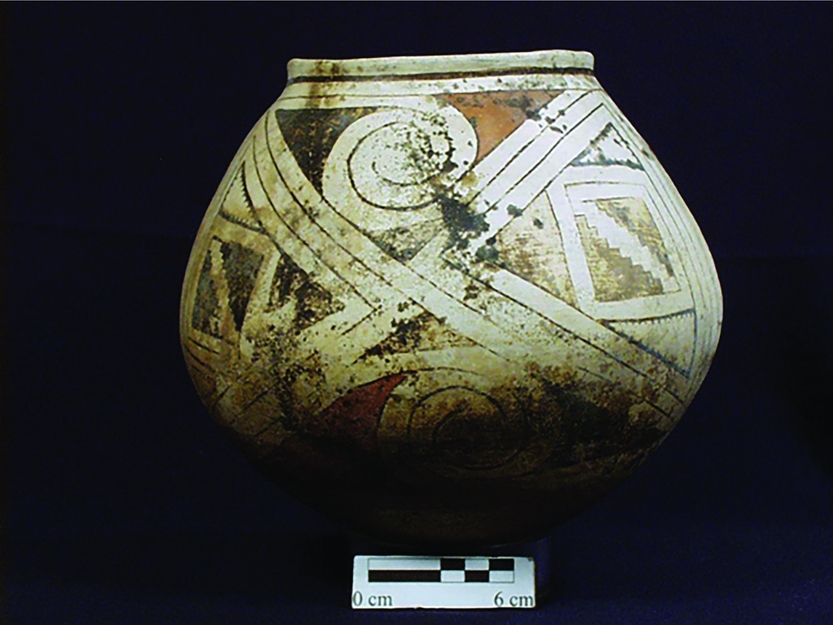
The Medio period society (AD 1200 to 1450) of Casas Grandes reflects one of the most politically complex cultures north of Mesoamerica (Di Peso Reference Di Peso1974; Rakita Reference Rakita2009) and an area of Mesoamerican influence that fundamentally changed late prehistoric cultures throughout the North American Southwest (Mathiowetz Reference Mathiowetz2011; Riley Reference Riley2005). Furthermore, the Medio period is an anthropologically significant example of the development of political complexity in the context of small-scale farming communities (Rakita Reference Rakita2009). Archaeologists and others are consequently interested in the economic and political organization during the Medio period and how this system developed.
One aspect of the evident political complexity and Mesoamerican influence is an economy that transcends the typical household economy of most southwestern cultures, focusing on the apparent specialized aviculture of macaws and perhaps turkeys and the specialized production of goods such as roasted agave, shell jewelry, architecture, ground stone metates, and pottery (Bagwell Reference Bagwell2006; Rakita and Cruz Reference Rakita, Cruz Antillón, Minnis and Whalen2015; VanPool and Leonard Reference VanPool and Leonard2002). Nevertheless, arguments for specialized production have been challenged, and debate continues concerning the presence and degree of specialized production evident throughout the region (Rakita and Cruz Reference Rakita, Cruz Antillón, Minnis and Whalen2015). Here we address the organization of ceramic production using the Standardization Hypothesis, which is the premise that the products of specialized producers tend to have more standardized morphologies than the products of generalized producers (Crown Reference Crown, Mills and Crown1995). We use geometric morphometric analysis to evaluate the variation in vessel form for Medio and Viejo period pottery and conclude that most Medio period Ramos Polychrome and some Babicora Polychrome demonstrate evidence indicating specialized production, but that the remaining Viejo and Medio period pottery types reflect generalized (household level) production. This in turn supports arguments for the primacy of Paquime, the apparent economic and religious center of the Casas Grandes world, with the Paquime elites and their interest in imported Mesoamerican goods and religion instigating the specialized production and social complexity.
Archaeology of the Casas Grandes Region
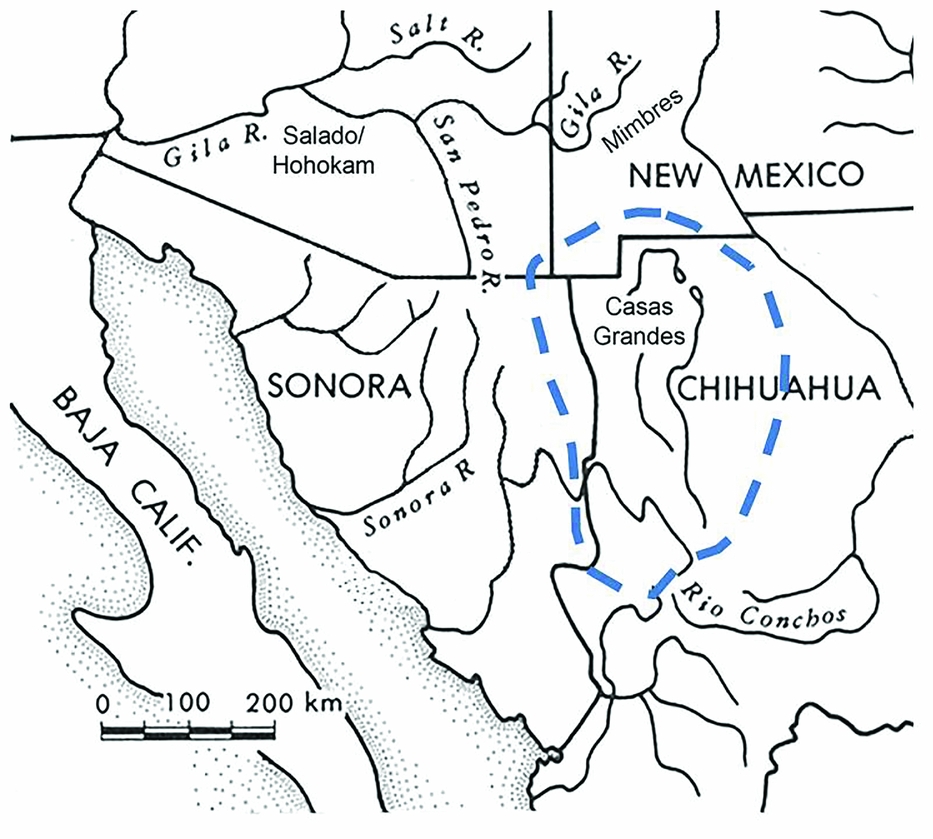
The Casas Grandes region encompasses northern Chihuahua, southern New Mexico, southern Arizona, and eastern Sonora (Figure 1). Charles Di Peso (Reference Di Peso1974) outlined a general chronology for the region that focused on the Viejo and the Medio periods. According to Di Peso and others working in the area, social differentiation, religion, political organization, and the economic system changed drastically in the thirteenth century as the region developed during the Medio period (Rakita Reference Rakita2009; VanPool and VanPool Reference VanPool and VanPool2007; Whalen and Minnis Reference Whalen and Minnis2009). A major component of this was the creation of specialized production and economic integration above the household level, especially at settlements such as Paquime. This specialization both reflected and reinforced increased political complexity, making the Casas Grandes region an excellent case study for examining the relationships between craft production and the development of political complexity. Yet, while it is generally accepted that some artifacts/resources were produced by Medio period specialists, the shift to a specialized economy was incomplete (Rakita and Cruz Reference Rakita, Cruz Antillón, Minnis and Whalen2015). As a result, the structure of craft production is an empirical question that must be determined for each class of artifacts.
The Casas Grandes region. (Adapted from Riley Reference Riley1987: Map 2.)

Paquime is one of the largest and most elaborate prehistoric settlements in the North American Southwest (Di Peso et al. Reference Di Peso, Rinaldo and Fenner1974). It has ceremonial platform mounds, two large Mesoamerican-style I-shaped ball courts, a T-shaped ball court, water reservoirs that fed a canal system running through the settlement, large ovens that could produce hundreds of pounds of roasted agave, one of the deepest known hand-dug wells in North America, evidence of human sacrifice, massively overbuilt architectural features including adobe walls over 0.5 m thick, storerooms containing over 60 pots from other regions of the Southwest, and tons of ocean shells from the Gulf of California and other parts of the west coast of Mexico. When first encountered by sixteenth-century Spanish explorers (at least 100 years after it had been abandoned), its beauty and grandeur was so impressive that they likened it to a Roman city (Gamboa Reference Gamboa and Stuhr2002:41). It is now listed as a World Heritage Site by UNESCO.
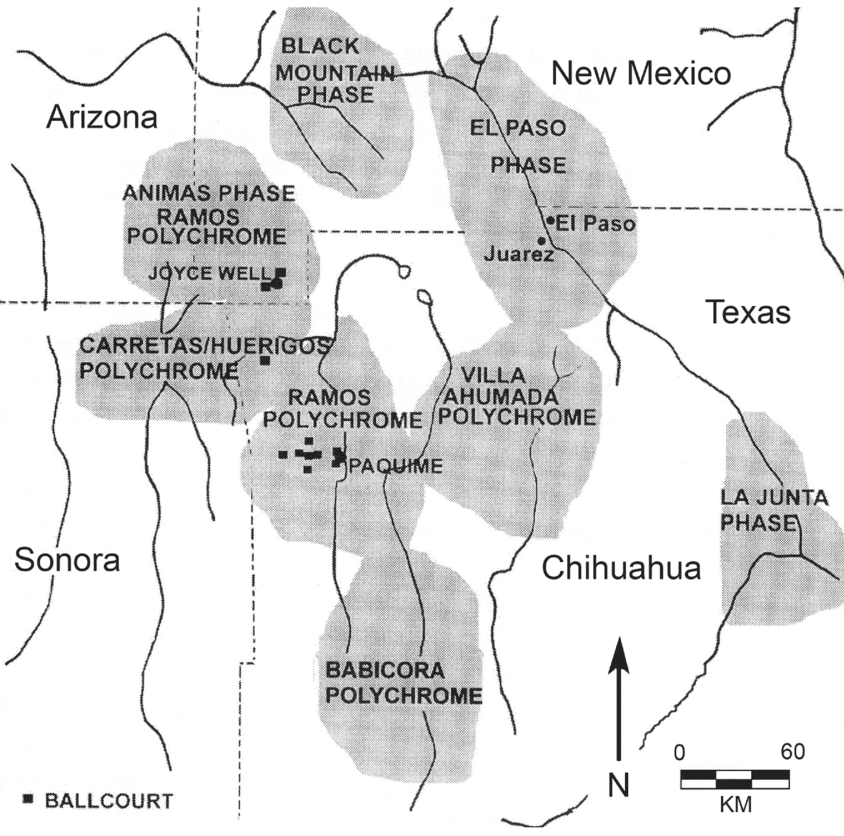
Other Medio period settlements are present within the region, although none compare to the size or grandeur of Paquime. These settlements range from a few large habitation sites perhaps half the size of Paquime, to small farming communities built on floodplains, terrace slopes, and in rockshelters (Bagwell Reference Bagwell2006; Cruz Antillón et al. Reference Cruz Antillón, Leonard, Maxwell, VanPool, Harmon, VanPool, Hyndman, Brandwein, Newell and Gallaga2004; Whalen and Pitezel Reference Whalen, Pitezel, Minnis and Whalen2015). One of the most striking aspects of Casas Grandes archaeology is its beautiful polychrome pottery characterized by black and red designs on a white background. Although this pottery is found throughout the Casas Grandes region, its distribution is not uniform. Some pottery types are found in greater concentrations in some locations (Carpenter Reference Carpenter, Skibo, McCluney and Walker2002), reflecting variable social relationships within the larger region. Paquime and nearby settlements contain a higher percentage of Ramos Polychrome (the most elaborately decorated polychrome with exceptionally fine line work, reflecting remarkable workmanship), areas to the east comprise more Villa Ahumada Polychrome, settlements to the northwest reflect more Carretas and Huerigos Polychromes, and so forth (Figure 2). When considered with architecture and other evidence, this indicates that the elites living at Paquime exerted substantial influence on settlements within a day's walk (about 30 km), extending further northward perhaps into the Animas region of southern New Mexico (Skibo et al. Reference Skibo, McCluney and Walker2002; VanPool et al. Reference VanPool, Oswald, Christy, Ferguson, Rakita, VanPool, VanPool, McCarthy and VanPool2013), but without direct control. They likely had less influence over settlements more than 30 km away to the east, south, and west/northwest (Carpenter Reference Carpenter, Skibo, McCluney and Walker2002; Whalen and Minnis Reference Whalen and Minnis2001, Reference Whalen and Minnis2009).
Ceramic zones in the Casas Grandes region. (Adapted from Carpenter Reference Carpenter, Skibo, McCluney and Walker2002:161.)

A higher level of political complexity is reflected in mortuary goods and contexts, architectural elaboration, the use of exotic west Mexican prestige goods such as copper and shell artifacts, and specialized craft production (production above the household level) in the Ramos-dominated zone centered on Paquime. It is less common or even absent in the zones dominated by other Medio period polychrome ceramic types. Part of the analysis of the organization of craft production is the consideration of Ramos Polychrome production. Its exceedingly well-executed designs in particular have caused some to suggest it is the product of highly skilled ceramic specialists, a hypothesis that has been supported by Sprehn's (Reference Sprehn2003) analysis of design composition, complexity, and vessel size standardization. In contrast to the Medio period Mesoamerican-inspired architecture and increased political/economic complexity, the preceding Viejo period (AD 700 to 1200) reflects the small-scale farming typical of contemporaneous Mogollon region settlements (Kelley and Searcy Reference Kelley, Searcy, Minnis and Whalen2015). There was likely limited social differentiation during the Viejo period based on modest site hierarchies and some burial good differentiation (Kelley and Searcy Reference Kelley, Searcy, Minnis and Whalen2015).
Casas Grandes Pottery
Casas Grandes ceramic types are split between the Viejo and Medio periods, with some overlap between the two. Types are primarily differentiated by finishing techniques and painted elements (Brand Reference Brand1935; Di Peso et al. Reference Di Peso, Rinaldo and Fenner1974; Sayles Reference Sayles1936; VanPool et al. Reference VanPool, Rakita, Cruz Antillón, Leonard, Nielsen-Grimm and Stavast2008:60). Di Peso (Reference Di Peso1974) defined a number of Viejo period types including Anchondo Red-on-brown, Leal Red-on-brown, Pilon Red-on-brown, Fernando Red-on-brown, and Mata Red-on-brown textured, but Kelley and Searcy (Reference Kelley, Searcy, Minnis and Whalen2015) note that these types are likely not valid across the entire region and may not be valid anywhere. We follow their lead in collapsing the Viejo subtypes into a single category of Viejo Red-on-brown (Kelley and Searcy Reference Kelley, Searcy, Minnis and Whalen2015). Viejo period jars typically have long necks that are frequently corrugated or incised and bodies decorated with simple banded designs, often with repeating triangles (Di Peso et al. Reference Di Peso, Rinaldo and Fenner1974; VanPool Reference VanPool2003). Viejo period pots also typically lack the duality and interlocking designs that are paramount on Medio period jars (VanPool and VanPool Reference VanPool, VanPool and Stuhr2002). VanPool (Reference VanPool2003) suggests that this indicates nonspecialist potters working at the household level were less structured by the social rules that appear during the Medio period (see Hendrickson [Reference Hendrickson2003], VanPool [Reference VanPool2003], and Whalen and Minnis [Reference Whalen and Minnis2012] for a discussion of Medio period design rules). In fact, there is no evidence that any Viejo period crafts were produced above the household level. As a result, the Viejo period ceramics provide a useful comparative assemblage for assessing the structure of Medio period ceramic production.
Polychrome vessels represent the main decorated ceramics of the Medio period. Di Peso and colleagues (Reference Di Peso1974) defined multiple variants for most types, but we focus on the standard versions. Babicora Polychrome vessels are typically jars and have thick red and black lines on a light brown surface with a thin wash. Carretas Polychrome vessels are usually unpolished bowls with decorations similar to Babicora but with red and black subglaze paint on a brown/orange surface. Corralitos Polychrome vessels are most often jars that are textured using incising or punching with a slipped surface and are decorated with thick red and black lines. Dublan Polychrome vessels have red and black lines that are painted closely together on a gray-brown surface with textured shoulders and necks on jars. Ramos Polychrome pots have a light paste color, are polished, have a fine-grained temper, and have red and black painted designs. Villa Ahumada Polychrome jars are constructed with a dark paste, have a white slip except at the bottom, and are painted with black and red designs. Santa Ana Polychrome jars are decorated using closely massed red and black lines on a light background in what has been informally described as “cat scratch designs.”
Casas Grandes ceramic types were originally defined by Brand (Reference Brand1935), who was formally trained as a geographer and was attempting to define types that reflected geography as opposed to time. Brand's types were further refined and expanded by Di Peso and others (Reference Di Peso, Rinaldo and Fenner1974), but these types still did not (and do not) vary systematically through time in a manner similar to most southwestern pottery types. Rakita and Raymond (Reference Rakita and Raymond2003) noted this and applied an evolutionary approach to identify a model of seriation for Casas Grandes ceramics. In their sample, Villa Ahumada was prevalent before most other Casas Grandes polychromes, but the seriation did not produce a fine-scale ceramic sequence (Rakita and Raymond Reference Rakita and Raymond2003). Whalen and Minnis (Reference Whalen and Minnis2012) continued the effort of linking the pottery to temporal trends and defined “early” and “late” Medio period ceramic assemblages. They found that Babicora is one of the earliest polychrome types in the region, that Dublan and Villa Ahumada Polychromes were introduced before AD 1300 during the early Medio period, and that the remaining polychromes, including Ramos, were produced after AD 1300 during the late Medio period (Whalen and Minnis Reference Whalen and Minnis2009, Reference Whalen and Minnis2012). Other research in the southern portion of the Casas Grandes region indicates that noncorrugated polychrome vessels appeared during the Viejo period (as was the case with Santa Ana) and developed into Babicora during the Medio period (Larkin et al. Reference Larkin, Kelley, Hendrickson, Newell and Gallaga2004). Thus, given the evidence of increasing economic and political complexity from the Viejo into the Medio period, culminating in the complex system centered at Paquime, it might be expected that the scale of ceramic production increased above the household level late in time and might be reflected only in the late Medio period pottery. This proposition can be evaluated using the Standardization Hypothesis.
The Standardization Hypothesis
Archaeologists recognize that the organization of production is a central component of the economic organization of a culture and have developed various methods to measure it (Costin Reference Costin and Schiffer1991). Specialized craft production is defined as “where a limited number of artisans produce goods for a much broader group of consumers” (Costin Reference Costin2015:1) and forms a continuum extending from each individual in a group making a product for their own use, to a single individual or group making that product for everyone in a society. Even so, it is useful to distinguish between “generalized production,” in which someone within each household makes the product for the consumption of that household, and “specialized production,” in which a limited number of individuals organized above the household level make the product for a community.
One of the most effective means of identifying the presence of craft production above the household level is the Standardization Hypothesis (Crown Reference Crown, Mills and Crown1995). In this context, standardization is the reduction of artifact variation. The Standardization Hypothesis holds that the morphology of artifacts becomes more standardized as specialization increases because (1) there are fewer producers manufacturing any given number of artifacts relative to the number of generalized producers required to make the same number of artifacts; (2) specialized producers have more skill and are therefore capable of making better formed/more standardized artifacts relative to generalized producers; (3) specialized manufacturers focused on streamlining their production will establish habits and standardized production sequences that efficiently produce the product; and (4) standardization allows consumers not directly involved in production to evaluate the suitability and quality of a product. Each of these four factors should be applicable in the context of Medio period specialization. Although ethnographic and archaeological evidence indicates that there can be highly skilled generalized producers—and novice specialized producers with limited skill—in general, specialized producers have greater skill than generalized producers (Crown Reference Crown, Mills and Crown1995, Reference Crown2007). Furthermore, specialists do in fact streamline production effort and methods more than the typical generalized producer, and specialized producers do work to create products that can be generally recognized as useful and high quality for those who are not directly involved in their production (Miloglav Reference Miloglav2013). As a result, items produced by specialists tend to be more uniform (standardized) than those made by nonspecialists. One measure of standardization that has often been used is the corrected coefficient of variation (CV*), which is based on the standard deviation standardized by the mean (Crown Reference Crown, Mills and Crown1995). It is a unit-free percentage that measures the variation within a sample while also correcting for the tendency of small samples to underestimate variation (VanPool and Leonard Reference VanPool and Leonard2011:54–56). Here, s is the standard deviation,
 $\bar{Y}$
is the mean, and n is the sample size.
 $$\begin{equation*}
CV^{\rm{*}} = {\rm{\ }}\frac{{\left( {s*100} \right)}}{{\bar{Y}}}*\left( {1 + \frac{1}{{4n}}} \right)
\end{equation*}$$
Crown (Reference Crown, Mills and Crown1995) used previously analyzed samples of ethnographic and historic ceramics to propose that ceramic assemblages with CV* values of roughly 10% or less on common metric traits such as rim diameter were likely produced by specialists, whereas values greater than 10% likely reflect generalized producers working at the household level. Crown (Reference Crown, Mills and Crown1995) further suggested that substantially declining CV* values likely reflect increased specialization, even if they are above the 10% threshold. This was the pattern she observed in her analysis of Salado Polychrome in which large vessels, presumably made for feasting, were associated with smaller CV* values (although still larger than 10%) when compared to other vessels, prompting Crown to conclude they were made by only the most skilled potters at the community level. Maria Sprehn (Reference Sprehn2003) used this approach to examine variation in vessel height and circumference in Ramos Polychrome, Babicora Polychrome, and Villa Ahumada Polychrome and found comparatively small CV* values, prompting her to conclude that Ramos jars, large Babicora jars, and large Villa Ahumada jars may have been manufactured by specialists.
Obviously the 10% demarcation between generalized and specialized producers is a heuristic distinction as opposed to a hard-and-fast delineation. VanPool and Leonard (Reference VanPool and Leonard2011:138–142) considered Crown's data and found it unlikely that generalized producers produce CV* values equal to or lower than 10% (only 10% of the assemblages produced by generalists are expected to fall below the 10% threshold), but the products of specialized producers can be expected to be above the 10% cutoff 37% of the time. This means that the 10% demarcation will misclassify products made by specialists as the products of generalists roughly one out of three times. This error rate justifies Crown's (Reference Crown, Mills and Crown1995) willingness to “stretch the boundary” for specialized production above the 10% threshold given that specialists are indeed associated with the range of CV* values she reported, but it does indicate that the 10% cutoff is excessively conservative for specialized producers. As a result, VanPool and Leonard (Reference VanPool and Leonard2011) suggest that CV* below 10% should be considered indicative of specialist production (63% of the specialist assemblages and 10% of the generalist assemblages fall within this range), CV* between 10% and 14% could reflect specialist or generalist production (24% of the specialist assemblages and 33% of the generalist assemblages fall within this range), and CV* greater than 14% should be considered indicative of generalist producers (13% of the specialist assemblages and 53% of the generalist assemblages fall within this range). Following Crown's (Reference Crown, Mills and Crown1995) logic, decreasing CV* values through time or across ceramic types likely reflect differences in the organization of production, even in cases when the CV* is above 10%, so long as it is below 14%.
There are additional factors that can affect the degree of standardization. Costin and Hagstrum (Reference Costin and Hagstrum1995) make a distinction between two types of standardization. Mechanical standardization is the unintentional decrease in variation due to repeated production by the manufacturer (Costin and Hagstrum Reference Costin and Hagstrum1995). Intentional standardization is found in aspects of an artifact that are consciously made more uniform by the producer, because they impact performance characteristics (which make an item useful for a task). Costin and Hagstrum (Reference Costin and Hagstrum1995) conclude that the Standardization Hypothesis is most easily applied to attributes of mechanical standardization, given that intentional standardization can be produced even by generalized producers. As a starting assumption, it is reasonable to suggest that perimeter shapes of ceramics, the focus of this analysis, will reflect mechanical standardization at least somewhat given that variation is intuitively evident even when simply looking at the pots. We think that if there was intentional standardization, then the pots should look more similar.
Geometric Morphometrics
The Standardization Hypothesis focuses on variation in morphology, whether it be at the scale of decorative elements (e.g., line width), aspects of specific components of vessel shape (e.g., rim diameter), or attributes of the entire vessel (e.g., vessel volume). One useful means of quantifying variation in morphology, increasingly popular in archaeology, is geometric morphometrics, or GM (e.g., Buchanan et al. Reference Buchanan, O'Brien and Collard2014; Wilczek et al. Reference Wilczek, Monna, Barral, Burlet, Chateau and Navarro2014): the study of shape and its variation (Zelditch et al. Reference Zelditch, Swiderski and David Sheets2012). The first major application of GM (Kendall and Kendall Reference Kendall and Kendall1980) sought to answer questions about alignments at Stonehenge and other megalithic structures; since then GM methods have been used extensively (and primarily) in biology, paleontology, and physical anthropology to examine organismal morphology (Zelditch et al. Reference Zelditch, Swiderski and David Sheets2012). These works led to great improvements in GM methods and eventually to the reintroduction of GM analysis in archaeological contexts. Current GM methods can correct for size so that shapes of objects of very different sizes can be directly compared (e.g., the shapes of small and large Clovis points can be directly compared in archaeological analysis). Shape in GM contexts is consequently defined as the geometric information that remains when location, scale, and rotational effects are removed through a process called Procrustes superimposition (Zelditch et al. Reference Zelditch, Swiderski and David Sheets2012).
Morphometricians create Procrustes superimposition by fixing homologous landmarks recorded on different objects to a single, fixed point called the centroid. This center point represents the geographical average of the landmarks (e.g., the center of a pot with landmarks recorded along its edge; the centroid position is literally the average position of the coordinates with the x position being the average of all of the x components of the landmarks and the y position being the average of all of the y components; Zelditch et al. Reference Zelditch, Swiderski and David Sheets2012:457). The differences in the landmarks for the objects are then minimized by rescaling the objects relative to each other. This is analogous to someone taking pictures of multiple objects, say pottery as in our case, and “blowing them up” or “shrinking them down” using a copy machine until the pots are as close to the same size as possible. In the case of Procrustes superimposition, though, there is a statistical algorithm that directly minimizes the variation among all of the measured objects based on the distribution of their measured landmarks around the centroid (Webster and Sheets Reference Webster, David Sheets, Alroy and Hunt2010; Zelditch et al. Reference Zelditch, Swiderski and David Sheets2012). For example, if two pots shared the exact same proportions but one was half the size of the other, Procrustes superimposition would scale both sets of landmarks so that they were overlying one another. By doing so, this process removes size differences and allows differences in shape to be isolated.
Shape is measured using three types of landmarks: primary, secondary, and tertiary (also called sliding). Primary landmarks are homologous, unambiguous loci that designate corresponding points that match within and between populations (e.g., the tip of a projectile point; Zelditch et al. Reference Zelditch, Swiderski and David Sheets2012:461). A secondary or semi-landmark is a point on a curve, edge, or surface that is defined in terms of its position on a feature, whereas sliding or tertiary landmarks are points along the outline of a curve as opposed to a specific landmark (Perez et al. Reference Perez, Bernal and Gonzalez2006:770; Zelditch et al. Reference Zelditch, Swiderski and David Sheets2012:467). For example, the most outward point of the body of a pot, corresponding to its maximum diameter (Point of Vertical Tangency [VT] [Shepard Reference Shepard1956]), would be a secondary landmark (e.g., it corresponds to the same feature for each pot and hopefully will have some level of agreement among different researchers). Five landmarks placed equidistant along the curves between the start of the rims (End Points) and the wide points (VT) would be tertiary landmarks that do not necessarily reflect the same point/feature for all of the pots. Put another way, the curves measured using tertiary landmarks should be homologous between subjects, but the individual points along those curves can vary (Perez et al. Reference Perez, Bernal and Gonzalez2006).
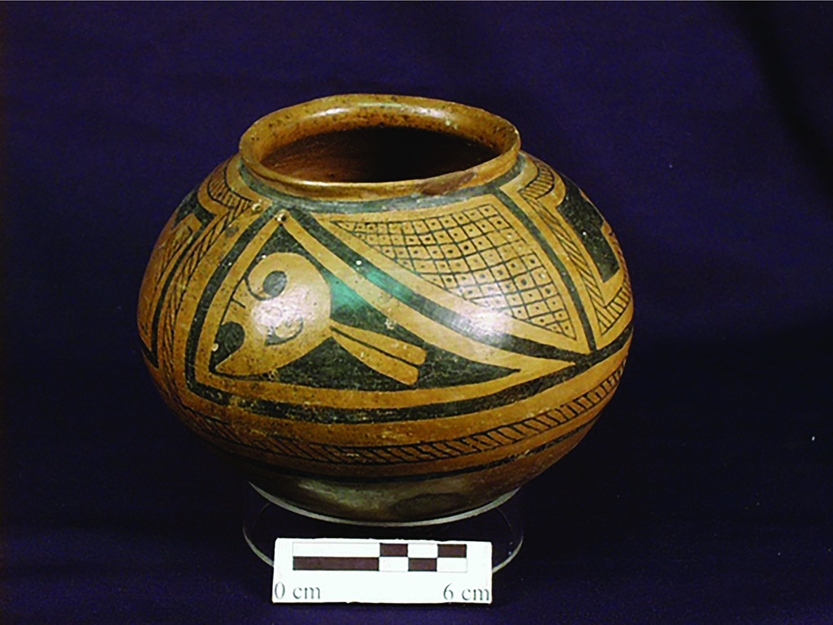
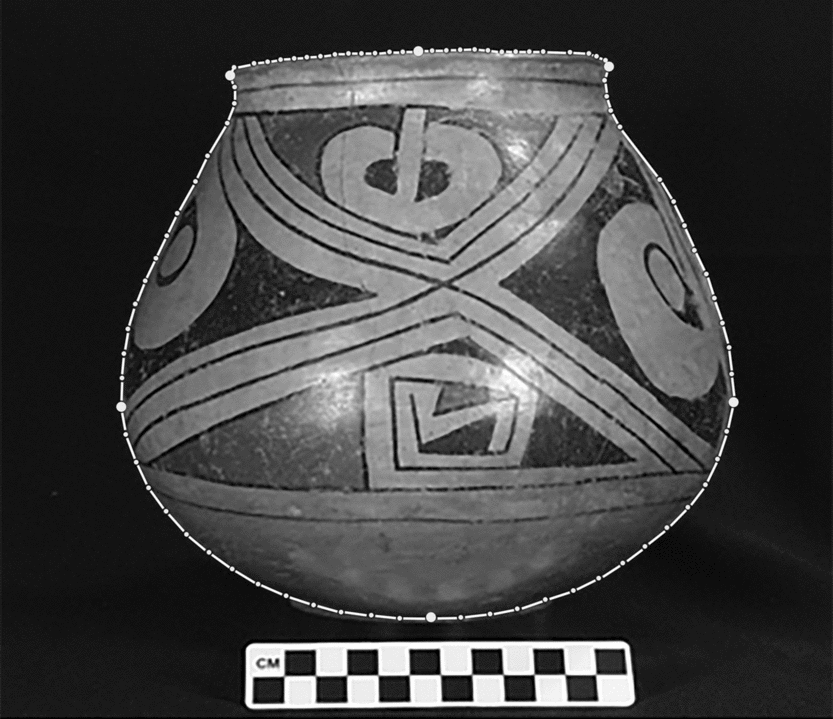
Defining and consistently placing landmarks is central to GM. Five general criteria are typically considered. The first is homology, which specifies that the points on one specimen correspond to the same points on others (Zelditch et al. Reference Zelditch, Swiderski and David Sheets2012). Second, there must be adequate landmarks to capture shape in order to detect corresponding geometric variation. Otherwise, differences in shape will not be evident. Third, landmark positions should be found reliably, as difficulty in locating specific positions would result in error with repeat measurements (Zelditch et al. Reference Zelditch, Swiderski and David Sheets2012). Secondary/tertiary landmarks record a region or part of a feature, which creates some ambiguity, but even then, clearly defining the number and general location of landmarks is key. Although different researchers may not always place the landmark in the exact same place, they will place it in a narrow range, leading to statistical replicability even if there is a small amount of variation. Fourth is consistency of relative position. It is important that landmarks do not switch positions relative to each other (e.g., Landmark 1 must be at the same relative position, say at the tip of a projectile point, on each object measured). Fifth, landmarks must lie within the same plane when dealing with 2-D representations of 3-D items such as pots (Zelditch et al. Reference Zelditch, Swiderski and David Sheets2012). With photographs of pottery, the images must be taken from a consistent angle in order to adequately assess shape variation. Even minor differences in the angle or perspective of photos, as illustrated by Figures 3 and 4, can lead to substantial errors in the measurement of shape.
Photo of a Carretas pot, taken at downward-facing angle, which causes parallax and prevents its inclusion in this study. Courtesy of the Centennial Museum at the University of Texas El Paso, photograph by Christine VanPool.

Ramos pot with secondary and tertiary landmarks. Courtesy of the El Paso Museum of Archaeology at Wilderness Park (Cat. # 59-9-235), photograph by Christine VanPool.

Methods
We used GM to assess the variation in a sample of Casas Grandes pottery in order to use the Standardization Hypothesis to evaluate the organization of craft production. The analysis focused on images of 89 pots photographed by Christine VanPool at the El Paso Museum of Archaeology (Texas), the Maxwell Museum of Anthropology (University of New Mexico, Albuquerque), Centennial Museum (University of Texas–El Paso), Miles Museum of Anthropology (Eastern New Mexico University, Portales), and the Laboratory of Anthropology (Museum of Indian Arts and Culture, Santa Fe, New Mexico). The vessels were separated by type, producing a sample of 20 Babicora Polychrome, 20 Ramos Polychrome, 16 Villa Ahumada Polychrome, 11 Viejo Red-on-brown, 10 Carretas Polychrome, 6 Dublan Polychrome, 4 Corralitos Polychrome, and 2 Santa Ana Polychrome vessels. All of these vessels are whole and were photographed from the same angle to produce a “head-on” image of their profiles. To have comparable data from all of these types, we used restricted globular jars with everted rims only. We ideally wanted samples of 20 pots for each type, but many types are rare in museum collections, and pots with missing rims or other substantial breaks could not be included because their shapes could not be fully measured for the GM analysis. Nevertheless, previous statistical analysis indicates that measures of central tendency such as the mean and measures of dispersion such as the standard deviation can be usefully estimated using even a small sample size. Types represented by at least 10 pots likely adequately reflect the underlying morphological variation for this study. For example, the mean rim diameter of the Carretas Polychrome pots (n = 10) included in our analysis is 10.3 cm with a standard deviation of 1.5 cm. Based on these results, we are 95% certain that the parametric mean rim diameter is between 9.4 cm and 11.2 cm, producing a possible range in CV* of 13.7% to 16.4%. This range of 3% does not meaningfully alter our conclusions regarding variation based on the actual calculated CV* of 14.9% (i.e., we would have reached the same conclusions in our analysis presented below for any CV* within the viable range). Nonetheless, the small samples of Corralitos, Dublan, and especially Santa Ana Polychrome are best considered illustrative, as opposed to statistically valid samples. We include them for completeness and because even limited information can help inform our understanding.
Roux (Reference Roux2003) demonstrates that the variation in an assemblage is far smaller if it includes only the products of a single artisan. Our sample includes pots from multiple museums, most of which were derived from donated materials from unprovenienced contexts. It is unlikely that the entire assemblage for any given type was derived from a single site, and based on our experience with Casas Grandes pottery, the vessels included in our sample reflect the general range of decoration quality, jar form, and paste color typical of each type. Thus, while Phillips and VanPool (Reference Phillips and VanPool2009) suggest that the work of individual potters can sometimes be recognized in Casas Grandes pottery, we see no indication that our pots reflect the work of a single artist or are otherwise a biased sample.
The software program tpsUtil was used to convert each group of photographs into TPS files. This was necessary in order to use common GM landmark placement and analytical packages, grouped into Integrated Morphometrics Package 8 (IMP8), a free software package available at http://www3.canisius.edu/~sheets/IMP%208.htm (from Canisius College in Buffalo, New York). Landmarks were placed for each pot with tpsDIG2. Because ceramics do not have discrete, homologous points matching within and between populations, no primary landmarks were used. Instead, six secondary landmarks were designated (see Figure 4). Beginning at the left edge of the lip, and moving clockwise, the six secondary points were
-
(1) the beginning of the left edge of the lip (End Point [EP]);
-
(2) the middle of the rim, which was found using tpsDIG2’s measuring tool;
-
(3) the right edge of the lip (EP);
-
(4) the widest right point of the vessel body (max. Point of Vertical Tangency [VT]);
-
(5) the midpoint of the base, which was found by using the measuring tool to bisect the pot by clicking on Landmark 4 and the widest left point of the body (Landmark 6), determining the middle of the resulting line and drawing another line from the midpoint to the base; and
-
(6) the widest left point of the vessel body (max. VT).
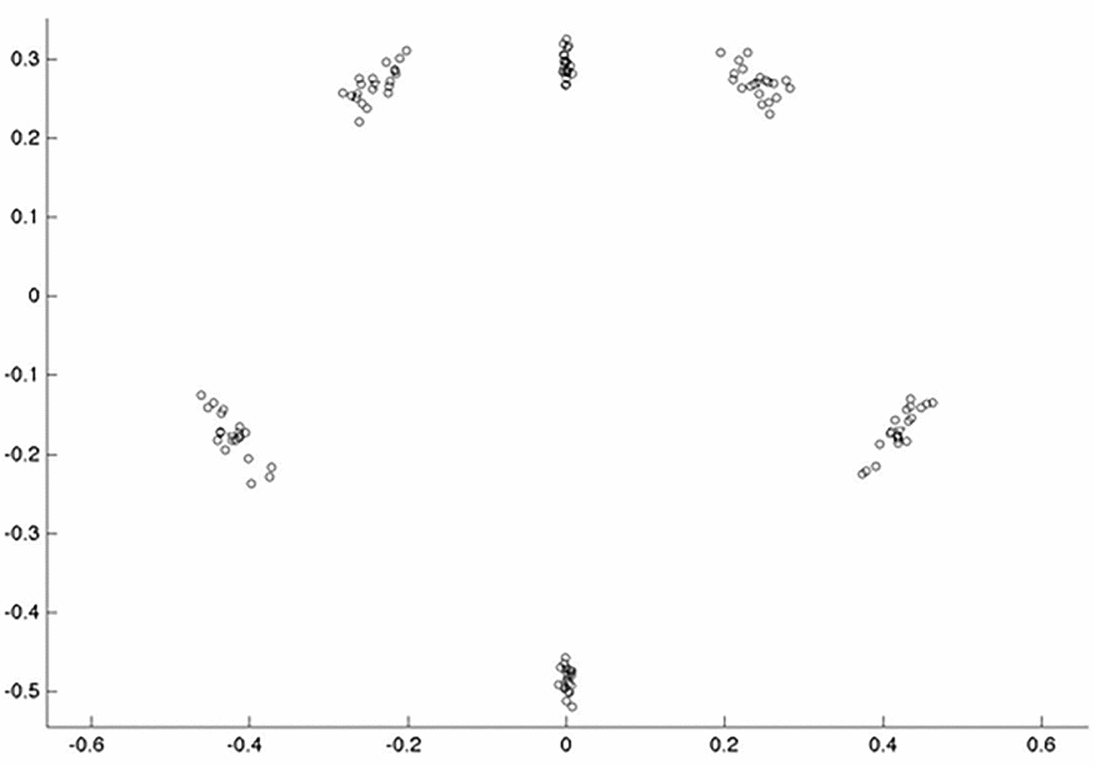
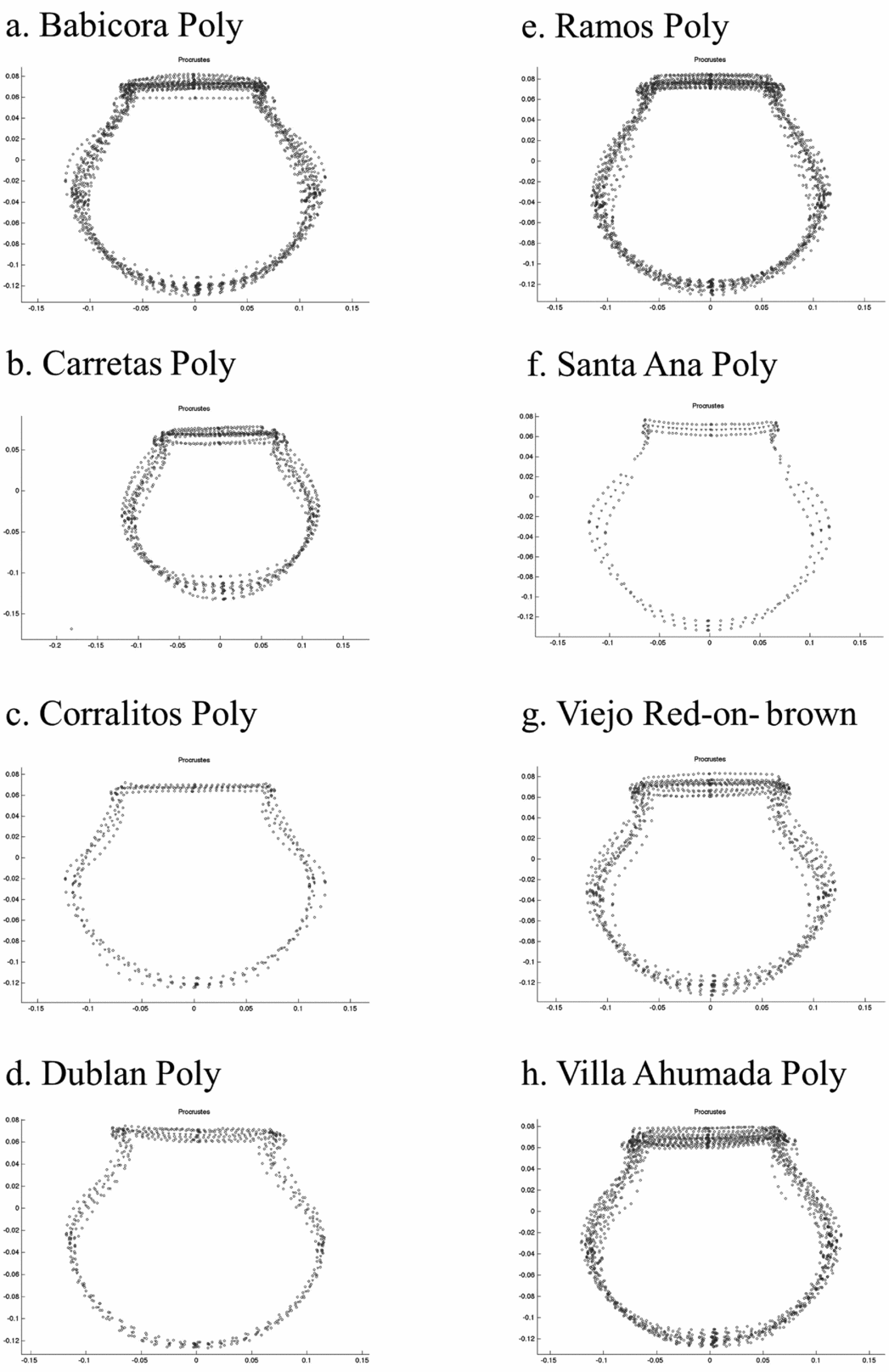
Fifteen sliding landmarks were placed between each set of secondary landmarks starting with 1 and 2 and moving clockwise. Each set of 15 was resampled, which is a process during which they are placed equidistant along the curve created by the sliding landmarks. They were then reexamined, and the landmarks were repositioned as necessary to ensure the curve was correctly represented. The procedure produced 90 tertiary and 6 secondary landmarks for each pot, which seems to effectively characterize the shapes of vessels without oversaturating the shape data (see Figure 4). The TPS data were then checked for inconsistencies in the number and placement order of landmarks. Procrustes superimposition was completed using CoordGen8, a program used to analyze GM data (Figure 5). Each circle is an individual landmark. Statistical analyses then focused on measuring shape variation.
Secondary landmark Procrustes superimposition for Ramos Polychrome.

Results
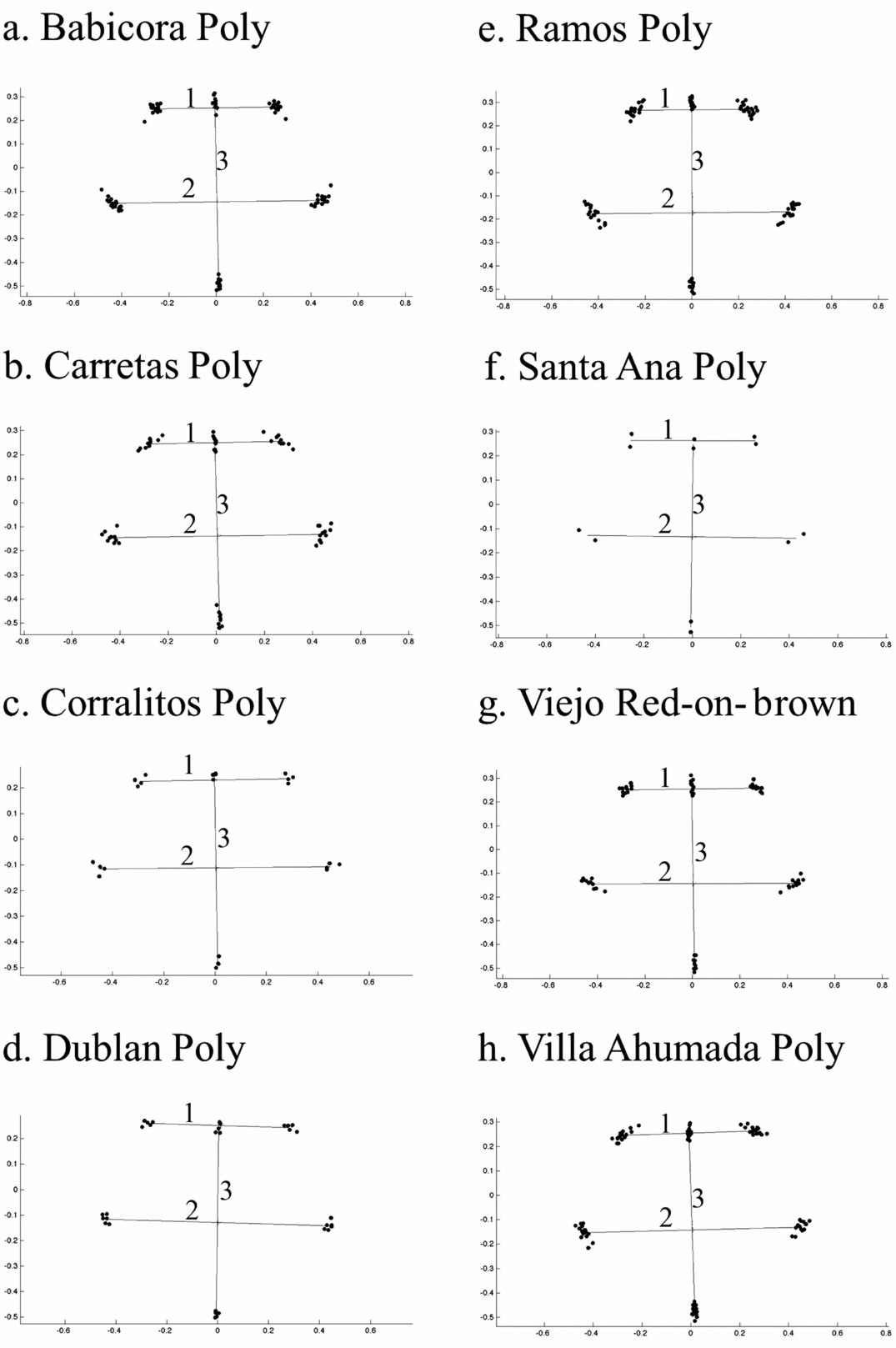
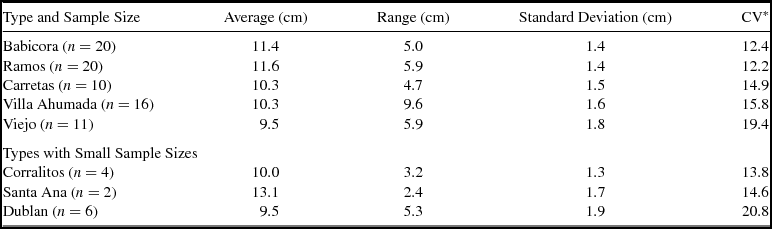
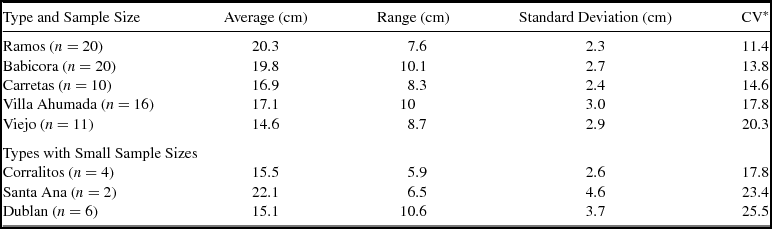
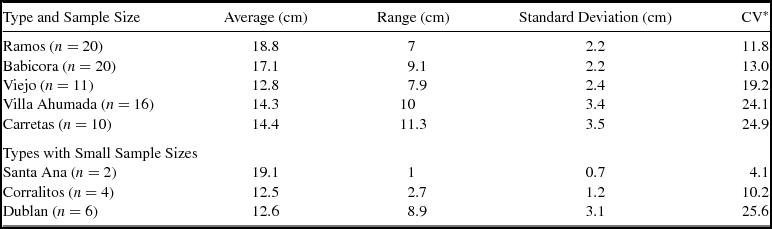
Figure 6 provides the results of the Procrustes superimposition for each pottery type. Given that the Viejo period pots are the earliest and are certainly associated with household production, they serve as a good marker of the variation typical of generalized production. The visual differences can be quantified given that the Procrustes results provide statistics, including morphological variances, shape and size means, and standard deviations. “Simple statistics,” a feature within CoordGen, gives information of two types: shape and size. To examine size we used Traditional Morphometrics Generator (TMorphGen), a program within CoordGen, to take separate measurements based on secondary landmarks. The software requires a protocol that specifies measurements between specific points. In this case we set it to record three distances between Landmarks (LMs) 1 and 3 (used to determine rim diameter; line 1 on Figure 7), LMs 4 and 6 (vessel body width; line 2 on Figure 7), and LMs 2 and 5 (vessel height; line 3 on Figure 7). To emphasize this point, these values are not influenced by the Procrustes superimposition and are the same as one would derive using a set of calipers to measure the same attributes from the physical objects themselves. These measurements are consequently the most easily quantified using standard statistical approaches and are most similar to the data used for analyses such as Crown (Reference Crown, Mills and Crown1995) and Sprehn (Reference Sprehn2003) based on the Standardization Hypothesis. Descriptive statistics, including CV* values, are presented in Tables 1, 2, and 3. Based on common ceramic measurements, Ramos and Babicora Polychromes have substantially less size variation than other types, including the least amount of variation in vessel body width, rim diameter, and vessel height. Santa Ana and Corralitos Polychromes also have low variation in height, but these results could be due to small sample sizes. The other pottery types are similar to the Viejo period pottery, suggesting that specialists produced Ramos and Babicora Polychromes, while the other pottery types were made by generalists.
SLM (sliding landmark) Procrustes superimposition for each pottery type.

TMorphGen measurements.

Rim Diameter Data by Type, Lowest to Highest CV*.

Vessel Body Width Data by Type, Lowest to Highest CV*.

Vessel Height Data by Type, Lowest to Highest CV*.

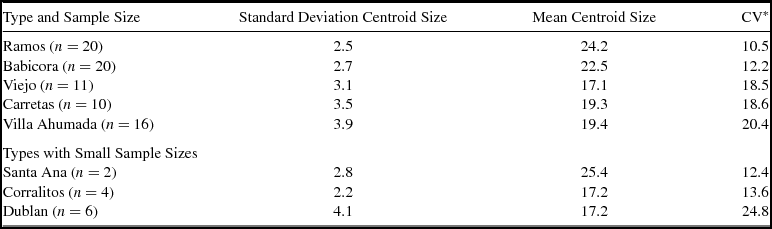
Although useful, the metric data considered above only reflect size, as opposed to shape data, and therefore do not really take advantage of GM. To examine shape data, we calculated CV* values for each ceramic type based on the relative location of the secondary landmarks (Figure 6), as opposed to linear measurements between set points (i.e., how close are the Landmark 1 measurements to each other, the Landmark 2 measurements to each other, and so forth). This information includes both shape and size data, in that it simultaneously reflects the absolute size of objects relative to the centroid while also reflecting the general location of the landmarks (Table 4).
Secondary Landmark Corrected Coefficients of Variation.

The software allows this comparison by calculating both an average and standard deviation as part of the Simple Statistics option based on landmark distance from the centroid, but these values correlate to the number of landmarks considered (e.g., an average based on seven landmarks is expected to be larger than one based on six landmarks for no other reason than the increased number of landmarks). As a result, the CV* values cannot be directly compared to a demarcating cutoff such as 10%. Put another way, the fact that the CV* values presented in Table 4 seem roughly comparable to the 10% cutoff simply reflects that we used six landmarks. If we had measured 9, 50, or 100 landmarks instead, the CV* values would be considerably smaller, depending on the number of landmarks. Still, general trends in relative CV* values will reflect differences in the relative standardization of pottery types. Again, Ramos and Babicora Polychromes produced CV* values substantially smaller than the other pottery types, which are well below the Viejo period Red-on-brown pottery made by generalized producers. This means that our samples of Ramos and Babicora Polychromes are more standardized than the other polychrome types and the early red-on-brown types when both size and shape are considered at the same time.
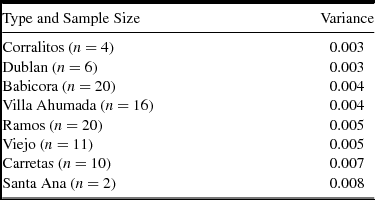
The CoordGen Simple Statistics feature also produces shape variances that give statistical information that has removed size using Procrustes superimposition, reflecting only differences in shape (Table 5). As mentioned, during Procrustes superimposition the set of landmark coordinates for each specimen are centered at their centroid, and then the landmarks are scaled so as to minimize size variation (Zelditch et al. Reference Zelditch, Swiderski and David Sheets2012). The variances do not correlate with the number of landmarks, but they also do not provide a mean value, making it impossible to calculate CV* values. For this portion of the analysis, we included all of the secondary and tertiary landmark data for a total of 96 landmarks, which capture the entire perimeter of each pot (Figure 6).
Shape Variances.

There are no known boundaries or standard markers by which to determine levels of standardization and specialization for ceramics based on perimeter shape, but the values do not show intuitively identifiable breaks like the other values above (Tables 1–4). Viejo Red-on-brown and Villa Ahumada Polychrome (the most variable types in Tables 1–4) reflect comparable variation to the other pottery types when only shape information is considered. This indicates that the increased variation above actually corresponds to variation in size, not actual shape. Put another way, the reason that Babicora and Ramos Polychromes have lower CV* values is that they are more similar in size, not that they are more symmetrical or otherwise more consistently shaped. The variances indicate that Casas Grandes ceramics were likely constructed with similar shaping methods for a substantial amount of time.
In terms of the GM analysis, we addressed several potentially complicating issues. A number of photographic aspects could affect landmark placement. Six pots in the sample were cracked, which resulted in small missing pieces of the rim. The curves were placed to include the crack instead of extrapolating to guess at the original rim shape. This contributed slightly to variation, but its effects were swamped by the high number of sliding landmarks and did not significantly change any of the results reported in Tables 1–5. Additionally, pots with flared handles near the rim were excluded from the analysis. In an initial view of the data, these caused considerable variation because handles were not present on most of the vessels.
In the final data cleanup, two photographs of pots were removed from the Villa Ahumada Polychrome sample (leaving the total of 16 pots reported above and used throughout the preceding analysis). One photograph had a flawed scale that significantly skewed rim, vessel body, and height measurements. The other omitted photograph was of a uniquely shaped pot that had a substantially longer and narrower neck than all other globular jars included in this study and was decorated on the bottom, another rarity for the ceramic type. This photograph did not reflect a typical jar as we wished for our sample. Excluding these two pots lowered Villa Ahumada Polychrome's CV* values by roughly 3% in all measures, but Villa Ahumada Polychrome remained one of the most variable types in terms of both shape and size.
Lighting and object support in the photographs also were important. Figure 8 displays a shaded area at the bottom of the pot, which made landmark placement for that portion very difficult. Furthermore, supports could somewhat obscure base shape. Background color can also affect landmark placement. Some vessels had black paint near the perimeter, and the photographs were taken with a dark background. This made recording those areas difficult, although using the zoom feature in tpsDIG2 helped. Although not used for Procrustes superimposition, the inclusion of a scale in each photo is necessary for calculations based on size (the analyses presented in Tables 1–4).
Ramos pot with shading. Courtesy of the El Paso Museum of Archaeology, photograph by Christine VanPool.

Discussion
Crown (Reference Crown, Mills and Crown1995) and VanPool and Leonard (Reference VanPool and Leonard2011) suggest that decreasing coefficients of variation can indicate specialization, especially when the CV* values are less than 14%. With this in mind, Babicora Polychrome (secondary landmark CV* = 12.2%) and Ramos Polychrome (secondary landmark CV* = 10.5%) were meaningfully more standardized relative to the preceding Viejo period Red-on-brown pottery and the other Medio period types. Results from TMorphGen, which essentially mimic common measurements of whole ceramic vessels, lead to the same conclusions. Ramos Polychrome CV* values are rim diameter = 12.2%, vessel body width = 11.4%, and height = 11.8%, which are substantially lower than other types in the sample. Babicora Polychrome CV* values are rim diameter = 12.4%, vessel body width = 13.8%, and height = 13.0%. This also shows less variation. Shape variances are average for both when compared to the rest of the sample (Babicora = 0.004 and Ramos = 0.005). In contrast, the other polychromes are roughly comparable to the Viejo period Red-on-brown pottery, which is almost certainly the product of generalists. As a result, we conclude that Ramos and Babicora Polychromes were more often crafted by specialists than the other pottery types we examined.
Sprehn (Reference Sprehn2003) and VanPool and colleagues (Reference VanPool, Rakita, Cruz Antillón, Leonard, Nielsen-Grimm and Stavast2008) note that Babicora and Ramos Polychromes share similar ceramic technology and iconography but are differentiated by the skill evident in their decoration, with Babicora typically appearing to be a “poorly executed” copy of Ramos designs (although some Babicora vessels are beautifully decorated and occasional Ramos vessels are poorly decorated). Additionally, Carpenter (Reference Carpenter, Skibo, McCluney and Walker2002) indicates that the two are primarily associated with different areas, with Ramos Polychrome most prominent in and around Paquime at the height of the Medio period, while Babicora Polychrome was initially made earlier and to the south. Thus, both ceramic types appear to be associated with specialized craft production above the household level, but it is possible that Ramos Polychrome was produced by even more highly skilled or specialized potters relative to Babicora Polychrome. Costin and Hagstrum (Reference Costin and Hagstrum1995) distinguish between attached and independent specialists. Attached specialists produce politically and socially symbolic goods for elite clients who often use them as badges of rank. Independent specialists in contrast produce materials for household consumption distributed through some sort of open market, in which they compete for the resources of others. Although attached specialists may be asked to make distinctive, unique objects (such as the beautifully decorated Ramos Polychrome effigies, which seemingly serve as “portraits” of individuals [C. VanPool et al. Reference VanPool, VanPool and Downs2017]), they can and do make standardized objects as well, especially if these objects are intended to be broadly distributed by their elite sponsors. Babicora Polychrome has low levels of variation in all measures indicative of specialized production, but its decorative aspects demonstrate lower levels of investment and less skill relative to Ramos Polychrome. This suggests to us that most of it was made by independent (and likely part-time) specialists who were skilled in standardizing the pots in terms of size and shape, but who either did not care or were not skilled enough to match the finer, more intricate decorations on Ramos Polychrome. Decorative aspects were likely less important relative to the efficiency of manufacturing the pottery, if there was not a larger sociopolitical message in the decorations. As a result, the comparatively crude decoration of Babicora Polychrome (which would still be considered finely decorated relative to other Casas Grandes and southwestern types) is indicative of independent specialists producing pottery for household use.
In contrast, Ramos Polychrome displays even lower levels of variation with the addition of high skill in decoration. Previous research indicates that the elites at Paquime sought to establish their settlement (and by extension themselves) as the center of Medio period religion and ritual (Di Peso Reference Di Peso1974; Swanson Reference Swanson2003; VanPool and VanPool Reference VanPool and VanPool2016). Although ceramic workshops were not found in the 50% or so of Paquime that was excavated, Rakita and Cruz (Reference Rakita, Cruz Antillón, Minnis and Whalen2015:63) suggest the elites oversaw the production of Ramos Polychrome there and perhaps elsewhere in the region. Woosley and Olinger conclude:
It does appear that Casas Grandes, as a center place, to some extent did control ceramic distribution throughout the region. Its potters, together with others from adjacent villages in the valley, may well be responsible for the bulk of Ramos Polychrome pottery found elsewhere in northern Mexico. (Reference Woosley, Olinger, Woosley and Ravesloot1993:122)
This religious (and by extension political) emphasis is reflected in the iconography of Ramos Polychrome, which is replete with horned serpent imagery, macaws, the theme of duality, and other religiously significant symbolism linked to leadership (Di Peso et al. Reference Di Peso, Rinaldo and Fenner1974; Searcy Reference Searcy2010). Paquime also likely was the focus of regional pilgrimages, which may have been one of the primary means of distributing Ramos Polychrome and other religiously significant materials across the region. Within this context, it is likely that the elites sought to create pottery that was both useful in a utilitarian sense (Ramos Polychrome was found in nearly all use contexts, including as cooking vessels) and symbolically and aesthetically striking, emphasizing their economic and religious status. They thus would have sought to attract (or train) the best potters and other artisans in the area and to produce the finest goods using attached specialists. (This same process is likely evident in specialized ground stone production in which metates made by specialists [Type 1A] are most common at Paquime and far less frequent at other communities [T. VanPool et al. Reference VanPool, Kircher, VanPool and Rakita2017].) The potters were actively sponsored by elites to produce vessels that were not only of excellent quality in terms of shape and size, but also had decoration that was used to convey politically or socially important messages. Analyses of effigy vessels further support this conclusion. Ramos Polychrome effigies were typically more finely constructed and more elaborately decorated than those of other types (Sprehn Reference Sprehn2003; C. VanPool et al. Reference VanPool, VanPool and Downs2017). Study of the individuals depicted in Ramos effigies also shows distinctive imagery and ritual clothing that would have been impractical in a utilitarian sense (C. VanPool et al. Reference VanPool, VanPool and Downs2017).
Given their general similarity to the high CV* values of the Viejo pots (secondary landmarks = 18.5%, rim diameter = 19.4%, vessel width = 20.3%, and height = 19.2%), the Carretas, Corralitos, Dublan, and Santa Ana Polychromes appear to be made by generalized producers. Furthermore, we conclude that most Villa Ahumada Polychrome pots also were made by generalized producers (secondary landmarks = 20.4%, average rim diameter = 15.8%, vessel body width = 17.8%, and height = 24.1%). This contrasts somewhat with Sprehn (Reference Sprehn2003), who concluded that most Villa Ahumada pots were made by generalists but that some large Villa Ahumada pots could have been produced by specialists based on the standardization in vessel height and circumference. It is indeed possible that specialists produced the large pots in her sample, but our data simply do not support the proposition that Villa Ahumada Polychrome was produced by specialists. Further research will help answer this question.
Conclusions
Our analysis has focused on three goals: (1) to expand the application of geometric morphometrics to southwestern pottery, especially in the context of the use of the Standardization Hypothesis; (2) to further the exploration of the organization of Medio period production; and (3) to provide insight into the structure of Casas Grandes political complexity. Our results demonstrate the utility of the GM approach for quantifying variation in artifact morphology and using this information to evaluate the organization of production using the Standardization Hypothesis. We conclude that some or all of the Ramos and Babicora Polychromes in our sample were made by specialists. We further suggest that at least a subset of the Ramos sample was likely made by attached specialists, probably in or near Paquime, and at least a subset of Babicora Polychrome was made by independent specialists, perhaps working throughout the region but especially to the south of Paquime based on pottery distribution patterns. Carretas, Corralitos, Dublan, Villa Ahumada, and Santa Ana Polychromes appear to have been made by generalized producers working as part of household economies. Of course, these conclusions do not necessarily apply to every pot of every type. It is entirely possible, even expected, that some Ramos and Babicora Polychromes were produced by generalized producers, while specialists may have occasionally made vessels of types generally produced at the household level (e.g., perhaps large Villa Ahumada Polychrome).
Further still, our results provide insight into the economic and political organization of Medio period Casas Grandes, and more generally into the development of complexity in middle range societies, bolstering previous arguments for Medio period specialized production above the household level (Rakita and Cruz Reference Rakita, Cruz Antillón, Minnis and Whalen2015), but indicating that specialized production was limited to a subset of economically and symbolically valuable goods. The Casas Grandes elites appear to have used finely decorated pottery loaded with ritually and religiously significant symbolism to represent their status and to broadcast it across the region, indeed, throughout much of the North American Southwest. In fact, Ramos Polychrome has been recovered as far away as central New Mexico (e.g., Lekson Reference Lekson2002). Ramos Polychrome and its associated imagery consequently forms what Searcy (Reference Searcy2010, following Robb Reference Robb1998) calls “tokens” of rulership, items that reflect economic specialization. In terms of the social significance of the pottery, the use of Ramos Polychrome pottery as a token loads it with additional sociopolitical significance and may help explain the ceramic zones archaeologists have previously identified (Carpenter Reference Carpenter, Skibo, McCluney and Walker2002). It may also reflect the presence of an economy in which highly skilled specialists attached to elites enjoyed economic and social rewards not typical even of other specialized producers. Babicora Polychrome potters lived in a less populated area that apparently had less access to high-prestige items such as west Mexican exotica, elaborate ritual architecture, and turquoise. The specialized production of Ramos Polychrome—as well as shell products, agave resources, metates, and controlled macaw and turkey husbandry—is unique in the Southwest, suggesting that the Paquime elites had greater access to resources and established a sociopolitical system of high differentiation that extended to labor control. During the Medio period, social hierarchies, political differentiation, and religious authority were important organizing principles of Paquime and the greater Casas Grandes region, as noted by Di Peso (Reference Di Peso1974), Rakita and Raymond (Reference Rakita and Raymond2003), Sprehn (Reference Sprehn2003), and VanPool and Leonard (Reference VanPool and Leonard2002).
Acknowledgments
We appreciate the excellent comments provided by David Phillips Jr. and two anonymous reviewers. We also thank the staff and directors of the museums who allowed the photographs to be taken, including Garth Bawden (Maxwell Museum of Anthropology, University of New Mexico), Scott Cutler (Centennial Museum at the University of Texas–El Paso), Marc Thompson (El Paso Museum of Archaeology), Curtis Schaafsma (Laboratory of Anthropology, Museum of Indian Arts and Culture, Santa Fe), and John Montgomery (Miles Museum, Eastern New Mexico University). We also appreciate Geoffrey E. Braswell and María A. Gutiérrez for their useful comments and guidance, and Philip Leflar for his invaluable help with the geometric morphometric software.
Data Availability Statement
All data are available from the senior author.