Children adopted internationally and children in foster care have in common a history of disturbances within early attachment relationships, including institutional caregiving, maltreatment, and/or repeated placement transitions (for a review, see Dozier & Rutter, Reference Dozier, Rutter, Cassidy and Shaver2008). A likely consequence of these early adversities is that these children are more likely than low-risk children to form insecure and disorganized attachments with their adoptive or foster families (e.g., Van den Dries, Juffer, van IJzendoorn, & Bakermans-Kranenburg, Reference Van den Dries, Juffer, van IJzendoorn and Bakermans-Kranenburg2009). That said, adopted and foster children are also at lower risk for attachment insecurity and disorganization than children living with their maltreating caregivers or in institutional settings (Cyr, Euser, Bakermans-Kranenburg, & van IJzendoorn, Reference Cyr, Euser, Bakemans-Kranenburg and van IJzendoorn2010; Lionetti, Pastore, & Barone, Reference Lionetti, Pastore and Barone2015). In other words, despite their difficult early histories, children placed in foster and adoptive homes appear to adapt to their current caregiving environments and show improvements in the organization and security of their attachment relationships (for a discussion, see Van den Dries et al., Reference Van den Dries, Juffer, van IJzendoorn and Bakermans-Kranenburg2009). Given this, there is a critical need to identify key caregiving-related variables that help promote resilient outcomes among these higher risk children.
The current study focuses on internationally adoptive and foster parents’ attachment-related representations. The Adult Attachment Interview (AAI; Main, Kaplan, & Cassidy, Reference Main, Kaplan and Cassidy1985) is the most well-validated and widely used measure for assessing adults’ mental representations of attachment (which are referred to as attachment states of minds). Parents’ attachment states of mind are assumed to guide their behavior during parent–child interactions, which in turn shapes children's developmental adaptation, including the quality of their attachment relationships (e.g., Dozier, Stovall, Albus, & Bates, Reference Dozier, Stovall, Albus and Bates2001; Shlafer, Raby, Lawler, Hesemeyer, & Roisman, Reference Shlafer, Raby, Lawler, Hesemeyer and Roisman2015; Verhage et al., Reference Verhage, Schuengel, Madigan, Fearon, Oosterman, Cassibba and van IJzendoorn2016). Although there has been substantial research into the attachment states of mind of both low- and high-risk parents (e.g., Bakermans-Kranenburg & van IJzendoorn, Reference Bakermans-Kranenburg and van IJzendoorn2009), there have been few studies of the AAI states of mind among internationally adoptive and foster parents.
The current study sought to advance our understanding of the attachment states of mind among internationally adoptive and foster parents in two ways. First, we conducted the first set of analyses into the basic latent structure of individual differences in adults’ AAI states of mind among these groups of parents of high-risk children. These analyses were intended to test whether recent findings regarding the factor structure and distributional properties of the AAI (e.g., Roisman, Fraley, & Belsky, Reference Roisman, Fraley and Belsky2007) accurately characterize the attachment states of mind of internationally adoptive and foster parents. Second, the current study examined the degree to which the attachment states of mind of internationally adoptive and foster parents differ from parents from community samples as well as parents who are living in poverty and have been referred to Child Protective Services (CPS) due to allegations of child maltreatment. We included these latter two groups of parents because they represent natural benchmarks for low- and high-risk parents. In light of the evidence of intergenerational transmission of attachment (Verhage et al., Reference Verhage, Schuengel, Madigan, Fearon, Oosterman, Cassibba and van IJzendoorn2016), information about internationally adoptive and foster parents’ placement on the continuum of risk regarding attachment states of mind may provide insights into the interpersonal processes that shape the development of attachment (in)security among these at-risk children.
Differences in the Attachment States of Mind Across Low- and High-Risk Parents
The AAI is an hour-long, semistructured interview focused on participants’ childhood relationships and experiences with their caregivers. The traditional coding system for the AAI (Main & Goldwyn, Reference Main and Goldwyn1998) focuses on the overall organization of adults’ discourse during the interview, which is believed to reflect adults’ states of mind regarding attachment. Specifically, coders evaluate adults’ attachment states of mind using a series of 9-point scales and then use the rating scores to make two independent classification decisions. First, adults are assigned one of three mutually exclusive categories that reflect their state of mind regarding childhood caregiving relationships. Adults are classified as having an autonomous state of mind if they express a valuing of attachment relationships, freely reflect on their childhood caregiving experiences, and describe their experiences and attachment figures in a balanced and coherent manner. In contrast, adults are classified as having a dismissing state of mind if they minimize the significance of their childhood attachment-related experiences by insisting on not being able to recall specific memories, idealizing their childhood caregiving relationships, or speaking derogatorily about attachment-related experiences. Adults are classified as having a preoccupied state of mind if they become emotionally overwhelmed when discussing previous attachment-related experiences as evidenced by angry or vague, passive language. In a second classification decision, coders classify adults as being unresolved or not regarding the loss of significant persons in their lives or experiences of childhood abuse based on whether they become disoriented or psychologically confused when discussing these experiences.
The development of the AAI has inspired a large body of developmentally informed research into attachment processes during adulthood (e.g., Hesse, Reference Hesse, Cassidy and Shaver2008), including studies of the base rates of the attachment classifications across various populations of adults. For example, in their meta-analysis of over 10,000 AAIs, Bakermans-Kranenburg and van IJzendoorn (Reference Bakermans-Kranenburg and van IJzendoorn2009) reported that the normative distribution of the AAI classifications among low-risk North American mothers was 58% autonomous, 23% dismissing, and 19% preoccupied, with 18% of these adults also being classified as unresolved. The other end of the risk continuum involved individuals who were considered at risk for nonautonomous attachment states of mind because of low socioeconomic status, adolescent parenthood, or other psychosocial risk factors. Among these individuals, only 41% were classified as autonomous, while 42% and 17% were classified as dismissing and preoccupied, respectively. In addition, 32% of these higher risk individuals were also classified as unresolved (Bakermans-Kranenburg & van IJzendoorn, Reference Bakermans-Kranenburg and van IJzendoorn2009).
Bakermans-Kranenburg and van IJzendoorn's (Reference Bakermans-Kranenburg and van IJzendoorn2009) meta-analysis included only one sample of internationally adoptive parents (Van Londen-Barentsen, Reference Van Londen-Barentsen2002) and one sample of foster parents (Dozier et al., Reference Dozier, Stovall, Albus and Bates2001). As a result, it was not possible to test whether the distributions of the various AAI classifications for these parents differed from the distributions for low- and high-risk parents. Recently, four additional studies involving the AAI states of mind of adoptive parents (Barone & Lionetti, Reference Barone and Lionetti2012; Lionetti, Reference Lionetti2014; Pace, Santona, Zavattini, & Di Folco, 2015; Santona & Zavattini, Reference Santona and Zavattini2005) and two additional studies involving foster parents (Ballen, Bernier, Moss, Tarabulsy, & St.-Laurent, Reference Ballen, Bernier, Moss, Tarabulsy and St.-Laurent2010; Jacobsen, Ivarsson, Wentzel-Larsen, Smith, & Moe, Reference Jacobsen, Ivarsson, Wentzel-Larsen, Smith and Moe2014) have been reported. These studies have produced highly variable estimates of the distributions of the AAI classifications among internationally adoptive and foster parents. For example, the estimated percentage of autonomous classifications has ranged from 46% to 76% for internationally adoptive parents (Santona & Zavattini, Reference Santona and Zavattini2005; Van Londen-Barentsen, Reference Van Londen-Barentsen2002) and has ranged from 36% to 87% for foster parents (Ballen et al., Reference Ballen, Bernier, Moss, Tarabulsy and St.-Laurent2010; Jacobsen et al., Reference Jacobsen, Ivarsson, Wentzel-Larsen, Smith and Moe2014). One likely explanation for the inconsistent findings is that these studies involved small sample sizes (i.e., ns between 39 and 100), which resulted in statistically imprecise estimates.
In addition to the inconsistent research findings in this area, the current study was also motivated by Dozier and Rutter's (Reference Dozier, Rutter, Cassidy and Shaver2008) hypotheses regarding the possible ways adoptive and foster parents’ attachment states of mind differ from those of other parents. Given the evidence that adoptive parents report higher levels of psychological adjustment and lower rates of certain forms of psychopathology than nonadoptive parents (e.g., Levy-Shiff, Goldschmidt, & Har-Even, Reference Levy-Shiff, Goldshmidt and Har-Even1991; McGue et al., Reference McGue, Keyes, Sharma, Elkins, Legrand, Johnson and Iacono2007), it is possible that internationally adoptive parents may be more likely to have autonomous states of mind than the general population of adults. In contrast, internationally adoptive parents often experience a number of stressful events related to parenthood, including problems with infertility, failed pregnancies, and the lack of control concerning the timing of placement with an adoptive child. These cumulative stressors may increase the risk for adoptive parents to develop unresolved states of mind.
Regarding foster parents, Dozier and Rutter (Reference Dozier, Rutter, Cassidy and Shaver2008) hypothesized that these parents may be more likely than nonfoster parents to have an autonomous state of mind given their desire to care for children who have experienced early adversity. Dozier and Rutter (Reference Dozier, Rutter, Cassidy and Shaver2008) also hypothesized that dismissing states of mind might be overrepresented among foster parents because foster parents must be able to accept that foster children may not permanently continue to live with them. Finally, foster parents may be more likely to have experienced early adversity themselves, which created a desire to care for children with similar experiences while also increasing the risk for developing unresolved states of mind.
Latent Structure of Adults’ Attachment States of Minds
During the last 15 years, researchers have begun to utilize advanced methodological tools that allow for empirical examination of the latent structure of individual differences in adults’ attachment states of mind. Specifically, factor analytic techniques have been used to identify the number of latent factors that underlie covariation among the AAI attachment state of mind ratings and the degree to which specific rating scales load on the various latent variables (see Haltigan, Roisman, & Haydon, Reference Haltigan, Roisman and Haydon2014, for an overview of research on the factor structure of the AAI). The factor analytic results from over 10 separate samples have provided robust evidence that the variation in the AAI ratings of individuals’ attachment states of mind is accounted for by two latent variables: one reflecting individuals’ dismissing states of mind and the other reflecting individuals’ preoccupied states of mind (Bernier, Larose, Boivin, & Soucy, Reference Bernier, Larose, Boivin and Soucy2004; Haltigan, Leerkes, Supple, & Calkins, Reference Haltigan, Leerkes, Supple and Calkins2014; Haltigan, Roisman, et al., Reference Haltigan, Leerkes, Wong, Fortuna, Roisman, Supple and Plamondon2014; Larose & Bernier, Reference Larose and Bernier2001; Macfie, Swan, Fitzpatrick, Watkins, & Rivas, Reference Macfie, Swan, Fitzpatrick, Watkins and Rivas2014; Martin et al., Reference Martin, Bureau, Lafontaine, Cloutier, Hsiao, Pallanca and Meinz2017 [this issue]; Raby, Labella, Martin, Carlson, & Roisman, Reference Raby, Labella, Martin, Carlson and Roisman2017 [this issue]; Roisman et al., Reference Roisman, Fraley and Belsky2007; Scharf, Mayseless, & Kivenson-Baron, Reference Scharf, Mayseless and Kivenson-Barne2012; Whipple, Bernier, & Mageau, Reference Whipple, Bernier and Mageau2011).
These findings challenge the traditional conceptualization of individual differences in adults’ attachment states of mind in three ways. First, the latent dismissing and preoccupied variables appear to be only modestly correlated, which is inconsistent with the traditional notion that dismissing and preoccupied states of mind represent incompatible attachment-related strategies. Second, the factor analytic evidence indicates that autonomous states of mind may not represent a distinct psychological construct. Instead, the rating scales used to make decisions about adults’ autonomous states of mind have loaded negatively on both the dismissing and preoccupied latent variables, which suggests that an autonomous state of mind reflects the co-occurrence of two empirically distinct types of discourse during the AAI: freely reflecting on one's childhood caregiving experiences (i.e., low on the latent dismissing factor) and describing these experiences and relationships in a balanced and emotionally well-regulated way (i.e., low on the latent preoccupied factor). Third, the ratings of unresolved states of mind regarding experiences of loss and childhood abuse have consistently loaded on the same factor as ratings that reflect attachment preoccupation, which indicates that unresolved and preoccupied discourse may reflect a single psychological phenomenon.
Although these factor analytic findings provide information regarding the basic structure of adults’ attachment-related discourse during the AAI, they do not indicate whether individual differences in the latent dismissing and preoccupied attachment state of mind variables are categorically or dimensionally distributed. Instead, taxometric analyses are required to address empirically whether variation in a latent variable is indicative of a latent dimension or a latent category (for an overview of these analytic techniques, see Ruscio, Haslam, & Ruscio, Reference Ruscio, Haslam and Ruscio2006). To date, only two taxometric analyses of adults’ attachment states of mind have been reported (Fraley & Roisman, Reference Fraley and Roisman2014; Roisman et al., Reference Roisman, Fraley and Belsky2007). The findings from both studies indicated that variation in adults’ AAI dismissing states of mind is consistent with a dimensional model. However, the taxometric results for preoccupied states of mind were indeterminate, as the evidence from both studies did not clearly support either a dimensional or a categorical model. As such, additional research into the distributional characteristics of adults’ preoccupied states of mind is needed.
Altogether, these factor analytic and taxometric findings provide valuable insights regarding the fundamental ways adults differ in their attachment states of mind as well as whether these differences are categorical or dimensional in nature. However, aside from a few exceptions (Macfie et al., Reference Macfie, Swan, Fitzpatrick, Watkins and Rivas2014; Martin et al., Reference Martin, Bureau, Lafontaine, Cloutier, Hsiao, Pallanca and Meinz2017 [this issue]; Raby et al., Reference Raby, Labella, Martin, Carlson and Roisman2017 [this issue]), many of the factor analytic studies involved community samples that tend to be characterized by lower levels of overall risk, and both of the taxometric analyses were based on community samples. The lack of data regarding the latent structure of the AAI among higher risk and/or more atypical samples of adults is especially noteworthy given the growing interest in using the AAI in clinical contexts (e.g., Steele & Steele, Reference Steele and Steele2008) and legal settings (e.g., Main, Hesse, & Hesse, Reference Main, Hesse and Hesse2011). Thus, in addition to investigating whether adults’ preoccupied attachment states of mind are dimensionally or categorically distributed, the current study sought to evaluate whether the inferences about the latent structure of the AAI generalize to parents of children who are at risk for insecure and disorganized attachments, including internationally adoptive parents, foster parents, and parents who are living in poverty and were referred to CPS for allegations of child maltreatment.
The Current Study
The overarching purpose of the current study was to advance our understanding of the attachment states of mind of internationally adoptive and foster parents by (a) examining for the first time the factor structure and distributional characteristics of individual differences in AAI states of mind among these unique groups of parents and (b) determining the placement of internationally adoptive and foster parents on the continuum of risk regarding attachment states of mind. To address these questions, the current study used data from relatively large samples of internationally adoptive and foster parents. Large sample sizes are a requirement for both confirmatory factor and taxometric analyses (MacCallum, Widaman, Zhang, & Hong, Reference MacCallum, Widaman, Zhang and Hong1999; Ruscio et al., Reference Ruscio, Haslam and Ruscio2006). In addition, the use of large sample sizes has the potential to produce more statistically robust results regarding whether internationally adoptive and foster parents are at an increased risk for insecure attachment states of mind.
The current study also included data on the attachment states of mind of parents from groups of parents that represent benchmarks of low and high risk, namely, parents from community samples and parents living in poverty and referred to CPS, respectively. Although nearly all the hypotheses (Dozier & Rutter, Reference Dozier, Rutter, Cassidy and Shaver2008) and prior research in this area (e.g., Jacobson et al., 2014; Pace et al., Reference Pace, Santona, Zavattini and Di Folco2015) have focused on potential differences between either internationally adoptive or foster parents and low-risk parents, it is also important to evaluate the degree to which the internationally adoptive and foster parents differ from higher risk parents in order to have a more complete understanding of internationally adoptive and foster parents’ placement on the full continuum of attachment-related risk.
We examined the degree to which internationally adoptive and foster parents differ from poverty/CPS-referred and community parents using the empirically derived dimensional indices of adults’ dismissing and preoccupied states of mind as well as the traditional AAI categories. In this way, the current study builds on the extensive body of research focused on the AAI categories (e.g., Bakermans-Kranenburg & van IJzendoorn, Reference Bakermans-Kranenburg and van IJzendoorn2009) while also incorporating modern methodological advances related to the conceptualization and assessment of individual differences in adults’ attachment states of mind.
Finally, we also examined whether the AAI-related differences between these groups of parents were robust to controls for sociodemographic variables. Specifically, parental sex, ethnicity, age, and socioeconomic status were included as covariates given the likelihood that these variables differ across the four groups of parents and the evidence that these variables are associated with adults’ attachment states of mind (e.g., Bakermans-Kranenburg & van IJzendoorn, Reference Bakermans-Kranenburg and van IJzendoorn2009; Haydon, Roisman, Owen, Booth-LaForce, & Cox, Reference Haydon, Roisman, Owen, Booth-LaForce and Cox2014). Although the precise causal relationships between these covariates and adults’ attachment states of mind are not well understood, it is likely that these covariates serve as markers for a range of interpersonal stresses and supports (both historic and present) that shape the development of adults’ attachment states of mind. All analyses related to differences in the attachment states of mind of the groups of parents were conducted both with and without the inclusion of these covariates. This analytic strategy allowed us to first describe the differences between the attachment states of mind of these groups of parents and then to evaluate whether the observed differences were unique to being an adoptive or foster parent per se or could be accounted for by differences in the sociodemographic characteristics of the parents.
Method
Participants
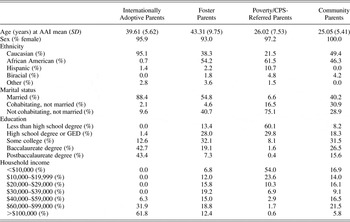
The current study included internationally adoptive parents (N = 147), foster parents (N = 300), and parents referred to CPS (N = 284) who had been recruited to participate in four randomized clinical trials designed to test the efficacy of an attachment-based parenting intervention for high-risk children. Specifically, the data were drawn from studies of infants in foster care (n = 178 foster parents, 61 CPS-referred parents; Bick & Dozier, Reference Bick and Dozier2013; Dozier et al., Reference Dozier, Peloso, Lindhiem, Gordon, Manni, Sepulveda and Levine2006; Lewis-Morrarty, Dozier, Bernard, Terraciano, & Moore, Reference Lewis-Morrarty, Dozier, Bernard, Terraciano and Moore2012), of infants and CPS-referred parents (n = 10 foster parents, n = 211 CPS-referred parents; e.g., Bernard, Dozier, Bick, & Gordon, Reference Bernard, Dozier, Bick and Gordon2015; Bernard, Dozier, Lewis-Morrarty, Lindhiem, & Carlson 2012; Lind, Bernard, Ross, & Dozier, Reference Lind, Bernard, Ross and Dozier2014), of toddlers in foster care (n = 112 foster parents, n = 12 CPS-referred parents; Lind, Raby, Caron, Roben, & Dozier, Reference Lind, Raby, Caron, Roben and Dozier2017 [this issue]), and of children whose parents adopted internationally (n = 147). For 93.4% of the parents, the AAI data were collected prior to intervention as part of an assessment of baseline functioning. This sample of foster parents does not overlap with the sample included in the report by Dozier et al. (Reference Dozier, Stovall, Albus and Bates2001). All parents were primary caregivers for at least one child enrolled in the intervention program, with the exception of 82 CPS-referred parents whose children had been removed from their care and placed in foster care. For these 81 cases, AAI data from the CPS-referred parent and the foster parent were included in the analyses. See Table 1 for information about the demographic characteristics of each of the groups of parents. Because over half of the CPS-referred parents reported a household income of less than $10,000, this group is hereafter referred to as poverty/CPS-referred parents.
Demographic characteristics of parents who adopted internationally, foster parents, parents living in poverty and referred to Child Protective Services (CPS), and parents from a community sample

Note: Data for community parents are from Haltigan, Leerkes, Supple, and Calkins (Reference Haltigan, Leerkes, Supple and Calkins2014). AAI, Adult Attachment Interview.
Two additional groups of parents were also included as low-risk comparisons for the analyses related to differences in parents’ attachment states of minds. For the analyses involving the dimensional attachment state of mind indices, data from Haltigan, Leerkes, Supple, et al. (Reference Haltigan, Leerkes, Supple and Calkins2014) were included as a comparison group. This sample was selected because it represents the largest sample (N = 259) analysis of the AAI dimensions with a community sample of parents of which we are aware. The only inclusion criteria for this sample were sex and parity (first-time mothers), age (18 or older), ethnicity (African American or Caucasian), and fluency in English. Detailed information about this sample and the psychometric characteristics of these AAI data are reported in Haltigan, Leerkes, Supple, et al. (Reference Haltigan, Leerkes, Supple and Calkins2014). The demographic information for this sample was recoded to be consistent with information available for the internationally adoptive, foster, and poverty/CPS-referred parents (see Table 1). Although this sample was not recruited on the basis of presence or absence of any risk factors, the distribution of the AAI classifications indicates the sample was at low risk for nonautonomous states of mind. As reported by Haltigan, Leerkes, Supple, et al. (Reference Haltigan, Leerkes, Supple and Calkins2014), 69% of the mothers in this sample were classified as autonomous, 26% as dismissing, and 5% as preoccupied, and only 4% of these mothers were classified as unresolved.
For the analyses involving the categorical AAI classifications, Bakermans-Kranenburg and van IJzendoorn's (Reference Bakermans-Kranenburg and van IJzendoorn2009) meta-analytic estimates of the normative distribution of AAI classifications for low-risk North American mothers were used for the comparison group (N = 748 for the three-way AAI distribution, N = 700 for the four-way AAI distribution). Individual-level demographic information is not available for this group of parents.
Measures
AAI
During the AAI, parents were asked to recall their childhood relationships with attachment figures, describe attachment-relevant experiences during childhood, and evaluate the impact of these experiences on their own development and current functioning. AAIs were audiotaped, transcribed verbatim, and then coded using the system developed by Main and Goldwyn (Reference Main and Goldwyn1998). Specifically, AAI narratives were first rated on a series of 9-point scales capturing the coders’ impressions of the quality of the parents’ childhood caregiving relationships, as well as parents’ states of mind regarding their caregiving experiences. Next, the information from the rating scales was used to make two classification decisions. The first was whether parents had an autonomous, dismissing, or preoccupied attachment state of mind, and the second was whether parents were unresolved regarding previous experiences of loss or abuse. A small number of cases did not fit criteria for these major classifications and therefore were labeled cannot classify. Individuals with cannot classify designations were assigned a secondary classification for the purposes of the three-way (i.e., dismissing, autonomous, or preoccupied) analyses.
Coding for the internationally adoptive parents, foster, and poverty/CPS-referred parents was completed without knowledge about whether the caregiver was an internationally adoptive, foster, or poverty/CPS-referred parent, except as revealed within the context of the AAI. All AAI transcripts were coded by Deane Dozier, who has completed reliability certification with Dr. Mary Main's lab. A second certified coder assigned codes for 88 randomly selected cases. Agreement for both the three-way and four-way classifications was 88% (κs = 0.79 and 0.81, respectively; both ps < .001). For cases with disagreements, the codes assigned by the primary coder (Deane Dozier) were used in the analyses.
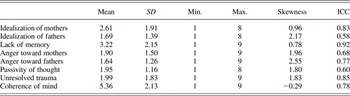
AAI state of mind rating scales identified by prior factor analyses as strong indicators of adults’ dismissing and preoccupied AAI states of mind were included in this report. This included ratings of adults’ coherence of mind, idealization of mothers and fathers, lack of recall, passivity of thought, anger toward mothers and fathers, and unresolved abuse. Consistent with prior research in this area, composite measures of anger toward mothers and idealization of mothers were created by averaging across all coded maternal caregiving figures, and composite measures of anger toward fathers and idealization of fathers were created by averaging across all coded paternal caregiving figures. Cases without applicable abuse experiences were recoded to be equal to a score of 1 (the low end of the unresolved abuse scale) so that such cases could be included in the factor and taxometric analyses. Descriptive information and reliability estimates for the AAI state of mind scales used in the analyses are reported in Table 2. The ratings assigned by the primary coder (Deane Dozier) were used in the analyses.
Descriptive and reliability data for Adult Attachment Interview state of mind ratings for the parents who adopted internationally, foster parents, and parents living in poverty and referred to Child Protective Services
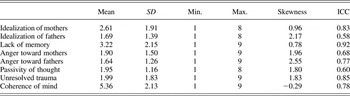
Note: N = 731. The theoretical range for all scales is 1–9. All intraclass correlations (ICCs) are p < .001.
Control variables
Parents completed a demographic questionnaire at the time of the AAI assessment. Four sociodemographic variables were included as control variables: parents’ sex, ethnicity, age at the time of the AAI, and socioeconomic status. Because a large number of the parents in the sample were White/non-Hispanic, a binary variable was created to represent ethnicity (1 = White/non-Hispanic, 0 = other). Educational attainment was coded on a 5-point scale, ranging from no GED or high school diploma to a post-baccalaureate degree. Household income was coded on a 7-point scale, ranging from less than $10,000 per year to $100,000 or more per year. Because educational attainment and income were strongly correlated (r = .77), these two measures were standardized and averaged to create a composite measure of socioeconomic status.
Results
The results are presented in two parts. The first part includes the results related to the latent structure of the AAI attachment state of mind ratings, namely, their factor structure and distributional properties. Because the goal of these analyses was to extend the results based on community samples, these analyses focused only on the samples of internationally adoptive, foster, and poverty/CPS-referred parents (see Haltigan, Leerkes, Wong, et al., Reference Haltigan, Roisman and Haydon2014, for factor analyses of the AAIs from the sample of community parents used in this study). The data from these samples were combined (total N = 731) in order to maximize the sample size for these analyses. The second part includes the results related to the potential differences in the attachment states of mind of internationally adoptive, foster, poverty/CPS-referred, and comparison parents.
Latent structure of the AAI
Confirmatory factor analysis
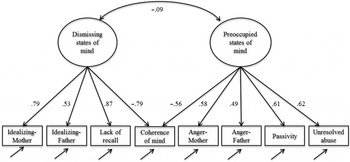
A confirmatory factor analysis of the AAI attachment state of mind ratings was conducted to evaluate whether the previously identified factor structure of the AAI state of mind ratings provides an adequate fit to the data for the samples of internationally adoptive, foster, and poverty/CPS-referred parents. Based on prior factor analyses of the AAI (e.g., Haltigan, Leerkes, Wong, et al., Reference Haltigan, Roisman and Haydon2014; Haltigan, Roisman, et al., Reference Haltigan, Leerkes, Wong, Fortuna, Roisman, Supple and Plamondon2014; Raby et al., Reference Raby, Labella, Martin, Carlson and Roisman2017 [this issue]), ratings of adults’ idealization of mothers and fathers and lack of recall were included as indicators of adults’ dismissing attachment states of mind, and ratings of adults’ coherence of mind, passivity of thought, anger toward mothers and fathers, and unresolved trauma were included as indicators of adults’ preoccupied attachment states of mind. Ratings of adults’ coherence of mind during the AAI were allowed to cross-load on both dismissing and preoccupied states of mind. All loadings were freely estimated, and the variance of the latent factors was set to 1. There was a small percentage of missing data for specific ratings scales because coders lacked sufficient information to confidently assign a rating (between 1% and 9%). To address these missing data, the factor loadings were estimated using maximum likelihood estimation within Mplus (Muthén & Muthén, Reference Muthén and Muthén1998–2015).
The overall fit indices and factor loadings are presented in Figure 1. According to Hu and Bentler's (Reference Hu and Bentler1999) guidelines, the two-factor model provided an acceptable fit to the data: the comparative fit index value was greater than 0.95, the root mean square error of approximation value was less than 0.06, and the standardized root mean square residual value was less than 0.08. Based on these results, composite measures of adults’ dismissing and preoccupied states of mind were created by averaging the relevant indicators. Consistent with prior research in this area (e.g., Haltigan, Roisman, et al., Reference Haltigan, Leerkes, Wong, Fortuna, Roisman, Supple and Plamondon2014; Raby et al., Reference Raby, Labella, Martin, Carlson and Roisman2017 [this issue]), the ratings for coherence of mind were not included in either composite given the substantial cross-loading (α = 0.76 for dismissing, α = 0.66 for preoccupied). The correlation between the composite measures of adults’ dismissing and preoccupied states of mind was statistically significant but trivial in overall magnitude (r = –.09, p = .02). The correlation between the latent dismissing and preoccupied states of mind factors also was close to zero (see Figure 1).
Standardized loadings from the confirmatory factor analysis of the Adult Attachment Interview state of mind rating scales (N = 731). χ2 (18) = 41.6, p < .001; root mean square error of approximation = 0.042, comparative fit index = 0.987, standardized root mean square residual = 0.031. All loadings were statistically significant at p < .001.

Taxometric analyses
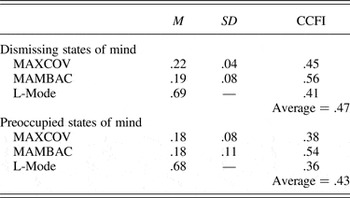
To examine whether individual differences in internationally adoptive, foster, and poverty/CPS-referred parents’ attachment states of mind are more consistent with a categorical or dimensional model, taxometric analyses were conducted on the state of mind scales. We used the same three taxometric procedures reported in Fraley and Roisman (Reference Fraley and Roisman2014): MAXCOV-HITMAX (MAXCOV; Meehl, Reference Meehl and Meehl1973; Meehl & Yonce, Reference Meehl and Yonce1996), MAMBAC (Meehl & Yonce, Reference Meehl and Yonce1994), and L-Mode (Waller & Meehl, Reference Waller and Meehl1998). Each of these procedures compares the empirical data against simulated data that have similar statistical characteristics as the empirical data (i.e., similar means, standard deviations, skews, and interitem covariances) but are generated under categorical and dimensional assumptions (for a more detailed description of these procedures, see Fraley & Roisman, Reference Fraley and Roisman2014). One way of quantifying the fit of the empirical data to these two sets of simulated data is through the use of the comparison curve fit index (CCFI; Ruscio, Ruscio, & Meron, Reference Ruscio, Ruscio and Meron2007). The CCFI can range from 0 to 1, with values of 0 being most compatible with a dimensional model and values of 1 being most consistent with a categorical model. When multiple taxometric procedures are used, the average CCFI across those analyses can be interpreted as a robust way of evaluating categorical and dimensional models (see Rusico, Walters, Marcus, & Kaczetow, 2010). Recent simulation research suggests that thresholds of .45 and .55 for the average CCFI perform relatively well in discriminating latent dimensions from latent categories (Ruscio et al., Reference Ruscio, Walters, Marcus and Kaczetow2010). Following these recommendations, average CCFI values less than .45 would be interpreted as evidence of dimensionality, values greater than .55 would be interpreted as evidence of taxonicity, and values between .45 and .55 would be treated as ambiguous.
Dismissing states of mind
To examine whether individual differences in adoptive, foster, and poverty/CPS-referred parents’ dismissing states of mind are more compatible with a categorical or dimensional model, we conducted taxometric analyses on the rating scales identified in the confirmatory factor analysis as unique indicators of dismissing attachment: idealization of mothers, idealization of fathers, and lack of recall. Coherence of mind was excluded from these analyses because it was not a unique indicator of dismissing or preoccupied states of mind. The CCFI values from each analysis and the estimated base rates under a categorical model are reported in Table 3. The average CCFI across these analyses was .47, indicating that the empirical data were not capable of discriminating between categorical and dimensional models.
Adult Attachment Interview taxometric base rate estimates and model fit indices based on MAXCOV, MAMBAC, and L-Mode analyses for the parents who adopted internationally, foster parents, and parents living in poverty and referred to Child Protective Services

Note: The mean is the average estimate of the category base rate under a categorical model, and the standard deviation is the category base rate estimates under a categorical model. CCFI, Comparison curve fit index. L-Mode base rates are based on two estimates; therefore, a standard deviation of those estimates is not reported. The average reported in the CCFI column represents the average CCFI value across the three taxometric analyses.
Preoccupied states of mind
We next examined the distributional characteristics of the preoccupation indicators: anger toward mothers, anger toward fathers, passivity, and unresolved trauma. The average CCFI value across analyses was .43, suggesting that the data were more compatible with a dimensional model than a categorical one.
AAI-related differences among internationally adoptive, foster, poverty/CPS, and community parents
The degree to which the attachment states of mind of internationally adoptive and foster parents differ from those of higher and lower risk parents (i.e., poverty/CPS-referred and community parents, respectively) was examined using a set of regression analyses. Potential differences between internationally adoptive and foster parents were also explored to complement studies on children's attachment outcomes (Van den Dries et al., Reference Van den Dries, Juffer, van IJzendoorn and Bakermans-Kranenburg2009). AAI-related differences were evaluated using the dimensional indices of adults’ attachment states of mind as well as the traditional AAI classifications. For each outcome, results of the basic model that did not include any covariates are presented along with the results of the analyses that control for parents’ sex, ethnicity, age, and socioeconomic status.
AAI dimensions
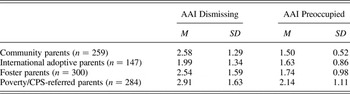
Table 4 includes the means and standard deviations for the two AAI state of mind dimensions for the samples of internationally adoptive, foster, and poverty/CPS-referred parents. The AAI data from Haltigan, Leerkes, Supple, et al. (Reference Haltigan, Leerkes, Supple and Calkins2014) were also included as a comparison sample of community parents. The measures of adults’ dismissing and preoccupied states of mind for this sample were re-created in order to exclude the coherence of mind ratings from both composites (α = 0.80 for dismissing; α = 0.55 for preoccupied).
Descriptive statistics for the dimensional indices of adults’ dismissing and preoccupied attachment states of mind

Note: AAI, Adult Attachment Interview; CPS, Child Protective Services. Data for community parents are drawn from Haltigan, Leerkes, Supple, and Calkins (Reference Haltigan, Leerkes, Supple and Calkins2014).
Preliminary analyses were first conducted to evaluate the associations between the covariates and adults’ dismissing and preoccupied states of mind using data from all four groups of parents (combined N = 990). White/non-Hispanic parents had lower scores than parents of other ethnicities on the dismissing dimension (r = –.20, p < .001) and the preoccupied dimension (r = –.07, p = .03). Older parents had lower scores than younger parents on the dismissing dimension (r = –.14, p < .001) but not the preoccupied dimension (r = –.03, p = .35). Parents with higher socioeconomic status had lower scores than parents with lower socioeconomic status on the dismissing dimension and the preoccupied dimension (rs = –.27 and –.19, respectively; both ps < .001). Parents’ sex was not significantly associated with the dismissing or preoccupied dimensions (r = –.03, p = .35 and r = .01, p = .89, respectively). However, these null results might be attributable to the small number of fathers included in these analyses (see Table 1), because unequal base rates of dichotomous variables reduce statistical power and attenuate effect size estimates (e.g., Babchishin & Helmus, Reference Babchishin and Helmusin press; McGrath & Meyer, Reference McGrath and Meyer2006). Other studies with more balanced proportions of male and female participants have consistently observed sex differences in the dimensional indices of adults’ dismissing and preoccupied states of mind (Haydon et al., Reference Haydon, Roisman, Owen, Booth-LaForce and Cox2014; Raby et al., Reference Raby, Labella, Martin, Carlson and Roisman2017 [this issue]; Roisman et al., Reference Roisman, Rogosch, Cicchetti, Groh, Haltigan, Haydon, Holland and Steele2017 [this issue]).
Internationally adoptive parents
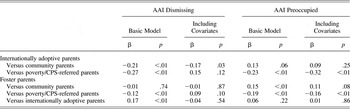
Comparisons across the different groups of parents are presented in Table 5. Parents who adopted internationally had lower scores on the dismissing dimension than community parents and had lower scores on both the dismissing and preoccupied dimensions than poverty/CPS-referred parents. After controlling for covariates, internationally adoptive parents had lower scores on the dismissing dimension than community parents and had lower scores on the preoccupied dimension than poverty/CPS-referred parents.
Differences between parents of children adopted internationally, foster parents, parents living in poverty and referred to Child Protective Services, and lower-risk parents for the Adult Attachment Interview dimensions

Note: AAI, Adult Attachment Interview; CPS, Child Protective Services. Data for community parents are drawn from Haltigan, Leerkes, Supple, and Calkins (Reference Haltigan, Leerkes, Supple and Calkins2014).
Foster parents
Foster parents did not significantly differ from community parents with regard to their dismissing states of mind before or after including covariates. Although foster parents had higher scores on the preoccupied dimension than community parents, this difference was not significant after accounting for the covariates. Foster parents had lower scores than poverty/CPS-referred parents on both the dismissing dimension and the preoccupied dimension. After including covariates, the difference related to the preoccupied dimension was still significant. Foster parents had higher scores on the dismissing dimension than internationally adoptive parents, but this difference was not significant after controlling for covariates.
AAI classifications
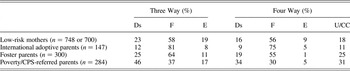
The three-way and four-way AAI classification distributions for each group of parents are presented in Table 6. The comparison sample for the categorical analyses was Bakermans-Kranenburg and van IJzendoorn's (Reference Bakermans-Kranenburg and van IJzendoorn2009) meta-analytic estimates of the distribution of AAI classifications for low-risk North American mothers. Note that the classification distributions for the poverty/CPS-referred parents are similar to the meta-analytic estimates for at-risk adults (which are 41% autonomous, 42% dismissing, and 17% preoccupied for the three-way meta-analytic distribution and 32% classified as unresolved according to Bakermans-Kranenburg & van IJzendoorn, Reference Bakermans-Kranenburg and van IJzendoorn2009). Associations between predictor variables (i.e., covariates and group membership) and specific AAI classifications were tested using a series of logistic regression analyses. Binary codes were created to represent individuals’ overall pattern of discourse during the AAI as reflected by the classifications from the three-way system (i.e., autonomous, dismissing, or preoccupied). In addition, a separate binary code was created to represent whether individuals were designated as unresolved or cannot classify (referred to as “unresolved”). These two groups were combined to be consistent with Bakermans-Kranenburg and van IJzendoorn (Reference Bakermans-Kranenburg and van IJzendoorn2009). The direction and magnitude of the associations were represented by odds ratios.
Distributions of Adult Attachment Interview classifications for parents who adopted internationally, foster parents, parents living in poverty and referred to CPS, and low-risk mothers

Note: The values are the percentages within each group. CPS, Child Protective Services; Ds, dismissing; F, autonomous; E, preoccupied; U, unresolved; CC, cannot classify. Data for low-risk mothers are drawn from Bakermans-Kranenburg and van IJzendoorn (Reference Bakermans-Kranenburg and van IJzendoorn2009). For the low-risk mothers, the sample sizes were 748 for the three-way distribution and 700 for the four-way distribution.
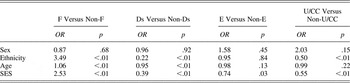
Preliminary analyses were conducted to evaluate the degree to which potential control variables were associated with AAI classifications (see Table 7). These analyses only involved the samples of internationally adoptive, foster, and poverty/CPS-referred parents because detailed demographic information is not available for participants in Bakermans-Kranenburg and van IJzendoorn's (Reference Bakermans-Kranenburg and van IJzendoorn2009) meta-analysis. Parents’ sex was not significantly associated with AAI classifications. White/non-Hispanic parents were more likely than parents of other ethnicities to be classified as autonomous and were less likely than parents of other ethnicities to be classified as dismissing or unresolved (but not preoccupied). Older parents were more likely than younger parents to be classified as autonomous and were less likely than younger parents to be classified as dismissing (but not preoccupied or unresolved). Parents with higher socioeconomic status were more likely than parents with lower socioeconomic status to be classified as autonomous and were less likely than parents with lower socioeconomic status to be classified as dismissing, preoccupied, or unresolved.
Associations between Adult Attachment Interview classifications and covariates within parents who adopted internationally, foster parents, and parents living in poverty and referred to Child Protective Services

Note: N = 731. F, Autonomous; Ds, dismissing; E, preoccupied; U, unresolved; CC, cannot classify; OR, odds ratio; SES, socioeconomic status. For sex, 1 = female, 0 = male. For ethnicity, 1 = white/non-Hispanic, 0 = other.
Internationally adoptive parents
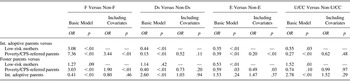
Group comparisons are presented in Table 8. Parents who adopted internationally were more likely to be classified as autonomous and less likely to be classified as dismissing, preoccupied or unresolved than low-risk mothers. Parents who adopted internationally also were more likely to be classified as autonomous and less likely to be classified as dismissing, preoccupied, or unresolved than poverty/CPS-referred parents. After controlling for covariates, the differences related to parents’ autonomous and parents’ preoccupied states of mind were still significant.
Differences between parents of children adopted internationally, foster parents, parents living in poverty and referred to Child Protective Services, and low-risk mothers for specific Adult Attachment Interview classifications

Note: F, Autonomous; Ds, dismissing; E, preoccupied; U, unresolved; CC, cannot classify; OR, odds ratio; CPS, Child Protective Services. Data for low-risk mothers are drawn from Bakermans-Kranenburg and van IJzendoorn (Reference Bakermans-Kranenburg and van IJzendoorn2009). Covariate information was not available for low-risk mothers.
Foster parents
The prevalence of autonomous and dismissing states of mind did not differ between foster parents and low-risk mothers. However, foster parents were less likely to be classified as preoccupied and more likely to be classified as unresolved than low-risk mothers. Moreover, foster parents were more likely to be classified as autonomous and less likely to be classified as dismissing or preoccupied (but not unresolved) than poverty/CPS-referred parents. After controlling for covariates, the differences between foster and poverty/CPS-referred parents’ autonomous and parents’ preoccupied states of mind were still significant. Foster parents were less likely to be classified as autonomous and more likely to be classified as dismissing or unresolved (but not preoccupied) than internationally adoptive parents. However, these differences were no longer significant after accounting for covariates.
Discussion
The present study addressed two issues related to the attachment states of mind among internationally adoptive and foster parents. The first involved identifying the latent structure of individual differences in AAI states of mind among these unique groups of parents. Results of the confirmatory factor analysis are consistent with the idea that the variation in the AAI ratings of parents’ attachment states of mind is most parsimoniously explained by two weakly correlated factors reflecting adults’ dismissing and adults’ preoccupied attachment states of mind. This factor structure for the AAI appears to be rather robust, as similar findings have been observed among individuals who differ in age (e.g., Haltigan, Roisman, et al., Reference Haltigan, Leerkes, Wong, Fortuna, Roisman, Supple and Plamondon2014; Whipple et al., Reference Whipple, Bernier and Mageau2011), individuals who differ in ethnicity (Haltigan, Leerkes, Wong, et al., Reference Haltigan, Roisman and Haydon2014), community samples (e.g., Roisman et al., Reference Roisman, Fraley and Belsky2007), individuals with histories of childhood poverty (Raby et al., Reference Raby, Labella, Martin, Carlson and Roisman2017 [this issue]), samples with clinical features (Macfie et al., 2015; Martin et al., Reference Martin, Bureau, Lafontaine, Cloutier, Hsiao, Pallanca and Meinz2017 [this issue]), and now among internationally adoptive, foster, and poverty/CPS-referred parents.
In addition, the taxometric analyses indicated that the individual differences in parents’ preoccupied states of mind are more consistent with a dimensional than a categorical model. These findings are of interest because they represent the first unambiguous evidence that preoccupation during the AAI is dimensionally distributed. The taxometric results also provided the first ambiguous evidence regarding the potential taxonicity or dimensionality of adults’ dismissing states of mind. The two prior taxometric analyses of the AAI both indicated that dismissing states of mind has a latent dimensional structure (Fraley & Roisman, Reference Fraley and Roisman2014; Roisman et al., Reference Roisman, Fraley and Belsky2007). Although the results from the current study do not replicate this finding, they do not refute it by providing clear evidence in favor of a latent categorical model. The ambiguous taxometric results for adults’ dismissing attachment may be explained by the highly skewed distributions for the ratings reflecting adults’ dismissing states of mind, especially the ratings of father idealization (see Table 2). The presence of high skewness in the observed variables makes it challenging to distinguish between data derived from categorical and dimensional models (see Ruscio et al., Reference Ruscio, Haslam and Ruscio2006). Given this potential obfuscating factor and the prior research indicating that AAI dismissing states of mind are dimensionally distributed, we are inclined to conclude that individual differences in dismissing attachment are best viewed and treated as continuous until additional evidence clearly indicates otherwise.
Taken together, these factor analytic and taxometric findings indicate that the latent structure of the AAI among internationally adoptive, foster, and poverty/CPS-referred parents is most accurately represented by dimensional indices of dismissing and preoccupied states of mind. Although the empirically derived dimensional AAI scores are somewhat inconsistent with the traditional understanding of individual differences in adults’ attachment states of mind, these dimensions do align with the theoretical ideas regarding deactivating and hyperactivating attachment strategies (Cassidy, Reference Cassidy1994; Kobak, Cole, Ferenz-Gillies, Fleming, & Gamble, Reference Kobak, Cole, Ferenz-Gillies, Fleming and Gamble1993; Main, Reference Main1990). One of the practical benefits of using these dimensional measures is that they allow for more statistically powerful tests of the potentially distinct implications of these different attachment strategies during adulthood under some circumstances (see Fraley & Spieker, Reference Fraley and Spieker2003, for simulation results). There is a growing corpus of research demonstrating that the empirically derived dimensional indices of adults’ dismissing and preoccupied states of mind are uniquely associated with different interpersonal behaviors (Fortuna, Roisman, Haydon, Groh, & Holland, Reference Fortuna, Roisman, Haydon, Groh and Holland2011; Haltigan, Leerkes, Supple, et al., Reference Haltigan, Leerkes, Supple and Calkins2014; Haydon, Roisman, & Burt, Reference Haydon, Roisman and Burt2012; Whipple et al., Reference Whipple, Bernier and Mageau2011), social–cognitive processes (Dykas, Woodhouse, Jones, & Cassidy, Reference Dykas, Woodhouse, Jones and Cassidy2014; Haydon, Roisman, Marks, & Fraley, Reference Haydon, Roisman, Marks and Fraley2011), and problematic behaviors (Haydon et al., Reference Haydon, Roisman and Burt2012; Martin et al., Reference Martin, Bureau, Lafontaine, Cloutier, Hsiao, Pallanca and Meinz2017 [this issue]).
The second aim of the present study was to examine the degree to which the attachment states of mind of internationally adoptive and foster parents differed from groups of parents that have traditionally been considered low and high risk for insecure attachment states of mind (namely, parents from community samples and poverty/CPS-referred parents, respectively). The results of the basic group comparisons indicated that internationally adoptive parents were not at greater risk for dismissing or preoccupied attachment states of mind. Internationally adoptive parents had lower scores than community parents on the dismissing dimension. Although foster parents did not differ from community parents regarding their dismissing states of mind, foster parents had slightly higher scores than community parents on the preoccupied dimension. In addition, both internationally adoptive and foster parents had lower scores than poverty/CPS-referred parents on both the dismissing and the preoccupied dimensions.
These results of the analyses involving the traditional AAI classifications were largely convergent with these findings. Specifically, internationally adoptive parents were less likely to be classified as having dismissing, preoccupied, or unresolved states of mind (and were more likely to be classified as autonomous) than the normative distribution for low-risk North American mothers. Although the frequencies of the autonomous and dismissing classifications were similar for foster and low-risk parents, foster parents were less likely to be classified as preoccupied and more likely to be classified as unresolved than low-risk parents. The latter finding is consistent with the results indicating that foster parents have higher scores than community parents on the empirically derived dimensional measure of parents’ preoccupied states of mind. In addition, both internationally adoptive and foster parents were less likely to be classified as having a dismissing or preoccupied attachment state of mind (and were more likely to be classified as autonomous) than poverty/CPS-referred parents.
We also examined whether the AAI-related differences between the groups of parents were robust to controls for the parents’ sociodemographic characteristics. Consistent with prior research (e.g., Bakermans-Kranenburg & van IJzendoorn, Reference Bakermans-Kranenburg and van IJzendoorn2009; Haydon et al., Reference Haydon, Roisman, Owen, Booth-LaForce and Cox2014), parents’ ethnicity, age, and socioeconomic status were associated with the dimensional and categorical measures of parents’ attachment states of mind. As expected, these characteristics also systematically varied across the four groups of parents. However, even after accounting for these variables, internationally adoptive parents still had lower scores on the dismissing dimension than community parents. Given that international adoption involves a deliberate effort to assume the responsibility of caring for a biologically unrelated child who has experienced early adversity, it is perhaps not surprising that internationally adoptive parents are less likely than nonadoptive parents to have attachment states of mind that reflect a strategy of downplaying the importance of attachment relationships. The difference between foster parents’ and community parents’ scores on the preoccupied dimension was no longer statistically significant after controlling for the covariates. However, after statistically controlling for sociodemographic variables, both internationally adoptive and foster parents continued to have lower scores on the preoccupied dimension (and were less likely to be classified as having a preoccupied state of mind) than poverty/CPS-referred parents. This difference between foster and CPS-referred parents is especially noteworthy, as it indicates that adults who provide foster care for children who have been removed from their birth parents are more likely to have developed attachment states of mind associated with high-quality caregiving than parents involved with CPS.
Altogether, these results indicate that both internationally adoptive and foster parents are situated on the lower end of the continuum of risk regarding attachment states of mind. The attachment states of mind of foster parents appear to be quite similar to those of community parents, a group that has traditionally been considered low risk. Internationally adoptive parents are at even lower risk than these low-risk parents for states of mind thought to reflect attachment insecurity during adulthood. These findings are suggestive of interpersonal processes that may help support the healthy adaptation of foster and internationally adopted children. Specifically, given the evidence that parents’ attachment states of mind are associated with how parents respond to their children's signals (e.g., Haltigan, Leerkes, Wong, et al., Reference Haltigan, Roisman and Haydon2014; Verhage et al., Reference Verhage, Schuengel, Madigan, Fearon, Oosterman, Cassibba and van IJzendoorn2016), internationally adoptive and foster parents may be especially likely to interact with their children in a highly sensitive manner. Sensitive caregiving is in turn influential in the development of a secure parent–child attachment relationship (e.g., Ainsworth, Blehar, Waters, & Wall, Reference Ainsworth, Blehar, Waters and Wall1978; Bernard et al., Reference Bernard, Dozier, Bick, Lewis-Morrarty, Lindhiem and Carlson2012; De Wolff & van IJzendoorn, Reference De Wolff and van IJzendoorn1997). In this way, the attachment states of mind of internationally adoptive and foster parents may promote shifts over time toward greater attachment security among these groups of children who have experienced early adversity (see Pace, Zavattini, & D'Alessio, Reference Pace, Zavattini and D'Alessio2012, for preliminary evidence).
There is emerging evidence supporting this intergenerational transmission process among adoptive and foster parents. The quality of children's attachments to their adoptive or foster parents is associated with the parents’ attachment states of mind (Barone & Lionetti, Reference Barone and Lionetti2012; Dozier et al., Reference Dozier, Stovall, Albus and Bates2001; Jacobson et al., 2014; Lionetti, Reference Lionetti2014; Stovall-McClough & Dozier, Reference Stovall-McClough and Dozier2004; Pace et al., Reference Pace, Zavattini and D'Alessio2012; but see Van Londen-Barentsen, Reference Van Londen-Barentsen2002) and caregiving quality (e.g., Dozier et al., Reference Dozier, Peloso, Lindhiem, Gordon, Manni, Sepulveda and Levine2006; Juffer, Bakermans-Kranenburg, & van IJzendoorn, Reference Juffer, Bakermans-Kranenburg and van IJzendoorn2005). However, most of these studies are based on concurrent or short-term longitudinal studies that include only one or two assessments of adoptive and foster children's attachment quality (for exceptions see Cohen & Farnia, Reference Cohen and Farnia2011; Lang et al., Reference Lang, Bovenschen, Gabler, Zimmermann, Nowacki, Kliewer and Spangler2016). Longitudinal studies with repeated assessments of children's attachment patterns beginning soon after placement in the foster or adoptive home would be ideally suited for documenting developmental changes in children's attachment patterns and evaluating degree to which these changes are facilitated by parents’ attachment states of mind and/or caregiving behaviors. In addition to their theoretical importance, the results from these types of studies would provide empirically based directions regarding when and how to intervene most effectively to promote the development of healthy attachment patterns among adoptive and foster children.
In summary, the current study provides novel evidence: (a) regarding the latent structure of attachment states of mind among internationally adoptive and foster parents, (b) that foster parents’ attachment states of mind are quite similar to those of low-risk community parents, and (c) that internationally adoptive parents are at even lower risk for dismissing attachment states of mind than community parents. Our hope is that these findings will encourage additional research into the impact of adoptive and foster parents’ attachment states of mind on their caregiving behavior as well as the quality of the parent–child attachment relationship. Research with these families allows for evaluating theoretical ideas regarding the significance of early attachment relationships among genetically unrelated parent–child pairs (e.g., Rutter, Reference Rutter2000) while also providing valuable information regarding how to promote the healthy development among these children who have experienced early adversity.