Introduction
The World Health Organization (WHO) estimates that there are more than 1000 million cases of soil-transmitted helminths in the world and proposes that the overall objective of any control programme should be to reduce the intensity of infection below the levels associated with morbidity in the human population (WHO, 1996). The studies of prevalence and control of parasitic diseases published in Mexico show an endemic problem of multifactorial origin. In Mexico, the most frequent soil-transmitted helminth is Ascaris lumbricoides (43–95% prevalence), which is distributed all around the country (Torres et al., Reference Torres, Flisser, Aguirre, Velasco, Mañon, Guzman, Dominguez, Gonzalez, Nava, del Rio, Garcia and Valdespino2000). In the state of Colima, the frequency of helminthiasis is 64% and 42% of these infections are due to A. lumbricoides (INDRE, 1994). A study of children aged 2–12 years in three urban communities of Colima showed a 30% prevalence of A. lumbricoides (Dávila et al., Reference Dávila, Vasquez, Trujillo and Huerta2002). Nitazoxanide (NTZ; 2-(acetolyloxy)-N-(5-nitro-2-thiazolyl)) is a new 5-nitrothiazole broad-spectrum derivative, synthesized and used as an anti-parasitic drug (Rossignol & Cavier, Reference Rossignol and Cavier1975). Recent investigations using anaerobic parasites have shown that nitazoxanide inhibits pyruvate ferrodoxin oxidoreductase (PFOR), a vital enzyme of intermediary metabolism in these organisms (Gilles & Hoffman, Reference Gilles and Hoffman2002). Clinical trials have demonstrated that this anti-parasitic drug is an effective agent for the treatment of intestinal ascariasis, with an efficacy that ranges from 62 to 100% (Romero et al., Reference Romero, Robert, Muñoz and Geyne1997; Abaza et al., Reference Abaza, El-Zayali, Kabil and Rizk1998; Diaz et al., Reference Diaz, Mondragon, Ramirez and Bernal2003). The aim of the present study was to determine the prevalence of A. lumbricoides and the efficacy and safety of NTZ treatment in the population of Ocotillo, Colima, Mexico. The association of ascariasis with several risk factors, such as socio-economic level, hygienic habits and housing factors, is also discussed.
Materials and methods
Subjects
The study was carried out in Ocotillo, Colima, a rural town of 510 inhabitants, located in the western part of the Mexican Republic, at latitude (DMS) 19°19′60″ N, longitude (DMS) 103°39′0″ W, having an average temperature of 23°C. Ocotillo is mainly an agricultural community where the men are farmers and the majority of women are housewives. Houses have electricity (94%), tap water (86%), drainage (66%) and cement floors (71%). Two hundred and eighty randomly chosen residents (age range: 2 to 98 years old) signed an informed-consent form and were included for screening of intestinal parasites. A questionnaire was completed for each subject, which included the following variables: (1) socio-demographic: age, sex, education, and socio-economic level; (2) hygiene habits: hand washing before eating and after going to the toilet, washing fruits and vegetables before eating, and quality of drinking water; (3) household facilities: bathroom, latrine, type of floor, drainage and number of inhabitants per household. With reference to ethical aspects, the protocol and questionnaire were approved by the Committees of Investigation and Ethics of the University of Guadalajara, Mexico.
Parasitological procedures
Three consecutive samples of faeces were collected from each subject, transported at 4°C to the laboratory and processed immediately. Stools were analysed using the floatation concentration Faust test and egg counts were performed by the Kato–Katz technique, both before and after treatment. Smears were examined under 10 × and 40 × magnification, and parasites identified as described by the NCCLS (1997). Infection intensities were classified as light ( < 2000 eggs/g faeces (epg)), moderate (2000–10,000 epg) or heavy (>10,000 epg) as described previously (Romero et al., Reference Romero, Robert, Muñoz and Geyne1997).
Patient examination and treatment
All patients diagnosed with ascariasis infection underwent a complete physical examination before and after treatment. Nitazoxanide (Romark Laboratories, L.C., Tampa, Florida, USA) was administered orally as a 200 mg suspension (for 2- to 12-year-olds) or in 500 mg tablets for teenagers (13- to 18-year-olds) and adults (over 18 years old), accompanied by food. Ten days after treatment, the same parasitological studies were performed. Treatment was considered efficient when patients had three negative parasitological examinations after therapeutic action. The disappearance of clinical symptoms was considered as a clinical cure. Tolerance was measured by the rate of adverse events (Cooperstock et al., Reference Cooperstock, DuPont, Corrado, Fekety and Morgan1992).
Data analysis
Sample size estimates were based upon an expected prevalence rate of 30% and P values < 0.05 were taken as significant. Prevalence values were calculated as a percentage, while quantitative variables were determined by means and standard deviation (SD). Nominal data were described using percentage and frequency. Analysis of age distribution was performed using the Student's t-test, after confirmation of a normal distribution of variances with the level test. Associations among positives and socio-demographic variables or risk factors were estimated by using an odds ratio, with 95% confidence intervals. Statistically significant differences were calculated utilizing chi-square or Fisher’s exact tests, using SPSS 8.0 software (SPSS Inc., Chicago, Illinois, USA).
Results
Two hundred and eighty inhabitants from Ocotillo, Colima, Mexico participated in this study. Of those, 113 (40%) were males and 167 (60%) were females. Ages ranged from 2 to 98 years, including 80 children (2- to 12-year-olds), 36 teenagers (>12- to 18-year-olds) and 164 adults (over 18 years old). Of the total sample, one hundred and six (38%) were diagnosed with intestinal parasitic infections. The parasites included Entamoeba histolytica/Entamoeba dispar (27%), Giardia lamblia (7%) and two cases of Blastocystis hominis. The helminths included Hymenolepis nana (8%), Ascaris lumbricoides (81%), Enterobius vermicularis (3%) and one case of Trichuris trichiura. When samples were analysed using only the Faust test, the percentage of recovery was 70%, with two examinations it was 92%, and with three tests 100%.
Of individuals diagnosed with A. lumbricoides, 30 (35%) were 2- to 12-year-olds (children), 6 (7%) were >12- to 18-year-olds (teenagers) and 50 (58%) individuals were over 18 years old (adults). Of the adults, 40% were males and 60% females (all housewives). Of 86 individuals infected with A. lumbricoides, 65 (76%) were only infected with this parasite and 21 (24%) were infected with A. lumbricoides and other protozoa or helminths. Twenty-one of 86 cases infected with A. lumbricoides had as concurrent E. histolytica/E. dispar infection. Other parasitic protozoans and helminths were associated with A. lumbricoides (B. hominis, G. lamblia and T. trichiura). Fifteen cases (17%) had < 2000 epg of A. lumbricoides (light infections), and 71 cases (83%) had 2000–10,000 epg of A. lumbricoides (moderate infections). The highest prevalence of A. lumbricoides was found in housewives (P < 0.05), in inhabitants in houses without drainage (P < 0.02) and those in houses with dirt floors (P < 0.01).
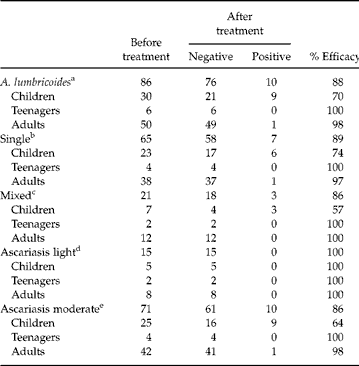
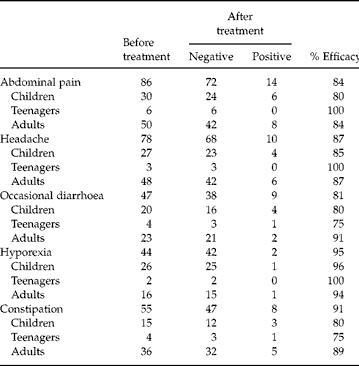
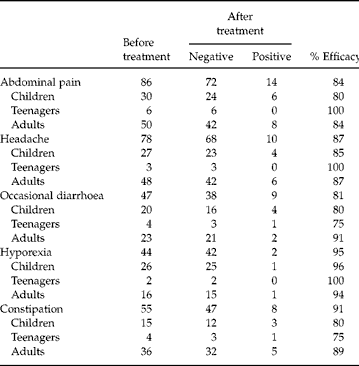
An important reduction in the prevalence of ascariasis was obtained after NTZ treatment, since the overall prevalence diminished from 81 to 13%. The efficacy was higher in teenagers (100%) followed by 98% in adults and lower (70%) in children. When A. lumbricoides was identified as a single infection, the cure rate was 89%, compared to 86% in mixed ascariasis. In ascariasis with < 2000 epg the efficacy was 100% and in ascariasis with 2000–10,000 epg the efficacy was 86% (table 1). After treatment, clinical symptoms were significantly reduced. Abdominal pain diminished from 100 to 16%, headaches from 91 to 13%, occasional diarrhoea from 55 to 19%, hyporexia (diminished appetite) from 51 to 5% and constipation from 64% to 15% (table 2). The oral dose of nitazoxanide was generally well tolerated, and the principal side-effects were abdominal pain (16%), headaches (6%) and nausea (9%). All symptoms disappeared before the end of the third day of treatment.
Efficacy of nitazoxanide (NTZ) against Ascaris lumbricoides in children (2–12 years old), teenagers (>12–18 years old) and adults (>18 years old) in a rural community in Colima, Mexico.
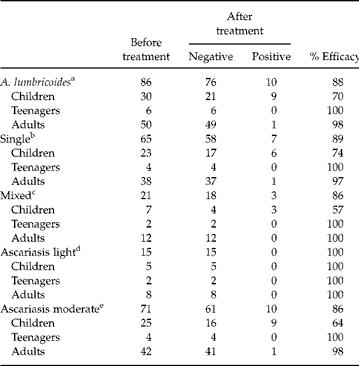
a Total of Ascaris lumbricoides cases in three consecutive samples of faeces with two coproparasitologic techniques (Faust and Kato–Katz).
b Ascariasis single – only infected with A. lumbricoides.
c Ascariasis mixed – A. lumbricoides and other parasites.
d Ascariasis light < 2000 eggs/g faeces (Romero et al., Reference Romero, Robert, Muñoz and Geyne1997).
e Ascariasis moderate 2000–10,000 eggs/g faeces (Romero et al., Reference Romero, Robert, Muñoz and Geyne1997).
Clinical efficacy of nitazoxanide (NTZ) against Ascariasis in children (aged 2–12 years), teenagers (>12–18 years old) and adults (>18 years old) in a rural community in Colima, Mexico.
Discussion
The findings of the present study further demonstrate the frequency of soil-transmitted helminth infections in a rural area in Mexico. The most frequently found helminth was A. lumbricoides, the prevalence of which was significantly different (P < 0.005) from that of other parasites. The highest prevalence was in adults, where statistically significant differences were found between men and women. The probability of recording parasites was greater when three consecutive Faust techniques were used. The frequency of A. lumbricoides is presumably due to the presence of dirt floors inside and outside houses, which favours the transmission of soil-transmitted helminths in rural areas with warm climates. The transmission of ascariasis depends on faecal contamination of the soil, a lack of appropriate sanitary facilities, poor health education and poor hygiene. Children, who play in the soil and eat dirt, are at highest risk of contracting ascariasis infection. However, in the present case study, a greater frequency of infection occurred in adults, probably due to poor sanitation and hygiene.
NTZ was administrated in a 3-day dose, unlike the common anthelmintic albendazole, which is administered for only 1 day. To prevent or delay anthelmintic resistance the use of low albendazole dosages should be avoided, since 200 mg and even 400 mg doses of albendazole are actually subcurative (Geerts & Gryseels, Reference Geerts and Gryseels2000). NTZ is more effective against ascariasis in cases of single infection with A. lumbricoides, and less effective in ascariasis mixed with other parasitic infections. Finally, the effectiveness of treatment on light infections and moderate infections was compared. The results indicate that 100% of patients with light infections were cured, as well as 86% of patients with moderate infections. In the latter, egg counts were significantly reduced (from moderate to light). In a previous report from the same State of Colima, Dávila et al. (Reference Dávila, Vasquez, Trujillo and Huerta2002) showed that protozoans were the parasites with the highest prevalence. This was probably due to the study being carried out in three urban communities, whereas the present study was undertaken in a rural community. Dávila et al. (Reference Dávila, Vasquez, Trujillo and Huerta2002) also indicated eradication percentages of A. lumbricoides of 63% and 76% for single and associated parasitosis, respectively, treated with nitazoxanide. This compares with 69% eradication with mebendazole treatment and 67% with mebendazole and quinfamide together, without a significant difference between the effects of NTZ and the other two drugs.
All patients enrolled in the present study showed significant improvements in clinical symptoms using NTZ, with a statistical significance P < 0.05. Before treatment, headaches were present in 91% of individuals and these decreased to 13%. These symptoms could be attributed to other aetiologies, since physical examinations did not consider hypertension and stress, which are very common in adults. Constipation, which was very common in adults, decreased after treatment from 42% to 6%. Hyporexia (diminished appetite) was more frequent in children and disappeared after treatment in 96% of cases.
Housing characteristics were a risk factor for the presence of intestinal parasites, as demonstrated by a higher prevalence in families with dirt floors and the absence of drainage. Poor hygiene, poor food handling habits and poor household facilities may be regarded as the main risk factors associated with prevalent parasitic diseases. The majority of housewives had not washed their hands before eating and preparing food. There were significant differences among socio-demographic variables. Despite the fact that most houses had sanitary services, 81% of the population had intestinal ascariasis, suggesting that the population had deficient hygiene habits. Few studies have examined the socio-cultural factors that affect the transmission of intestinal ascariasis. In a study of prevalence and intensity of A. lumbricoides infection in rural Honduran communities, Smith et al. (Reference Smith, DeKaminsky, Niwas, Soto and Jolly2001) showed that the highest frequency of infection was found in 5- to 12-year-old children, and that households with the least education and poor levels of sanitation may also have a higher prevalence of helminth infections, the major problems being the lack of hygiene and sanitation. When the World Health Organization (WHO) came up with a recommendation for controlling soil-transmitted helminths, their aim was based on the health of both mothers and children.
Regular chemotherapy of infected populations reduces mortality and morbidity in schoolchildren (WHO, 1987). A programme of national health weeks, run by the Ministry of Health in Mexico, provides antiparasitic treatment every 6 months for children and has reduced the intensity of infection with helminths in childhood. An evaluation of the treatment success of the national programme was accomplished through sentinel stool surveys from a sample of the population before and after each drug administration. The efficacy against A. lumbricoides was 87.4% and egg counts were reduced by 99.7% (WHO, 1996). The present results show that the global efficacy was 88% against A. lumbricoides and the control of morbidity was 97.5%, as estimated by egg count reductions. These results are in agreement with the overall aim of a control programme that reduces morbidity in the human population (WHO, 1996). The results of treatment against helminths in Bangladesh suggested that reducing the morbidity is more important than eliminating all infections (Hall et al., Reference Hall, Anwar and Tomkins1992). Ascariasis infection is endemic and prevalent in housewives and it can be an important cause of dissemination in the overall population. Housewives spend more time in the house as they prepare the food, and if they have poor sanitary practices they may transmit the infection to other family members. Hence treatment with a compound such as nitazoxanide, with high efficacy against A. lumbricoides (98%), is necessary.
These results suggest that nitazoxanide (Fox & Saravolatz, Reference Fox and Saravolatz2005), a new drug being used in Mexico for treatment of human intestinal helminths, is likely to be a safe, well-tolerated and effective drug. An important potential problem is anthelmintic resistance seen in programmes that depend exclusively on the administration of a single drug for many years. However, the development of anthelmintic resistance can be avoided with the simultaneous or rotational use of two or more drugs with different mechanisms of action (Geerts et al., 1997; Geerts & Gryseels, Reference Geerts and Gryseels2000). Nitazoxanide offers a valuable drug alternative for the treatment of ascariasis infections, producing an effective parasitological and clinical response both in adults and children, as has been reported in other countries (Rossignol et al., 1998; Doumbo et al., Reference Doumbo, Rossignol, Pichard, Troare, Dembele, Diakite, Traore and Diallo1999, Ortiz et al., 2001).
Acknowledgements
This study was supported by a grant from the University of Guadalajara, Mexico. Nitazoxanide suspension and tablets were supplied by Columbia Laboratory S.A. de C.V. in Mexico. We thank Drs Dolores Correa and Eduardo Castro for reviewing the English language.