Since the opening of the Suez Canal in 1869, there has been an influx of Red Sea and Indo-Pacific species into the Mediterranean Sea, a phenomenon known as lessepsian migration (Por, Reference Por1971). In the most recent comprehensive account, 77 lessepsian fish species were enumerated (CIESM, 2006; Bariche, Reference Bariche2010a, Reference Baricheb; Golani, Reference Golani, Golani and Appelbaum-Golani2010). The French coast in the north-western Mediterranean is the farthest point from the Suez Canal, and at present, only a single species, Siganus luridus, has been recorded there, near Marseilles (Daniel et al., Reference Daniel, Piro, Charbonnel, Francour and Letourneur2009).
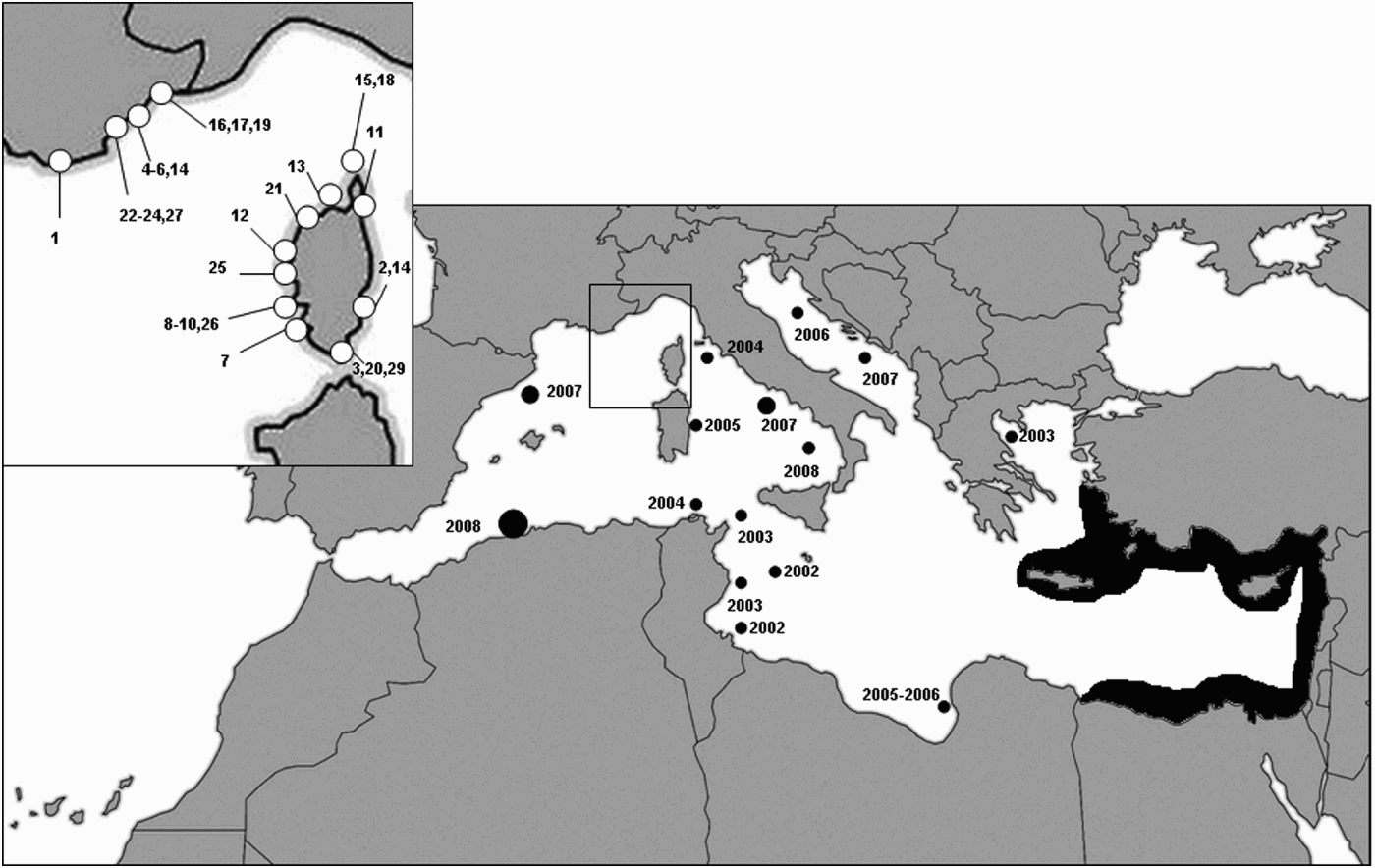
Fistularia commersonii Rüppel, 1838 is a reef-associated species of minor importance in commercial fisheries. It is widely distributed in the Indo-Pacific and eastern central Pacific where it lives solitarily or in small groups (Froese & Pauly, Reference Froese and Pauly2010). The first individual recorded in the Mediterranean Sea was captured in January 2000 by a fisherman along the coast of Israel at a depth of 35 m (Golani, Reference Golani2000), and the species quickly spread towards the eastern Mediterranean basin (Karachle et al., Reference Karachle, Triantaphyllidis and Stergiou2004) (Figure 1). It reached the southern shores of Italy in December 2002 (Azzurro et al., Reference Azzurro, Pizzicori and Andaloro2004), the North Tyrrhenian Sea in October 2004 (Micarelli et al., Reference Micarelli, Bartelettani and Ceccarelli2006), the southern coasts of Spain in November–December 2007 (Granada; 3°44′14″W 36°43′22″N) and northernmost Palamos (Girona; 3°08′27.80″E 41°50′57.76″N) (Sanchez-Tocino et al., Reference Sanchez-Tocino, Hidalgo Puertas and Pontes2007). With such a widespread range of occurrence over just a short period of time, F. commersonii is then the fastest and farthest lessepsian fish migrant ever recorded (Golani et al., Reference Golani, Azzurro, Corsini-Foka, Andaloro and Bernardi2007). Its spreading is characterized by very short time intervals between new records, followed by a rapidly increasing abundance in the invaded areas (Joksimović et al., Reference Joksimović, Dragičević and Dulčić2008). Reaching the western part of the Mediterranean Sea in less than ten years, it is considered as a ‘lessepsian sprinter’ (Karachle et al., Reference Karachle, Triantaphyllidis and Stergiou2004; Ben Rais Lasram et al., Reference Ben Rais Lasram, Tomasini, Guilhaumon, Romdhane, Do Chi and Mouillot2008).
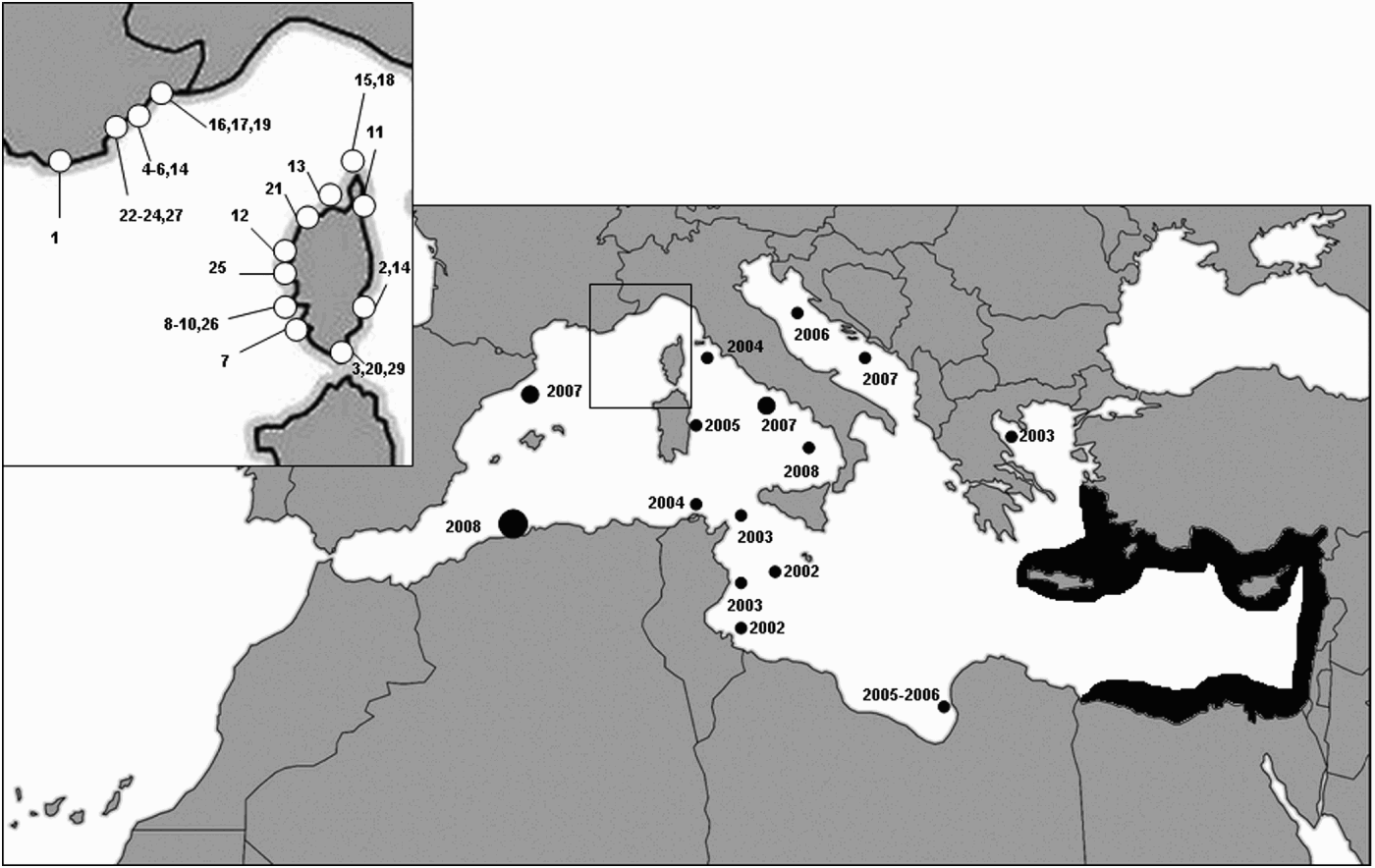
Location map of the records of Fistularia commersonii along the French coast. Numbers (inset map) denote records described in Table 1. Years indicate the spreading of the species within the Mediterranean Sea (modified from Kara & Oudjane, Reference Kara and Oudjane2009). The black portion denotes the areas where the species is frequently observed (DAISIE, 2008). Circle sizes correspond to the number of individuals caught (small, from 1 to 5 individuals; medium, 12–15 individuals; large, more than 100 individuals).
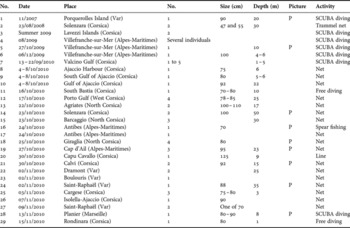
Chronological observations of Fistularia commersonii along the French Mediterranean coast.

P, picture available; Size, standard length, cm.
The first observation of F. commersonii along the French Mediterranean coast was made in November 2007 in the waters of Porquerolles Island (Var, France) (No. 1; Table 1; Figure 1). The species was clearly identified from an underwater picture of a large individual (P. Francour, unpublished data). In August 2008, two individuals were captured in the north-eastern part of Corsica (Miniconi, Reference Miniconi2010). These individuals, measuring 47 and 55 cm total length (TL), were caught at 30 m depth by a trammel net (No. 2; Table 1). Following these initial observations, an information campaign was launched by the ECOMERS Laboratory using fact sheets that were published in magazines and on several websites. Through this campaign, underwater observations of individuals were reported during the summer of 2009 in the south of Corsica (No. 3) and in the Bay of Villefranche-sur-Mer (Alpes-Maritimes) (No. 4). In October and December 2009, the species was again observed by SCUBA divers in the same place (Nos 5 & 6).
In September 2010 and mainly between October and November 2010, F. commersonii was repeatedly recorded in Corsica (Nos 7–15, 18, 20–21, 25–26, 29) and in Alpes-Maritimes and Var (Nos 16–17, 19, 22–24, 27; Table 1; Figure 2). A single individual was reported from the Bouches-du-Rhône, close to Marseilles (No. 28; Table 1). One to four individuals were fished in each case. The sizes of the specimens ranged from 70 cm to around 1 m in length (SL). Most of the individuals were fished by professional fishermen using trammel nets, while three individuals (Nos 11, 16 & 28) were either observed by free divers or caught by spear-fishing. All the fishermen confirmed that they have never fished this species before. In less than one month (16 October to 15 November 2010), it has become widely fished in Corsica, Alpes-Maritimes, and Var (Nos 11–29, Table 1).
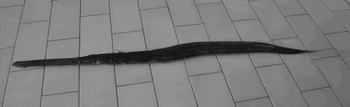
Fistularia commersonii (1 m TL; 88 cm SL; No. 24 in Table 1) caught in Saint-Raphaël (Var, France) in November 2010. (Photograph: M. Piboule.)

Interestingly, the presence of the species along the French coast during the first two years of sightings was reported only through in situ observations, except for one catch by trammel net, while most of the recorded observations in 2010 came from professional fishing. In the latter, the catches were made each time on rocky areas between 5 and 50 m depth. No catch was recorded on sandy areas, even if the species was observed on sandy-muddy bottoms and Posidonia oceanica meadows in the eastern Mediterranean (Bilecenoglu et al., Reference Bilecenoglu, Taskavak and Bogac Kunt2002; Kalogirou et al., Reference Kalogirou, Corsini, Kondilatos and Wennhage2007). As fishermen's habits did not change from one year to another, the high number of catches at the end of 2010 could correspond to a true increase in abundance of F. commersonii along the French coast. Moreover, the presence of this species could not have been previously missed due to its conspicuous shape and size: F. commersonii can be distinguished from all other Mediterranean fish by its size (up to 1.5 m TL; Froese & Pauly, Reference Froese and Pauly2010), and its very long tubular snout, extremely elongated body shape and whiplike filamented caudal middle rays. It can also be distinguished from F. petimba by the absence of body plates on the back and its colour pattern (Fritzsche, Reference Fritzsche1976).
Most of the individuals caught or observed in France were around 1 m in length (SL), i.e. considered to be adult individuals (Golani, Reference Golani2000). In addition, the different records from the French coasts occurred only in autumn and winter, as also observed by Occhipinti-Ambrogi & Galil (Reference Occhipinti-Ambrogi and Galil2008) in Italian waters. One specimen, measuring about 93 cm in length (SL), was caught by a trawl net in the coastal waters off San Remo (western Ligurian Sea, Italy; 43°48′47″N 007°51′16″E) on 30 October 2007 (Garibaldi & Orsi Relini, Reference Garibaldi and Orsi Relini2008). Meanwhile, a school of F. commersonii, composed of approximately 15–20 individuals which were about 30–40 cm long, was sighted near Savona (Italy) along the north-western coast of the Ligurian Sea (43°59′15″N 8°9′43″E) on 30 August 2008 (Occhipinti-Ambrogi & Galil, Reference Occhipinti-Ambrogi and Galil2008). These records correspond respectively to the underwater sighting of a large individual (~90 cm) in November 2007 in Porquerolles (No. 1) and to the two small individuals (47 and 55 cm) fished along the east coast of Corsica in August 2008 (No. 2; Table 1). It confirms the prediction of Garibaldi & Orsi Relini (Reference Garibaldi and Orsi Relini2008) that F. commersonii may start to appear along the French and Spanish coasts by October 2008. Even without information from the Italian waters in 2009 or 2010, we hypothesize that the first observations of Fistularia commersonii in 2007 and 2008 (Nos 1–2; Table 1) could correspond to unsuccessful attempts of colonization in the north-western Mediterranean by fast swimming adults (2007, Italy and France) and then by sub-adults (2008, Italy and France) while its reappearance in 2010 (Nos 7–28) is the result of a second invasion event, this time possibly indicating the start of a successful establishment given the high frequency of occurrence in the fisheries catch. These establishment stages are similar to that suggested by Golani (Reference Golani, Golani and Appelbaum-Golani2010) for the invasion of Etrumeus teres.
What could have instigated the possible establishment of F. commersonii in the French coasts? Occhipinti-Ambrogi & Galil (Reference Occhipinti-Ambrogi and Galil2008) proposed that ‘the small school of young F. commersonii sighted off the Savona coast arrived with the prevailing currents from the established populations along the Latium and Tuscany coasts’ and suggested that F. commersonii is able to reproduce successfully in the Tyrrhenian Sea. Golani et al. (Reference Golani, Azzurro, Corsini-Foka, Andaloro and Bernardi2007) also inferred that a few individuals of F. commersonii invaded the Mediterranean Sea, and an expansion followed through larval dispersal. However, the parasitological findings of Pais et al. (Reference Pais, Merella, Follesa and Garippa2007) do not fit well with the above-mentioned hypothesis. Consequently, Merella et al. (Reference Merella, Casu, Garippa and Pais2010) questioned this bottleneck hypothesis. The symmetry of Italian and French records, at least in 2007 and 2008, reinforces the hypothesis of successful reproduction in the Tyrrhenian Sea and, consequently, the successful arrival of numerous adults along the French coast in 2010.
In conclusion, an increase in the number of lessepsian fish species arriving in the western Mediterranean is expected to continue in the future. This is because the rate of lessepsian fish species entering the eastern Mediterranean is still increasing with time (Belmaker et al., Reference Belmaker, Brokovich, China, Golani, Mouillot, Golani and Appelbaum-Golani2010). Furthermore, modifications in the main current circulation experienced by the Mediterranean during the last few decades could deeply modify the water exchange between the western and eastern basins (Lascaratos et al., Reference Lascaratos, Roether, Nittis and Klein1999), and some models have shown the possibility of an additional surface salt content in many regions of the western basin (Gasparini et al., Reference Gasparini, Ortona, Budillon, Astraldi and Sansone2005). These new oceanographic conditions, coupled with the present warming of the western basin (Francour et al., Reference Francour, Boudouresque, Harmelin, Harmelin-Vivien and Quignard1994; Bianchi, Reference Bianchi2007), could facilitate the spreading of lessepsian species towards the western basin. The most recent records of F. commersonii (this study) and Siganus luridus (Daniel et al., Reference Daniel, Piro, Charbonnel, Francour and Letourneur2009) in the north-western Mediterranean could then be the hint of future extensive spreading of lessepsian species in the western basin, as hypothesized by Francour et al. (Reference Francour, Mangialajo, Pastor, Golani and Appelbaum-Golani2010).
ACKNOWLEDGEMENTS
We wish to thank all the people who gave us information about the different Fistularia commersonii observations and catches in France, especially: Jean-Marie Dominici (Natural Reserve of Scandola, Corsica), Jean-Michel Culioli (Marine Park of Bonifacio Strait, Corsica), Pierre Gilles (Oceanographic Museum of Monaco), Christian Decugis, Eric Charbonnel (Côte Bleue Marine Park), Christophe Bruchez, and Michel Piboule for his work concerning one of the specimens caught in Saint-Raphaël.