Natural disasters have been exponentially increasing in frequency during recent decades, causing significant socioeconomic impact. Reference Harrison and Williams1,2 According to a World Bank report, approximately 790 million individuals around the world are exposed to 2 or more natural hazards. Reference Dilley, Chen and Deichmann3 Tsunamis, catastrophic tidal waves caused by the displacement of a massive volume of water, resulted in the highest number of fatalities in 1994-2013 and are 20 times more lethal than earthquakes. Reference Dilley, Chen and Deichmann3,Reference Bronfman, Cisternas and Repetto4 Rather than isolated, transitory events, natural disasters have ongoing cycles of impact extending over a long period of time and are known to recur. Reference Harrison and Williams1,Reference de Ruiter, Couasnon and van den Homberg5 Therefore, it is critical to learn from the past disasters and their lingering psychological effects.
On December 26, 2004, the third-largest tsunami in recorded history slammed into the coastlines of Sri Lanka, Thailand, and Indonesia. It was caused by a sudden, unexpected undersea earthquake of magnitude 9.15 spanning from a 900-mile fault between the Burma Plate and the Indian Plate. The tsunami waves resulted in 280,000 deaths and 125,000 injuries across South Asia, Southeast Asia, and East Africa. Reference Chastel6,Reference Morrow and Llewellyn7 Sri Lanka was among the most severely affected countries by the disaster. The waves devastated 900 miles of its shores and penetrated up to 1.25 miles inland, resulting in over 31,000 deaths and 500,000 displacements in the small island that has a total population of 19 million. Reference Nishikiori, Abe and Costa8
As a result of the collective loss, the Indian Ocean Tsunami brought significant short- and long-term psychological effects, including bereavement, grief, fear, suicidal ideation, and alcohol misuse. Reference Danvers, Sivayokan and Somasundaram9 Previously, we conducted a cross-sectional survey 6 mo after the disaster to assess the psychological and physical health of affected adults from contiguous coastal districts impacted by the tsunami, revealing a posttraumatic stress disorder (PTSD) prevalence of 56% and a depression prevalence of 68.9%. Reference Ranasinghe and Levy10 Studies reported 14-39% of children in severely affected Sri Lankan coastal communities suffered from tsunami-related PTSD 1 mo posttsunami, and 19.9% and 37.8% of mothers in tsunami-inflicted families reported PTSD and depressive symptoms, respectively, 4 mo after the tsunami. Reference Neuner, Schauer and Catani11,Reference Wickrama and Wickrama12 National prevalence of PTSD in the Sri Lankan general population is not reported in the literature; however, the prevalence of major depression in Sri Lanka was at 4.1% and estimated global prevalence at 4.4% in 2017. 13,14 A series of follow-up studies conducted in Thailand reported decreasing prevalence of PTSD among children from 57.3% at 6 wk to 2.7% at 5 y after the tsunami. Reference Piyasil, Ketumarn and Prubrukarn15
Long-lasting, severe mental health outcomes may persist especially from high degrees of exposure to a traumatic event that is unexpected or involves death or injury, threat to life, and property loss. Reference Harville, Jacobs and Boynton-Jarrett16,Reference Norris, Friedman and Watson17 Previous studies after the 9/11 attack in the United States (US) reported that PTSD prevalence in affected populations steadily declined with time, but was still at 4.1% even 5 y after the event, when the US average prevalence of PTSD was 3.6%. Reference Neria, Olfson and Gameroff18,19 Similar studies after Hurricane Katrina reported a reduced but still high psychological burden 12 y after the disaster, with 1 in 6 reporting posttraumatic symptoms and 1 in 5 reporting persistent psychological distress. Reference Raker, Lowe and Arcaya20 In a longitudinal study in the Netherlands, severe PTSD symptoms persisted in 16.7% of the participants who were affected by an explosion of a firework storage building even after 10 y. Reference van der Velden, Wong and Boshuizen21 After the Great East Japan Earthquake and the collapse of the Fukushima-Daiichi Nuclear Power Plant, the surrounding communities suffered from posttraumatic stress reactions with the prevalence of 14.1-24.9% within 1 y and 15-18.1% within 3 y, Reference Katayanagi, Seto and Nakaya22–Reference Oe, Fujii and Maeda26 and this coupled with weakened community responses went on to cause chronic physical diseases, anxiety, and increases in disaster-related suicide in Fukushima in the long-term. Reference Ando, Kuwabara and Araki24,Reference Maeda and Oe27,Reference Takebayashi, Hoshino and Kunii28
In our previous study of the population affected from the Indian Ocean Tsunami and living in temporary shelter, we found that female gender and causal belief patterns are associated with development of PTSD 6 mo posttsunami. Reference Ranasinghe and Levy10,Reference Levy, Slade and Ranasinghe29 In addition, persistent psychological reactions after traumatic events can be associated with older age, poor subjective health, and comorbid depression. Reference Armenta and Rush30,Reference Roberts, Ocaka and Browne31 Psychosocial factors such as unemployment, gender, and education are associated with PTSD, depression, and their co-occurrence posttrauma. Reference Farhood, Fares and Sabbagh32 Individual traits of resilience and higher level of social support are associated with lower rates of depression and stress. Reference Kim, Kim and Shin33,Reference Southwick, Vythilingam and Charney34 Posttraumatic symptoms have been reported to lead to decreased quality of life and elevated suicide risk. Reference Johansen, Wahl and Eilertsen35,Reference Krysinska and Lester36 To our knowledge, the long-term outcomes of the Indian Ocean Tsunami in the Sri Lankan population have not yet been documented in the literature.
The objective of this study is to investigate the prevalence of PTSD and depression 8 y after the tsunami and explore factors that are associated with PTSD and depression among adults living in 5 severely affected coastal districts in Sri Lanka.
Methods
Study Design and Population
The study was conducted in 2012-2013, a total of 8 y after the 2004 Indian Ocean Tsunami. The study population was from the more populous west coastal districts of the island of Sri Lanka: Hambanthota, Matara, Galle, Kalutara, and Colombo. Sri Lanka has a long-established universal health-care system with a comprehensive public health network, whose official data were used to identify affected communities for the survey. Houses were chosen based on accessibility to the survey team. One adult (>16 y) who volunteered to participate from each house was recruited for the study. People who had any kind of self-disclosed cognitive inability or who could not read or understand the local languages were excluded.
Data Collection
After a pilot study, a structured survey was developed for data collection. The questionnaire was translated from English to the local language Sinhala, followed by blind back translation and open comparison between English and Sinhala versions. The survey procedure was supervised by the principal investigator, who has native proficiency in Sinhala, and was administered by trained local medical graduates in teams of 2. Written consent of the participants was obtained before the interview. Approvals from Johns Hopkins School of Medicine Institutional Review Board and University of Colombo Ethical Review Committee were obtained.
Demographic information and other covariates were collected including age, gender, marital status, education level, ethnicity, religion, subjective physical and psychological health, resilience, and social support. Subjective health was evaluated by asking the subjects to rate their physical and psychological health both before and after the tsunami, from 1 (poor) to 5 (excellent). Change of subjective health was defined as the subjective health score after the tsunami minus that before the tsunami. Resilience was evaluated with the Connor-Davidson Resilience Scale (CD-RISC), a 25-item scoring scale ranging from 0 to 100 with a higher score indicating higher resilience. Reference Connor and Davidson37 Social support was assessed through the 7-item version of the MOS Social Support Survey, which gives a final numerical value with a maximum score of 35 with higher score indicating higher social support. Reference Sherbourne and Stewart38
Exposure to the tsunami was evaluated with 15 tsunami-related events including: (1) serious injury or threat to one’s own life; (2) death of family member; (3) serious injury or threat to family member’s life; (4) death of close person; (5) serious injury or threat to close person’s life; (6) death of person not close to oneself; (7) serious injury or threat to other’s life; (8) destruction of family house or property; (9) destruction of other’s homes or property; (10) damage to other’s homes or property; (11) damage to private property; (12) damage to public property; (13) minor injury; (14) contact with tsunami water; (15) fear of death. Direct exposure (DE) was defined as experience of at least 1 event among (1), (2), (3), (4), (5), (8), (13), (14); the rest were classified as indirect or nonexposure (INE). Reference Heir, Rosendal and Bergh-Johannesson39 Previous trauma exposure other than the tsunami was collected through the Trauma History Screen, a validated 14-item self-reported tool that inquires 13 types of traumatic event and 1 “other” category. Reference Carlson, Smith and Palmieri40
Psychological assessments used in the study were the same as the previous study that was conducted 6 mo after the tsunami in Sri Lanka. Reference Ranasinghe and Levy10,Reference Levy, Slade and Ranasinghe29 Briefly, PTSD was assessed by means of the PTSD Symptom Scale-Interview version (PSS-I). Reference Foa, Riggs and Dancu41 Full-criteria PTSD was diagnosed according to DSM-IV (Diagnostic and Statistical Manual of Mental Disorders), which was the presence of 1 or more reexperience symptoms, 3 or more avoidance symptoms, and 2 or more hyperarousal symptoms. Reference Foa and Tolin42,Reference Pai, Suris and North43 Partial PTSD was defined when 1 or more symptoms were present in each of the 3 symptom groups. Reference Stein, Walker and Hazen44 Depression was evaluated through the Center for Epidemiological Studies-Depression (CES-D) scale, which is a 20-item scale based on self-reported symptoms. Reference Carleton, Thibodeau and Teale45,Reference Thomas, Jones and Scarinci46 The cutoff used to identify individuals with depression was 16, additionally raw scores were used to gauge the severity of depression.
Statistical Analysis
Basic demographic information was presented by exposure status as the mean and standard deviation (SD) for continuous variables and the percentage for categorical variables. DE and INE groups were compared with the unpaired t-test for continuous variables and Pearson’s chi-squared test for categorical variables. After initial bivariate analyses to calculate crude odds ratios, multiple logistic regression was used to identify associated factors for partial PTSD and depression. Partial PTSD was selected as the outcome variable due to the low number of subjects fulfilling the criteria for full PTSD. From the full model including exposure to the tsunami, age, gender, marital status, number of children, education, frequency of religious activity, subjective physical health status before and after the tsunami, social support, resilience, number of other trauma exposure, and diagnosis of either depression or partial PTSD, backward selection was used to derive the best predictors for the final regression model. Multiple linear regression with backward selection was used with CES-D scores to assess factors associated with the severity of depression. Eight subjects with predominantly missing data were excluded from multiple regression models after confirming that there was no significant difference in all variables between total and included participants. In all analyses, a 2-tailed P-value of < 0.05 was considered significant. Statistical analyses were performed with R version 4.0.2 (R Core Team, Vienna, Austria).
Results
Baseline Characteristics of the Study Population
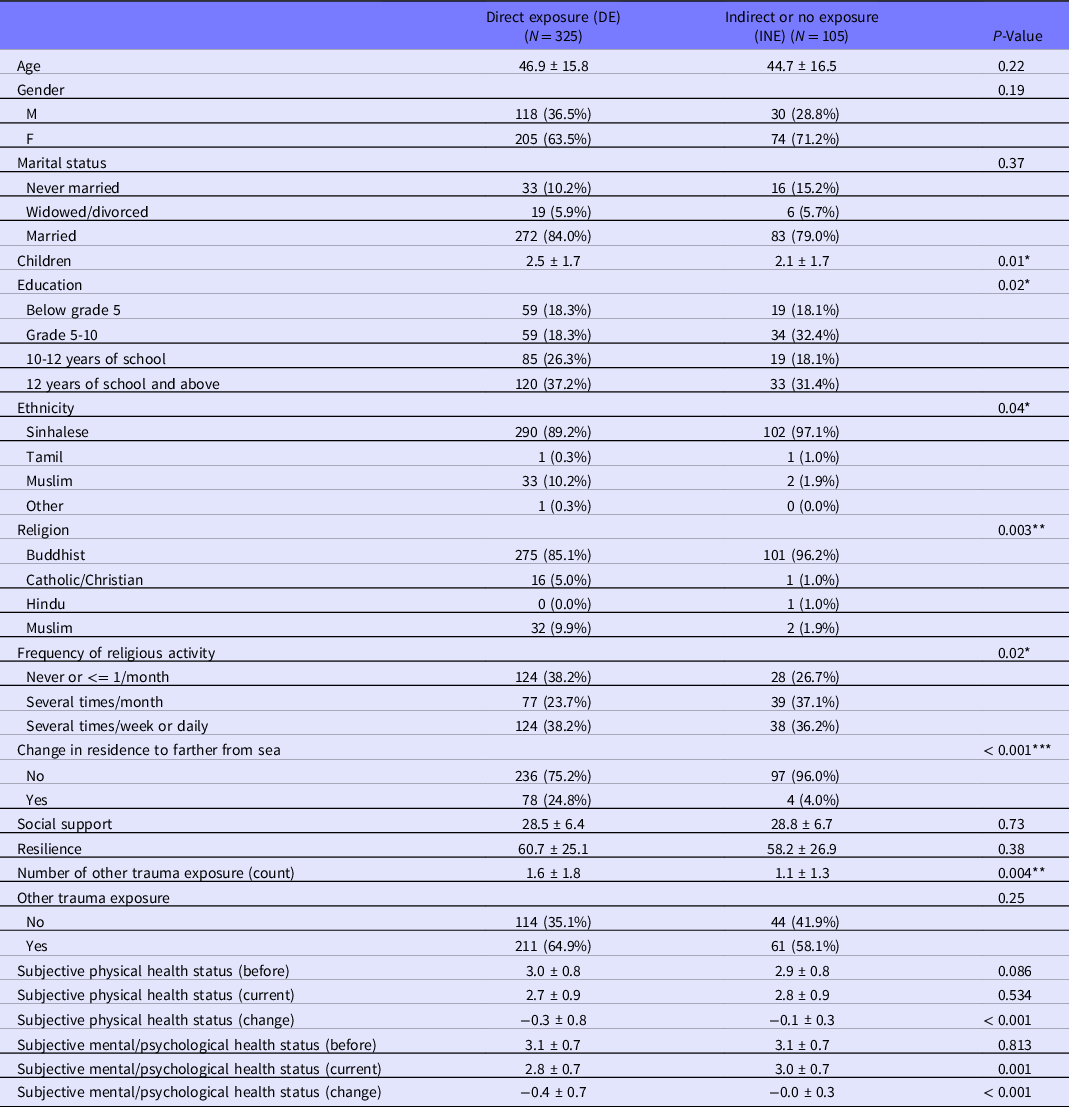
The study population consists of 430 (325 in DE, and 105 in INE) adults over 16 y of age. The demographic and clinical characteristics of the study population are shown in Table 1. There were no significant differences in age, gender, and marital status: mean age was 46.9 y among DE, and 44.7 y among INE; 63.5% and 71.2% of the DE and INE groups were female, respectively. The majority of participants were married: 84.0% of the DE and 79.0% of the INE. One-quarter of (24.8%) of the DE individuals reported a change in residence to farther from the sea after the tsunami, which was significantly higher than the 4.0% among INE individuals (P < 0.001). Social support and resilience scores were similar in both groups, with no significant difference. Mean social support scores were 28.5 in the DE and 28.8 in the INE; mean resilience scores were 60.7 in the DE and 58.2 in the INE. Both DE and INE groups, had negative average change in subjective physical and psychological health status. However, DE individuals experienced a significantly worse decline in both subjective physical and psychological health: the average change in physical health was −0.3 in DE compared with −0.1 in the INE (P = 0.001), and the average change in psychological health was −0.4 among DE compared with −0.0 among INE (P < 0.001).
Characteristics of participants according to exposure status

Note: Data are presented as N (%) for categorical variables; mean ± SD for continuous variables.
* P < 0.05; ** P < 0.01; *** P < 0.001.
Psychological and Physical Health Outcomes Among DE Individuals and INE Individuals
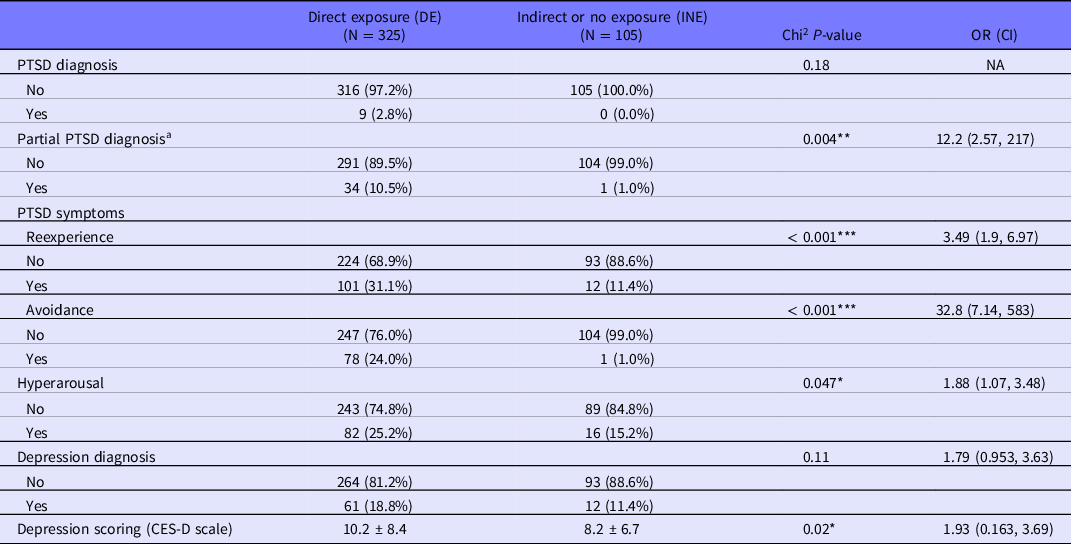
Psychological outcomes and subjective health among DE and INE individuals were compared (Table 2). Only 9 (2.8%) participants in the DE group met the criteria for PTSD, while there were none in the INE group (P = 0.18). The DE participants had a significantly higher prevalence of partial PTSD compared with the INE (10.5% vs 1.0%; P = 0.004). Regarding specific symptom categories, DE individuals were significantly more likely to suffer reexperience (31.1% vs 11.4%; P < 0.001), avoidance (24.0% vs 1.0%; P < 0.001), and hyperarousal (25.2% vs 15.2%; P = 0.047) symptoms compared with INE individuals. According to the survey, the top 3 symptoms of PTSD were having recurrent or intrusive distressing thoughts or recollections about the tsunami, being overly alert, and having irritability or angry outbursts. DE individuals had a higher prevalence of depression, with 61 (18.8%) compared with INE 12 (11.4%) (P = 0.11). DE participants also had significantly higher mean CES-D scores (10.2 vs 8.2; P = 0.02). The top 3 symptoms for depression were feeling depressed, feeling sad, and feeling that everything one did was an effort.
Association with tsunami exposure and physical/psychological health outcomes

a Partial PTSD: at least 1 symptom from all categories (reexperience, avoidance, arousal).
Note: Data are presented as N (%) for categorical variables; mean ± SD for continuous variables.
* P < .05; ** P < .01; *** P < .001.
Factors Associated With Partial PTSD
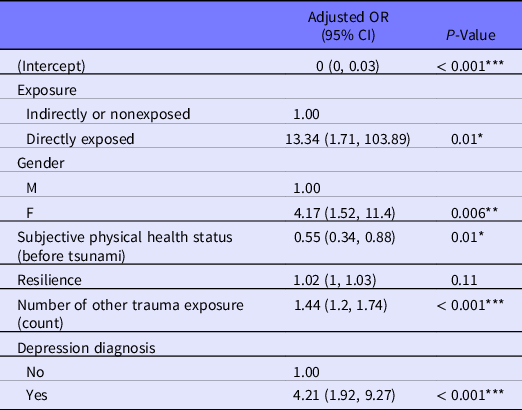
According to the best predictor model (Table 3), direct tsunami exposure was significantly associated with the diagnosis of partial PTSD (odds ratio [OR], 13.34; 95% confidence interval [CI], 1.71-103.89; P = 0.01). Additionally, females were more likely to develop partial PTSD adjusting for other variables (OR, 4.17; 95% CI, 1.52-11.4; P = 0.006). Better subjective physical health status before the tsunami was negatively associated with partial PTSD (OR, 0.55; 95% CI, 0.34-0.88; P = 0.01). With every additional trauma experience apart from the tsunami, subjects were more likely to develop partial PTSD (OR, 1.44; 95% CI, 1.20-1.74; P < 0.001). Diagnosis of depression was a significant predictor for partial PTSD compared with subjects without depression (OR, 4.21; 95% CI, 1.92-9.27; P < 0.001). In binary unadjusted analysis, individuals who reported as widowed or divorced had a higher rate of partial PTSD compared with being never married (OR, 4.84; 95% CI, 1.15-24.9; P = 0.04). Individuals engaging in religious activities more than several times weekly were more likely to meet criteria for partial PTSD compared with subjects engaging less often in religious activities, with a frequency fewer than once a month (OR, 4.49; 95% CI, 1.65-15.70; P = 0.007; Supplementary Table 1). Of note, although the number of subjects with full PTSD was low, diagnosis of full PTSD had significant associations with direct exposure to tsunami, physical health status before the tsunami, number of other trauma exposure, and depression. Although individuals with full PTSD had a slightly lower average score of resilience compared with those without PTSD (56.7 vs 60.1; P = 0.686), resilience was not significantly associated with full or partial PTSD in either unadjusted or adjusted regression analysis.
Associated factors for partial PTSD, best predictor model

Note: The full model controlled for direct exposure to the tsunami, age, gender, marital status, number of children, education, frequency of religious activity, subjective physical health status before and after the tsunami, social support, resilience, number of other trauma exposure, and depression. Backward selection was used to derive the best predictors.
* P < .05; ** P < .01; *** P < .001.
Factors Associated With Depression
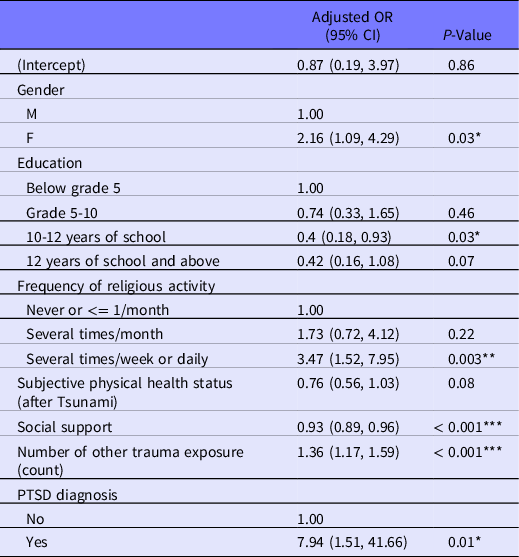
According to the best predictor model (Table 4), female gender was associated with depression (OR, 2.16; 95% CI, 1.09-4.29; P = 0.03). Individuals with higher education levels were less likely to have depression; participants with 10-12 y of education had a lower rate compared with less than 5 y of education (OR, 0.4; 95% CI, 0.18-0.93; P = 0.03). Individuals who attended religious activities more than several times weekly were more likely to have depression compared with those who engaged in religious activities less than once a month (OR, 3.47; 95% CI, 1.52-7.95; P = 0.003). Better subjective physical health after the tsunami was negatively associated with depression, but the association was not significant (P = 0.08). Higher social support score was significantly associated with lower odds of depression (OR, 0.93; 95% CI, 0.89-0.96; P < 0.001). Every additional trauma experience apart from the tsunami led to higher odds of depression (OR, 1.36; 95% CI, 1.17-1.59; P < 0.001). As with the case of depression with partial PTSD, PTSD diagnosis was found to be highly associated with depression (OR, 7.94; 95% CI, 1.51-41.66; P = 0.01). Individuals with depression had lower resilience scores on average (58.0 vs 60.5; P = 0.441), but resilience was not significantly associated with depression in unadjusted and adjusted analyses. Similar associations were identified using the linear depression score as the outcome in the regression model (Supplementary Table 2).
Associated factors for depression, best predictor model

Note: The full model controlled for direct exposure to the tsunami, age, gender, marital status, number of children, education, frequency of religious activity, subjective physical health status before and after the tsunami, social support, resilience, number of other trauma exposure, and PTSD. Backward selection was employed to derive the best predictors.
* P < .05; ** P < .01; *** P < .001.
Limitations
The current study is among the few studies investigating the long-term effects of natural disasters and is the first to investigate the long-term psychological consequences of the Indian Ocean tsunami in a population in Sri Lanka. However, this study has limitations. First, the study population was sampled through convenience sampling in the regions severely struck by the 2004 tsunami. Although areas were sampled randomly, houses were selected based on accessibility to the team. Then, individuals who volunteered to participate from each house were recruited. This sampling method may have introduced selection bias toward those who were more responsive to recruitment. However, this study attempted to mitigate this effect by choosing regions randomly from a large pool of participants. Second, psychological and physical health variables were evaluated with self-reported tools, as opposed to a physician evaluation. Third, cultural and situational factors may have influenced their decision to participate, responses, and the threshold of self-evaluations. Survey fatigue may have affected their responses and nonresponses as well. A pilot study was conducted before the main survey to mitigate some of those factors. Last, this investigation was, by design, a cross-sectional study, and we did not have data on PTSD and depression symptoms preceding the tsunami; therefore, the longitudinal effects could not be assessed. Although the study team performed a similar survey in 2006, Reference Ranasinghe and Levy10 the previous study population consisted of individuals directly affected by the tsunami and living in temporary shelters, while the present study, instead of being a follow-up study on the same individuals, re-sampled individuals in the same regions. Therefore, the 2 study populations are not directly comparable. Due to this cross-sectional design, this study was able to evaluate the association of PTSD and depression with covariates but was not able to evaluate risk or causal associations.
Discussion
This study aimed to analyze the psychological consequences 8 y after the Indian Ocean Tsunami, a massive disaster that devastated the coasts of Sri Lanka, and other countries in Asia and Africa. In the present study, investigating 5 communities in the Sri Lankan coasts impacted by the tsunami, the prevalence of PTSD, partial PTSD, and depression were 2.8%, 10.5%, and 18.8%, respectively, among directly exposed individuals 8 y after the event.
This is a major decrease from our 2006 study on the people from same costal districts and living in temporary shelters in Sri Lanka, which found that the prevalence of PTSD and depression in 6 mo post-tsunami was 56% and 69%, respectively. Reference Ranasinghe and Levy10 Likewise, previous studies have reported decreasing PTSD prevalence with time after major national trauma. Reference Neria, Olfson and Gameroff18,Reference Silver, Holman and McIntosh47 Studies have highlighted the resilient nature of the human psyche that enables the majority of individuals to recover without chronic psychological repercussions, which was in line with the higher resilience score observed among non PTSD subjects. Reference Goldmann and Galea48,Reference Norris, Tracy and Galea49 It has been reported that resilience factors and social bonds can help individuals to cope in the wake of trauma and, thus, protect individuals against longstanding PTSD. Reference Norris, Stevens and Pfefferbaum50,Reference Charuvastra and Cloitre51 However, we identified that 1 in 10 exposed individuals met the criteria for partial PTSD. The literature underscores the importance of subsyndromal PTSD over a relatively low full PTSD prevalence, which brings forward a need for psychological screening and assistance in individuals without a diagnostic label. Reference Pietrzak, Schechter and Bromet52
Even though the baseline comparison group was the INE population from the same area, their depression prevalence was higher than the Sri Lankan national prevalence of 4.1%. 13 This could be attributed to secondary trauma from the community, the high occurrence of internal displacement, and conflict in the Sri Lankan coastal communities, which are known to have significant impact on long-term psychiatric consequences. Reference Kessler, McLaughlin and Koenen53
In comparing DE and INE individuals with the tsunami, direct exposure to the tsunami was still significantly associated with post-traumatic stress symptoms. Exposed individuals were more likely to report a worse change in subjective psychological and physical health post-tsunami. Individuals exposed to the tsunami had a 6.2 times higher proportion of having relocated farther from the sea. This could be a result of multiple reasons, such as, social and/or financial decision due to property loss, an external regulatory requirement, and presence of higher rate avoidance symptoms of PTSD, which 25.6% of DE individuals but only 3.5% of INE individuals.
This study identified direct exposure to the tsunami, gender, marital status, frequency of religious activity, subjective physical health status before the tsunami, resilience, number of other trauma exposure, and depression as factors associated with partial PTSD. The result was consistent with findings from previous studies, in which female gender and depression were associated with PTSD. Reference Vishnevsky, Cann and Calhoun54,Reference Tolin and Foa55 A high frequency of religious activities was correlated with partial PTSD in binary analysis, although religion and subjective religiosity were not significantly associated with partial or full PTSD diagnosis. The cross-sectional nature of this study precludes determination of directionality of this association. Our finding is consistent with previously published literature that has demonstrated that religiosity can play a protective role in psychological health, and that significant changes may occur in religious participation after traumatic events, especially those with PTSD. Reference Leo, Izadikhah and Fein56,Reference Park, Smith and Lee57 Therefore, people with lingering traumatic symptoms may have been more inclined to engage in religious activities as a coping mechanism. On the other hand, high religiosity may have been a risk factor for the development of PTSD, as shown by previous studies suggesting the mediating role of religiosity on post-traumatic symptoms. Reference Wortmann, Park and Edmondson58,Reference Sakat and Schiff59
Factors associated with depression were similar to those associated with PTSD. Additionally, for depression, our finding suggests that there may be positive effects of higher education level and social support, which was consistent with the previously published literature. Reference Shih, Cheng and Chang60–Reference Weiss, Francis and Senf62 Direct exposure to the tsunami was not significantly associated with depression, although a trend increase was seen among the DE group, which could indicate events or exposures other than the tsunami may have contributed to the high prevalence of depression (18.8% among DE and 11.4% among INE). PTSD and depression were associated with each other, in accordance with the consensus that PTSD and depression can co-occur and show overlapping symptoms. Reference Gros, Price and Magruder63,Reference Flory and Yehuda64 Furthermore, better subjective physical health was negatively associated with both PTSD and depression. Previous studies have also established the link between psychiatric conditions and disruptions in physical health. Reference McFarlane65,Reference Stubbs, Vancampfort and Veronese66 This connection suggests that physical and psychological health should be targeted comprehensively in public health interventions after traumatic events.
Given the long-lasting effect of PTSD and depression after natural disasters, interventions to improve psychological health are important. Since the founding of disaster mental health in 1992, it has become clear that reliance only upon traditional mental health may not be enough in the wake of large-scale disasters. Access to trained professional mental health providers is limited, especially following a disaster. Reference Wickramasinghe, Widanapathirana and Vijayabandara67 A recommendation from the Johns Hopkins Center for Public Health Preparedness has included the training of local indigenous human resources to provide “micro-counseling” and crisis-oriented psychological intervention, such as psychological first aid, to enhance community resilience. Reference Everly and Lating68,Reference McCabe, Semon and Thompson69 Consonant with this recommendation, the United Nations has recommended a “whole society” approach to the psychological health consequences of disaster. 70 Civilian paraprofessionals, educators, faith-based leaders, and emergency services personnel have been successfully trained to deliver brief counseling and psychological crisis intervention services since the 1960s. Reference McCabe, Semon and Thompson69,Reference Durlak71,Reference Jain72 Innovative peer support programs also are shown to be important in this context. Reference Castellano73 Given extant evidence as to the existence of a lingering and adverse psychological impact after disasters, such as the tsunami described herein, there exists sufficient rationale to take under consideration the training of local community members as a way of expanding access to psychological support in the wake of disasters. It is important to implement short-term and long-term evaluations and psychological support for affected population. Additionally, it is critical to recognize population at risk for long-term sequelae to assist them in their recovery.
The Indian Ocean Tsunami of 2004 provides insight into how a massive natural disaster affects the population in the short and long term. Further studies can be done to evaluate the impact of the tsunami beyond 8 y. Additional studies should also focus on assessment of risk factors, causal associations, and effectiveness of interventions. The prevalence and associated factors that were delineated for posttraumatic symptoms and depression could be applied to the plethora of natural disasters occurring every year.
Conclusions
This is a cross-sectional survey study conducted in 5 affected districts of Sri Lanka to evaluate the long-term psychological effect after the 2004 Indian Ocean Tsunami. Among 430 participants, 325 fulfilled the criteria of direct exposure to the tsunami and 105 were indirectly or not exposed. The prevalence of PTSD, partial PTSD, and depression were 2.8%, 10.5%, and 18.8% among the DE and 0%, 1.0%, and 11.4% among the INE, respectively. Direct exposure to the tsunami, female gender, other trauma exposure, and depression were associated with partial PTSD, while better previous physical health was protective. Female gender, high frequency of religious activities, other trauma exposure, and PTSD were associated with depression, while education and social support were negatively associated. Although the prevalence of PTSD and depression appeared to be down trending, there were still psychological repercussions 8 y after the tsunami. In the future, large-scale cohort studies in trauma-inflicted populations should be considered to evaluate long-term psychological outcomes, risk factors associated with adverse outcomes and more importantly effectiveness of interventions.
Supplementary material
To view supplementary material for this article, please visit https://doi.org/10.1017/dmp.2022.73
Acknowledgments
The authors thank the participants and postgraduate medical students for their assistance in data collection.
Declaration of Conflicting Interests
The authors certify that they have no affiliations with any organization or entity with any financial or nonfinancial interest in this research that could be construed as a potential conflict of interest.