Introduction
Since the World Health Organization (WHO) launched the Global Age-Friendly Cities project in 2006 (WHO 2007), there has been rapidly growing interest in the concept of age-friendliness on the part of policy makers world-wide. For example, the Global Age-Friendly Cities and Communities Network created in 2010 by the WHO includes cities such as New York (United States of America), Manchester (United Kingdom), Brussels (Belgium), Akita (Japan) and Canberra (Australia) (WHO 2010). The Network includes just over 100 cities world-wide to date. Cities that participate in the Network formally commit to working towards becoming more age-friendly in order to enhance the quality of life of older adults. Moreover, states in several countries including Spain, Australia and Brazil have introduced age-friendly initiatives (Plouffe and Kalache Reference Plouffe and Kalache2011).
In Canada, not only have individual cities joined the WHO Age-Friendly Cities and Communities Network, but several provinces (British Columbia, Manitoba, Quebec, Nova Scotia, Newfoundland/Labrador) have launched age-friendly initiatives in order to encourage all communities in the province to become more age-friendly (Public Health Agency of Canada 2010). Nationally, the Canadian government, which was one of the drivers and funders behind the WHO Age-Friendly Cities project, is promoting age-friendliness as a policy solution to healthy ageing (Butler-Jones Reference Butler-Jones2010).
Although the notion of age-friendliness has become part of the policy agenda in many jurisdictions, there is to date a paucity of empirical research in this area. In this paper we address two objectives. First, we explore how age-friendly rural communities are in Manitoba, a mid-Western Canadian province; and second, we examine whether age-friendliness varies across community characteristics such as population size and a community's relative affluence. An understanding of how community characteristics relate to age-friendliness is important as it may identify communities that are disadvantaged in terms of age-friendliness, thereby potentially negatively impacting older adults' quality of life. From the perspective of public policy initiatives, identifying which types of communities tend to be less age-friendly may suggest opportunities for targeting supports or interventions, such as implementation of specific supports or services in certain communities.
What is an age-friendly community?
There is currently no universally accepted definition of what constitutes an ‘age-friendly’ community (Alley et al. Reference Alley, Liebig, Pynoos, Banerjee and Choi2007; Feldman and Oberlink Reference Feldman and Oberlink2003; Liddle et al. Reference Liddle, Scharf, Bartlam, Bernard and Sim2013; Lui et al. Reference Lui, Everingham, Warburton, Cuthill and Bartlett2009; Menec et al. Reference Menec, Means, Keating, Parkhurst and Eales2011; Novek and Menec Reference Novek and Menec2013; Smith, Lehning and Dunkle Reference Smith, Lehning and Dunkle2013; WHO 2007). Premises underlying the concept are that older adults are valued participants in society and that they may require a wide range of supports and services in order to remain independent and healthy and enjoy a high quality of life in old age. For example, Alley et al. define an age-friendly community as ‘a place where older people are actively involved, valued, and supported with infrastructure and services that effectively accommodate their needs’ (2007: 5). Similarly, the WHO defines age-friendliness in terms of a community where ‘policies, services, settings and structures support and enable people to age actively’ (2007: 5). Active ageing, in turn, is defined in terms of health, participation and security (WHO 2002).
Common to conceptualisations of age-friendliness is that features in both the physical and social environments need to be considered (Lui et al. Reference Lui, Everingham, Warburton, Cuthill and Bartlett2009; Smith, Lehning and Dunkle Reference Smith, Lehning and Dunkle2013). A comparison of six definitions that can be thought of as falling under the umbrella of age-friendliness shows many similarities in features identified (Lui et al. Reference Lui, Everingham, Warburton, Cuthill and Bartlett2009). For example, the notion of ‘livable’ communities by the American Association of Retired Persons describes six key components: land use; transport and mobility; housing; cooperation and communication; public education and involvement in community planning; and leadership. Similarly, the AdvantAge Initiative launched in the late 1990s defines an ‘elder-friendly’ community as one that: addresses basics needs (e.g. housing, safety, information about services); promotes social and civic engagement; optimises physical and mental health and wellbeing; and maximises independence for frail and disabled individuals (e.g. by providing accessible transportation, and supporting family and other care-givers) (Feldman and Oberlink Reference Feldman and Oberlink2003; Hanson and Emlet Reference Hanson and Emlet2006).
More recently, the WHO (2007; see also Plouffe and Kalache Reference Plouffe and Kalache2010) proposed that age-friendly domains include: outdoor spaces and buildings; housing; transportation; respect and inclusion; social participation; civic participation and employment; communication and information; and community supports and health services (WHO 2007). To identify specific features of an age-friendly community, focus groups were conducted in 33 cities around the world with older adults, informal care-givers of older adults and services providers. Findings were developed into a guide and checklist to help communities become more age-friendly (WHO 2007).
In Canada, a similar project was launched in parallel with the WHO one, with a focus on rural and remote communities, in recognition of the fact that a third of Canadian adults aged 65 or older live in rural areas (Dandy and Bollman Reference Dandy and Bollman2008). Using the same research protocol as in the WHO project, focus groups were conducted in ten rural or remote communities across Canada, with the findings subsequently developed into a guide to help rural and remote communities become more age-friendly (Federal, Provincial, Territorial Ministers Responsible for Seniors 2007). Both the WHO's Age-Friendly Cities guide (WHO 2007) and the Canadian Age-Friendly Rural and Remote Communities guide (Federal, Provincial, Territorial Ministers Responsible for Seniors 2007) provide extensive lists of specific features that can help to make a community age-friendly.
In sum, a variety of definitions of age-friendliness have been proposed. Importantly, all definitions are based on the premise that age-friendliness needs to be examined in a holistic way, with a variety of domains being critical in older adults' lives. Age-friendly domains identified fit well with, but also expand on, the broader literature on determinants of health (Evans and Stoddart Reference Evans and Stoddart1990), impacts of the socio-economic environment on peoples' health (e.g. Kawachi and Berkman Reference Kawachi and Berkman2003), as well as a rapidly growing literature on the impacts of the physical environment on health-related behaviour and health outcomes (e.g. Dannenberg et al. Reference Dannenberg, Jackson, Frumkin, Schieber, Pratt, Kochtitzky and Tilson2003; Sallis et al. Reference Sallis, Cervero, Ascher, Henderson, Kraft and Kerr2006). For instance, research has demonstrated relationships between features of the neighbourhood environment (e.g. mixed land use, walkability) and physical activity and obesity (for reviews, see Ding and Gebel Reference Ding and Gebel2012; Rosso, Auchincloss and Michael Reference Rosso, Auchincloss and Michael2011; Saelens and Handy Reference Saelens and Handy2008).
In this paper we conceptualise the present study within the framework recently proposed by Menec et al. (Reference Menec, Means, Keating, Parkhurst and Eales2011), which applies ecological theory to the notion of age-friendliness. Ecological theory is particularly useful in this context as it makes explicit the interconnectedness between the person and the environment in which she or he lives (e.g. Bronfenbrenner Reference Bronfenbrenner, Husen and Postlethwaite1994; Lawton and Nahemow Reference Lawton, Nahemow, Eisdorfer and Lawton1973). One key principle of ecological theory is that environmental influences vary in terms of their immediacy to individuals or groups, with some being relatively close (e.g. family and friends), whereas others are further removed (e.g. policies) (Bronfenbrenner Reference Bronfenbrenner, Husen and Postlethwaite1994; McLeroy et al. Reference McLeroy, Bibeau, Steckler and Glanz1988). Age-friendly features must therefore be considered within a larger context, such as the demographic make-up of a community or its location (e.g. urban or rural) (Menec et al. Reference Menec, Means, Keating, Parkhurst and Eales2011).
One of the objectives of the present study was, therefore, to examine community characteristics in relation to age-friendliness. One might expect that a number of characteristics would be important. For example, more affluent communities might be more age-friendly, as they may have the means to provide more opportunities for older adults than less affluent communities. Such socio-economic variation would be consistent with previous research suggesting that socio-economically deprived areas have fewer recreation-related resources and facilities than socio-economically more advantaged areas (Estabrooks, Lee and Gyurcsik Reference Estabrooks, Lee and Gyurcsik2003; Giles-Corti and Donovan Reference Giles-Corti and Donovan2002; Hillsdon et al. Reference Hillsdon, Panter, Foster and Jones2007; Powell et al. Reference Powell, Slater, Chaloupka and Harper2006). Having access to fewer resources may be one of the factors that explains why older adults living in socio-economically deprived areas are less healthy than their counterparts living in more socio-economically advantaged regions (e.g. Propper et al. Reference Propper, Jones, Bolster, Burgess, Johnston and Sarker2005; Ross, Tremblay and Graham Reference Ross, Tremblay and Graham2004).
Similarly, the size and location of communities are likely to be important. In this respect, research has documented the challenges that rural communities in Canada and elsewhere experience, such as limited infrastructure and transportation options, which create problems for older adults' mobility (Ryser and Halseth Reference Ryser and Halseth2012) and social participation (Ford Reference Ford2008), fewer social and health services (Hanlon and Halseth Reference Hanlon and Halseth2005; Hanlon et al. Reference Hanlon, Halseth, Clasby and Pow2007; Winterton and Warburton Reference Winterton and Warburton2011), and difficulties in attracting and retaining health-care providers (Wilson et al. Reference Wilson, Couper, De Vries, Reid, Fish and Marais2009). Thus larger, more urban communities may be able to accommodate the needs of seniors more readily and may more easily become age-friendly than smaller, rural communities.
Context of the present study
The province of Manitoba, the setting of this study, has a population of about 1.2 million, 14 per cent of whom are 65 years or older (Statistics Canada 2007). The province covers an area of about 650,000 square kilometres and extends into the far north, close to the Arctic Circle. Manitoba is largely rural and remote in nature, with about two-thirds of the population concentrated into one city, Winnipeg, located in the south of the province. Manitoba has been involved in age-friendly work since the WHO initiated its Global Age-Friendly Cities project (WHO 2007), with a Manitoba city (Portage la Prairie) being one of the 33 participating cities. Manitoba was also involved in the Canadian Age-Friendly Rural and Remote Communities project (Federal, Provincial, Territorial Ministers Responsible for Seniors 2007).
In February 2008, the provincial government launched the Age-Friendly Manitoba Initiative. Since then, municipalities throughout the province have been formally invited by government to join the Initiative and become more age-friendly. To date, 86 municipalities have joined the Initiative, representing over 80 per cent of the population of the province. The Initiative therefore covers most of the province. Communities that are part of the Initiative provide the setting for the present study to examine age-friendliness and community characteristics related to it.
Methods
Data source
The present study arose out of a larger programme of research, the Age-Friendly Community–University Research Alliance, which formed a partnership between university researchers and the provincial government's Age-Friendly Manitoba Initiative. As a result of this partnership, our research team developed the protocol for and conducted needs assessments in communities that are part of the Initiative. The needs assessment consultations are considered the first step in having communities identify priorities for action. Thus, whether a community requested a needs assessment consultation would depend on its readiness for action. Because needs assessments were part of a larger government-led policy initiative, they had to: (a) be sensitive to communities' needs; (b) be relatively short to ensure that the time commitment would not overburden participants, while at the same time providing sufficient time to identify issues and priorities to allow the community to move forward in becoming more age-friendly; and (c) allow a quick turn-around in presenting findings back to the community. The process we developed had two components. First, we developed a short, paper-and-pencil survey to assess participants' perceptions of their community's age-friendliness and, second, we facilitated a group discussion that allowed participants to identify priorities that should be addressed to make the community more age-friendly. In this paper we report on the survey data derived from the needs assessment consultations. Ethics approval to conduct needs assessment consultations was granted by the University of Manitoba's Health Research Ethics Board.
Communities
Our study is based on survey responses from communities that held a needs assessment consultation up to May 2012 (56 communities, or 66 per cent of communities that are to date part of the Age-Friendly Manitoba Initiative). There was no difference between communities that had a needs assessment and those that did not in terms of various socio-demographic community characteristics (e.g. percentage of the population aged 65 or older; average community income). It is noteworthy, however, that the two largest cities in the province did not have a needs assessment and are not included in this study. Thus, the study is based on smaller, mostly rural communities.
Communities included in this study were widely dispersed throughout Manitoba, including several located in the far north of the province. It is important to note here that the Age-Friendly Manitoba Initiative is implemented via municipalities. There are two types of municipalities that are officially recognised as legal entities in Manitoba: single settlements (villages, towns or cities) and ‘rural municipalities’. Rural municipalities refer to geographic areas that may contain one or more small villages. In the context of the Age-Friendly Manitoba Initiative, rural municipalities are treated the same way as single settlement municipalities. We refer in this paper to both types of municipalities as ‘communities’ for simplicity's sake. In three rural municipalities separate consultations were held in two small villages, on request of the municipality's Age-Friendly Advisory Committee. For the present purposes, survey responses from the two villages were combined and attributed to the municipality.
Participants
As noted above, needs assessments were an integral part of the Age-Friendly Manitoba Initiative. As such, Age-Friendly Advisory Committees, the committees that lead the Initiative in the communities, were instrumental in helping conduct the needs assessments. This is true to the principles of a participatory process, as it assumes that community members know the community best and need to ‘own’ the process. This meant that the research team was involved in the selection of participants only to the extent of suggesting who to invite to ensure that different perspectives would be heard including, importantly, older adults but also other key stakeholders, such as representatives of community organisations, the business community and municipal government, all of whom are critical in helping communities become more age-friendly. The community's Age-Friendly Advisory Committee then identified and invited community members using a variety of strategies including direct invitations to relevant individuals, word of mouth, advertisements in newspaper, and so forth. The Committee also selected and organised the location for the consultation. This approach meant that the number and type of individuals invited could vary considerably between communities.
A total of 1,373 individuals across the 56 communities completed the survey, with the number of participants ranging from eight to 83 (mean=24; median=22). In order to simplify the needs assessment process, no personal information about participants was collected. Participants were asked only which of the following best described them: senior; care-giver to a family member or friend who is a senior; service provider; representative of a governmental organisation; representative of a non-governmental organisation; representative of municipal government; or business person/merchant. There were 778 individuals who identified themselves as a ‘senior’, 489 indicated another category and 106 individuals failed to answer the question.
Measures
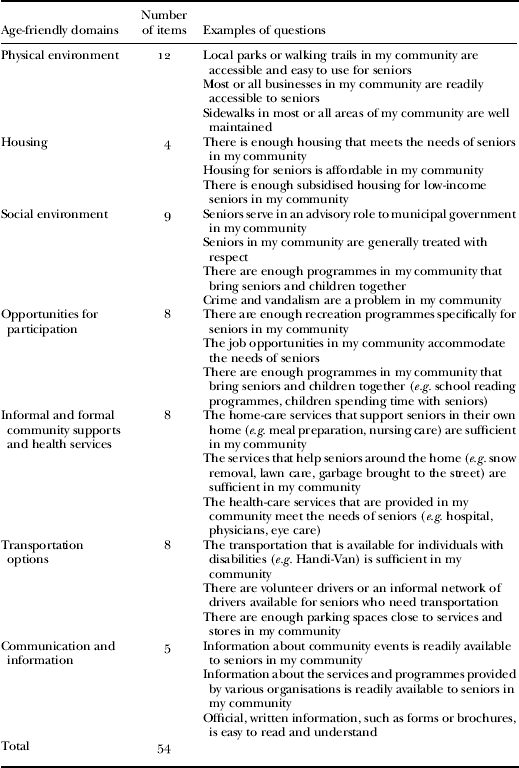
As there was no pre-existing questionnaire available that captures the diversity of domains identified in age-friendly models (e.g. WHO 2007), we developed an age-friendly survey for the purposes of the needs assessments. The survey was based on features of age-friendly communities identified in previous research (Federal, Provincial, Territorial Ministers Responsible for Seniors 2007; Novek and Menec Reference Novek and Menec2013; WHO 2007) to maximise content validity. Examples of survey items are shown in Table 1. Items were conceptually mapped on to the domains proposed by Menec et al. (Reference Menec, Means, Keating, Parkhurst and Eales2011): physical environment, housing, social environment, opportunities for participation, informal and formal community supports and health services, transportation options, and communication and information. These domains are consistent with several definitions of age-friendliness (Alley et al. Reference Alley, Liebig, Pynoos, Banerjee and Choi2007; Lui et al. Reference Lui, Everingham, Warburton, Cuthill and Bartlett2009; WHO 2007). We did not aim to have an equal number of items for each domain, rather we tried to capture the range of features subsumed under each, while keeping in mind that the survey overall needed to be manageable in length so as not to create too much participant burden. Moreover, the survey uses a yes/no/don't know response format to simplify responding.
Age-friendly survey
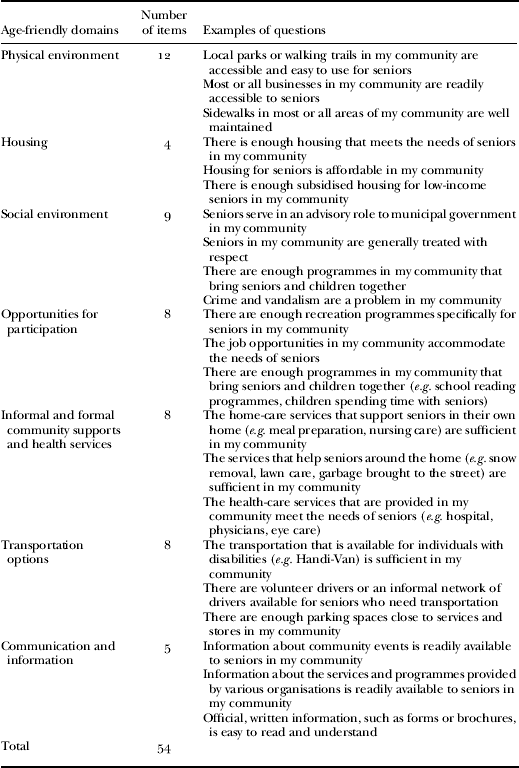
To create an Age-Friendly Index, we summed ‘yes’ responses across all items. As such, we treated affirmative responses on our Index as 1 and treated ‘no/don't know’ responses as 0. We also created separate indices for each of the seven age-friendly domains (see Table 1) by summing ‘yes’ responses on relevant items. Initially, 47 questions were included in the survey. After conducting several needs assessment consultations, the survey was expanded to 54 items based on feedback from participants who felt that some important questions were missing. For example, participants felt it was important to include items pertaining to volunteer drivers, availability of parking close to stores and socially isolated older adults. Ten communities used the 47-item survey and 46 communities used the the 54-item version. The Index demonstrated good internal reliability both for the 54-item and 47-item versions of the scale (Cronbach's alpha=0.86 versus 0.87). Internal reliability was also equally good for respondents who self-identified themselves as ‘seniors’ (alpha=0.87) compared with other respondents (alpha=0.89). The eight subscales had adequate internal reliability, with five of the scales yielding Cronbach's alpha values >0.70; three subscales had alpha values ranging from 0.63 to 0.68.
Because we did not want to lose the ten communities (308 participants) that used the 47-item scale, we decided to apply a weight adjustment, a technique that is often used in survey studies to deal with partial non-responses (Kalton and Kasprzyk Reference Kalton and Kasprzyk1982). We therefore weighted the responses to the 47-item scales proportional to the 54-item scale [(sum of 47 items/47) × 54]. We used the same weighting approach for each of the subscales. As a way of validating the scale, we included a single-item question with high face-validity in some communities: ‘Overall, how would you describe the age-friendliness of your community? Would you say it is…’ (1=poor, 2=fair, 3=good, 4=very good, 5=excellent). The correlation between the Age-Friendly Index and the single item was moderate (Pearson r=0.41, p<0.0001), providing some evidence for convergent validity.
Publicly accessible 2006 census data were used to derive community characteristics, including two measures related to the population (population size and the percentage of residents aged 65 or older) and two socio-economic status indicators (percentage of residents with less than high school education and median income). Similar measures have been used in previous research. For example, more affluent neighbourhoods have been shown to contain more services for older adults (Menec et al. Reference Menec, Veselyuk, Blandford and Nowicki2009). A measure of urban–rural was also included. There is no universally accepted definition of ‘rural’ in Canada (duPlessis, Beshiri and Bollman Reference duPlessis, Beshiri and Bollman2001). One useful definition provided by Statistics Canada categorises communities along an urban–rural continuum, based on population and proximity to larger centres (metropolitan-influenced zones, MIZ) (McNiven, Puderer and Janes Reference McNiven, Puderer and Janes2000). Thus, a small town with a population of less than 10,000 can be categorised differently depending on whether it is close to a larger centre or further away. The MIZ categories have been shown to be useful in differentiating between types of rural communities in Canada (Lavergne and Kephart Reference Lavergne and Kephart2012).
In the present context it was important to differentiate between degrees of rurality, given that the majority of communities in Manitoba have relatively small populations. However, some of them are in close proximity to Winnipeg, an urban centre with a population of about 600,000. Winnipeg functions as a major service and transportation hub. For example, the only international airport in the province and specialised health-care services are located in Winnipeg. Winnipeg thus exerts an influence on the population throughout Manitoba, but especially so for nearby communities.
The definition of MIZ developed by Statistics Canada (McNiven, Puderer and Janes Reference McNiven, Puderer and Janes2000) divides municipalities into several categories: Census Metropolitan Areas (CMA) are urban core areas with a population of at least 100,000; Census Agglomerations (CA) are urban areas witha population between 10,000 and 100,000. Municipalities that are outside a CMA or CA are further categorised into MIZ depending on the percentage of employed residents that commute to work in a CMA or CA. Strong MIZ include municipalities in which at least 30 per cent of the employed labour force commute; in moderate MIZ between 5 and 30 per cent of the employed labour force commute; in weak MIZ more than 0 per cent but less than 5 per cent of labour force participants commute; municipalities with no commuters are classified as ‘no MIZ’. For the present purposes, we first categorised the 56 communities as follows: CMA (N=4), CA (N=2), strong MIZ (N=1), moderate MIZ (N=18), weak MIZ (N=23) or no MIZ (N=8). As the number of communities in some of the categories was small, we subsequently combined CMA, CA and strong MIZ communities into one relatively more urban group. It is important to note here that Winnipeg, the only city in the province that has a population greater than 100,000 and is therefore classified as a CMA, was not one of the 56 communities in our study; the four communities categorised as CMA are small ‘bedroom’ communities located close to Winnipeg.
Analytic approach
The data were analysed using multi-level regression with a random intercept to reflect the structure of the data, with individuals (Level 1) nested within communities (Level 2). Two sets of analyses were conducted using SAS version 9.2 PROC MIXED. First, we analysed the overall Age-Friendly Index using population size, percentage of residents aged 65 or older, percentage of residents with less than high school education, median income and MIZ as predictors. Second, using the same predictors, we conducted separate analyses using each of the seven age-friendly subscales as the outcome measure.
Results
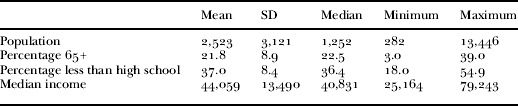
The 56 communities varied widely in terms of the Age-Friendly Index, from a low score of 11.4 to a high score of 34.2 (mean=21.8, standard deviation=9.4). Table 2 shows descriptive statistics for community characteristics. The population sizes of participating communities were small, reflective of rural Manitoba as a whole, ranging from 282 individuals in the smallest community to 13,446 in the largest, with a mean of 2,523. The percentage of residents aged 65 or older ranged from 3 to 39 per cent across the 56 communities, with a mean of 21.8 per cent, which is considerably above the provincial statistic of 14 per cent. There was also considerable variability across communities in terms of the percentage of residents with less than high school education and median income.
Descriptive statistics of community characteristics (56 communities)
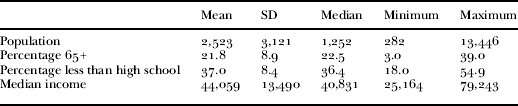
Notes: Median income is expressed in Canadian dollars. SD: standard deviation.
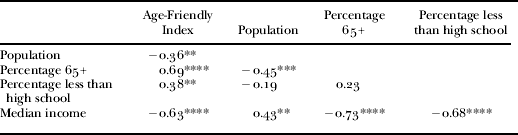
Table 3 shows correlations between the Age-Friendly Index and community characteristics. The Index was significantly correlated with all measures. The larger the population and the higher the median income, the less age-friendly communities were rated and, conversely, the higher the percentage of individuals and residents aged 65 or older with less than high school education, the more age-friendly they were perceived to be. Community characteristics were also correlated with each other. For example, the higher the percentage of residents aged 65 or older, the lower the median income (r=−0.73). This is not surprising as older individuals would tend to be on fixed, lower incomes than younger individuals. A higher concentration of older adults in a community would, therefore, tend to reduce a community's income level.
Correlations between Age-Friendly Index and community characteristics
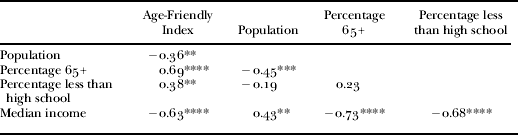
Note: Population size and median income were expressed in thousands to make them similar in scale to the other census variables.
Significance levels: ** p<0.01, *** p<0.001, **** p<0.0001.
A univariate analysis of variance (ANOVA) conducted to examine whether MIZ categories were related to the Age-Friendly Index yielded a significant overall effect, F(3,1369)=49.84, p<0.0001. Subsequent post hoc analyses using Scheffé's test indicated that communities in our CMA/CA/strong MIZ category were rated significantly lower on the Age-Friendly Index (mean=13.59) than moderate MIZ (mean=21.65), weak MIZ (mean=23.72) and no MIZ communities (mean=23.11). Moreover, moderate MIZ communities had a significantly lower Age-Friendly Index score than their weak MIZ counterparts.
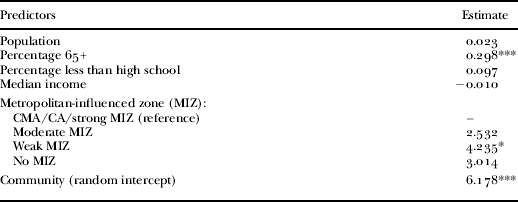
Given that all community characteristics were significantly related to the Age-Friendly Index, we next conducted a multi-level regression analysis with all predictors entered simultaneously into the model (see Table 4). Diagnostics were first computed to confirm that multicollinearity was not an issue. Only two effects remained statistically significant in the multivariate analysis. The higher the percentage of residents aged 65+, the higher the Age-Friendly Index, and weak MIZ communities were rated higher on the Age-Friendly Index than CMA/CA/strong MIZ communities.
Predictors of age-friendliness: multi-level regression analysis for overall Age-Friendly Index
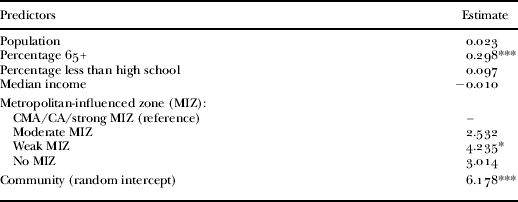
Notes: Population size and median income were expressed in thousands to make them similar in scale to the other census variables. CMA: Census Metropolitan Area. CA: Census Agglomeration.
Significance levels: * p<0.05, *** p<0.001.
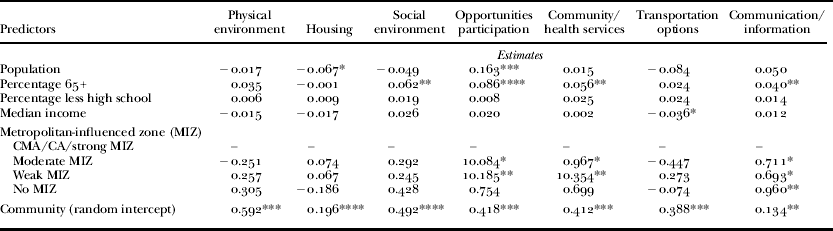
Lastly, we conducted analyses for each of the seven age-friendly subscales (see Table 5). In terms of population size, the larger the population, the less housing participants thought was available, but the more opportunities for participation. A greater percentage of residents aged 65 or older was associated with higher scores on the subscales for social environment, opportunities for participation, health-care services, and communication and information. Median income was related only to transportation options; the higher the communities' income, the lower the transportation options were perceived to be. Moreover, moderate and weak MIZ communities were rated higher on opportunities for participation, health-care services, and communication and information than CMA/CA/strong MIZ communities. No MIZ communities were also rated higher on communication and information than their CMA/CA/strong MIZ counterparts.
Predictors of age-friendliness: multi-level regression analyses for age-friendly subscales

Notes: Population size and median income were expressed in thousands to make them similar in scale to the other census variables. CMA: Census Metropolitan Area. CA: Census Agglomeration.
Significance levels: * p<0.05, ** p<0.01, *** p<0.001, **** p<0.0001.
To examine the proportion of variance explained by the community characteristics we used the multi-level analogue to R-square proposed by Raudenbush and Bryk (Reference Raudenbush and Bryk2002). For the overall Age-Friendly Index, 71 per cent of the variance was explained by the five community characteristics. For the subscales, the variance accounted for ranged from 32 per cent for the social environment to 70 per cent for transportation options.
Discussion
The notion of age-friendliness is gaining increasing attention in the policy domain and numerous communities (large and small) around the world have started to work on becoming more age-friendly (Public Health Agency of Canada 2010; WHO 2010). Although the concept is clearly appealing to decision makers, research that has examined age-friendliness in diverse contexts is only starting to emerge (Novek and Menec Reference Novek and Menec2013; Smith, Lehning and Dunkle Reference Smith, Lehning and Dunkle2013). The present study contributes to the literature by systematically exploring to what extent rural communities are perceived to be age-friendly by residents and whether certain community characteristics tend to be associated with greater (or lesser) age-friendliness. The findings presented her indicate that there is wide variation in ratings of age-friendliness across communities, as measured with our Age-Friendly Index, with a three-fold difference between communities with the most opportunities, services and programmes for older adults, relative to those with the least. Although all community characteristics were associated with age-friendliness ratings when they were considered separately, once all community characteristics were controlled for, only the percentage of residents aged 65 or older and the degree of rurality were related to overall perceptions of age-friendliness.
That communities with a higher percentage of residents aged 65 or older were rated as more age-friendly is encouraging as it indicates that communities are responsive to the needs of older adults. It also indicates that age-friendliness is not contingent on other factors, such that even small, relatively less affluent communities can be age-friendly. An alternative interpretation is that older adults are attracted to age-friendly communities. Becoming age-friendly could therefore be a strategy for communities to attract older migrants (Liddle et al. Reference Liddle, Scharf, Bartlam, Bernard and Sim2013; Spina and Menec Reference Spina and Menecin press).
However, it is worth noting that not all age-friendly domains were associated with the percentage of residents aged 65 or older. Rather, communities with a higher proportion of older residents were rated as having a better social environment, more opportunities for social participation, more health-care services, and better communication and information. Other domains explored, such as transport and housing, were not related to the proportion of older residents. This is consistent with previous research that shows the difficulties rural communities have in providing a range of services, such as transportation options (e.g. Ryser and Halseth Reference Ryser and Halseth2012; Winterton and Warburton Reference Winterton and Warburton2011). Moreover, some of the structural barriers to making communities more age-friendly, such as land use regulations that restrict the type of housing that can be built, have been described by others (Lehning, Chun and Scharlach Reference Lehning, Chun and Scharlach2007). Health-care services can also be difficult to enhance, as they are influenced by the availability of health-care providers (e.g. physicians). Attracting and retaining health-care providers is a major challenge in rural areas in Canada and other countries (e.g. Wilson et al. Reference Wilson, Couper, De Vries, Reid, Fish and Marais2009). However, our finding that communities with a higher proportion of older residents were rated more highly on health-care services in the present study suggests that the health-care system is responsive to the higher care needs in these communities. For example, home care for older adults who are still quite independent but do require some assistance (e.g. with preparation of meals or bathing) is provided on a needs basis in Manitoba and is provided free of charge to all older residents. Thus, communities with more older individuals would also tend to receive more home-care support.
More rural communities had higher age-friendliness ratings relative to more urban communities, with both moderate and weak MIZ communities rated as having more opportunities for participation, more community and health services, and better communication and information. Does this mean that urban communities are less age-friendly than rural ones? Not necessarily; rather, the finding must be interpreted in light of our definition of rural–urban. Using the Statistics Canada definition of MIZ (McNiven, Puderer and Janes Reference McNiven, Puderer and Janes2000), our relatively more urban communities included communities that are part of a larger census metropolitan area, but do not include the largest centre (Winnipeg) itself. Also included is a small village close to Winnipeg, which Statistics Canada classifies as a strong MIZ. Thus, it might be more accurate to say that communities in close proximity to a large urban centre are the least age-friendly. This supports research that shows there are fewer services, including transportation options and health-care services, in suburban relative to urban areas (Roeger, Reed and Smith Reference Roeger, Reed and Smith2010; Silver, Blustein and Weitzman Reference Silver, Blustein and Weitzman2012).
It could be argued that communities close to a larger centre do not have to be as age-friendly, given that residents presumably have access to many opportunities and services in the city. However, as has been pointed out in the context of suburbs (Harris Reference Harris2004; Miller, Harris and Ferguson Reference Miller, Harris and Ferguson2006a), these communities are highly car dependent, which creates challenges when people are no longer able to drive in older age. In order for individuals to age in place in these communities, services will have to be enhanced and the physical design modified to improve accessibility and walkability (cf. Miller, Harris and Ferguson Reference Miller, Harris and Ferguson2006b; Southworth Reference Southworth1997). That communities close to Winnipeg joined the Age-Friendly Manitoba Initiative suggests that they are aware of these issues and have a desire to become more age-friendly.
It is also interesting to note that communities located in the north of the province, which were classified as not being in a MIZ, were less age-friendly than more southern rural communities. However, they were rated as having better communication and information than urban communities. Unlike the more urban communities, these villages and towns do not have the advantage of being close to a larger, service-intense centre. They could therefore benefit from becoming more age-friendly. While issues like transportation present a particular challenge in northern communities, some of which are accessed via airplane only, other domains may be more easily enhanced, such as opportunities for participation.
The findings regarding population size also warrant addressing. Although population size was not significantly associated with overall age-friendly ratings, the larger the community, the poorer housing and transportation options were rated to be, but the better the opportunities for participation. That providing transportation options presents a greater challenge in larger towns makes sense as, on the one hand, these communities cover a greater geographic area, making them less walkable. On the other hand, even the larger communities in our study were still quite small (the largest with a population of just over 13,000), which may make them too small to implement a viable public transit system. Why housing options should be rated more poorly in larger communities is not clear. However, it may be due to the greater need, given that the number of older adults would tend to be larger. It is also not clear why higher median income was negatively related to transportation options. Indeed, we expected the reverse, with more affluent communities expected to be able to provide more services and opportunities. The finding may be driven by the unique characteristics of a few communities. Specifically, among the highest income communities were those located in the far north, all mining towns. Given their remote location, transportation for older adults would be a challenge.
We acknowledge several limitations of this study at this point. First, a participant selection bias may be at play, as individuals who completed the age-friendly survey were invited to attend a needs assessment consultation to identify age-friendly priorities. As such, individuals who were particularly critical of the community may have attended or, alternatively, individuals who wanted to ensure that good aspects were mentioned might have participated. We also do not have information about participants (e.g. their age, gender, mobility limitations); thus, we do not know if they reflected a diversity of perspectives. Moreover, the sample size in some communities was small; larger samples may have provided a better assessment of the community's age-friendliness.
Second, our age-friendly survey was developed for the purposes of a needs assessment process. As such, the survey had to be as short and easy to complete as possible. We recognise that our yes/no response format does not provide as nuanced an assessment of age-friendly features as would be possible with a Likert-type response scale that would allow ratings of the degree of agreement or disagreement with each survey question. Third, our survey measures individuals' perceptions of various features. Whether these perceptions match the services and opportunities that actually exist is not clear. For instance, research indicates that people are often not aware of what community support services are available (Denton et al. Reference Denton, Ploeg, Tindale, Hutchison, Brazil, Akhtar-Danesh, Quinlan, Lillie, Millen Plenderleith and Boos2008). Lastly, our study was an initial step in assessing age-friendliness across diverse communities. It does not relate age-friendliness to outcomes, such as social connectivity, mobility, health or quality of life. Examining these relationships is a task for future research. Similarly, an examination of how communities move toward becoming more age-friendly, that is, an examination of the process of becoming more age-friendly and, ultimately, how becoming more age-friendly affects outcomes, are important questions for future research.
In conclusion, the present study adds to the empirical literature on age-friendly communities, which to date is quite scarce, by examining what kinds of community characteristics are related to age-friendliness. The findings generally suggest that communities are responsive to the needs of their older residents. Thus, a higher proportion of older residents was associated with greater age-friendliness, with age-friendliness not being contingent on other factors, such as its relative affluence. However, our study also suggests that certain domains are more easily addressed than others; specifically, the social environment, opportunities for participation, and communication and information. In contrast, the physical environment, housing, health-care services and transportation options may be more difficult to enhance, particularly for relatively small villages and towns. That different results were obtained for the various age-friendly domains underscores the importance of considering age-friendliness in a holistic way and measuring it in terms of a range of community features.
Our study further highlights the importance of differentiating between degrees of rurality, as different patterns emerged for communities of different sizes and proximity to a census metropolitan area. Small communities located within the census metropolitan area and those farthest away in the north of the province emerged as the least age-friendly, suggesting that in order for older adults to age in place in these communities, and to optimise older adults' quality of life, aspects of the physical and social environment would need to be enhanced in these settings.
Acknowledgements
This research was supported by a Social Sciences and Humanities Research Council of Canada grant under its Community–University Research Alliance programme. V. Menec holds a Canada Research Chair in Healthy Aging.