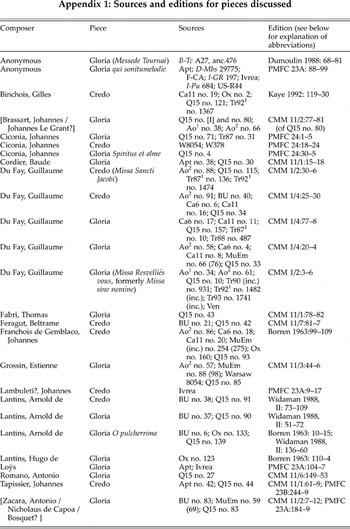
Much of our knowledge of early fifteenth-century sacred polyphony derives from the study of a small group of partially concordant manuscripts compiled in northern Italy (BU, Ox, Q15), southern Germany (Tr87, Tr92), and the Low Countries (Ca6, Ca11) from the mid-1420s to the 1470s. Through this diverse assortment of choirbooks and personal anthologies, the motets and Mass movements of Antonio Zacara da Teramo and Johannes Franchois de Gemblaco, of Gilles Binchois and Guillaume Du Fay, have come to be known. These manuscripts are, of course, mediated sources: they do not stem from the hands of the composers themselves, but from the hands of skilled scribes whose names are for the most part lost to us. Yet for all their anonymity, these scribes were far from passive transmitters of the music of their age. Where a single piece occurs in multiple sources, scribal intervention is suggested by significant variants in the readings: the addition or excision of a contratenor, for example, or the pairing of one piece with another.Footnote 1 Studying these variants helps shed light on the mechanisms of music dissemination before the advent of music printing.
The concluding Amen sections of early fifteenth-century Gloria and Credo settings which are examined in this article (see Appendix 1 for a list of the pieces discussed) display tremendous variety in length and style, ranging from brief and homophonic to substantial and figural. In several cases, different sources for the same piece transmit Amen settings that are seemingly unrelated to each other – even where the rest of the piece is transmitted without variation. Close examination of these individual cases brings to light patterns of instability, and suggests that certain types of settings were more susceptible than others to emendation.
A three-voice Credo by Franchois (found in five sources: Ao, Ca6, Ca11, Ox and Q15) is particularly illustrative of the questions raised by the inconsistent transmission of concluding Amen sections.Footnote 2 Like the other Gloria and Credo settings that can be securely attributed to Franchois, this Credo uses systematic imitation throughout: each major section begins with a point of imitation.Footnote 3 This holds true, as well, for the lengthy setting of the word ‘Amen’ that closes the Credo in the Cambrai sources. Although it ends on a different final (D) from the main body of the Credo (G), the Amen given in these sources is stylistically consistent with the music it follows.
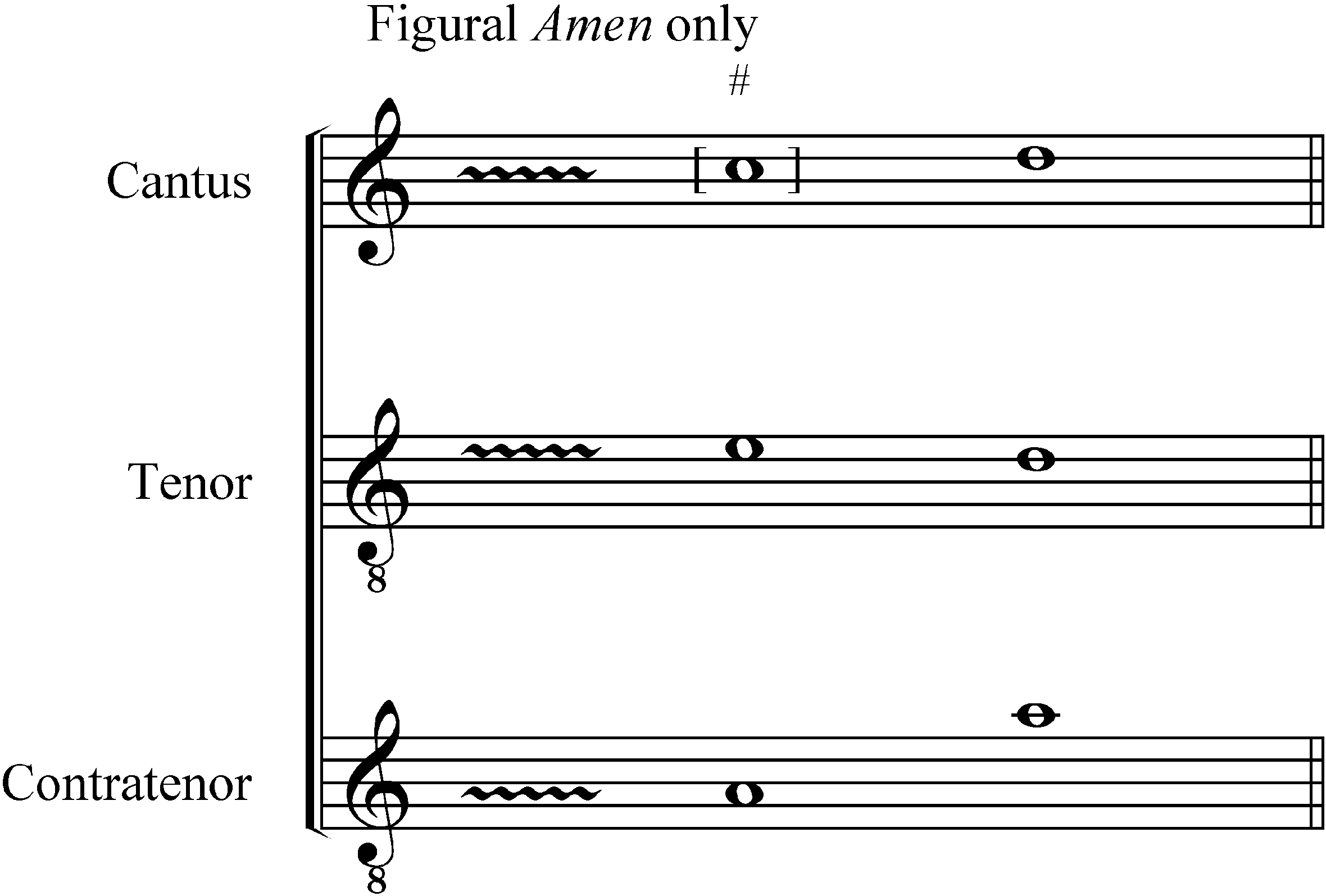
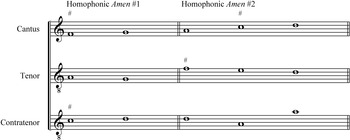
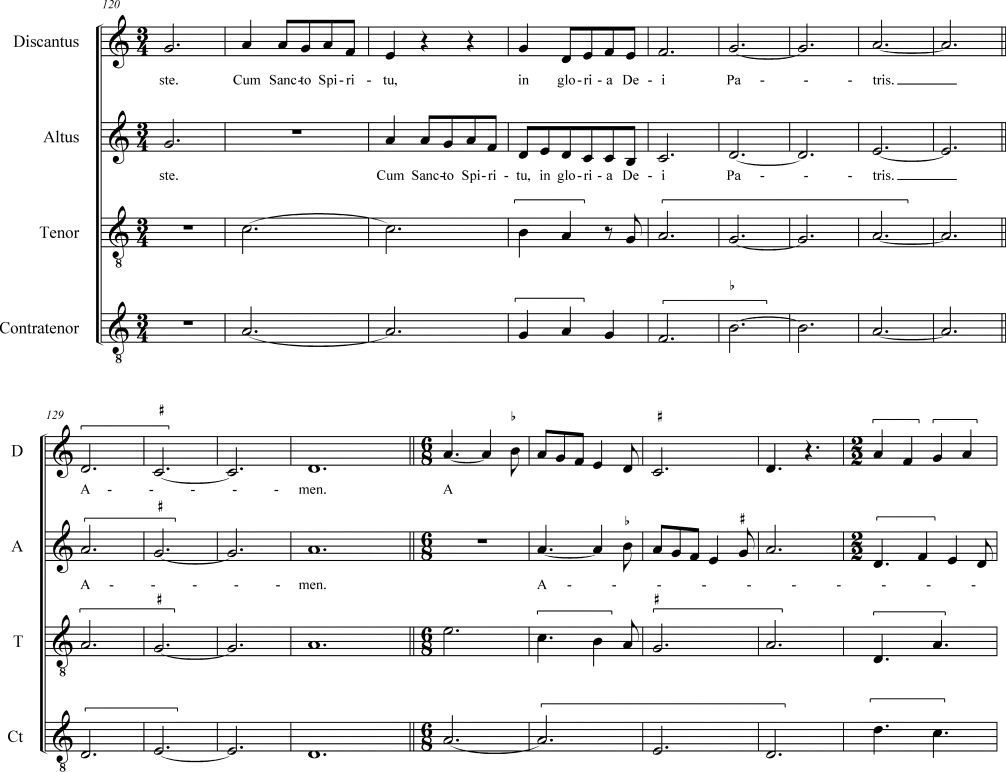
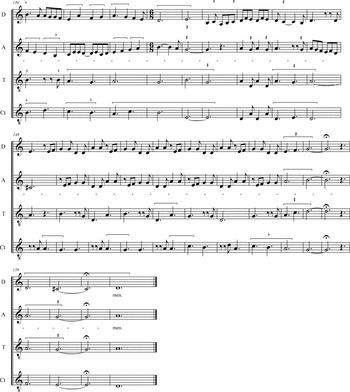
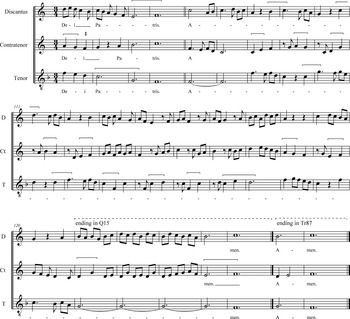
It is surprising, then, to turn to the same Credo in an earlier source (Ox) and find no trace of this Amen, but instead two short, homophonic settings: the first comprising just two sonorities and cadencing to G, and the second, three sonorities and cadencing to D. Each Amen is simply a cadence, devoid of prefatory musical material, separated from the other by a vertical line and employing the minimum amount of music needed to set the two-syllable word. The second Amen from Ox is found in Ao, where it is followed by the lengthy Cambrai Amen, here marked ‘Aliud’. The situation becomes still more puzzling when the Q15 recension is taken into account. Here, as in Ao and Ox, we find two Amen sections. However, the Q15 version corresponds neither to Ao nor to Ox. Rather, the long Amen, as transmitted in Ao and the Cambrai sources, is preceded by a homophonic Amen consisting of five sonorities and concluding on G.Footnote 4 To complicate matters further, a close look at the shorter Amen in Q15 reveals that it is a composite of the two Ox Amen settings, albeit in reverse order. These variant readings – all of which are musically viable – are summarised in Example 1.
Ao (fols. 114v–117r).

Ca11 (fols. 38v–41v), Ca6 (fols. 33v–36r).
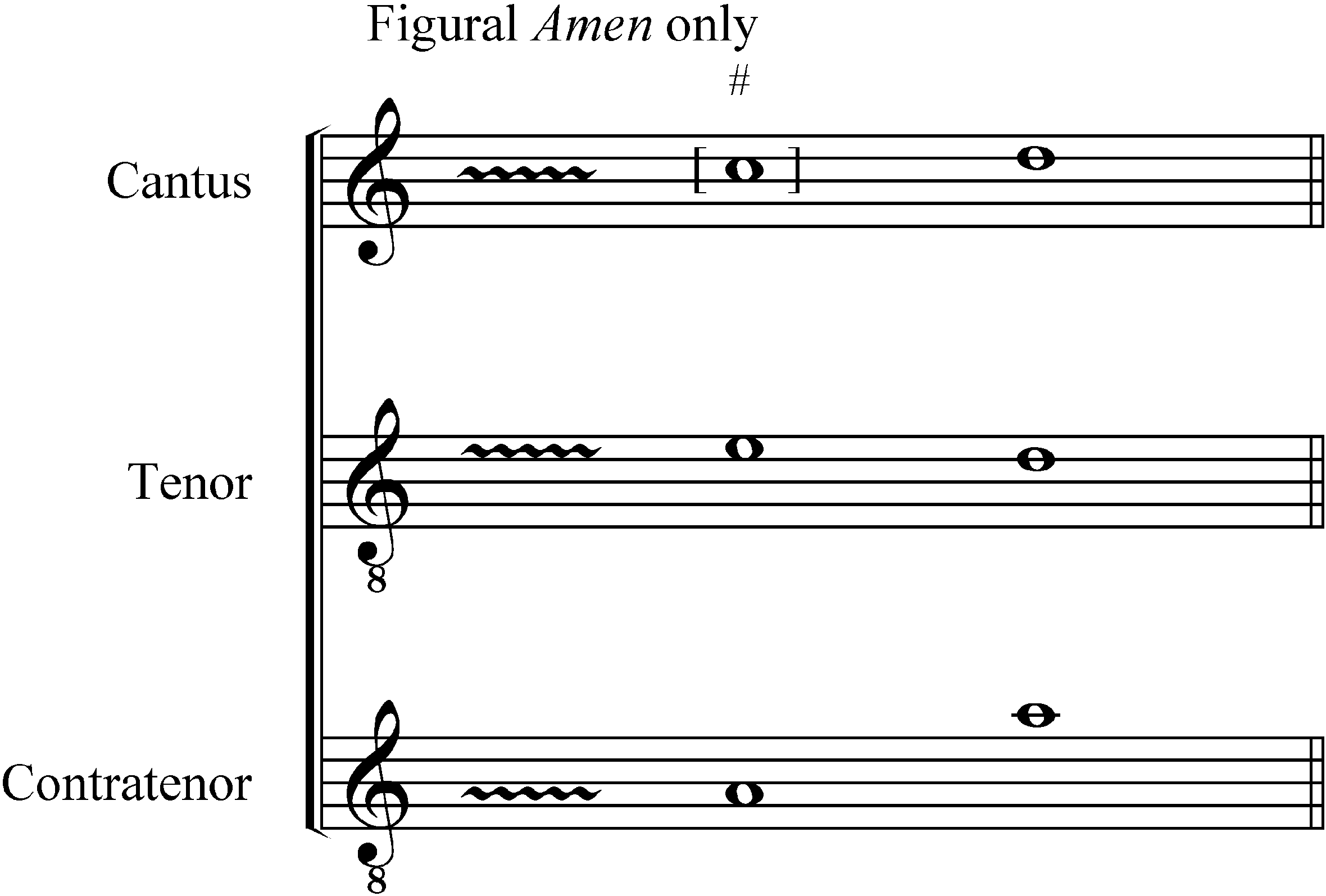
Ox (fols. 74v–75v).

Q15 (fols. R115v–117r=A118v–120r).

Why do these virtually contemporary sources transmit such diverse versions of the concluding Amen? The Q15 copy of the Credo is almost certainly the earliest, but should this lead us to assume that it presents the version closest to Franchois's original?Footnote 5 Such questions, as well as the latent similarities between the short Amen sections given in Ao, Ox and Q15, invite a closer examination into the role of scribes in editing and recomposing the music they copied. Clearly there is far more going on here than the mere misreading of exemplars or the transmission of corrupt exemplars. Deliberate decisions were made as to the appropriate way to conclude this piece and, at several points in the transmission, substantial changes were made to the composer-originated version. In order to hypothesise a plausible transmission scenario for the Franchois Credo, it must be placed within a larger context, that is, in comparison with the transmission of other contemporary Gloria and Credo settings.
Secondary literature on this repertory has tended to refer to two types of Amen settings: ‘short’ and ‘long’. While these labels can be useful on a case-by-case basis, they are too imprecise to describe the diversity encountered in the repertory as a whole. The lack of systematic nomenclature with respect to the length and style of concluding Amen sections makes it difficult to discuss with clarity the variety of scribal emendations found in these sources. To describe the situation of the Franchois Credo simply as a case where a long Amen has been replaced in some sources with a short Amen downplays the complex re-arrangement of materials that took place. In order to understand further the nature and function of the Amen sections, a vocabulary has to be developed with which to discuss the various types of settings.
In refining the nomenclature, it is necessary to leave aside modern transcriptions of these pieces, at least momentarily, and focus on the fifteenth-century sources themselves, a great many of which are now readily accessible in high-quality facsimile reproductions or online.Footnote 6 A close study of their layout exposes telling anomalies in copying that are of necessity glossed over in modern editions. Recent studies of these sources have shed light on the copying process, revealing evidence of conscious emendation and aspects such as the original format of the exemplars.Footnote 7 In the case of the Gloria and Credo settings under examination, a consideration of the sources helps to understand the decisions a scribe would make in the face of space constraints, incomplete exemplars, changing musical styles, and – occasionally – his desire to arrange and rearrange his collection in his own way. It also reveals that the Franchois Credo is but an extreme example of a relatively common phenomenon during the early fifteenth century: the abbreviation, extension and revision of the extensive Amen sections that conclude Gloria and Credo settings.
***
Perhaps because of their frequent instability in the fifteenth century, and their bewildering variety in length and style, there has to date been no systematic tracing of the early history of the polyphonic Amen. The self-contained Amen of the late sixteenth and early seventeenth centuries has been touched upon, but the abundance of lengthy Amen sections found in Gloria and Credo settings from the Messe de Tournai onwards remains largely unexplored. The ‘Amen’ entry in the New Grove Dictionary of Music and Musicians is representative: the authors cover the Middle Ages with the short but sweeping observation that ‘in polyphonic settings of the Gloria and Credo composers such as Machaut often set the amen separately’, before moving on to address Martin Luther's inclusion of Amen settings in the Agnus Dei and litanies, and the development of the seventeenth-century fugal Amen.Footnote 8 The similarly cursory treatment in Musik in Geschichte und Gegenwart emphasises the development of monophonic, melismatic Amens. It provides only the briefest of summaries of the history of the polyphonic Amen, mentioning Machaut and Michael Praetorius as notable bookends to an otherwise apparently unremarkable period of Amen composition.Footnote 9 Before surveying the repertory at hand, then, a brief overview of polyphonic Amen settings in the fourteenth and early fifteenth centuries is in order.
The earliest polyphonic settings of the Gloria and Credo date from the 1300s and unfold syllabically, discant-style, all the better to get the lengthy texts out of the way efficiently and intelligibly. The Amen sections which follow the bodies of the movements, however, are replete with hockets, sequences and rhythmic canons – precisely those procedures, in fact, which had been condemned soundly by John XXII in his extravagant bull, Docta sanctorum patrum, of 1324–25.Footnote 10 Such exigencies were apparently tolerated in settings of short, recognisable texts such as the Kyrie and Agnus Dei, in which they frequently occur – and also in Amen sections, which are the musical highpoint of many fourteenth-century Gloria and Credo settings. The composer of the Gloria from the Tournai Mass, for instance, revelled in the possibilities afforded by the unrestricted setting of a single word: his Amen extends over 169 measures, while the preceding eighty-three words of the Gloria fly by in a mere 228 measures.
Gloria and Credo settings in later fourteenth-century sources invariably conclude with extended Amen sections. The Gloria and Credo settings from Machaut's Messe de Nostre Dame furnish especially familiar examples of the lengthy polyphonic Amen. In some cases, as in the Old Hall manuscript, the Amen sections are bound seamlessly to the preceding music. In others, notably the continental source Apt, Basilique Saint-Anne Trésor 16bis, they stand alone, separated audibly from the previous music by a clear cadence, and set apart visually by a line of demarcation.
Extant sources suggest that these fourteenth-century Amen settings were transmitted with remarkable stability. Where variations occur, they tend to result from the excision or addition of internal phrases, rather than the removal and replacement of the Amen in its entirety.Footnote 11 As suggested by the case of the Franchois Credo discussed earlier, the situation gets considerably more complex in the early fifteenth century. During this period, lengthy figural Amen settings continue to circulate, but brief Amen sections written in note-against-note counterpoint also appear. That this expansion in the stylistic range is accompanied by an increase in instances of unstable transmission suggests that the concluding Amen became increasingly susceptible to scribal manipulation during this period. Indeed, I argue here that one particular type of short Amen, the self-contained, two-sonority homophonic Amen, arose as a result of scribal abbreviation of lengthier treatments.
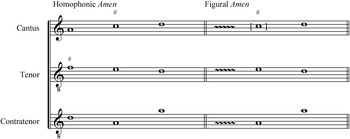
As noted above, the vocabulary currently used for the discussion of polyphonic Amen settings uses length as a defining characteristic, and is thus insufficient to describe the variety of Amen-types encountered in the major fifteenth-century sources. A more nuanced categorisation considers the fabric of the musical setting in addition to its length. Generally, the short Amen (two or three breves in length) proceeds in a manner that can be described as ‘chordal’ or ‘homophonic’, with all the voices in the texture moving simultaneously from sonority to sonority in note-against-note counterpoint. Characteristic of most ‘long’ Amen settings (three or more breves in length), however, is rhythmic differentiation of the voices and the use of compositional devices such as imitation, hocket and isorhythm.Footnote 12 Johannes Ciconia's Gloria Spiritus et alme provides a representative example of each kind of Amen (Example 2).
Self-contained homophonic Amen, followed by self-contained figural Amen in Ciconia, Gloria Spiritus et Alme (transcription based on PMFC 24:34).
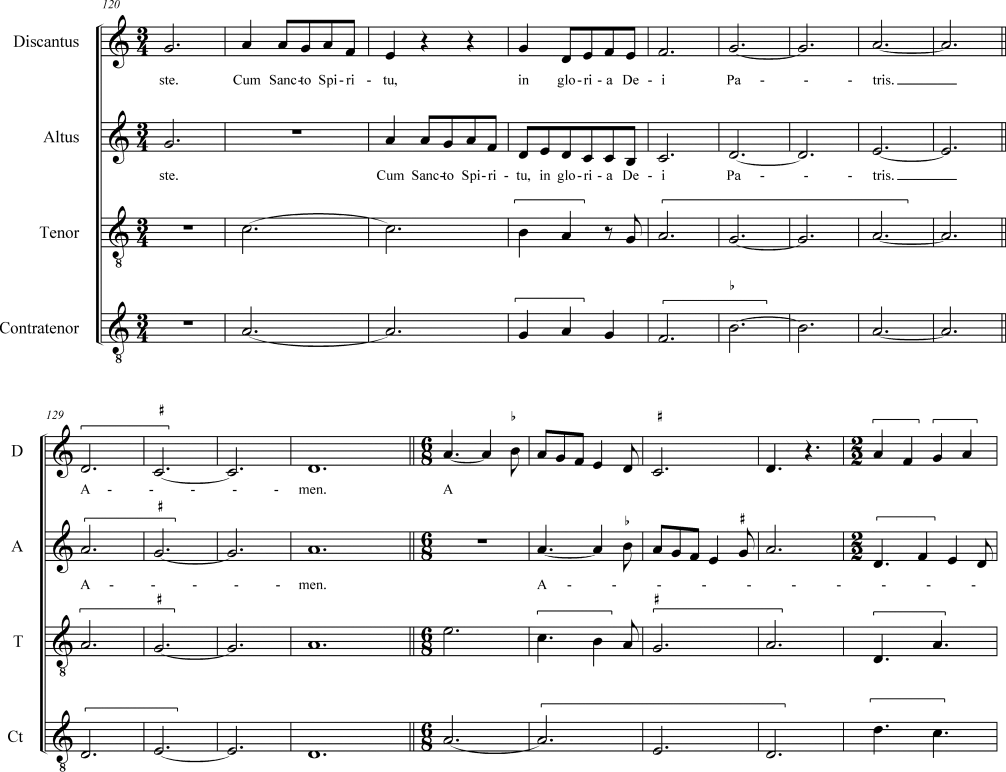

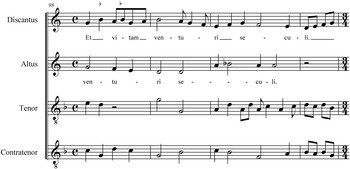
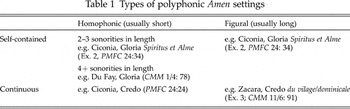
When musical texture is taken into account, two categories of Amen settings roughly congruent with the short/long groupings emerge: ‘homophonic’ and ‘figural’. These can be defined according to the relation between the Amen and the main body of the setting (Gloria or Credo): Amen sections of both types are either ‘self-contained’, preceded by a cadence and a break in texture at the concluding patris or saeculi (Ex. 2), or ‘continuous’, flowing seamlessly from these words into the Amen (Ex. 3).
Continuous figural Amen in Zacara, Credo du vilage/dominicale (transcription based on CMM 11/6:91).

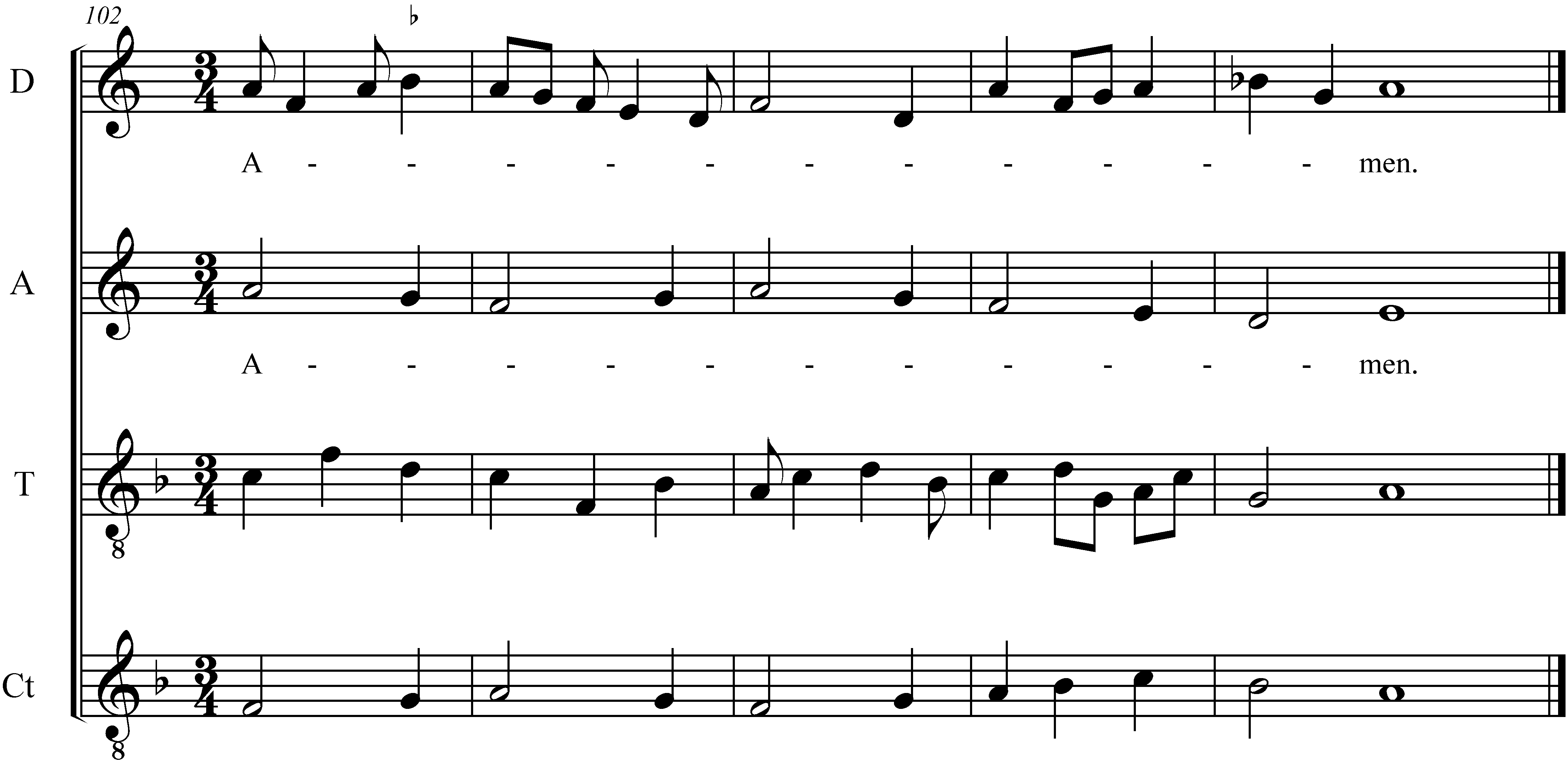
The aural distinction between self-contained and continuous Amen settings is reinforced visually through manuscript layout: almost invariably, scribes separate self-contained Amen settings from the preceding music with a vertical line.Footnote 13 Within manuscripts, these demarcations are identical to those used to distinguish self-contained unus/chorus sections or to indicate major textual and musical divisions. Table 1 summarises the types of Amen settings in fifteenth-century sources for polyphonic Gloria and Credo settings.
Types of polyphonic Amen settings

In pieces within which the constituent sections are self-contained, the Amen is usually likewise self-contained. Where this is not the case, one needs to assess carefully the reliability of the functionally inconsistent source and determine whether or not an emendation may have taken place. The Tr92 reading of the Credo from Du Fay's Missa Sancti Jacobi is an illustrative example.Footnote 14 This Credo is made up of a series of self-contained unus/chorus sections. In Ao, Q15 and Tr87, the Amen is self-contained as expected.Footnote 15 In Tr92, however, the concluding Amen is unrelated to the one transmitted in these other sources and, furthermore, is continuous with the material of the preceding chorus section. Closer examination reveals that the entire final chorus section (starting with ‘Et unam sanctam catholicam’) given in Tr92 is different from that given in the other sources. Yet both versions end on the D final, both contain musical material that relates motivically to material found in the body of the movement, and both are viable conclusions to the movement.Footnote 16
The fact that the majority of sources are concordant with the earliest reading (Q15) is not sufficient evidence to prove that reading to be the most accurate. However, the continuity between sections in an otherwise sectional piece casts suspicion on the Tr92 reading. When one takes this stylistic inconsistency into account alongside the Q15 scribe's apparently quick acquisition of other pieces by Du Fay, it seems probable that the majority reading does in fact transmit Du Fay's version.Footnote 17 A likely copying scenario involves the Tr92 scribe working from an exemplar in which the final section of the Credo (starting with ‘Et unam sanctam’) was copied on its own folio, separate from the preceding sections. Either this folio was missing, leading the scribe to compose a new conclusion himself (which would account for the motivic connections), or the scribe accidentally substituted for the correct folio one from another piece, one less sectional than Du Fay's Credo, but one which nevertheless offered a feasible conclusion.
Admittedly, external factors (such as the layout of a given source) or contextual information (such as the frequency with which a particular version appears in extant sources) is unlikely to produce incontrovertible proof that one recension comes closest to what the composer originally wrote. Indeed, any speculation about which Amen Du Fay wrote for his Missa Sancti Jacobi – or, equally, which Amen is the product of a creative scribe and why that scribe saw fit to make changes to the music he was copying – will inevitably court criticism on the grounds of ‘intentional fallacy’.Footnote 18 Still, if one is ready to concede that questions of intent are ultimately unanswerable or even that attribution is beside the point, the process of noting and accounting, however tentatively, for suggestive inconsistencies in ‘external evidence’ (e.g. layout) and ‘internal evidence’ (e.g. the musical ‘text’) proves to be productive in itself. This kind of exploration acknowledges scribal agency and exposes our own assumptions about a composer's style.Footnote 19 At the same time, in highlighting the happy coexistence of multiple versions of a concluding Amen in the fifteenth century, even within the same source, it resists the Romanticist urge to ascribe greater or lesser value to one or another reading on the basis of presumed authenticity or corruption.
Although the unique Amen given in the Tr92 reading of the Credo from Missa Sancti Jacobi may be the result of a misplaced exemplar, there are several cases in the manuscripts under consideration in which scribes deliberately altered concluding Amen sections. One such instance has been dealt with in depth by Robert Palmer in ‘Squaring the Triangle: Interrelations and Their Meanings in Some Early Fifteenth-Century Mass Pairs’.Footnote 20 As Palmer shows, the pairing in Q15 of a Credo by Johannes Tapissier with a Gloria by ‘Tomas Fabri scolaris Tapissier’ was a scribally asserted pairing. The Q15 scribe supported his pairing by removing the original Amen from Tapissier's Credo, which survives in an earlier source (Apt), and replacing it with one newly composed to match more closely the concluding Amen of the Fabri Gloria.Footnote 21 This is a rare instance of Amen instability being rooted in a scribe's desire to impose his own musical preferences – in this case, a predilection for musically unified pairings – on the compositions he transmits.
More common are situations in which the emendation of an Amen was motivated by the pragmatic desire to save space. One instance where a scribe was apparently tempted to curtail an Amen but subsequently changed his mind is found in the BU recension of a Beltrame Feragut Credo, also transmitted in Q15.Footnote 22 In both manuscripts, the Credo concludes with a self-contained, figural Amen. Footnote 23 In BU, the Cantus part fills fol. 11v (p. 22) and, as indicated by a hand pointing to the penultimate system of the facing page, spills over onto the following page for the Amen. A second look at the last system of fol. 11v, however, shows that there is in fact already a short, continuous Amen indicated in the Cantus: the scribe has carefully placed the ‘-li’ of the final word ‘seculi’ under a group of minims, to allow ‘Amen’ to be sung on the final cadence of the section. It appears that the scribe, assuming that insufficient space for the Amen would remain after the copying of the Tenor, simply texted an Amen onto the final cadence of the actual Credo, which would otherwise have carried the syllable ‘-li’. On discovering that there was sufficient room on the facing page, he decided to include the figural Amen. For this scribe, then, the self-contained Amen was expendable – unnecessary for a logical, grammatically complete performance of the piece.
A general comparison of BU readings of Amen sections with those of contemporary sources suggests that the BU scribe was more likely than most to excise a figural Amen in order to conserve space. The Q15 scribe, in contrast, seems to have been partial to figural Amen sections, adding them as he came across them, or perhaps composing them himself, just as he appears to have done with Contratenors.Footnote 24 Where multiple extant versions of a Gloria or Credo exist – some with short, homophonic Amen sections, others with long figural Amen settings – the Q15 scribe almost invariably provided the figural Amen. While it is often supplemented with a short Amen, he apparently sought to include the figural Amen wherever possible.Footnote 25
In a few instances, it appears that a scribe was prompted to make changes to his copy of a Gloria or Credo after coming across an exemplar containing a different Amen.Footnote 26 In the case of Ciconia's Gloria Spiritus et alme, for example, the Q15 scribe seems to have come across a self-contained figural Amen midway through his copying of the work.Footnote 27 The second opening is in standard choirbook format, providing the music from ‘Qui sedes’ onward, with Cantus I and the Tenor on fol. 5v and Cantus II and the Contratenor on the facing page (fol. 6r). This layout becomes irregular, though, when the Amen is reached. Tenor, Cantus II and Contratenor parts provide both a short, self-contained homophonic Amen and a self-contained figural Amen. The Cantus I part at the top of fol. 5v gives only the short, homophonic Amen. A closer look at the bottom of the page, however, reveals an inscription below the Tenor Amen: ‘Amen de triplo’, indicating that the subsequent notation carries the Cantus I part of the figural Amen.
Two scenarios can account for this anomaly. Either the scribe had originally used an exemplar containing only the short Amen, and added the long Amen when he acquired it. Or he had an exemplar with a long Amen, but decided to replace it with a short Amen before changing his mind and including the long Amen after all. Several points suggest that the former scenario is the more probable. First, as noted above, the Q15 scribe generally tended to provide figural Amen settings whenever possible. Second, Q15 contains a disproportionate amount of Ciconia's music, probably due to the efforts of Giovanni Gasparo, canon of Vicenza, to perpetuate his legacy.Footnote 28 Thus, people within the circle of the Q15 scribe, if not the scribe himself, would probably have been aware of Ciconia's tendency to conclude his Gloria and Credo settings with lengthy, self-contained figural Amen sections. Out of his surviving works in this genre, only one is transmitted without an Amen of this type.Footnote 29
With this understanding of Ciconia's conventions, as well as an awareness of the Q15 scribe's considerable musical competence, one can put forward a copying scenario in which the scribe initially had an exemplar containing only the short homophonic Amen and the three contrapuntally essential voice parts: Cantus I, Cantus II, and the Tenor. The clumsiness of the Contratenor, whose interaction with the other voices is troublesome throughout, suggests that it was a later addition, lacking in this putative exemplar.Footnote 30 Continuing with this line of reasoning, one can hypothesise that at this early stage the Q15 scribe wrote out all parts, save the Contratenor, concluding each with the short, homophonic Amen given in his exemplar. At some point during his work, he either came across another exemplar containing a long Amen, or he decided – perhaps upon observing Ciconia's standard practice – that a long Amen would be appropriate and composed one himself. Rather than recopying the piece, he sought to accommodate the figural Amen in the space remaining in the final opening. The Amen passages of the Tenor and Cantus II could be written out immediately following the short Amen. Owing to insufficient room for the Cantus I Amen, however, the scribe was forced to copy it below the complete Tenor part, labelling it ‘Amen de triplo’ to avoid confusion.Footnote 31
That the Contratenor is a later addition is supported by the layout of fol. 6r, where the scribe copied out Cantus II with the long Amen and added the Contratenor part below.Footnote 32 The two missing measures of music in the Amen contratenoris make it very unlikely that this part originated with the composer or the scribe of Q15. On this basis, one can propose that the scribe came across a different exemplar containing both a problematic Contratenor and long Amen sections for all parts and added these to his earlier version, leaving behind traces of his copying chronology.
Although in many instances space considerations led scribes to omit a figural Amen entirely, in other cases they solved the problem by shortening it. This scenario, however, can be supported over the possibility of scribal extension only when some aspect of the layout (e.g. crowded notation, added staves) indicates that space was a concern. Such clues are evident in the Tr92 reading of a Binchois Credo, also found in Q15, Ox and Ca11.Footnote 33 The Tr92 Amen is roughly one-third the length of the otherwise concordant Amen transmitted in Q15, Ox and Ca11. Palmer considers the Tr92 version to be the original, citing the Q15 reading of this piece as an instance of that scribe's reworking of pieces on aesthetic grounds.Footnote 34 His view appears reliant in part on statements in a review of Philip Kaye's edition of Binchois's sacred works by Andrew Kirkman and Philip Weller.Footnote 35 There the authors observe that the ‘huge Amen … extends the work to enormous length’, making this reading of the Credo ‘his longest work in any medium’, and state that the Tr92 Amen is ‘more conventionally proportioned’.Footnote 36 Furthermore, they write, the longer version transmitted in the other three sources contains ‘a canon of an extension otherwise unknown in Binchois's output and based on a sequential figure which is absent from the rest of a piece whose motivic content is otherwise highly consistent’.Footnote 37 Proceeding from these stylistic observations, Kirkman and Weller argue that ‘there can be little doubt that the Trent 92 version was the earlier one’.Footnote 38 They label the longer reading ‘extended’, and identify the Q15 scribe as the most likely source for the alteration. A careful examination of the sources themselves, however, problematises this scenario, discouraging too firm a reliance on what we consider to be a composer's conventions.
Q15, Ca11 and Ox present concordant Amen settings that comprise an opening phrase a3, a subsequent Cantus–Contratenor duet and a concluding phrase a3. As noted earlier, Tr92 provides only the opening phrase a3. In terms of layout, there is sufficient space in the Q15, Ca11 and Ox readings to allow for the apparently disproportionate Amen to be transmitted in its entirety. In Tr92, however, the scribe ran out of space as he copied out the Amen. It appears that rather than planning in advance the layout of the third opening (fols. 7v–8r), he worked section by section, completing each part in all three voices before moving on to the next. This resulted in an anomalous layout by the time he reached the final section of the movement. He was able to squeeze his reading of the Cantus Amen onto the penultimate system of fol. 7v, and the Contratenor Amen onto the seventh staff of the facing page (fol. 8r). As the Tenor turned out to be a little longer than he expected, he was unable to fit it onto the two systems he had allocated for it on fol. 8r. As it happens, both the first and last phrases of the longer Amen conclude on the final (F). Assuming for the moment that the longer version is original, this construction allowed the Tr92 scribe to leave out the second and third phrases entirely when it became clear that to include them would force him to carry the Amen over onto a new opening.Footnote 39 He completed the Tenor on the last system of fol. 7v, resulting in a mildly confusing but nevertheless logical reading of the Amen. Keeping in mind this possible scenario and remembering that the Trent readings are in general not particularly reliable, it becomes harder to say with confidence that the Tr92 recension is the earliest.
The hypothesis proposed by Kirkman and Weller necessitates a direct stemmatic relationship among the sources transmitting the longer reading. In other words, the scribes of Ca11 and Ox must have had access to an exemplar based on the Q15 scribe's newly composed, extended Amen. Given the divergent readings of other works among these sources, this claim would seem tendentious at best. With respect to the lack of motivic connections between the extended Amen and the body, an examination of a broad range of figural Amen sections from this period suggests that such connections are the exception rather than the rule, even in cases where scribal intervention can be ruled out. Zacara seems to have been the only composer to have systematically established motivic links between an Amen and the work it concludes. Even in his works, however, this technique was limited to parodies of secular compositions. Moreover, within Q15 itself one finds evidence of motivic connections that clearly resulted from later scribal intervention: the composer-originated Amen in the Tapissier Credo (discussed earlier) relates to the Amen of the Cordier Gloria with which it was originally paired, rather than to the Credo itself. Consequently, it seems ill-advised to throw out the longer reading of the Binchois Amen purely on the grounds of motivic inconsistency with the companion Credo.
It is equally problematic to dismiss the longer Amen on the grounds that its length is unprecedented in Binchois's extant output. If but one other Binchois Gloria or Credo with a similarly proportioned Amen had survived, the ‘long’ reading would be perfectly plausible. One should, therefore, be careful to attribute too much weight to the argumentum ex silentio: just because no similarly lengthy Amen by Binchois exists today, does not mean that there never was one – or indeed many – at all.
Unstable transmission was not always the result of space constraints. In other pieces for which a pair of self-contained Amen sections survives, the possibility of the longer Amen being a ‘composing out’ of the shorter one is a plausible alternative to the theory of the shorter Amen being an abbreviation. A case in point is provided by Hugo de Lantins Gloria in Ox, fols. 58v–59r, which contains two homophonic Amen sections, each cadencing to C. The first Amen lasts two sonorities, while the second is seven sonorities long, and is labelled ‘aliud’. The shorter Amen not only repeats the final cadence of the Gloria, but also is identical in pitch and duration to the first and last sonorities of the ‘aliud’ Amen. Taking the scribe's ‘aliud’ label at face value, one could conclude that the latter is an extended alternative to the composer-originated, shorter Amen. Alternatively, one might take the ‘aliud’ rubric to be an indication of scribal preference. Although any conclusion must be tentative, I would suggest that in light of the inconsistency in ‘aliud’ labelling seen with the Franchois Credo discussed earlier as well as the obvious aural redundancy of the first Amen, the ‘aliud’ designation is not an indicator of later addition. I would propose instead that the short Amen is an abbreviation of the longer one.
It is worth noting that the second, homophonic, all-fermata Amen in the Hugo de Lantins Gloria is one of a number of such Amen settings that we find for the first time in the first half of the fifteenth century.Footnote 40 Studying these Amen settings in the context of other fermata passages in Masses and motet movements during this period, Bonnie Blackburn observes that composers often used such passages to set important words or phrases (e.g. ‘ex Maria Virgine’ or ‘Jesu Christe’).Footnote 41 Du Fay seems to have enjoyed the effect of these simultaneously moving voices, as they are common, and frequently expansive, among his early Gloria and Credo settings.Footnote 42 Indeed, the Amen of one of his Gloria settings comprises no less than twenty-seven successive sonorities.Footnote 43
While these lengthier homophonic Amen sections were transmitted with relative stability, the method of notation often varies. The Gloria from the Missa O pulcherrima of Arnold de Lantins, for example, is documented in three slightly different versions (BU, Ox, Q15).Footnote 44 While pitches and rhythmic values are consistent, a comparison of the sources shows that the notation of the pitches and the intervening rests varies from source to source. In Q15, the successive chords are clustered together as follows: 4–2–4–3–1. The groupings are supported by ligation and all but the last pair are punctuated by breve rests. In Ox, these groupings are implied through ligation, but instead of durationally precise rests, we find vertical slashes of varying length between the groups. In BU, the rests have disappeared and the ligatures broken up, but traces of the Ox/Q15 groupings can be seen in the location of the longs.
Occasionally, variant readings can be connected to scribes taken aback by forays into unexpected tonal areas. Such was probably the case for the BU scribe when copying a Credo by Arnold de Lantins, also found in Q15.Footnote 45 Jean Widaman argues convincingly that the differences between the two readings stem from the conservative tastes of the BU scribe who, unhappy with an unexpected move to C rather than the expected G for the final cadence, re-composed the ending to finish on G.Footnote 46 She concludes that ‘the BU Amen is a plausible alternative to the [Q15] version, not a clumsy rewrite [and that] … the Amen sections of the Gloria and Credo in [Q15] are probably closer to Arnold's original than the BU readings’.Footnote 47 That the BU scribe was experimenting with alternate endings becomes even clearer when the Credo is compared with the preceding Gloria.Footnote 48 There an erasure of an E-flat in the Contratenor and its replacement with a G suggest a situation involving more than just the correction of a miscopied note.Footnote 49 Widaman posits that the scribe, ‘dissatisfied with the striking moves to C at the close of both members of the mass pair, tried out but abandoned an Amen for the Gloria ending on B-flat (traces of which remain at the end of the BU Contratenor), and succeeded in emending the Amen of the Credo to a cadence on G’.Footnote 50
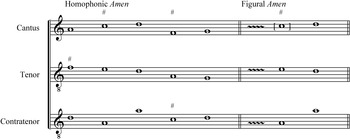
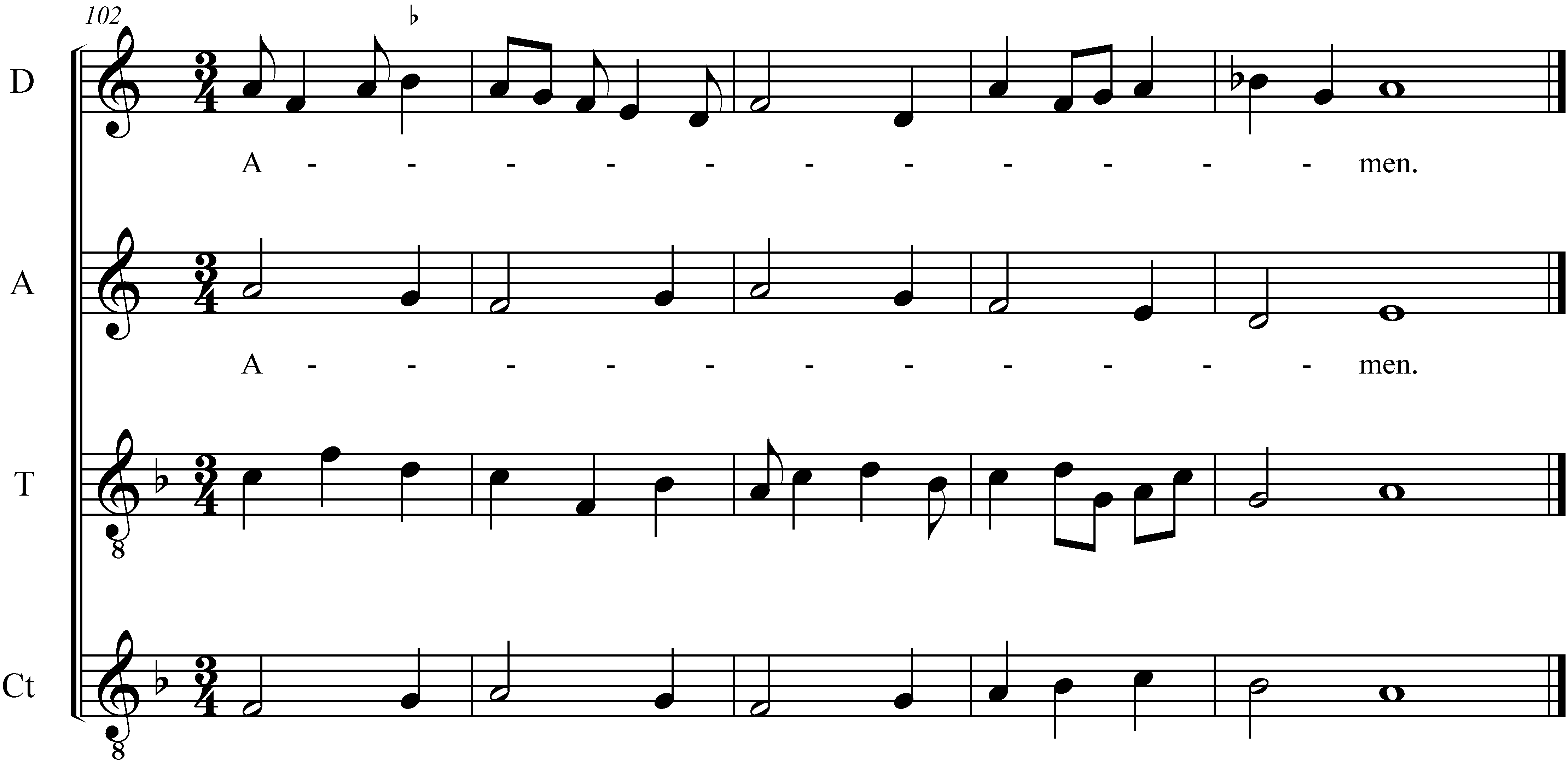
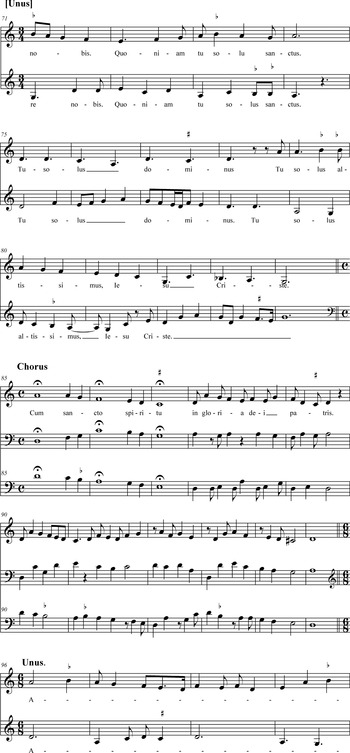
Given the ubiquity of lengthy figural Amen sections in early Gloria and Credo settings, it would be tempting to assume that every longer Amen originated with the composer, and that shorter versions of the same Amen must be later, scribal abbreviations. In cases, such as the reading of the Binchois Credo in Tr92 discussed above, there is codicological evidence to support this assumption. Sometimes, though, an uncharacteristic turn of phrase or marked change in texture suggests that a figural Amen was actually extended at some point in its transmission. The Q15 reading of the figural Amen for Ciconia's Gloria (Q15, no. 71; Tr87, no. 31), for example, contains an extended duet on the penultimate note in the Tenor that is unparalleled in Ciconia's oeuvre and stylistically incongruous with the rest of the Amen. A different Amen is given in the only other concordant source, Tr87 (see Ex. 4).Footnote 51 Since the carefully conceived manuscript Q15 is situated closer in time and space to Ciconia's milieu, one might wish to give its reading priority over that found in the later, more casual Trent source. However, the style and construction of the Amen setting in Tr87 suggests that it may reflect more closely the Amen Ciconia originally wrote. In both readings, the figural Amen begins in typical Ciconia fashion with a short motive treated imitatively, followed by a second motive, likewise in imitation. In Tr87 the voices then carry out a standard concluding cadence on F. In Q15, however, the Tenor pauses on the penultimate G for a full four breves before finally resolving to F. Meanwhile, the upper voices engage in an uncharacteristically busy minim-against-minim passage that sounds out of place in the otherwise imitative texture.
Ciconia, Gloria (transcription based on PMFC 24:5).

On the surface, it may seem that this claim of extension rests on the grounds of assumptions about style and convention that I dismissed with respect to the Binchois Amen. However, there is one important difference here: the layout of the short, Tr87 reading of the Ciconia Gloria shows no signs that a lack of space led its scribe to abbreviate the Amen. The Amen is found on the first three lines of a new opening, with a Credo notated on the next line down. Unless the scribe copied this Credo first, allotting only three lines for the Amen of the preceding Gloria (an unlikely scenario), there would have been sufficient space on this new opening for the longer version of the Amen. The manuscript layout, then, suggests extension in Q15, rather than pragmatically motivated abbreviation in Tr87. Responsibility for this alteration must lie either with the Q15 scribe or with the scribe of his exemplar. Meanwhile, a version related more closely to the putative original must also have circulated, and it is this version that was copied into Tr87 in the 1440s.
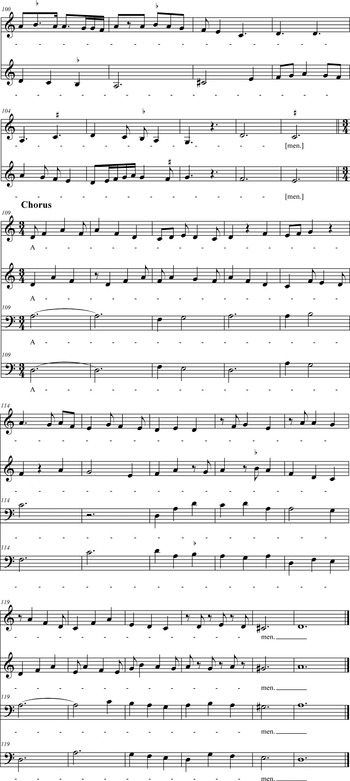
The unusual structure of the figural Amen of an Antonio Romano Gloria found uniquely in Q15 suggests that, like the Ciconia Gloria discussed above, it was subject to scribal manipulation.Footnote 52 Romano's Gloria has been identified by Margaret Bent as one example of a specific type of unus/chorus pieces, known as ‘a versi’.Footnote 53 Most unus/chorus pieces consist of alternating two- and three-voice sections, with the Tenor dropping out during the duets. Consequently, these pieces need only three singers (Cantus I, Cantus II and Tenor). Those unus/chorus works that are written a versi uniquely require four rather than three singers: the duets (unus) are typically sung by Cantus I and Cantus II, while the three-part sections (chorus) are sung by Cantus I, Contratenor and Tenor. Romano's Gloria contains the alternating a2 and a3 sections characteristic of a versi pieces, and it finishes with a lengthy Amen section of which the first half is a2 and the second half is a4 (see Ex. 5).Footnote 54 The latter section requires all the performers to participate at once – for the first and only time in the movement. This stands out as one of the few instances in extant a versi pieces where an a4 section is present.Footnote 55 Could this a2/a4 Amen be the result of a musically competent scribe – possibly, although not necessarily, the scribe of Q15 – wishing to create a more substantial conclusion to the movement, and mediating the move to four parts with an intervening a2 section? In the absence of concordances, this must necessarily remain no more than speculation. However, if it were correct, one should expect to find remnants of the pre-existing Amen somewhere. These can indeed be found in the concluding melisma on ‘patris’, where all voices cadence on the D final at ‘-tris’ before embarking on a brief figural melisma. If, as I propose, the a2/a4 Amen is a later accretion, then what appears now to be a concluding melisma on ‘patris’ is likely to have been the original, self-contained, figural Amen.
Romano, Gloria (transcription based on CMM 11/6: 152–153).


There are several instances in which a Contratenor is either left out of the Amen entirely, or behaves differently in an Amen than it does in the body of the work. In these cases, either the Contratenor or the Amen must be a subsequent addition. A clear example of an added Contratenor is found in Brassart's Gloria that has two incarnations in Q15: one as a discarded Stage II bifolio used as front flyleaves for the manuscript, another as a slightly later recopy.Footnote 56 The earlier version of the Gloria was scored for three voices (C–Ct–T) and occupied a single opening.Footnote 57 At some point during Stage III of the book's compilation, the scribe acquired a version of the piece with a different Contratenor. There was insufficient room for it on the original copy, so he recopied the piece on two openings and included the new Contratenor as an alius Contratenor.
Significantly, this alius Contratenor does not participate in the figural Amen. Whether or not the version of the Gloria originating with the composer had a Contratenor remains an open question. Still, it is safe to assume that it included a self-contained Amen of some sort. Being self-contained, the Amen could in principle be removed from the body of the work without disrupting its logic. Accordingly, one can hypothesise that one branch of the stemma transmitted a version with a figural Amen and the Stage I Contratenor, while another branch transmitted one with a short Amen or no Amen at all. The scribe of Q15 initially had access to the first version, and later came across a Contratenor that had been composed to go with the second version (without the figural Amen). He did not consider this alius Contratenor to be problematic, however; probably a singer choosing the alius Contratenor would simply revert to the original Contratenor upon arrival at the Amen.
Inconsistency in Contratenor function between the body of a movement and its Amen can help establish a chronology of emendation, as is the case in the BU reading of a Gloria variously attributed to Antonio Zacara da Teramo (Q15 indexer), Bosquet (MuEm) and Nicolaus de Capua (BU).Footnote 58 The Q15 reading is patently corrupt: it provides only Cantus I and Cantus II, even though at the very least a Tenor is required to eliminate the frequent fourths that occur between these voices. These upper parts are concordant with the MuEm reading, which is given a4. In MuEm, the upper voices are in the same range and interact in dialogue fashion, while the lower voices move note-against-note for the most part. These relationships are maintained in the brief figural Amen that concludes the movement. As all the voices are stylistically and functionally consistent throughout, the MuEm reading is unproblematic.
The BU reading diverges considerably from that in MuEm/Q15.Footnote 59 The MuEm Contratenor is here replaced with a much more active Contratenor, and the Amen is completely unrelated to the MuEm/Q15 Amen. The BU Amen shows every indication of having been composed specifically to provide a motivically related musical match to the Gloria. Cantus I begins the Amen with a clear reference to its opening phrase, while underneath it the Tenor sounds the first four notes of the color. In the body of the Gloria as well as in the Amen, the BU Contratenor is much more active than the Contratenor in MuEm. It has been proposed that the Capua attribution in BU in fact refers to this addition of an updated Contratenor.Footnote 60 If Capua added the Contratenor to update the texture, it seems probable that he composed the new Amen as well, replacing the serviceable Amen found in Q15 and MuEm with one he found more aesthetically satisfying.
In light of their melismatic nature, one might suppose long Amen sections (homophonic or figural) to have been ideal for the addition of tropes, if not by the composer, then by later scribes. Surprisingly, though, there is only a handful of movements out of all extant fourteenth- and fifteenth-century Gloria and Credo settings for which tropes were supplied. The first instance occurs in the Ven recension of the Gloria from Du Fay's Missa Resvelliés vous. Footnote 61 The Ao readings of this Gloria provide a long, self-contained Amen without tropes and are concordant with the version transmitted in Q15.Footnote 62 Ven, however, omits both the Contratenor and the long Amen, transmitting instead a continuous, figural Amen.Footnote 63 An examination of the piece as a whole reveals that this is the result of creative re-texting that takes advantage of the last of the long melismas with which Du Fay concludes each of the three sections of the movement (at ‘gloriam tuam’, ‘deprecationem nostram’ and ‘patris’). Whether the scribe omitted the self-contained long Amen found in Ao and Q15 in order to avoid having the piece spill over onto the subsequent opening, or whether he simply did not have access to it, the need for a concluding Amen was easily met by texting the word ‘Amen’ under the pre-existing melisma on ‘patris’. The Cantus voice of the resulting continuous figural Amen is supplemented with a generic textual trope in praise of Christ: ‘Gloria sit semp[er] tibi D[omi]ne Yh[es]u [Christ]e’.
The only other instance of Amen tropes in the major sources for early fifteenth-century polyphony occurs in the Gloria–Credo pair by Du Fay that constitutes Heinrich Besseler's fourth fragmentum bipartitum.Footnote 64 The Gloria and the Credo both conclude with a lengthy, self-contained figural Amen. In both of these Amen sections, tropes are laid under a melodic phrase that is heard in succession in all four voices. Each iteration of the melody is distinct, and is heard in relief against the surrounding material, which is made up of the imitative and hocket passages characteristic of figural Amen sections.Footnote 65 At Stage I of the copying of Q15, the scribe added the Easter text ‘Resurrexit dominus, alleluia/Et apparuit Petro, alleluia’ to the Amen.Footnote 66 This early inclusion attests to its presence in his exemplar. This was probably not the case, however, with the lewd French text (‘tu m'a[s] monté su[s] la pance et riens n'a[s] fait/otre te reface dieu que ce m'a fait’) found below the Latin words, and added at Stage II.Footnote 67 One can only speculate as to why the scribe decided to add them so long after having originally copied out the piece. Besseler states unequivocally that ‘the melody in the Gloria is that of a French folksong’.Footnote 68 Although he was unaware of the lapse in time between the inscription of the Latin text and the addition of the French text and though he provides no evidence for his assertion, his theory appears to be supported by the copying chronology. If the troped melody is indeed a bawdy French folksong, the Italian scribe was unlikely to have been aware of it. At some point in Stage II, he may have been apprised of the original text of the melody, and added it underneath the Latin text – not for performance, one assumes, but rather for his own private amusement and that of his colleagues.
In Q15, the Credo Amen also contains vernacular text in addition to the Latin. Unlike the Gloria tropes, however, the vernacular Credo tropes are Italian (‘La vilanella non e bella se non la dominica’) and were written in at Stage I of the copying process. William Prizer has located this text in Petrucci's Frottole IX (Venice, 1509), where it appears, set to a different melody, as a refrain in a barzelletta by Antonio Capriolo.Footnote 69 The early inclusion in Q15 suggests that the scribe may have recognised the jaunty, triple-meter tune himself and made a note of it in his copy of the piece.Footnote 70 This would help explain his interest in including the French text for the Gloria melody when he came across it some years later.
While these vernacular texts were almost certainly not intended to be sung, the Latin tropes probably were. In both the Gloria and Credo, the added Latin texts effectively make the movements proper to the Easter season and may in fact, as Besseler argues, have been called for by Du Fay.Footnote 71 In BU and Q15, the Credo Amen is supplemented with the following verses, taken from a well-known Easter prose Surgit Christus cum trophaeo:Footnote 72
Constructed as a dialogue between the speaker and Mary Magdalene regarding Christ's crucifixion and resurrection, Surgit Christus circulated widely in medieval Europe.Footnote 73 Ca6 and Ca11 provide an entirely different set of Latin texts for the Credo Amen. In these sources, the text ‘O Maria virgo pia, esto nobis propitia’, rather than the Surgit Christus excerpt, is sung by each voice in succession.
While the Cambrai sources and the Italian sources transmit different trope texts for the Credo Amen, they share an emphasis on the Virgin Mary: the text as given in BU and Q15 refers obliquely to the weeping Virgin (‘matrem flentem’) witnessing her son's death, while the Cambrai sources invoke her directly.Footnote 74 This attention to the Virgin occurs not just in the concluding Amen, but also in the body of the Credo itself, where the words ‘ex Maria virgine’ are set homophonically, with each chord marked by a fermata. As noted earlier, this type of homophonic fermata passage frequently occurs on the words ‘Jesu Christe’ in fifteenth-century Gloria settings and effectively emphasises these important words.Footnote 75 Du Fay seems to have liked using this device to draw attention to specific passages, drawing out highlighted aphorisms from the lengthy texts.Footnote 76 In the Credo under examination, the combination of homophonic writing in the body of the movement and Marian references in the Amen tropes creates a kind of metatext that emerges as the piece unfolds in time. In Q15, our attention is drawn first to Christ's birth, at once human and miraculous, ‘ex Maria virgine’. Subsequently, the Amen invites the listener to witness through the eyes of Mary Magdalene the weeping of Mary (‘Maria virgine’) upon the death of her son. The mother's tears testify to Christ's humanity, while the Angel's voice reminds Mary Magdalene of his divinity. In Cambrai, the combination of homophony and tropes generates a different metatext, one in which the Virgin's status as intercessor as projected in the Amen is connected to her role as Mother of God.
The presence of any tropes at all in the northern sources Ca6 and Ca11 implies that the exemplar on which they were based circulated with tropes. Their difference from those in BU and Q15 may indicate a scribal desire to apply a local Marian text to the Amen. The Cambrai trope, like Surgit Christi, has the regular accent-pattern of a sequence or prose and, although I have been unable to find an exact textual match for it, similar texts are found in northern and English sources.Footnote 77 While they are, of course, far removed from the Cambrai tradition, we can speculate that one of the local scribes, or the scribe of the exemplar from which these northern scribes worked, was familiar with a similar rhyming text and that he added this to his version of the Du Fay Amen.
Having established the polyphonic Amen section as a common site for editing and reworking in the early fifteenth century, new light can be shed on the Franchois Credo with which this article began, and the astonishing disparity among the readings of its concluding Amen. As noted above, the self-contained figural Amen that appears in all sources apart from Ox ends on a different final (D) than does the body of the work (G). This is highly unusual. With the exception of the Arnold de Lantins Mass pair, all the Gloria and Credos setting transmitted in the sources surveyed are tonally consistent. In the case of the Lantins pair, the unusual ending prompted the BU scribe to emend the ending of the Credo and to try, albeit unsuccessfully, to do the same in the Gloria. The odd move to D in the long Amen of the Franchois Credo seems to have spawned a similar set of emendations, giving rise to the diverse constellation of self-contained Amen sections summarised in Example 1. That the continuous figural Amen of the preceding Gloria, also by Franchois and also concluding on D rather than the expected G, was not subject to alteration underscores the apparent unwillingness of scribes to meddle with Amen sections continuous in texture with the preceding material.
The scribes of Ca11 and Ao were undisturbed by the tonal inconsistency. In the Ca11 reading, the figural Amen is transmitted without alternatives. The scribe prioritised the figural Amen, devoting an entire page (fol. 41v) to it and, in a reversal of the usual situation, omitting the homophonic Amen when it became clear there would be no room for it. This is consistent with his tendency to copy out figural Amen settings before homophonic ones, which he labels ‘aliud’.Footnote 78 The Ao scribe provides both a homophonic Amen and a figural Amen, but these offer choices in length rather than in mode: the homophonic Amen corresponds to the first three sonorities of the Q15 homophonic Amen, such that both the figural Amen and its shorter alternative end on D.
The figural Amen is preceded in Q15 by a homophonic Amen consisting of five sonorities and ending on the expected final, G. Users of this anthology would thus have had a choice between a chordal Amen consistent modally with the body, ending on G, or a figural Amen consistent stylistically with the body. Its resemblance to the longer self-contained homophonic Amen sections found frequently in the works of Du Fay and others leads one to speculate that it was composed as a less pedestrian alternative to the abbreviated Amen settings that abound in these sources. No doubt the Q15 scribe retained the figural Amen even as he supplied a homophonic one because he recognised its affinity with the figural Amen of the Gloria with which the Credo is paired.
The Ox reading is the most puzzling. Its two homophonic Amen settings (fol. 75v) correspond to the two main elements of the Q15 Amen, transmitted in reverse order, however, and separated by a line of demarcation. The absence of the figural Amen can be explained rather easily through lack of space. This becomes clear when we compare the Franchois Credo to the only other Credo in Ox with the same layout (i.e. in both, the second opening provides the music from ‘Et in spiritum sanctum Dominum’ onwards): the three-voice Credo by Bartolomeo da Bologna given on fols. 136v–138r. The scribe planned the layout of the second opening of the Bartolomeo Credo with care, leaving enough room to fill the remainder of the opening with Morir desio po’ che fortuna, on which the Credo is based. He was more conservative in allotting space for the conclusion of the Franchois Credo, though. He squeezed the section starting with ‘Et in spiritum’ onto the verso of the second opening – ending up with extra space at the bottom of the page – and filled the facing recto with two secular songs. Nevertheless, he was sufficiently astute to provide modal alternatives for this movement: the first of his homophonic Amen settings ends on G while the second ends on D.
Taking these observations into account, the following scenario emerges as the most likely. The Q15 scribe had access to an exemplar with a figural Amen and possibly also the short chordal Amen. The latter may have originated with the composer or it may have been added at some point during the transmission, when someone found the move to D at the end of the figural Amen unpalatable. This person is unlikely to have been the scribe of Q15, as his collection shows a predilection for long Amen sections and an effort to assert pairings. The Ox scribe may have had access to a similar (if not the same) exemplar, but chose to omit the figural Amen. He noticed, however, that the figural Amen cadenced on D. This led him to rearrange the elements of the short Amen to allow for the same tonal alternatives we find in Q15: a final cadence on G and a final cadence on D. We may safely assume from the line of demarcation – which would be unnecessary if these were both meant to be sung back-to-back – that, as with the Gloria by Hugo de Lantins, these are meant to be alternatives to each other.
***
In his entry on ‘Amen’ in the new MGG, Schlager suggests that the Amen (both monophonic and polyphonic) grew, over the course of the Middle Ages and into the Early Modern period, into a self-sufficient section, formed according to the principles of absolute music.Footnote 79 Whether or not we can actually hear these figural Amen settings as ‘absolute music’, it must be noted that the lack of text-dependence to which Schlager refers made them especially vulnerable to alteration. Musical phrases could be added, lengthened or removed altogether, and the text itself would still make sense. A scribe with a preference for the extended Amen option would be able to interpolate phrases into an existing setting, perhaps to emphasise a structural element such as unus/chorus alternation, or to add variety to a setting he considered monotonous.
In examining the major sources of polyphony from the early 1400s, this article has endeavoured to provide insight into the range of revisions scribes could make when copying out the final section of a Gloria or Credo movement. Occasionally, as in the Tapissier-Fabri Mass pair, the replacement of a pre-existing, self-contained Amen with a new one could be used to effect an entirely new, scribe-originated pairing of movements. Sometimes, as was the case with the Franchois Credo and the Arnold de Lantins Mass pair, the reasons for instability can be connected to discomfort at a concluding cadence located on a pitch other than the final. More frequently, the instability of an Amen can be traced to pragmatic issues such as space constraints. Often, in such cases, the scribe abbreviates a figural Amen in order to fit a movement onto a single opening. In extreme situations, an Amen might be excised altogether and replaced with a short, homophonic Amen, essentially an abstracted cadence. Multiple exemplars might then circulate, some with the longer Amen, others with the shorter.Footnote 80 If a scribe had access to both, or to an exemplar with both, he would likely include both options in his copy of the movement. He might mark one ‘aliud’ (Ca11, Ox and Ao) or he might refrain from labelling what he felt was perfectly obvious (Q15) – that one was an alternative to the other.
In contrast to the self-contained Amen, continuous Amen settings were transmitted with remarkable stability. Without exception in the sources I examined, works in which the body of the piece flows seamlessly (via a bridging cadence or overlapping counterpoint) into the concluding Amen are transmitted with the latter concordant in all sources. Probably their complicated binding to the preceding music made it daunting for even the most accomplished scribes to consider removing them. After all, unlike self-contained Amen sections, these continuous settings could not be replaced with the sort of simple abstract cadence that most scribes would surely have been able to compose. Self-contained settings, however, were appendages to the main text, unnecessary for the aural resolution of the piece. They could be excised cleanly from the preceding Gloria or Credo and replaced with something entirely different without destroying the musical or textual coherence of the setting. Moreover, coming as it does at the end of the piece, a self-contained figural Amen would have been the saving grace of a scribe determined to fit a movement onto one opening. He need only truncate the Amen at an appropriate cadence and he would have a performable reading conforming to the space constraints of his manuscript.
Admittedly, the motivations for revision that I have suggested here cover but a narrow range of possibilities, and I have projected them onto a cast restricted entirely to scribes and composers. In all the cases discussed, modifications to Amen sections seem to be connected either to practical exigencies (for instance, when a scribe ran out of room) or to what we might call ‘aesthetic’ considerations (when one long Amen was replaced with another). Additional reasons for revision and for the presentation of long and short Amen settings could certainly be imagined as viable alternatives, however, and scribes and composers would have been far from the only people with an interest in how long or short these settings were or how they sounded. Given how considerably liturgical and ritual practices changed over time and how they varied over space, it is possible, even likely, that this fluidity was reflected in the two most substantial components of the Mass Ordinary.Footnote 81 In the case of the Dufay Mass pair transmitted with a troped long Amen, the substitution of the Easter tropes given in the Italian sources (Q15 and BU) for Marian tropes in the Cambrai manuscripts (Ca6 and C11) is suggestive of broader liturgical concerns. On the one hand, the tropes, rather like a cantus prius factus, are a means of ‘propering’ the Mass Ordinary, and their inclusion makes the long Amen a locus of devotional significance.Footnote 82 On the other hand, the appearance of the short, self-contained Amen also brings to mind John XXII's clear, if ineffectual, proscription of hockets in sacred music, and raises the possibility that such concerns may have persisted in some areas, among some clerics, in the fifteenth century.
In his article on the scribally asserted pairing of the Tapissier Credo with the Fabri Gloria, Palmer comments that the emendations we find in the Q15 readings of the Amen sections of these movements ‘are not isolated instances [and that] … apparent revisions to concluding Amens are unusually conspicuous among the Gloria-Credo pairs in Q15. Just why these endeavors should seemingly be so concentrated at the ends of movements remains unclear.’Footnote 83 In light of the examples considered in this article – of which many more exist in the sources under consideration – we can refine Palmer's statement and hypothesise as to why the concluding Amen was so frequently subject to scribal tinkering. Certainly these revisions ‘are not isolated instances’; they are by no means restricted to or even especially prevalent in the Q15 manuscript. Rather, emendation of concluding Amen sections was a common phenomenon in the early fifteenth century. Understanding the nature of these emendations and some of the factors that motivated them adds detail to our increasingly nuanced image of scribal activity and the cultures of musical authorship during this period.
Manuscript sigla used
- Ao
Aosta, Seminario Maggiore, 15
- Apt
Basilique Sainte-Anne Trésor 16bis (olim A 1° D 19)
- BCT
Tournai, Archives et Bibliothèque de la Cathédrale, B.C.T. A27
- BU
Bologna, Biblioteca Universitaria, 2216
- Ca6
Cambrai, Médiathèque Municipale, 6
- Ca11
Cambrai, Médiathèque Muncipale, 11
- Ivrea
Ivrea, Biblioteca Capitolare, 115 [IV]
- MuEm
Munich, Bayerische Staatsbibliothek, clm 14274 (olim Mus. ms. 3232a)
- OH
London, British Library, Add. 57950 (Old Hall)
- Ox
Oxford, Bodleian Library, Canon. misc. 213
- Q15
Bologna, Museo Internazionale e Biblioteca della Musica di Bologna, Q.15 (olim 37)
- Tr87
Trent, Castello del Buonconsiglio, Monumenti e Collezioni Provinciale, 1374 (olim 87)
- Tr92
Trent, Castello del Buonconsiglio, Monumenti e Collezioni Provinciale, 1379 (olim 92)
- Ven
Venice, Biblioteca Nazionale Marciana, MS ital. IX, 145 (=7554)
- W378
Warsaw, Biblioteka Narodowa, Lat F.I.378 (formerly in St Petersburg)
- W8054
Warsaw, Biblioteka Narodowa, III.8054 (olim Krasiński 52)
- Zw
Zisterzienser-Stift Zwettl, Bibliothek und Musikarchiv, without shelfmark

Note: explanation of abbreviations
- Dumoulin
J. Dumoulin et al., eds., La Messe de Tournai: Étude et Nouvelle Transcription (Tournai and Louvain-la-Neuve, 1988).
- PMFC 23A
Giulio Cattin and Francesco Facchin, eds., French Sacred Music, Polyphonic Music of the Fourteenth Century 23A (Monaco, 1989).
- Kaye 1992
Philip Kaye, ed., The Sacred Music of Gilles Binchois (Oxford and New York, 1992).
- CMM 11/1–7
Gilbert Reaney, ed., Early Fifteenth-Century Music, Corpus Mensurabilis Musicae 11 (Stuttgart, 1955–83).
- PMFC 24
Margaret Bent and Anne Hallmark, eds. The Works of Johannes Ciconia, Polyphonic Music of the Fourteenth Century 24 (Monaco, 1985).
- CMM 1/1–6
Heinrich Besseler, ed., Guillaume Dufay: Opera Omnia (Rome, 1951–1966).
- Borren1963
Charles van den Borren, ed., Polyphonia Sacra; A Continental Miscellany of the Fifteenth Century, rev. 2nd edn (University Park, PA, 1963).
- Widaman
Jean Widaman, ‘The Mass Ordinary Settings of Arnold de Lantins: A Case Study in the Transmission of Early Fifteenth-Century Music’, Ph.D. diss., Brandeis University, 1988.