I. INTRODUCTION
Intermetallic compounds play a vital role in designing new materials for various technology applications including refractory and structural applications, spintronic and magnetic and superconductivity applications. Ab initio study on rhodium-based intermetallic compounds Rh3X (X = Ti, Zr, Hf, V, Nb, Ta) has been carried out by Rajagopalan and Sundareswari Reference Rajagopalan and Sundareswari1 at ambient conditions and under compression. The discovery of Heusler alloys Reference Heusler2 has revolutionized the research field on intermetallics, since one can derive potential candidates for multifunctional applications. Full Heusler alloys (R2TX type where R = rare-earth, T = transition metal, and X = p-electron element of the periodic table) with L21 structure, and half Heusler alloys (RTX type) with C1b structure, have been studied Reference Kübler, Williams and Sommers3–Reference Cheng, Nadgorny, Bussmann, Carpenter, Das, Trotter, Raphael and Harris5 mainly for their half metallic character. Many such materials are reported to be ferromagnetic; some are spintronic with 100% spin polarization.
Several Heusler alloys Reference Wurmehl, Fecher, Kandpal, Ksenofontov, Felser, Lin and Morais6–Reference Krishnaveni, Sundareswari and Rajagopalan24 have been prepared and reported by experimentalists and also by theoreticians. The properties observed in half Heusler compounds include half metallicity, semiconductivity, giant magnetoresistance, or heavy Fermion state.
Increasing demand for energy necessitates finding alternative ways of generating electricity. Thermoelectric materials generate electric current using the Seebeck effect. The major challenge is the generation of very high thermoelectric current. Over the years, many half Heusler alloys have been investigated for their thermoelectric properties. The figure of merit (ZT) value characterizes the efficiency of the thermoelectric property of the given material. ZT = σS 2 T/κ, where T is the temperature, σ is the electrical conductivity, S is the Seebeck coefficient, and κ is the thermal conductivity which contains both the electronic and the lattice contributions. Increased efficiency of thermoelectric performance of a given material can be sought by enhancing its Seebeck coefficient, its electrical conductivity or lowering its electronic/lattice thermal conductivity. That can be attained by tuning the electronic structure of the given material. Reference Müchler, Casper, Yan, Chadov and Felser25
Mahan and Sofo
Reference Mahan and Sofo26
have reported that if the f-levels of any given system lie close to the Fermi level, then that system has good thermoelectric response. That motivates us to consider an f-electron-based rare-earth (R) ternary half Heusler compound, namely DyPdBi, which has been synthesized and reported earlier.
Reference Gofryk, Kaczorowski, Plackowski, Leithe-Jasper and Grin15
This compound DyPdBi crystallizes
Reference Gofryk, Kaczorowski, Plackowski, Leithe-Jasper and Grin15
in the cubic structure of MgAgAs type, with the space group 216
 $\left( {F\bar 43m} \right)$
where Dy occupies the position (0,0,0), Pd occupies position (3/4,3/4,3/4), and Bi occupies (1/2,1/2,1/2) position.
Reference Larson, Mahanti, Sportouch and Kanatzidis12
Experimental investigations
Reference Gofryk, Kaczorowski, Plackowski, Leithe-Jasper and Grin15
show that DyPdBi is antiferromagnetic up to 3.5 K, exhibits metallic behavior at low temperature, and is semiconducting at high temperature.
In this paper, we report the electronic and transport properties of the DyPdBi compound as predicted by first principles electronic band structure calculations. Although much theoretical work has been reported for quite a number of thermoelectric materials, f-electron systems have not been explored extensively to the best of our knowledge. As one has to compare and look for possible accord between the existing experimental results for DyPdBi with that of the theory of strongly correlated f-electron systems, to begin with we performed band structure calculations on DyPdBi by applying different exchange correlation potentials. To study the thermoelectric properties of DyPdBi, the transport coefficients have been calculated by using Boltzmann theory. The BoltzTraP code, developed by Madsen and Singh Reference Madsen and Singh27 as implemented in the Wien2k package, was used to calculate the Seebeck coefficient, power factor, and other transport coefficients.
II. COMPUTATIONAL DETAILS
First principles band structure calculations have been performed on the DyPdBi compound using the full potential linear augmented plane wave (FP-LAPW) method with PBEsol-GGA Reference Perdew, Ruzsinszky, Csonka, Vydrov, Scuseria, Constantin, Zhou and Burke28 exchange correlation as implemented in the Wien2k (13.1) code Reference Blaha, Schwarz, Madsen, Kvasnicka and Luitz29 by generating the structure file with an experimental lattice parameter Reference Gofryk, Kaczorowski, Plackowski, Leithe-Jasper and Grin15 of a exp = 12.5388 a.u. The FP-LAPW method includes a procedure for solving Kohn–Sham equations for the ground state density, total energy, and eigenvalues of a many electron system by introducing a basis set. To determine the basis set, the given unit cell was divided into non-overlapping, touching spheres called muffin-tin (MT) spheres. The MT potential is assumed to be spherically symmetric close to the nuclei/core and is assumed to be plane in the interstitial region. The solutions of the Schrodinger equation outside the MT spheres are plane waves; in this region, the potential is constant. The solutions of the Schrodinger equation inside the MT spheres are made up of angular momentum partial waves. The solutions for the entire space are obtained by matching the two solutions at the boundaries of the MT spheres. The convergence of the combined basis set is controlled by a cutoff parameter R MT K max, where R MT is the smallest MT sphere radius in the unit cell, and K max is the magnitude of the largest K-vector. Also, the charge leakage from the core is kept minimal. The radii of the MTs used were 2.6, 2.6, and 2.62 a.u., Reference Cottenier30 respectively for Dy, Pd, and Bi, for the calculations performed initially without spin orbit coupling (SOC) on a k-mesh of 31 × 31 × 31 where RK max = 7 and G max = 10. Reference Yang, Li, Wu, Zhang, Chen and Yang31 Volume optimization and fitting in equation of states gives the optimized lattice constant as a opt = 12:5519 a.u.
In general, the intrinsic spin of the electron couples with its orbital spin angular momentum and gives rise to the total angular momentum. All energy levels except for the s-states of one electron atoms are thus split into two substates. This produces the fine structure of the spectral lines. The spin–orbit interaction scales as Z 2, hence it is important for atoms with high atomic numbers. For the present f-electron-based DyPdBi compound, one has to consider the effect of SOC. Accordingly, the above calculations were repeated by including SOC. In both the cases, self-consistent field calculations were performed, with an energy convergence of 0.0001 Ry, and charge convergence of 0.0001e. Splitting of f-electron bands of dysprosium at the Fermi level is well demonstrated by the Density of States (DoS) histograms that were drawn with SOC (see Fig. 2). This result ensures the good thermoelectric response of DyPdBi as suggested by Mahan and Sofo. Reference Mahan and Sofo26
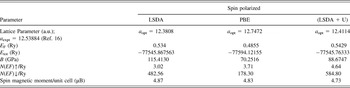
To explore the band structure of the f-electron-based ternary half Heusler compound DyPdBi, the band structure calculation has been extended by performing spin polarized calculations (as DyPdBi is experimentally reported to be magnetic) with local spin density approximation (LSDA), and with the Perdew–Burke–Ernzerhof (PBE) exchange correlation potential. The spin polarized calculation was performed with a k-mesh of 17 × 17 × 17. RK max = 7 and G max = 14 were used. The radii of the MT orbitals were 2.5 a.u. for Dy, 2.55 a.u. for Pd, and 2.6 a.u. for Bi. In this case also, self-consistent calculations were carried out with the energy convergence of 0.0001 Ry and charge convergence of 0.0001e. The optimized lattice parameter was calculated for each of the above mentioned exchange correlation schemes by fitting the volume optimization into the Birch–Murunaghan equation of state. The optimized lattice parameter (a opt), total energy (E tot), Fermi energy (E F), bulk modulus (B), DoS at Fermi level (N(E F)) of both the spin-up and spin-down states and spin magnetic moment/unit cell (µB) values of DyPdBi compound, by LSDA and PBE correlation schemes, are presented in Table I. The present compound DyPdBi is comprised of dysprosium (Dy) which has half-filled f-orbitals and is strongly correlated. The behavior of electrons in such systems can be described well by including the onsite Coulomb interaction in the conventional Hamiltonian. Hence the calculations were done by including the Hubbard potential for dysprosium. The Hubbard potential explicitly includes the Coulomb parameter (U) and Coulomb exchange parameter J for the 4f electrons. The value of the Hubbard potential for dysprosium is based upon the literature Reference Saini, Singh, Nautiyal and Auluck32 with U = 0.49 Ry and J = 0.05 Ry. Coulomb-corrected LSDA (LSDA + U) was applied, as this method, introduced by Anisimov et al., Reference Saini, Singh, Nautiyal and Auluck32 is found to be very efficient for several rare-earth compounds. Reference Saini, Singh, Nautiyal and Auluck34–Reference Saini, Nautiyal and Auluck40
Structural, electronic and magnetic properties of DyPdBi.

III. RESULTS AND DISCUSSION
A. Structural, electronic, and magnetic properties of DyPdBi
From Table I, it is clear that LSDA underestimates the experimental lattice parameter of DyPdBi, whereas the PBE calculation overestimates the same. Due to this, there is considerable shift in the Fermi energy level and fluctuation in the bulk modulus values of the respective scheme. The DoS at the Fermi energy level is very low for the spin-up states in comparison to that for the spin-down states. The spin magnetic moment per unit cell ranges between 4.73 and 4.87 µB.
1. Density of states
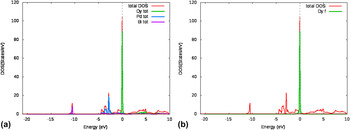
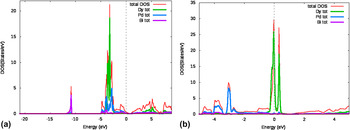
The total and partial DoS histograms of DyPdBi as calculated for PBEsol without SOC are shown in Figs. 1(a) and 1(b). From Fig. 1(a), one finds that the total DoS of the compound DyPdBi is around 110 states/eV at the Fermi energy level, of which around 90 states/eV are contributed mainly by dysprosium. Figure 1(b) suggests that it is only the Dy-f states that contribute to the total DoS of the compound. Thus, nearly 80% of the total DoS at Fermi level is due to Dy-f states alone.
(a) Total and (b) partial DoS histograms of DyPdBi without SOC.

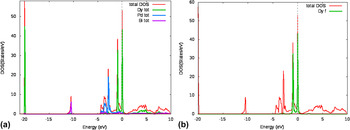
The total and partial DoS histograms of DyPdBi for PBEsol with SOC are presented in Figs. 2(a) and 2(b). From these figures, one can clearly see that the Dy-f states split into two levels; one level comprised of a few states below the Fermi level and the other comprised of a few states at the Fermi level. The states below the Fermi level are shifted down by 1.0 eV from the Fermi level. Figure 2(b) shows that the total DoS at the Fermi level is nearly 54 states/eV, of which 45 states/eV are contributed by Dy-f states. Comparison of Figs. 1 and 2 suggest that the inclusion of SOC in this calculation has reduced the influence of Dy-f states by approximately 50% at the Fermi level besides the splitting Reference Larson, Mahanti, Sportouch and Kanatzidis12 that is caused.
(a) Total and (b) partial DoS histograms of DyPdBi with SOC.

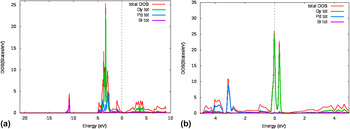
Though we performed spin polarized calculations for various exchange correlation schemes, viz., LSDA, PBE, and (LSDA + U) on DyPdBi, the DoS histograms are analyzed for LSDA and (LSDA + U) Reference Larson, Mahanti, Sportouch and Kanatzidis12,Reference Anisimov, Zaanen and Andersen33–Reference Singh, Saini, Nautiyal and Auluck39 alone as these methods are known to be rather efficient for many of the rare-earth compounds. Figures 3(a) and 3(b) show the total and partial DoS histograms of DyPdBi using LSDA for spin-up and spin-down states, respectively. Similarly Figs. 4(a) and 4(b) show the same for (LSDA + U). From Figs. 3(a) and 4(a) drawn for spin-up states, it is clear that the total, and hence the partial, DoS is very low of the order of 3–4 states/eV at the Fermi energy level. Inclusion of the Hubbard potential is not of much significance at the Fermi level for spin-up states. From Figs. 3(b) and 4(b), drawn for spin-down states, it can be inferred that the total DoS at the Fermi energy level is almost all due to dysprosium and has increased from 26 states/eV to 30 states/eV. The inclusion of the Hubbard potential did not have much influence on the DoS of dysprosium at the Fermi energy level.
DoS histograms for (a) spin up and (b) spin down states of DyPdBi by LSDA.

DoS histograms for (a) spin up and (b) spin down states of DyPdBi by (LSDA + U).

2. Band structure
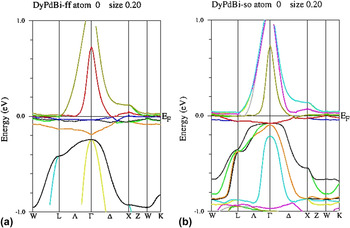
Electronic structure plays a major role in understanding the properties of a given material under ambient conditions. The band structure of the compound DyPdBi is shown in Figs. 5(a) and 5(b) without SOC, and with SOC, respectively. From Fig. 5(a), one can infer that without SOC the f-states of dysprosium spread around the Fermi level, making the compound more metallic.
Band structure of DyPdBi drawn (a) without SOC and (b) with SOC.

With the inclusion of SOC, from Fig. 5(b), it is observed that at the point, the f-states of dysprosium undergo splitting. The splitting is not as significant for the k-points that run from L to W and X to K points.
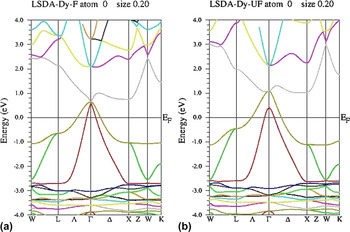
Figures 6(a) and 6(b) represent the band structure of spin-up states of DyPdBi for LSDA and (LSDA + U). Analysis of Fig. 6 shows that the spin-up energy bands of both LSDA and (LSDA + U) have a very narrow peak at the point and above the Fermi level, and the gap between adjacent bands comparatively increases in the LSDA + U calculation. This again depicts the metallic nature of DyPdBi. Mahan and Sofo Reference Mahan and Sofo26 has reported that the f-electron states which are more tightly bound in atoms bind little in solids and as a result they give larger contributions to the DoS which are of Lorentzian shape with rather narrow widths. In the present case of DyPdBi also, the spin-up states band structure displays such a narrow peak at the Fermi energy level. The existence of such a Lorentzian narrow peak with a sharp singularity close to the Fermi level is a signature for a potential thermoelectric material. The Lorentzian peak near the Fermi level enhances the electrical conductivity in spin-up states.
Band structure of spin-up states of DyPdBi (a) for LSDA and (b) for (LSDA + U).

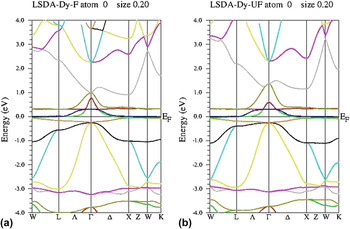
In contrast, the spin-down energy bands of LSDA and (LSDA + U) shown in Figs. 7(a) and 7(b) are flat, and they spread just above and below the Fermi level. Further, one can see that the conduction band minimum lies almost along the Fermi energy level except in the vicinity of the Γ point, but the valence band maximum lies just below the Fermi level at about 0.2 eV at the Γ point, showing semiconducting-like nature. The presence of such flat bands at the valence band maximum corresponds to a large effective mass and is another key factor to improve the thermoelectric efficiency. Reference Saini, Nautiyal and Auluck40 Thereby it is inferred that DyPdBi could be semimetallic since it exhibits metallic nature for spin-up band structure calculations, and semiconducting like behavior for spin-down calculations.
Band structure of spin-down states of DyPdBi (a) for LSDA and (b) for (LSDA + U).

B. Transport properties
The transport properties of DyPdBi were calculated by using the BoltzTraP code Reference Madsen and Singh27 interfaced to the Wien2k program. Further in reference with Refs. Reference Saini, Nautiyal and Auluck40 and Reference Rameshe, Rajagopalan and Palanivel41: The calculations are based on a semiclassical treatment for the solution of the Boltzmann equation utilizing the relaxation time approximation and the rigid body approximation. The Seebeck Coefficient (S), as a function of temperature (T) and doping (ρ), is given by
 $$S\left( {T,\rho } \right) = {{\int {{\rm{d}}E\,\sigma \left( E \right)\left( {E - \mu } \right){{{\rm{d}}f} \mathord{\left/ {\vphantom {{{\rm{d}}f} {{\rm{d}}E}}} \right. \kern-\nulldelimiterspace} {{\rm{d}}E}}} } \over {\int {{\rm{d}}E\,\sigma \left( E \right){{{\rm{d}}f} \mathord{\left/ {\vphantom {{{\rm{d}}f} {{\rm{d}}E}}} \right. \kern-\nulldelimiterspace} {{\rm{d}}E}}} }}\quad ,$$
where f is the Fermi function, μ is the chemical potential, σ(E) is the transport function given by, σ(E) = N(E)·V2(E)·τ(E), where N(E) is the DoS, V(E) is the band velocity, and τ(E) is the scattering time. Under the constant scattering time approximation τ(E) is independent of energy. Reference Singh42 The thermoelectric power factor S 2σ is assessed by the term σ(T) and is given by, σ(T) = ∫dE σ(E) df/dE.
The transport properties of DyPdBi based on PBEsol-GGA without SOC, with SOC and with (LSDA + U) calculations were estimated by applying the BoltzTraP code. The values of Seebeck coefficient, power factor, resistivity, σ/τ, and S 2σ/τ, at 300 K for Fermi energy thus calculated are listed in Table II. Analysis of this table shows that there is good agreement of our theoretical results with the available experimental data Reference Gofryk, Kaczorowski, Plackowski, Leithe-Jasper and Grin15 which give the Seebeck coefficient of 92 µV/K, power factor of 20 µW/(cm K2), and the resistivity of 422 µΩ cm. The BoltzTrap output that has been calculated for the scheme with SOC at 300 K for Fermi energy gives the Seebeck coefficient value to be 138 µV/K and the power factor to be 30.8 µW/(cm K2). The estimated power factor value matches well with that of existing potential thermoelectric materials, namely TiCoSb-based Reference Yang, Li, Wu, Zhang, Chen and Yang31 alloys that have a maximum power factor of 23 µW/(cm K2) at 850 K and 34 µW/(cm K2) for ZrNiSn-based alloys. Reference Cottenier30 The obtained Seebeck coefficient value matches well with that of yet another potential thermoelectric (TE) material, namely Fe2VAl, Reference Singh42 whose Seebeck coefficient is −130 µV/K at 300 K.
Transport properties of DyPdBi at 300 K for Fermi energy.

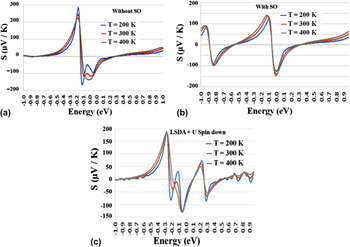
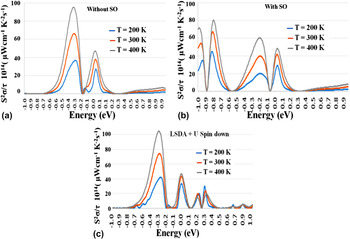
To look for the experimental positive Seebeck coefficient value, graphs are drawn and are explained below. The variation of Seebeck coefficient, S 2σ/τ values, with the total energy is plotted for PBEsol-GGA (Perdew–Burke–Ernzerhof revised for solids - generalized gradient approximation) without SOC, with SOC, and with (LSDA + U)—spin-down at temperatures 200, 300, and 400 K. These plots are presented in Figs. 8 and 9. In these figures, the reference level at zero represents the Fermi energy level in eV and the relaxation time is taken as 0.8 × 10⁻¹⁴ s as suggested in the BoltzTraP user manual. Analysis of Figs. 8(a)–8(c) reveals a peak in the Seebeck coefficient value and it remains positive just below the Fermi energy for temperatures 200, 300, and 400 K. This is in accordance with the reported literature Reference Gofryk, Kaczorowski, Plackowski, Leithe-Jasper and Grin15 that suggests the possibility that holes play a major role in the electrical and heat transport properties of the DyPdBi compound. Further, in Fig. 8(a), we see that the Seebeck coefficient is maximum at 200 K and decreases with increases in temperature, whereas in Figs. 8(b) and 8(c), it remains stable with temperature.
DyPdBi Seebeck Coefficient vs total energy (a) without SOC, (b) with SOC, and (c) LSDA + U (Spin Down).

DyPdBi S2σ/τ vs total energy (a) without SOC, (b) with SOC, and (c) LSDA + U (Spin Down).

S 2σ/τ is another important parameter to characterize a thermoelectric material as found by the research group of Dresselhaus et al. Reference Poudel, Hao, Ma, Lan, Minnich, Yu, Yan, Wang, Muto, Vashaee, Chen, Liu, Dresselhaus, Chen and Ren44–Reference Hicks and Dresselhaus46 Its variation with energy for DyPdBi at temperatures 200, 300, and 400 K is shown in Figs. 9(a), 9(b) and 9(c). One can find two peaks in Fig. 9(a), one below the Fermi energy level and the other almost at the Fermi energy level. The value of S 2σ/τ is maximum at 400 K for both the peaks and is found to decrease with a decrease in temperature. The same observation is seen in Figs. 9(b) and 9(c), except that there is an additional peak in the case of the scheme drawn with SOC, where the peak lies deep inside the Fermi level.
IV. CONCLUSIONS
The first principles calculation of the half Heusler DyPdBi compound is investigated and presented by using the FP-LAPW method as implemented in the Wien2k code. Different exchange correlation potentials, namely PBEsol with and without SOC, spin polarized LSDA, and LSDA + U were used. The optimized structural parameter of a opt = 12.4114 a.u.: was obtained by using LSDA + U and it matches well with the experimental data. Spin polarized calculations reveal that the DoS at the Fermi energy level is greater for spin-down states; it is very feeble for spin-up states. The spin magnetic moment per unit cell ranges from 4.73 to 4.87 µB in the above study. The DoS histogram drawn for PBEsol with SOC reveals the splitting of dysprosium f-states at the Fermi energy level. This is to be appreciated, as it is one of the requirements for being a good thermoelectric material. There is approximately a 50% reduction in the DoS of Dy f-electron states at the Fermi level by the inclusion of SOC. The inclusion of onsite coulomb interaction LSDA + U increases the total DoS at the Fermi energy level to 30 states/eV from 25 states/eV. The band structure of spin polarized LSDA + U calculations both for spin-up and spin-down states augments the possibility of DyPdBi to be a potential candidate for TE applications. The band structure of spin-up states reveals the presence of a Lorentzian narrow peak with a sharp singularity very close to the Fermi level, which is a signature for a potential thermoelectric material. Further, for spin-down states, the presence of localized flat bands that correspond to infinite effective mass at the valence band maximum is another key factor to improve the thermoelectric efficiency.
The calculated power factor 30.8 W/(cm K2) using PBEsol with SOC, and 34.76 W/(cm K2) by LSDA + U, at Fermi energy for 300 K are in good agreement with the experimentally reported values.
The above band profile investigations on DyPdBi suggest that it may serve as a good thermoelectric material. Further its efficiency can be improved by doping which allows one to tune the band structure of DyPdBi suitably to obtain maximum TE efficiency.
ACKNOWLEDGMENTS
MS thanks Prof. Dr. M. Rajagopalan of the Anna University for his constant support and encouragement, and Prof. Sushil Auluck, NPL, New Delhi for his valuable suggestions.