Implications
This work examined the effect of milking six times daily during the first 21 days of lactation on production and reproduction. Increasing milking frequency to six times daily for the first 21 days of lactation increased milk and energy-corrected milk (ECM) yields throughout the experimental period and later, during the entire lactation, for first and second lactation cows. This effect persisted in the succeeding lactation. No adverse affect was found concerning energy balance, mastitis, metabolic diseases or reproduction. Collectively, it seems that this practice will economically be beneficial for first and second lactation cows only on well-managed conventional or robotic milking farms.
Introduction
Traditionally, cows are milked twice a day over many years. Frequent milking (three times a day) increases milk production in dairy cows (Campos et al., Reference Campos, Wilcox, Head, Webb and Hayen1994; Erdman and Varner, Reference Erdman and Varner1995) and is routinely practiced in large commercial dairy herds in the United States and Israel. Upon widespread use of automatic milking systems in the 1980s (Kruip et al., Reference Kruip, Stefanowska and Ouweltjes2000), it was suggested that milking frequency be increased to more than three times a day. Several studies then indicated that frequent milking during early lactation increases milk production not only during the frequent milking period but also throughout the rest of the lactation (Bar-Peled et al., Reference Bar-Peled, Maltz, Bruckental, Folman, Kali, Gacitua and Lehrer1995; Hale et al., Reference Hale, Capuco and Erdman2003; Wall and McFadden, Reference Wall and McFadden2007). Everitt and Phillips (Reference Everitt and Phillips1971) were the first to show that frequent suckling during the first 10 weeks of lactation has a long carryover effect on milk production. Shortening the ‘window’ of frequent milking to 6 weeks (Bar-Peled et al., Reference Bar-Peled, Maltz, Bruckental, Folman, Kali, Gacitua and Lehrer1995) or 3 weeks during early lactation resulted in a carryover effect on milk production for the entire lactation (Hale et al., Reference Hale, Capuco and Erdman2003; Dahl et al., Reference Dahl, Wallace, Shanks and Lueking2004; Wall and McFadden, Reference Wall and McFadden2007). Similarly, milking six times a day starting 1 or 4 days after calving and continuing for 21 days resulted in higher production performance relative to that achieved by milking six times a day throughout the entire lactation (Eslamizad et al., Reference Eslamizad, Dehghan-Banadaky, Rezayazdi and Moradi-Shahrbabak2010). Soberon et al. (Reference Soberon, Lukas, Van Amburgh, Capuco, Galton and Overton2010) reported that primiparous cows respond better to high milking frequency (HMF), that is, four times a day, than multiparous cows; however, whether the HMF×lactation interaction is also relevant for 6× milking frequency is not clear.
Nevertheless, in most of the studies examining milking six times a day, the number of cows was relatively small (Bar-Peled et al., Reference Bar-Peled, Maltz, Bruckental, Folman, Kali, Gacitua and Lehrer1995; Dahl et al., Reference Dahl, Wallace, Shanks and Lueking2004; Eslamizad et al., Reference Eslamizad, Dehghan-Banadaky, Rezayazdi and Moradi-Shahrbabak2010). In light of this, we examined the interaction between milking six times a day in early lactation and lactation age. The animal population included cows from first, second and >second lactations. The effect of HMF during the first 21 days of lactation was examined throughout the remainder of the lactation period (short-term effect) and in the successive lactation (long-lasting effect). The examined parameters were as follows: milk production and ECM yield through lactations, energy balance after calving, postpartum metabolic diseases, changes in body condition score (BCS) and fertility.
Material and methods
Cows and experimental layout
The study was performed in a commercial dairy farm on 152 cows and heifers. Heifers were paired according to their predicted transmitting ability (PTA). Pregnant cows, 6 to 7 months in lactation, were paired according to predicted 305-day ECM yield, age, days in milk (DIM) and expected calving date. One cow from each pair was arbitrarily allocated to a control group milked three times daily (3× milking cows) and the counterpart to an HMF group milked six times daily through the first 21 days of lactation followed by three times a day until the end of lactation (6× milking cows). Actual accumulated 305-day ECM yield before calving of second lactation cows did not differ between the 6× and 3× milking groups (11 720 v. 11 623 kg, SEM=353, P>0.05) or between the groups for >second lactation cows (11 760 v. 11 732 kg, SEM=407, P>0.05). Heifers were paired according to their PTA. Cows were classified according to their postpartum BCS and those with BCS<2.75 were excluded from the trial. Cows that experienced abortion or suffered from acute mastitis before calving, and their counterparts, were also excluded from the experiment. In addition, pairs in which one of the cows was culled before completing 5 months in lactation postpartum were excluded from the analysis. The total number of cows remaining in the experiment was 122. Out of these, 32 cows were in first lactation, 40 were in second lactation and 50 were in advanced lactations (>second lactation).
During the first 21 days of lactation, cows from both groups were housed in a barn located 30 m away from the milking parlor. During this period, cows were fed three times a day with a total mixing ration (TMR) consisting of NEL, 1.749 Mcal/kg dry matter (DM); CP, 18.5% of DM; soluble carbohydrates, 38.4% of DM; forage NDF, 58.6% of DM. After 21 days of lactation, the cows were taken to the milking groups according to age and, respectively, fed TMR formulated according to National Research Council recommendations (Reference Nørgaard, Sorensen, Sorensen, Andersen and Sejrsen2001).
During the experimental period, the milking times for both groups were 0350, 1030 and 1830 h. Additional milkings for the 6× milking group were at 0630, 1300 and 2100 h. Note that in every shift, both groups were the first to be milked and the 6× milking group was also the last to be milked. During the summer, all cows were cooled six times a day by a combination of wetting and forced ventilation (Flamenbaum et al., Reference Flamenbaum, Wolfenson, Mamen and Berman1986) in the milking parlor holding yard before and between milkings.
Milk production and composition
Milk yield was recorded at each milking by electronic milk meters (GEA Westfalia, Oelde, Werner-Habig, Germany). Daily milk yield was then calculated by accumulation of all milkings at the particular day. Milk samples were collected once a week from every milking. For each cow, samples were pooled and delivered to the National Laboratory of the Israel Cattle Breeders Association for fat, protein and lactose analysis and somatic cell count (SCC). In addition, ECM yield was calculated according to the formula: ECM=0.1×milk (kg)+20.2092×protein (kg)+7.65×fat (kg).
BCS
The BCS was measured on a five-point scale (Ferguson et al., Reference Ferguson, Galligan and Thomsen1994) during the 1st week of the dry period, 1 week postpartum and at peak lactation (6 to 7 weeks postpartum). Cows were classified into one of the three categories: fat (BCS>3.25), normal (2.75<BCS<3.25) and thin (BCS⩽2.75), according to their BCS 1 week after calving. The difference in BCS between the 1st week after calving and peak lactation was calculated and three categories were defined: (i) cows that gained BCS during this period (+1), (ii) cows for which BCS did not change (0) and (iii) cows that lost BCS during this period (−1).
IGF-1 analysis
Blood samples were collected throughout the experiment: at the initiation of the dry period and on days 7, 21 and 35 after calving. Samples were collected at 0800 h (about 3 h after TMR distribution) from the coccygeal vein into sterile evacuated tubes containing sodium heparin (Vacutainer; Becton Dickinson and Co., Franklin Lakes, NJ, USA), and immediately placed on ice. Plasma was harvested by centrifugation at 1850×g for 20 min at 4°C and stored at −20°C until analysis. Plasma IGF-1 concentration was analyzed according to Plaut et al. (Reference Plaut, Cohick, Bauman and Baxter1991). In brief, 250 ml plasma was extracted with 300 µl glycylglycine HCl (0.1 M, pH 2) at 37°C for 24 h; 25 µl of the extracted plasma and 100 µl of anti-hIGF-I (NIH, Bethesda, MD, USA) were added to 275 µl of assay buffer (0.15 M sodium phosphate, 0.02% protamine sulfate, 0.2% bovine serum albumin, 0.02% sodium azide, pH 7.5). After 1 h at room temperature, 100 µl of 125IGF-I (20 000 cpm) was added and the tubes were incubated for 24 h at 4°C. Then, 100 µl of secondary antibody goat anti-rabbit immunoglobulin-G in phosphate buffered saline containing 0.2% normal rabbit serum was added, and incubation continued for another 24 h at 4°C. The hormone–antibody complex was precipitated by addition of 1 ml of 12% polyethylene glycol 6000 and centrifugation for 30 min at 4°C at 3000×g. The supernatant was decanted and the assay precipitates were counted in a Kontron gamma counter (Kontron Analytical, Munchenstein, Switzarland) with a log-logit program. Intra- and interassay CV were 5.7% and 8.7%, respectively.
Fertility features
Cows were routinely checked by the local veterinarian between days 5 and 12 postpartum. Endometritis diagnosis was based on uterine discharge. Cows with endometritis were treated with intrauterine antibiotics until discharge was resolved. At the same time, cows were scored for BCS and checked for ketosis (i.e. keto bodies in the urine). Cows diagnosed with ketosis were drenched with propylene glycol (300 ml/cow per day). In severe cases, corticosteroids were administered simultaneously. Cows were scored again for body condition at peak lactation, that is, 40 to 50 DIM.
Multiparous and primiparous cows were inseminated after a voluntary waiting period of 60 and 80 days, respectively. Cows were inseminated upon visual observations and/or excessive activity which was measured by pedometers (Afimilk, Kibbutz Afikim, Emek Hayarden, Israel). Cows that were not observed to be in heat after the voluntary waiting period were diagnosed for ovarian activity by the local veterinarian, respectively, treated with prostaglandin and inseminated. Cows that returned in heat were inseminated again. Pregnancy diagnoses were performed at 42 days postinsemination and again before drying off to confirm pregnancy. The examined fertility parameters were as follows: (i) interval from calving to pregnancy, (ii) days from calving to first insemination and (iii) conception rate from first insemination (i.e. number of pregnant cows divided by the total number of first inseminations).
Statistical analysis
Data analysis was carried out by SAS procedures (SAS Institute, Reference Silanikove, Merin and Leitner2002). Variables not associated with reproduction were analyzed by the MIXED procedure. Continuous variables (monthly milk and ECM yields, protein and fat percentages, and protein and fat yields, log SCC and IGF-1 concentrations) were analyzed as repeated measurements. The effects of BCS at week 1 after calving and the change in BCS between week 1 postpartum and peak lactation on milk and ECM yields were analyzed as class variables. The fixed effects in the model were treatment (control or HMF) and age (lactation=1, 2 or >2). The effects of treatment, age×treatment and age×treatment×month of lactation (ML) were tested. The differences between the categories were tested using the PDIFF option (SAS Institute, Reference Silanikove, Merin and Leitner2002).
The following model was used:
 \eqalignno{$$Y_{{ijklm}} \,=\,&\mu {\plus}T_{i} {\plus}L_{j} {\plus}C(T{\rm {\times}}L)_{{ijk}} {\plus}ML_{{ijkl}} {\plus}ML_{{ijkl}} \cr& {\times}ML_{{ijkl}} {\plus}ML_{{ijkl}} {\times}ML_{{ijkl}} {\times}ML_{{ijkl}} {\plus}E_{{ijklm}}} $$
where Y ijklm is the dependent variable, μ the overall mean, T i the treatment effect i, L j the lactation, j=1, 2 or >2, C(T×L) ijk cow k nested in treatment i and cow nested in lactation j, ML ijkl the month in milk and E ijklm a random residual.
A similar model was run in which the three disease effects were examined as class variables: metritis (0=negative or 1=positive), ketosis (0=negative or 1=positive) and mastitis (0=SCC<250 000 cells/ml or 1=SCC>250 000 cells/ml). The interactions of each disease with treatment were also tested. The distribution (%) of non-affected and affected cows between categories was tested by χ 2 test in the FREQ procedure. The analysis of fertility performance was carried out by PHREG, FREQ and LOGISTIC procedures of SAS (SAS Institute, Reference Silanikove, Merin and Leitner2002). Differences between categories were tested by the PDIFF option (SAS Institute, Reference Silanikove, Merin and Leitner2002). Least squares means and adjusted SEM are presented in figures; P<0.05 was used for significance testing unless otherwise stated.
Results
Milk and energy-corrected milk yield
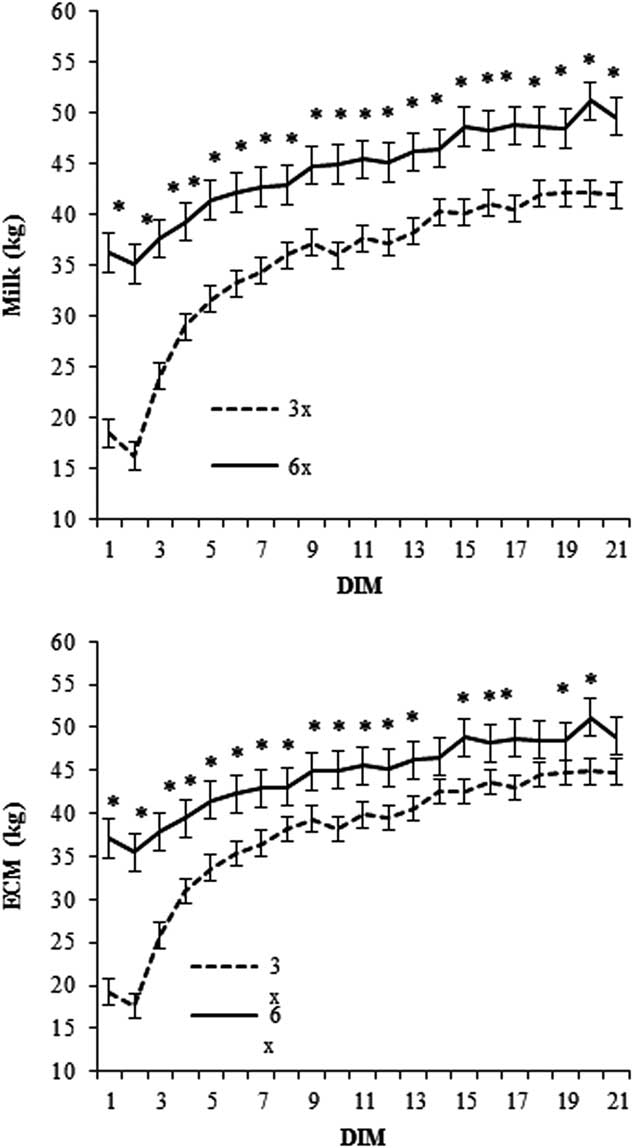
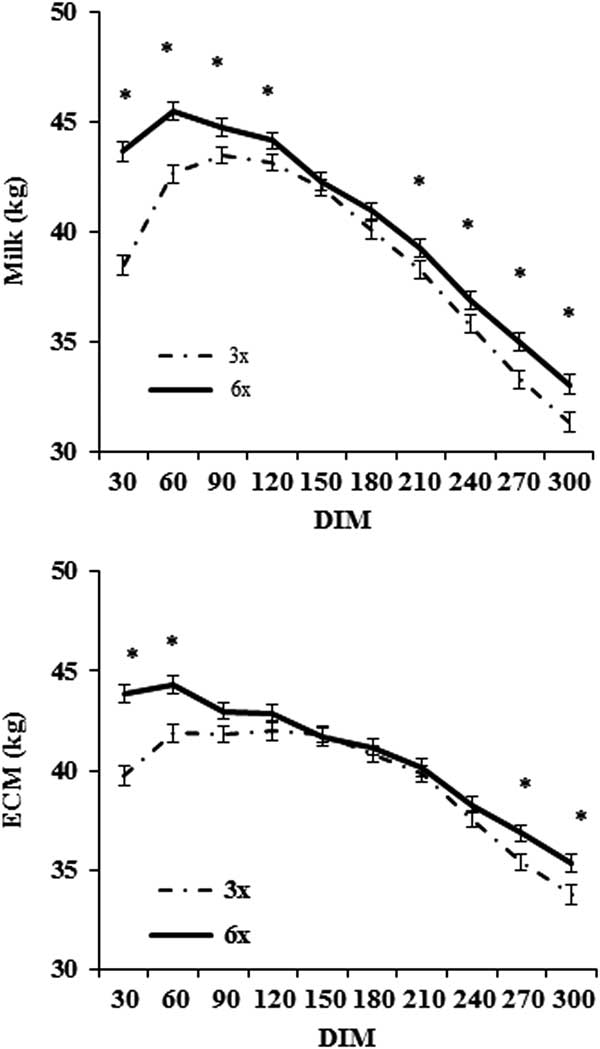
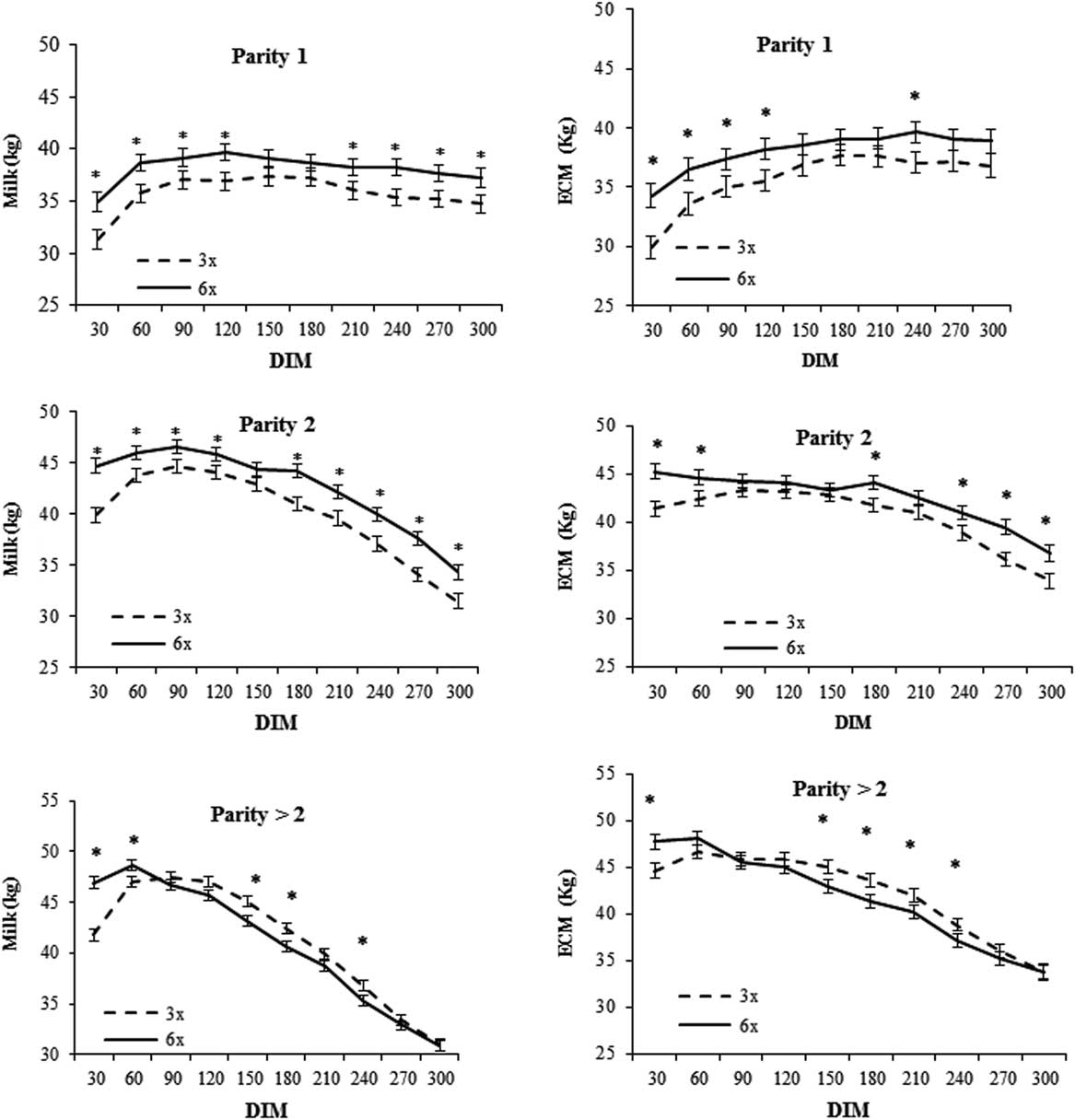
Average milk and ECM yields of 6× milking cows were significantly higher during the first 21 days of lactation (P<0.05, Figure 1). After conversion to 3× milking and throughout the remaining lactation, their milk and ECM yields remained higher than in the control group (Figure 2). For the 305 days of lactation, the difference in milk yield was 503 kg (P=0.001) and in ECM 395 kg (P=0.001) in favor of the 6× milking group. The effects of treatment on milk and ECM yields differed between lactations (lactation×treatment interaction, P<0.05). In the first and second, but not in >second lactation, the milk and ECM yields of cows subjected to HMF were much higher than those in the control group (P<0.05, Figure 3). Milk yield for 305 days of lactation was higher in the HMF v. control group by 756 and 832 kg for the first and second lactation cows, respectively (SEM=152 and 125 kg, respectively, P=0.001). The differences in ECM yield were 692 and 603 kg for the first and second lactation cows, respectively (SEM=79.3 and 134 kg, respectively, P=0.001). The milk and ECM yields did not differ between groups of >second lactation cows (P>0.05).
Daily milk and energy-corrected milk (ECM) yields of all cows in control (3×) and experimental (6×) groups during the first 21 days of lactation. *Significant difference (P<0.05) between treatments. Data are presented as least squares means±SEM (P<0.05). DIM=days in milk.

Average 305-day daily milk and energy-corrected milk (ECM) yields of all cows in control (3×) and experimental (6×) groups. *Significant difference (P<0.05) between treatments. Data are presented as least squares means±SEM. DIM=days in milk.

Average 305-day daily milk and energy-corrected milk (ECM) yields of cows by lactations (first, second or >second) in control (3×) and experimental (6×) groups throughout the entire lactation. *Significant difference (P<0.05) between treatments. Data are presented as least squares means±SEM. DIM=days in milk.

The lactation×treatment×month interaction revealed higher milk production by the first and second lactation cows from the 6× milking group relative to the control group throughout lactation (P<0.05), whereas the ECM was higher at 30, 60, 270 and 300 DIM (P<0.05) in the former. Milk production by the >second lactation cows through the first and second months of lactation was significantly higher for the 6×milking cows v. controls, but then became lower at 150, 180 and 240 DIM (P<0.05). Similarly, the ECM yield was higher for the 6× milking cows v. controls in the first ML, and then became significantly lower between 150 and 240 DIM (P<0.05).
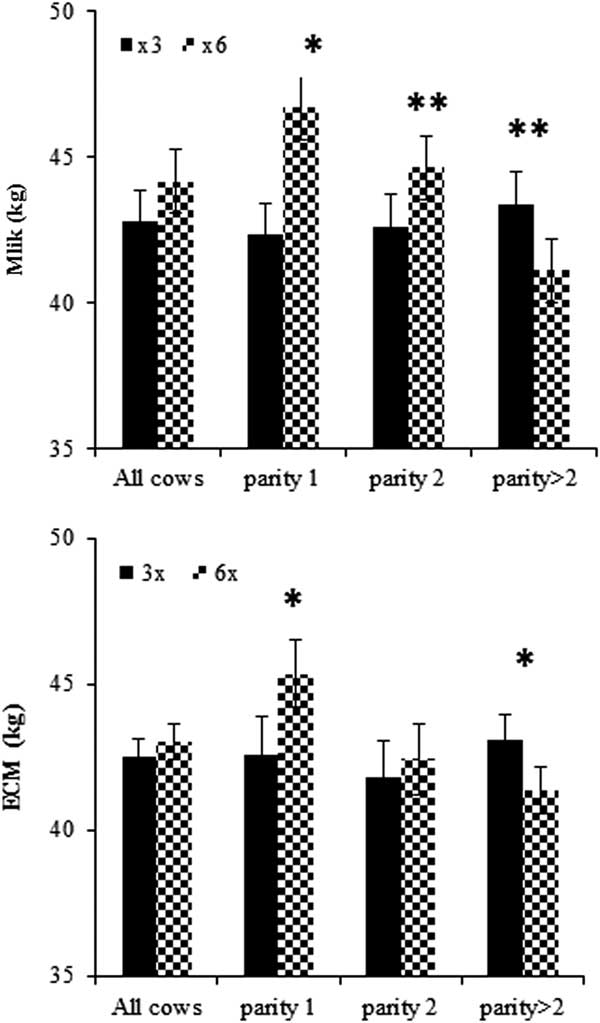
The 305-day lactation milk and ECM yields were also analyzed for the succeeding lactation (i.e. after the next calving). The milk yield of previously first lactation cows was higher by 1339 kg in 6× milking cows relative to the control group (P<0.02, Figure 4); milk yield of previously second lactation cows tended to be higher by 613 kg (P=0.1) in 6× milking cows relative to the controls; milk yield of previously >second lactation cows tended to be higher in the controls relative to the 6× milking cows (695 kg, P=0.08). The ECM yield was higher in the 6× milking first lactation cows (854 kg, P<0.05), similar for second lactation cows (186 kg, P>0.05) but lower in the 6× milking >second lactation cows (525 kg, P<0.05).
Average 305-day daily milk and energy-corrected milk (ECM) yields of cows by lactations in control (3×) and experimental (6×) groups in the succeeding lactation. *Significant difference (P<0.05) between treatments. **Tendency toward a significant difference (P=0.1). Data are presented as least squares means±SEM.

Milk composition
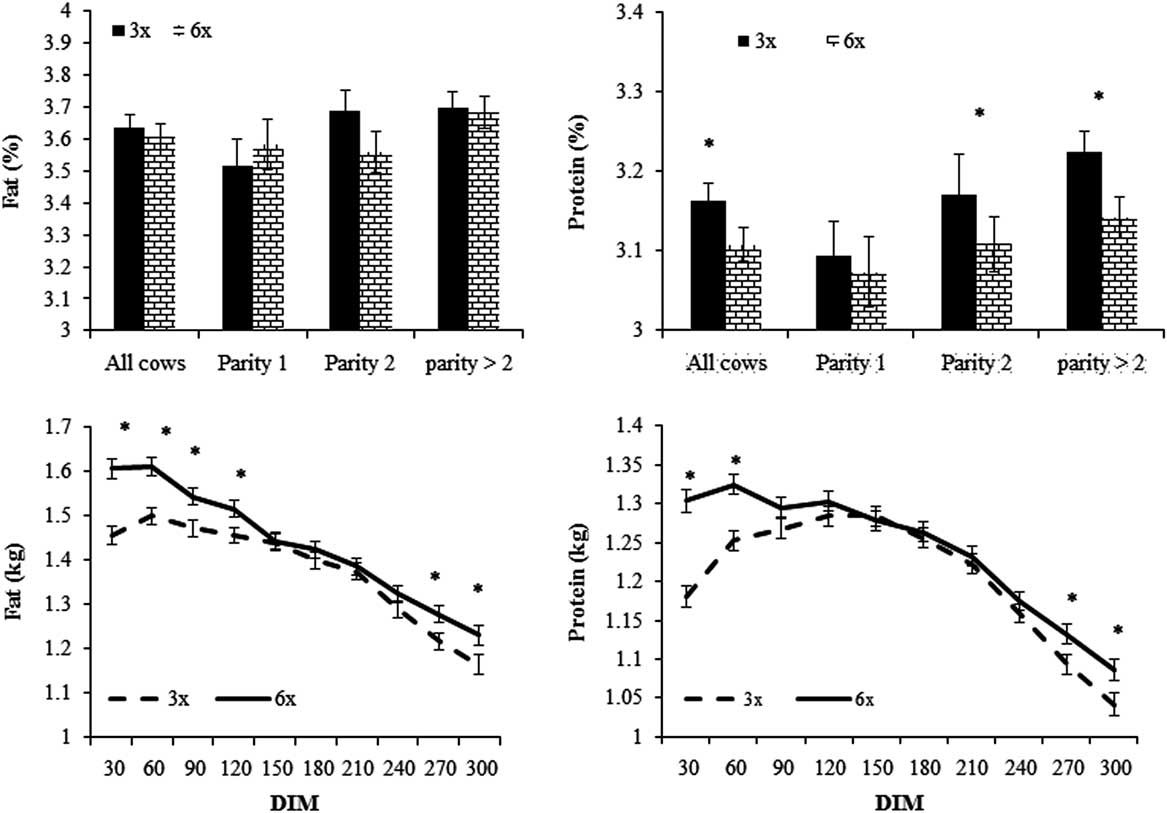
Milk fat and protein percentages did not differ between groups for either first or second lactation cows through the first 21 days of lactation (P>0.05), whereas for >second lactation cows, fat (4.24 v. 3.84, SEM=0.2, P=0.05) and protein (3.3 v. 3.05, SEM=0.12, P=0.04) percentages were higher in the control v. 6× milking group, respectively. The 305-day lactation fat percentage did not differ between the two groups (P>0.05) but the protein percentage was higher for the control group (P<0.05) in second and >second lactation cows, but not in the first lactation cows (Figure 5).
Average 305-day milk protein and fat percentages of cows from control (3×) and experimental (6×) groups and their yields by month of lactation. *Significant difference (P<0.05) between treatments. Data are presented as least squares means±SEM. DIM=days in milk.

The average monthly fat yield was higher for first and second lactation cows in the 6× milking group relative to their control counterparts (P<0.05, Figure 5) with a prominent effect in the first 4 and last 2 months of lactation. The protein yield was higher in the first and second lactation cows for the 6× milking group (P<0.05) but was lower in >second lactation cows (P<0.05). A significant difference was noted for the first 2 months and last 2 months of lactation. The milk fat to protein ratio was similar between the two groups and within each lactation age during the first 21 days and throughout the lactation (P>0.05).
BCS
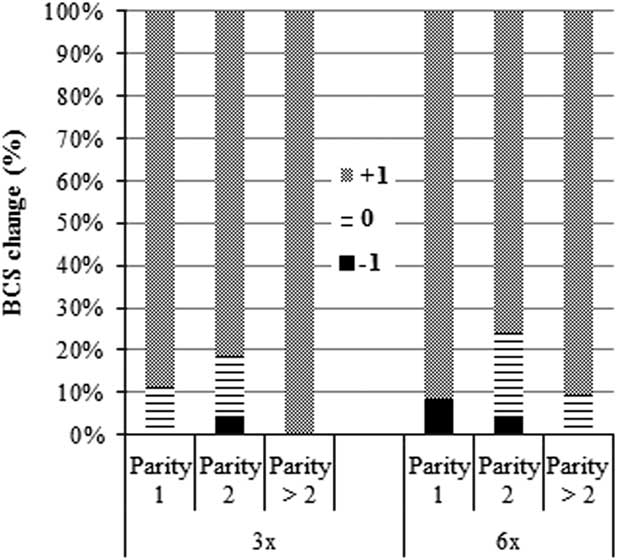
In general, BCS after calving did not differ between groups. However, BCS of second lactation cows in the 6× milking group was lower than that in the control group (2.97 v. 3.22, respectively, SEM=0.11, P=0.01). The BCS at peak lactation did not differ between groups or lactations (P>0.05). The BCS difference between calving and peak lactation did not differ between groups in first and >second lactation cows. In contrast, 9.16% of the second lactation cows in the 6× milking group lost BCS while in the control group BCS was constant.
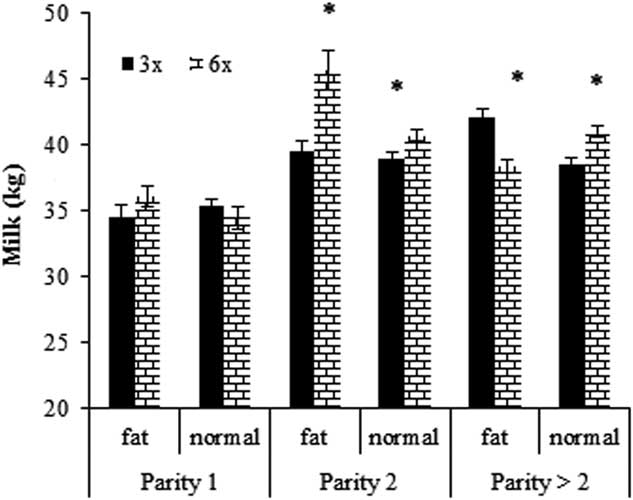
A higher proportion of first lactation cows in the 6× milking group gained BCS between calving and peak lactation relative to the control group (100% v. 88.9%, respectively). In contrast, lesser proportion (~10%) of second and >second lactations cows in the 6× milking group gained BCS between calving and peak lactation compared with the control group (P<0.001, Figure 6). Milk yield of the first lactation cows classified as ‘fat’ or ‘normal’ after calving did not differ between groups (P>0.05). Milk production by the second lactation cows classified as ‘fat’ or ‘normal’ was higher in the 6× lactating cows compared with their control counterparts (P<0.05), with a pronounced difference in the ‘fat’ cows (Figure 7). Milk production by the >second lactation cows classified as ‘fat’ was higher in the control v. 6× milking group (P<0.05). On the other hand, control cows that were classified as ‘normal’ had lower milk yield relative to their counterparts in the 6× milking group (P<0.05, Figure 7).
Distribution of cows in different lactations whose BCS changed between postcalving and peak lactation according to three categories: loss of body condition (−1), no change (0) and gain of body condition (+1) for control (3×) and experimental (6×) groups.

Milk yield of cows of control (3×) and experimental (6×) groups categorized according to their BCS in the 1st week after calving: ‘fat’=BCS>3.25 (solid bar); ‘normal’=2.75<BCS⩽3.25 (hatched bar). *Significant difference (P<0.05) between treatments. Data are presented as least squares means±SEM.

Metabolic diseases and mastitis
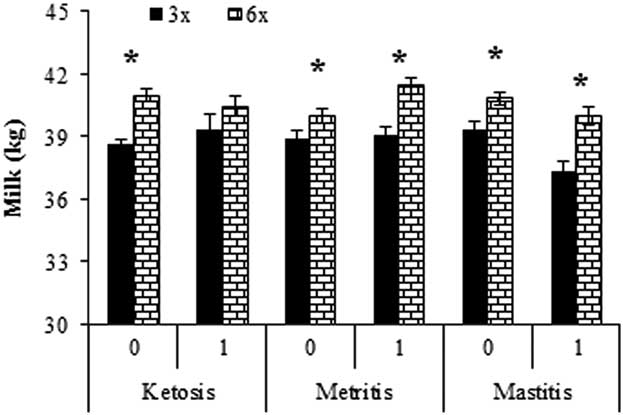
In general, the proportion of cows within the three disease (i.e. ketosis, metritis and mastitis) categories did not differ between groups. Further analysis examined the milk yield as a dependent variable within every disease and within each disease category. Findings revealed a difference in milk yield between the two experimental groups within each metritis category in favor of the 6× milking group (P<0.05, Figure 8). Milk production by 6× milking cows was higher relative to controls (P<0.05) in cows diagnosed as not having ketosis (i.e. category 0) but not in cows diagnosed with ketosis (i.e. category 1).
Average 305-day milk yield for non-affected cows (0) or cows affected (1) by metritis, ketosis or mastitis in control (3×) and experimental (6×) groups. *Significant difference (P<0.05) between treatments. Data are presented as least squares means±SEM. 0=SCC<250 000 cells/ml; 1=SCC⩾250 000 cells/ml.

In the two categories of mastitis, there was a significant difference in favor of the 6× milking group (P<0.05). The SCC (transformed to log) was slightly higher in the 6× milking cows but did not differ from the control group for any lactation (P>0.05). The LSMEANS for the whole lactation for both groups was lower than 90 000 cells/ml in the first lactation cows, lower than 150 000 cells/ml in the second lactation cows and 226 000 and 211 000 cells/ml (SEM=52 000) in the control and 6× milking >second lactation cows, respectively.
Fertility
Days to first insemination
The days from calving to first insemination did not differ between the 6× milking and control group (88.98 v. 88.19, respectively, SEM=4.41, P=0.85). Lactation×treatment interaction did not differ between groups (P=0.3). Days from calving to first insemination was higher in first lactation cows than in the older cows but did not differ between groups (99.55 v. 92.5 for control and 6× milking group, respectively, SEM=5.9, P=0.4). Days from calving to first insemination for the second lactation cows was numerically lower in the controls relative to the 6× milking group (77.3 v. 86.1, respectively, SEM=5.9, P=0.3) and for the >second lactation cows, it did not differ between groups (P=0.9). The proportion of cows with >90 days from calving to first insemination did not differ between the control and 6× milking groups (46.7 v. 53.3%, respectively, P=0.8).
Days to pregnancy
Days from calving to pregnancy did not differ between groups and was 156 v. 143 for control and 6× milking cows, respectively (SEM=14.9, P=0.2). The lactation×treatment interaction was not significantly different (P=0.4). The number of open days in first lactation cows was numerically higher in the control v. 6× milking group (160 v. 177 days, respectively, SEM=28.4, P=0.55), tended to be smaller in the control compared with the 6× milking group for the second lactation (93.55 v. 137.73 days, respectively, SEM=27.13, P=0.1), and was not significantly different between the control and 6× milking >second lactation groups (158.75 v. 155.44 days, respectively, SEM=21.53, P=0.8).
Conception rate from first insemination
The conception rate from first insemination did not differ between the two groups, as reflected by LOGISTIC and Q 2 procedures (P=0.6).
IGF-1 concentration
Plasma IGF-1 concentrations in first lactation cows were higher in the 6× milking cows than in controls on the first 7 days of lactation (59.56 v. 30.57 ng/ml, respectively, SEM=7.2, P=0.002), were numerically higher in second lactation cows (49.12 v. 43.5 ng/ml, SEM=4.7, P=0.4), and tended to be higher in >second lactation cows from the 6× milking group relative to controls (42.4 v. 33.7 ng/ml, SEM=3.4, P=0.1). However, IGF-1 concentrations did not differ between groups beyond 7 days of lactation.
Discussion
The long-term effect of HMF for the first 21 days of lactation was expressed by significantly higher milk production in the succeeding lactation in previously first lactation cows (a difference of 1342 kg for 305 days of lactation), and tended to be higher in the previous second lactation cows (a difference of 616 kg for 305 days of lactation). However, HMF had a deleterious effect on the >second lactation cows in the succeeding lactation (a difference of 695 kg for 305 days of lactation). To our knowledge, this is the first work to show a long-term effect beyond the specific lactation in which the HMF was practiced. The non-significant difference between the HMF >second lactation cows and their control counterparts in milk and ECM yields for the entire lactation after the HMF was ceased (i.e. short-term effect) brought us to assume that cows with full udder capacity (i.e. older cows) are less responsive to frequent milking. A similar assumption was made by Eslamizad et al. (Reference Eslamizad, Dehghan-Banadaky, Rezayazdi and Moradi-Shahrbabak2010).
Increasing the milking frequency from 3× to 6× during the first 21 days of lactation immediately increased milk and ECM yields by 26.5% and 19%, respectively. Similar differences were observed in studies comparing 4× and 2× milking frequencies (Hale et al., Reference Hale, Capuco and Erdman2003) and 6× and 3× frequencies (Bar-Peled et al., Reference Bar-Peled, Maltz, Bruckental, Folman, Kali, Gacitua and Lehrer1995; Sanders, 2000). There was a clear carryover effect for the entire lactation, which is consistent with some studies (Hale et al., Reference Hale, Capuco and Erdman2003; Wall and McFadden, Reference Wall and McFadden2007; Stelwagen et al., Reference Stelwagen, Phyn, Davis, Guinard-Flament, Pomiès, Roche and Kay2013) but not with others (Soberon et al., Reference Soberon, Lukas, Van Amburgh, Capuco, Galton and Overton2010; Phyn et al., Reference Phyn, Kay, Rius, Morgan, Roach, Grala and Roche2011). These results might prove the hypothesis that a narrow window exists after calving when the mammary gland is responsive to frequent milking (Wall and McFadden, Reference Wall and McFadden2008). The duration of 21 days after calving seems to be sufficient because a longer duration of HMF, 42 or 90 days (Bar-Peled et al., Reference Bar-Peled, Maltz, Bruckental, Folman, Kali, Gacitua and Lehrer1995; Eslamizad et al., Reference Eslamizad, Dehghan-Banadaky, Rezayazdi and Moradi-Shahrbabak2010), did not have any additional effect on milk yield. A few other studies demonstrated that an even shorter HMF period (1 to 14 or 7 to 21 days) might have a persistent effect similar to that found in this study with a 21-day period (Hale et al., Reference Hale, Capuco and Erdman2003; Dahl et al., Reference Dahl, Wallace, Shanks and Lueking2004; Wall and McFadden, Reference Wall and McFadden2007). Nevertheless, this carryover effect was only observed in first and second lactation cows, reflected by a significant lactation interaction with milking frequency. Such an interaction was also reported by Allen et al. (Reference Allen, DePeters and Laben1986) as a pronounced response to frequent milking observed in animals with smaller udder capacity, such as heifers. In the present study, HMF also positively affected the second lactation cows to some extent. On the other hand, the mature cows (>second lactation) in our study did not respond to the frequent milking, even producing less milk and ECM yields between 150 and 240 DIM compared with the control group. Our results are in contrast to Wall and McFadden (Reference Wall and McFadden2008), who did not find any relationship between age and the magnitude of the milk yield due to frequent milking, and to others who reported a significant carryover effect of frequent milking for multiparous cows that was similar or better to that with primiparous cows (Hale et al., Reference Hale, Capuco and Erdman2003; Wall and McFadden, Reference Wall and McFadden2007; Soberon et al., Reference Soberon, Ryan, Nydam, Galton and Overton2011).
An HMF has been shown to decrease milk fat and protein percentages relative to controls during the experimental period (Bar-Peled et al., Reference Bar-Peled, Maltz, Bruckental, Folman, Kali, Gacitua and Lehrer1995; Hale et al., Reference Hale, Capuco and Erdman2003), as also found in our study in >second lactation cows. Milk fat and protein percentages for the whole lactation have been reported to be lower (Erdman and Varner, Reference Erdman and Varner1995; Hale et al., Reference Hale, Capuco and Erdman2003; Soberon et al., Reference Soberon, Ryan, Nydam, Galton and Overton2011) or similar (Bar-Peled et al., Reference Bar-Peled, Maltz, Bruckental, Folman, Kali, Gacitua and Lehrer1995) for HMF cows relative to controls. However, in our study, only milk protein percentage was lower for second and >second lactation cows compared with their control counterparts, whereas fat percentage was not affected. The milk fat and protein yields throughout the lactation in the present study were higher for the 6× milked first and second lactation cows than for their control counterparts, and found to be similar to those reported by Soberon et al. (Reference Soberon, Lukas, Van Amburgh, Capuco, Galton and Overton2010), but not to those found by Hale et al. (Reference Hale, Capuco and Erdman2003). The month×lactation interaction was significant, as also found by Soberon et al. (Reference Soberon, Ryan, Nydam, Galton and Overton2011).
Despite the increase in milk and ECM yields throughout lactation reported in the present study for first and second lactation cows, this had little effect on their BCS. Only 10% of the first lactation cows lost BCS between calving and peak lactation, while none of second lactation cows did. Similarly, Hale et al. (Reference Hale, Capuco and Erdman2003) and Soberon et al. (Reference Soberon, Ryan, Nydam, Galton and Overton2011) reported an increase in milk yield without any effect on BCS. The latter authors also reported that the increase in milk yield was accompanied by an increased risk of ketosis. However, there was no change in the proportion of cows diagnosed as subclinically ketotic in our work, or in that reported by Fernandez et al. (Reference Fernandez, Ryan, Galton and Overton2004). Differences between study results might be due to different management practices, such as the distance traveled by cows during the HMF period, as well as feeding practices. The cows in our study were housed in a nearby barn, located 30 m from the milking parlor, and were given free access throughout the day to an enriched diet. In support of this, Nørgaard et al. (2005) found that high nutrient availability can increase epithelial cell numbers in the mammary gland.
The increase in milk yield in response to HMF can be attributed to several mechanisms. First, a local mechanism such as frequent removal of the whey protein – the feedback inhibitor of lactation – might play a role in the increased milk yield, most likely due to dilution of its concentration in the milk (Henderson and Peaker, Reference Henderson and Peaker1984; Wilde et al., Reference Wilde, Addey, Boddy and Peaker1995). Later, two other local regulators were also proposed as acting as feedback inhibition of lactation: (a) βcasein1-28-milk enzymatic system (plasminogen activator, plasminogen and plasmin) that acted on β-casein to form a fragment (βCN1-28) (Silanikove et al., Reference Sanders2006) and (b) serotonin – a hormone and neurotransmitter that is synthesized from the amino acid l-tryptophan (Collier et al., Reference Collier, Hernandez and Horseman2012). Those three local regulators alter tight junctions, reduce milk protein gene expression and increased apoptosis. Nevertheless, this hypothesis cannot explain the carryover effect, that is, when these cows were milked three times a day and further in the succeeding lactation. Capuco et al. (Reference Capuco, Wood, Baldwin, McLeod and Paape2001) suggested that the increase in milk yield until peak lactation might be due to increased differentiation. Hale et al. (Reference Hale, Capuco and Erdman2003) reported an increase in mammary cell proliferation on days 7 and 14 after calving. In contrast, Soberon et al. (Reference Soberon, Lukas, Van Amburgh, Capuco, Galton and Overton2010) did not find any significant difference in mammary epithelial cell proliferation in primiparous cows milked 4× v. 2× from days 2 to 21, and then 2× until day 119 of lactation, despite the significant milk increase for 17 weeks after calving. Although the discrepancies between studies are controversial, the induction of differentiation and proliferation by HMF cannot be ruled out, particularly due to the long-lasting effect, into the succeeding lactation. The pronounced effect of HMF on first lactation cows for the two successive lactations, and the gradual decrease of this effect as the lactation number proceeds might be attributed to higher elasticity of the udder of young cows compared with older cows (Allen et al., Reference Allen, DePeters and Laben1986). Several hormones have been reported to regulate galactopoietic effects of frequent milking on milk production in cows, one of them being prolactin (PRL) (Dahl et al., Reference Dahl, Wallace, Shanks and Lueking2004; Wall and McFadden, Reference Wall and McFadden2008). Nevertheless, there is no evidence for galactopoietic effects of PRL during an established lactation in ruminants (Plaut et al., Reference Plaut, Bauman, Agergaard and Akers1987; Wall et al., Reference Wall, Crawford, Ellis, Dahl and McFadden2006; Eslamizad et al., Reference Eslamizad, Dehghan-Banadaky, Rezayazdi and Moradi-Shahrbabak2010). The latter authors, who reported that frequent milking does not alter the PRL concentrations at any specific sampling time during HMF, suggested that increasing milk production occurs via local factors rather than stimulation of PRL secretion. Knight (Reference Knight2001) suggested that domestic animals selected for milk production are not dependent on PRL to support lactation, whereas growth hormone (GH) takes over some of the responsibility for maintaining milk yield. The hormone IGF-1 has been proposed as an important mediator of galactopoietic factors such as GH or bovine somatotropin (Wilde et al., Reference Wilde, Henderson, Knight, Blatchford, Faulkner and Vernon1987; Hillerton et al., Reference Hillerton, Knight, Turvey, Wheatley and Wilde1990; Forsyth, Reference Forsyth1996), who reported that increased IGF-1 concentration might in turn enhance both mammary differentiation and proliferation of mammary cells for goats and cows. We might assume that higher IGF-1 concentration 7 days after calving, as found in the present work, contributed to those two processes, followed by higher milk production during the entire lactation and the succeeding lactation as well.
High milk production by itself might be associated with decreased reproductive performance (Butler, Reference Butler1998; Royal et al., Reference Royal, Darwash, Flint, Webb, Woolliams and Lamming2000; Lucy, Reference Lucy2001). The further increase in milk yield due to HMF might be assumed to depress reproductive performance even more. Nevertheless, some studies have reported that fertility is not necessarily impaired by increased milk production at either the individual cow or herd level (Lopez-Gatius et al., Reference Lopez-Gatius, Garcia-Ispierto, Santolaria, Yaniz, Nogareda and Lopez-Bejar2006; Lof et al., Reference Lof, Gustafsson and Emanuelson2007; LeBlanc, Reference LeBlanc2010). Our results support this statement because we did not find any negative effect on reproductive parameters such as days to first insemination, days to pregnancy or conception rate for first insemination. Consequently, we believe that a well-managed dairy farm will not necessarily experience a negative association between production and reproduction.
Conclusions
Increasing milking frequency to six times a day for the first 21 days of lactation increased milk and ECM yields throughout the experimental period and later, during the entire lactation, for both primiparous and second lactation cows. This effect persisted in the succeeding lactation, suggesting a long-lasting effect through two consecutive lactations. Milk fat and protein yields were higher for the 6× milked first and second lactation cows throughout the entire lactation. The HMF did not affect BCS between calving and peak lactation and was not associated with udder or metabolic diseases. Collectively, it seems that increased milking frequency (6×) during the short ‘window’ after calving contributes to higher milk production throughout the whole lactation period and into the succeeding lactation. Such a practice might be implemented for first and second lactation cows that are better responders to HMF, but not for >second lactation cows, on conventional milking farms that are well managed as well as on robotic milking farms.
Acknowledgments
The authors thank the farm personnel where the trial was executed. Without their long-term cooperation, the study would never have been completed. The authors also thank Dr Avi Shamay (Volcani Center, Institute of Animal Science, Bet-Dagan, Israel) who analyzed the IGF-1 concentrations. This research was partially funded by the Israel Marketing Board (Yehud, Israel).