INTRODUCTION
The fish assemblage of the Galapagos Islands is characterized by an unusual mix of tropical and temperate water species. This is mainly due to the influence of three major oceanic currents that vary in intensity and direction seasonally (Chavez & Brusca, Reference Chavez, Brusca and James1991): the Panama Current brings warm waters from the north; the Humboldt Current brings cooler waters from the south; and the upwelling sub-equatorial (or Cromwell) Current, with highly productive cold waters which surface to the west (Banks, Reference Banks, Danulat and Edgar2002). This environmental complexity results in a greater variety of habitats, with five major bio-geographical regions identified for sub-tidal reef communities in the Galapagos Marine Reserve (GMR), with a consistently different species composition for each region (Edgar et al., Reference Edgar, Fariña, Calvopiña, Martínez, Banks, Danulat and Edgar2002).
The first collection of Galapagos fish was conducted in 1835 by Charles Darwin and it included 15 records (Grove & Lavenberg, Reference Grove and Lavenberg1997). The last review conducted by McCosker and Rosenblatt in 2010, based on published and unpublished records, set the fish records in Galapagos at 550 species, representing 128 families, excluding mesopelagic species (McCosker & Rosenblatt, Reference McCosker and Rosenblatt2010). In the Galapagos Islands there are numerous registered Indo-Pacific reef fish species, constituting nearly 16% of its fish fauna, and being particularly abundant in the northern islands of Wolf and Darwin (Edgar et al., Reference Edgar, Fariña, Calvopiña, Martínez, Banks, Danulat and Edgar2002).
The giant trevally, Caranx ignobilis (Forsskål, 1775), the largest Indo-Pacific carangid, is a top predator that reaches a maximum weight of up to 80 kg and 170 cm in total length (TL) (Meyer et al., Reference Meyer, Holland and Papastamatiou2007). It is considered an Indo-Pacific species, with a known distribution ranging from East Africa to the Hawaiian and Marquesas Islands eastwards (Talbot & Williams, Reference Talbot and Williams1956; Wetherbee et al., 2004). This highly mobile jack inhabits reefs in coastal areas, islands and atolls, although diet analysis suggests occasional use of open water habitats (Sudekum et al., Reference Sudekum, Parrish, Radtke and Ralston1991). Studies of its life history and ecology have revealed that it is a moderately fast growing species, reaching maturity at 60 cm TL, and with a pronounced seasonal spawning cycle (Sudekum et al., Reference Sudekum, Parrish, Radtke and Ralston1991). Its diet is mainly composed of fish, large crustaceans and cephalopods, which combined with its large size and aggressive predatory behaviour makes this carangid play a significant role in the trophic ecology of the reefs where it is common (Sudekum et al., Reference Sudekum, Parrish, Radtke and Ralston1991; Wetherbee et al., Reference Wetherbee, Holland, Meyer and Lowe2004; Meyer et al., Reference Meyer, Holland and Papastamatiou2007). This species is heavily targeted by commercial and recreational fishers, which has caused a significant decline in stocks in populated areas, only remaining abundant in remote reefs and atolls (Shomura, Reference Shomura1987; Friedlander & DeMartini, Reference Friedlander and DeMartini2002; Meyer et al., Reference Meyer, Holland and Papastamatiou2007). This first record of C. ignobilis in the Galapagos Islands also constitutes its first register in the Tropical East Pacific (TEP), establishing a new eastern distribution limit.
The whitemargin unicornfish, Naso annulatus (Quoy & Gaimard, 1825), is a member of the family Acanthuridae with a wide Indo-Pacific distribution, ranging from the Red Sea to the Hawaiian and Marquesas Islands (Robertson et al., Reference Robertson, Grove and McCosker2004). It is one of the five Naso species that are known to have a horn-shaped protuberance on the forehead (Smith, Reference Smith1966; Randall, Reference Randall2002; Arai & Sato, 2006). This unicornfish is strongly associated with shallow water reef environments, with large adults forming small aggregations on steep drop-offs (Randall, Reference Randall2002). Naso annulatus forages on the benthos during juvenile stages, mainly on green filamentous algae, and on gelatinous zooplankton in the pelagic zone as adults (Choat et al., Reference Choat, Clements and Robbins2002; Klanten et al., Reference Klanten, Herwerden, Choat and Blair2004). This change in diet tends to occur at 20 cm standard length (SL) (Green & Bellwood, Reference Green and Bellwood2009). Naso annulatus is listed as of ‘Least Concern' in the IUCN Red List of Threatened Species given that it is heavily targeted throughout its range, although there are no indications of population declines due to overfishing (Abesamis et al., Reference Abesamis, Clements, Choat, McIlwain, Myers, Nanola, Rocha, Russell and Stockwell2012). This is the first record of N. annulatus in the Galapagos Islands and the third record for this species in the TEP. Two previous records, both consisting of one adult, were at Clipperton Atoll in 1996 and Cocos Island in 1997 (Robertson et al., Reference Robertson, Grove and McCosker2004), so it is considered a vagrant species for the TEP (Robertson & Allen, Reference Robertson and Allen1996).
MATERIALS AND METHODS
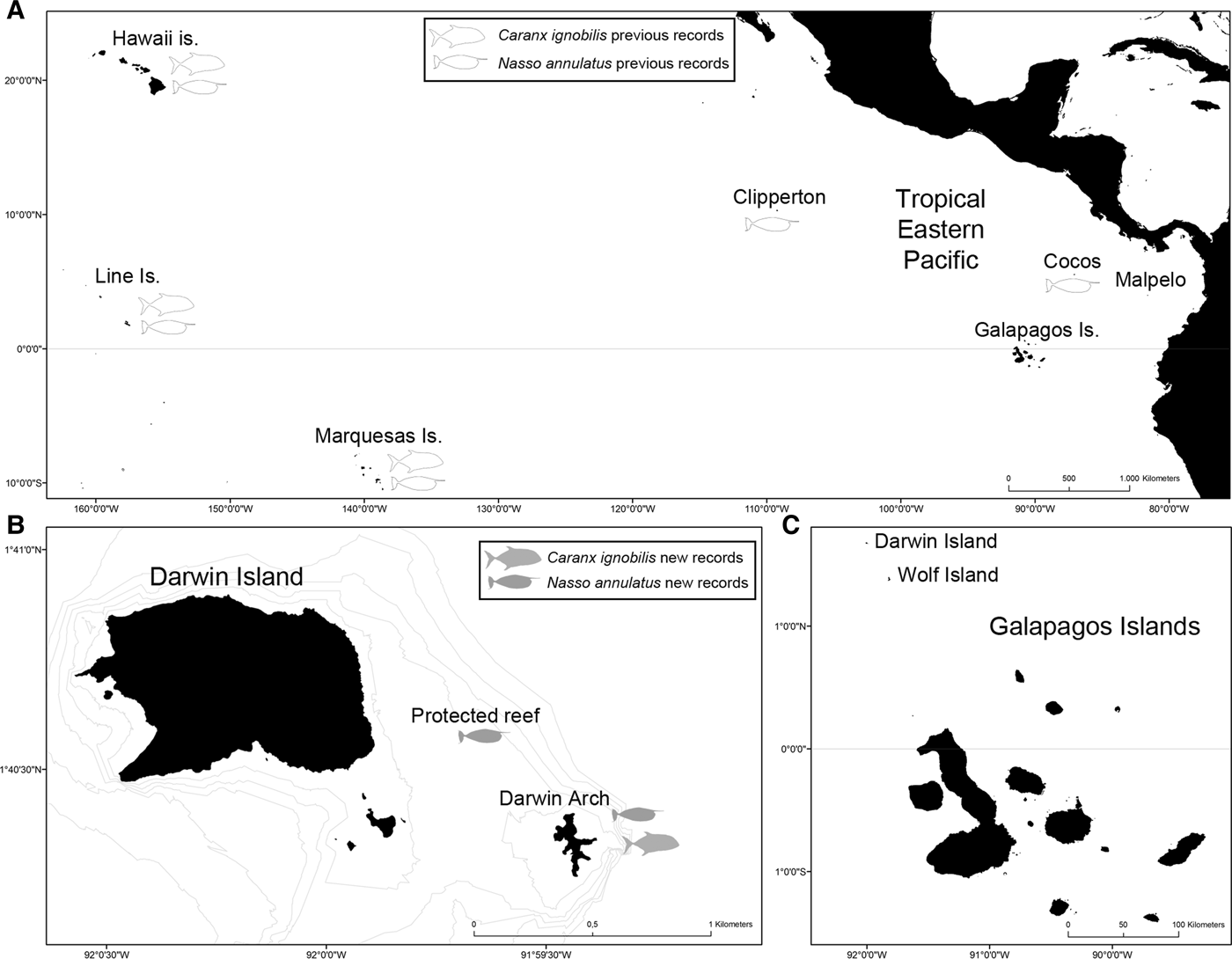
Both species were recorded in the same area, the Darwin Arch (1°40.41′N 91°59.35′W) an exposed fore reef facing the predominant south-east current, located half mile south-east of Darwin Island (Figure 1). The Darwin Arch and the Island are connected underwater by a shallow platform, forming a protected reef. This remote island, along with the neighbouring island of Wolf, constitutes the Far North bio-geographical region of the GMR (Edgar et al., Reference Edgar, Fariña, Calvopiña, Martínez, Banks, Danulat and Edgar2002). Since the first sighting of both species in September 2011, authors have been revisiting the same location and conducting underwater surveys for several unrelated projects in the described area and its surroundings. Interviews and consultations with local fishermen and dive guides were also carried out to determine whether both species were known from previous sightings, with negative results. Fish size was obtained using laser photogrametry. This system consists of a photo camera with two calibrated parallel lasers attached that provide a scale bar of known length. In this way, a lateral picture of a fish allows obtaining the TL of the fish by counting pixels between lasers marks and extrapolating to fish TL (Rohner et al., Reference Rohner, Richardson, Marshall, Weeks and Pierce2011).
(A) Map of the Tropical Eastern Pacific region showing the locations of the previous records of Caranx ignobilis and Naso annulatus; (B) map of the Galapagos Archipelago with the islands of Darwin and Wolf indicated; (C) map of Darwin Island and surrounding reefs, showing the locations of new records of C. ignobilis and N. annulatus.

RESULTS
SYSTEMATICS
Order PERCIFORMES
Suborder PERCOIDEI
Family CARANGIDAE
Genus Caranx Lacépède, 1801
Caranx ignobilis Forsskål, 1775
A giant trevally was first sighted and photographed by the authors in September 2011 at Darwin Island (Figure 2). This is an unmistakable species in adulthood, mainly due to its size. There are three species of genus Caranx in the study site that have some similarity to C. ignobilis: C. lugubris, C. melampygus and C. sexfasciatus. However none of them reach sizes close to 100 cm TL; besides the silvery grey to black above colour patterns of C. ignobilis differ clearly from the other three species, being uniform grey to brown in C. lugubris, brassy and covered with small blue black spots in C. melampygus and silvery olive to iridescent blue-green above with a black spot at the upper angle of the opercle in C. sexfasciatus (Carpenter & Niem, 1999). Additionally, its identification was confirmed by McCosker from the photographs taken (McCosker, personal communication, 2012). Thereafter, on subsequent visits to the same location in October 2011 and March, May, June, August and October 2012, this species has become regularly sighted at the same reef, indicating a continued presence in the area. In nearby Wolf Island, located 20 miles south-east of Darwin Island, this species has not been reported. All records consisted of adult individuals with sizes ranging between 100 and 110 cm TL. The giant trevallys were seen patrolling the reef, alone or in small groups of three individuals at most. The lack of previous records in the TEP, the consistency in sizes observed and the fact that no more than three individuals were seen at the same time, suggest that the same giant trevallys may have been re-sighted since 2011, residing at the reef. Sexual colour differences have been documented in this species, with males conspicuously darker than females (Talbot & Williams, Reference Talbot and Williams1956; Westernhagen, Reference von Westernhagen1974). All individuals observed in Darwin Island had a dusky to black body, indicating that they were males.
Three individuals of Caranx ignobilis patrolling the reef at Darwin Arch, Galapagos Islands, in September 2011 (photograph: D. Acuña-Marrero).

SYSTEMATICS
Order PERCIFORMES
Suborder ACANTHUROIDEI
Family ACANTHURIDAE
Genus Naso Lacépède, 1801
Naso annulatus Quoy & Gaimard, 1825
Naso annulatus was first sighted in September 2011 by the authors along several days during a survey trip in Darwin Island. Species identification was made through four taxonomic keys: its horn-shaped protuberance; two pairs of cutting keels on plates on tail base; two long filaments from each corner of caudal fin; and the presence of a white margin surrounding the mouth and the membranes between rays on caudal fin (Figure 3). There are two other species of the genus Naso recorded as vagrants in Galapagos that resemble N. annulatus (McCosker & Rosenblatt, Reference McCosker and Rosenblatt2010): N. vlamingii, which lack the horn-shaped protuberance in the head, and N. brevirostris, of which the caudal fin is slightly rounded and there is lack of filaments from each corner of the caudal fin (Randall, Reference Randall, Fisher and Bianchi1984). Additionally, its identification was confirmed by McCosker from the photographs taken (McCosker, personal communication, 2012). All sightings, consisted of an adult individual of 65 cm TL and were found in the same reef site (Darwin Arch), associated with a steep drop-off. This species was not re-sighted until October 2012, despite several visits to the same location in October 2011 and February, May, June and September 2012. On this occasion three different individuals were recorded, one 65 cm TL at Darwin Arch's reef, and two 30 cm TL at a nearby protected reef 400 m away.
Naso annulatus photographed at 20 m of depth at Darwin Arch drop-off, Galapagos Islands, in September 2011 (photograph: D. Acuña-Marrero).

DISCUSSION
The Eastern Pacific Barrier (EPB), first described by Charles Darwin in his Origin of Species (Darwin, Reference Darwin1872), is a 4000–7000 km deep water gap without islands that separates the Eastern Pacific from the Central Pacific (Lessios & Robertson, Reference Lessios and Robertson2006). Despite this barrier, 126 species of shore fish are known from both sides of the EPB, of which 80 likely migrated eastwards and 22 westwards (Robertson et al., Reference Robertson, Grove and McCosker2004). This indicates that the barrier is permeable to occasional migrations, particularly from west to east, due to the action of the westerly North Equatorial counter-current, with its effect magnified during El Niño–Southern Oscillation (ENSO) events (Robertson et al., Reference Robertson, Grove and McCosker2004; McCosker & Rosenblatt, Reference McCosker and Rosenblatt2010). This seems to be the case for C. Ignobilis and N. annulatus, as both are present in the Hawaiian, Johnston, Line and Marquesas Islands, which are considered the main source for fish migrating eastward across the EPB (Friedlander & DeMartini, Reference Friedlander and DeMartini2002; Robertson et al., Reference Robertson, Grove and McCosker2004; Wetherbee et al., Reference Wetherbee, Holland, Meyer and Lowe2004) (Figure 1). The occurrence of Indo-Pacific vagrant species in the Galapagos northern islands of Darwin and Wolf is considered common, especially related to ENSO events (Edgar et al., Reference Edgar, Fariña, Calvopiña, Martínez, Banks, Danulat and Edgar2002). Direct migration of adults or sub-adults (Luiz et al., Reference Luiz, Madin, Robertson, Rocha, Wirtz and Floeter2011), dispersal during the larval stage by oceanic currents and active swimming behaviour (Planes et al., Reference Planes, Jones and Thorrold2009), or the association of newly settled larvae or adults to drifting flotsam (Hunter & Mitchell, Reference Hunter and Mitchell1966) could explain this recent colonization event, although further research is required to determine the exact reason. Given that this is the first record of C. ignobilis in the TEP, that N. annulatus is considered a vagrant species in the TEP, the records of both species are rare and restricted to one specific area in the GMR, and there is no evidence of reproductive populations in any cases, we propose the inclusion of both species in the Galapagos shore fish list as vagrants.
ACKNOWLEDGEMENTS
We thank the George Blake Kimberly Rapier Charitable Lead Trust and the Walton Family Foundation–Eastern Tropical Pacific Phase III Project, Lindblad Expeditions, Galapagos Conservancy and The Leona M. and Harry B. Helmsley Charitable Trust for funding the different projects that supported the trips to the study zone in 2011 and 2012. We thank Dr John McCosker of the Aquatic Department of Aquatic Biology, California Academy of Sciences, for corroborating the species identification. We thank Galapagos National Park and all scientists and crews who participated in the trips referred in this paper for their support.