INTRODUCTION
In West Africa, where >0·7 of the world's cacao (Theobroma cacao L.) is produced, yield improvement in the crop has been associated with selection for progenies with high vegetative vigour (Posnette Reference Posnette1951; Glendinning Reference Glendinning1967; Lockwood Reference Lockwood1976). At the start of formal research into cacao, the Amelonado variety that formed the basis of the cocoa industry was found to be highly susceptible to the cocoa swollen shoot virus disease (CSSVD), and established with difficulty under poor shade (Crowdy & Posnette Reference Crowdy and Posnette1947). Yield gains resulted in part from better field establishment of seedlings and precocity (Glendinning Reference Glendinning1960; Toxopeus Reference Toxopeus1968) and slower spread of the swollen shoot virus disease in some introduced Upper Amazon germplasm (Legg & Lockwood Reference Legg and Lockwood1981). Introduction of Pound's germplasm of Upper Amazon origin (Lockwood & Gyamfi Reference Lockwood and Gyamfi1979) provided much of the basis for yield improvement in West Africa, as the seedling progenies from these clones were observed to out-perform those of the West African Amelonado (originating from the Lower Amazon region) that formed the basis of the cacao industry in West Africa in the early 1900s.
The majority of economic traits in cocoa have been found to be inherited additively (Engels Reference Engels1985; Tan & Tan Reference Tan and Tan1990; Lockwood & Pang Reference Lockwood, Pang, End, Eskes, Lee and Lockwood1994; Cervantes-Martinez et al. Reference Cervantes-Martinez, Brown, Schnell, Phillips-Mora, Takrama and Motamayor2006). Both Adomako et al. (Reference Adomako, Allen and Adu-Ampomah1999a ) and Padi et al. (Reference Padi, Opoku, Adomako and Adu-Ampomah2012) reported that general combining ability (GCA) was most important in cacao for selecting parents to generate progenies with high dry bean yields in Ghana. For tree vigour (estimated as the size of stem cross-sectional area), both GCA and specific combining ability (SCA) effects have been observed to be significant (Adomako et al. Reference Adomako, Allen and Adu-Ampomah1999a ; Cervantes-Martinez et al. Reference Cervantes-Martinez, Brown, Schnell, Phillips-Mora, Takrama and Motamayor2006). Realized heritability for yield and tree vigour, estimated as the correlation between performance of clones and their progenitor ortets for these traits was found to be significant only for tree vigour but not for bean yields (Padi et al. Reference Padi, Takrama, Opoku, Dadzie and Assuah2013b ), suggesting that depending on the cacao genetic group under study, both additive and non-additive gene effects may be important for dry bean yields. Recurrent selection for GCA capitalizing on additive gene action has been advocated for improving cacao, for better adaptation to its rapidly changing production environment (Pires et al. Reference Pires, Monteiro, Pinto, Figueira, Yamada and Anhert1999). In Ghana, reciprocal recurrent selection efforts launched in 1999 evaluated the progenies derived from inter-group or intra-group crosses of the Iquitos, Nanay, Marañón and Posnette's inter-Amazon T selections for yield and resistance to black pod and swollen shoot virus diseases (Eskes Reference Eskes2011). The results generally supported earlier findings of the higher resistance to the CSSVD for progenies derived from crosses that involved at least one clone of the Iquitos genetic group (Thresh et al. Reference Thresh, Owusu, Boamah and Lockwood1988). Padi et al. (Reference Padi, Opoku, Adomako and Adu-Ampomah2012) noted that in the above set of experiments, progenies of intra-Parinari crosses had the highest yields, although specific crosses that were used as standards (for example, T85/799 × IMC 53 and PA 150 × Pound 7) were no less productive than the best intra-Parinari progenies. Recent fingerprinting of the clones used in these breeding efforts has revealed a narrow genetic base of the active clone collection (Padi et al. Reference Padi, Ofori, Takrama, Djan, Opoku, Dadzie, Bhattacharjee, Motamayor and Zhang2015). Of the ten genetic groups defined for cocoa (Motamayor et al. Reference Motamayor, Lachenaud, da Silva e Mota, Loor, Kuhn, Brown and Schnell2008), only a few clones from the Amelonado, Iquitos, Nanay and Marañón genetic groups have contributed significantly to variety development, necessitating broadening of the genetic base for further yield gains.
Analyses of experiments conducted over different time periods in the cacao breeding programme (Adomako et al. Reference Adomako, Allen and Adu-Ampomah1999a , Reference Adomako, Allen and Adu-Ampomah b ; Padi et al. Reference Padi, Opoku, Adomako and Adu-Ampomah2012) enabled identification of productive ortets from superior families for yield that could serve as parents for the next cycle of crossing and selection (Padi et al. Reference Padi, Takrama, Opoku, Dadzie and Assuah2013b ). This selection of ortets was premised on the notion that the parental clones in the breeding programme have only undergone one or two generations of genetic enhancement from the mother trees in the Amazon basin, and further genetic gains are possible from inter-crossing these ortets. To increase the genetic base, the best performing clones across major cacao producing countries (Eskes Reference Eskes2011) were included to initiate the second cycle of crossing and selection. Yield efficiency was an important criterion in the selection of the ortets and clones (Padi et al. Reference Padi, Opoku, Adomako and Adu-Ampomah2012).
Yield efficiency has been defined as a ratio of bean yields to tree trunk cross-sectional area (TCSA, Adomako et al. Reference Adomako, Allen and Adu-Ampomah1999a ; Daymond et al. Reference Daymond, Hadley, Machado and Ng2002; Pang Reference Pang2006). The TCSA represents the intensity of vegetative growth and provides an estimate of tree vigour over time (Nesme et al. Reference Nesme, Plenet, Hucbourg, Fandos and Lauri2005). At a given planting density, cacao progenies that partition smaller proportions of assimilates to increments in vegetative vigour are preferred for establishing commercial plantations because they facilitate crop management operations such as pruning, application of foliar pesticides and fertilizers, and harvesting. As both components of yield efficiency (vigour and bean yields) have generally been considered to be under additive gene control, GCA effects were found to be more important than SCA in the inheritance of yield efficiency following analyses of progenies derived exclusively from Upper Amazon germplasm (Pang Reference Pang2006; Padi et al. Reference Padi, Opoku, Adomako and Adu-Ampomah2012). Broadening the genetic base with the inclusion of clones from various genetic groups in a breeding programme could potentially result in different inheritance patterns for yield efficiency. The current work used progenies derived from a North Carolina II (NC II) mating design to assess the combining abilities for yield efficiency of the set of clones obtained from ortet selection in superior families and from best clones evaluated in international clone trials. Expanding knowledge of the breeding value of these clones will help identify germplasm for developing F1 progenies with higher yield efficiencies for commercial planting.
MATERIALS AND METHODS
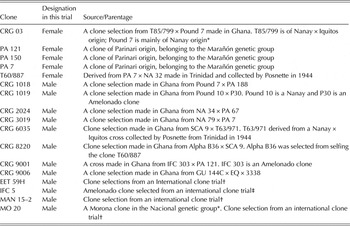
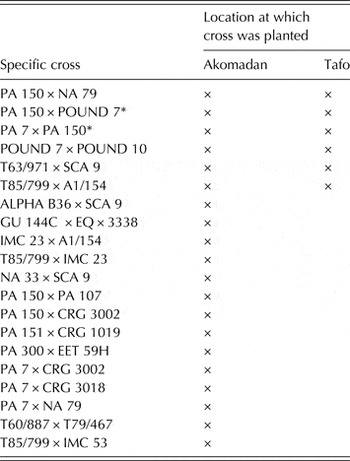
Crosses were made between five female and 12 male clones using a NC II mating design from June to July 2009 (Table 1). The female clones were selected from among the important seed garden clones in Ghana, whereas the males represent best clones from first cycle selection for seedling vigour and yield. The 17 cacao clones were genotyped using single nucleotide polymorphism (SNP) markers to obtain estimates of genetic diversity and pedigree relationships in the progeny. Based on their distribution across the ten chromosomes of cacao and level of polymorphism, 86 SNP markers were selected (Supplementary Material Table S1, available from http://journals.cambridge.org/AGS) from 1560 candidate SNP markers that had been developed using cDNA sequences from a wide range of cacao tissues (Argout et al. Reference Argout, Fouet, Wincker, Gramacho, Legavre, Sabau, Risterucci, Da Silva, Cascardo, Allegre, Kuhn, Verica, Courtois, Loor, Babin, Sounigo, Ducamp, Guiltinan, Ruiz, Alemanno, Machado, Phillips, Schnell, Gilmour, Rosenquist, Butler, Maximova and Lanaud2008). The map positions of these SNP markers on the T. cacao consensus linkage map are given in Allegre et al. (Reference Allegre, Argout, Boccara, Fouet, Roguet, Bérard, Thévenin, Chauveau, Rivallan, Clement, Courtois, Gramacho, Boland-Augé, Tahi, Umaharan, Brunel and Lanaud2012). Single nucleotide polymorphism fingerprinting was performed using KBiosciences competitive Allele-Specific Polymerase chain reaction (KASPar) chemistry (KBiosciences, Hoddesdon, Hertfordshire, UK). While generating seed pods for the experiment, pods from two crosses (CRG 03 × MO 20 and PA 121 × CRG 8220) were lost due to damage caused by infection from Phytophthora spp. and could not be included in the experiment, leading to only 58 of the expected 60 F1 progenies. Based on their performance in previous experiments (Eskes Reference Eskes2011; Padi et al. Reference Padi, Opoku, Adomako and Adu-Ampomah2012), four specific crosses were included as standards. These were PA 150 × Pound 7, PA 7 × PA 150, Pound 7 × Pound 10 and T63/971 × SCA 9. The trials were designed for two locations, Tafo (6°13′N, 0°22′W, 277 m a.s.l.) and Akomadan (7°42′N; 2°10′W, 389 m a.s.l.). For the progenies planted at Tafo, two additional progenies (PA 150 × NA 79 and T85/799 × A1/154) were included to obtain 64 families. Infections from Phytophthora spp. to developing seed pods resulted in inadequate seed pods for 14 progenies planned for the experimental site located at Akomadan. Fourteen other specific crosses were therefore added to obtain the total of 64 families for this location (Table 2) since the trial area was prepared 1 year ahead of the pollination programme. Mature hand-pollinated seed pods were harvested and seeds were nursed in polythene nursery bags from December 2009 to April 2010.
Description of clones used in the experiment by source or parentage

* Motamayor et al. (Reference Motamayor, Lachenaud, da Silva e Mota, Loor, Kuhn, Brown and Schnell2008).
† Eskes (Reference Eskes2011).
List of specific crosses evaluated alongside families generated from an incomplete North Carolina II design at two locations

* Standard varieties recommended for production in the Seed Gardens in Ghana.
Daily rainfall records during the period of the experiment were obtained from weather stations located within 150 m from experimental plots at each location. As the roots of cacao are concentrated in the top 30 cm of the soil (De Oliveira Leite & Valle Reference De Oliveira Leite and Valle1990), soil samples were taken to 30 cm depth at four spots per replicate and bulked for physical and chemical analysis, for each of four replications of the trials. At Akomadan, cassava and tomato had been grown in rotation for several years, whereas the plot at Tafo had been fallow for 6 years, following several years of cacao cultivation. Land preparation at the two sites was completed in June 2009 and plantain was established at a spacing of 2·5 × 2·5 m between and within rows to provide temporary shade to the cacao plants. Stakes of Gliricidia sepium cut to a height of 1·2 m were planted in alternate rows of the plantain to obtain a planting density of 5 × 5 m to provide longer term shade to cacao plants. Cacao seedlings were transplanted at each site in May 2010 at a spacing of 2·5 × 2·5 m2 (1600 plants/ha) with 20 plants per plot in a randomized complete block design with four replicates to obtain 80 plants per family. Missing plants within plots (mainly from the effects of drought that occurs from December to February) were replaced during the first 24 months. In July 2010, each cacao seedling was fertilized with 70 g nitrogen (N) supplied as ammonium sulphate. No agrochemicals were applied thereafter for the first 24 months after planting. Following the start of flower production, application of fertilizers and agro-pesticides followed recommended practices for cacao production in Ghana. Essentially, N:P:K (0 : 22 : 18) fertilizer was applied by broadcasting 350 kg/ha in May each year. Insect pests were controlled using imidacloprid (200 SL) as Confidor (Bayer CropScience, Monheim, Germany) at the rate of 150 ml/ha from August to December each year. Black pod disease caused by Phythophthora spp. was controlled by applying Ridomil Gold (Syngenta; 60% copper oxide and 6% mefenoxam) at the rate of 3·4 g/l of water and applied to drench developing pods on trees. The rate of fungicide per hectare was therefore dependent on the number of pods per tree at the time of fungicide application.
In April 2012, data were obtained on the percentage survival of seedlings initially planted in each plot. Stem diameter of each seedling was measured 15 cm above the ground surface with the aid of electronic callipers at 6-monthly intervals from September 2010 to March 2015. The TCSA was obtained from stem diameter measurements. Data recording for the plot at Akomadan ceased in December 2013 due to damage from bush fire. For the plot at Tafo, annual yields were estimated from the total number of pods produced per plot (typically in four separate annual harvests) divided by the pod value. The pod index was obtained from the number of pods required to obtain 1 kg of dry cacao beans, estimated from the dry weight of a sample of 30 pods per plot. Since black pod disease caused by Phytophthora spp. was controlled by following the recommended regime of fungicide sprays, incidence of the disease was minimal and diseased pods were excluded from yield estimations. Precocity, a widely used standard technical term (Visser & de Vries Reference Visser and de Vries1970; Volz & Knight Reference Volz and Knight1986; Knäbel et al. Reference Knäbel, Friend, Palmer, Diack, Wiedow, Alspach, Deng, Gardiner, Tustin, Schaffer, Foster and Chagné2015) was defined as the yield obtained in the first year of recording from April 2012 to March 2013. In general, progenies that recorded at least 200 kg/ha of dry beans before 36 months after transplanting were considered precocious (Padi et al. Reference Padi, Opoku, Adomako and Adu-Ampomah2012). Yield efficiency was estimated as the cumulative yield (averaged per tree) from April 2013 to March 2015 divided by the increase in TCSA over the same period.
Data analysis
Analysis of genetic relatedness of the 17 parental clones was done by means of principal co-ordinate analysis (PCoA) using GENALEX 6·501 (Peakall & Smouse Reference Peakall and Smouse2006, Reference Peakall and Smouse2012). Pairwise Euclidean distances (GD) were calculated on the 86 SNP data, and the GD was used to conduct the PCoA using a covariance matrix with data standardization option. For the agronomic data obtained, plot level values were used in analyses of variance (ANOVA). Among the traits studied, only the percentage survival of seedlings did not meet the condition of normality (based on the plot of residuals), and was arcsine transformed prior to ANOVA. All statistical analyses were performed using GenStat statistical software, version 12 (VSN International Ltd, Hemel Hempstead, UK). First, the ANOVA considered all 64 crosses to test for significant differences among the progenies at each site. Initially, the ANOVA was conducted with a model that considered the effects of years. However, the effects of year, and the interactions year × female, year × male and year × female × male were not significant, so the analyses utilized the cumulative or average trait values across years, with progenies considered fixed effect. The GCA and SCA effects were estimated with the following model (Dabholkar Reference Dabholkar1999):
 $$Y_{ijk} = \mu + g_i + g_j + s_{ij} + r_k + e_{ijk} $$
where Y ijk is the value of the character measured on cross i × j in the kth replication, μ is the population mean effect, g i is the GCA effect of the ith parent, g j is the GCA effect of the jth parent, s ij is the SCA effect of cross i × j, r k is the replication effect and e ijk is the environmental effect peculiar to (ijk)th individual. The effects of females and males were considered fixed whereas replication effect was considered random. The additive and dominance variances were estimated following Dabholkar (Reference Dabholkar1999). Additive variances due to females or males were estimated as four times the covariance of half sibs of females or males (derived from equating the appropriate mean squares to their expectations). The dominance variance was estimated as 4 × (covariance of full sibs – 2 × the average covariance of half sibs). The average covariance of half sibs was estimated following the method of King et al. (Reference King, Quinby, Stephens, Kramer and Lahr1961). The variance components were used to estimate narrow-sense heritability (h 2) on a full-sib progeny mean basis as suggested by Hohls (Reference Hohls1996) as follows:
 $$h^2 = \displaystyle{{2\left( {\sigma _{\rm m}^2 + \sigma _{\rm f}^2} \right)} \over {\sigma _e^2 /r + \sigma _{{\rm mf}}^2 + 2\left( {\sigma _{\rm m}^2 + \sigma _{\rm f}^2} \right)}}$$
where
 ${\rm (}\sigma _{\rm m}^2 + \sigma _{\rm f}^2 )$
is the variance component for the pooled additive variance attributable to male
 ${\rm (}\sigma _{\rm m}^2 )$
and female
 ${\rm (}\sigma _{\rm f}^2 )$
parents,
 $\sigma _e^2 $
is the residual variance, r is the number of replications, and
 $\sigma _{{\rm mf}}^2 $
is the variance of the female × male parent interaction (non-additive variance). The standard error of heritability was estimated following Hohls (Reference Hohls1996). The genetic control of yield efficiency was further examined by a plot of the observed yield efficiency GCA values v. the expected GCA values. The genotypic correlation (and associated standard error) between two traits, i and j were estimated as suggested by Hallauer & Miranda (Reference Hallauer and Miranda1988) as:
 $$r_{\rm g} = \displaystyle{{cov(ij)} \over {\sqrt {\left( {\sigma _i^2 \times \sigma _j^2} \right)}}} $$
where r
g is the genetic correlation, cov(ij ) represents the average (averaged across male and female covariance estimates) additive genetic covariance between traits i and j,
 $\sigma _i^2 \; $
is the average (averaged across male and female variance estimates) additive genetic variance for trait i, and
 $\sigma _j^2 $
is the average additive genetic variance for trait j. Pearson's simple correlation coefficients between traits were calculated on a progeny mean basis.
RESULTS
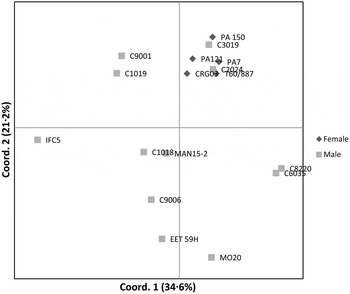
Based on the 86 SNP loci, the male clones used in the current study presented a higher level of diversity compared with the five female clones used (Fig. 1). With all the 86 loci considered, the combined probability of identity, i.e. the probability that two individuals drawn at random from a population have identical genotypes, was of the order of 10−15–10−36, indicating the sufficiency of the markers in discriminating among the clones (Supplementary Material Table S1, available from http://journals.cambridge.org/AGS). Heterozygosity of the clones was also higher among the males (0·4 ± 0·04) compared with the female clones (0·2 ± 0·30). For the female clones, individual heterozygosities ranged from 12·8% in PA 150 and CRG 03 to 27·9% in T60/887. Among male clones, individual heterozygosity ranged from 22·1 to 62·4% in CRG 9001 and MO 20, respectively.
Principal coordinate plot of 17 cacao clones genotyped at 86 single nucleotide polymorphism (SNP) loci, five clones used as females and 12 as males in an incomplete factorial mating to generate 58 F1 crosses.

Location characteristics and growth of cacao seedlings
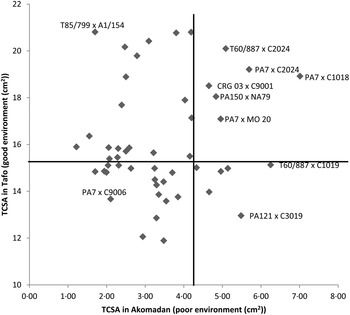
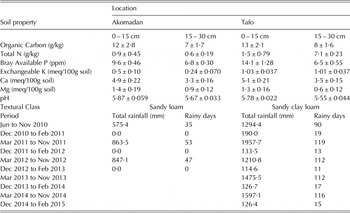
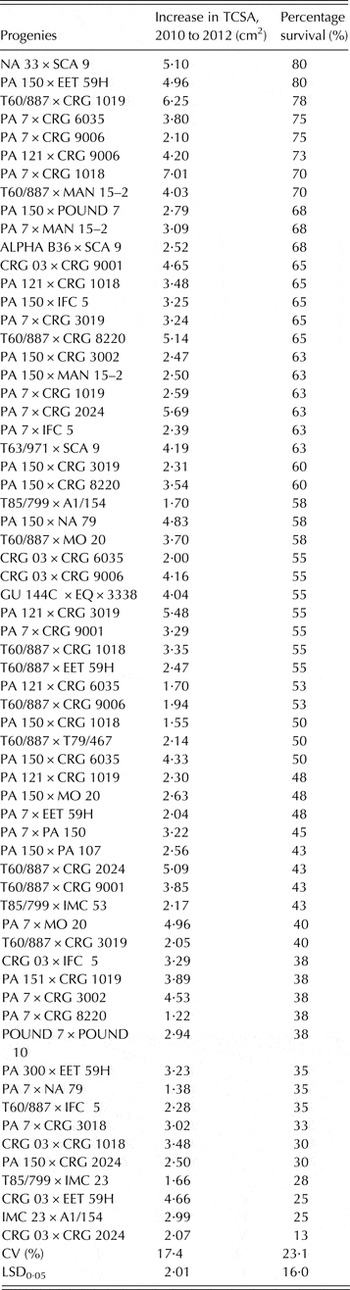
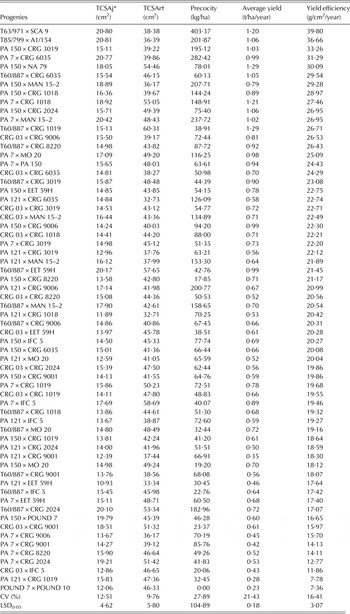
The experimental plot at Akomadan was characterized by a sandy texture with low organic matter content and a very low concentration of mineral matter compared with that at Tafo (Table 3). The total rainfall received and its distribution was also more favourable for cacao growth at Tafo compared with that received at Akomadan. Rainfall total and distribution during the first 24 months after transplanting is critical to cacao seedling survival. During the first dry period after transplanting (December 2010–February 2011), seedlings at Tafo received a total of 190 mm of rain on 19 days, whereas plantings at Akomadan received no rain during this period (Table 3). Similar patterns of rainfall were recorded in the following year at both locations. These were associated with much higher relative humidity values during the 3-month dry periods at Tafo compared with that at Akomadan (data not presented). Growth of cacao seedlings at the two locations was therefore markedly different. At Akomadan, the increase in TCSA of seedlings during the juvenile phase of 2010–2012 ranged from 1·22 to 7·01 cm2 with an average of 3·31 cm2 (Table 4). In general, seedling survival was poor at this location with only eight of the 64 families recording 70% or more survival of the seedlings initially planted in May 2010. Replacement of dead stands was therefore done after each dry spell at Akomadan to ensure that the initial density of 1600 plants/ha was maintained. The progenies with the best survival rate at Akomadan were dominated by those with PA 7 as a female parent (Table 4). A positive correlation between the increase in TCSA and percentage of plants surviving (r = 0·36, P < 0·01) was observed at this location. Growth of cacao seedlings at Tafo was very rapid. The performance of the progenies is indicated in Table 5. Increase in TCSA during the juvenile period ranged from 10·93 to 20·81 cm2, with an average of 15·67 cm2. Two progenies, T63/971 × SCA 9 and T85/799 × A1/154, had the most rapid increase in TCSA during the juvenile phase. Six of the 12 crosses involving PA 7 as female parent had TCSA increases in this period that were not different from those of the two best progenies. Between locations, 50 progenies were evaluated in common. A poor correlation (r = 0·12) for the increase in TCSA during the juvenile phase was observed between locations (Fig. 2). Compared with their respective location means, only six progenies maintained high increases in TCSA at both locations. Notably, T85/799 × A1/154 was most sensitive to location effects, being among the fastest growing at Tafo but was among the progenies with the least increases in TCSA at Akomadan. T60/887 × CRG 1019 and PA 121 × CRG 3019 showed strong adaptation to the poor environmental conditions at Akomadan.
Relationship between increase in trunk cross-sectional area (TCSA) during the juvenile phase for 50 F1 cacao progenies evaluated at two locations in Ghana with contrasting environmental conditions.

Soil properties (± standard error) determined to two depths, rainfall totals and the number of rainy days at the trial sites

Increase in trunk cross-sectional area (TCSA) and percentage survival of 64 cacao progenies evaluated over a period of 24 months at Akomadan, Ghana

Growth and yield performance of 64 cacao progenies evaluated over a 5-year period at Tafo, Ghana

* TCSAj is the juvenile stage increment in trunk cross-sectional area.
† TCSAr is the reproductive stage increment in trunk cross-sectional area.
At Tafo, records on seedling survival were not analysed because the growing conditions were favourable and did not induce seedling mortality. During the reproductive phase the progenies recorded, on average, an increase of 44 cm2 in TCSA (Table 5). Referred to as precocity, the dry bean yield in the first year of production (from April 2012 to March 2013) was significantly higher (P < 0·05) in the progeny of T63/971 × SCA 9 at 403 kg/ha, compared with the other progenies that recorded yields from 0 to 282 kg/ha (Table 5). Based on the criterion of a minimum yield of 200 kg/ha during the third year after planting, five other crosses (PA 7 × CRG 6035, PA 7 × MAN-15-2, PA 150 × MAN 15-2, T85/799 × A1/154 and PA 121 × CRG 9006) were also considered precocious. Average dry bean yields over the two subsequent years (April 2013–March 2015) varied fivefold from 0·23 t/ha in Pound 7 × Pound 10 to 1·29 t/ha in T60/887 × CRG 1019 and PA 150 × NA 79. PA 7 × CRG 1018 and T63/971 × SCA 9 had average yields not significantly different from the best yielding progenies. Yield efficiency, which integrates average yield and vegetative vigour, was highest in T63/971 × SCA 9 and T85/799 × A1/154. Compared with the two standard varieties recommended for the Seed Gardens in Ghana (PA 7 × PA 150 and PA 150 × Pound 7), the current evaluation provides several new progenies that perform better in terms of precocity, average yield and yield efficiency in these early production years.
Variance components, heritability and correlation between traits
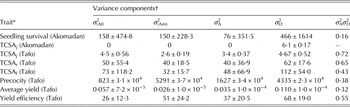
For the trial located at Akomadan, the dominance variance associated with the percentage of plant survival was greater than the additive variance estimates (Table 6), although in each case the associated standard errors were very large. The additive to dominance variance ratio indicated the importance of non-additive effects in the control of seedling survival. For plant vigour, estimated as the increase in TCSA, all estimates of additive variance were zero, with the dominance variance highly significant (P < 0·01). The low estimates of the additive relative to the dominance variance led to very low narrow sense heritability estimates for seedling survival at Akomadan (h 2 = 0·2 ± 0·14). Similarly, at Tafo the dominance variance estimates were larger than the corresponding additive variances leading to additive: dominance variance ratios less than unity for all six traits studied. Examining the additive variance component estimates shows that although the magnitude of the female component is larger than that of the male variance for precocity and yield efficiency only, the associated standard errors indicate a higher level of significance of male additive variance than additive variance due to females. Narrow sense heritability estimates at Tafo were moderate for the three estimates of tree vigour, low for precocity and average yield and moderate for yield efficiency (Table 7).
Variance components (± standard errors) from performance of cacao progenies obtained from a factorial cross of five females and 12 males evaluated at Akomadan and Tafo from 2010 to 2015

* TCSA j and TCSAr is the increase in trunk cross-sectional area during the juvenile and reproductive phases, respectively, and TCSAf is the increase in trunk cross-sectional area at the end of the recording period.
† σ 2 (Af) is the additive variance component due to females, σ 2 (Am) is the additive variance component due to males, σ 2 A is the average additive variance component from females and males, σ 2 D is the dominance variance component, and σ 2 A /σ 2 D is the additive: dominance variance ratio.
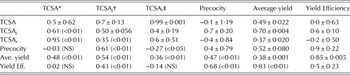
Narrow sense heritability (italic type in the diagonal, ± standard error), and phenotypic (below diagonal, P values in parenthesis) and genotypic (above diagonal, ± standard error) correlation coefficients between growth and yield-related traits among cacao progenies evaluated in Tafo from May 2010 to March 2015

NS, not significant.
* TCSA is the absolute trunk cross-sectional area at the end of the recording period in March 2015.
† TCSA j is the juvenile stage increment in trunk cross-sectional area.
‡ TCSA r is the reproductive stage increment in trunk cross-sectional area.
In general, genotypic and phenotypic correlations between traits produced estimates that were similar in direction and magnitude (Table 7). Although significant, the correlation between increase in TCSA during the juvenile and reproductive phases were weak. Whereas the increase in TCSA during the juvenile phase was significantly correlated with all three reproductive traits recorded (P < 0·05), the two other estimates of vegetative vigour did not produce significant correlation coefficients with precocity or yield efficiency. Thus progenies with fast juvenile growth were generally also precocious (r g = 0·66 ± 0·195; r p = 0·61, P < 0·01). Precocious progenies were associated with slow increases in reproductive stage TCSA, had high average yields and high-yield efficiencies.
Combining abilities for traits
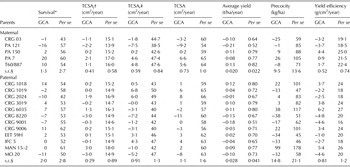
For Akomadan, only the GCA and per se performance for seedling survival are presented because the ANOVA indicated lack of significance for males or females for the increase in juvenile TCSA. For seedling survival, the GCA estimate among the female clones was significant (P < 0·05) for all progeny except PA 150 (Table 8). PA 7 and T60/887 had significant positive contribution to seedling survival (P < 0·05), whereas PA 121 and CRG 03 had negative contributions to seedling survival. For the male clones, CRG 1018, CRG 9006 and CRG 6035 contributed positively to seedling survival whereas MO 20, CRG 2024, CRG 8220 and CRG 9001 had negative contributions to seedling survival. Among the males, the per se performance was only moderately correlated with the GCA effects (r = 0·56, P = 0·059) with CRG 9006 and MAN 15–2 having the best per se performance for seedling survival.
General combining ability (GCA) and maternal and paternal per se performance for vegetative and reproductive traits for five female and 12 male cacao clones evaluated at two locations in Ghana

* Survival of seedlings was taken at Akomadan, all other data were taken at Tafo.
† TCSAj is the increase in trunk cross-sectional area from date of planting to first pod production.
‡ TCSAr is the increase in trunk cross-sectional area during pod production years.
§ Standard error for comparison of performance for GCA effects, standard error of difference for the variables.
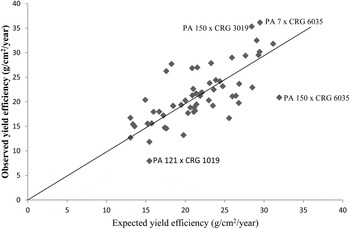
At Tafo, the female clones showed a consistent pattern of GCA for the three measures of vegetative vigour (estimated as increases in TCSA). PA 7 and T60/887 had positive contributions to vigour during both the juvenile and reproductive phases, PA 150 had estimates that were not significantly different from zero, and CRG 03 and PA 121 had negative GCA estimates (Table 8). Among males, the pattern of GCA estimates for TCSA was different for the juvenile and reproductive phases. For the juvenile phase increment in TCSA, MAN 15–2, CRG 6035 and CRG 2024 had positive GCA estimates, whereas MO 20, CRG 8220 had negative estimates of GCA. The remaining clones had GCA estimates that were not significantly different from zero. In the reproductive phase, only CRG 2024 maintained its positive GCA contribution that was observed in the juvenile phase. Rather, clones IFC 5, EET 59H and CRG 1019 contributed positively to vegetative growth whiles the crop was in the reproductive phase. Notably, CRG 8220 and MO 20 recorded negative GCA estimates for tree vigour during both juvenile and reproductive stages. For the reproductive traits, all GCA estimates for average yield for the female clones were significant. T60/887, PA 150 and PA 7 contributed positively to yield whereas PA 121 and CRG 03 had negative GCA estimates for average yield. PA 7 was the only female clone that had a significant positive contribution (P < 0·05) to earliness to produce dry bean yields (precocity), with an average of 105 kg/ha among its progenies. For yield efficiency, however, the GCA estimate of PA 7 was not significantly different from zero. PA 150 had the most significant contribution to yield efficiency among the female clones. Both PA 121 and CRG 03 had significant negative GCA estimates for yield efficiency (P < 0·05). Among the male clones, MAN 15–2 and CRG 6035 had positive GCA estimates for average yield, precocity and yield efficiency. CRG 3019 and CRG 1018 had significant GCA estimates for average yield and yield efficiency (P < 0·05), but not for precocity. The worst performing clones for the three yield traits include MO 20, CRG 8220 and CRG 9001. The high contribution to reproductive phase plant vigour by CRG 1019 led to negative GCA estimate for both precocity and yield efficiency by this clone. Highly significant correlation coefficients (r = 0·84–0·99; P < 0·01) were observed between the paternal per se performance and the GCA estimates for yield related traits. Prediction of the yield efficiency of the progeny based on the sum of the GCA values of the parents (Fig. 3) was only moderately efficient, with an R 2 = 0·502, indicating that both additive and dominance effects contributed to expression of the trait. Large deviations from the 1 : 1 line are indicative of the presence of large non-additive effects. For example, whereas the performance of PA 7 × CRG 6035 and PA 150 × CRG 3019 had positive deviations from the 1 : 1 line based on the GCA estimates of their parents, PA 150 × CRG 6035 and PA 121 × CRG 1019 had large negative deviations from the 1 : 1 line although both parents recorded positive GCA for yield efficiency for PA 150 × CRG 6035, whereas both parents of PA 121 × CRG 1019 had negative GCA estimates for the trait.
Observed yield efficiency of 58 F1 cacao progenies, and their predicted yield efficiencies calculated for each cross from the general combining ability (GCA) effect of two parents and the overall mean. Note, deviations from the 1 : 1 line due in part to specific combining ability (SCA) effects (R 2 = 0·502).

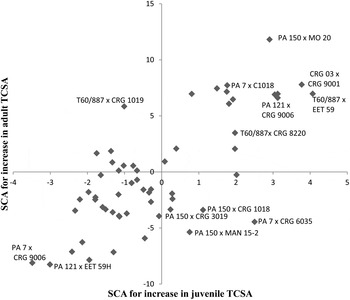
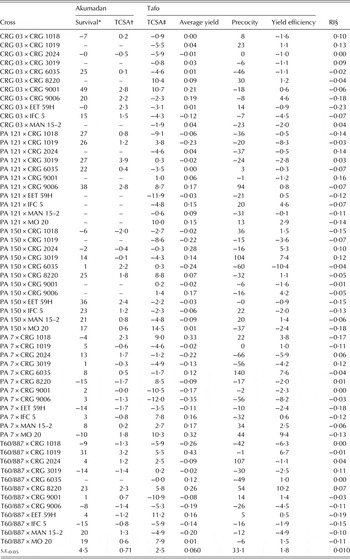
The SCA effects of the progenies (Table 9) for the various traits reflected closely the mean performance indicated in Table 4. For Akomadan, families with positive SCA effects for seedling survival and increase in TCSA such as PA 150 × EET 59H, T60/887 × CRG 1019, CRG 03 × CRG 9001 and PA 121 × CRG 9006 similarly had the best mean performance for the two traits, as indicated in Table 4. Moreover, these progenies maintained similar positive SCA effects for the increase in TCSA at Tafo (Fig. 4), indicating their broad adaptation to growing conditions in the cocoa belt. The correlation between SCA effects of progenies for increments in TCSA between the juvenile and reproductive phases was moderate (Fig. 4; r = 0·53, P < 0·001) indicating that a number of progenies had different magnitudes of SCA effects for the increments in TCSA between the juvenile and reproductive phases. For example, the progeny T60/887 × CRG 1019 that had SCA effects close to zero for the juvenile phase increments in TCSA was among the progenies with the most positive SCA effect for reproductive phase increment in TCSA. The relationship between the magnitude of the SCA effect for the reproductive phase increase in TCSA relative to that of the juvenile phase increase in TCSA had a direct impact on the SCA effect for yield efficiency. For example, PA 150 × MAN 15–2, PA 150 × CRG 3019, PA 150 × CRG 1018 and PA 7 × CRG 6035, which recorded negative SCA effects for the reproductive phase TCSA but positive for the juvenile phase TCSA (Fig. 4), recorded positive SCA effects for yield efficiency (Table 9) mainly because continuing growth during reproductive development reduces yield efficiency. Consistent with the high GCA for yield efficiency recorded for PA 150, the majority of progenies of this clone had relatively lower SCA estimates for TCSA in the reproductive phase than in the juvenile phase.
Relationship between the specific combining ability (SCA) effects of 58 F1 cacao progenies for the increase in trunk cross-sectional area (TCSA) in the juvenile and adult stages of growth evaluated at Tafo, Ghana. The covariance between the two traits for SCA was R 2 = 0·534.

Specific combining abilities for crosses between five female and 12 male cacao clones for growth and yield traits, at two locations in Ghana, and the Ritland relatedness index (RI) based on 86 SNP loci

* Percentage of seedlings that survived at the end of the juvenile phase, arcsine transformed.
† TCSA is increase in trunk cross-sectional area from planting in June 2010 to September 2012.
‡ The TCSA at the end of recording period in March 2015.
§ The Ritland relatedness index range from 0·5 (completely related) to −0·5 (completely unrelated).
Only four progenies had significant positive SCA effects for precocity, namely PA 7 × CRG 6035, T60/887 × CRG 2024, PA 150 × CRG 3019 and PA 121 × CRG 9006. The progeny PA 7 × CRG 6035 therefore had favourable SCA effects for all the key traits studied at Tafo: positive SCA effect for juvenile phase increase in TCSA, a negative SCA effect for reproductive phase increase in TCSA, positive SCA effect for average yield and a consequent positive SCA effect for yield efficiency. In addition, this progeny had high survival of seedlings under the marginal production conditions at Akomadan.
To determine whether the Ritland relatedness index (RI; Ritland Reference Ritland1996) may be used to predict favourable SCA for important traits in cacao, the RI values were correlated with the SCA effects for the 58 progenies at Tafo. As RI values increase (females and males becoming more genetically related) there should be evidence of inbreeding, such as decreasing SCA effects for TCSA, average yield or yield efficiency. Although the correlation coefficients in all cases were negative, no significant patterns were observed across the 58 F1 progenies, and the largest correlation coefficient observed was between RI and juvenile phase increase in TCSA (r = −0·18). For correlations using the sets of progeny obtained per maternal parent, an indication of decreasing SCA effect for yield with increasing RI estimates was seen only for PA 7 (r = −0·54) among the 12 progenies of this clone.
DISCUSSION
The current study demonstrated that considerable variation for tree vigour (which is necessary for adaptation to different environments) and yield attributes exists among progenies derived from recurrent selection of Pound's introductions. This suggests that although concerns for the narrow genetic base of cacao in West Africa persist, there is substantial scope for increasing yield and yield efficiency in cacao plantations by selecting for parental clones among the first generation hybrids of the earlier introductions into West Africa.
Single nucleotide polymorphism fingerprinting re-emphasized two points critical to successful cacao breeding. First, Pound 7 × Pound 10, which was included as a standard based on its high vigour and yield in earlier trials (Padi et al. Reference Padi, Opoku, Adomako and Adu-Ampomah2012), was the progeny with the worst performance for growth and yield in the present study. Subsequent fingerprinting revealed that the actual cross analysed in Padi et al. (Reference Padi, Opoku, Adomako and Adu-Ampomah2012) was a mixed stand of Pound 7 × PA 188 and Pound 7 × P 30 (Padi et al. Reference Padi, Ofori, Takrama, Djan, Opoku, Dadzie, Bhattacharjee, Motamayor and Zhang2015), whereas the correctly identified clones were used to generate the progeny in the present study. Mainstreaming DNA fingerprinting to accurately determine genetic identity is therefore necessary to estimate the value of clones to breeding improved cacao varieties. Second, there was little evidence that mating closely related clones led to progenies with reduced agronomic performance. In the present study, the expected negative correlation coefficient between the RI and the SCA effects for productivity related traits were not observed, probably because the parents are not inbred so that recombination at heterozygous loci reduced inbreeding effects. This observation suggests that crosses between clones derived from the same genetic group may not preclude opportunities for obtaining productive progenies. In maize, positive SCA effects are considered to arise from parents from different heterotic groups (Badu-Apraku et al. Reference Badu-Apraku, Oyekunle, Fakorede, Vroh, Akinwale and Aderounmu2013). Contrary to the results of the present study, Adomako & Adu-Ampomah (Reference Adomako and Adu-Ampomah2000) evaluated cacao progenies of inter- or intra-group mating derived from the Nanay, Iquitos and Marañón genetic groups and observed that yields of inter-group hybrids were higher than that of intra-group hybrids. Similarly, Dias & Kageyama (Reference Dias and Kageyama1995) could not detect inbreeding depression with five self-compatible cacao clones. Husband & Schemske (Reference Husband and Schemske1996) noted that habitually out-breeding species generally express inbreeding either very early or very late in their life-cycle, and it remains to be detected whether progenies in the present study will express patterns of inbreeding depression based on the relatedness of their progenitor clones in later years.
The short-term cacao breeding strategy in Ghana relies on testing clones as males for the existing female clones that have been planted over several hectares in some 27 seed gardens. The females in the present study were selected from the most important seed garden female parents available in Ghana, as in much of West Africa. These female clones are closely related to one another (evidenced by their genotypes at 86 SNP loci) as they are descended from a small number of genetic groups that made significant contributions to cacao production during the early years of formal research (Posnette Reference Posnette1951). These close genetic relationships may explain the lower levels of additive variance among females relative to the males for the traits recorded in the current study. With the contrasts in environmental conditions in the cocoa growing belt exemplified by the two locations used in the present study, it will be worthwhile to broaden the genetic base of female clones used in the seed gardens for seed production, to increase opportunities for developing specifically adapted varieties. Although phenological traits are typically very stable across environments (Stener Reference Stener2013), in the present study the correlation for increase in juvenile TCSA between the two locations was poor. This might reflect the strong contrast between the two production environments, and a case for developing specifically adapted varieties for areas with marginal production conditions. Low concentration of soil mineral content, low rainfall and dry spells are known stress factors for cocoa seedling establishment and survival (Padi et al. Reference Padi, Adu-Gyamfi, Akpertey, Arthur and Ofori2013a ; Ofori et al. Reference Ofori, Padi, Acheampong and Lowor2015). As in the study of Padi et al. (Reference Padi, Adu-Gyamfi, Akpertey, Arthur and Ofori2013a ) a poor correlation was observed in the current study between increase in TCSA and seedling survival at Akomadan. However, progenies with PA 7 as the female parent had faster growth and higher percentage survival, indicating the adaptability of this clone for developing varieties for areas with marginal production conditions. For example, PA 7 × CRG 9006, which showed high percentage seedling survival at Akomadan in the present study, was observed to have similarly good survival under no-shade planting and water stress (Padi et al. Reference Padi, Adu-Gyamfi, Akpertey, Arthur and Ofori2013a ). Padi et al. (Reference Padi, Takrama, Opoku, Dadzie and Assuah2013b ) evaluated the adaptability of cacao clones at two sites with contrasting production inputs: they observed that T85/799 and PA 7 were responsible for genotype × clone interaction, with T85/799 showing poor growth in the low-input environment, whereas PA 7 maintained average performance regardless of environment. In the present study, the progeny T85/799 × A1/154 displayed increase in TCSA between the two sites that is consistent with the sensitivity of the clone T85/799 observed by Padi et al. (Reference Padi, Takrama, Opoku, Dadzie and Assuah2013b ). On the basis of these results, progenies developed with the clone T85/799 as a parent should be restricted to areas with relatively high rainfall and more fertile soils. This observation is particularly important because T85/799 is one of the most important parents in the seed gardens across West Africa.
In the predominantly low-input cacao production systems in West Africa, precocity is an important trait that facilitates adoption of improved varieties because it indicates early returns on investment in the farm business. Adomako et al. (Reference Adomako, Allen and Adu-Ampomah1999a ) found that progenies with Scavina 9 (SCA 9) in their pedigree are generally precocious. The findings of the present study are in agreement with this observation in that CRG 6035 (derived from SCA 9) had a positive GCA for precocity, and T63/971 × SCA 9 was the most precocious progeny. Consistent with previous reports (Glendinning Reference Glendinning1966b ; Paulin et al. Reference Paulin, Mossu, Lachenaud, Eskes, Tay, Lee, Yap, Zulkarnain, Thong, Bong and Tee1994; Padi et al. Reference Padi, Opoku, Adomako and Adu-Ampomah2012) a positive correlation was observed in the current study between the increase in juvenile TCSA with precocity, bean yield and yield efficiency. Thus for Akomadan, where the trial could not be monitored after the juvenile phase, the progenies with positive SCA for juvenile TCSA including PA 7 × CRG 1018, T60/887 × CRG 1019, PA 7 × CRG 2024, PA 121 × CRG 3019 and T60/887 × CRG 8220 have potential for high yields, and may be suitable for areas with production conditions considered marginal for the crop. Moreover, these progenies had average yields higher than the standard varieties at Tafo. While high bean yields remain the ultimate objective for producers, trees that are excessively large pose difficulties to crop management operations. With the onset of reproductive growth in cacao, varieties for commercial planting are expected to display considerable reduction in vegetative growth so that yield efficiency is maximized. In the current study, some progenies continued to increase rapidly in vegetative vigour during reproduction. Generally, these are expected to be low-yielding (Glendinning Reference Glendinning1966a ; Adomako et al. Reference Adomako, Allen and Adu-Ampomah1999a ); however, in the present study two progenies that had large reproductive phase increase in TCSA (T60/887 × CRG 1019 and PA 150 × NA 79) recorded concurrent large yields, although with relatively lower yield efficiencies than would have been predicted from their large bean yields. High-yield efficiency is a key breeding objective for researchers in breeding programmes of the major cacao-producing countries. The argument for the value of this measure is that the TCSA is linearly correlated with above-ground biomass (Westwood & Roberts Reference Westwood and Roberts1970), so that yield efficiency reflects returns on tree management inputs. In a cacao plantation, the absolute TCSA arises from the sum of the juvenile phase and reproductive phase TCSA increments. In the present study, the absolute TCSA was moderately correlated with average yield but not with yield efficiency, and the genetic correlation between juvenile phase TCSA and yield efficiency was large and positive, indicating that although absolute plant size may be beneficial for attaining high yield, this should preferably arise from fast increases in juvenile TCSA and a relatively slower increase in reproductive phase TCSA. Five progenies with high-yield efficiencies had growth patterns consistent with this assertion, i.e. T63/971 × SCA 9, T85/799 × A1/154, PA 150 × CRG 3019, PA 150 × MAN 15–2 and PA 7 × CRG 6035. A second group of progenies achieved high-yield efficiencies through relatively slower juvenile phase increase in TCSA, faster increases in reproductive phase TCSA and high average yields. These included PA 150 × NA 79, T60/887 × CRG 1019 and PA 7 × CRG 1018. As there is a tendency for progenies in the latter group to have larger absolute TCSA over the former set, it is important when recommending varieties based on yield efficiencies that progenies falling into these two groups are not recommended for the same plantations. Large variation in tree-to-tree yields in cacao plantations have been attributed to differences in vigour (Lachenaud & Montagnon Reference Lachenaud and Montagnon2002; Adomako & Adu-Ampomah Reference Adomako, Adu-Ampomah, Bekele, End and Eskes2005) leading to overall low productivity for progenies with relatively small size. Similar to observations in the present study, Daymond et al. (Reference Daymond, Hadley, Machado and Ng2002) observed higher heritability for yield efficiency than for bean yield as yield varied somewhat in response to vigour. Selecting for yield efficiency may therefore lead to more rapid breeding gains in productivity than selecting directly for large average bean yields.
In the present study, although the relative importance of GCA and SCA differed depending on the trait, non-additive effects were generally more important than additive effects. At Akomadan, the GCA effects for TCSA were not significant, whereas >0·5 and >0·33 of crosses had significant SCA effects for seedling survival and TCSA, respectively, emphasizing the predominance of non-additive genetic control for both traits (following the interpretation of Sprague & Tatum Reference Sprague and Tatum1942). Similar observations of non-additive control of the traits at Tafo were observed from the ratio of additive to dominance variance estimates. Compared with previous reports in which total pod counts per tree were used as a proxy for bean yields, several authors found the additive component to be more important than non-additive component for yield (Soria et al. Reference Soria, Ocampo and Paez1974; Tan Reference Tan1990; Adomako et al. Reference Adomako, Allen and Adu-Ampomah1999a ). However, Dias & Kageyama (Reference Dias and Kageyama1995) and Cervantes-Martinez et al. (Reference Cervantes-Martinez, Brown, Schnell, Phillips-Mora, Takrama and Motamayor2006) found significant non-additive genetic control for total pods and TCSA, in agreement with the results of the present study.
Foster & Bridgewater (Reference Foster and Bridgewater1986) noted that maximum genetic gain in progeny means for a trait is achieved when both additive and dominance variances are used. This may be achieved by selecting parents that have good GCA effects and that, when crossed with specific parents, consistently produce families with high SCA values (or means that are better than expected based solely on GCA). The progenies PA 150 × CRG 3019 and PA 7 × CRG 6035 should meet the breeding objective of developing productive progenies. These progenies had fast increases in juvenile TCSA, slow increases in reproductive stage TCSA, high average yields, and high-yield efficiencies. The calculated SCA of these progenies indicated that the actual progeny means exceeded the desired expected change for yield efficiency in each case. Both GCA and SCA are important for the five key productivity related traits (high juvenile TCSA, slow reproductive TCSA, precocity, high yield and yield efficiency) in the present study. Ortet selection and vegetative propagation will facilitate the capture of non-additive genetic variation in the best progenies. Such clones have recently gained value in rehabilitation of aged cacao plantations across West Africa.
CONCLUSIONS
Cacao breeding worldwide is in the early phases considering that most of the clones available for production are only one or two generations of genetic selection from the mother trees in the Amazon forest. Although recent legislation in countries of cacao diversity (countries in the Amazon region) may pose difficulties for access to new germplasm by the countries of production (mainly in West Africa), the present study emphasizes that the potential for productivity enhancement in currently available germplasm in West Africa is yet to be fully exploited. All studied characters varied several folds in the progenies at each location. The yields reported in the present study are much higher than the average yields obtained in the major producing countries in West Africa. Indeed, the seed garden varieties included in the study were not among the best for increase in TCSA, seedling survival, yield or yield efficiency suggesting the potential for productivity gains from the use of the progenies in the present study. Recurrent selections from Pound's introductions in West Africa, and clones more recently available through internationally coordinated trials have the potential to meet long-term breeding objectives in the major production countries. It is worth noting that the present study analysed trait variations in a relatively young cacao crop, and variation for resistance to black pod disease has not been accounted for in the analyses. Nonetheless, the strong correlation between early and late yields is well known in cacao and the results of the present study should be valid in general for cacao breeding programmes, at least in West Africa. Information on resistance to black pod under natural field infection and artificial inoculations will require several more years of data recording for meaningful results. Whereas the female clones used in the present study are widely available in the cocoa producing countries, the male clones prefixed CRG are obtainable from the Cocoa Research Institute of Ghana (CRIG) following standard quarantine protocols for international cacao germplasm exchange.
This study was supported, in part, by the West and Central African Council for Agricultural Research and Development (WECARD), and the Ghana Cocoa Board. This paper is published with the permission of the Executive Director of the Cocoa Research Institute of Ghana as manuscript number CRIG/03/2015/028/002.
SUPPLEMENTARY MATERIAL
The supplementary material for this article can be found at http://dx.doi.org/10.1017/S0021859616000459.