Research on attitudes toward nuclear weapons indicates elite–public gaps. Historical case studies, declassified documents, and contemporary war games indicate that elites have been reluctant to support nuclear use, while survey experimental work suggests the public can be highly supportive of it.Footnote 1 How are we to make sense of this gap? Is earlier qualitative work on elite views wrong, and do public views as measured by recent survey work accurately represent the views of elites?Footnote 2 Or do elites and members of the public have fundamentally different views of nuclear weapons—and if so, how do we explain these differences, and what do they imply for survey experimental research?
Here, I theorize elite–public gaps on nuclear weapons. I argue that two features of public attitudes explain these gaps: low knowledge and low salience. Most of the time, the public knows little and cares little about nuclear weapons. When forming opinions about nuclear weapons, they likely resort to simple heuristic devices, such as treating nuclear weapons like conventional ones. National security elites, who represent the advisers and decision makers involved in deliberations on nuclear use, care and know significantly more about nuclear weapons. In particular, they are likely to have domain-specific knowledge or frameworks the public does not, driving elite–public gaps in ways not captured by simple demographic correlates. When focusing events like a nuclear crisis increase public knowledge and attention to nuclear weapons, public views are more likely to reflect elite ones.
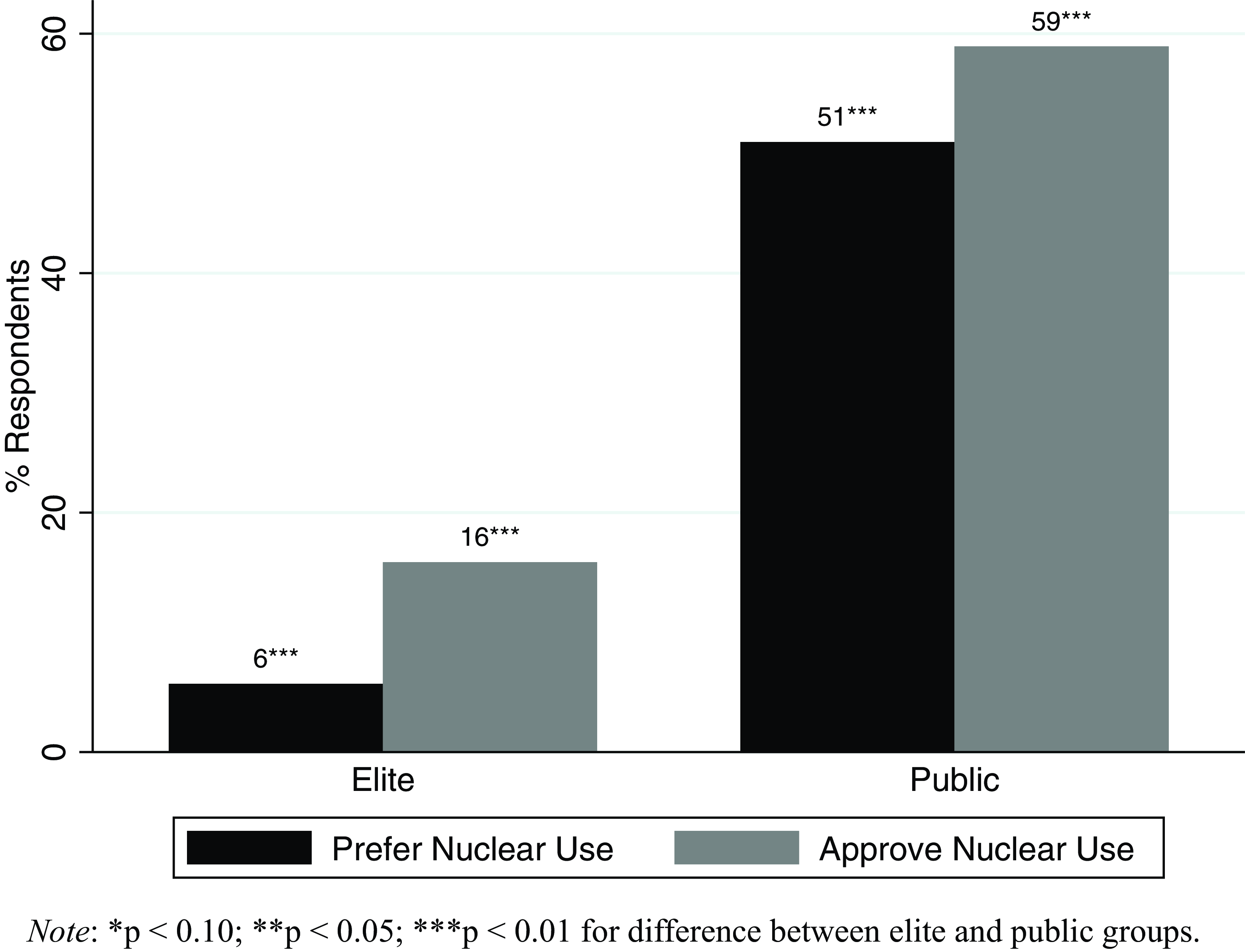
I test these arguments using parallel survey experiments of the US public and US national security elites. I field three parallel surveys: one on a public sample prior to Russia’s 2022 invasion of Ukraine, when nuclear weapons were a lower-salience issue; a second on a public sample in winter 2022–2023, after Russia’s invasion of Ukraine, when nuclear weapons became more salient; and a third on an elite sample of national security professionals at the US Naval War College and US National Defense University in spring 2023. Few elite respondents (only roughly 5 to 15 percent) preferred or approved nuclear use. The public was significantly more likely to support nuclear use (50 to 60 percent). In both the elite and public surveys, respondents who demonstrated more nuclear knowledge were less willing to support nuclear use. In addition, respondents for whom nuclear weapons had higher salience, either because they completed the survey after Russia’s invasion of Ukraine, or because they came of age under the nuclear shadow of the Cold War, were less supportive of nuclear use. In other words, these informed and attentive mass respondents behaved more like elites.
The findings have important implications for scholarship and policy. They provide the first direct evidence of US elite–public gaps in attitudes toward nuclear weapons and contribute to a small but growing body of work that suggests such gaps also exist in other nuclear-armed states. They also provide evidence that domain-specific knowledge and salience drive these gaps. These gaps suggest that we reconsider the significance of public attitudes toward nuclear weapons. Methodologically, the findings suggest that peacetime survey experiments of low-knowledge and low-salience members of the public may not represent elite views or even public attitudes in a crisis or conflict.
This article proceeds in four main parts. First, I discuss recent survey experimental work on nuclear weapons attitudes and highlight evidence of elite–public gaps. In doing so, I theorize the features of public attitudes toward nuclear weapons that explain these gaps, particularly the roles of issue knowledge and salience. Second, I summarize the research design. Third, I present the results. I conclude with a discussion of implications for scholarship and policy.
Elite–Public Gaps on Nuclear Weapons: Theory and Evidence
The Conditional Relevance of Public Opinion
In the last decade, dozens of survey experiments have examined attitudes toward nuclear use. Nearly all of them have used public samples.Footnote 3 Scholars justify the study of public attitudes toward nuclear weapons in two ways. First, they argue that public views may reflect leaders’ views, pointing to recent findings that elite–public gaps in political attitudes may be overstated.Footnote 4 Second, scholars sometimes argue that public opinion can be an important constraint on or driver of foreign policy.Footnote 5 There may be reasons to doubt both of these justifications under certain conditions. As I will show, there is strong evidence of elite–public gaps in attitudes toward nuclear use.
The recent wave of survey work concludes that the public is willing to support nuclear use, with majorities approving of it and large minorities (30 to 40 percent) even preferring it to conventional military options.Footnote 6 But in stark contrast to these recent results, research involving national security elites, including historical case studies, analyses of declassified accounts of US government workings, and contemporary war games with elite participants, suggests that elites have been reluctant to support nuclear use.Footnote 7
While survey data on the nuclear attitudes of elites is limited, it also suggests gaps. In one of the few examples of work directly studying both elite and public attitudes, Smetana and Onderco find that German elites are much less likely than the German public to support the use of nuclear weapons.Footnote 8 Smetana, Vranka, and Rosendorf find similar gaps between the British public and British parliamentarians.Footnote 9
This evidence of elite–public gaps on nuclear weapons is reinforced by general findings that, while elite–public gaps in political behavior may generally be overstated, they are likelier when it comes to questions of international security.Footnote 10
If elite and public views diverge, the relevance of public opinion to nuclear decision making is likely to vary across crises. Saunders, for instance, demonstrates that, for public opinion to constrain elites in the use of force abroad, the public must “want different things than the leader wants (preferences), knows what leaders are doing (information), cares enough to judge the leader on these actions (salience), and has the ability to impose costs on leaders (coordination and tools of punishment).”Footnote 11 Applying these principles to nuclear crises, we can derive three conditions for the relevance of public opinion to nuclear use.
First, public opinion more likely constrains when it conflicts with elite preferences. If public and elite preferences overlap, the former may be redundant. When public and elite preferences converge, elites might still find value in referencing public opinion to bolster the credibility of their threats or assurances to international audiences.Footnote 12 But convergence means that the public will not constrain elites, though it may permit elite action.
Second, public opinion is more likely to constrain when it is strong, durable, and provides a clear signal to decision makers. However, public preferences on foreign policy, including nuclear use, appear weak or malleable.Footnote 13 They respond to both peer and elite cues.Footnote 14 Recent experimental work shows that arguments and counterarguments can also change public opinion on nuclear use.Footnote 15 Whether and how these competing cues and arguments diffuse across the public may be difficult to predict ex ante.
Third, public opinion is more likely to constrain when leaders perceive the domestic political stakes in a crisis as greater than the international stakes. Even if public views are strong and diverge from elite views, leaders might see the public’s preferred policy as too risky, either because it risks failing to achieve important goals in the crisis or because it would seriously conflict with the preferences of important international audiences.Footnote 16 Nuclear crises vary significantly in their international and domestic stakes.Footnote 17 As Tannenwald argues, recent survey results demonstrating the US public’s willingness to use nuclear weapons say “nothing about how presidents respond to public opinion.”Footnote 18 The public is often either unwilling or unable to punish leaders for violating public preferences on foreign policy, meaning that elites confronting crises with high international stakes may be more willing to act against the public’s wishes.
Theorizing Elite–Public Gaps on Nuclear Weapons
I argue that two features help explain public–elite gaps on nuclear weapons: knowledge and salience. First, knowledge about nuclear weapons is likely to shape attitudes toward them. Past work shows a linkage between policy-relevant knowledge and policy preferences. US public respondents who know more about international legal norms are less likely to support nuclear use.Footnote 19 Support among US respondents for the US wars in Afghanistan and Iraq was strongly associated with respondents’ knowledge about the wars.Footnote 20 Survey work has shown that high-knowledge and low-knowledge individuals hold different attitudes on a range of foreign policy actors, including the European Union, NATO, and China.Footnote 21 This link is not merely due to selection effects—rather, policy-relevant knowledge shapes preferences.Footnote 22 Correcting misperceptions about international issues can shift public opinion on a range of issues, including trade and war.Footnote 23 Significantly, the more knowledgeable an individual is on a given topic, the more likely their views will mirror those of experts.Footnote 24
In the absence of a focusing event like a nuclear crisis, the US public knows little about nuclear weapons. According to one recent analysis, “A limited percentage of Americans say they are familiar with US nuclear weapons policy, their costs, their effects, and other issues related to the US nuclear weapons arsenal. But regardless of their age, most Americans today do not consider themselves familiar with nuclear issues.”Footnote 25 Even during the Cold War, researchers concluded that “only approximately 5 percent of the public have detailed knowledge of [nuclear] arms control.”Footnote 26 As Post and Sechser argue, “Because public knowledge about nuclear weapons issues is low, evaluating public attitudes about nuclear weapons requires that citizens first be given appropriate context so that they may connect their implicit normative values to specific nuclear policies.”Footnote 27 Without these explicit cues, public respondents may resort to simple heuristics such as whether nuclear use is more effective and may treat nuclear weapons like conventional ones. They may also rely on elite cues.
Second, the salience of nuclear weapons will shape attitudes toward them. Issue salience is “the importance individuals place on certain issues.”Footnote 28 The salience of an issue may rise or fall in an absolute sense or relative to other issues.Footnote 29 Salience may shift as a result of an individual’s personal experience with an issue or “due to the attention of media outlets or other political actors.”Footnote 30 The salience of nuclear issues is particularly sensitive to focusing events, such as crises.Footnote 31 When an issue has higher salience, individuals may have personal experience with it, or they will seek issue-relevant knowledge to inform their opinion.Footnote 32 By contrast, as researchers have noted, “In the absence of such motivation (e.g., when asked about a low-salience issue), we expect people to save their cognitive energy for something more worthwhile. When asked to evaluate a policy that is of less personal importance, we expect people to pick up on cues, which can be processed quickly and easily, with little or no effort.”Footnote 33
Scholars of American public opinion report that, generally, the “salience of nuclear weapons issues relative to other concerns (economy, healthcare, energy, etc.) can be relatively low.”Footnote 34 Public opinion polls also confirm the low salience of nuclear weapons for the public in other nuclear-armed states.Footnote 35 Due to this relatively low baseline salience, the public is more likely to rely on heuristics in evaluating such issues. However, the emergence of focusing events such as nuclear crises may increase that salience.Footnote 36 As Maria Rost Rublee vividly describes:
If Americans were actually faced with possible nuclear use, a tsunami of dread-provoking images would saturate the media from not only Hiroshima and Nagasaki, but also nuclear tests and accidents: photographs of burned, mutilated bodies from the atomic bombing of Japan; videos of ominous mushroom clouds from nuclear tests; testimonies about cancer and other radiation-caused illness from survivors of nuclear accidents; and more.Footnote 37
For national security elites, nuclear weapons will be a higher-salience and higher-knowledge issue.
These theoretical expectations have three observable implications for public and elite attitudes toward nuclear weapons. First, we should expect the public to be more supportive of nuclear use than elites, and low-knowledge or low-salience respondents to be more supportive than high-knowledge or high-salience respondents. As we have seen, survey work on the US public consistently shows that most respondents would approve of nuclear use and that large minorities would even prefer it to non-nuclear options. By contrast, qualitative work on elites, and the history of nuclear nonuse, suggest that elites are less willing to support nuclear use. Respondents with knowledge of nuclear weapons issues are more likely to reflect expert views, which, if studies of US decision makers and war games are correct, should be more wary of nuclear use.
Second, the views of elites and high-knowledge, high-salience respondents are likely more attuned to the ethical considerations of nuclear use than the views of the public and low-knowledge, low-salience respondents. Previous work suggests that the public has been very willing to support nuclear use and that this support is less sensitive to ethical considerations. As Tannenwald notes, “Evidence suggests that the locus of the taboo today lies with elites for whom nuclear weapons remain a salient issue.”Footnote 38 Goddard and Larkin note that “As the taboo took hold, elites were either directly socialized into the norm and came to believe their use unthinkable, or else feared their publics would reject as immoral any nuclear use.”Footnote 39
Third, public views of nuclear use and the views of low-knowledge, low-salience respondents are more likely to show signs of traditional effectiveness-based heuristics. Public opinion, especially on low-salience issues, is often formed by heuristics.Footnote 40 However, “increased issue salience motivates people to go beyond heuristics and engage in the systematic processing of policy-relevant information.”Footnote 41 Without elite cues or domain-specific knowledge, the public may apply heuristics commonly used for conventional weapons. For instance, the US public is more likely to support nuclear strikes when they are viewed as more effective than conventional ones, but support for nuclear use declines as civilian deaths rise.Footnote 42 Other work indicates that public respondents evaluate nuclear or conventional strikes using these kinds of metrics.Footnote 43 To the extent that elites have been socialized into the “bright line” constraints of the nuclear taboo, they should be less sensitive to these utilitarian considerations.Footnote 44 One observable implication of the importance of heuristics is that the views of the public and especially low-knowledge, low-salience respondents are more likely than the views of elites and high-knowledge, high-salience respondents to respond to the nuclear balance.Footnote 45 They are also more likely to justify nuclear use on effectiveness grounds.
Research Design
I test for elite–public gaps and the role of salience and knowledge with three parallel preregistered survey experiments: of the US public before Russia’s invasion of Ukraine; the US public after the invasion; and national security elites after the invasion.
The survey began with a short questionnaire measuring militant assertiveness and internationalism. Next, respondents were presented with a first vignette in the form of a mock news article describing an ongoing crisis between Russia and the United States in the Baltics. The vignette uses Russia as the target since it is the only nuclear-armed state that could plausibly be described as having either strategic nuclear parity or superiority with the United States. As detailed later, the vignette provides a description of the strategic nuclear balance, to which respondents were randomly assigned. Next, a manipulation check measured uptake of this nuclear-balance treatment. Respondents then reported their preference between two policy options for the United States: imposing economic sanctions on Russia, or dispatching US ground forces to the Baltics. They were also asked how much they would approve of a US decision to dispatch ground forces.
Next, respondents read a second vignette describing the crisis escalating to a conflict, with direct clashes between American and Russian conventional troops. Again, respondents were presented with two policy options: dispatching additional ground forces, or launching a limited nuclear strike against Russian forces. They were then asked which policy they preferred, whether they would approve of the nuclear strike, and whether they thought the nuclear strike would be ethical. The experimental design is summarized in Figure 1.
Research design

Independent Variables
Because this study investigates several aspects of attitudes toward nuclear weapons, it uses four sets of independent variables.
First, I identify whether the respondent is a member of the public or a national security elite. Second, as detailed later, I test the impact of issue salience in two ways: by exploiting differences in real-world conditions between the two public survey waves; and by controlling for cohort-level variation in nuclear weapons salience across public respondents. The first public survey was distributed prior to Russia’s invasion of Ukraine, Russian nuclear threats, and the increase in concern among the US public about nuclear weapons. The second survey was issued after Russia’s invasion, at a time when the salience of nuclear weapons, as I demonstrate later, was much higher. Differences between these two survey waves, controlling for other factors, allow us to proxy for the salience of nuclear weapons. I also use differences in salience across cohorts, providing evidence that salience is likely higher for respondents who became adults during the Cold War. Third, the survey includes five multiple-choice items measuring respondents’ knowledge of nuclear weapons issues. For each respondent, I code whether they answered each question correctly and add a variable indicating “more” knowledge (four or more items answered correctly) or “less” knowledge (one or fewer items answered correctly). Fourth, in testing whether respondents apply simple heuristics, respondents are randomly assigned to one of four US nuclear-balance conditions: primacy; superiority; parity; and inferiority. For the elite and pre-Ukraine public surveys, I test only the superiority and inferiority conditions due to smaller sample sizes and power concerns.
The survey also includes prompts for demographic information and attitudes on the use of force and the US role in the world generally.
Dependent Variable
The primary dependent variable is attitude toward nuclear use. In the first vignette, this is respondent preference and approval for dispatching ground troops over economic sanctions. In the second vignette, and the primary focus of the study, this is preference and approval for nuclear use over dispatching additional ground troops and whether they viewed the nuclear strike as ethical. In the results section, for reasons of space, I focus on respondent attitudes toward nuclear use following the second, conflict-based vignette. In the online supplement, I present respondent attitudes on dispatching troops following the first, crisis-based vignette.
Sampling Strategy
The results draw from survey experiments of the US public and a subset of US national security elites. Public respondents were recruited through Qualtrics, and the survey was completed through an anonymous online link. Samples matched national distributions for race, ethnicity, age, and household income according to the latest census data. Public responses were collected in two waves, a pilot in December 2020 and a larger wave in the winter of 2022–2023. The two waves allow us to test for shifts in background conditions that may change the salience of nuclear weapons.
In past experiments, scholars have sought to capture elite attitudes toward nuclear weapons in two ways. The first is to look for heterogeneity in attitudes across demographic characteristics that are thought to indicate “elite” status within society. For instance, Press, Sagan, and Valentino used “measures of elite status includ[ing] education level, income, age, gender, and subjects’ self-reported level of interest in political events.”Footnote 46 Finding that most of these measures were not associated with different preferences for nuclear use, they noted that “although more research is necessary to explore elite attitudes on nuclear weapons, these findings suggest that elites may not differ dramatically from the general public in their views toward nuclear weapons.”Footnote 47 The second way is to use national legislators.Footnote 48 However, in all nuclear-armed states, launch authority is officially vested in one or only a few members of the executive, not the legislative branch, and members of the executive are advised by military and national security elites.Footnote 49
My sampling strategy for the national security elite population improves representativeness relative to previous work by using samples that better reflect decision makers and their advisers. In the United States and most nuclear-armed states, the authority to launch nuclear weapons rests solely with the national leader, which makes it difficult to develop a representative sample for survey-based research.Footnote 50
However, a US nuclear strike would involve other government entities. In a memo to Congress, General Mark Milley, former chair of the Joint Chiefs of Staff, wrote that “by Presidential Directive and SecDef Directives, the Chairman is part of this process to ensure the President is fully informed when determining the use of the world’s deadliest weapons.”Footnote 51 He also noted that “the Chairman operates the National Military Command System” responsible for issuing nuclear orders and that nuclear command and control procedures would require a “decision conference” including the chair, along with other advisers.Footnote 52 According to former STRATCOM Commander General John Hyten, his job “is to provide advice” to the president on the use of nuclear weapons.Footnote 53 The president’s military advisers, including the chair of the Joint Chiefs of Staff, “would offer the President details and an assessment of the possible incoming attack, while the STRATCOM commander would explain the President’s options for a retaliatory attack.”Footnote 54 Research shows that advisers can significantly influence presidential decisions.Footnote 55
Alumni of the National Defense University and the Naval War College occupy top decision-making and advisory positions in these organizations. Although most students at both institutions are US military officers, roughly a third are civilians from the Departments of Defense, Energy, State, Homeland Security, and other national security agencies. At the time of the survey, seven of the eight members of the Joint Chiefs of Staff, including the chair, went to the National Defense University or the Naval War College.Footnote 56 Since the end of the Cold War, eight of the twelve chairs have studied in at least one of these institutions. At the time of writing, within STRATCOM, the commander, the director of global operations (J3), the director of command, control, communications and computer systems (J6), the director of joint exercises, training, and assessments (J7), and the foreign policy advisor have all studied at the National Defense University or the Naval War College. Half of all STRATCOM commanders ever, including five of the last six, studied at one of these two schools. Since 2009, STRATCOM has annually organized the Deterrence and Escalation Game and Review Exercise, a “strategic wargame” that “studies the dynamics of strategic deterrence, assurance, and escalation management to inform the whole of government, combatant commands, and allies across the spectrum of warfighting against a reactive nuclear-armed adversary.”Footnote 57 It is STRATCOM’s principal exercise of this kind, and it is hosted at the Naval War College.
My elite sample, surveyed in spring 2023, consisted of students, faculty, and researchers at the Naval War College and National Defense University.Footnote 58 Roughly two-thirds of these respondents reported having military experience. The sample also includes military and civilian faculty and researchers at both institutions.Footnote 59 As we will see, the strong relationship between knowledge, salience, identity, and support for nuclear use further strengthens our confidence in the representativeness of the sample; individuals in advisory positions related to nuclear weapons are likely to be high-knowledge, high-salience individuals.
There are limitations to this sample. Only a fraction of the alumni of these two institutions go on to serve in top decision-making positions. In addition, roughly two-thirds of the sample has military experience, which may make this a more hawkish sample.Footnote 60 Still, the sample likely represents decision makers better than previous survey experiments.
Results
The results largely support the theoretical predictions, with a strong relationship between elite status, knowledge, and salience in terms of support for nuclear use, ethical considerations, and sensitivity to the nuclear balance.
Support for Nuclear Use
I find that the public is significantly more likely than national security elites to prefer or approve of nuclear use.Footnote 61 I begin by comparing the elite sample to the baseline low-salience (pre-Ukraine) public sample, which is likely most comparable to public samples in earlier survey work on public attitudes toward nuclear use. In this sample, 51 percent preferred using nuclear weapons to dispatching ground troops, compared to only 6 percent of the national security elites (Figure 2).Footnote 62 Similarly, regardless of preference, 59 percent of the public approved of nuclear use, compared to only 16 percent of national security elites. The differences between the high-knowledge, high-salience elite sample and the low-knowledge, low-salience public sample are significant at the 0.001 level.
Support for nuclear use across elite and low-salience public samples

These elite–public gaps are even more notable given the demographic composition of the two samples. Compared to the public sample, the national security elite sample is whiter, less liberal, and more male, all attributes that are associated with greater support for nuclear use.Footnote 63
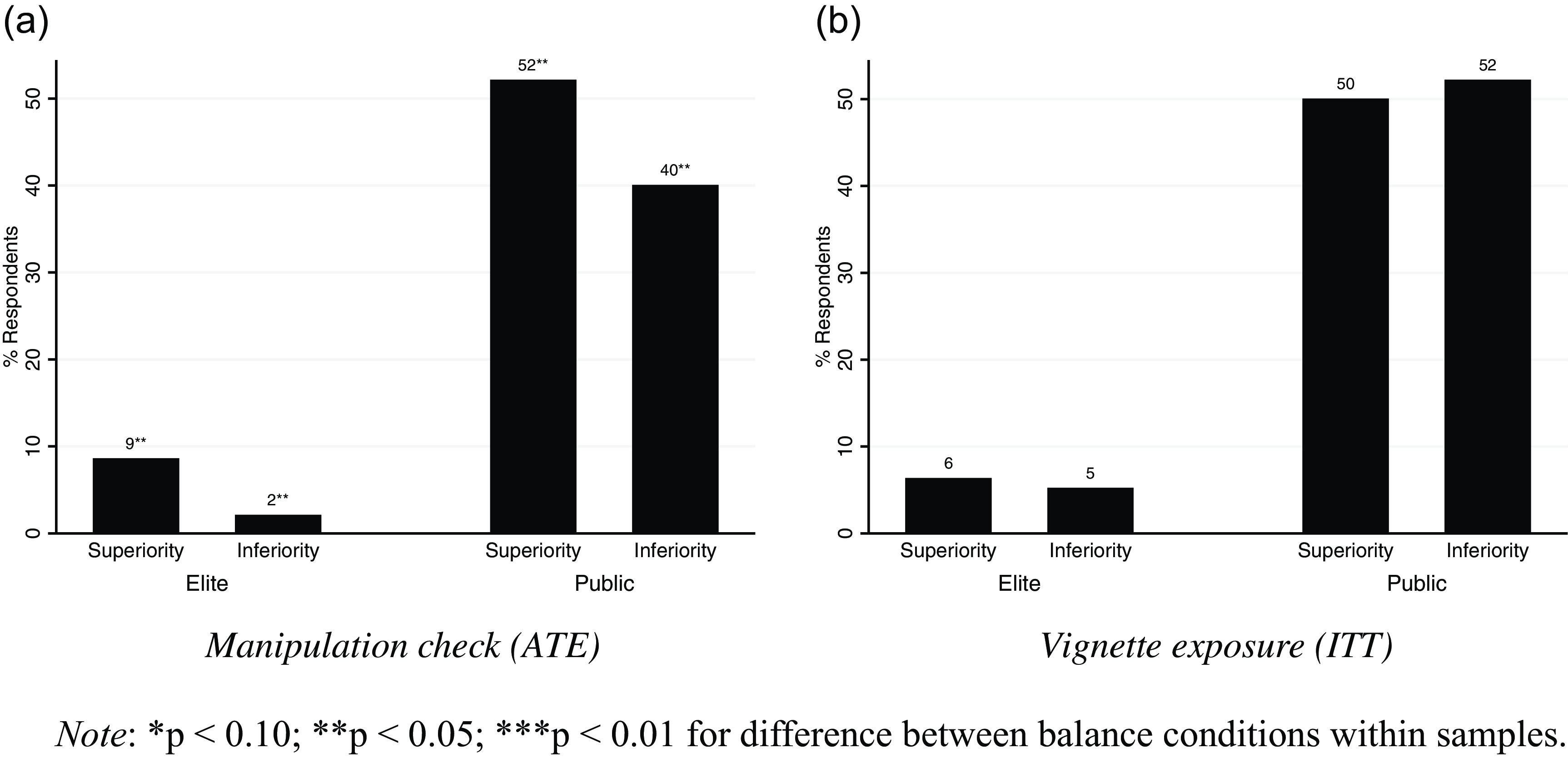
The results further suggest that the impact of the nuclear balance depends on the sample and on the measure used. I present results based on both respondent-reported perceptions of the balance and exposure to treatment, to provide differential measures based on “noncompliance” (Figure 3).Footnote 64 Panel (a) illustrates preference for nuclear use in the post-Ukraine elite sample and the pre-Ukraine (baseline) public sample based on how respondents reported perceiving the nuclear balance, constituting an average treatment effect (ATE).Footnote 65 For the public, moving from inferiority to superiority increased preference for nuclear use by twelve percentage points (from 40 to 52 percent) and approval of nuclear use by five percentage points (from 52 to 57 percent), though only the shift in preference is significant at conventional thresholds.Footnote 66 Elite views were less sensitive to the nuclear balance: moving from inferiority to superiority increases preference for nuclear use by only six percentage points and approval of nuclear use by only six percentage points. The difference between the superiority and inferiority conditions in the elite sample is significant at the 0.1 level when measured by the manipulation check. However, other intra-sample elite differences are not statistically significant at conventional thresholds.Footnote 67
Preference for nuclear use among elite and low-salience public samples across nuclear-balance treatments

However, relying on manipulation checks may introduce post-treatment bias, particularly if observations are dropped.Footnote 68 Further, noncompliance and lack of treatment “uptake” complicate causal estimates. For this reason, panel (b) also reports results based on treatment exposure, providing intent-to-treat (ITT) estimates. Here, the nuclear balance has no impact, with within-sample across-balance differences statistically insignificant and, in the public sample, the inferiority group even reporting a slightly higher preference for nuclear use.
Nuclear Salience
The results shift, however, when assessing public respondents for whom nuclear weapons have higher salience. I test for salience in two ways: by exploiting changing background conditions between the two public surveys to provide a quasi-experiment; and by examining differences in salience across cohorts. First, I leverage shifts in real-world nuclear salience between the two public surveys. The first pilot survey was conducted in late 2020, before Russia’s invasion of Ukraine. At the time, nuclear weapons were of little interest to the American public (low baseline salience).
The second wave of the public survey was conducted after Russia’s February 2022 invasion of Ukraine and the Russian government’s threats to use nuclear weapons.Footnote 69 At this time, nuclear weapons acquired higher salience. There was significant concern about nuclear escalation. I check the increased salience of nuclear weapons using data on internet searches from Google Trends. Scholars have validated this approach as a measure of issue salience and public attention, sometimes showing that it outperforms traditional polling because it better captures the public’s true behavior.Footnote 70 Google Trends data strongly correlate with traditional survey-based measures of issue salience but are more granular.Footnote 71
In February 2022 Google searches for “nuclear weapons” were the highest in twenty years, the entire period for which data are available. Searches for “potassium iodide” (anti-radiation pills) hit their highest level since the Fukushima nuclear accident in 2011. Potassium iodide pills sold out, and online retailers saw large spikes in demand for other survival products.Footnote 72 The five fastest “rising” search terms during this period were “will putin use nuclear weapons,” “will russia attack US with nuclear weapons,” “what happens if russia uses nuclear weapons,” “will russia use nuclear weapons on us,” and “does belarus have nuclear weapons.” Just a month after Russia’s invasion, three-quarters of US adults surveyed said they were concerned about possible Russian nuclear attacks on the United States.Footnote 73 Nearly a year later, 69 percent of US adults surveyed still said that they were “extremely or somewhat concerned about the possibility of a nuclear war in the next five years.”Footnote 74 Figure 4 plots Google searches for “nuclear weapons” and “potassium iodide” over the previous five years (scaled from 0 to 100, with 100 indicating the maximum level over the period).Footnote 75 Vertical lines indicate the dates the two surveys were fielded. Relevant internet searches increased significantly with the shifting real-world conditions; nuclear-weapons-related searches increased ten to fifty times.
Google searches for “nuclear weapons” and “potassium iodide,” January 2019 to January 2024

I test for differences in preference for and approval of nuclear weapons use between the low-salience and high-salience groups, controlling for demographic composition of the samples. In the public sample, the high-salience group is sixteen percentage points less likely to prefer and twenty-two percentage points less likely to approve of nuclear use compared to the low-salience group (Figure 5). Controlling for demographic factors, the high-salience group is still eleven percentage points less likely to prefer and sixteen points less likely to approve nuclear use. Both differences are significant at the 0.001 level. In addition, for the high-salience group, attitudes are not meaningfully sensitive to the nuclear balance, with the difference in preference and approval between different superiority conditions statistically insignificant. This further suggests that public respondents for whom nuclear weapons are a high-salience or high-knowledge issue behave more like elites.
Support for nuclear use in public sample, by issue salience

The post-Ukraine high-salience group also offers an opportunity to further examine shifts in the nuclear balance because it included two additional treatments describing the nuclear balance as either parity between the United States and Russia or complete US nuclear primacy, in which a strategic nuclear exchange would result in zero US deaths. As in the earlier discussion of the balance conditions, I report results (in Figure 6) by both respondent perceptions (ATE) and treatment exposure (ITT). Nearly all the differences between parity, superiority, and inferiority were statistically insignificant. But preference and approval of nuclear use are higher under primacy than parity, and both differences are significant at conventional thresholds.
Support for nuclear use in post-Ukraine (high-salience) public sample across nuclear-balance treatments

Second, I control for nuclear weapons salience based on cohort differentials. Scholars have noted that exogenous events and background conditions, particularly during an individual’s “formative years,” can have lasting effects on policy predispositions.Footnote 76 The salience of nuclear weapons varies over time and was significantly higher during the Cold War than it has been since then.Footnote 77 Figure 7 plots the proportion of material in the Google Ngram corpus of books referencing “nuclear weapons” and “nuclear war.” Given this trend, we would expect nuclear weapons to have higher salience for respondents who became adults during the Cold War.
Proportion of Google Ngram corpus containing “nuclear weapons” and “nuclear war”

I run a model assessing the relationship between whether a respondent is part of the “Cold War generation” (that is, they turned eighteen before the end of the Cold War) and their preference for nuclear use. I control for factors that are correlated with preferences for nuclear use, including gender, race, political preferences, and support for the death penalty. Those in the Cold War generation are more than sixteen percentage points less likely to support nuclear use, controlling for other demographic factors.
Nuclear Knowledge
Finally, I consider how nuclear knowledge is associated with attitudes toward nuclear weapons.Footnote 78 I divide the public sample into high-knowledge (four or five knowledge questions correct) and low-knowledge (zero or one correct) groups and compare each group’s attitude toward nuclear use and response to the nuclear balance (Figure 8).
Preference for nuclear use in public sample, by nuclear knowledge and balance condition

The high-knowledge group is significantly less likely than the low-knowledge group to prefer nuclear use when perceiving US superiority (26 percent versus 57 percent). This difference is statistically significant at the 0.001 level, controlling for demographic factors. The low-knowledge group’s preferences may also be more sensitive to the nuclear balance. For this group, moving from inferiority to superiority increases preferences for nuclear use by twelve percentage points, from 45 percent to 57 percent (ATE). For the high-knowledge group, preferences for nuclear use are very similar under superiority and inferiority (26 percent versus 30 percent) and statistically indistinguishable (ATE). In other words, high-knowledge public respondents behave more like national security elites.
Summary
I run two additional full models assessing the relationship between, on the one hand, preference and approval for nuclear use, and on the other, measures of nuclear salience and knowledge. Here, I control for factors that are associated with attitudes toward nuclear weapons and their use, including gender, age, race, political beliefs, and support for the death penalty.Footnote 79 This ensures that the results are not due to variation in demographic characteristics between samples and also that the measures of salience, knowledge, and elite status have independent relationships with attitudes toward nuclear use. Here, elites, respondents with more nuclear knowledge, those who became adults during the Cold War, and those in the post-Ukraine sample were between ten and twenty percentage points less likely to prefer or approve nuclear weapons use, compared to the low-knowledge, low-salience public baseline. This also demonstrates that national security elites are still significantly less likely to support nuclear use than their post-Ukraine public counterparts, even accounting for demographics and domain-specific knowledge. Figure 9 illustrates these relationships by reporting marginal effects along with 95 percent and 99 percent confidence intervals.
Relationship between knowledge, salience, identity, and support for nuclear use

As an additional test of attitudes toward nuclear weapons and the use of heuristics, I also examine views of the ethics and the military advantages of nuclear use. Much (though not all) work on the nuclear taboo has identified it as an elite phenomenon, and recent surveys suggest the public has not internalized it.Footnote 80 Ethical constraints, therefore, might constitute a form of domain-specific knowledge or attitudes that is more common among elites and members of the public for whom nuclear weapons are high-salience or high-knowledge issues. The surveys bear this out. Most of both the low-salience (55 percent) and low-knowledge (53 percent) public groups say that the nuclear strike would be ethical (Figure 10). Only 36 percent of the high-salience public, 30 percent of the high-knowledge public, and 29 percent of elites say it would be ethical. I also examine whether respondents perceive or justify nuclear use based on military advantage, which could indicate conventional utilitarian heuristics. Low-salience (18 percent) and low-knowledge (20 percent) public samples were more likely to approve of nuclear use because of perceived military advantage than high-salience (13 percent), high-knowledge (12 percent), and elite (3 percent) samples.
Percentage of respondents saying nuclear strike is ethical or provides a military advantage

Conclusion
These findings offer new insights into attitudes toward nuclear weapons and into elite–public gaps in political behavior. Elites are significantly less likely than the public to support nuclear use. And the attitudes of high-salience or high-knowledge public respondents resemble those of elites.
The findings here have important implications for scholarship and policy. First, and contrary to implications drawn from surveys of the US public, elites appear reluctant to support nuclear use. Yet, strikingly, a large portion of the US public seems to be willing to risk nuclear escalation—which, as the vignettes describe, could kill tens of millions—by launching nuclear strikes against a nuclear-armed adversary. The findings suggest that results from survey experiments using public samples may not represent the views of elites.
Second, the results indicate that peacetime public samples may have challenges with respect to external validity. They may not reflect public opinion in an actual nuclear crisis, when public attention will be focused intensely on the consequences of nuclear use, as US officials, intellectuals, and the media spread information about the meaning of a nuclear strike. Scholars may need to find ways to improve the realism of these interventions, such as through better modeling the information environment of a nuclear crisis or using more vivid exposures through virtual reality.Footnote 81 Interestingly, the results here contrast with findings that Russia’s invasion of Ukraine and nuclear threats increased willingness to use nuclear weapons among members of the public in Europe.Footnote 82 This contrast may be due to international differences in threat perceptions. Because Russia is likely viewed as a more direct threat to Europe, respondents there may see nuclear weapons as more important for self-defense. US respondents, who likely view Russia as less of a direct threat, may be less willing to accept the risks of nuclear escalation for the security of an ally.
Third, the effects of salience and knowledge suggest that efforts to decrease nuclear risk may benefit from public education campaigns. Increasing public knowledge about nuclear weapons, their effects, and their risks may reduce public demand for and acceptance of nuclear threats and strikes.
Fourth, the attitudes of national leaders toward nuclear weapons may vary with the degree to which they have internalized elite views based on their experience. For instance, a leader such as US President Joe Biden, who worked on nuclear weapons issues for decades in the Senate, may be more likely to hold views similar to the elites surveyed here. By contrast, US President Donald Trump, who appears to have had little if any exposure to nuclear weapons issues before his presidency, may have views that diverge from elite ones.Footnote 83
Future research can build on these results in several ways. First, it can investigate the attitudes toward nuclear weapons of national security elites in other countries. Much of the survey research on mass public attitudes toward nuclear weapons has used US samples and, as noted earlier, has consistently seen a greater willingness to use nuclear weapons than among US national security elites. While results from US samples are important given the significance of the United States for global nuclear issues, these findings may not generalize to other national contexts. Recent survey work in both China and Russia suggests that these populations are less willing to support nuclear use than the American public.Footnote 84 Scholars can also investigate the extent to which different elite populations hold systematically different attitudes toward nuclear weapons and their use and what this might imply for interstate crisis dynamics involving these countries. Second, scholars can investigate what drives potential cross-national or temporal variation in nuclear salience or knowledge and what this means for nuclear attitudes. Third, research can further probe the links between knowledge of and attitudes toward other foreign policy issues. Finally, scholars can investigate the extent to which support for nuclear use may be driven by different assessments of the probability of escalation, given that the public still appears willing to use nuclear weapons against a nuclear-armed state.Footnote 85
Data Availability Statement
Replication files for this research note may be found at <https://doi.org/10.7910/DVN/AIPA0V>.
Supplementary Material
Supplementary material for this research note is available at <https://doi.org/10.1017/S0020818325100799>.
Acknowledgements
I thank Peter Dombrowski, Michael Goldfien, Michal Onderco, Scott D. Sagan, Joshua A. Schwartz, Michal Smetana, Nina Tannenwald, Sanne Verschuren, Mathew Jie Sheng Yeo, participants in the Fletcher Faculty Research Seminar and the US Naval War College Deterrence Studies Institute Seminar, and the anonymous reviewers for helpful comments on earlier versions. For kind assistance with this project I also thank Justin Anderson, Chris Chyba, Paul Hart, BJ Miller, David Vacchi, and the Princeton Survey Research Center.