Introduction
Lyme borreliosis is a multisystem, tick-born, infectious disease caused by the Borrelia burgdorferi bacteria, with a clinical course progressing in stages involving predominantly the skin, joints and nervous system.Reference Stanek and Strle1 In Central Europe, the arthropodal vector of Borrelia burgdorferi is the Ixodes ricinus tick.Reference Stanek and Strle1 In Hungary (population 10 million), 1500 to 2000 cases of Lyme borreliosis are diagnosed every year.
Early, non-disseminated Lyme disease features an erythema chronicum migrans rash and influenza-like general symptoms, both of which usually resolve within six weeks.Reference Stanek and Strle1, Reference Nadelman and Wormser2 Further stages of Lyme disease are characterised by variable combinations of cardiac, neurological, rheumatological, ophthalmological and dermatological symptoms.Reference Stanek and Strle1–Reference Steere and Glickstein4 Cranial nerve paralysis (involving the facial and/or glossopharyngeal nerves) is a frequent manifestation of early disseminated Lyme neuroborreliosis, and is usually combined with carditis and lymphadenosis cutis benigna.Reference Stanek and Strle1
Recurrent laryngeal nerve paralysis is a rare and unusual complication of Lyme disease, and has been previously reported only three times.Reference Neuschaefer-Rube, Haase, Angerstein and Kremer5–Reference Schroeter, Belz and Blenk7 These three adult patients had no other neurological or prodromal symptoms, and the diagnosis of isolated Lyme neuroborreliosis was established from the suspicious clinical history, recurrent laryngeal nerve palsy and positive Lyme disease serology. Diagnosis of Lyme borreliosis is based on clinical suspicion and anti-borrelia serology results; however, a positive antibody result must always be assessed in the light of the clinical picture.Reference Stanek and Strle1
We herein present the case history of a teenage, female patient with recurrent laryngeal nerve palsy due to subclinical Lyme disease, confirmed by anti-borrelia enzyme-linked immunofluorescent assay and Western blot results.
Case report
A 15-year-old girl presented with a six-week history of a hoarse, soft voice. The hoarseness was worse in the evening. No stridor or swallowing difficulties were reported. No other general symptoms were observed (e.g. fever, weakness, weight loss).Reference Stanek and Strle1 The patient's parents had observed some tick bites, with a transitory exanthematous rash, on her gluteal and abdominal regions, three months earlier.
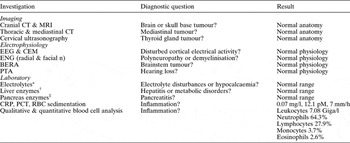
Videolaryngoscopic examination revealed right-sided recurrent laryngeal nerve paralysis. The right vocal fold was fixed in a paramedian position, whereas the left vocal fold was unaffected. The laryngeal mucosa and piriform sinuses appeared normal. Voice tonality and duration (8 seconds) had significantly deteriorated. The right vocal fold showed irregular stroboscopic movements (228 Hz) compared with the left side. Various imaging, laboratory and electrophysiological investigations were performed in order to elucidate the differential diagnosis of idiopathic recurrent laryngeal nerve paralysis (Table I).
Investigation of differential diagnosis of idiopathic recurrent laryngeal nerve paralysis: imaging, electrophysiology and laboratory methods and results

*Na, K, Ca, Cl, Mg and PO43−. †GOT = AST: aspartate-aminotransferase, GPT = ALT: alaninaminotransferase, GGT: gamma-glutamyl-transferase, and CE: cholinesterase. ‡Amylase and lipase. EEG = electroencephalography; CEM = cortical electrical mapping; ENG = electroneurography; n = nerve; BERA = brainstem evoked response audiometry; PTA = pure tone audiometry; lactate dehydrogenase; CRP = C-reactive protein; PCT = procalcitonin; RBC = red blood cell
Serological examinations were performed to test for adenovirus, cytomegalovirus (CMV), Epstein-Barr virus (EBV), herpes simplex virus types one and two, varicella zoster virus, enteric cytopathogen human orphan virus, respiratory human enteric orphan virus and Toxoplasma gondii infection; serum levels of immunoglobulin (Ig) M and G were analysed using antigen-specific enzyme-linked immunosorbent assay. Serum levels of anti-borrelia IgG and IgM were assessed using enzyme-linked fluorescent immonoassay (Vidas™; Biomerieux, Paris, France, USA). Enzyme-linked immunosorbent assays specific for adenovirus and varicella zoster virus gave negative results. Enzyme-linked immunosorbent assays specific for herpes simplex virus types one and two, CMV, EBV, enteric cytopathogen human orphan virus, respiratory human enteric orphan virus and Toxoplasma gondii showed previous and inactive infection, with an increased IgG serum level (>12 IU/ml) and a raised but normal IgM serum level (<12 IU/ml). Serological assessment for anti-borrelia IgG and IgM gave levels greater than 100.0 IU/ml, thereby establishing borrelia seropositivity. This positive screening result was confirmed by borrelia-specific Western blot analysis (using Borrelia burgdorferi EcoBlot IgG and IgM; Virotech, Rüsselsheim, Germany). The anti-borrelia IgG serum level was in the cut-off or suspicious zone: one band of p34 (outer surface protein B) was visible on the blot. The anti-borrelia IgM serum level was positive: four bands were differentiated on the blot (i.e. p34 (outer surface protein B), p83, p39 and p23 (native outer surface protein C)).
• This paper describes a case of recurrent laryngeal nerve paralysis due to subclinical Lyme borreliosis
• Recurrent laryngeal nerve paralysis can only be established as due to neuroborreliosis if Lyme disease serology is positive
• Parenteral application of third generation cephalosporins is an effective treatment for Lyme neuroborreliosis
Conservative medical treatment with vitamin B1 (50 mg twice daily orally), speech training and electrical stimulation of the recurrent laryngeal nerve (Galvan-Farad therapy using external direct current) were ineffective. An increase in anti-borrelia IgM serum levels was observed, confirming subclinical Lyme disease (i.e. isolated neuroborreliosis). Therefore, intravenous ceftriaxone treatment (2000 mg/day, in a 100 ml sodium chloride infusion over 30 minutes; Rocephin™, Roche, Rüsselsheim, Switzerland) was applied for 14 days.Reference Wormser, Ramanathan, Nowakowski, McKenna, Visintainer and Dornbush8 The paralytic right vocal fold showed complete recovery by the seventh day of antibiotic treatment, confirmed by videolaryngoscopy. Voice tonality and duration (22 seconds) had also normalised, and the right vocal fold showed regular stroboscopic movements compared with the left side.
Discussion
Neuroborreliosis can appear in unusual cranial nerves without significant prodromal symptoms. Recurrent laryngeal nerve paralysis can only be diagnosed as being due to neuroborreliosis if Lyme disease serology is positive and investigation for the aforementioned differential diagnosis gives normal results. In patients with recurrent laryngeal nerve paralysis and an uncertain clinical history, serum screening for anti-borrelia Ig is suggested. Parenteral application of third generation cephalosporins is effective treatment for Lyme neuroborreliosis.