

%20--%3e%3c!DOCTYPE%20svg%20PUBLIC%20'-//W3C//DTD%20SVG%201.0//EN'%20'http://www.w3.org/TR/2001/REC-SVG-20010904/DTD/svg10.dtd'%3e%3csvg%20version='1.0'%20id='Layer_1'%20xmlns='http://www.w3.org/2000/svg'%20xmlns:xlink='http://www.w3.org/1999/xlink'%20x='0px'%20y='0px'%20width='64px'%20height='64px'%20viewBox='5.5%20-3.5%2064%2064'%20enable-background='new%205.5%20-3.5%2064%2064'%20xml:space='preserve'%3e%3cg%3e%3ccircle%20fill='%23FFFFFF'%20fill-opacity='0'%20cx='37.785'%20cy='28.501'%20r='28.836'/%3e%3cpath%20fill='%23595959'%20d='M37.441-3.5c8.951,0,16.572,3.125,22.857,9.372c3.008,3.009,5.295,6.448,6.857,10.314%20c1.561,3.867,2.344,7.971,2.344,12.314c0,4.381-0.773,8.486-2.314,12.313c-1.543,3.828-3.82,7.21-6.828,10.143%20c-3.123,3.085-6.666,5.448-10.629,7.086c-3.961,1.638-8.057,2.457-12.285,2.457s-8.276-0.808-12.143-2.429%20c-3.866-1.618-7.333-3.961-10.4-7.027c-3.067-3.066-5.4-6.524-7-10.372S5.5,32.767,5.5,28.5c0-4.229,0.809-8.295,2.428-12.2%20c1.619-3.905,3.972-7.4,7.057-10.486C21.08-0.394,28.565-3.5,37.441-3.5z%20M37.557,2.272c-7.314,0-13.467,2.553-18.458,7.657%20c-2.515,2.553-4.448,5.419-5.8,8.6c-1.354,3.181-2.029,6.505-2.029,9.972c0,3.429,0.675,6.734,2.029,9.913%20c1.353,3.183,3.285,6.021,5.8,8.516c2.514,2.496,5.351,4.399,8.515,5.715c3.161,1.314,6.476,1.971,9.943,1.971%20c3.428,0,6.75-0.665,9.973-1.999c3.219-1.335,6.121-3.257,8.713-5.771c4.99-4.876,7.484-10.99,7.484-18.344%20c0-3.543-0.648-6.895-1.943-10.057c-1.293-3.162-3.18-5.98-5.654-8.458C50.984,4.844,44.795,2.272,37.557,2.272z%20M37.156,23.187%20l-4.287,2.229c-0.458-0.951-1.019-1.619-1.685-2c-0.667-0.38-1.286-0.571-1.858-0.571c-2.856,0-4.286,1.885-4.286,5.657%20c0,1.714,0.362,3.084,1.085,4.113c0.724,1.029,1.791,1.544,3.201,1.544c1.867,0,3.181-0.915,3.944-2.743l3.942,2%20c-0.838,1.563-2,2.791-3.486,3.686c-1.484,0.896-3.123,1.343-4.914,1.343c-2.857,0-5.163-0.875-6.915-2.629%20c-1.752-1.752-2.628-4.19-2.628-7.313c0-3.048,0.886-5.466,2.657-7.257c1.771-1.79,4.009-2.686,6.715-2.686%20C32.604,18.558,35.441,20.101,37.156,23.187z%20M55.613,23.187l-4.229,2.229c-0.457-0.951-1.02-1.619-1.686-2%20c-0.668-0.38-1.307-0.571-1.914-0.571c-2.857,0-4.287,1.885-4.287,5.657c0,1.714,0.363,3.084,1.086,4.113%20c0.723,1.029,1.789,1.544,3.201,1.544c1.865,0,3.18-0.915,3.941-2.743l4,2c-0.875,1.563-2.057,2.791-3.541,3.686%20c-1.486,0.896-3.105,1.343-4.857,1.343c-2.896,0-5.209-0.875-6.941-2.629c-1.736-1.752-2.602-4.19-2.602-7.313%20c0-3.048,0.885-5.466,2.658-7.257c1.77-1.79,4.008-2.686,6.713-2.686C51.117,18.558,53.938,20.101,55.613,23.187z'/%3e%3c/g%3e%3c/svg%3e)
%20--%3e%3c!DOCTYPE%20svg%20PUBLIC%20'-//W3C//DTD%20SVG%201.0//EN'%20'http://www.w3.org/TR/2001/REC-SVG-20010904/DTD/svg10.dtd'%3e%3csvg%20version='1.0'%20id='Layer_1'%20xmlns='http://www.w3.org/2000/svg'%20xmlns:xlink='http://www.w3.org/1999/xlink'%20x='0px'%20y='0px'%20width='64px'%20height='64px'%20viewBox='5.5%20-3.5%2064%2064'%20enable-background='new%205.5%20-3.5%2064%2064'%20xml:space='preserve'%3e%3cg%3e%3ccircle%20fill='%23FFFFFF'%20fill-opacity='0'%20cx='37.637'%20cy='28.806'%20r='28.276'/%3e%3cg%3e%3cpath%20fill='%23595959'%20d='M37.443-3.5c8.988,0,16.57,3.085,22.742,9.257C66.393,11.967,69.5,19.548,69.5,28.5c0,8.991-3.049,16.476-9.145,22.456%20C53.879,57.319,46.242,60.5,37.443,60.5c-8.649,0-16.153-3.144-22.514-9.43C8.644,44.784,5.5,37.262,5.5,28.5%20c0-8.761,3.144-16.342,9.429-22.742C21.101-0.415,28.604-3.5,37.443-3.5z%20M37.557,2.272c-7.276,0-13.428,2.553-18.457,7.657%20c-5.22,5.334-7.829,11.525-7.829,18.572c0,7.086,2.59,13.22,7.77,18.398c5.181,5.182,11.352,7.771,18.514,7.771%20c7.123,0,13.334-2.607,18.629-7.828c5.029-4.838,7.543-10.952,7.543-18.343c0-7.276-2.553-13.465-7.656-18.571%20C50.967,4.824,44.795,2.272,37.557,2.272z%20M46.129,20.557v13.085h-3.656v15.542h-9.944V33.643h-3.656V20.557%20c0-0.572,0.2-1.057,0.599-1.457c0.401-0.399,0.887-0.6,1.457-0.6h13.144c0.533,0,1.01,0.2,1.428,0.6%20C45.918,19.5,46.129,19.986,46.129,20.557z%20M33.042,12.329c0-3.008,1.485-4.514,4.458-4.514s4.457,1.504,4.457,4.514%20c0,2.971-1.486,4.457-4.457,4.457S33.042,15.3,33.042,12.329z'/%3e%3c/g%3e%3c/g%3e%3c/svg%3e)
Introduction
Clinicians and health professions educators are being asked to redesign education and care delivery amid persistent burnout, moral distress, and workforce instability, pressures amplified by pandemic aftereffects and ongoing staffing constraints [1–Reference Smallwood, Bismark and Willis3]. National calls to action now emphasize that providing wellness cultures and improving healthcare worker well-being is a systems responsibility and a prerequisite for a sustainable workforce capable of leading transformation [4].
Innovation is often positioned as a strategic competency for system improvement, while well-being is addressed through downstream wellness programming or individual coping strategies. This separation fuels a false tradeoff of innovation versus well-being, despite the reality that transformational work occurs in complex adaptive environments that require sustained cognitive, emotional, and relational capacity [Reference Spanos, Leask, Patel, Datyner, Loh and Braithwaite5]. Innovation competencies, such as systems thinking, adaptive leadership, creativity, and collaborative problem solving are essential for navigating complexity and advancing change [Reference Spanos, Leask, Patel, Datyner, Loh and Braithwaite5]. At the same time, professional well-being and coping capacity influence clinicians’ ability to tolerate uncertainty, stay fully engaged, persist through iteration, and engage productively in change efforts [Reference Lee, Dai, Li, Lin and Wang6].
Emerging organizational evidence suggests these constructs are linked: cultures that support innovation, evidence-based practice, and wellness are associated with lower burnout and better mental health outcomes across nurses and the broader healthcare workforce [Reference O’Hara, Melnyk, Hsieh, Helsabeck, Giuliano and Vital7]. National nursing education and workforce frameworks also underscore the need to build innovation-related competencies while supporting the conditions that sustain the workforce, including well-being [8,9]. However, empirical studies intentionally integrating innovation development with holistic well-being and evaluating both remain limited. Although innovative behavior and creativity have been associated with positive work outcomes [Reference Papachristopoulos, Gradito Dubord, Jauvin, Forest and Coulombe10], few programs have concurrently measured innovation competency and multidimensional well-being using mixed methods, alongside qualitative analysis of participants lived experience.
To address this gap, The Ohio State University College of Nursing launched a one-year Innovation Fellowship (“Dream Team”) during the COVID-19 pandemic, grounded in Integrative Nurse Coaching and designed to develop innovation competency while supporting participant well-being through individual and group coaching, education, and an applied innovation project [Reference Barr, Gillespie, Hanners, Militello, Newtz and Thrane11]. Early feasibility work suggested potential benefits for both innovation capacity and perceived well-being [Reference Barr, Gillespie, Hanners, Militello, Newtz and Thrane11]. The Fellowship was subsequently expanded to support nurse- and health professional–led innovation while explicitly attending to identity development, boundary-setting, mentorship, and psychological safety within a community of practice.
The purpose of the present study was to examine outcomes from five years of Fellowship cohorts, including participant well-being, innovation skill development, and perceived links among innovation, professional identity, and wellness using a convergent mixed-methods design. By evaluating quantitative change in holistic well-being and innovation competency alongside qualitative mechanisms of change, this work provides preliminary evidence for a scalable professional development model that integrates innovation and well-being as mutually reinforcing aims. This study aimed to (1) evaluate pre–post changes in fellows’ integrative well-being and innovation competency, (2) examine fellows’ perceptions of the Fellowship’s influence on innovation skills, professional identity, and well-being, and (3) integrate quantitative and qualitative findings to identify potential mechanisms linking innovation competency and well-being.
Methods
Design
This study used a convergent mixed-methods design. Quantitative and qualitative data were collected in parallel within fellowship cohorts and analyzed separately, then integrated through joint interpretation. The study was approved as part of a broader program evaluation by the university’s institutional review board; participation in surveys and evaluations was voluntary, and data were analyzed in de-identified form. Analyses used all available data; paired analyses were restricted to respondents with matched pre–post surveys within the same Fellowship year.
Program description and setting
The Innovation Fellowship is an interdisciplinary one-year program for health professionals designed to build innovation capacity and support well-being. Fellows participate in a national cohort model that recruits participants across institutions and geographic regions rather than from a single local unit. This structure allows participants to remain embedded in their home organizations while engaging in a shared learning community, expanding peer networks, and applying innovation skills to context-specific projects. National cohort designs are increasingly used in innovation and leadership fellowships, although they are not universal across fellowship programs; some models remain institution-based, specialty-based, or internally focused. Comparable fellowship models in healthcare and academic innovation commonly include longitudinal cohorts, project-based learning, mentoring/coaching, peer community, and dissemination or implementation outcomes [Reference Smith, Morassaei and Ruco12–14]. The Fellowship evaluated here included a multi-day in-person retreat, monthly virtual sessions combining innovation content with reflection/legacy work, individual and group coaching, development of an applied innovation project, and peer community/networking. The simultaneous pursuit of innovation and well-being is a core design principle of the fellowship, emphasizing the need to integrate these ideas rather than view them as separate or competing.
Participants and sampling
Over five years, 63 fellows participated, representing 16 academic universities, 10 healthcare organizations, and 3 countries; most participants were nurse faculty, although role/profession was not systematically collected on the evaluation surveys. Not all fellows participated in the research study. Fellows in recent cohorts were invited to complete surveys at the beginning and end of the fellowship year, along with ongoing program evaluation forms. For the present analysis, the research team aggregated de-identified evaluation data across multiple cohorts and fellowship years. Paired pre–post data reflect responses from the same individuals collected within a single fellowship year.
Quantitative sample
For well-being, 50 Integrative Health and Wellbeing Assessment (IHWA) surveys were available across cohorts (35 pre-fellowship and 15 post-fellowship); 14 fellows completed both pre- and post-IHWA and were included in paired pre–post analyses. For innovation competency, 45 unique responses were available after deduplication by participant and timepoint, including 36 pre-fellowship and 9 post-fellowship surveys; 6 fellows provided paired pre–post innovation competency data. Demographic characteristics were not consistently collected in early cohorts and are therefore not reported.
Qualitative sample
Qualitative data were drawn from open-ended responses on (a) continuing education (CE) evaluation forms completed after monthly sessions, (b) retreat evaluation forms, and (c) end-of-year fellowship surveys. Facilitators also documented implementation reflections from group sessions and retreats to contextualize findings and inform program refinement. Responses spanned multiple cohorts and reflected a range of participant roles (e.g., academic faculty, clinical nurses, advanced practice providers, and other health professionals).
Measures
Integrative well-being
Well-being was assessed using the IHWA, a multidimensional self-report measure designed to assess perceived wellness across integrative domains on a 1–5 Likert scale (1 = never, 5 = always), with higher scores indicating greater well-being [Reference McElligott, Eckardt, Dossey, Luck and Eckardt15]. Consistent with established program-evaluation practice, analyses used 32 IHWA items. An overall IHWA score was computed for each respondent by averaging all non-missing items (range 1–5). Items were also organized into eight domains aligned with the IHWA structure and the Ohio State wellness model, life balance & satisfaction, emotional, physical, social, spiritual, environmental, intellectual, and health responsibility, and domain-level mean scores (range 1–5) were calculated for each participant. Cronbach’s alpha with this sample was calculated to assess internal consistency and is reported in the Results.
Innovation competency
Innovation competency was assessed using a 19-item Innovation Competency Scale informed by Benner’s novice-to-expert framework (Appendix A) [Reference Benner16]. Benner’s framework was selected because the Fellowship was designed as a developmental professional formation experience rather than a single knowledge-based training. The novice-to-expert structure provided an intuitive way for fellows to self-assess progression from early awareness of innovation concepts toward more confident, context-responsive application of innovation skills. The scale was adapted for this evaluation by aligning Benner’s five developmental levels with innovation-related competencies drawn from the innovation and entrepreneurship literature and the Fellowship curriculum. Items assessed innovation-related skills and dispositions, including identifying opportunities for change, applying design thinking, navigating systems, leading teams, and pitching ideas. Respondents rated each item on a 5-point developmental scale corresponding to Benner levels: 1 = Novice, 2 = Advanced Beginner, 3 = Competent, 4 = Proficient, and 5 = Expert. For each respondent, a mean innovation competency score ranging from 1 to 5 was calculated across all available items, and an overall Benner level was derived from the mean score.
Because this adapted scale was developed for program evaluation and has not yet undergone full psychometric validation, innovation competency findings should be interpreted as developmental self-assessment data rather than as definitive measurement of competency. Internal consistency reliability was excellent when calculated using all available responses at each timepoint (Cronbach’s alpha approximately 0.95 at baseline and 0.94 at follow-up), supporting reliability within this evaluation sample; however, additional validation work is needed in future studies.
Quantitative analysis
Descriptive and pre–post analyses were conducted in alignment with the Fellowship’s program-evaluation goals. For the IHWA, descriptive statistics (mean, standard deviation, minimum, and maximum) were calculated at baseline and follow-up using all available surveys. The 35 pre-fellowship and 15 post-fellowship IHWA surveys were retained for descriptive reporting; however, inferential pre–post tests were limited to the 14 fellows with matched pre- and post-fellowship responses within the same Fellowship year. Baseline-only IHWA surveys were not included in paired change analyses because they could not contribute to within-person change estimates. Because demographic fields were not consistently collected in early cohorts, we could not reliably compare paired respondents with baseline-only respondents on demographic or role characteristics. For the paired sample, pre- and post-fellowship means were computed for the overall IHWA score and each domain; mean change scores (post–pre) and paired-samples t-tests were conducted for the overall score and domains. We estimated 95% confidence intervals for mean change and calculated Cohen’s d effect sizes. To aid interpretation of individual change, overall IHWA mean score differences were categorized using pre-specified program-evaluation thresholds: meaningful improvement (increase ≥ 0.30 points), meaningful decline (decrease ≥ 0.30 points), and stable (absolute change < 0.30); changes of ≥0.50 points were noted as a more robust shift. These thresholds were selected a priori for pragmatic program-evaluation interpretation on a 1–5 scale: a 0.30-point shift represents approximately 6% of the full scale, and a 0.50-point shift represents a 10% scale shift. These thresholds should not be interpreted as established minimal clinically important differences for the IHWA.
For innovation competency, descriptive statistics were calculated for the mean innovation competency score at baseline (n = 36) and follow-up (n = 9) using all available surveys. Paired analyses were conducted for the subset of fellows with matched pre–post innovation competency data (n = 6). For this paired subset, we calculated pre- and post-fellowship mean scores, computed mean change scores (post–pre), summarized the distribution of individual changes, and examined shifts in Benner-level categories (e.g., proportion Competent vs. Proficient) from baseline to follow-up. Because of the small follow-up and paired sample sizes, pre–post analyses for innovation competency were considered exploratory, and no adjustments were made for multiple comparisons; results should therefore be interpreted cautiously and not as definitive evidence of effectiveness.
Associations between innovation competency and well-being
After cleaning and deduplicating records, a merged dataset was created for participants who had both IHWA and innovation competency scores at the same timepoint and/or paired pre–post data on both measures. Association analyses were retained only as exploratory, hypothesis-generating analyses because sample sizes were small, particularly at follow-up and in the paired subset. Cross-sectional correlations between innovation competency and IHWA total scores were examined at baseline and follow-up, and change-score correlations were examined only for the small subset with paired data on both measures. These analyses were not used to draw causal conclusions or to establish the strength of association between innovation competency and well-being.
Qualitative data collection and analysis
Qualitative data were collected through open-ended items embedded in routine program evaluations and surveys administered throughout the Fellowship year. Prompts invited fellows to reflect on the most valuable aspects of the retreat and Fellowship experience, perceived impacts on their personal and professional lives, changes made in work practices or boundaries, and recommendations for program improvement. Open-ended responses were compiled across multiple qualitative sources and cohorts, including CE evaluation forms completed after monthly sessions, retreat evaluation forms, and end-of-year Fellowship surveys. In addition, qualitative insights were captured from participant discussions during Fellowship group meetings and retreats and incorporated into the qualitative dataset.
A qualitative content analysis with a reflexive thematic approach was used to identify patterns in perceived program impact and opportunities for refinement. The analytic team included three authors with experience in innovation fellowship implementation, nursing education, and qualitative interpretation. First, the analytic team reviewed the full dataset multiple times to become familiar with the breadth and tone of responses. Second, initial codes were generated to capture salient ideas (e.g., legacy and purpose, identity as an innovator, boundary-setting and saying no, stress reduction, design-thinking skill development, innovation project progress, community and psychological safety, and recommendations such as increased in-person time or additional business-skills content). Third, codes were clustered into candidate themes and iteratively refined across data sources to develop a coherent thematic framework. Finally, representative quotations were selected to illustrate themes, and analytic memos were used to document interpretations and articulate how themes related to innovation competency, well-being, and Fellowship design.
Integration of quantitative and qualitative strands
After completing quantitative and qualitative analyses separately, the research team conducted a joint interpretation to examine convergence, complementarity, and divergence across data sources. Specifically, we compared patterns of change in IHWA and innovation competency with qualitative themes (e.g., identity development, boundary-setting, and community/psychological safety), examined whether fellows’ narratives offered plausible explanations for observed quantitative patterns, and synthesized integrated key findings to inform program refinement and future research. Because paired quantitative samples were small, qualitative findings were used to contextualize and explain possible mechanisms rather than to overstate causal effectiveness.
Results
Quantitative findings
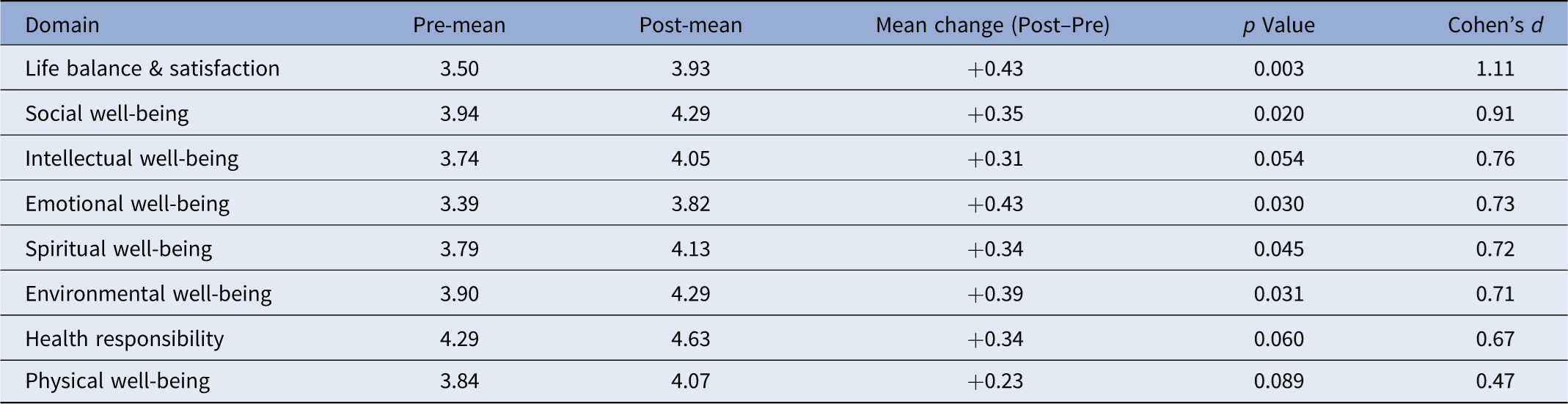
Integrative well-being (IHWA). Fifty IHWA surveys were available (35 pre, 15 post), including 14 paired pre–post responses. All available IHWA surveys were used to describe the evaluation sample at each timepoint, while inferential testing was restricted to the paired sample to avoid treating independent and matched observations as equivalent. In the paired sample, overall IHWA significantly improved from 3.84 (SD = 0.32) to 4.16 (SD = 0.32) on a 1–5 scale (Delta = +0.31; p = .003; d ∼1.08). Domain-level changes are reported in Table 1. Life balance & satisfaction, emotional well-being, environmental well-being, and health responsibility demonstrated the clearest gains, with additional improvements across social and spiritual domains. Using the pre-specified meaningful-change threshold (≥0.30), 12/14 fellows showed meaningful improvement, 0/14 declined, and 2/14 remained stable.
Integrative Health and Wellness Assessment (IHWA) domain scores at baseline and follow-up (paired sample, n = 14)

Table 1. Long description
A table with eight rows and five columns comparing pre and post mean scores across various well-being domains. The columns are labeled Domain, Pre-mean, Post-mean, Mean change (Post-Pre), p Value, and Cohen’s d. The rows list different well-being domains and their corresponding values. Row 1: Life balance & satisfaction, Pre-mean 3.50, Post-mean 3.93, Mean change +0.43, p Value 0.003, Cohen’s d 1.11. Row 2: Social well-being, Pre-mean 3.94, Post-mean 4.29, Mean change +0.35, p Value 0.020, Cohen’s d 0.91. Row 3: Intellectual well-being, Pre-mean 3.74, Post-mean 4.05, Mean change +0.31, p Value 0.054, Cohen’s d 0.76. Row 4: Emotional well-being, Pre-mean 3.39, Post-mean 3.82, Mean change +0.43, p Value 0.030, Cohen’s d 0.73. Row 5: Spiritual well-being, Pre-mean 3.79, Post-mean 4.13, Mean change +0.34, p Value 0.045, Cohen’s d 0.72. Row 6: Environmental well-being, Pre-mean 3.90, Post-mean 4.29, Mean change +0.39, p Value 0.031, Cohen’s d 0.71. Row 7: Health responsibility, Pre-mean 4.29, Post-mean 4.63, Mean change +0.34, p Value 0.060, Cohen’s d 0.67. Row 8: Physical well-being, Pre-mean 3.84, Post-mean 4.07, Mean change +0.23, p Value 0.089, Cohen’s d 0.47.
Note: IHWA = Integrative Health and Wellness Assessment (1–5 scale; higher scores indicate greater well-being). Values reflect domain-level mean scores for fellows with paired pre–post data within the same Fellowship year (n = 14). p values are from paired-samples t-tests; Cohen’s d reflects within-subject effect size.
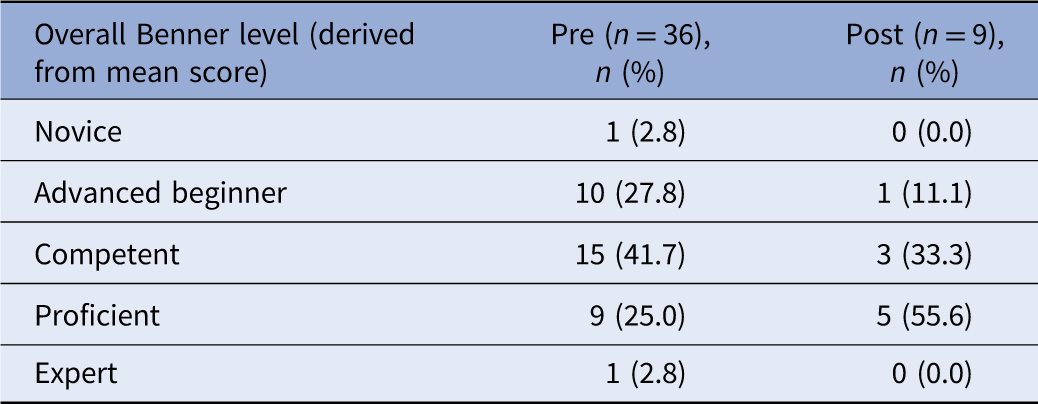
Innovation competency. After deduplication, baseline innovation competency surveys were available for 36 fellows (mean = 3.00, SD = 0.77) and follow-up surveys for 9 fellows (mean = 3.53, SD = 0.54) on the Benner-aligned 1-5 scale. Overall Benner-level distributions shifted from predominantly Competent at baseline (41.7%) to predominantly Proficient at follow-up (55.6%), with no fellows classified as Novice at follow-up (Table 2). Six fellows provided paired data; mean scores increased from 2.79 to 3.73 (Delta = +0.94; median Delta = +0.68). Because only 6 fellows had paired innovation competency data, these findings are interpreted as descriptive and exploratory rather than confirmatory.
Distribution of overall innovation competency levels (Benner Novice–Expert) at baseline and follow-up

Table 2. Long description
A table comparing the distribution of overall innovation competency levels at baseline and follow-up. The table has four rows and three columns. The columns are labeled ‘Overall Benner level (derived from mean score)’, ‘Pre (n = 36), n (%)’, and ‘Post (n = 9), n (%)’. The rows are labeled ‘Novice’, ‘Advanced beginner’, ‘Competent’, ‘Proficient’, and ‘Expert’. Row 1: Novice, Pre 1 (2.8), Post 0 (0.0). Row 2: Advanced beginner, Pre 10 (27.8), Post 1 (11.1). Row 3: Competent, Pre 15 (41.7), Post 3 (33.3). Row 4: Proficient, Pre 9 (25.0), Post 5 (55.6). Row 5: Expert, Pre 1 (2.8), Post 0 (0.0). The table shows a shift from predominantly Competent at baseline to predominantly Proficient at follow-up.
Note: Overall Benner level was derived from each fellow’s mean innovation competency score (mean of 19 items rated 1–5: 1 = Novice, 5 = Expert) using the following cut points: Novice < 1.5; Advanced Beginner 1.5–2.49; Competent 2.5–3.49; Proficient 3.5–4.49; Expert ≥ 4.5. Counts reflect unique respondents after deduplication by participant and timepoint.
Associations between innovation competency and well-being (exploratory). Among participants with both measures available at baseline (n = 29), innovation competency was unrelated to IHWA (r = −0.02, p = .93). At follow-up (n = 6), the association was moderate and positive but not statistically significant (r = 0.68, p = .14). In the paired subset with both measures (n = 6), change scores were not associated (r = 0.05, p = .92). Given the very small follow-up and paired samples, these analyses are underpowered and should not be interpreted as evidence for or against a true association between innovation competency and well-being. They are included only to transparently report the exploratory analysis and to inform future, adequately powered studies.
Qualitative findings
Four cross-cutting themes described how fellows experienced the Fellowship and perceived its influence on innovation, identity, and well-being (Table 3). First, fellows described clarifying legacy and claiming an identity as innovators, using purpose to guide decisions about commitments and projects. Second, fellows reported improved boundary-setting and work–life rebalance, including saying no to misaligned roles and experiencing reduced stress. Third, fellows described tangible innovation skill development and project progress, including applying design-thinking tools and producing more robust plans, budgets, and pitches. Finally, community, mentorship, and psychological safety were repeatedly emphasized as enabling conditions that supported vulnerability, experimentation, and learning from failure. Across data sources, fellows also identified program refinement opportunities related to platform burden, clarity of structure/feedback, desire for more in-person time, and added practice-oriented content on the “business side” of innovation. Representative quotations are provided in Table 3.
Cross-cutting qualitative themes describing fellowship impact on innovation, identity, and well-being (across cohorts and data sources)

Table 3. Long description
A table with four rows and three columns. The columns are labeled ‘Theme’, ‘Description’, and ‘Impact’. Row 1: Theme, Clarifying legacy and claiming identity; Description, Using purpose to guide decisions about commitments and projects; Impact, Innovation, identity. Row 2: Theme, Improved boundary-setting and work-life rebalance; Description, Saying no to misaligned roles and experiencing reduced stress; Impact, Well-being. Row 3: Theme, Tangible innovation skill development and project progress; Description, Applying design-thinking tools and producing more robust plans, budgets, and pitches; Impact, Innovation. Row 4: Theme, Community, mentorship, and psychological safety; Description, Enabling conditions that supported vulnerability, experimentation, and learning from failure; Impact, Well-being. The table also mentions program refinement opportunities related to platform burden, clarity of structure/feedback, desire for more in-person time, and added practice-oriented content on the business side of innovation.
Note: Qualitative data were drawn from open-ended items in continuing education (CE) evaluation forms, retreat evaluation forms, and end-of-year surveys across cohorts.
Integrated findings
Integration of quantitative and qualitative results suggests the Fellowship was associated with meaningful gains in well-being and descriptive gains in innovation competency among respondents with available paired data, while qualitative findings clarify how these outcomes may develop together (Table 4). Quantitatively, fellows demonstrated significant improvement in IHWA scores, while innovation competency increased descriptively, with paired results suggesting upward movement despite limited follow-up sample size. Qualitative themes illuminate plausible mechanisms and enabling conditions: identity/legacy work appeared to catalyze values-aligned prioritization, boundary-setting, and sustained engagement; applied skill-building and project progress strengthened innovation efficacy; and community, mentorship, and psychological safety provided a supportive context for experimentation, vulnerability, and learning from failure. Together, these findings indicate the Fellowship functions as an integrated system of practices, rather than a content-only intervention, through which innovation capacity and professional well-being may be mutually reinforced.
Mixed-methods joint display of Innovation Fellowship outcomes and mechanisms linking innovation competency and integrative well-being. Joint display integrating quantitative outcomes, qualitative themes, and inferred mechanisms linking innovation competency and integrative well-being. Integrative Health and Wellness Assessment (IHWA) (1–5). Meaningful individual change defined as |Δ| ≥ 0.30; ≥0.50 noted as a robust shift. Quantitative associations are exploratory due to small, paired samples

Table 4. Long description
A table with three columns and four rows. The columns are labeled ‘Quantitative outcomes (What changed)’, ‘Qualitative themes (What fellows described)’, and ‘Integrated interpretation (Plausible mechanisms)’. Row 1: Integrative well-being (IHWA) improved in paired sample (n=14): 3.84 ± 0.32 – 4.16 ± 0.32; Δ = +0.31, p = .003, d ≈ 1.08. 12/14 showed meaningful improvement (≥0.30), 0/14 meaningful decline, 2/14 stable. Domain improvements were most evident in life balance & satisfaction, emotional well-being, physical well-being, environmental well-being, and health responsibility. Theme 2: Boundaries, well-being, and work-life rebalance. Fellows described boundary-setting (e.g., “saying no,” stepping down from misaligned roles), reduced stress/overload, and improved ability to manage demands. Boundary-setting as a pathway to well-being gains. Values- and identity-driven prioritization likely reduced overload and protected recovery time, aligning with improvements in life balance, emotional well-being, and health responsibility. Row 2: Innovation competency (all available surveys) increased descriptively: Pre n=36, mean = 3.00 (SD = 0.77); Post n=9, mean = 3.53 (SD = 0.54) on the Benner-aligned 1–5 scale. Benner-level distributions shifted from predominantly Competent at baseline (41.7%) to predominantly Proficient at follow-up (55.6%), with 0% Novice at follow-up (Table 2). Theme 3: Innovation skills, design thinking, and project progress. Fellows described applying design-thinking tools, prototyping/iterating, pitching ideas, developing budgets/plans, and moving projects from idea to action (pilot/proposal/implementation). Skill acquisition + efficacy supports innovation growth. Practical tools, coaching, and project traction may strengthen confidence and perceived control, supporting persistence through uncertainty and iteration. Row 3: Innovation competency (paired subset): n=6, mean scores increased from 2.79 to 3.73, Δ = +0.94 (median Δ = +0.68). 5/6 improved; 1/6 showed a negligible decrease (−0.05, stable). Theme 1: Identity and legacy formation as innovators. Fellows described a shift in self-concept and clarity of purpose (“legacy”), which guided what to start/stop/continue and how to invest creative energy. Identity as a linking mechanism. Clarifying “who I am and what I’m building” may increase innovation behaviors while also legitimizing boundaries that protect well-being, supporting sustained engagement in change work. Row 4: Innovation ↔ well-being association (exploratory): At baseline (n=29 with both measures), innovation competency and IHWA were unrelated (r = −0.02). At follow-up (n=6 with both measures), higher innovation competency trended with higher well-being (r = 0.68, p = .14). Change-change association in paired subset (n=6) was near zero (r = 0.05, p = .92), likely underpowered. Theme 4: Community, mentorship, and psychological safety. Fellows emphasized the cohort as a “safe space,” with mentoring and peer community enabling vulnerability, learning from failure, honest reflection on stress/burnout, and willingness to experiment and take innovation risks. Psychological safety/community of practice as enabling conditions. A supportive, psychologically safe cohort may simultaneously increase innovation risk-taking and strengthen social/emotional well-being, helping explain broad well-being gains alongside innovation growth.
Discussion
This mixed-methods evaluation provides preliminary program-evaluation evidence for integrating innovation development and well-being within a healthcare innovation fellowship as a translational workforce development strategy. Fellows demonstrated meaningful improvements in integrative well-being and descriptive upward movement in innovation competency, while qualitative findings clarified how these outcomes may co-develop through identity work, boundary-setting, applied skill-building, and supportive community conditions (Table 4). Because paired quantitative samples were small, especially for innovation competency, findings should be interpreted as promising program-evaluation evidence rather than definitive effectiveness data.
Innovation and well-being as mutually reinforcing
Our findings align with emerging literature indicating that innovative behavior and creativity are associated with positive affect and engagement, and that well-being supports the cognitive and emotional resources needed for innovation [Reference Papachristopoulos, Gradito Dubord, Jauvin, Forest and Coulombe10,Reference Kong and Li17,Reference Fredrickson18]. This is also consistent with findings from recent research that show a strong association between having an innovative culture and higher well-being and job satisfaction in health professionals [Reference O’Hara, Melnyk, Hsieh, Helsabeck, Giuliano and Vital7]. However, exploratory association analyses in this study were underpowered and did not establish a statistically significant relationship between innovation competency and well-being. The mixed-methods pattern is therefore best interpreted as a plausible, hypothesis-generating signal that requires adequately powered studies to test the proposed bidirectional model.
Mechanisms: identity, boundaries, and psychological safety
A distinctive contribution of this Fellowship model is the explicit integration of identity/legacy work with innovation training. Fellows’ narratives suggest that clarifying purpose and “innovator identity” enabled more strategic prioritization and boundary-setting, which may help explain improvements in life balance, emotional well-being, and health responsibility. In parallel, community, mentorship, and psychological safety emerged as enabling conditions for experimentation, honest reflection, and learning from failure – elements consistent with broader evidence linking psychological safety to learning and performance and to better adaptation and lower burnout in healthcare settings [Reference Edmondson and Bransby19–Reference LaPlante, Ponte and Magny-Normilus21]. Together, these findings support designing innovation fellowships as communities of practice rather than content-delivery programs alone [Reference Kitto, Fantaye, Ghidinelli, Andenmatten, Wiedler and de Boer22].
Reproducibility and theoretical fit
The Fellowship’s evaluation protocol and core design may be adapted to other longitudinal, developmental, and project-based professional development programs. Key reproducible elements include a defined cohort structure, repeated developmental measurement, an applied project, individual or group coaching, qualitative reflection, and tracking of participant- and organization-level outcomes. Although this study focused on innovation competency and well-being, the underlying approach is not limited to innovation fellowships.
Integrative Nurse Coaching may provide a useful theoretical foundation for other professional development, leadership, faculty development, evidence-based practice, quality-improvement, and clinician well-being programs because it emphasizes reflection, self-awareness, values clarification, behavior change, goal attainment, and whole-person well-being. These processes are relevant across settings where participants are expected not only to learn new content but also to apply that learning in complex systems, sustain personal and professional growth, and navigate barriers to change. In this way, Integrative Nurse Coaching offers more than a wellness framework; it provides a person-centered and action-oriented process for supporting professional formation, resilience, and implementation of meaningful work.
Programs adapting this model should align measures and outcomes with their specific aims. For example, a leadership program may measure leadership self-efficacy, psychological safety, and team outcomes; a quality-improvement or evidence-based practice program may measure project implementation, practice change, dissemination, and organizational impact; and a clinician well-being program may emphasize burnout, resilience, meaning, and retention. Across these settings, the coaching-based structure may remain consistent while the specific competency measures, project outcomes, and institutional metrics are tailored to the program context.
Implications for faculty development and workforce sustainability
For programs of nursing and health systems, these findings suggest that innovation capacity-building may be strengthened when programs explicitly (a) frame innovation and well-being as complementary aims, (b) include identity and values clarification to support workload alignment, and (c) embed learning in psychologically safe, mentored peer communities. The research protocol and evaluation approach could be reproduced beyond innovation fellowships in leadership development programs, evidence-based practice or quality-improvement academies, implementation science training, faculty development initiatives, transition-to-practice or advanced practice provider fellowships, and clinician well-being programs. In each case, the core structure would include longitudinal coaching or mentoring, a real-world project, repeated developmental self-assessment, well-being measurement, and qualitative evaluation of participant experience. Program refinements identified by fellows – such as streamlined platforms, structured accountability, additional in-person touchpoints, and applied “business-side” innovation content – represent practical levers to improve feasibility and amplify impact.
Potential institutional impact
Although this evaluation focused on fellow-level outcomes, internal tracking and fellows’ narratives suggest the Fellowship may strengthen broader academic and translational capacity by building internal innovation leadership, expanding mentorship and collaboration networks, and accelerating movement from ideas to disseminated and fundable work. Current trends in fellowship evaluation increasingly emphasize outcomes beyond participant satisfaction, including engagement, retention, career advancement, scholarly productivity, implementation outcomes, commercialization activity, and return on investment (ROI) [Reference Opperman, Liebig, Bowling, Johnson and Harper23–Reference Merck, Duey-Holtz, Fox, Hill, Hahn and Newton25]. Formal ROI was not calculated in the present evaluation; therefore, ROI-related outcomes are discussed as future evaluation priorities rather than study findings. ROI for innovation and professional development fellowships may include direct financial outcomes, such as grants, contracts, inventions, licensing, reduced turnover costs, or faster time to productivity, as well as indirect institutional value, such as improved engagement, leadership capacity, culture of innovation, and project implementation. Fellows in this evaluation described a “safe” internal mentorship pathway, access to peer models/templates for grants and proposals, and increased confidence in positioning projects for real-world impact. Several fellows also reported downstream scholarly and translational activities linked to Fellowship participation, including abstracts/presentations and publications, grant development and submissions, and early translation/commercialization steps (e.g., engagement with institutional innovation/commercialization resources). These signals warrant future multilevel evaluation linking participant outcomes to institutional metrics (e.g., retention, promotion, grant activity, dissemination outputs, project implementation, commercialization milestones, and culture change).
Limitations
Findings should be interpreted considering several limitations. Participants were self-selected and may differ from the broader workforce. Quantitative analyses were constrained by small follow-up and paired samples, limiting statistical power and increasing susceptibility to attrition and response bias. The low post-fellowship survey return rate likely reflected several practical factors: participation in the research evaluation was completely voluntary and not a required part of the Fellowship, early cohorts were launched during a period of pandemic-related disruption, fellows completed surveys after the active fellowship year when engagement naturally decreases, and participants reported platform and time-burden challenges that may have reduced completion. Future iterations should reduce attrition by streamlining survey platforms, embedding survey completion into scheduled fellowship touchpoints, using standardized reminders, clarifying the importance of post-program data, and considering incentives or protected time for evaluation completion. The absence of a comparison group limits causal inference, and reliance on self-report measures introduces potential response effects. Qualitative data were collected primarily through program evaluation mechanisms and may reflect social desirability or response bias, particularly because fellows had relationships with program leaders. However, the inclusion of multiple data sources across cohorts and attention to both strengths and refinement opportunities helped provide a broader view of participant experience. Lastly, demographic data were not consistently collected in early cohorts, preventing subgroup analyses or comparison of paired respondents with baseline-only respondents. Despite these limitations, convergence across quantitative and qualitative strands strengthens confidence that the Fellowship plausibly contributed to changes in well-being and innovation competency and helps clarify mechanisms to test in future studies.
Future directions
Future research should test the innovation–well-being model using larger samples with fully paired measures, comparison or waitlist designs where feasible, and prospective measurement of proposed mediators (e.g., psychological safety, innovator identity, and boundary-setting behaviors). Future studies should also examine Integrative Nurse Coaching as a transferable foundation for longitudinal professional development programs where reflection, behavior change, applied project work, and well-being are central to the intended outcomes. In this approach, the coaching structure may remain consistent across settings, while the specific measures and outcomes can be tailored to the program context. Studies should also prospectively track translational career outcomes (e.g., grant submissions/awards, publications/presentations, implementation milestones, commercialization activities, and retention/promotion outcomes) to quantify how innovation-for-well-being fellowships influence research-to-impact pathways and institutional ROI. Linking participant outcomes to organizational metrics (e.g., retention, implementation outcomes, and innovation/EBP/wellness culture) would further clarify how these programs contribute to sustainable workforce and institutional transformation. In addition, we are currently preparing a long-term follow-up outreach to all past participants to assess sustained impact, how the fellowship has shaped their career trajectories, professional roles, well-being practices, and broader life outcomes over time, thereby strengthening the evidence base for durable, downstream effects.
Conclusion
In this mixed-methods evaluation of a healthcare Innovation Fellowship, fellows demonstrated meaningful improvements in integrative well-being and descriptive gains in innovation competency over one year among respondents with available data. Qualitative themes revealed that identity and legacy work, boundary-setting, and community within a psychologically safe container were central mechanisms enabling these changes. Rather than competing priorities, innovation and well-being can be designed and cultivated together. For nursing and health professions education, this work offers a practical, empirically informed model for training clinicians and educators to lead innovation in ways that are both meaningful and sustainable for the people doing the work while also highlighting the need for future studies with larger fully paired samples, comparison groups, and prospective ROI metrics.
Supplementary material
The supplementary material for this article can be found at https://doi.org/10.1017/cts.2026.10817.
Acknowledgements
The authors thank the Innovation Fellowship participants and mentors for their engagement, reflections, and commitment to improving healthcare education and practice. We also acknowledge the contributions of program collaborators and institutional partners who supported Fellowship delivery and evaluation across cohorts. During the final stages of manuscript preparation, the authors used OpenAI’s ChatGPT for editorial assistance after the manuscript was drafted (e.g., revising for clarity, improving organization, and proofreading). All substantive content, analysis, interpretation, and conclusions are the responsibility of the authors, who reviewed and edited all AI-assisted text and verified accuracy prior to submission.
Author contributions
Shane Gahn: Formal analysis, Visualization, Writing – original draft, Writing – review & editing; Michael Ackerman: Conceptualization, Supervision, Writing – review & editing; Abbey Elliott: Formal analysis, Writing – original draft, Writing – review & editing; Paula Garvey: Formal analysis, Validation, Writing – original draft, Writing – review & editing; Elizabeth Gatchell: Validation, Writing – original draft, Writing – review & editing; Stephanie Justice: Formal analysis, Validation, Writing – original draft, Writing – review & editing; Christina Lightner: Validation, Writing – original draft, Writing – review & editing; Karen Meade: Writing – original draft, Writing – review & editing; Bernadette Mazurek Melnyk: Conceptualization, Supervision, Writing – review & editing; Sophie Nathenson: Conceptualization, Formal analysis, Methodology, Project administration, Writing – review & editing; Jacquelyn Svoboda: Formal analysis, Writing – original draft, Writing – review & editing; Taura L. Barr: Conceptualization, Data curation, Formal analysis, Investigation, Methodology, Project administration, Supervision, Visualization, Writing – original draft, Writing – review & editing.
Funding statement
This research received no specific grant from any funding agency, commercial or not-for-profit sectors.
Competing interests
The authors declare no conflicts of interest.


 Open access

