Introduction
The clinical value of tonsillectomy has caused much debate over the past two decades, despite tonsil disease representing a significant burden to patients, caregivers and healthcare systems. A 2009 government review of spending practices within the National Health Service (NHS) highlighted tonsillectomy as a procedure of limited clinical value and recommended a significant reduction in the number being performed, leading many primary care trusts to tighten restrictions on elective tonsillectomy referrals.Reference Konieczny, Pitts-Tucker, Biggs and Pringle1,Reference Hopkins, Almeyda, Alreefy, Ismail-Koch, Lim and Possamai2 Paediatric tonsillectomy in England fell by 41 per cent from 1996 to 2011, due in part to the adoption of the Scottish Intercollegiate Guidelines Network recommendations on tonsillectomy.3 Of concern, during the same period, tonsillitis patient admission rates increased by 310 per cent, and retropharyngeal and parapharyngeal abscess rates increased by 39 per cent.Reference Lau, Upile, Wilkie, Leong and Swift4 Despite this, a recent study evaluating evidence-based criteria for tonsillectomies concluded that even when criteria are met, seven out of eight patients are unlikely to benefit.Reference Šumilo, Nichols, Ryan and Marshall5 With ongoing controversy surrounding the efficacy of paediatric tonsillectomy and worrying levels of admissions secondary to acute tonsillitis complications, there remains a clinical need for further well-designed prospective studies in this area, particularly investigating long-term outcomes.Reference Phillips and Hilger6,Reference Douglas, Altmyer, Cottom, Young, Redding and Clark7
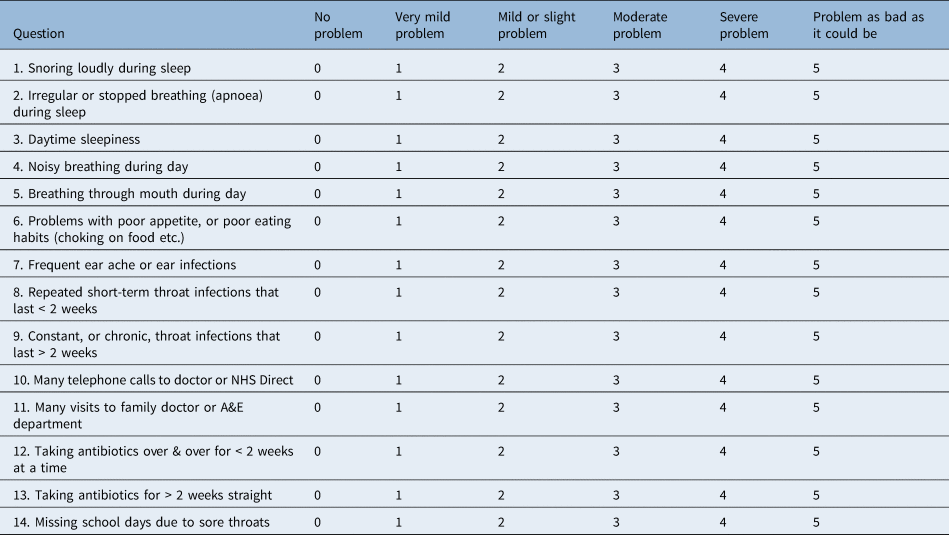
Patient-reported outcome measures are a necessary means of demonstrating clinical effectiveness, giving patients the opportunity to provide feedback on their medical management, helping with engagement and facilitating patient-centred care.Reference Briffa8 The Paediatric Throat Disorders Outcome Test (‘T-14’) is a disease-specific validated tool designed to assess obstructive and infective symptoms in paediatric throat disorders. Developed by ENT UK in 2010, it is an adaptation of the Tonsil and Adenoid Health Status Instrument modified for the UK population.Reference Hopkins, Almeyda, Alreefy, Ismail-Koch, Lim and Possamai2 The Paediatric Throat Disorders Outcome Test is completed by the patient's caregiver, and comprises 14 questions, 6 relating to obstructive symptoms and 8 relating to infective symptoms. Each question is scored from zero to five, with a higher score denoting greater impact of that symptom on the patient's quality of life.
Few published studies have investigated the long-term impact of paediatric tonsillectomy on quality of life. Our aim, therefore, was to assess the long-term effect of tonsillectomy and adenotonsillectomy on Paediatric Throat Disorders Outcome Test outcomes.
Materials and methods
A prospective observational study was conducted. Patients aged less than 16 years undergoing tonsillectomy or adenotonsillectomy were recruited consecutively from February to October 2018. Indications for surgery included recurrent tonsillitis, obstructive sleep-disordered breathing or both, as defined by the ENT UK commissioning guide on tonsillectomy and Scottish Intercollegiate Guidelines Network Guideline 117.3,Reference ENT9
Patients’ caregivers were invited to complete the Paediatric Throat Disorders Outcome Test questionnaire (Table 1) pre-operatively, and at 21 days and 2 years post-operatively. Pre-operative results were collected on the day of surgery; the caregivers were then contacted via telephone to collect the post-operative results.
Paediatric Throat Disorders Outcome Test

NHS = National Health Service; A&E = accident and emergency
Conducted as an audit of clinical practice, the study was registered with the clinical audit department of the Mid and South Essex NHS Foundation Trust.
Statistical analysis was performed using Microsoft Excel™ spreadsheet software, version 16.41. Pre- and post-operative Paediatric Throat Disorders Outcome Test scores were compared using the paired samples t-test, with a two-tailed p-value of 0.05 or lower considered statistically significant.
Results
A total of 80 patients were recruited and had Paediatric Throat Disorders Outcome Test questionnaires completed pre-operatively. Of these, 68 (85 per cent) had questionnaires completed at 21 days and 66 (83 per cent) at 2 years post-operatively. Forty-seven patients (59 per cent) were male, and the mean age at surgery was six years (range, 2–15 years). Indications for surgery included 47 patients with recurrent tonsillitis, 21 with obstructive sleep-disordered breathing, and 12 suffering from both recurrent tonsillitis and obstructive sleep-disordered breathing. Operations were performed by 7 different surgeons, with 44 patients undergoing tonsillectomy and 36 patients undergoing adenotonsillectomy.
Significant reductions were seen in mean total and individual Paediatric Throat Disorders Outcome Test scores post-operatively when compared with the pre-operative scores. Mean total Paediatric Throat Disorders Outcome Test scores were 30.4 pre-operatively, 1.9 at 21 days and 4.2 at 2 years (Table 2). The differences between the pre-operative and post-operative scores were statistically significant (p ≤ 0.003) at 21 days and 2 years.
Paediatric Throat Disorders Outcome Test scores pre- and post-operatively

*Paediatric Throat Disorders Outcome Test scores pre- and post-operatively were compared using the paired samples t-test. †The differences between the pre- and post-operative mean total Paediatric Throat Disorders Outcome Test scores, obstructive component scores and infective component scores were all statistically significant, with p values of less than 0.005.
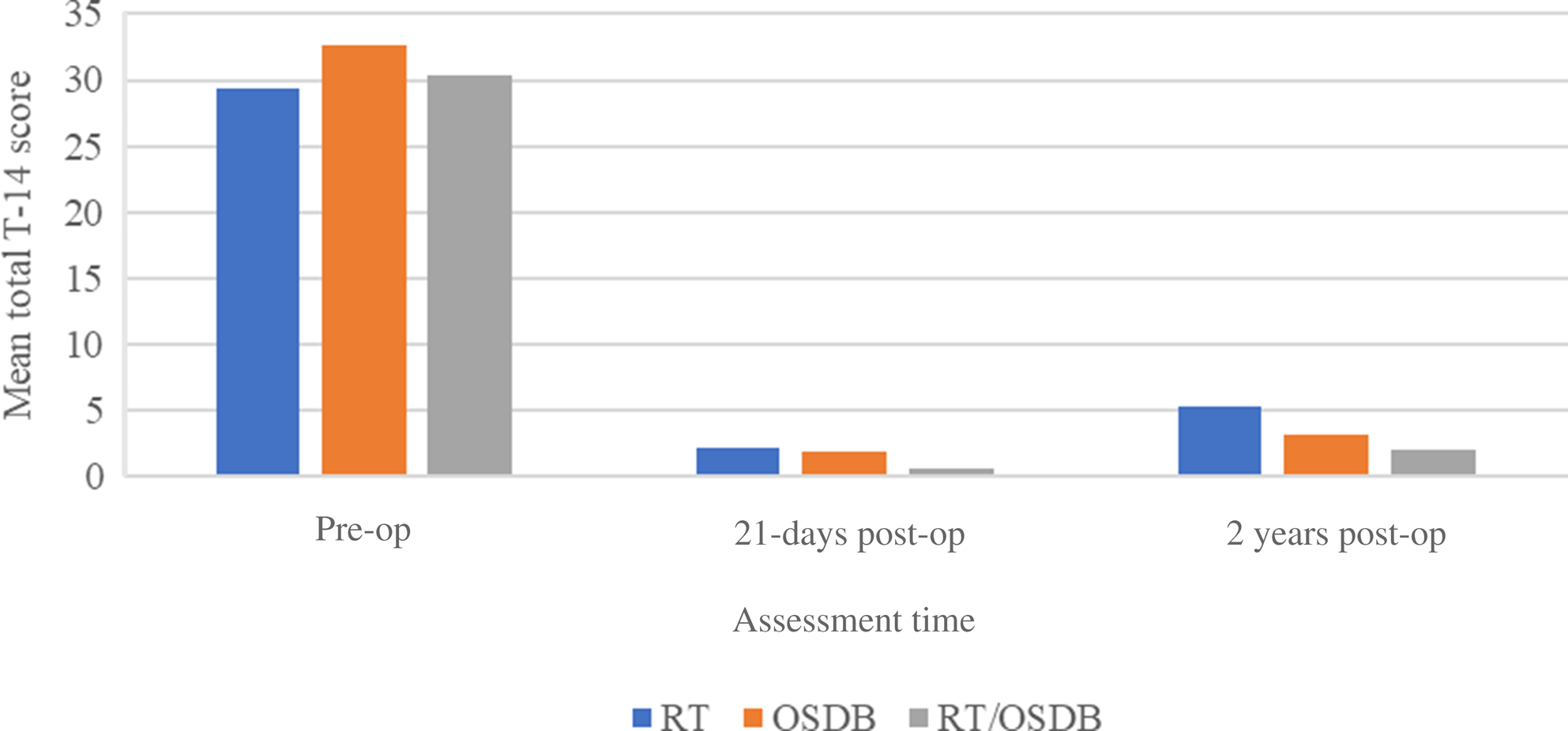
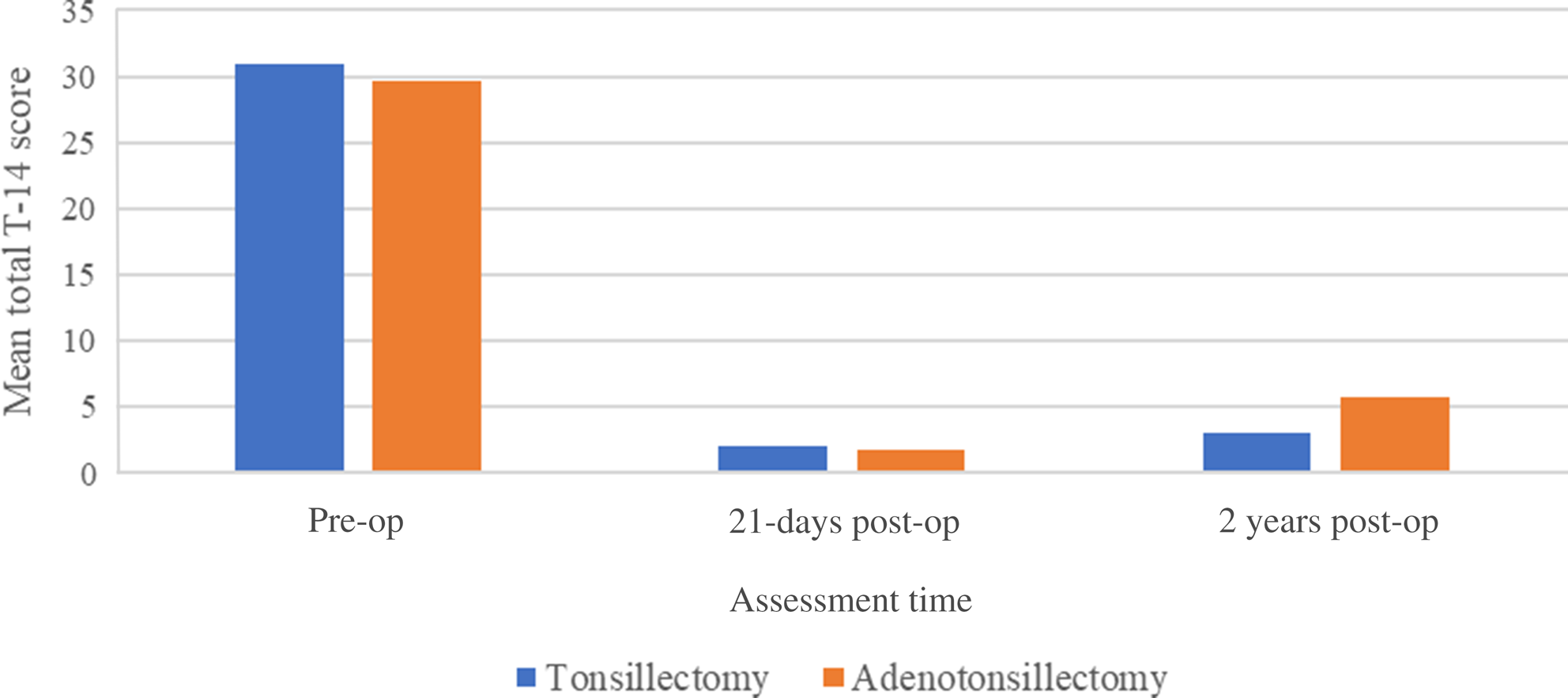
A subgroup analysis using the independent samples t-test was also performed. The mean total and individual Paediatric Throat Disorders Outcome Test scores were compared at each time point for surgical indication (recurrent tonsillitis, obstructive sleep-disordered breathing or both) and operation performed (tonsillectomy or adenotonsillectomy). Pre-operatively, the subgroup with both recurrent tonsillitis and obstructive sleep-disordered breathing had a statistically significant higher mean Paediatric Throat Disorders Outcome Test score for infective component question 9 (mean score = 3.1) when compared with the recurrent tonsillitis subgroup (mean score = 1.8, p = 0.036) and the obstructive sleep-disordered breathing subgroup (mean score = 1.9, p = 0.049). At two years, the adenotonsillectomy subgroup had a statistically significant higher mean Paediatric Throat Disorders Outcome Test score for obstructive component question 5 (mean score = 0.8) when compared with the tonsillectomy subgroup (mean score = 0.3, p = 0.030). No other subgroup comparisons were found to be significant. The mean total Paediatric Throat Disorders Outcome Test scores for both subgroup analyses are represented graphically in Figures 1 and 2.
Total Paediatric Throat Disorders Outcome Test (‘T-14’) scores pre-operatively (‘pre-op’) and up to two years post-operatively (‘post-op’) by indication for surgery. RT = recurrent tonsillitis; OSDB = obstructive sleep-disordered breathing; RT/OSDB = recurrent tonsillitis and obstructive sleep-disordered breathing

Total Paediatric Throat Disorders Outcome Test (‘T-14’) scores pre-operatively (‘pre-op’) and up to two years post-operatively (‘post-op’) by operation performed (tonsillectomy or adenotonsillectomy).

Discussion
Historically, there has been limited investigation of the impact of paediatric tonsillectomy on quality of life, with most studies focusing on traditional surgical outcomes. Recent years have seen an increasing use of patient-reported outcome measures as a primary outcome measure, although these studies have predominantly used generic rather than disease-specific tools, and have primarily involved patients suffering from obstructive sleep-disordered breathing rather than recurrent tonsillitis.Reference Lam, Woods, Du, Milton, Kao and Huynh10
One of the largest randomised, controlled trials published – the Childhood Adenotonsillectomy TrialReference Marcus, Moore, Rosen, Giordani, Garetz and Taylor11 – investigated whether early adenotonsillectomy in children with obstructive sleep apnoea resulted in improved outcomes compared with ‘watchful waiting’. Of 464 children randomised, 226 were assigned to early adenotonsillectomy and followed up for seven months. The trial failed to meet its primary endpoint, a significant change in attention and executive function, but did show significant improvements in quality of life (measured by the generic Paediatric Quality of Life Inventory) in the treatment group versus control group.Reference Marcus, Moore, Rosen, Giordani, Garetz and Taylor11
Following validation of the Paediatric Throat Disorders Outcome Test questionnaire, Hopkins et al.Reference Hopkins, Almeyda, Alreefy, Ismail-Koch, Lim and Possamai2 conducted a multicentre prospective cohort study (n = 276) investigating the impact of tonsillectomy, adenotonsillectomy or conservative management on Paediatric Throat Disorders Outcome Test outcomes measured pre-operatively and one year post-operatively. Significant improvements in Paediatric Throat Disorders Outcome Test scores were seen in all groups, with the largest differences in the surgery groups (mean change in total Paediatric Throat Disorders Outcome Test scores: tonsillectomy = 24.8, adenotonsillectomy = 25.7 and non-surgical = 18.5). Significant reductions were also seen in the number of missed school days because of throat problems post-operatively in the surgery groups (tonsillectomy = 3.1 fewer days, adenotonsillectomy = 1.9 fewer days) compared with the non-surgery group (0.2 fewer days).Reference Hopkins, Almeyda, Alreefy, Ismail-Koch, Lim and Possamai2
The largest study so far to use Paediatric Throat Disorders Outcome Test outcomes to assess paediatric tonsillectomy, recruiting 535 patients with obstructive sleep-disordered breathing, was published in 2019.Reference Walijee, Sood, Markey, Krishnan, Lee and De12 Patients underwent adenotonsillectomy, adenoidectomy or tonsillectomy, and Paediatric Throat Disorders Outcome Test questionnaires were completed pre-operatively and six weeks post-operatively. The authors showed a statistically significant improvement in the mean total Paediatric Throat Disorders Outcome Test scores following surgery (pre-operative mean score = 31.19, post-operative mean score = 1.87; p < 0.00).Reference Walijee, Sood, Markey, Krishnan, Lee and De12
Few studies have investigated the long-term effect of paediatric tonsillectomy on quality of life. We identified only one study with a follow-up period extending to at least 2 years, with the majority having follow-up periods of 6–12 months.Reference Konieczny, Pitts-Tucker, Biggs and Pringle1 Konieczny et al. conducted a prospective observational study of 54 patients undergoing tonsillectomy or adenotonsillectomy for recurrent tonsillitis and/or obstructive sleep-disordered breathing.Reference Konieczny, Pitts-Tucker, Biggs and Pringle1 Paediatric Throat Disorders Outcome Test outcomes were measured pre-operatively, and at three months, six months, one year, two years and five years post-operatively. They reported statistically significant reductions in Paediatric Throat Disorders Outcome Test scores at all post-operative timepoints when compared with the pre-operative scores. The mean total Paediatric Throat Disorders Outcome Test scores were: 33.3 pre-operatively (n = 54), 3.4 at three months (n = 54), 1.5 at two years (n = 44) and 1.0 at five years (n = 46).Reference Konieczny, Pitts-Tucker, Biggs and Pringle1
Our study showed a significant difference between subgroups for infective component question 9 pre-operatively, with the subgroup with both recurrent tonsillitis and obstructive sleep-disordered breathing having a higher mean Paediatric Throat Disorders Outcome Test score compared with the recurrent tonsillitis subgroup and the obstructive sleep-disordered breathing subgroup. This might indicate that quality of life is adversely affected to a greater extent in patients suffering from both recurrent tonsillitis and obstructive sleep-disordered breathing, as opposed to just recurrent tonsillitis or obstructive sleep-disordered breathing. There was also a significant difference for obstructive component question 5 at two years, with the adenotonsillectomy subgroup having a higher mean Paediatric Throat Disorders Outcome Test score compared with the tonsillectomy subgroup. This could potentially indicate that patients suffering from recurrent tonsillitis alone might do better long-term post-operatively compared with those suffering from obstructive sleep-disordered breathing. Overall, our findings are in line with the results reported in the literature, indicating that tonsillectomy and adenotonsillectomy significantly improve quality of life in children suffering from recurrent tonsillitis, obstructive sleep-disordered breathing or both.
Limitations
As with other patient-reported outcome measures used in children, the Paediatric Throat Disorders Outcome Test questionnaire relies on responses from patients’ caregivers, who do not experience the symptoms themselves, which can result in proxy response bias. However, as it is usually the caregiver who seeks medical intervention in the first instance, and with many children unable to complete the questionnaire appropriately themselves, the authors believe it is appropriate to use proxy respondents in this setting.
• Tonsil disease represents a health burden, yet the clinical value of tonsillectomy has caused much debate
• Few studies have assessed the long-term effect of paediatric tonsillectomy on quality of life
• The Paediatric Throat Disorders Outcome Test is a validated tool to assess obstructive and infective symptoms in paediatric throat disorders
• This prospective observational study showed significant reductions in mean total test scores at 21 days and 2 years post-operatively (p ≤ 0.003)
• Paediatric tonsillectomy and adenotonsillectomy improve quality of life up to two years post-operatively, and thus remain a valuable use of healthcare resources
This study did not include a control group; thus, it is not possible to make comparisons between surgery and conservative management. However, Hopkins et al., in their follow-up study, showed a significant reduction in missed school days post-operatively in the surgery groups compared with the non-surgery group.Reference Hopkins, Almeyda, Alreefy, Ismail-Koch, Lim and Possamai2
Conclusion
This is the largest study to date assessing the long-term impact of paediatric tonsillectomy and adenotonsillectomy using Paediatric Throat Disorders Outcome Test outcomes. Our results provide supporting evidence that paediatric tonsillectomy and adenotonsillectomy significantly improve quality of life up to two years post-operatively and therefore remain a valuable use of healthcare resources.
Acknowledgements
The authors would like to thank the Wizard Ward team at Broomfield Hospital for assisting with data collection and Dr Laura Bennett for assisting with manuscript preparation.
Competing interests
None declared