INTRODUCTION
Social cognition theory indicates that individuals have a natural propensity to classify leaders and followers (Fiske & Taylor, Reference Fiske and Taylor1991). However, a large body of organizational behavior research mainly adopts leader-centric perspective, while neglecting the exploration of the followership (Bjugstad, Thach, Thompson, & Morris, Reference Bjugstad, Thach, Thompson and Morris2006). As a response to these research gaps, implicit followership theory (IFT) is proposed and paid more attention by scholars recently. IFT is defined as ‘individuals’ personal assumptions about traits and behaviors that characterize followers’ (Shondrick & Lord, Reference Shondrick and Lord2010; Sy, Reference Sy2010; Whiteley, Sy, & Johnson, Reference Whiteley, Sy and Johnson2012). In the current research, we focus on the effects of leaders’ implicit followership theory (LIFT), which affects leaders’ cognitive and information-processing processes of comparing followers’ actual behaviors with their inherent schema for those followers, forming impression of followers and finally taking corresponding actions based on the match degree (Shondrick & Lord, Reference Shondrick and Lord2010; Sy, Reference Sy2010; Whiteley, Sy, & Johnson, Reference Whiteley, Sy and Johnson2012).
According to social cognitive theory, LIFT is likely to exert influence on leaders’ behaviors, for the reason that leaders may use LIFT as a benchmark to form impressions and cognitions of their followers (Lord & Maher, Reference Lord and Maher2002). Also, as implicit theory indicate, leaders’ cognitions shape their judgment of and response to others (Fiske & Taylor, Reference Fiske and Taylor1991). Thus, it is likely that leaders will internalize and endorse a particular kind of LIFT and gradually adopt LIFT as fixed standards to select, evaluate and treat their followers (Shondrick & Lord, Reference Shondrick and Lord2010). From this perspective, exploring the effects of LIFT on followers’ attitudes, abilities, cognitions and performance can help scholars understand how LIFT influences leaders’ interpretations of their surrounding environmental cues and further influence their sequential behaviors (Lord & Brown, Reference Lord and Brown2004; Avolio, Walumbwa, & Weber, Reference Avolio, Walumbwa and Weber2009), consequently deepen our understanding of ‘how leaders and followers perceive, decide and take action’ from follower-centric perspective (Shondrick & Lord, Reference Shondrick and Lord2010; Sy, Reference Sy2010; Whiteley, Sy, & Johnson, Reference Whiteley, Sy and Johnson2012).
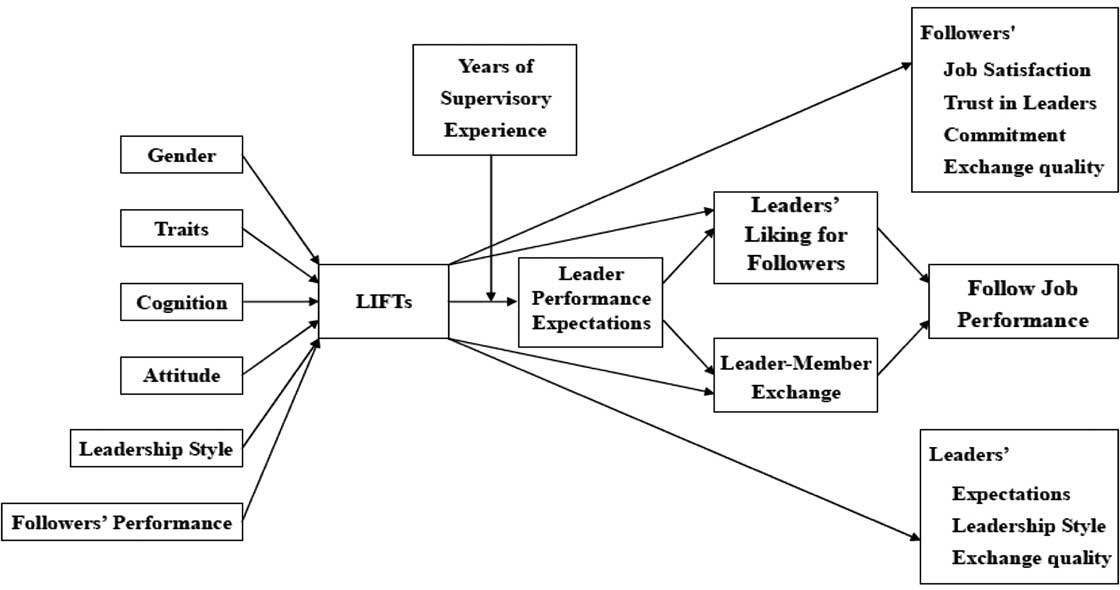
After developing series of related measurement scales (Carsten, Uhl-Bien, West, Patera, & McGregor, Reference Carsten and Uhl-Bien2010; Sy, Reference Sy2010; Van Gils, Van Quaquebeke, & Van Knippenberg, Reference Van Gils, Van Quaquebeke and Van Knippenberg2010), the number of research exploring antecedents and effects of IFT gradually increases. Specifically, previous research has explored big five-factor personalities (Duong, Reference Duong2012), individual traits and states (e.g., emotions) (Kruse & Sy, Reference Kruse and Sy2011), leadership styles (Wofford & Goodwin, Reference Wofford and Goodwin1994; Goodwin, Wofford, & Boyd, Reference Goodwin, Wofford and Boyd2000) and, etc. as antecedents of IFT. As for the effects of IFT, positive LIFT exerts significant impacts on leader-centric outcomes, follower-centric outcomes as well as the quality of the relationship between leaders and followers. Specifically, positive LIFT predicts leaders’ liking toward and the relationship quality with their followers (Shondrick & Lord, Reference Shondrick and Lord2010; Sy, Reference Sy2010), further influences followers’ job satisfaction, sense of well-being as well as performance (Carsten & Uhl-Bien, Reference Carsten, Uhl-Bien, West, Patera and McGregor2009; Kruse, Reference Kruse2010; Sy, Reference Sy2010; Whiteley, Sy, & Johnson, Reference Whiteley, Sy and Johnson2012). The research literatures are summarized as Figure 1.
Summary of research on leaders’ implicit followership theory (LIFT)

However, relatively few studies have tested how and why LIFT relates to followers’ creativity, and if so, the mechanisms through which positive LIFT relates to followers’ creativity. We choose creativity as the outcome variables for two main reasons. First, employees’ creativity is the source and basis of enterprise innovation (Gregory & Joseph, Reference Gregory and Joseph2000) and is playing an increasingly important role in the organizational viability and success; thus enterprises highly emphasize and value employees’ creativity and eagerly want to figure out what predicts creativity (Zhou & Shalley, Reference Zhou and Shalley2003; Ng & Lucianetti, Reference Ng and Lucianetti2016). Second, LIFT could potentially affect employees’ creativity. According to social cognitive theory, leader will adopt his/her internalized and endorsed LIFT as fixed standards to select, evaluate and treat their followers (Shondrick & Lord, Reference Shondrick and Lord2010), which, arguably, will further influences a wide range of employee attitudinal and behavioral outcomes (Sy, Reference Sy2010; Whiteley, Sy, & Johnson, Reference Whiteley, Sy and Johnson2012). Creativity might be one of the affected outcomes.
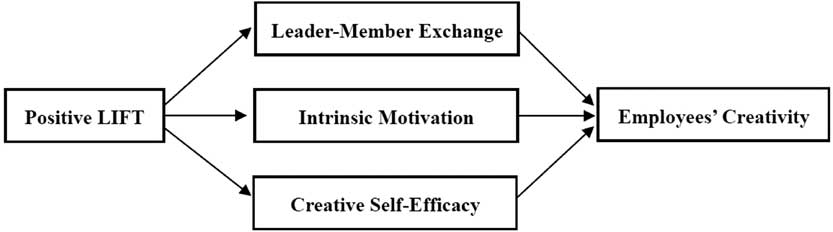
The previous IFT literature mainly used social learning theory (i.e., Whiteley, Sy, & Johnson, Reference Whiteley, Sy and Johnson2012) and social exchange theory (i.e., Kong & Qian, Reference Kong and Qian2015) to explain why positive LIFT can affect employees’ outcomes. The rationale is that leader with positive IFT will have more positive performance expectation for their followers and form higher-quality leader–member exchange (LMX) relationship with them, thus eliciting followers’ positive attitudes and behaviors. Apart from the two mentioned theoretical frameworks, we argue that self-determination theory (Deci & Ryan, Reference Deci and Ryan1985), which highlights individuals’ intrinsic motivation in predicting their behaviors, could also have explanatory power in explaining positive LIFT’s effect, given the fact that employees’ intrinsic motivation is an important underlying mechanism linking leaders’ cognition/behaviors and followers’ creativity (Zhang & Bartol, Reference Zhang and Bartol2010). Regretfully, there is still no study simultaneously examining the three intermediate mechanisms in one model. To fill this gap, the current study examines the mediating roles of the core variables of the three mentioned theories – LMX as a social exchange process, intrinsic motivation as a self-determination process and creative self-efficacy as a social learning process – in the positive LIFT–creativity relationship.
Specifically, LMX is defined as the quality of exchange between a leader and a follower (Graen & Scandura, Reference Graen and Scandura1987); creative self-efficacy is defined as followers’ belief that they can be creative in their work roles (Tierney & Farmer, Reference Tierney, Famer and Graen2002); intrinsic motivation is manifest in the enjoyment of and interest in an activity for its own sake, and it is a fundamentally approach form of motivation (Deci & Ryan, Reference Deci and Ryan1985). Together, we argue that the reason why positive LIFT predicts followers’ creativity is that positive LIFT enhances high-quality LMX, followers’ creative self-efficacy and intrinsic motivation. In turn, high-quality LMX, followers’ creative self-efficacy and intrinsic motivation improve followers’ creativity.
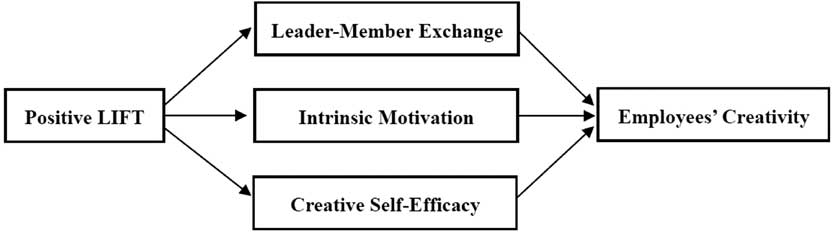
In general, the current research attempts to answer the following questions: (1) Does positive LIFT influence employees’ creativity? If so, what is the nature of the relationship? (2) How the effect of positive LIFT on employees’ creativity occur? By answering these two basic questions, we contribute to the extant literature in two ways. First, the current studies extends the LIFT literature by being the first to explore the effect of positive LIFT on creativity. Further, our simultaneously examination of three mediating effects helps to offer in-depth insights into the question of how positive LIFT and employees’ creativity are related, and give direct empirical test to the explanatory value of three potential theoretical frameworks in explicating the effects of positive LIFT. Second, we also advances the creativity research by considering the role leader’s cognition in predicting creativity. To the best of our knowledge, most of the studies focus on the effects of leaders’ behaviors and attitudes on employees’ creativity. Insights into the influence of leaders’ implicit cognitions on creativity are needed in order to push the literature forward (Figure 2).
Research model. LIFT=leaders’ implicit followership theory
Theory and Hypotheses
Positive LIFT and followers’ creativity
The main components of LIFT are cognitive structures or prototypes, which are defined as abstract composites of the most representative member or the most commonly shared attributes of a particular category. During the interactions with followers, leaders’ extant cognitive structures will be activated and then automatically or spontaneously categorize their followers accordingly (Epitropaki & Martin, Reference Engle and Lord2004). Throughout these above processes, leaders understand, interpret and respond to their followers through the ‘sense-making’ function of their LIFT (Weick, Reference Weick1995). More details, when a leader engages in comparing their LIFT with a real follower, he will shape attitudes and behaviors toward the follower base on the congruence of his/her LIFT and impressions of the follower. Previous conceptual and empirical research has provided strong evidence that leaders view upon and sequential interact with their followers account for great variances in explaining followers’ performance (Collinson, Reference Collinson2006; Carsten & Uhl-Bien, Reference Carsten, Uhl-Bien, West, Patera and McGregor2009). In the current study, we only pay attention to the effect of positive LIFT, which refers to positive conceptions and assumptions leaders hold about their followers’ traits, characters and behaviors (Whiteley, Sy, & Johnson, Reference Whiteley, Sy and Johnson2012). Considering from the viewpoint of broader concept (Cronbach & Gleser, Reference Cronbach and Gleser1965), the traits of outcome variable depend on the choice of antecedent variable (Hogan & Roberts, Reference Hogan and Roberts1996). Once positive LIFT is established and activated, it will further induces the correlated actions such as setting high goals for ‘good employees’ (Conger & Kanungo, Reference Conger and Kanungo1988), consequently exerting influence on a series of interactional outcomes (e.g., leader’s liking toward followers, and relationship quality between leaders and followers) (Hogan & Roberts, Reference Hogan and Roberts1996; Epitropaki & Martin, Reference Engle and Lord2004). Also, there are empirical studies finding that positive LIFT has significant positive effects on followers’ job performance (Whiteley, Sy, & Johnson, Reference Whiteley, Sy and Johnson2012).
Based on the LIFT and creativity literature, we argue that positive LIFT can also help to enhance followers’ creativity. Creativity is defined as the generation, promotion, and implementation or novel and useful ideas about products, practices, services or products; and it is a resource-intensive and risky endeavor (Amabile, Reference Amabile1988). Although there are no direct empirical supports regarding the positive relationship between positive LIFT and followers’ creativity, several studies can provide indirect supports (Kong & Qian, Reference Kong and Qian2015; Tierney, Reference Tierney2015). For example, Whiteley, Sy, and Johnson (Reference Whiteley, Sy and Johnson2012) have explored and examined a ‘naturally occurring Pygmalion effect’ process linking positive LIFT and employee job performance. We argue that the same ‘Pygmalion effect’ logic can also be applied to explaining why positive LIFT can improve followers’ creativity. That is, leaders with positive LIFT will hold high expectation for employees regarding creative performance and communicate this high expectation with employees in daily interactions, which will further triggers the ‘Pygmalion effect’ and makes the enhancement of employee creativity become a reality.
Hypothesis 1: Positive LIFT is positively related to followers’ creativity.
The mediating role of LMX
Social exchange theory holds that organization can obtain followers’ positive attitudinal and behavioral reciprocations through forming high-quality exchanges with their followers (Blau, Reference Blau1964; Graen & Scandura, Reference Graen and Scandura1987; Rhoades & Eisenberger, Reference Rhoades and Eisenberger2002). Furthermore, LMX argues that the focus of leadership effectiveness research should be shifted to the topic of the mutual relationship between leaders and followers. Under organization situation, due to leaders’ limited time, energy and resources, leaders will form differential exchange relationship with different followers and accordingly adopt different management styles (Wayne, Shore, Bommer, & Tetrick, Reference Wayne, Shore, Bommer and Tetrick2002). For followers who have high-quality exchanges relationship with their leaders (Scott & Bruce, Reference Scott and Bruce1994), they will get more trust as well as care from their leaders and simultaneously will even be given privileges (e.g., work autonomy, work flexibility, more promotion opportunities and rewards).
We argue that LMX will mediate the relationship between positive LIFT and employees’ creativity. First, it is both theoretically and empirically supported that leaders with positive LIFT will build high-quality LMX relationship with followers (Sy, Reference Sy2010; Whiteley, Sy, & Johnson, Reference Whiteley, Sy and Johnson2012; Kong & Qian, Reference Kong and Qian2015). As noted above, once positive LIFT is built up and activated, it will activate the generations of numerous kinds of related conceptual representations that are consistent with the activated positive concepts (e.g., followers are good employees) and accordingly induce a series of related behaviors, such as building high-quality LMX relationship with them (Kong & Qian, Reference Kong and Qian2015). Further, high LMX relationship will enable employees to achieve superior creative performance when engaging in the time-consuming, resource-intensive and risky creativity activities (Tierney, Reference Tierney2015). In one respect, high LMX relationship will provide followers with the essential tangible and intangible resources (Sparrowe & Liden, Reference Sparrowe and Liden2005) which are needed for the resource-intensive creativity activities (Amabile, Reference Amabile1988), which helps to facilitate their creativity (Tierney, Reference Tierney2015). In another respect, high LMX followers will perceive their jobs and tasks as more challenging, meaningful and have a strong sense of achievement associated with their job (Liden & Graen, Reference Liden and Graen1980); these positive perceptions will augment employees’ level of efforts extended to the task necessary for creativity, which is beneficial for their enhancement of creativity (Amabile, Reference Amabile1988). In addition, according social exchange theory and the norm of reciprocation (Blau, Reference Blau1964), high-LMX employees will tend to reciprocate their leaders’ good treatment with positive workplace behaviors, such as high level of creativity.
Hypothesis 2: LMX mediates the positive relationship between positive LIFT and followers’ creativity.
The mediating role of intrinsic motivation
Intrinsic motivation is manifest in the enjoyment of and interest in an activity for its own sake, and it is one of the several fundamental forms of motivation (Deci & Ryan, Reference Deci and Ryan1985). According to self-determination theory (Deci & Ryan, Reference Deci and Ryan1985), intrinsic motivation is the most autonomous form of motivation and is argued to be associated with higher levels of performance (particularly for complex tasks) compared with less autonomous form of motivation (extrinsic motivation) (Gagne & Deci, Reference Gagne and Deci2005). High-intrinsic motivation followers put emphasis on the job itself, and pay more attention to the enjoyment that job brings about. Also, they are more apt to face up to the challenges of work, take up moderately adventurous activities, for that these challenges and adventures can not only help them obtain more interest from work (Amabile, Reference Amabile1997), but also satisfy their curiosity and realize their self-value (Forbes & Domm, Reference Forbes and Domm2004). One key point for followers’ creativity management is to understand followers’ intrinsic feelings about creativity activities (Amabile, Reference Amabile1988).
We argue that positive LIFT can lead to follower’s high intrinsic motivation by satisfying the three basic needs of follower. Specifically, followers will be given more guidance and coaching, encouragement, and social support from the leaders with positive LIFT (Whiteley, Sy, & Johnson, Reference Whiteley, Sy and Johnson2012; Kong & Qian, Reference Kong and Qian2015). These good treatments from leaders can make followers more likely to focus on their tasks instead of the external controls such as worries and fears, which helps to boost followers’ intrinsic motivation (Shin & Zhou, Reference Shin and Zhou2003). Also, leaders with positive LIFT will also express high expectation for followers (Whiteley, Sy, & Johnson, Reference Whiteley, Sy and Johnson2012). In order to help followers achieve such high performance, leaders might encourage followers to challenge the status quos, or even reformulate issues or problems; this might also contribute to the enhancement of followers’ intrinsic motivation (Shin & Zhou, Reference Shin and Zhou2003).
Further, the enhanced intrinsic motivation will lead to follower’s high creativity. Amabile’s (Reference Amabile1988, Reference Amabile1996) componential theory of creativity argues that intrinsic motivational is one of the most important and powerful antecedents of followers’ creativity. Specifically, when faced with the time-consuming and resource-intensive creativity activities, employees with high intrinsic motivation are more apt to devote more efforts to facing up to the challenging and difficult creativity activities, and consequently more likely to come up with creative ideas and finally put these ideas (e.g., novel methods, technology and service) into practice (Shin & Zhou, Reference Shin and Zhou2003; Zhang & Bartol, Reference Zhang and Bartol2010).
Hypothesis 3: Intrinsic motivation mediates the positive relationship between positive LIFT and followers’ creativity.
The mediating role of creative self-efficacy
The concept of self-efficacy is first proposed by Bandura as a major component of social cognitive theory. Self-efficacy refers to individuals’ perceptions and confidence of their ability to execute a specific task, and it is suggested to be able to activate individuals’ motivations and sequential behaviors (Bandura, Reference Bandura1977; Tierney & Farmer, Reference Tierney, Famer and Graen2002). Based upon the work of Bandura, Tierney and Farmer (Reference Tierney, Famer and Graen2002) proposed the concept of creative self-efficacy, which is defined as followers’ belief that they can be creative in their work roles. It has been suggested that creative self-efficacy is positive correlated to followers’ creativity (Tierney & Farmer, Reference Tierney, Famer and Graen2002). Moreover, the Pygmalion process for creativity, which explores the positive influence of creative self-efficacy on followers’ creativity, has been examined by scholars (Tierney & Farmer, Reference Tierney and Farmer2004). In the current study, we argue that creative self-efficacy is also a mediating mechanism linking positive LIFT and follower’s creativity.
First, positive LIFT will boost follower’s creative self-efficacy. There are four major techniques for enhancing follower’s creative self-efficacy: enactive mastery or personal attainments, vicarious experience or learning, verbal persuasion, and affective or physiological arousal (Bandura, Reference Bandura1977); at least two of them (enactive mastery, verbal persuasion) can be influenced by positive LIFT. First, positive LIFT can enhance follower’s creative efficacy through enactive mastery or personal attainment. According to Pygmalion effect, leader would hold higher creative performance expectation for followers who match positive LIFT and express more liking toward as well as building higher-quality relationship with them (Whiteley, Sy, & Johnson, Reference Whiteley, Sy and Johnson2012), making those followers more easily to achieve successful creative experience. Second, positive LIFT can also ameliorate follower’s creative self-efficacy by verbal persuasion. Leader will have more intimate communications will followers who match their positive LIFT. During these communication processes, leader will verbally convey the message to supervisors that creative behaviors is appropriate and encouraged (Bandura, Reference Bandura1977).
Further, creative self-efficacy facilitates the follower’s creativity (Bandura, Reference Bandura1977). Followers who have higher creative self-efficacy will have more confidence in their creative capabilities and further have stronger intrinsic motivation under the working situations (Bandura & Locke, Reference Bandura and Locke2003). According to Ford’s (Reference Ford1996) theory of creative individual action, creative self-efficacy is the major driving force of followers’ creativity. Creative processes, to a large degree, involve putting new ideas and thoughts into practices, which necessitates long-term investment of time, resources and energy (Bandura, Reference Bandura1977; Amabile, Reference Amabile1988).
Hypothesis 4: Creative self-efficacy mediates the positive relationship between positive LIFTs and followers’ creativity.
METHOD
Sample and procedure
We selected full-time employees from traditional work teams of 16 Chinese companies in diverse industries and with various job types to increase external validity of proposed relationships. In order to minimize common method variance (Podsakoff, MacKenzie, Lee, & Podsakoff, Reference Podsakoff, MacKenzie, Lee and Podsakoff2003), the study uses time-lagged data. Two questionnaire surveys apart by 3 months were conducted. The objects of the first survey (T1) are followers, and the survey questions cover followers’ creative self-efficacy, LMX, intrinsic motivation and demographic information. The objects of the second survey (T2) are leaders, and the survey content includes positive LIFT and followers’ creativity. Completed questionnaires were sealed in envelopes by participants and then returned to either the researcher or the human resources departments.
Before T1, we randomly chose 400 employees as the sample. In T1, 400 questionnaires, along each with a cover letter assuring confidentiality and voluntary participation, were distributed to followers, and among them 352 (88%) were finally collected. After 2 months, T2 was conducted with leaders of the surveyed followers as objects. Among 352 followers, 11 had left their positions or changed their supervisors, we thus excluded these 11 cases and accordingly distributed 341 questionnaires to the matched supervisors, among which 319 (93.5%) were finally collected. After excluding several invalid questionnaires, our final sample included 267 (83.7%) leader–follower dyads. Among the 267 followers, 52.1% were male, with average age of 31.4, and average working experience of 7.81 years. As for educational level, 92.3% got ‘bachelor or above’ degree. For position level, 37.4% were frontline employees, 16.5% were frontline supervisors, and 10.2% were technical workers. Although our data collection procedures did not completely eliminate the common methods variance, it reduced common method variance to a large degree (Atwater & Carmeli, Reference Atwater and Carmeli2009).
Measures
Measuring scales of this study all come from leading international research literature and have been proven as high reliability and validity in both China and the west. Questionnaires used in both surveys were in Chinese. Translation/back-translation procedures (Brislin, Reference Brislin1980) were followed to translate the English-based measures into Chinese.
Positive LIFT
Positive LIFT was measured with the nine positive attributes from the LIFT scale (Sy, Reference Sy2010). Leaders were asked to indicate on a 7-point scale. The LIFT scale consists of three dimensions with three items each, including Industry (hardworking, productive, goes above and beyond), Enthusiasm (excited, outgoing, happy) and Good Citizen (loyal, reliable, team player). Cronbach’s α for the scale was 0.834.
Followers’ creativity
Followers’ creativity was measured with the 9-item scale developed by Tierney, Famer, and Graen (Reference Tierney and Farmer1999). Leaders were asked to indicate on a 7-point scale. Sample items are ‘The follower can demonstrated originality in his/her work,’ ‘The follower can find new uses for existing methods and equipment.’ Cronbach’s α of this scale was 0.913.
LMX
We adopted the 7-item scale developed by Liden, Wayne, and Stilwell (Reference Liden, Wayne and Stilwell1993) to measure LMX, which was adapted from Scandura and Graen (Reference Scandura and Graen1984). This scale is the most widely adopted scale in LMX research area. Followers were asked to indicate on a 7-point scale. Sample items are ‘I understand my leader’s problems and needs.’ Cronbach’s α of this scale was 0.834.
Followers’ intrinsic motivation
We assessed followers’ intrinsic motivation with 5-items scale of Tierney, Famer, and Graen (Reference Tierney and Farmer1999). Followers were asked to indicate on a 7-point scale. Sample items are ‘I enjoy finding solutions to complex problems.’ Cronbach’s α of this scale was 0.824.
Followers’ creative self-efficacy
Creative self-efficacy was assessed with Tierney and Farmer’s (Reference Tierney, Famer and Graen2002) 4-item scale. Followers were asked to indicate on a 7-point scale. Sample items are ‘I have confidence in my ability to solve my problems.’ Cronbach’s α of this scale was 0.856.
Control variables
Besides the aforementioned variables, we also included followers’ age, gender, organizational tenure as well as organizational level as the control variables.
RESULTS
Confirmatory factor analysis
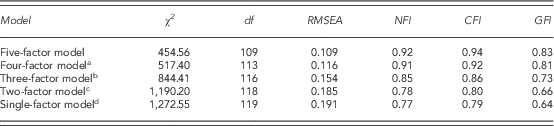
In order to examine discriminant validity among the variables (positive LIFT, follower’s creativity, LMX, intrinsic motivation and creative self-efficacy) as well as examining the measuring parameters of the adopted measuring scales, confirmatory factor analysis of the study variables was conducted with Lisrel 8.80. Comparisons among models with different numbers of factors have been conducted and the results as illustrated in Table 1 show that five-factor model has the closest fit. The indices for the five-factor model included the following: (χ2(109)=454.56, confirmatory fit index (CFI)=0.94, goodness-of-fit index (GFI)=0.83, normed fit index (NFI)=0.92, root mean square error of approximation (RMSEA)=0.109.
Model fit results for confirmatory factor analyses

Note. n=267.
a Positive leaders’ implicit followership theory (LIFT) and leader–member exchange (LMX) are merged into one potential factor.
b Positive LIFT, LMX and intrinsic motivation are merged into one potential factor.
c Positive LIFT, LMX, intrinsic motivation and creative self-efficacy are merged into one potential factor.
d All variables are merged into one potential factor.
Descriptive statistics and correlations
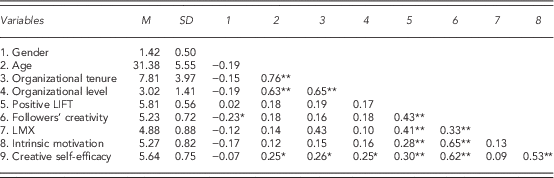
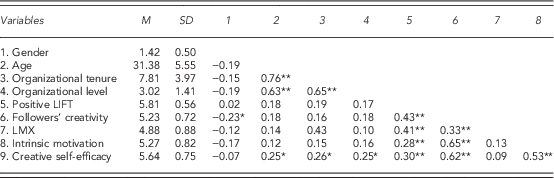
Means, standard deviations and correlations among variables are presented in Table 2. Positive LIFT is significantly correlated with followers’ creativity (r=0.43, p<.01) LMX (r=0.41, p<.01), intrinsic motivation (r=0.28, p<.01) and creative self-efficacy (r=0.30, p<.01). Moreover, LMX (r=0.33, p<.01), intrinsic motivation (r=0.65, p<.01) and creative self-efficacy (r=0.61, p<.01) are significantly correlated with followers’ creativity. As for the control variables, none of the four variables – followers’ age (r=0.18, ns), gender (r=0.02, ns), organizational tenure (r=0.19, ns) and organizational level (r=0.17, ns) – has significant relationship with positive LIFT, suggesting that positive LIFT among followers of different ages, gender, organizational tenure or organizational level did not vary significantly.
Means, standard deviations and correlations
Note. n=267.
LIFT=leaders’ implicit followership theory; LMX=leader–member exchange.
*p<.05; **p<.01.
Hypothesis tests
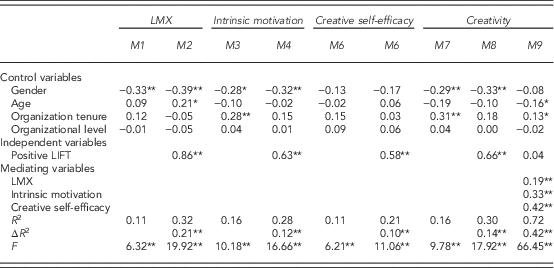
Hypothesis 1 assumed that positive LIFT had significant positive effect on followers’ creativity. In order to test this hypothesis, we set positive LIFT as an independent variable and followers’ creativity as the dependent variable in a hierarchical regression analysis along with control variables. The result illustrated in M8 of Table 3 shows that after controlling for followers’ demographic variables, the positive effect of positive LIFT on followers’ creativity is significant (b=0.66, p<.01), which is supportive of Hypothesis 1.
Results of regression analysis

Note. n=267.
LIFT=leaders’ implicit followership theory; LMX=leader–member exchange.
*p<.05; **p<.01.
Hypothesis 2 proposed that LMX mediated the positive relationship between positive LIFT and follower’s creativity. We drew on Baron and Kenny’s (Reference Baron and Kenny1986) work to test the mediating effect. First, in M2 of Table 3, positive LIFT was positively related to LMX (b=0.86, p<.01). Second, in M9 of Table 3, the entering of LMX added significantly to the explained variance in follower creativity with a positive coefficient (b=0.19, p<.01). These results provided initial support for Hypothesis 2. In order to provide further support for Hypothesis 2, Sobel test and PRODCLIN program (MacKinnon, Fritz, Williams, & Lockwood, Reference MacKinnon, Fritz, Williams and Lockwood2007) were applied. Sobel test indicated that the mediating effect of LMX in the relationship between positive LIFT and follower creativity was supported (Z=3.96, p<.01). The results of PRODCLIN program also showed the mediating effect was significant (95% confidence interval [CI]=[0.09, 0.25], [not containing 0]). Thus, Hypothesis 2 was fully supported.
Hypothesis 3 proposed that intrinsic motivation mediated the positive relationship between positive LIFT and follower’s creativity. First, in M4 of Table 3, positive LIFT was positively related to intrinsic motivation (b=0.63, p<.01). Second, in M9 of Table 3, the entering of intrinsic motivation added significantly to the explained variance in follower creativity with a positive coefficient (b=0.33, p<.01). These results provided initial support for Hypothesis 3. In order to provide further support for Hypothesis 2, Sobel test and PRODCLIN program (MacKinnon et al., Reference MacKinnon, Fritz, Williams and Lockwood2007) were applied. Sobel test indicated that the mediating effect of intrinsic motivation in the relationship between positive LIFT and follower creativity was supported (Z=4.28, p<.01). The results of PRODCLIN program also showed the mediating effect was significant (95% CI=[0.12, 0.31], [not containing 0]). Thus, Hypothesis 3 was fully supported.
Hypothesis 4 proposed that creative self-efficacy mediated the positive relationship between positive LIFT and follower’s creativity. First, in M6 of Table 3, positive LIFT was positively related to creative self-efficacy (b=0.58, p<.01). Second, in M9 of Table 3, the entering of self-efficacy added significantly to the explained variance in follower’s creativity with a positive coefficient (b=0.42, p<.01). These results provided initial support for Hypothesis 4. In order to provide further support for Hypothesis 2, Sobel test and PRODCLIN program (MacKinnon et al., Reference MacKinnon, Fritz, Williams and Lockwood2007) were applied. Sobel test indicated that the mediating effect of creative self-efficacy in the relationship between positive LIFT and follower’s creativity was supported (Z=4.44, p<.01). The results of PRODCLIN program also showed the mediating effect was significant (95% CI=[0.14, 0.36], [not containing 0]). Thus, Hypothesis 4 was fully supported.
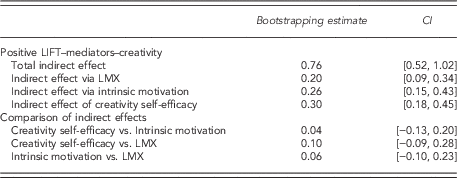
Further investigation showed that there was no significant difference between the indirect effects via creativity self-efficacy, intrinsic motivation and LMX. Specifically, the indirect effect through creativity self-efficacy was not significantly different from that through intrinsic motivation (difference=0.04, 95% CI=[−13, 0.20]) and LMX (difference=0.10, 95% CI=[−0.09, 0.28]); the indirect through intrinsic motivation was not significantly different from that through LMX (difference=0.06, 95% CI=[−0.10, 0.23]) (Table 4).
Comparison of indirect effects

Note. CI=confidence interval; LIFT=leaders’ implicit followership theory; LMX=leader–member exchange.
DISCUSSION
LIFT is a booming research area and have captured many scholars’ attention in recent years. Since the proposition of this concept, numerous studies have been launched and provided us with deeper insight into the leadership and followership processes inside the organization settings (Shondrick & Lord, Reference Shondrick and Lord2010; Sy, Reference Sy2010; Whiteley, Sy, & Johnson, Reference Whiteley, Sy and Johnson2012). However, extant IFT literature only has explored the effects of positive LIFT on followers’ attitudinal outcomes (e.g., job satisfaction, organizational commitment, well-being, etc.) (Shondrick & Lord, Reference Shondrick and Lord2010; Sy, Reference Sy2010; Whiteley, Sy, & Johnson, Reference Whiteley, Sy and Johnson2012), while neglecting the potential effects of positive LIFT on other outcomes (e.g., followers’ behavior, perception, exchange quality with organization or supervisor, etc.). The current study filled the research gap and explored the influence of positive LIFT on follower’s creativity.
Theoretical implications
The current research contains several theoretical implications. First, this study makes contributions to social cognitive theory and IFT. Research on IFT addresses a major gap in the leadership literature on how leaders and followers ‘perceive, decide, behavior, and take action’ (Shondrick & Lord, Reference Shondrick and Lord2010; Sy, Reference Sy2010; Whiteley, Sy, & Johnson, Reference Whiteley, Sy and Johnson2012). Also, IFT research facilitates the application of social cognitive theory and implicit theory in the practice of management. Related research on IFT is launched based upon implicit leadership theory (Strenberg, Reference Strenberg1985). Implicit leadership theory and IFT are both theory extended from the implicit theory (Sy, Reference Sy2010). Implicit leadership theory describes cognitive structures or prototypes specifying the traits and abilities that characterize leaders (Strenberg, Reference Strenberg1985), while IFT explains how leaders judge and respond to their followers (Engle & Lord, Reference Epitropaki and Martin1997). However, while there have been numerous studies exploring implicit leadership theory (Strenberg, Reference Strenberg1985), the antecedents and effects of IFT are still understudied, which is conducive to deepen and enrich the leadership and followership processes within the organizational settings (Lord & Brown, Reference Lord and Brown2004). Under this circumstance, our study, to some degree, deepens our understanding of organizational followership process.
Second, the current study contributes to the LIFT literature by examining the ‘positive LIFT-employees’ creativity’ relationship. By doing so, the study also advances our understanding of workplace leadership phenomenon by among the first to explore the roles of leaders’ implicit cognition in influencing followers’ creativity. In the present study, we found that followers under the leadership of leaders with positive LIFT are more likely to exhibit high level of creativity behaviors. Further, in order to clarify the question of how positive LIFT influence employees’ creativity, the study explores the underlying mechanisms linking positive LIFT and followers’ creativity. It was found that LMX, intrinsic motivation and creative self-efficacy fully mediated the positive relationship between positive LIFT and followers’ creative, indicating that social exchange theory, self-determination theory and social leaning theory are all reasonable theoretical frameworks to give account for how positive LIFT can exert influence on creativity.
Finally, the current study extends the creativity literature by investigating the effect of leader’s implicit cognition on employees’ creativity. Under social background, innovation plays a more important role in the survival and development of enterprises (George & Zhou, 2002), followers’ creativity has been highly valued and emphasized by enterprises due to the fact that it is the source and basis for enterprises’ innovation and innovative performance (Amabile, Conti, Coon, Lazenby, & Herron, Reference Amabile, Conti, Coon, Lazenby and Herron1996; Oldham & Cummings, Reference Oldham and Cummings1996; Zhou, Reference Zhou1998; George & Zhou, Reference George and Zhou2002). Attempting to help enterprises to gain their competitive advantages, the study investigates the antecedent of followers’ creativity from LIFT perspective, which is also the first to explore the ‘positive LIFT-followers’ creativity’ link and its ‘black box.’
Practical implications
The current study also has several practical implications. First, positive LIFT is conducive to enhance followers’ creativity. Broader concept perspective indicates that positive antecedents often lead to positive outcomes (Hogan & Roberts, Reference Hogan and Roberts1996). The study provides support and evidence for this viewpoint. The result indicated that, in order to enhance follower’s creativity, efforts from triple sides of organizations, leaders and followers are required: First, for organizations, some intervention strategies should be taken to increase positive LIFT. For example, organization can enact norms and policy for positive leader and follower interaction through frequent and constructive team-working task or outdoor activities. These constructive activities enable leaders have more opportunities to capture the good qualities of their followers and thus are conducive to the forming of positive LIFT.
Second, high-quality LMX, intrinsic motivation and creative self-efficacy are found to have positive relationship with followers’ creativity. Under the highly competitive society, in order to improve followers’ creativity, leaders should not solely pay attention to the build-up of creative climate through job design and policy making, but also try to: (1) form high-quality leader–member relationship through giving followers more care and support; (2) motivate follower’s intrinsic motivation by satisfying their basic needs of a sense of competency, autonomy and relatedness; (3) boost follower’s creative self-efficacy through helping or guiding followers achieve success in creative activities, verbally encouraging them to carry out creative activities and giving them psychological arousal toward creative activities.
Limitations and future directions
In modern leadership research, studies on IFT have provided a novel and follower-centered perspective for scholars to uncover followers’ psychological mechanisms during the processes of leadership, which also offer us a new approach to leadership research (Shondrick & Lord, Reference Shondrick and Lord2010; Sy, Reference Sy2010; Whiteley, Sy, & Johnson, Reference Whiteley, Sy and Johnson2012). A noteworthy strength of the current study lies in its rigorous research design. Specifically, longitudinal research design was adopted to reduce common methods variance to a large extent, hence ensuring us to get more convincing and accurate findings from the collected data. However, like every previous research, the study is not without limitations. First, the variable measurement scales we adopted in the current study were all developed in Western cultural backgrounds which show good psychometrical properties in both Western and Chinese cultural background. However, due to the fact that our research, it may be more appropriate for us to adopt scales which are developed basing on Chinese sample and thus are more suitable for Chinese cultural background. Second, our sample only includes 16 large- and medium-sized Chinese enterprises and these enterprises were randomly selected by researcher, which, to some degree, limited the external validity of our research findings.
Under the background situation of followers diversity and value diversity, it is obviously insufficient that we explore the leadership process within the organizational settings solely from the explicit theories perspective. From the above perspective, we argue that future research have several directions as follows: (1) exploring the leadership process in the organizational settings adopting a more comprehensive perspective. Traditional organizational behavior research explores the leadership process mainly from leader-centric perspective. Future research should explore leadership process from follower-centric perspective and also lay more emphasis on the role of situation. (2) Strengthening the researching and studying of implicit theory, one effective way for which is to integrate the views and methods of cognitive psychology, sociology, and strategic leadership. Also, when explaining how implicit theory affect the potential outcome variables, future research can introduce more mediators as well as moderators. (3) The present study assessed LIFT at the individual level. This was done because LIFT represents broad conceptions of followers that are likely to guide global leadership judgments and interpersonal dynamics, such that they have a relatively equal impact on all follower outcomes. In this research, there are more than 100 supervisor managed only one subordinate. This also had the added benefit of substantially reducing the length of the surveys, and potential survey fatigue and response bias. As such, we deemed it appropriate to assess LIFT for their workgroup, rather than one-one. (4) Filling the research voids by paying more attention to the exploration of the outcomes of LIFT. As new-generation followers and knowledge followers gradually becomes the majority of the labor, future LIFT research should concentrate more on the delineation of the constitutes and structure of LIFT aimed at the above two groups as well as how the LIFT influence their interaction with leaders and performance expectation. (5) Looking for new or alternative approach to learn about the leadership process. IFTs give us insights into how leaders make judgments and responses to followers according to their pre-existing schemas, which reply scholars’ calls of strengthening the research on how leaders and followers ‘perceive-decide-act-execute’ (Avolio, Walumbwa, & Weber, Reference Avolio, Walumbwa and Weber2009). Apart from implicit theory, more new approach should be proposed to promote the studies of leadership.
Conclusion
The current study introduced LMX, intrinsic motivation and creative self-efficacy as mediators to explore the underlying mechanisms linking positive LIFT and creativity, answering when the strength of the link becomes stronger or weaker. Adopting 267 leader–follower dyads as our final sample, we found that: (1) positive LIFT had significant positive effect on followers’ creativity; (2) followers’ LMX with leader, intrinsic motivation and creative self-efficacy LMX mediated the positive relationship between positive LIFT and followers’ creativity; (3) no significance difference was found between the mediating effects of LMX, intrinsic motivation and creative self-efficacy.