1. Introduction
Metaphor as a meaning-making tool is used to conceptualize novel events and experiences. The conceptualization is done through mapping correspondences between a more concrete or familiar source domain and a more abstract or unfamiliar target domain (see Kövecses, Reference Kövecses2000; Kövecses, Reference Kövecses2003; Lakoff & Johnson, Reference Lakoff and Johnson1980). The impact of metaphors on framing emerging infectious diseases has been widely studied (e.g., Brown et al., Reference Brown, Nerlich, Crawford, Koteyko and Carter2009; Nerlich, Reference Nerlich2004; Nerlich, Hamilton, & Rowe, Reference Nerlich, Hamilton and Rowe2002; Nerlich & Koteyko, Reference Nerlich and Koteyko2012; Sontag, Reference Sontag1978, Reference Sontag1989). In 2020, a novel coronavirus, SARS-CoV-2, caused a global pandemic of a new infectious disease, COVID-19, which meant that scholars have now focused on understanding how the virus and the disease are conceptualized metaphorically (e.g., Abdel-Raheem, Reference Abdel-Raheem2021; Charteris-Black, Reference Charteris-Black2021; Craig, Reference Craig2020; Kazemian & Hatamzadeh, Reference Kazemian and Hatamzadeh2022; Nerlich, Reference Nerlich2020; Nerlich & Jaspal, Reference Nerlich and Jaspal2021; Semino, Reference Semino2021).
Despite an avalanche of cognitive studies on illnesses, particularly coronavirus, and worthwhile contributions in areas such as metaphor, metonymy, and conceptual blending, an overview of these studies reveals a gap and a growing imbalance. The disparity is associated with the gain in popularity of certain aspects of cognitive linguistics, like conceptual metaphor theory (CMT), yet the underrepresentation of other aspects, like force dynamics (FD). Regarding the illnesses, COVID-19 in particular, there is no single study that systemically studies the relationship between Talmy’s FD and CMT. Following Talmy, Kövecses has used FD to study emotion metaphors. Although his suggested model (Kövecses, Reference Kövecses and Liforthcoming) on FD and metaphor is limited to emotion metaphors, it seems that the range of domains to which his model can be applied is not restricted to emotion, as any action can be caused and thus can be seen as a force (Kövecses, Reference Kövecses and Liforthcoming). As illness metaphors, particularly coronavirus and covid metaphors, are rooted in the exchange of forces and actions (see Semino, Reference Semino2021), this article is intended to examine how two frameworks, Talmy’s (Reference Talmy1988, Reference Talmy2000) FD and CMT, can be joined to constitute a natural fit to studying coronavirus and covid metaphors.
In this article, we adopt Kövecses’ (Reference Kövecses2020a, Reference Kövecses2020b, Reference Kövecses and Liforthcoming) multilevel view of metaphor and FD to deal with the force and action relations in COVID-19 conceptualization. We aim to show how the combination of CMT and FD can work in cases featuring illness metaphors. Most of the corona-related conceptual metaphors are related to forces (see Kazemian & Hatamzadeh, Reference Kazemian and Hatamzadeh2022; Olza et al., Reference Olza, Koller, Ibarretxe-Antuñano, Pérez-Sobrino and Semino2021; Semino, Reference Semino2021); therefore, we can conceptualize illnesses in terms of a generic level metaphor, which is illnesses are forces. It has been demonstrated that the conceptual metaphor Causes are forces is classified among the event structure metaphor (Lakoff, Reference Lakoff and Ortony1993). By virtue of Causes are forces, illnesses are interpreted as forces, yet equivalent to causes.
2. Theoretical background
2.1. Metaphor
In the last four decades, CMT has witnessed a prominent and rewarding wave of scholarship and a period of intense focus following Lakoff and Johnson’s groundbreaking work (Lakoff & Johnson, Reference Lakoff and Johnson1980). Considering the metaphor as a conceptualizing device rather than an ornamental one, CMT marked a paradigm shift in the metaphor area of research. CMT defines conceptual metaphors in terms of mapping, the basic notion of CMT. A conceptual metaphor is mapping a domain (concrete) onto another (abstract) or understanding one domain in terms of another (see Lakoff & Johnson, Reference Lakoff and Johnson1980).
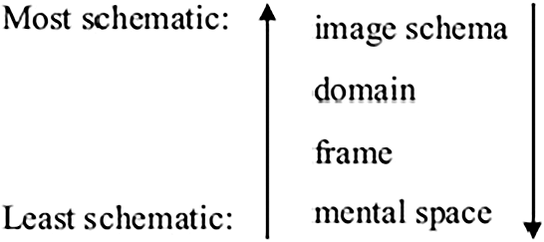
Although CMT is celebrated for its notable attainments within cognitive linguistics, it has also met widespread criticism. Serious criticism that has been leveled at it, is a deep-seated theoretical–conceptual dilemma with the concept of domain (Kövecses, Reference Kövecses2020b, p. 50). The multilevel view of metaphor (see Kövecses, Reference Kövecses2020b) seems to be a way out of this dilemma, and it can be solved when we consider the occurrence of metaphors at four simultaneous levels of schematicity in an interlocking vertical hierarchy of image schemas, which are analogue conceptual structures, domains, frames, and mental spaces, which are non-analogue (i.e., propositional; see Kövecses, Reference Kövecses2020b). This four-level hierarchy is diagrammed in Fig. 1. It shows that the level of schematicity is aligned with direction of arrows; the upward arrow indicates increase in schematicity, whereas the downward arrow indicates increase in specificity.
Schematicity hierarchy for four conceptual structures (Kövecses, Reference Kövecses2020a, p. 52).

Providing accounts of metaphor requires understanding the basic tool kit of cognitive linguistics (i.e., image schema, domain, frame, and mental space). The first concept to be considered is image schemas, which are highly schematic gestalts and rooted in our very basic spatial sense and the ways environment can affect us (see Dancygier & Sweetser, Reference Dancygier and Sweetser2014; Hampe, Reference Hampe2005). It has been purported that this level is the most abstract level, which entails a wide range of aspects and triggers a variety of more specific conventional metaphors. Basic schemas can be listed as Path, Force, Counter-Force, Balance, Control, Cycle, In/Out, Center/Periphery, Link, and so forth (see Johnson, Reference Johnson1987; Lakoff & Johnson, Reference Lakoff and Johnson1980). Domains, which are located immediately after image schemas, are non-analogue patterns of experience and intrinsically propositional in a highly schematic fashion (Kövecses, Reference Kövecses2020b, p. Reference Lakoff and Johnson53). The domain level brings about a base for FD, yet is deeply rooted in the image schema level. Compared to the two earlier concepts, frames (see Fillmore, Reference Fillmore1982) are less schematic. They elaborate on certain aspects of a domain matrix and include relationships that exist between them, which means frames are included in domains (Sullivan, Reference Sullivan2013). Going through the hierarchy downward, the last level occurs at the mental space level, yielding detailed information concerning the metaphorical concepts. This framework contributes to our deeper understanding of complex metaphorical structures delineating a novel concept such as COVID-19 with respect to force entities. Mental spaces (see Fauconnier, Reference Fauconnier1994) as the most specific cognitive structures function at a very conceptually rich level and are used in online representations of our understanding (Kövecses, Reference Kövecses2020b, p. 54).
2.2. Illness metaphor and force dynamics
In the last few decades, there has been a surge of interest in the Illness metaphors, so that considerable literature has grown up around the theme of metaphorical concepts in defining disease. A widely investigated field is interpreting cancer through metaphors. An influential study in this regard was Sontag’s (Reference Sontag1978, Reference Sontag1989) work, examining metaphors relating to tuberculosis, cancer, and AIDS.
Semino et al. (Reference Semino, Demjén, Demmen, Koller, Payne, Hardie and Rayson2015, Reference Semino, Demjén, Hardie, Payne and Rayson2018) examined how war metaphors and journey metaphors were used in the language of both patients and practitioners when talking about cancer. It was hypothesized that while journey metaphors are apt to empower the patients, war metaphors instantiate a sense of frustration in the patients. Likewise, in the case of pandemics, the war metaphor also attracted particular attention. Nerlich, Hamilton, & Rowe (Reference Nerlich, Hamilton and Rowe2002) studied the war metaphor during various disease outbreaks, such as foot and mouth disease, an animal disease, when the war metaphor was dominant; during the 2003 outbreak of severe acute respiratory syndrome (SARS), a precursor to the current pandemic, which did not affect the UK, which meant a lesser use of the war metaphor (Wallis & Nerlich, Reference Wallis and Nerlich2005). They also studied the metaphor as used for invasive species and bird flu outbreaks and found that the war metaphor overall provided policy-makers in particular with a sense of control and, at least to some extent, elicited feelings of solidarity in the population (see Larson, Nerlich, & Wallis, Reference Larson, Nerlich and Wallis2005).
In the same fashion, illness metaphors lie at the heart of our understanding of metaphorical concepts representing COVID-19. A variety of papers endeavored to clarify the conceptual metaphors drawn upon to perceive COVID-19 as a pandemic widespread in the world in 2020 (see Abdel-Raheem, Reference Abdel-Raheem2021; Kazemian & Hatamzadeh, Reference Kazemian and Hatamzadeh2022; Nerlich & Jaspal, Reference Nerlich and Jaspal2021; Semino, Reference Semino2021). However, the studies undertaken so far have failed to illuminate the force schema, and none of them demonstrated a link between CMT and FD. What remains less clear is the impact of FD on conceptualizing complex metaphorical structures. This indicates a need to discern how both CMT and FD conceptualize the same phenomena employing different terminologies. Our paper seeks to explore the overlap between these two models among metaphorical structures apprehending COVID-19.
FD is one of the constitutive construal operations structuring conceptualizations of linguistic and social interactions (see Croft & Cruse, Reference Croft and Cruse2004). This schema is grounded in somesthesia and kinesthesia; therefore, it is ubiquitous in all interactions dealing with force. Just as the conceptual metaphor of WAR structures ways of talking about arguments, illnesses, and many more relatively abstract topics, so the schema of force structures the way we talk about causing, letting, hindering, or helping (Talmy, Reference Talmy2000, p. 409). In this construal, two force-interacting entities are involved, namely Agonist (ago) and Antagonist (ant). Agonist is the entity whose circumstance is at issue (Talmy, Reference Talmy2000, p. 415), and Antagonist holds a force-interactive relation with that entity.
As has been long argued, some conceptual metaphors (e.g., emotion metaphors) are instantiation of general FD (see Kövecses, Reference Kövecses2000, Reference Kövecses2003). In this view, two forceful entities (emotional and rational selves) are involved, and there is a certain outcome. However, this cannot be only true about emotion metaphors because any action can be caused and correspondingly can be seen as a force (see Kövecses, Reference Kövecses and Liforthcoming).
Since conceptual metaphors of illness demonstrate the exchange of forces and actions (see Semino, Reference Semino2021), they also can be regarded as the very manifestation of cause and force. Given the force-dynamic characters of these metaphors and given that they are required to incorporate the existence of conceptual structure associated with illnesses, it can be argued that illness metaphors are mostly constituted force dynamically.
In the same manner that emotion metaphors are pertinently associated with force schema, the conceptualization of illness is motivated by force schema, in which two forceful entities are involved (see Fig. 2). Both of these types of metaphors provoke a sequence of causality present in the inevitable interaction between two force entities. This schema can be applied twice, thereby allowing a force-dynamic interpretation of illness experience. First, a forceful entity (virus) affects another forceful entity (human) as a result of which illnesses come about. The second application of the schema is seen in effect of a forceful entity (illness) on another one (the same human) who tries to deal with the illness. In other words, our construal of illnesses is very general. Certain causes lead to illnesses, and the illness causes humans to react. Here, the cause of the illness (virus) has the force that can change the state of the human body, and illness also has the force to affect the human reaction.
The schematic frame of illnesses.

Taking the above-mentioned model into consideration, it seems that we can construe illnesses as one of our image schemas, force schema. The idea that arises from the virus is the notion of force, embodying the elements inherent in force schema, including interaction between force entities, a constellation of causality, unequal power among the entities, a blockage during the correlation, and so on. Rather than attempting to identify the foregrounded elements of force schema in expressions narrating COVID-19, we tend to understand the development of metaphorical expressions surrounding COVID-19, through both CMT and FD.
By virtue of CMT, a set of source domains were observed to play a part in deciphering the obliqueness within the metaphorical expressions expounding on COVID-19 (Kazemian & Hatamzadeh, Reference Kazemian and Hatamzadeh2022). war, fire, natural force, and wild animal are underlying and universal source domains, which are responsible to account for COVID-19 in metaphorical expressions. What seems noteworthy to point out is the fact that these source domains foster a sense of force, which is a matter of contention in force-dynamic pattern. Therefore, apart from the role that CMT plays in framing illness metaphors, it is in the light of force schema that the principal and pertinent properties of the idea of force are perceived in these source domains in thinking of COVID-19.
Another salient point about conceptualizing COVID-19 on grounds of force-dynamic framework is the occurrence of a sequence of causality turning up in the case of COVID-19. Stemming from a natural force, the virus triggers illness and affects the human body. Although the same significance is elicited from the Causes are forces metaphor, the notion of force deduced from the above-mentioned source domains is a focal matter in force schema.
Moreover, despite its success in explicating metaphorical expressions and despite its ubiquity in various contexts, CMT suffers from various deficiencies. One of the limitations that CMT imposes on the concepts could be its functioning at the most general level (see Kövecses, Reference Kövecses2020b). Despite its achievement in different contexts, CMT has failed to demonstrate the constant association between the force entities and their interaction. However, FD resolves the problem, determines the correlation between Agonist and Antagonist, and allows for a more specific examination of the metaphorical expressions. This presumably means that in interpreting metaphorical expressions reflecting the idea of force and emanating from force schema, FD leads us to a richer understanding than merely CMT, which fails to represent a detailed analysis. Through the lens of FD, we would arrive at the deeper structure of metaphorical expressions, the underlying layers motivating metaphors.
One more argument which discloses the need of FD besides CMT in the current paper is the psychological elements available in Agonist and Antagonist, which is ignored by CMT. As proposed by Talmy (Reference Talmy2000), the Agonist’s inner psychological state constructs his/her desires and motivate Agonist force tendency to overcome or to be suppressed by Antagonist. Talmy contends that this is the psychological element that makes Agonist stronger to resist the Antagonist’s power (Talmy, Reference Talmy2000, p. 435). Since in the case of COVID-19, psychology of the Agonist also plays a part in defeating the virus, rather than merely the body, understanding expressions delineating COVID through force-dynamic pattern seems quite pertinent. This realization by FD is significant since CMT has not been able to account for the Agonist’s or the Antagonist’s psych, that is responsible for conquering Antagonist.
2.3. Kӧvecses’s model
A large and growing body of literature has investigated the metaphorical expressions describing emotions (Barcelona, Reference Barcelona1986; Csábi, Reference Csábi1998; Kӧvecses, Reference Kӧvecses1986, Reference Kӧvecses1990, Reference Kӧvecses1991a, Reference Kӧvecses1991b, Reference Kӧvecses, Taylor and MacLaury1995). However, there are relatively few published studies delving into the emotion concepts and the metaphors characterizing them in a more specific way. As maintained by Kӧvecses, in the case of emotions, CMT is concerned with generic-level metaphors and lacks clarity regarding the various aspects of emotions. Moreover, concepts of emotions have been appraised as causes that trigger definite reactions, inevitably they give rise to the Causes are forces metaphor (Kövecses, Reference Kövecses2000, p. 61). All emotion concepts seem to be motivated by the emotion is force metaphor. Accordingly, force-dynamic pattern illustrating the concepts of emotion in a more detailed fashion, fosters the notion of force inherent in emotions. It is only since the work of Kӧvecses (Reference Kövecses2000) that those interpreting concepts of emotion through FD have gained particular attention. Prior to the Kövecses (Reference Kövecses2000) study, the role of FD in elucidating the metaphorical expressions employed to evaluate emotion concepts was largely unknown.
Drawing upon Talmy’s model of FD, Kӧvecses discerns how to figure out the certain aspects in emotions through force schema. Talmy’s model encompasses all the particular elements foregrounded in force schema:
The primary distinction that language marks here is a role difference between the two entities exerting the forces. One force-exerting entity is singled out for focal attention—the salient issue in the interaction is whether this entity is able to manifest its force tendency or, on the contrary, is overcome. The second force entity, correlatively, is considered for the effect that it has on the first, effectively overcoming it or not.
(Talmy, Reference Talmy2000, p. 413)In the light of this formulation, Kӧvecses (Reference Kövecses2000) illustrates how FD and CMT can be joined together to allow for a more precise and comprehensive delineation of the metaphorical expressions in terms of emotions. In this framework, the emotions are regarded as Antagonist, whose force tendencies would indicate action, while Agonist, the person’s self, tends toward repose. Whereas in the interaction between Agonist and Antagonist, Agonist endeavors to remain unaffected by the Antagonist (emotion), the Antagonist’s tendency leads the Agonist toward a radical change in behavior.
Kӧvecses’s conjoined model regarding emotions is deeply rooted in force schema and is manifested through emotion is internal pressure inside a container. The concept of ‘internal pressure inside a container’ conjures up two entailments, people are containers and emotion is a substance in a container. The particular embodiment of the container is the human body, whereas liquid and gas exemplify certain substances in a container. Taking into account FD pattern, there exists a conceptual mapping between internal pressure, identified as force, and emotion. Bearing in mind this source and target mapping, the pattern legitimizes a complex yet accurate explication of the function of Agonist and Antagonist. In this mapping, the internal pressure is understood in terms of source domain, so that the container would be the Agonist and the pressurized substance regarded as the Antagonist. On this account, the intrinsic force tendency of the Antagonist (pressurized substance) is understood as the change of the level of the substance in the container and the intrinsic force tendency of the Agonist (container) is comprehended as resisting the force, that is pressure. An inevitable consequence of a stronger Antagonist could be detected as the substance going out of the container and Agonist’s behavior undergoes a change.
In the same vein, in terms of the target domain, representing the rational self is known as Agonist, and the emotion is identified as Antagonist. In the target domain, the intrinsic force tendency of the Antagonist (emotion) is determined as the emotion could provoke the self to respond to the pressure and the intrinsic force tendency of the Agonist (the rational self) would be Agonist’s attempts to resist being affected by the Antagonist’s force. In consequence of the force from a stronger Antagonist, the resultant action is found to be the self’s response to the pressurized substance in the container. That is to say, while the Agonist gravitates toward repose, the Antagonist tends toward action and consequentially, due to a stronger Antagonist (emotion) the rational self is affected by the Antagonist’s action.
This relatively complex pattern represents the interrelatedness of conceptual metaphors delineating emotions and force-dynamic model portraying force-related concepts. In order to gain a more specific interpretation of the metaphorical expressions emanating from force schema, employing the force-dynamic pattern would be quite helpful. While investigating unknown and sensitive concepts through merely CMT could yield a more general analysis without going through a precise examination of force entities and their tendencies, a conjoined model of CMT and FD could resolve the issue, as proposed by Kӧvecses (Reference Kövecses2000).
3. Data and method
Due to the considerable merits of corpus data for metaphor research over imagined and elicited types of data (see Deignan, Reference Deignan2005; Kort, Reference Kort2017), this study tries to investigate corpus-driven metaphors intimately related to coronavirus. The data were drawn from a ready-made media-based corpus, namely The Coronavirus Corpus (It is readily accessible through https://www.english-corpora.org/corona/). It primarily features world online magazines/news websites yielding various insights into the impact of the coronavirus in 2020 and beyond.
As source domains of corona-related metaphors have already been suggested by previous studies (e.g., Kazemian & Hatamzadeh, Reference Kazemian and Hatamzadeh2022; Olza et al., Reference Olza, Koller, Ibarretxe-Antuñano, Pérez-Sobrino and Semino2021; Semino, Reference Semino2021), we did not find it necessary to carry out an extra stage for sampling and compiling a lexicon listing terms, which could be used metaphorically. These terms are fire, victim, terrorist, enemy, struggle, battle, animal, beast, flood, tsunami, and so on. It should be noted that these steps were taken in our previous study (Kazemian & Hatamzadeh, Reference Kazemian and Hatamzadeh2022) on the same corpus. After collecting the list, each of the keywords exemplified as source domain, such as war, fight, enemy, and storm, was looked up in the corpus to find proper and illustrative examples for our analysis. One might note that our searching was not only limited to the prototypical word of the frame. For example, for war frame, rather than limiting our search to ‘war’, we looked up different words belonging to this frame such as fight, battle, combat, and threat (see Wicke & Bolognesi, Reference Wicke and Bolognesi2020). Having an appropriate level of granularity and improving precision in identifying metaphors, we tested searches with two-word to five-word bundles.
After finding 10 corona-related metaphors for each candidate, we performed the four-step metaphor identification procedure (MIP; Pragglejaz Group, 2007):
-
(1) We read the entire text in the corpus to establish a general understanding of the meaning of corona-related metaphors.
-
(2) We determined the lexical units in the text.
-
(3) We examined the meaning of lexical units in the context (contextual meaning), taking into account what comes before and after the lexical unit. We also considered other basic meanings of the lexical units out of the context.
-
(4) In case of more basic contemporary meaning in contexts other than the one in the context under examination, the lexical unit was marked as metaphorical.
To be sure about the true metaphorical nature of expressions in illustrative examples and to improve the reliability of this study, the implementation of MIP was accompanied by some account of inter-rater reliability. Five competent people specialized in the field of metaphors were asked to rate the identified metaphors, and they unanimously approve their metaphorical nature.
After implementing the identification procedure in full, Kӧvecses’ conjoined model of CMT and FD (Kövecses, Reference Kövecses2000) was adopted for our qualitative analysis.
Following open data and materials policy, the data that support the findings of this study are publicly available in Open Source Framework (OSF) at https://osf.io/z7y5v/?view_only=998000ea685a4cb9b592b08ca3d9b1a1.
4. Discussion
4.1. Virus is an opponent
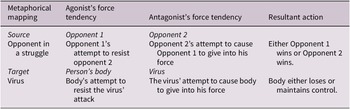
What is known about Virus is an opponent is fundamentally driven from studies conducted on metaphorical understanding of COVID-19 (Kazemian & Hatamzadeh, Reference Kazemian and Hatamzadeh2022; Nerlich, Reference Nerlich2020; Nerlich & Jaspal, Reference Nerlich and Jaspal2021). Violence metaphors, predominantly, instantiate the notion of force and epitomize force schema. Principally, force gains our attention when we are involved in the imbalance of power and strength (Johnson, Reference Johnson1987, p. 42). Johnson (Reference Johnson1987) specifies some features of the force schema among which the necessity of interaction, the degree of power or intensity, and the existence of a sequence of causality are of primary importance (Johnson, Reference Johnson1987, p. 44). In the case of COVID-19 and the Virus is an opponent metaphor, these properties are substantially detectable. In pursuit of a conjoined structure of FD and CMT, the generic-level metaphor Causes are forces is conceivable according to which the following complex structure emerges.
Table 1 represents the struggle between a person’s body and the virus. The virus first attacks the body and, by exerting the force toward it, causes the body to respond, that is, the body attempts to maintain control. This struggle ends in two results, winning or losing. These two results can be seen in (1) and (2).


Virus is an opponent

In (1), however, he (his body) has applied a counter-force for a long time to regain the control, it could not beat the force of virus and virus caused the body to give in to its force. In (2), by contrast, we see a stronger ago coming into place. Here, again, Saini’s body has applied a counter-force for a long time and could successfully repel the attack.
Image schema level:
Causes are forces.
Domain level:
Illnesses is an interaction of forces between forceful entities.
Frame level:
Covid is an opponent.
Mapping at the frame level:

Mental space level:
The recovery/death of patients infected with covid 19 is a victory/defeat in a hard-fought battle.
Touching upon a number of hypotheses (Lakoff, Reference Lakoff1987; Langacker, Reference Langacker1987; Rosch, Reference Rosch, Rosch and Lloyd1978), Kӧvecses (Reference Kövecses2020b) organizes the metaphors into hierarchies at various levels of generality. Kӧvecses’ hierarchy is a four-level framework representing concepts from the most schematic to the least schematic. Arising from our most basic embodied experiences, the metaphors at the image schema level symbolize extremely general metaphorical concepts. Utilizing Kӧvecses’s framework and bearing in mind the Virus is an opponent metaphor, the metaphor at the image schema level could be perceived as Causes are forces. However, the Causes are forces metaphor entails a wide range of aspects divulging the notion of force and is not able to provide a comprehensive account on the idea underlying war metaphors in the case of COVID-19. For this reason, in order to devise a structure, elucidating the role of the virus as a force and evoking the force schema, the metaphor Illness are forces at the domain level seems quite relevant. As proposed by Kӧvecses, domains are furnished with more information than image schemas (Kövecses, Reference Kövecses2020b, p. 53). In this ‘schematicity hierarchy’, the next level could be illustrated at the frame level conjuring up the metaphor Virus is an opponent, which represents the cause of the illness, the virus, interpreted as an opponent. Less schematic than image schemas, frames provide more specific information regarding a concept than domains. Finally, the precise conceptualization occurs at the mental space level through which the force tendency of both ago and ant is manifested in a well-defined way. Relying on the level of image schema, domain, and frame, mental space level is the most specific and least schematic level of metaphors. Providing the most individual metaphors, mental space level makes new inferences and evaluations (Kövecses, Reference Kövecses2020b, p. 69). Although this accurately delineated structure ‘is not a conventional frame-level metaphor’ (Kövecses, Reference Kövecses and Liforthcoming), it unequivocally depicts the imbalance of strength between the ago and the ant and the resultant action imposed on the ago. Since the metaphors at the mental space level are the most specific and highly individual, they offer a detailed account of metaphors, yet superficial metaphors rather than deep metaphors occurring at the three other levels.
4.2. Virus is a natural force
4.2.1. Virus is fire
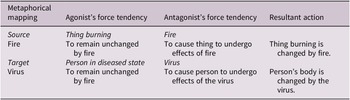
Building on previous work (Kazemian & Hatamzadeh, Reference Kazemian and Hatamzadeh2022; Semino, Reference Semino2021), we discuss another metaphor through which conceptualization of the coronavirus is conceivable. Fire is purported to contribute to the understanding of the virus metaphorically. Basically, what develops from the fire schema is the notion of ‘blockage’ (Johnson’s terminology), which is highlighted in the force schema. Inevitably, blocking or resisting our force when regarded as fire, the virus is perceived as an ant in Talmy’s model. Table 2 illustrates how CMT and FD coalesced into one dominant structure.
Virus is free

What is deduced from Table 2 is the correspondence between fire and the virus in which the force schema is evident. The virus, conceptualized as fire, triggers changes in a person’s body. That is to say, the ant’s force tendency is to bring the person in a diseased state to experience the effects of the virus (fever in sentence (3)). On the contrary, the ago’s force tendency is to remain unchanged and not to be affected by the virus. Notwithstanding how the ago’s force tendency goes, the resultant action could be defined as the person’s being put into the diseased state and being imbued with the effects of the virus including fever. The effects are to be manifested as COVID fever in sentence (3).

Image schema level:
Causes are forces.
Domain level:
Illnesses is an interaction of forces between forceful entities.
Frame level:
Covid is fire.
Mapping at the frame level:

Mental space level:
Republicans’ willingness for an increase in the number of COVID 19 infected Americans [to achieve their political goals] is throwing American people into the fire.
This hierarchy of semantic concepts are designed to illustrate a potential sequence of conceptual metaphors, being responsible for illuminating the complex structure shown in sentence (3). Since the metaphors at the image schema and the domain level are precisely the same in all the source domains under scrutiny, we tend to jump to other levels to be more concise.
The Virus is fire metaphor clarifies the role of the virus as fire, identified as some sort of natural force being manifested in force schema. Finally, the more specific realization of the metaphor implied in (3) could be: Republicans’ willingness for an increase in the number of COVID 19 infected Americans [to achieve their political goals] is throwing American people into the fire. Providing superficial metaphor at the individual level, the metaphor lays stress on the part ago and ant play in demystifying the notion underlying sentence (3).
4.2.2. Virus is a storm
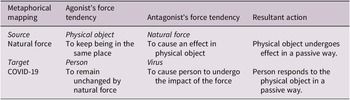
In view of the available literature on the natural force domain, the metaphor Virus is a storm is also conceivable for Covid-19 (see Kazemian & Hatamzadeh, Reference Kazemian and Hatamzadeh2022; Nerlich, Reference Nerlich2020; Nerlich & Halliday, Reference Nerlich and Halliday2007). What seems to be necessary to point to is the marked depiction of force schema in the above-mentioned metaphor. The predominant notion hidden in the natural force scenario is the ant’s (storm, tsunami, and wind) force tendency to move the ago (people and objects) in its way from one location to the other, devastatingly. Therefore, drawing parallels between the natural force domain and the virus seems quite reasonable. Rather than unraveling the underlying correspondence between the two domains, we tend to delineate a fairly complex structure offered in Table 3 to elucidate the potential link between CMT and FD.
Virus is a storm

Overall, Table 3 indicates the efficacy of this amalgamated model in deciphering sentences such as (4). Taking into account (4), the role of ‘Tsunami of Covid’ as an ant, aiming at changing the present state of the ago (campus as a metonymy for students and staff), is obvious. While the force tendency of ago and ant is in strong opposition, the resultant action would be the physical object’s giving up its resistance to the force.

Image schema level:
Causes are forces.
Domain level:
Illness is interaction of forces between forceful entities.
Frame level:
Covid is a storm.
Mapping at the frame level:

Mental space level:
COVID 19 infecting our students and staff is tsunami washing on to our campuses.
As it was pointed out earlier, in order for the readers to figure out the contextual meaning of a combined model constituting CMT and FD, a metaphorical framework rendering a hierarchy of generic-level to specific-level metaphors is required. To avoid redundancy, we jump to the frame level at which COVID is conceptualized in terms of storm, affecting the human body (sick and disability) in a destructive manner. To bring it to an end, delineating the metaphorical interpretation of (4) could simply lead to mental space level according to which the emerged structures are context-bound and situationally based metaphors. The COVID 19 infecting our Students and staff is tsunami washing on to our campuses metaphor divulges the ago and ant’s force tendency and insists on the resultant action. Offering new implication, this metaphor at the most individual level is heavily contingent on the schematic information on the image schema, domain, and frame levels.
4.3. Virus is a wild animal
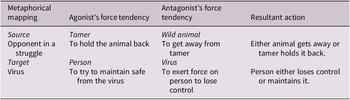
Adopting CMT, the semantic correlation between the virus and the wild animal yields another conceptual metaphor to think of and to talk of the coronavirus (see Kazemian & Hatamzadeh, Reference Kazemian and Hatamzadeh2022). The foregrounded potentiality of a beast could be its tremendous and uncontrollable power. What attracts our attention in this metaphor is the force underpinned by ‘tame the beast’ in sentence (5).

To weigh up the role of the force entities in sentence (5), going through Table 4 seems quite helpful. Looking at Table 4, it is apparent that the tamer is thought of as ago and the wild animal as ant. While the ant (wild animal in the source domain) attempts to exert force on the tamer, the tamer strives to resist this force. However, ant is stronger than the ago and the ant’s force tendency becomes salient. Inevitably, the ago gives in to the ant’s force tendency, and the resultant action in the target domain would be the person’s being beaten by the virus in this struggle. In example (5), pairing rapid tests and oral treatments are to tame the virus ‘to save lives and reduce hospitalization’.
Virus is a wild animal

Image Schema level:
Causes are forces.
Domain level:
Illness is an interaction of forces between forceful entities.
Frame level:
COVID is a wild animal.
Mapping at the frame level:

Mental space level:
Doctor’s treatment of mild to moderate cases of COVID with a ready-to-go oral medication is the taming of a mild beast with the tamer’s strength.
A close inspection of a hierarchy of metaphors makes the dominant themes, inherent in metaphorical concepts, obvious. The first metaphor in this hierarchical model seeks to determine the salient role of causality in force schema. The Causes are forces metaphor is indicative of the fact that the force of the coronavirus beast triggers changes in the person’s body, that is, illness. That would be noteworthy to insist that the Causes are forces metaphor has an experiential basis and is deeply entrenched in people’s experiences (Kövecses, Reference Kövecses and Liforthcoming). This highly schematic level offers deep metaphors, deeply enriched and effortlessly conceived. Since image schemata contain the general chunks of information rather than the detailed ones, there would be a shift from the image schema level to the domain level, delineating Illness is an interaction of forces between forceful entities. On the other hand, illness is also caused by the virus, which is perceived as wild animal at frame level. Therefore, COVID is wild animal emerges at the frame level as a widely held metaphor interpreting COVID-19. Nevertheless, none of these levels could possibly account for the force entities. Accordingly, the mental space would render the force tendency of both the ago and the ant. Moreover, the resultant action of the force interaction is also revealed at the mental space level. Thus, the metaphor doctor’s treatment of mild to moderate cases of COVID with a ready-to-go oral medication is the taming of a mild beast with the tamer’s strength arises out of the data indicated in Table 4. The sentence signifies a superficial metaphor at the individual level highlighting specific information from the wild animal frame.
4.4. Divided-self
Playing a pivotal role in force-dynamic pattern, the term ‘self-divided’ can be traced back to Freud’s taxonomy regarding the boundary between different parts of the psyche; ego, superego, and id. To clarify exactly what is meant by ‘self-divided’, we draw upon Talmy’s definition, putting forth the idea of two conflicting force entities within a single psyche. To theorize his assertion, Talmy considers two sentences; I held myself back from responding and I refrained from responding. What is deduced from these expressions is that ‘there is one part of the self that wants to perform a certain act and another part that wants that not to happen, where that second part is stronger and so prevents the act’s performance’ (Talmy, Reference Talmy2000, p. 431). On this account, the whole psyche is divided into two opposing force entities, the Agonist and the stronger one the Antagonist. The idea is also conceivable in the case of COVID-19, in which we are dealing with two conflicting force entities. Taking into account the following sentence would illuminate our position:

What is interesting in the above sentence is the interaction between two opposing parts of the COVID’s psyche, which needs to be traced and grasped. While one part of the COVID’s psyche tends toward ‘cart off many souls’, the second part, which is reckoned as the stronger part, intends to ‘burn itself out’. The former part stands for Agonist, imbued with COVID’s desires and the latter part is denoted as the Antagonist, playing the role of a blockage. Talmy deems the desiring part of the psyche to be more central and the blocking part to be more peripheral (Talmy, Reference Talmy2000, p. 433). While COVID is inclined to inflect and exterminate myriads of people, its blocking part is liable to put an end to its existence. Moreover, the metaphorical expression lurking in this sentence prompts the Virus is fire metaphor, which interprets virus in terms of fire. It seems noteworthy to imply that the salient point about the fire is its instant spread and wild nature (Kazemian & Hatamzadeh, Reference Kazemian and Hatamzadeh2022).
Bearing in mind the concept of self-divided and its manifestation in the above-mentioned sentence, the framework of FD becomes as significant as CMT. What makes FD valid and authentic is paying particular attention to the psychological elements and the interactions between two conflicting parts of the psyche, the desiring part and the blocking part. The well-founded pattern of FD unravels the complex structure potentially perceived in metaphorical expressions pertaining to force schema. This provides some directions toward solutions regarding the equivocality of such sentences, particularly those that give an account of an unknown and sensitive concept such as COVID-19. However, the fact that mere CMT is not able to explain the force entities and their tendencies does not imply that the reliability of CMT is doubted. We simply claim that FD pattern would seem to be more apt for supplying solutions to the probable ambiguities inherent in metaphorical expressions which foster a sense of force.
5. Conclusion
Our study set out to explore the mental schema of FD that seems to underlie many current conceptual metaphors of COVID-19, such as war, fire, natural force, and wild animal through which expounding on the nature of COVID-19 was conceivable. We argued that an analysis that combines insights form CMT and FDT can deepen our understanding of the metaphorical framing of COVID-19. We also argued that studying COVID-19 metaphors in this way can strengthen the theoretical links between CMT and FDT as proposed by Kӧvecses (Reference Kövecses2000). This model could make a significant contribution to establishing meaning in conceptual metaphors interpreting COVID-19. Returning to the question posed at the beginning of this study, it is now possible to state that the concept of illness serves as a good example to demonstrate the structures constituting the conceptual system. The illness frame could be considered as a specific instance of the force image schema, and illness metaphors largely fall under the generic-level metaphor, Causes are forces. One salient property of the above-mentioned source domains could be presumably identified to be the force schema, and all its pertinent features revealed in them. We can obtain a rich understanding of metaphors through Talmy’s FD, which is a felicitous framework in clarifying the semantic concepts instantiating a sequence of causation. Since in the case of COVID-19, we are encountering the issues of causality, the idea seems quite pertinent to the notion of FD.
Additionally, the current research encompasses another issue of utmost importance in the field of schema analysis. Developed from Kӧvecses (Reference Kövecses2020b), a hierarchy of metaphors at four levels is an appropriate structure, that plays a part in examining metaphorical meaning of COVID-19. On the basis of these multilevel metaphors, understanding coronavirus arises out of our world experiences, motivating conceptual structures at the image schema level and leading to semantic structures at the domain level and the frame level, respectively. Since the domain level is the level at which FD is actualized, the link between the embodied metaphors and FD seems quite comprehensible and explicable.
Our research has revealed the link between CMT and FD and has offered additional evidence in terms of COVID-19. It extends our knowledge of schematic concepts concerning FD and their role in conceptualizing the complex structures including metaphorical concepts. The current paper appears to be the first study to adopt Kӧvecses’s (forthcoming) model (a conjoined framework of CMT and FD) to COVID’s conceptual metaphors. It lays the groundwork for future research into illness metaphors as well as other conceptual metaphors in which the force schema is involved.
Acknowledgments
The authors would like to extend their gratitude to Brigitte Nerlich for her constructive comments on an earlier version of this paper.
Data availability statement
The data that support the findings of this study are openly available in OSF at https://osf.io/z7y5v/?view_only=998000ea685a4cb9b592b08ca3d9b1a1.