


Introduction
This study examines public support for armed non-state actors (ANSAs) in the Middle East based on original survey experiments. The focus is on three of the most influential ANSAs, which together constitute what is often termed the “Axis of Resistance”: Hezbollah in Lebanon, the Popular Mobilization Units (PMU) in Iraq, and the Houthis in Yemen. These organizations are predominantly Shi‘a Islamist in orientation and are widely recognized as recipients of military, financial, and ideological support from the Islamic Republic of Iran, a regional power where Shi‘ism is the state religion. While the Houthis’ religious affiliation is doctrinally distinct from the Twelver tradition of their partners, these groups are increasingly grouped under a common sectarian-political label in both academic and policy discourse.Footnote 1 As a result, public and policy discourse often presumes that sectarian affiliation maps directly onto patterns of support: Shi‘a populations are expected to be supportive, while non-Shi‘a populations are presumed to be opposed. While many academic studies adopt more nuanced approaches, this deterministic reading frequently informs media narratives and policy analysis.
In fact, sectarian differences have long been a central lens for understanding political conflict in the Middle East. Since the 2003 Iraq War, many violent confrontations—whether in Iraq, Lebanon, Syria, or the broader rivalry between Iran and Saudi Arabia—have been framed as “sectarian conflicts” or “sectarian wars.” While definitions vary, “sectarianism” is generally understood as a political project that mobilizes sectarian identities to frame disputes, generate divisions, and pursue power and authority. In other words, sectarian differences may exist in society, but sectarianism as politics emerges when elites instrumentalize those differences in struggles over power and authority. This “classical” sectarianism thesis has attracted significant criticism for its reductionism and its tendency to treat sectarian identity as static (Davis, Reference Davis2008; Haddad, Reference Haddad2017; Reference Haddad2020; Hashemi and Postel, Reference Hashemi, Postel, Hashemi and Postel2017). Furthermore, the regional landscape of the 2020s has witnessed a shift toward pragmatic realignment and de-ideologization, exemplified by the 2023 normalization of relations between Saudi Arabia and Iran. More recently, the Gaza war of 2023–2025 has served as a critical juncture, allowing ANSAs to intensify their rhetoric as defenders of the Palestinian cause. This suggests that public evaluations of these groups may be increasingly structured by a geopolitical axis of “resistance” against Israel, potentially overriding traditional sectarian logics. Notwithstanding these shifting dynamics, policy and security discourses continue to rely heavily on the “Iranian proxy” or “Iran-backed Shi‘a militia” labels (e.g., Robinson and Merrow, Reference Robinson and Merrow2024; Smyth, Reference Smyth2019), reflexively foregrounding sectarian ties to Tehran. While such practical narratives remain deeply entrenched, they often lack robust empirical grounding, highlighting the critical need for evidence-based analysis of how these groups are actually perceived on the ground.
For all the acknowledged salience of sectarian identity, there is little empirical evidence that public support for ANSAs systematically varies across sectarian lines. Moreover, it remains unclear whether members of different sectarian communities evaluate ANSAs’ goals and actions differently. One reason for this empirical gap lies in the difficulty of collecting reliable survey data in conflict-affected countries such as Lebanon, Iraq, and Yemen.Footnote 2
Taken together, these debates highlight the need for systematic empirical investigation of citizens’ attitudes toward ANSAs within the Axis of Resistance. This study addresses that gap by implementing original survey experiments in Lebanon, Iraq, and Yemen during the Gaza war of 2023–2025. Using a list experiment to mitigate social desirability bias (SDB), we assess the extent to which sectarian affiliation and attitudes toward Iran shape public support for Hezbollah, the PMU, and the Houthis. By doing so, this study contributes to the literature in three ways: it provides rare evidence from conflict-affected contexts, tests competing explanations derived from the sectarianism thesis and regional patronage politics, and advances a more nuanced understanding of the determinants of popular support for and opposition to ANSAs in the Middle East. Crucially, by unpacking the “Iran favorability” effect, we seek to move beyond the tautological observation that supporters of Iran support Iran-aligned groups, instead investigating whether such support is rooted in co-sectarian identity or in shared geopolitical orientations toward regional power dynamics.
Rethinking the roles of sectarianism in the studies of the axis of resistance
Middle Eastern politics in the 2020s and the sectarianism thesis
Because the three ANSAs that constitute the Axis of Resistance—Hezbollah, the PMU, and the Houthis—are all, in part, Shi‘a Islamist organizations, their dynamics have often been explained primarily through the lens of sectarian identity. In the 2000s in particular, the sectarianism thesis became a dominant framework for interpreting Middle Eastern politics. It posited a core regional rivalry between Shi‘a forces led by Iran and Sunni forces centered on Saudi Arabia and extended this paradigm to domestic politics in Lebanon, Iraq, Syria, and Yemen, portraying their political turmoil as products of sectarian conflict and proxy wars (e.g. Nasr, Reference Nasr2006).
Yet scholars have increasingly highlighted the limits of this classical sectarianism thesis. Many argue that sectarian divisions should not be understood as the cause of conflict, but rather as a consequence—mobilized and amplified within struggles for political and economic power. Political elites—what Davis (Reference Davis2008, 556) calls “sectarian entrepreneurs”—deliberately instrumentalize sectarian identity to maintain and expand their rule, manipulating popular fears and distrust. This process has been described as the “sectarianization” of politics, defined as “the process by which political actors mobilize religious identities in specific contexts to achieve political goals, rather than sectarian difference being an immutable social fact” (Hashemi and Postel, Reference Hashemi, Postel, Hashemi and Postel2017, 4). Building on this perspective, Fanar Haddad and others have argued that sectarianism is not a fixed attribute but a variable discourse with “discursive potential”: it is not constantly active but rather can be activated or lie dormant depending on political context. Accordingly, they criticize the classical sectarianism thesis as a form of cultural reductionism that attempts to explain diverse phenomena in static terms of sectarian difference (Haddad, Reference Haddad2017; Reference Haddad2020; Hashemi and Postel, Reference Hashemi, Postel, Hashemi and Postel2017; Majed, Reference Majed and Sadiki2020; Sakai and Suechika, Reference Sakai, Suechika and Sadiki2020).
Thus, to analyze Middle Eastern conflicts and political struggles that appear, at first glance, to be sectarian in nature, it is essential to consider other explanatory factors as well. Political variables such as authoritarianism, failed democratization, weak state capacity, and intensified elite rivalries; economic variables such as inequality and rent-seeking; and ideological variables such as incomplete nation-building or fragile nationalism—all shape the role and salience of sectarian identity in different arenas (Maréchal and Zemni, Reference Maréchal and Zemni2012).
Indeed, the limitations of the classical sectarianism thesis have become even clearer in the 2010s (Abdo, Reference Abdo2017; Gause, Reference Gause2014; Wehrey, Reference Wehrey2017). Saudi Arabia and Iran, once bitter rivals, normalized diplomatic relations in 2023, while Turkey and the UAE have increasingly prioritized economic pragmatism over ideological confrontation. This shift toward “de-ideologization” suggests that regional relations have entered a post-sectarian stage. The Gaza war of 2023–2025 further exposed these limits by elevating a geopolitical “resistance” axis over sectarian divides. In turn, accounts of domestic politics in Lebanon or Iraq as mere extensions of the Saudi–Iranian rivalry have lost explanatory power. Sectarian identities, once mobilized, have by no means disappeared, however. In countries where sectarian power-sharing has been institutionalized, such as Iraq and Lebanon, sectarian identity continues to serve as a key line of social and political division (Al-Ali, Reference Al-Ali2014; Haddad, Reference Haddad2011; Salloukh et al., Reference Salloukh, Barakat, Al-Habbal, Khattab and Mikaelian2015). The key task, then, is not only to reject the classical thesis—which risks reproducing an orientalist view that assumes religious difference naturally generates perpetual conflict—but also to analyze why and how sectarian identities become politicized, while maintaining attention to non-sectarian explanatory factors (Ghosn and Parkinson, Reference Ghosn and Parkinson2019; Majed, Reference Majed and Sadiki2020; Yamao, Reference Yamao2025).
Rather than testing whether sectarianism exists, this study evaluates whether sectarian affiliation alone can account for variation in support for ANSAs, or whether such support is more strongly conditioned by geopolitical evaluations of Iran’s regional role.
Explaining public support for the axis of resistance
Hezbollah, the PMU, and the Houthis share a Shi‘a (or, in the Yemeni case, Zaydi) base and have all deepened their ties with Iran. Sectarian identity is therefore an indispensable lens for comparison. Yet what “sect” means to citizens in each national context is neither uniform nor straightforward.
Shi‘a identity has played a central role in these groups’ mobilization strategies and legitimacy discourses. Hezbollah has drawn upon the narrative of the Shi‘a as “the oppressed” in Lebanon (e.g., Alagha, Reference Alagha2006, Reference Alagha2011a, Reference Alagha2011b; Al-Aloosy, Reference Al-Aloosy2020; Farida, Reference Farida2019; Helou and Mollica, Reference Helou and Mollica2024; Kanaaneh, Reference Kanaaneh2021); the PMU has framed its mobilization around the “defense of holy sites” (Al Alaadin and Felbab-Brown, Reference Alaadin and Felbab-Brown2022; Hassaan, Reference Hassaan2021; Jbour, Reference Al Jbour2021; Knights, Reference Knights2020; Knights et al., Reference Knights, Malik and Smith2023; Mansour, Reference Mansour2021); and the Houthis have emphasized Zaydi religious traditions (Al-Dawsari, Reference Al-Dawsari, Cook and Maher2024; Hamidaddin, Reference Hamidaddin2022). Crucially, as Salmoni et al. (Reference Salmoni, Loidolt and Wells2010) argue, the Houthi movement’s internal ideological shift toward “resistance” narratives has effectively bridged these doctrinal gaps, allowing them to function as a core pillar of the Axis of Resistance. These discursive frames suggest the utility of examining support for these actors through a sectarian lens.
At the same time, analyses that rely exclusively on sectarian identity risk serious pitfalls.
First, they can obscure the multiplicity of bases of support these groups command. Hezbollah, for instance, enjoys some backing from non-Shi‘a Lebanese, attributable to cross-sectarian or national factors such as its resistance against Israel or its provision of social services (Kanaaneh, Reference Kanaaneh2024; Karakoç et al., Reference Karakoç, Özcan and Özcan2022). In Iraq, PMU forces have at times garnered support from non-Shi‘a constituencies, such as Sunni tribes, particularly during joint operations against the Islamic State (Hassaan, Reference Hassaan2021; Yamao, Reference Yamao2025). Likewise, support for the Houthis is often tied less to sectarian loyalty than to widespread frustration with state corruption and foreign intervention (Brandt, Reference Brandt2017; International Crisis Group 2014; Lackner, Reference Lackner2023).
Second, an exclusive focus on sectarianism risks marginalizing other critical explanatory variables—political, economic, and ideological—that shape support for ANSAs. Overemphasizing sectarianism as an independent variable can lead to an oversimplified picture of local political dynamics and social support bases.
In short, while sectarian identity remains a salient factor in understanding the Axis of Resistance, it is insufficient on its own. Analyses must simultaneously account for political, economic, and ideological factors. In this study’s focus on citizens’ support for ANSAs, sectarianism is best understood not as a singular determinant but as one variable whose effects are mediated through interaction with other contextual factors.
Hypothesis and experimental design
Hypotheses
What role does sectarian identity play in shaping citizens’ support for—or opposition to—the three ANSAs that constitute the Axis of Resistance: Hezbollah, the PMU, and the Houthis? Building on the preceding discussion, we develop two testable hypotheses to evaluate whether support for ANSAs is driven by fixed communal identities or by strategic evaluations of regional power dynamics.
First, the sectarianism thesis suggests that support is primarily determined by shared identity. Since these organizations are Shi‘a Islamist in nature, support or opposition is expected to depend primarily on whether individuals identify themselves as Shi‘a—whether this self-identification stems from intrinsic motivation or from external mobilization. In the context of this study, this includes those identifying as Zaydi in Yemen, given the political convergence of Zaydi and Twelver identities within the Axis of Resistance framework.
Hypothesis 1 (Sectarian Hypothesis): Shi‘a are more likely than members of other sects to support ANSAs.
Second, from a regional patronage perspective, support may be driven by favorability toward Iran, the primary patron of these actors. However, we argue that this favorability is not merely a reflection of religious solidarity, but a functional evaluation of Iran’s geopolitical role. In the context of the Gaza war (2023–2025), Iran’s stance as a “counter-hegemonic” power confronting Israel provides a non-sectarian basis for support. Put differently, individuals may support these ANSAs not because of who they are (their sect), but because of what they represent (resistance against regional adversaries).
Hypothesis 2 (Iran Hypothesis): Individuals with more favorable attitudes toward Iran—particularly those who prioritize its geopolitical role in the regional order—are more likely to support ANSAs.
Crucially, we do not treat “Iran favorability” as a monolith. Instead, we investigate whether this support stems from co-sectarian affinity or from a shared geopolitical stance against Israel. By doing so, we seek to unpack the underlying drivers of support that are often obscured by the label “Iranian proxy.”
Experimental design
To test these hypotheses, we conducted original survey experiments in Lebanon, Iraq, and Yemen. Fieldwork was carried out from January 10 to February 28, 2025, through the online survey company Cint. Using a common questionnaire designed in Arabic and hosted on Qualtrics, the survey targeted Lebanese, Iraqi, and Yemeni respondents aged 18 and above registered in Cint’s sampling pool. The sample sizes were 823 in Lebanon, 755 in Iraq, and 954 in Yemen.
The study received approval from the Research Ethics Committee for Social Sciences and Humanities at Kyushu University (Approval No. 188, December 24, 2024). All procedures followed relevant ethical guidelines, and informed consent was obtained from all respondents prior to participation.
It is well established that online surveys in developing or conflict-affected contexts are inherently prone to sampling biases, as they typically skew toward younger, male, and more urbanized populations with regular internet access. Our samples were no exception; with the exception of Lebanon, there was a marked gender imbalance (App Figure 1), and younger cohorts in their twenties and thirties were overrepresented across all three countries (App Figure 2). Additionally, Sunni respondents were somewhat overrepresented relative to population shares in Lebanon and Yemen (App Figure 3).
The purpose of the survey was to assess citizens’ support for domestic ANSAs in the context of the Gaza War, which began in October 2023 and subsequently escalated and spread, including Israeli Defense Forces strikes in Lebanon, Iraq, and Yemen. Specifically, we sought to measure the extent to which respondents regarded ANSAs as primary sources of instability in their respective countries. Direct questioning, however, was judged inappropriate, as criticizing active conflict parties entails significant risks and can constitute a taboo, thereby exacerbating SDB. To mitigate this problem, we employed a list experiment.
In the list experiment, respondents were randomly assigned to a control or a treatment group. They were asked: “How many of the following statements do you support?” and instructed to report only the number of items they supported, not which ones. The sensitive item—“ [Hezbollah/PMU/Houthi] is the main cause of instability in my country”—was included only in the treatment group. To avoid ceiling and floor effects, the list contained three additional items: one expected to be widely supported, one expected to divide opinion, and one expected to be widely rejected. If randomization was successful, the difference in mean support between the two groups represents the proportion of respondents in each country who view their respective ANSA as the primary source of domestic instability.
Question wording (list experiment):
How many of the following statements do you support?
-
1. Israel is the major cause of conflicts in the Middle East.
-
2. The UN should play a leading role in an Israel–Palestinian ceasefire.
-
3. The [Lebanese/Iraqi/Yemeni] state should turn to all-out war with Israel.
-
4. [Hezbollah/PMU/Houthi] is the main cause of instability in my country.
Result of the list experiment
Balance check
We first conducted balance checks to confirm the integrity of the randomization process. It is important to distinguish the internal validity of the experiment from the external validity challenges inherent in online panels discussed in the previous section. While our initial samples displayed demographic skews toward younger and male respondents, the randomization between the control and treatment groups within each country was successful.
We compared distributions across basic demographic variables—gender, age, education, and income—as well as the key explanatory variables: sectarian affiliation and attitudes toward Iran. As shown in Figure 1, which presents the standardized mean differences (SMD) for all covariates, all scores fell within the threshold of ± 0.1 (or ± 10%). No statistically significant imbalances were observed between the control and treatment groups across all three countries. This confirms that the two groups are statistically equivalent in their baseline characteristics, ensuring that the estimated proportion of respondents viewing ANSAs as a source of instability is not confounded by preexisting differences between the groups. This experimental balance allowed us to proceed with the estimation of the sensitive item’s prevalence.
Standardized Mean Differences (SMD) for covariate balance across Lebanon, Iraq, and Yemen.
Note: The figure displays the standardized mean differences (SMD) for all pre-treatment covariates between the control and treatment groups. The vertical dashed lines indicate the threshold; values within this range suggest that the randomization was successful and the groups are statistically balanced.

Figure 1. Long description
Three scatter plots depict standardized biases for covariates across Lebanon, Iraq, and Yemen. Panel A: Lebanon. The scatter plot shows standardized biases for covariates such as Gender, Age, Education, Income, Sect, and Iran. The x-axis represents standardized biases ranging from -25 to 25, and the y-axis lists the covariates. The data points, represented by red circles, indicate the control-treatment biases for each covariate. Panel B: Iraq: List experiment. This scatter plot follows the same structure as Panel A, with the x-axis representing standardized biases and the y-axis listing the covariates. The red circles show the control-treatment biases for each covariate in Iraq. Panel C: Yemen: List experiment. This scatter plot also follows the same structure, with the x-axis representing standardized biases and the y-axis listing the covariates. The red circles indicate the control-treatment biases for each covariate in Yemen.
Estimated prevalence of opposition to ANSAs
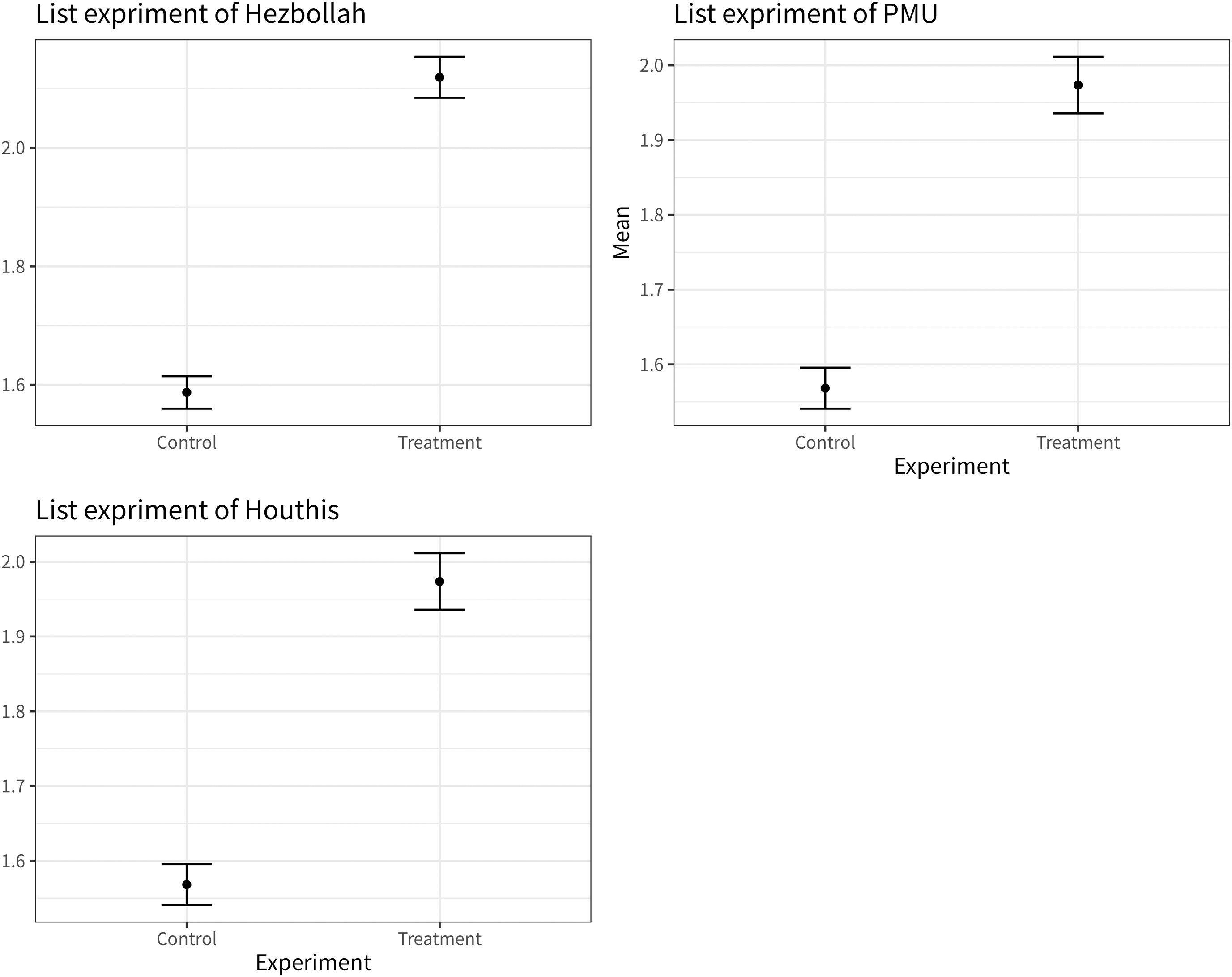
We now turn to the main results of the list experiment. Figure 2 presents the estimated prevalence of respondents who view the respective ANSAs as the primary source of domestic instability, calculated using the difference-in-means estimator.
Estimated proportion of respondents viewing ANSAs as the main source of instability.
Note: Bars display the estimated proportion of respondents who view their domestic ANSA as the primary source of instability, calculated using the list experiment’s difference-in-means estimator (the difference in mean item counts between treatment and control groups). Error bars represent 95% confidence intervals.

The results reveal significant levels of opposition to each organization. In Lebanon, the estimated prevalence was 53.18%, indicating that more than half of the population regards Hezbollah as the principal cause of instability. In Iraq, the corresponding figure was 40.53%, suggesting that a substantial plurality views the PMU as the main source of domestic turmoil. In Yemen, the estimated proportion was 42.83%, showing that nearly 43% of respondents attribute the country’s instability to the Houthis.
These findings are particularly striking given the timing of the survey during the Gaza war (2023–2025). Despite the ANSAs’ efforts to frame themselves as defenders of the Palestinian cause, a large share of respondents in all three countries remained critical of their domestic roles. The overall pattern is clear: approximately 40% to 50% of respondents evaluated their domestic ANSA as a key driver of instability rather than a provider of security. Given successful random assignment, the difference in mean item counts identifies the estimated prevalence of endorsement of the sensitive statement within each sample.
Analysis
Models
Building on the preceding results, we now examine the central question: who is more likely to adopt critical attitudes toward ANSAs? To test our hypotheses, we estimate ordinary least squares (OLS) models using the number of supported items in the list experiment as the dependent variable. The models include interaction terms between the treatment group and the key explanatory variables.
For Hypothesis 1 (Sectarian Hypothesis), we constructed a binary variable indicating sectarian affiliation: respondents identifying as Shi‘a were coded as 1, and all others as 0. In Yemen, Zaydis were categorized as Shi‘a. A negative and statistically significant interaction between this Shi‘a dummy and the treatment group would indicate that Shi‘a respondents are less likely than non-Shi‘a to identify ANSAs as sources of instability in their countries.
For Hypothesis 2 (Iran Hypothesis), we used attitudes toward Iran. Respondents were asked: “To what extent do you have a favorable opinion of Iran?” Responses were coded on a five-point scale from 1 (“strongly dislike”) to 5 (“strongly like”). We then interacted this variable with the treatment group. A negative and significant coefficient for this interaction would imply that respondents with more favorable views of Iran are less likely to view ANSAs as destabilizing actors.
Hypothesis testing
Sectarian hypothesis (H1)
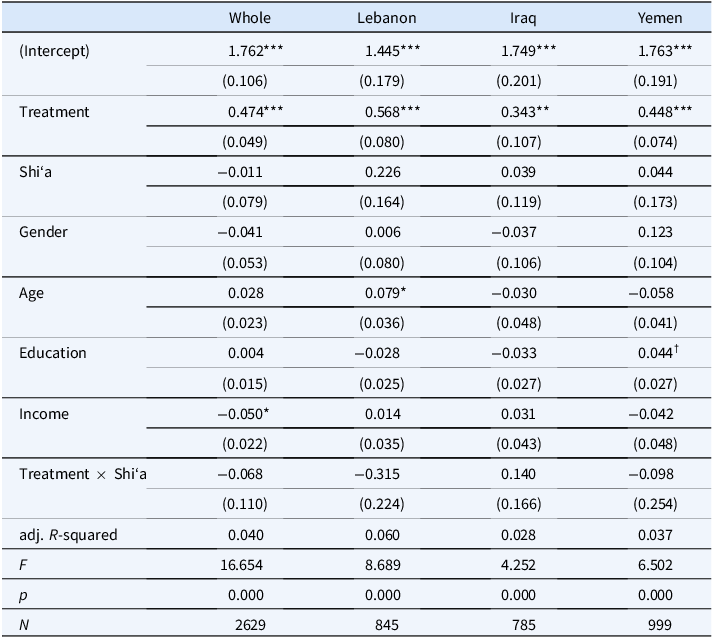
The estimation results for Hypothesis 1 (Sectarian Hypothesis) are presented in Table 1. The coefficients for the treatment group were statistically significant in all three countries: 0.568 in Lebanon, 0.343 in Iraq, and 0.448 in Yemen. These results are consistent with the simple mean differences reported earlier, confirming the robustness of the experimental findings even after controlling for covariates.
OLS estimation for the sectarian hypothesis

Table 1. Long description
The table presents the estimation results for the sectarian hypothesis across different regions. It includes data for Whole, Lebanon, Iraq, and Yemen. The table has 11 rows and 5 columns. The columns are labeled as Whole, Lebanon, Iraq, and Yemen. The rows are labeled as Intercept, Treatment, Shi’a, Gender, Age, Education, Income, Treatment x Shi’a, adj. R-squared, F, p, and N. Each cell contains numerical values and standard errors in parentheses. Notable values include significant coefficients for the treatment group in Lebanon (0.568), Iraq (0.343), and Yemen (0.448). The adjusted R-squared values vary across regions, with Lebanon having the highest value at 0.060 and Iraq the lowest at 0.028. The F and p-values indicate the statistical significance of the models.
Significance: ***= p < 0.001; **= p < 0.01; *= p < 0.05; †= p < 0.1.
By contrast, the interaction terms between the treatment group and the Shi‘a dummy were negative in all countries except Iraq, but none reached statistical significance. This indicates that sectarian affiliation alone does not systematically explain variation in support for ANSAs.
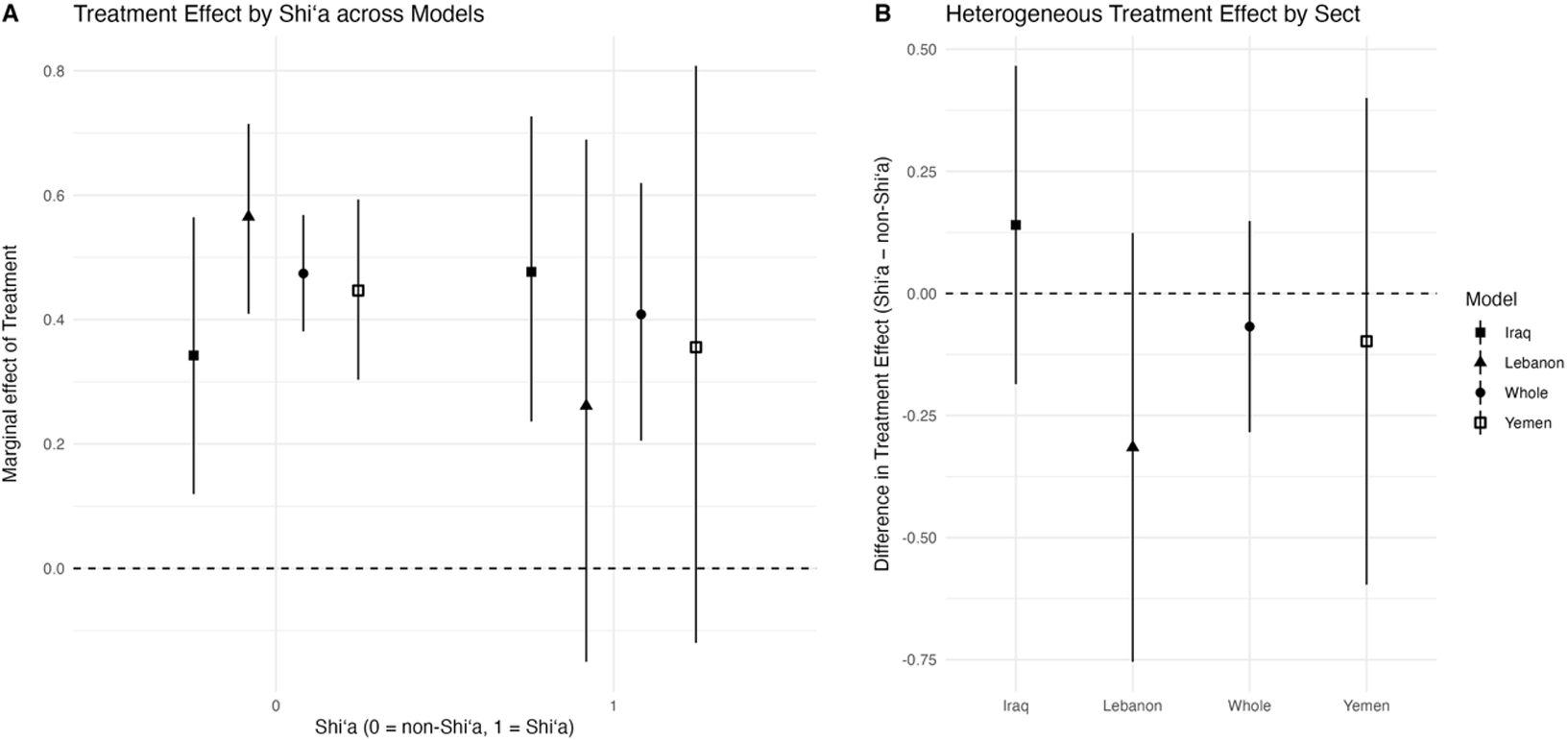
Figure 3 plots the heterogeneous treatment effects by sectarian affiliation. Panel A presents the marginal effect of the treatment for Shi‘a and non-Shi‘a respondents in the pooled sample as well as in each country. Across all specifications, the treatment effect is generally positive, indicating that indirect measurement through the list experiment increases the likelihood of identifying ANSAs as sources of instability. Importantly, the magnitude of this effect does not differ systematically between Shi‘a and non-Shi‘a respondents.
Treatment effect by Shi‘a affiliation.
Note: Panel A displays the estimated treatment effect on list-experiment item counts conditional on respondents’ sectarian affiliation (Shi‘a vs, non-Shi‘a), in the pooled sample and separately by country. Point estimates represent the marginal effect of Treatment, with 95% confidence intervals. Panel B displays the estimated differences in treatment effects between Shi‘a and non-Shi‘a respondents (the Treatment × Shi‘a interaction coefficient), with 95% confidence intervals. Confidence intervals that cross zero indicate no statistically significant sectarian difference in treatment effects.

Panel B directly displays the coefficient of the interaction term (Treatment × Shi‘a), representing the difference in treatment effects between the two groups. In the pooled data and in all three country samples, the confidence intervals include zero, indicating no statistically significant sectarian heterogeneity in the treatment effect.
Taken together, while the average treatment effect is robust and consistently observed, there is no clear evidence that it is systematically stronger or weaker among Shi‘a respondents. Hypothesis 1—the classical sectarian expectation that Shi‘a are more likely to support their domestic ANSA—therefore receives no empirical support.
As noted in the experimental design section, the distribution of sectarian groups in Lebanon and Yemen deviates from population estimates. To address potential concerns regarding external validity, we conducted robustness checks using post-stratification weights and models that include detailed sectarian controls. Given the absence of recent official census data, weights were constructed based on widely accepted scholarly and institutional estimates of sectarian composition. For Lebanon, the sample was weighted to approximate Sunni (32.35%), Shi‘a (32.35%), Maronite (29.41%), and other minorities (5.89%). For Yemen, weights were applied to reflect Sunni (65.0%), Zaydi (30.0%), and others (5.0%). Iraq did not require weighting because no substantial sectarian imbalance was observed.Footnote 3
The weighted estimations (App Table 1) substantively replicate the baseline results reported in Table 1. The treatment effect remains positive and statistically significant across all specifications, confirming that indirect measurement reveals higher levels of criticism toward ANSAs. The main effect of the Shi‘a dummy remains statistically insignificant in both pooled and country-specific models, and the interaction term (Treatment × Shi‘a) remains insignificant in Iraq and Yemen, reaching only limited significance in Lebanon.
Furthermore, models including detailed sectarian controls (App Table 2) yield substantively similar results. These findings indicate that the null effect for Hypothesis 1 is not an artifact of sample composition. Sectarian affiliation, in itself, does not systematically condition support for Hezbollah, the PMU, or the Houthis.
Iran hypothesis (H2)
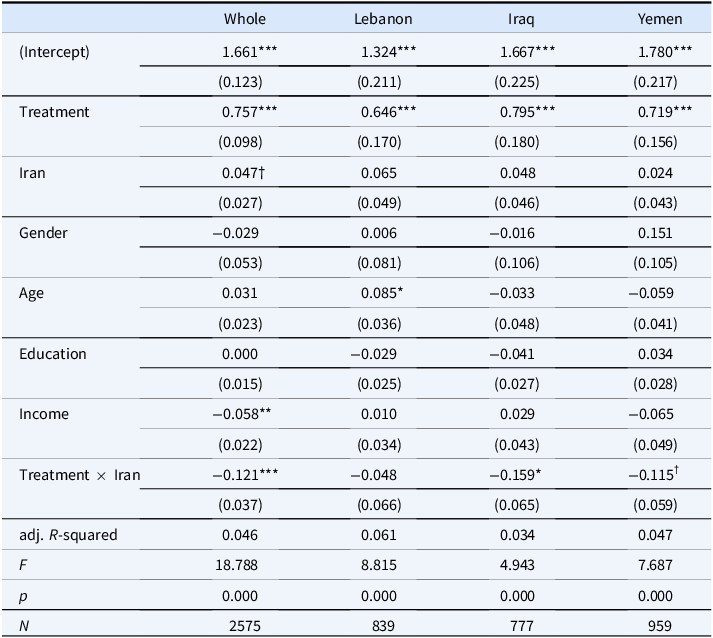
The estimation results for Hypothesis 2 (Iran Hypothesis) are displayed in Table 2. Again, the coefficients for the treatment group were statistically significant in all three countries: 0.646 in Lebanon, 0.795 in Iraq, and 0.719 in Yemen. These values corroborate the list experiment results and attest to their robustness under model specification.
OLS estimation for the Iran hypothesis

Table 2. Long description
The table presents the estimation results for the Iran Hypothesis across different regions, including Whole, Lebanon, Iraq, and Yemen. It consists of 11 rows and 5 columns. The columns are labeled as Whole, Lebanon, Iraq, and Yemen. The rows are labeled as Intercept, Treatment, Iran, Gender, Age, Education, Income, Treatment x Iran, adj. R-squared, F, p, and N. Each cell contains numerical values and standard errors in parentheses. Notable values include significant coefficients for the treatment group in all regions: 0.757 for Whole, 0.646 for Lebanon, 0.795 for Iraq, and 0.719 for Yemen. The table also includes adjusted R-squared values, F-values, p-values, and sample sizes for each region.
Significance: *** = p < 0.001; ** = p < 0.01; * = p < 0.05; † = p < 0.1.
The critical finding lies in the interaction between the treatment group and attitudes toward Iran. In every case, the coefficient was negative. It was statistically significant at the 0.1% level in the pooled dataset, at the 5% level in Iraq, and at the 10% level in Yemen. These results demonstrate that the more favorable one’s perception of Iran, the less likely one is to identify ANSAs as destabilizing actors. In other words, positive attitudes toward Iran are strongly associated with lower levels of criticism toward ANSAs.
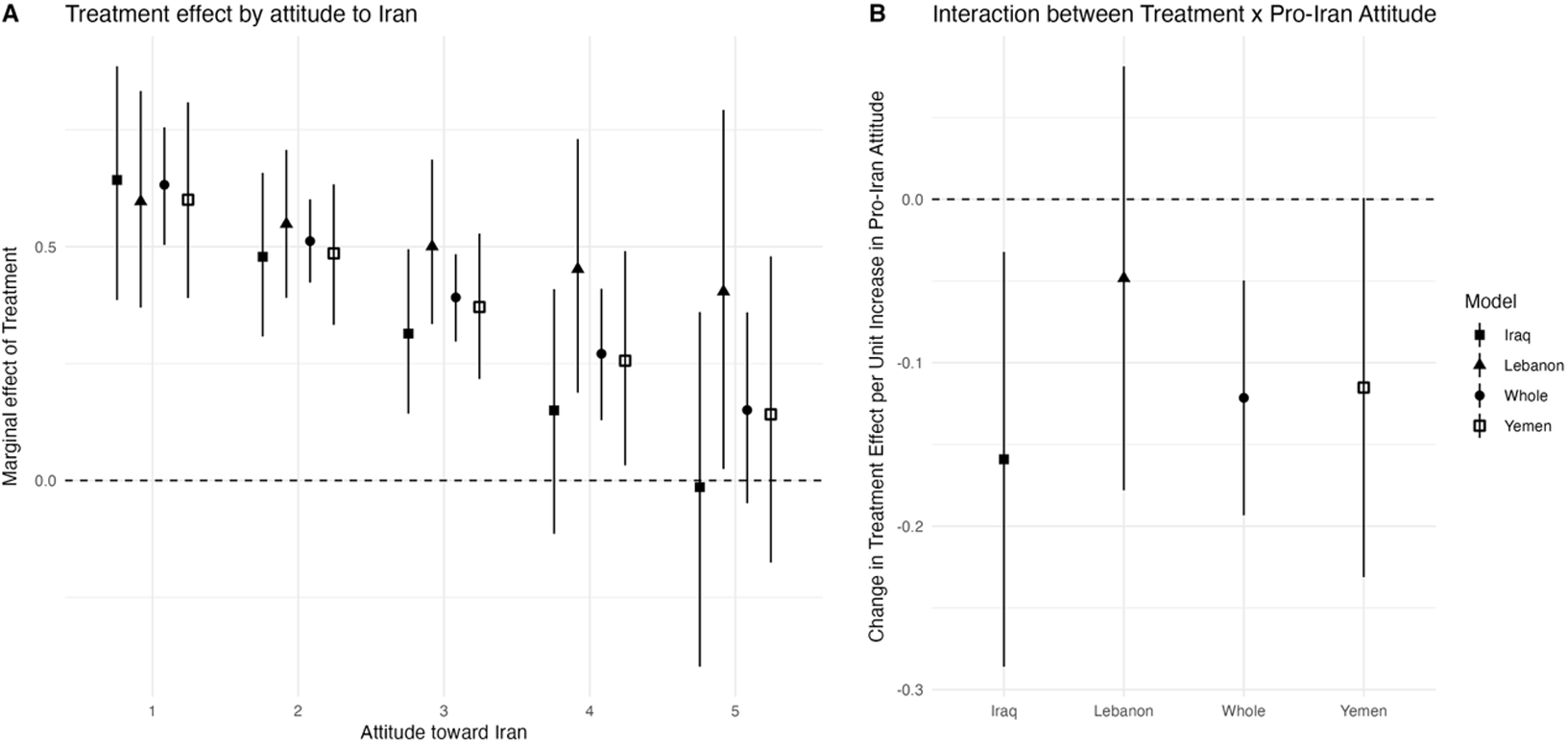
Figure 4 visualizes the conditional treatment effect by attitudes toward Iran. Panel A presents the marginal effect of the treatment across levels of Iran favorability. In the pooled data and in each country sample, the treatment effect decreases as respondents’ favorability toward Iran increases. This pattern is particularly pronounced in Iraq.
Treatment effect by attitude toward Iran.
Note: Panel A displays the estimated marginal treatment effect across levels of self-reported favorability toward Iran (1 = least favorable, 5 = most favorable), with 95% confidence intervals. Panel B displays the coefficient on the Treatment × Iran interaction term, representing the change in the treatment effect associated with a one-unit increase in Iran favorability, with 95% confidence intervals.

Panel B directly plots the coefficient of the interaction term (Treatment × Iran), indicating how the treatment effect changes with a one-unit increase in favorability toward Iran. The interaction term is negative and statistically significant in the pooled sample and in Iraq and Yemen, with Lebanon displaying a similar directional trend. Substantively, this means that respondents who view Iran more favorably are less likely to identify their domestic ANSA as a source of instability when measured indirectly.
These findings are consistent with Hypothesis 2: positive evaluations of Iran are associated with greater support for ANSAs.
To further verify these results, we applied the same weighting procedure used for the sectarian analysis. The weighted results (App Table 3) strongly confirm the findings presented in Table 2: the interaction term (Treatment × Iran) remains statistically significant across all specifications, including the Lebanon sample, which becomes more stable after weighting. If the observed Iran effect were merely a spurious correlation driven by sample composition, weighting would be expected to attenuate or destabilize the coefficients; instead, the interaction becomes even more stable and statistically robust. Models that include detailed sectarian controls (App Table 4) yield substantively similar results, reinforcing the conclusion that attitudes toward Iran exert a conditional effect on support for ANSAs that is independent of granular sectarian identities and not driven by the demographic or sectarian composition of our samples.
Discussion
The limited effect of sectarian differences
The results of the experiments show that simple sectarian divisions alone cannot adequately explain citizens’ attitudes toward ANSAs. Instead, perceptions of external actors—particularly Iran—emerged as a more significant determinant. In other words, rather than sectarian affiliation per se, patterns of patronage within the regional order and political orientations toward external actors appear to shape support for or opposition to ANSAs.
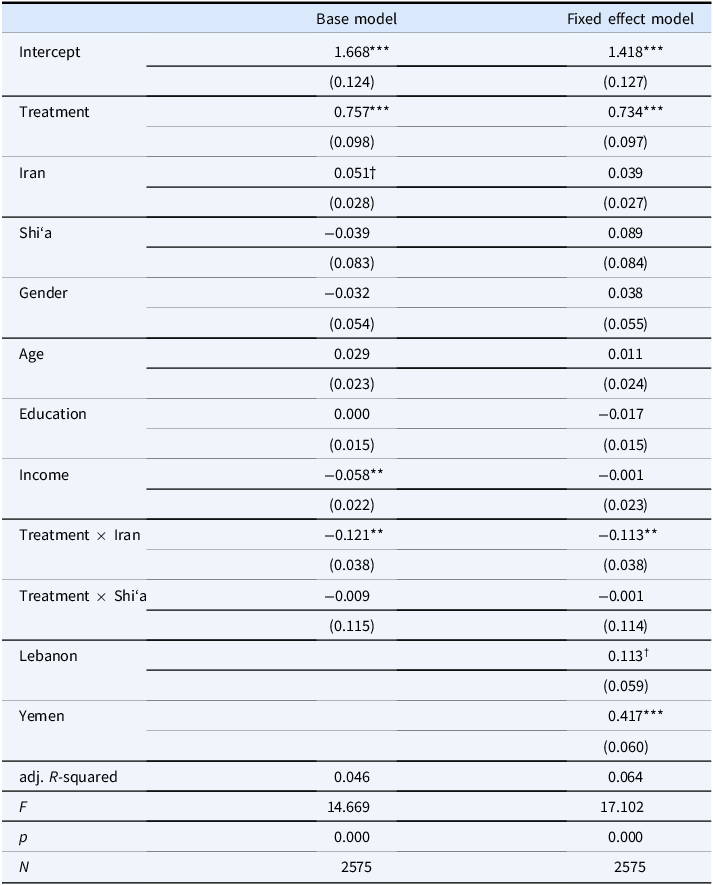
To compare the explanatory power of sectarian affiliation (H1) and attitudes toward Iran (H2) under identical modeling assumptions, we estimated a unified model including both variables and their respective interactions with the treatment indicator (Table 3).
Competing explanations: sectarian identity versus attitudes toward Iran

Table 3. Long description
A table comparing the explanatory power of sectarian affiliation and attitudes toward Iran under identical modeling assumptions. The table has 16 rows and 4 columns. The columns are labeled Intercept, Treatment, Iran, Shi’a, Gender, Age, Education, Income, Treatment x Iran, Treatment x Shi’a, Lebanon, Yemen, adj. R-squared, F, p, and N. The rows are labeled Base model and Fixed effect model. The values in the table are as follows: Intercept: Base model 1.668 (0.124), Fixed effect model 1.418 (0.127); Treatment: Base model 0.757 (0.098), Fixed effect model 0.734 (0.097); Iran: Base model 0.051 (0.028), Fixed effect model 0.039 (0.027); Shi’a: Base model -0.039 (0.083), Fixed effect model 0.089 (0.084); Gender: Base model -0.032 (0.054), Fixed effect model 0.038 (0.055); Age: Base model 0.029 (0.023), Fixed effect model 0.011 (0.024); Education: Base model 0.000 (0.015), Fixed effect model -0.017 (0.015); Income: Base model -0.058 (0.022), Fixed effect model -0.001 (0.023); Treatment x Iran: Base model -0.121 (0.038), Fixed effect model -0.113 (0.038); Treatment x Shi’a: Base model -0.009 (0.115), Fixed effect model -0.001 (0.114); Lebanon: Base model not applicable, Fixed effect model 0.113 (0.059); Yemen: Base model not applicable, Fixed effect model 0.417 (0.060); adj. R-squared: Base model 0.046, Fixed effect model 0.064; F: Base model 14.669, Fixed effect model 17.102; p: Base model 0.000, Fixed effect model 0.000; N: Base model 2575, Fixed effect model 2575.
Significance: ***= p < 0.001; **= p < 0.01; *= p < 0.05; †= p < 0.1.
The pooled baseline model yields three clear findings. First, the treatment coefficient remains strongly positive and statistically significant, confirming substantial endorsement of the sensitive statement. Second, the interaction term between treatment and Iran favorability is negative and statistically significant, indicating that respondents with more favorable views of Iran are less likely to classify ANSAs as destabilizing actors. Third, the interaction term between treatment and the Shi‘a dummy remains statistically insignificant. Importantly, the Iran interaction effect persists even when sectarian affiliation is included in the same model. This suggests that the Iran effect is not merely a proxy for sectarian identity.
We further estimated a model including country fixed effects to account for cross-national variation. The negative and statistically significant interaction between treatment and Iran favorability remains substantively unchanged, while the interaction between treatment and Shi‘a affiliation remains insignificant. This indicates that the conditional Iran effect is not driven by a single country case but is observed consistently across contexts. Post-stratification weighting and sect-controlled specifications yield substantively similar results (App Table 5). Overall, these integrated models demonstrate that geopolitical attitudes toward Iran provide greater explanatory leverage than sectarian identity in accounting for variation in support for ANSAs.
Why, then, was the classical sectarian hypothesis not supported, despite its prominence in earlier scholarship? Two explanations are plausible. First, even within the Shi‘a community, there exists a considerable degree of opposition to ANSAs. Second, a nontrivial number of non-Shi‘a respondents express support for ANSAs. Both factors weaken the explanatory power of sectarian affiliation alone. This interpretation is consistent with observed variation in attitudes toward Iran among both Shi‘a and non-Shi‘a respondents.
Online Appendix Figure A4 presents a boxplot of attitudes toward Iran by sectarian identity. Although Shi‘a respondents generally express more favorable views of Iran than non-Shi‘a, significant variation exists within the Shi‘a population. In Iraq and Yemen, for instance, one-quarter of Shi‘a respondents reported less favorable attitudes toward Iran than the average non-Shi‘a respondent. Conversely, in all three countries, some non-Shi‘a respondents expressed highly favorable views of Iran, selecting “like” or “strongly like.” Even regarding an issue where sectarian differences might be expected to be most salient—attitudes toward Iran—sectarian identity is far from a sufficient predictor.
Sectarian identity thus does not function as an absolute dividing line for political attitudes: being Shi‘a does not automatically translate into support for Hezbollah, the PMU, or the Houthis, and citizens—Shi‘a and non-Shi‘a alike—evaluate these groups based on their actual activities and perceived regional role. The null findings for Hypothesis 1 indicate that sectarian identity is not a fixed, automatic determinant of attitudes toward ANSAs; its salience depends on context and can be overridden by other considerations, above all attitudes toward Iran.
Iran as a sectarian state or a regional power?
This issue is also important when examining perceptions of Iran, as highlighted in Hypothesis 2. While the statistical results confirmed that favorable views of Iran are significantly associated with support for ANSAs, it remains necessary to unpack what such favorability means. It is unlikely that respondents support Iran simply because it is a “Shi‘a state.”
From a regional rather than a purely sectarian perspective, at least two dimensions of favorability toward Iran can be identified. The first is a sectarian dimension, whereby respondents view Iran positively as a co-sectarian power. The second is a regional-political dimension, in which Iran is perceived favorably as a regional power confronting Israel—an interpretation that is particularly relevant given that the survey was conducted during the Gaza war (Bergen et al., Reference Bergen, Rondeaux, Rothenberg and Sterman2022; Milani, Reference Milani2025; Sobelman, Reference Sobelman2025).
Iran as Shi‘a state
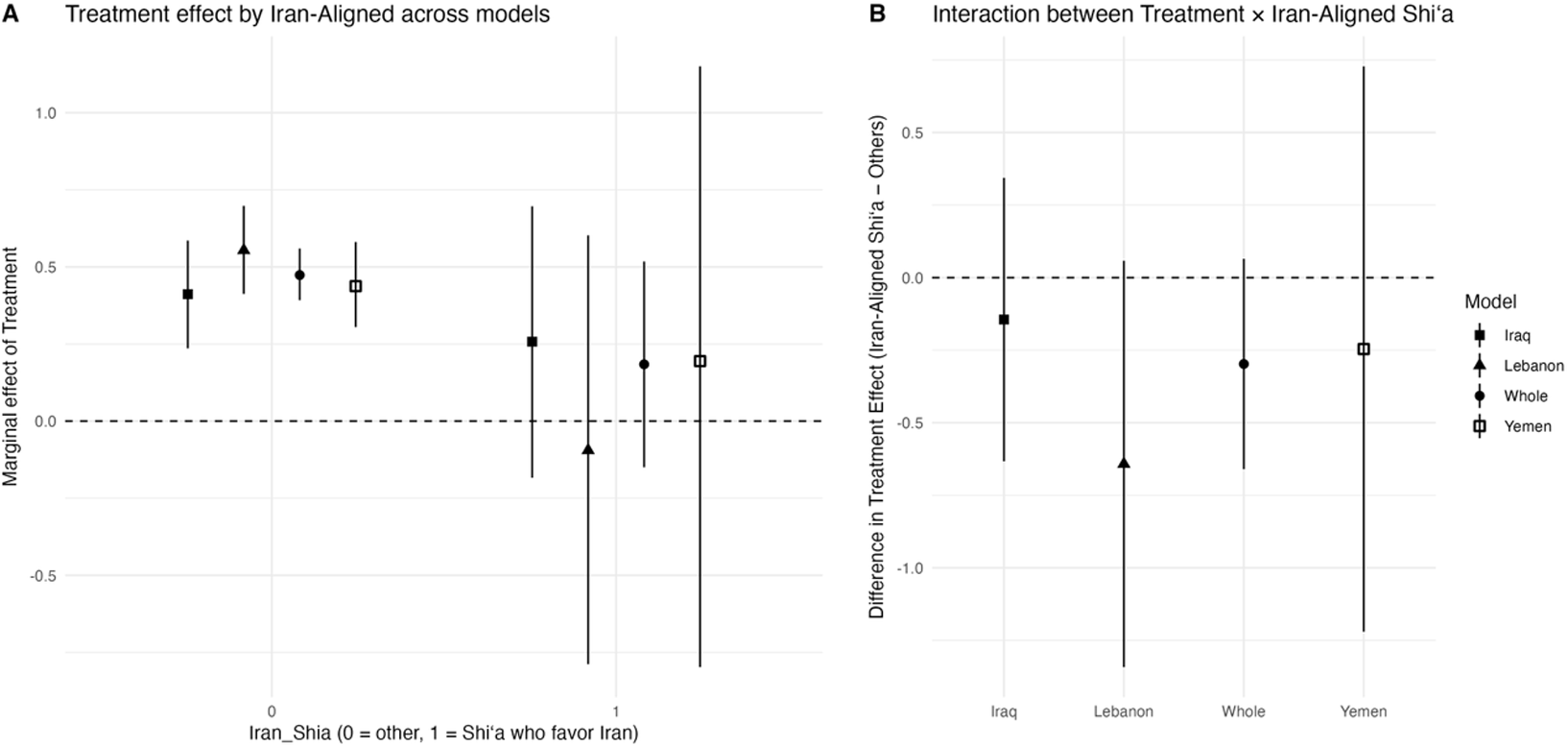
To analyze the sectarian dimension, we created a dummy variable coded as 1 for respondents who both expressed favorable attitudes toward Iran (“like” or “strongly like”) and identified as Shi‘a, and 0 otherwise. We then estimated its interaction with the treatment group using the same model specification (see App Table 6). The marginal effects are plotted in Figure 5.
Treatment effect by Shi‘a favorable toward Iran.
Note: Panel A displays the estimated marginal treatment effect for respondents coded as Iran_Shia = 1 (Shi‘a respondents expressing favorable attitudes toward Iran) versus all others, with 95% confidence intervals. Panel B displays the coefficient on the Treatment × Iran_Shia interaction term, with 95% confidence intervals.

Panel A of Figure 5 presents the marginal treatment effect for respondents classified as Iran_Shia = 1—that is, Shi‘a respondents who express favorable views toward Iran—compared to all others. The estimates suggest that the treatment effect is somewhat attenuated among pro-Iran Shi‘a respondents, although the confidence intervals substantially overlap.
Panel B directly plots the interaction term (Treatment × Iran_Shia). The coefficients are negative in all three countries but reach statistical significance only in Lebanon, at the 10% level. Given the limited sample size, this result should be interpreted with caution: in Lebanon, Shi‘a identity may shape positive views of Iran and thereby influence support for ANSAs, but the small number of observations prevents a firm conclusion, and no significant effect emerges in Iraq or Yemen. Taken together, these findings are consistent with the earlier analysis of Hypothesis 1, where sectarian affiliation alone did not produce robust explanatory power.
Applying post-stratification weights yields a statistically significant interaction in the pooled sample and in Lebanon, while remaining insignificant in Iraq and Yemen (App Table 7). However, once detailed sectarian controls are included, the interaction term loses statistical significance across specifications (App Table 8).
These results indicate that support rooted in “Iran as a Shi‘a state” does not provide a stable or cross-nationally consistent mechanism. If sectarian solidarity were the primary driver, we would expect a systematically strong conditional effect among pro-Iran Shi‘a respondents. Instead, the evidence suggests that Iran favorability cannot be reduced to sectarian proximity alone.
Iran as regional power against Israel
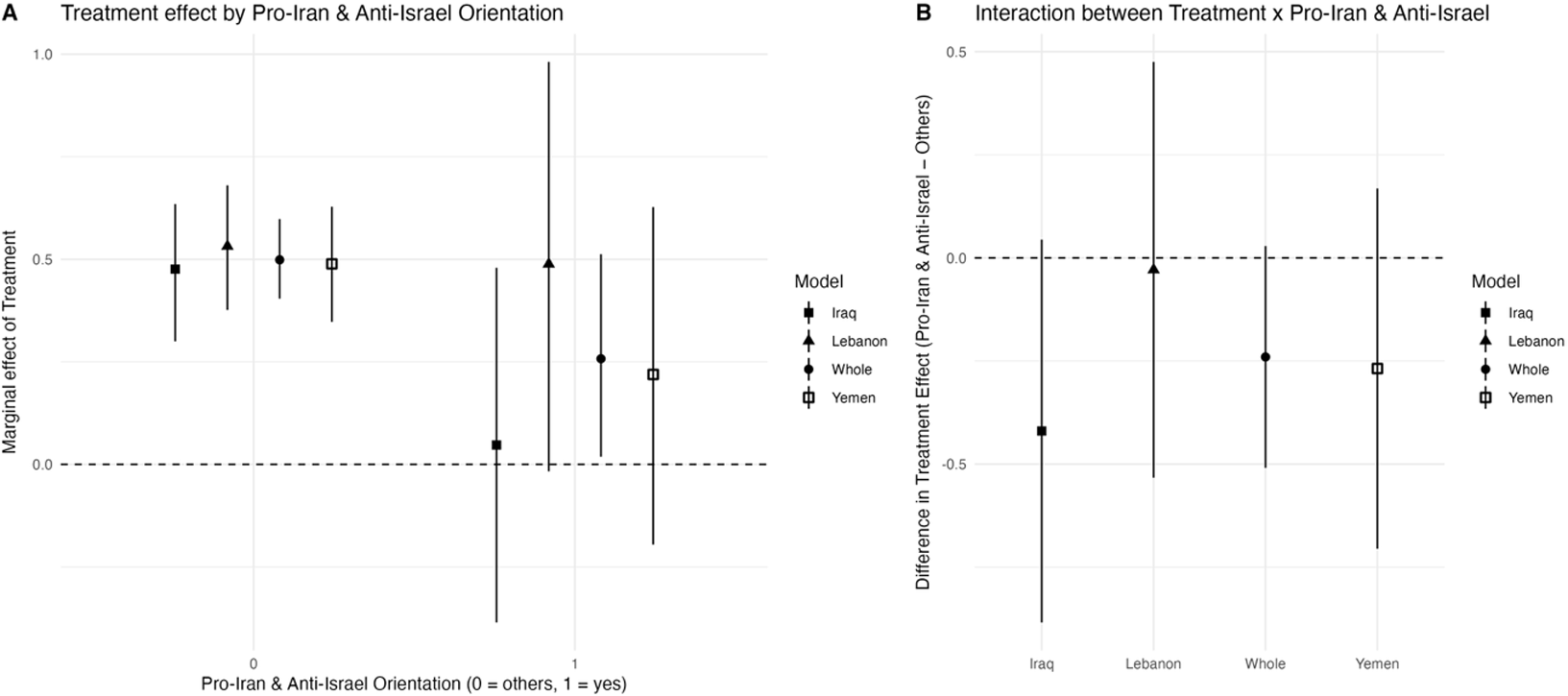
Finally, we turn to the regional-political dimension: favorable perceptions of Iran as a regional power confronting Israel. To test this, we created a dummy variable coded as 1 for respondents who both expressed favorable attitudes toward Iran (“like” or “strongly like”) and unfavorable attitudes toward Israel (“dislike” or “strongly dislike”), and 0 otherwise. We then estimated its interaction with the treatment group (see App Table 9). The marginal effects are plotted in Figure 6. Panel A of Figure 6 presents the marginal treatment effect for respondents who express both favorable attitudes toward Iran and unfavorable attitudes toward Israel. The treatment effect is attenuated among this group, indicating that individuals who view Iran as a counterweight to Israel are less likely to classify ANSAs as sources of instability.
Treatment effect by favorable perception of Iran as a regional power.
Note: Panel A displays the estimated marginal treatment effect for respondents coded as Iran_anti_Israel = 1 (favorable attitudes toward Iran combined with unfavorable attitudes toward Israel) versus all others, with 95% confidence intervals. Panel B displays the coefficient on the Treatment × Iran_anti_Israel interaction term, with 95% confidence intervals; as discussed in the text, this interaction reaches statistical significance at the 10% level in the pooled sample and in Iraq.

Panel B directly plots the interaction term (Treatment × Iran_anti_Israel). While the 95% confidence intervals appear to cross zero, the 90% confidence intervals exclude zero in the pooled sample and in Iraq, indicating statistical significance at the 10% level.
When post-stratification weights are applied, the interaction becomes statistically significant at the 1% level in the pooled sample and at the 5% level in Lebanon, while remaining significant in Iraq (App Table 10). Controlling for sectarian affiliation yields similar results (App Table 11).
These findings suggest that part of the Iran favorability effect is rooted in geopolitical alignment—specifically, perceiving Iran as a regional power confronting Israel. The stability of this effect in weighted models indicates that this mechanism carries greater explanatory weight than sectarian identity alone.
One might ask whether the association between favorable attitudes toward Iran and reduced criticism of ANSAs is tautological, given that these actors are widely labeled “Iranian proxies” in media and policy discourse. Two considerations weigh against this interpretation. First, the two constructs are conceptually and empirically distinct: the Iran item evaluates a foreign state in general terms, whereas the outcome measure captures indirect, list-experiment-based assessments of a specific domestic actor.Footnote 4 Second, we tested whether the pattern reflects a narrow, Iran-specific mechanism or, alternatively, a more diffuse disposition—such as general sympathy for political Islamism—that would mechanically produce a similar correlation regardless of its object.
We estimated additional interaction models using (i) ideological sympathy for Islamism, asked alongside other ideological orientations such as Arab nationalism and (ii) attitudes toward the United States. Islamism sympathy does not interact significantly with the treatment in any country or in the pooled sample (App Table 12), indicating that the effect is not a by-product of generic ideological sympathy. Attitudes toward the United States do interact significantly with the treatment, most strongly in Lebanon (App Table 13), which is consistent with rather than damaging to the Iran Hypothesis.Footnote 5 Taken together, not all valenced political attitudes predict criticism of ANSAs—only those tied to the specific geopolitical axis implicated in Hypothesis 2 do so, a selectivity difficult to reconcile with a purely tautological account.
Conclusion
In summary, this study has demonstrated that citizens’ support for ANSAs in Lebanon, Iraq, and Yemen cannot be explained solely by sectarian affiliation. The classical sectarianism thesis—which assumes that Shi‘a are inherently more supportive of ANSAs—was not supported. Rather, attitudes toward Iran proved to be the more consistent and significant determinant of support.
Our findings suggest that the explanatory power of sectarian identity is limited, both because many Shi‘a respondents expressed opposition to ANSAs and because some non-Shi‘a respondents expressed support for them. By contrast, favorable views of Iran—particularly when tied to its role as a regional power confronting Israel—emerged as a crucial factor shaping citizens’ perceptions of ANSAs, although the statistical significance is modest and varies across countries.
Theoretically, these results underscore the need to move beyond static assumptions of sectarian identity. Sectarianism, while still relevant in certain institutional contexts, does not operate as an automatic determinant of political attitudes. Instead, citizens’ support for ANSAs is better understood as contingent upon broader political and regional dynamics, including perceptions of patronage, foreign policy orientations, and the regional balance of power.
At the same time, the study faces limitations. The reliance on online surveys in conflict-affected societies introduces demographic biases, particularly regarding gender and age. Moreover, attitudes measured during wartime may be influenced by temporary pressures. Future research should therefore adopt complementary methodologies—including offline surveys, qualitative interviews, and longitudinal designs—to capture more accurately the shifting interaction between sectarian, political, and regional factors over time.
Overall, the findings call for a theoretical shift away from sectarianism-centered explanations toward frameworks that integrate regional patronage politics, geopolitical alignments, and public opinion dynamics. While sectarian identity remains relevant in certain institutionalized contexts, our results demonstrate that citizens’ support for ANSAs is more decisively shaped by their perceptions of external actors, particularly Iran. Recognizing this complexity not only refines our understanding of legitimacy and political mobilization in the Middle East but also provides a comparative perspective for analyzing ANSAs in other conflict-prone regions.
Supplementary material
The supplementary material for this article can be found at https://doi.org/10.1017/S1755048326100492.
Acknowledgments
This work was supported by JSPS KAKENHI under Grant Numbers JP23H00043 and JP22KK0018.
Replication data
Replication data and code are deposited in Harvard Dataverse: https://doi.org/10.7910/DVN/FWG8IA.
Kota Suechika is a Professor at the College of International Relations, Ritsumeikan University, Kyoto, Japan. He can be reached at suechika@ir.ritsumei.ac.jp.
Dai Yamao is a Professor at the School of Social and Cultural Studies, Kyushu University, Fukuoka, Japan. He can be reached at daiyamao@scs.kyushu-u.ac.jp.



 Open access

