Antisocial behaviors (ASB) consist of behaviors and attitudes that violate societal norms, including both aggressive (e.g., physical fighting and assault with a weapon) and nonaggressive rule breaking (e.g., theft, property destruction, and truancy) dimensions (Burt, Reference Burt2009; Frick et al., Reference Frick, Lahey, Loeber, Tannenbaum, Van Horn, Christ and Hanson1993; Loeber & Schmaling, Reference Loeber and Schmaling1985). Although ASB are relatively common during adolescence (Moffitt, Reference Moffitt1993), they are highly impairing as adolescents engaged in ASB are at increased risk for academic failure (Farrington, Reference Farrington1995), developing psychopathology (Castellani et al., Reference Castellani, Pastorelli, Eisenberg, Gerbino, Di Giunta, Ceravolo and Milioni2014), and are more likely to engage in criminal activity in adulthood (Mercer, Keijers, Crocetti, Branje, & Meeus, Reference Mercer, Keijsers, Crocetti, Branje and Meeus2016). Furthermore, ASB are a tremendous cost to society, including the increased economic burden they convey on our health care system, schools and communities, and the juvenile justice system (Foster & Jones, Reference Foster and Jones2005). The indirect costs of juvenile incarceration alone have been estimated to be between $8 and $21 billion annually at state and local government levels (Justice Policy Institute, 2014). Given the pervasive and substantial impact of ASB, a better understanding of the multitude of developmental pathways that contribute to ASB are paramount.
Adolescent to Adult Pathways of ASB
Adolescence is marked by drastic changes in social, psychological, and brain development (Casey, Jones, & Hare, Reference Casey, Jones and Hare2008). In contrast to their childhood years, adolescents are more peer directed in their social interactions and simultaneously seek greater separation from their caregivers, leading to increased risky behaviors and a higher likelihood of engagement in ASB (Kelley, Schochet, & Landry, Reference Kelley, Schochet and Landry2004). Not all adolescents engage in ASB, and most adolescents who do tend to desist as they age into adulthood (Moffitt, Reference Moffitt1993, Reference Moffitt2001) given that prefrontal and subcortical regions of the brain (which pertain to executive control and emotion reactivity) become more fully developed by adulthood (Casey et al., Reference Casey, Jones and Hare2008). However, a small subset of youth also persist in their ASB well into adulthood (Moffit, Reference Moffitt1993, Reference Moffitt2001). Sampson and Laub (Reference Sampson and Laub2003) examined the rates of criminal offending (i.e., violent crime, property offenses, and alcohol/drug crimes) in a sample of 500 delinquent males who were followed from childhood (youngest was age 7) to late adulthood (oldest was age 70) and found evidence of two distinct pathways where peak criminal offending was exhibited during the mid-30s. Massoglia (Reference Massoglia2006) used latent class models to characterize the structure of ASB during adolescence (ages 11–17) and examined whether individuals transition out of ASB by adulthood (ages 21–27) using data from the National Survey of Youth. Four distinct adolescent ASB classes emerged from the analysis: normative, predatory (i.e., aggressive and violent), drug use, and pervasive (i.e., chronic offenders), and a significant proportion of adolescents who engaged in predatory, drug use, or pervasive ASB transitioned between these classes as they aged into adulthood, rather than having completely desisted in their ASB. Several studies have similarly identified unique groups of individuals who peak in ASB during adolescence but persist in modest levels of ASB well into their mid-20s (DiLalla & Gottesman, Reference DiLalla and Gottesman1989; Moffitt, Reference Moffitt, Lahey, Moffitt and Caspi2003; Nagin & Tremblay, Reference Nagin and Tremblay2005; Odgers et al., Reference Odgers, Moffitt, Broadbent, Dickson, Hancox, Harrington and Caspi2008), including studies using data from the National Longitudinal Study of Adolescent to Adult Health (Add Health; Barnes, Beaver, & Boutwell, Reference Barnes, Beaver and Boutwell2011; Tung & Lee, Reference Tung and Lee2016; Zheng & Cleveland, Reference Zheng and Cleveland2015). Taken together, these studies suggest that there are likely to be unique pathways of ASB from adolescence into adulthood. It has been postulated that individual differences in biological and environmental antecedents may be associated with distinct developmental pathways of ASB (Burt, Reference Burt2009; Farrington, Reference Farrington1987; Ingoldsby & Shaw, Reference Ingoldsby and Shaw2002; Taylor, Iacono, & McGue, Reference Taylor, Iacono and McGue2000).
Genetic Predispositions for ASB
Behavioral genetic studies suggest that the developmental trajectories of ASB differ in their heritability. For example, based on a twin subsample (N = 2,284 twin pairs) from the Add Health, genetic influences accounted for 56% to 70% of the variance within the “life-course persistent offender” pathway (i.e., individuals who positively endorsed delinquency items across all three waves of the Add Health study) and 35% of the variance in the “adolescence-limited offender” pathway (i.e., individuals who positively endorsed delinquency items at Wave 3, but not at Waves 1 or 2; Barnes et al., Reference Barnes, Beaver and Boutwell2011). More recently, Zheng and Cleveland (Reference Zheng and Cleveland2015) used latent class growth analysis to characterize homogenous pathways of ASB within a twin sample, also from Add Health (N = 356 twin pairs) and found that additive genetic influences had a more significant influence for males in the “chronic” class than “desister” or “decliner” classes of ASB. Nonshared environmental factors were significantly more relevant for desisters and decliners than either shared environmental or genetic factors (Zheng & Cleveland, Reference Zheng and Cleveland2015). These studies suggest that genetic influences may play a more important role for certain (i.e., chronic or persistent) developmental pathways of ASB, although the precise genetic architecture underlying these pathways has yet to be conclusively determined.
Although identifying the genes for ASB remains an ongoing effort, genes regulating dopamine and serotonin transmission have been a central focus because of the prominent role they play in human and animal aggression (see recent reviews by Ficks & Waldman, Reference Ficks and Waldman2014; and Veroude et al., Reference Veroude, Zhang-James, Fernàndez-Castillo, Bakker, Cormand and Faraone2016). The dopamine system is principally involved in behavioral activation and reward processing (Everitt & Robbins, Reference Everitt and Robbins2000). This system has long been implicated in modulating several ASB-related traits such as impulsivity and physical aggression in mice (Tidey & Miczek, Reference Tidey and Miczek1996) and in humans (Buckholtz et al., Reference Buckholtz, Treadway, Cowan, Woodward, Li, Ansari and Kessler2010; Schlüter et al., Reference Schlüter, Winz, Henkel, Prinz, Rademacher, Schmaljohann and Mottaghy2013). Genetic variation in polymorphisms relevant to dopamine transmission have been linked to various subtypes of ASB as well (Burt & Mikolajewski, Reference Burt and Mikolajewski2008; Windhorst et al., Reference Windhorst, Mileva-Seitz, Rippe, Tiemeier, Jaddoe, Verhulst and Bakermans-Kranenburg2016). Separate studies have also reported on the association of the serotonin system, which is involved in emotion regulation and inhibition, and ASB-related phenotypes in humans (Davidson, Putnam, & Larson, Reference Davidson, Putnam and Larson2000; Moore, Scarpa, & Raine, Reference Moore, Scarpa and Raine2002) and in animal models (e.g., Gibbons, Barr, Bridger, & Liebowitz, Reference Gibbons, Barr, Bridger and Liebowitz1979; Holmes, Murphy, & Crawley, Reference Holmes, Murphy and Crawley2002). Genetic influences on serotonergic systems have also been implicated in human ASB (Haberstick, Smolen, & Hewitt, Reference Haberstick, Smolen and Hewitt2006).
However, most studies have studied dopamine and serotonin as separate systems in relation to ASB, despite increasing evidence that they are interconnected (D'Souza & Craig, Reference D'Souza and Craig2008; Seo, Patrick, & Kennealy, Reference Seo, Patrick and Kennealy2008). For example, immediately following a threat, mice were found to have increased prefrontal dopaminergic activity and a corresponding decrease in serotonergic functioning (Van Erp & Miczek, Reference Van Erp and Miczek2000). Human studies have similarly shown that high levels of dopamine activity corresponded with lower levels of serotonin activity in association with human aggression and psychopathic traits (Soderstrom, Blennow, Manhem, & Forsman, Reference Soderstrom, Blennow, Manhem and Forsman2001). These studies suggest that genetic variation in these systems should be considered from a multigenic perspective, such that dopaminergic and serotonergic gene variants may collectively account for a greater portion of the phenotypic variance than they would independently (Plomin, Haworth, & Davis, Reference Plomin, Haworth and Davis2009). Few studies have examined the multigenic influence of dopamine and serotonin genes on ASB. Hence, the current study focuses on polymorphisms across six well-characterized dopaminergic and serotonergic genes (i.e., dopamine active transporter 1 [DAT1], dopamine receptor D4 [DRD4], dopamine receptor D2 [DRD2], catechol-O-methyltransferase [COMT], monoamine oxidase A [MAOA], and serotonin transporter linked polymorphic regon [5-HTTLPR]) in relation to ASB.
Methods to quantify multigenic influences from known biological systems have been unsatisfactory, however. One common approach is to sum the number of putative risk alleles across several polymorphisms, such that total scores represent an individual's cumulative genetic risk or susceptibility to an outcome (e.g., Beaver & Belsky, Reference Beaver and Belsky2012; Belsky & Beaver, Reference Belsky and Beaver2011; Nikolova, Ferrell, Manuck, & Hariri, Reference Nikolova, Ferrell, Manuck and Hariri2011; Stice, Yokum, Burger, Epstein, & Smolen, Reference Stice, Yokum, Burger, Epstein and Smolen2012; Thibodeau, Cicchetti, & Rogosch, Reference Thibodeau, Cicchetti and Rogosch2015). This method is used in studies where the genetic variants are selected based on prior knowledge of their biological function, rather than through an empirical investigation of the most highly associated genetic variants across the genome (Derringer et al., Reference Derringer, Krueger, Dick, Saccone, Grucza, Agrawal and Nurnberger2010; Marceau et al., Reference Marceau, Palmer, Neiderhiser, Smith, McGeary and Knopik2016; Stice et al., Reference Stice, Yokum, Burger, Epstein and Smolen2012). The primary advantages of this approach are that it reduces the burden of multiple testing and consequently improves power (Windhorst et al., Reference Windhorst, Mileva-Seitz, Rippe, Tiemeier, Jaddoe, Verhulst and Bakermans-Kranenburg2016). However, this approach may not be biologically plausible; first, the effect of each risk allele on the outcome cannot be assumed to be equivalent at each locus, given that genome-wide association studies (GWAS) of ASB have demonstrated that some loci confer larger effects on ASB than others (Pappa et al., Reference Pappa, St. Pourcain, Benke, Cavadino, Hakulinen, Nivard and Evans2016; Salvatore & Dick, Reference Salvatore and Dick2016; Tielbeek et al., Reference Tielbeek, Medland, Benyamin, Byrne, Heath, Madden and Verweij2012). Second, assumptions regarding the risk variant at each locus need to be made to compute this score, which will not likely account for the possibility of inverse or reciprocal effects of dopamine and serotonergic genes (Seo et al., Reference Seo, Patrick and Kennealy2008). Third, findings have been mixed with regard to whether genetic risk scores computed in this way are predictive of ASB and ASB-related traits (Gizer & Waldman, Reference Gizer and Waldman2012; Thibodeau et al., Reference Thibodeau, Cicchetti and Rogosch2015).
An alternative strategy is to derive robust prediction estimates for each locus so that the genetic risk score also reflects the relative effects of each locus on the outcome. Obtaining prediction estimates for each locus usually requires a comparable but independent data set (i.e., a testing set) so that the model is not overfitted to the data (i.e., the extent to which a model for one data set might not be generalizable to a different data set). Alternatively, one can split the data in half, such that one half of the data would be used as the training set and the other half would be used as the validation set to avoid issues with overfitting. However, this approach has the significant disadvantage of reducing the sample size of the resultant models by half, a sacrifice that genetically informed studies can ill afford. Furthermore, the results would depend entirely on the random sets that were used for the training and validation sample, which may lead to unstable estimates if the process were repeated. A variation of this approach that does not require an independent data set per se is a technique called k-fold cross-validation (Kohavi, Reference Kohavi1995). In this approach, a single data set is partitioned k number of times to create k unique and equally sized validation samples. The remaining k – 1 partitions are used to measure or validate how well the model performs in terms of its predictive ability. To attain stability of the model, this process is repeated k times (i.e., folds) on the different partitions, and the prediction estimates are then averaged over each fold (Cordell, Reference Cordell2009). This method has been previously used in polygenic risk score predictions for cardiovascular disease and adult psychopathology (e.g., International Schizophrenia Consortium, 2009; Simonson, Wills, Keller, & McQueen, Reference Simonson, Wills, Keller and McQueen2011). To address the conceptual limitations of a total risk alleles approach, the current study used k-fold cross-validation to derive robust prediction estimates for ASB from multiple dopaminergic and serotonergic gene variants, which were then be used to derive weighted multigenic risk scores (MRS).
Gene × Environment (G × E) Interaction Supportive Parenting and School Connectedness
The expression of ASB may depend not only on an individual's underlying genetic susceptibility for ASB but also on whether the individual is exposed to certain types of environments (G × E; Caspi et al., Reference Caspi, McClay, Moffitt, Mill, Martin, Craig and Poulton2002; Jaffee et al., Reference Jaffee, Caspi, Moffitt, Dodge, Rutter, Taylor and Tully2005). Home environments characterized by high instability and low parental involvement and warmth are well-established risk factors for ASB (Catalano & Hawkins, Reference Catalano, Hawkins and Hawkins1996; Doyle & Markiewicz, Reference Doyle and Markiewicz2005), and many G × E studies of ASB have focused on the moderating role of family-related adversity. Meta-analyses suggest that polymorphic variation in dopaminergic and serotonergic genes increase risk for ASB in the presence, but not necessarily in the absence, of severe family adversity (e.g., maltreatment; Byrd & Manuck, Reference Byrd and Manuck2014; Kim-Cohen et al., Reference Kim-Cohen, Caspi, Taylor, Williams, Newcombe, Craig and Moffitt2006; Tielbeek et al., Reference Tielbeek, Karlsson Linnér, Beers, Posthuma, Popma and Polderman2016). However, a myopic focus on the extreme (i.e., negative) end of the environment spectrum betrays the significant amount of variation that exists within an individual's environment, including his or her exposure to more supportive influences from family. Emerging evidence suggests higher frequency warm and supportive maternal behavior at age 12 leads to promotive changes in the amygdala and prefrontal cortex in the offspring 4 years later, suggesting that positive parenting may impact brain development even during the period of adolescence (Whittle et al., Reference Whittle, Simmons, Dennison, Vijayakumar, Schwartz, Yap and Allen2014).
One promising theory posits that genetic influences may confer heightened sensitivity to both adverse and enriched environments, a phenomenon known as differential susceptibility (Belsky & Pluess, Reference Belsky and Pluess2009). Although tests of differential susceptibility are still emerging, there is promising evidence from studies employing rigorous, developmentally sensitive methods to study these effects in the context of parenting (Bakermans-Kranenburg & van IJzendoorn, Reference Bakermans-Kranenburg and van Ijzendoorn2011). For instance, Tung and Lee (Reference Tung and Lee2016) found that perceived parental support (i.e., closeness and warmth) moderated the association between adolescent 5-HTTLPR genotype and their trajectories of ASB measured into early adulthood (mid-20s). Specifically, individuals with the long–long (LL) genotype were least likely to be in the “adolescent peak” ASB trajectory class if they reported high-quality parental support, but were the most likely to be in this trajectory of ASB if they reported low-quality parental support compared to individuals who carried at least one short allele (Tung & Lee, Reference Tung and Lee2016). Belsky and Beaver (Reference Belsky and Beaver2011) found that adolescent youths carrying a greater number of sensitivity alleles (using a simple composite of alleles) in DAT1, DRD2, DRD4, MAOA, and 5-HTTLPR had simultaneously higher and lower scores on self-regulation (e.g., impulsivity) when they self-reported low- and high-quality supportive parenting, respectively. Thus, genes may potentially contribute to an individual's sensitivity to variations in the family environment, leading to developmental outcomes that are “for better and for worse” (Belsky & Pluess, Reference Belsky and Pluess2009).
However, meta-analytic evidence also show that familial influences tend to decrease while nonfamilial influences increase with age as it relates to the development of ASB (Ferguson, Reference Ferguson2010; Rhee & Waldman, Reference Rhee and Waldman2002), suggesting that nonfamilial factors may also play a significant role in moderating genetic susceptibility to ASB during the period of adolescence and early adulthood. The school environment represents a potentially important ecological context that may plausibly interact with genetic factors underlying adolescent to adult trajectories of ASB. The extent to which adolescents felt accepted and supported by others in their school environment predicted lower levels of delinquency and alcohol use relative to those who did not feel as connected with their school environment (Crosnoe, Erickson, & Dornbusch, Reference Crosnoe, Erickson and Dornbusch2002). Several studies have also found that adolescents who felt disengaged from their schools or had poor relationships with their teachers were more likely to engage in delinquency during adolescence and had more substance use and mental health problems in their later years (Bond et al., Reference Bond, Butler, Thomas, Carlin, Glover, Bowes and Patton2007; Jacobson & Rowe, Reference Jacobson and Rowe1999; Resnick et al., Reference Resnick, Bearman, Blum, Bauman, Harris, Jones and Ireland1997; Schochet, Dadds, Ham, & Montague, 2006). Research from affective neuroscience suggests that social connectedness more broadly may impact patterns of brain development. For instance, social isolation (i.e., feeling disconnected or rejected) predicted greater activity in the anterior cingulate cortex among adolescents, a region of the brain that is involved in emotion regulation (Masten et al., Reference Masten, Eisenberger, Borofsky, Pfeifer, McNealy, Mazziotta and Dapretto2009). In a study of adults, individuals who reported being more socially connected with others at baseline had increases in vagal tone over time, an index of autonomic flexibility that is linked to well-being (Kok & Fredrickson, Reference Kok and Fredrickson2010). Social connectedness (and specifically, school connectedness) may also impact gene expression. Twin studies have shown that monozygotic twins may have different perceptions of their school experience (such as involvement in class, relationship with staff and teachers, and peer-related stressors), leading to individual differences in their behavior and academic achievement (Asbury, Almeida, Hibel, Harlaar, & Plomin, Reference Asbury, Almeida, Hibel, Harlaar and Plomin2008; Walker & Plomin, Reference Walker and Plomin2006). Finally, animal models have demonstrated the promotive effects of environmental enrichment more broadly (i.e., a combination of social relationships, cognitive, sensory, and physical resources) on behavioral and neuronal development, even after early exposure to stress (Hackman, Farah, & Meaney, Reference Hackman, Farah and Meaney2010). Despite its biological plausibility, studies of G × E have largely ignored the role that the school environment may play in the development of ASB.
It is also noteworthy that previous G × E studies focusing on nonfamilial environmental influences on ASB have largely examined the role of deviant peers (Cleveland, Wiebe, & Rowe, Reference Cleveland, Wiebe and Rowe2005; Kendler et al., Reference Kendler, Jacobson, Gardner, Gillespie, Aggen and Prescott2007; Lee, Reference Lee2011). Few studies have investigated the potential moderating role of the school environment independent from deviant peer effects. This is a crucial gap in the literature because adolescents are also exposed to varying degrees of structure and support from their teachers, safety from staff and administrators, and access to school-based programs and activities that may buffer the individual from negative peer or familial influences as they relate to the development of ASB (Bond et al., Reference Bond, Butler, Thomas, Carlin, Glover, Bowes and Patton2007; Mrug & Windle, Reference Mrug and Windle2009). One exception is the study by Crosnoe et al. (Reference Crosnoe, Erickson and Dornbusch2002), which showed that high levels of school connectedness attenuated the negative effects of deviant peer affiliation on adolescent ASB, suggesting that support from teachers and other positive characteristics of the school may buffer the negative effects of deviant peers on ASB. Hence, the degree to which adolescents feel supported, accepted, and connected to their schools, independent from the influence of their peers, may serve as not only a potential risk factor for future negative outcomes but also a source of support and enrichment that leads to positive behavioral adjustment, making this a strong candidate for assessing differential susceptibility.
In addition, some studies have shown that adolescents with a genetic propensity to be antisocial may select (or attract) peers who are also antisocial (Kendler, Jacobson, Myers, & Eaves, Reference Kendler, Jacobson, Myers and Eaves2008), which is known as a gene–environment correlation (rGE). Hence, there is some possibility that G × E studies focusing on peer closeness (or any other plausible environmental exposure) may have been driven by an rGE effect rather than a true G × E (Jaffee & Price, Reference Jaffee and Price2007). As relatively few G × E studies have systematically tested for concurrent rGE effects (Knafo & Jaffee, Reference Knafo and Jaffee2013), the possibility that environmental influences, including school connectedness and supportive parenting, and ASB may be partially explained by an individual's genetic constitution is also an important inquiry in studies of G × E.
Current Study
The current study uses a rigorous developmental psychopathology approach to examine the interplay between multigenic and multi-environmental influences on the pathways of ASB. The aims and hypotheses of the study were as follows:
-
1. To examine pathways of ASB from adolescence to adulthood. Using data from a large, nationally representative prospective sample of adolescents (i.e., Add Health, Waves 1–4) who have been followed into their early 30s, it is hypothesized that later onset developmental pathways of ASB will be identified in line with previous studies that have similarly examined ASB into the later years of adulthood.
-
2. To assess the relative influence of each dopamine and serotonin gene variant (i.e., DAT1, DRD4, DRD2, MAOA, COMT, and 5-HTTLPR) on ASB and compute weighted MRS on the basis of each polymorphism's relative contribution to ASB. A multigenic approach is hypothesized to more reliably predict the developmental pathways of ASB than each single polymorphism would alone, and possibly provide a stronger signal to detect G × E.
-
3. To test developmental G × E effects from the differential susceptibility perspective, whereby positive and negative dimensions of the adolescents’ family and school environment were examined as potential moderators of genetic susceptibility in relation to the developmental pathways of ASB. Given the increased importance of nonfamilial influences on behavioral outcomes during adolescence (Ferguson, Reference Ferguson2010; Rhee & Waldman, Reference Rhee and Waldman2002), it is hypothesized that variation in how connected an adolescent feels in his/her school will moderate the association between genetic susceptibility for ASB and developmental pathways of ASB, such that individuals with greater genetic susceptibility for ASB will be more likely to engage in ASB under conditions of low school connectedness, but the same individuals will also be protected from ASB under conditions of high school connectedness.
Method
Participants
Add Health began in 1994 and ascertained a stratified random sample of adolescents in Grades 7–12 from high schools across the United States. Data were collected from adolescents, parents, fellow students, school administrators, siblings, friends, and romantic partners across four waves of data collection: Wave 1 (1994–1995, Grades 7–12, N = 20,745), Wave 2 (1995–1996, Grades 8–12, N = 14,738), Wave 3 (2001–2002, ages 18–26, N = 15,197), and Wave 4 (2007–2008, ages 24–32, N = 15,701). Data collection for Wave 5 is currently ongoing. At Wave 1, the average age was 15.22 (SD = 1.65, range = 12–20), the racial/ethnic composition was 62.1% Caucasian (including Hispanic or Latino), 23.0% Black or African American, 7.1% Asian or Pacific Islander, 1.2% Native American, and 6.6% other, and 49.5% were males. Due to the nonrandom association of genotypes and race/ethnicityFootnote 1 (i.e., population stratification; Hutchison, Stallings, McGeary, & Bryan, Reference Hutchison, Stallings, McGeary and Bryan2004), analyses for the current study were performed for the Caucasian subsample of individuals in which genetic data were available, resulting in a sample of 8,834 with full genotypic and phenotypic information germane to the current investigation (individuals with mixed ancestry were excluded from the sample). Genotypes in the current study were nonrandomly associated with race/ethnicity. Full details of the study design and available measures can be obtained at http://www.cpc.unc.edu/projects/addhealth/design.
Measures
ASB
ASB was assessed during in-home interviews (“delinquency scale” and “fighting and violence”) conducted at Waves 1–4. Ten identical (or highly similar) items were assessed at each wave, reflecting the presence of nonaggressive rule-breaking behaviors (e.g., property damage, stealing, and selling drugs) and aggressive behaviors (e.g., pulling a knife or gun on someone and engaging in a fight). Items were summed to create a composite score (range = 0–10) at each wave.Footnote 2 The scale demonstrated good to adequate internal consistency across waves (Cronbach αs = 0.75, 0.75, 0.61, and 0.65 for Waves 1, 2, 3, and 4, respectively).
Supportive parenting
Supportive parenting was assessed during Wave 1 using 12 items from the “protective factors,” “relations with parents,” and the “personality and family” in-home interviews. The items assessed maternal warmth (e.g., “Your mother is warm and loving toward you”), care (e.g., “How much do you feel that your parents care about you?”), closeness (e.g., “How close do you feel to your mother?”), communication quality (e.g., “You are satisfied with the way your mother and you communicate with each other”), understanding (e.g., “How much do you feel that people in your family understand you?”), and the overall quality of the parental relationship (e.g., “Overall, you are satisfied with your relationship with you mother”). This construct has been used by several previous Add Health studies, demonstrating good internal consistency (Cronbach α = 0.83) and predictive validity (Borowsky, Ireland, & Resnik, Reference Borowsky, Ireland and Resnick2001; Li, Berk, & Lee, Reference Li, Berk and Lee2013; Resnick et al., Reference Resnick, Bearman, Blum, Bauman, Harris, Jones and Ireland1997). All 12 items were rated on a 5-point scale, where 0 = not at all and 4 = very much. Scores for each item were summed, and the resultant score was then standardized.
School connectedness
Six items from Wave 1 assessed the degree to which participants felt connected to their school. These items came from the “relations with parents” and “academics and education” in-home interviews. The items assessed feelings of belongingness (e.g., “You feel close to people at your school,” “You feel like you are part of your school,” and “You feel close to people at school”), teacher support (e.g., “Your teachers care a lot about you” and “Teachers treat students fairly”), and safety (e.g., “You feel safe in your school”). Given that the focus of the investigation was on the risk/protective role of the broader school context independent from peer effects, items pertaining to peer closeness were not included. All items were rated on a 5-point scale, where 0 = strongly disagree and 4 = strongly agree. Some items were reverse coded to maintain the consistency of the scale so that higher scores represent higher levels of school connectedness. The school connectedness scale has demonstrated good predictive validity in previous Add Health studies (Batanova & Loukas, Reference Batanova and Loukas2014; McNeely, Nonnemaker, & Blum, Reference McNeely, Nonnemaker and Blum2002). The scale also demonstrated adequate internal consistency (Cronbach α = 0.73). Scores for each item were summed, and the resultant score was then standardized.
Covariates
Peer closeness, substance use behaviors, and household income were included as covariates. Peer closeness and substance use behaviors are known to covary with the variables of interest (i.e., supportive parenting, school connectedness, and ASB) and were thus added into the multinomial logistic regression models to avoid the possibility of confounding due to peer and substance use effects. Peer closeness was assessed during the Wave 1 in-home interview. Items came from the “friends and family” section of the interview. Adolescents were asked to nominate at least one male and one female friend and then answer five yes or no questions pertaining to how frequently they saw their friends (e.g., “Did you go to your friend's house during the past 7 days?” and “Did you meet with your friend after school to hang out or go somewhere during the past 7 days?”) and how close they felt to the friends they nominated (e.g., “Did you talk to your friend about a problem during the past 7 days?” and “Did you talk to your friend the past 7 days?”). The final variable was the composite score of the items. Substance use behaviors included cigarette smoking (“Have you ever smoked cigarettes regularly, that is, at least 1 cigarette every day for 30 days?”), heavy alcohol consumption (“Over the past 12 months, on how many days did you drink 5 or more drinks in a row”), and marijuana use (“During the past 30 days, how many times did you use marijuana?”) assessed during in-home interviews conducted at each wave. Each substance use item was dichotomized and summed to create a composite score, which was then averaged across all four waves. Substance use items were dichotomized in the following ways: cigarette smoking (i.e., having smoked one cigarette a day, every day, for past 30 days), heavy alcohol consumption (i.e., at least one instance in which five or more drinks were consumed in a row over the past year), and marijuana use (i.e., at least one instance in which marijuana was consumed in the past 30 days). Household income was coded on an ordinal scale, where 1 = $0–$20,000 and 6 ≥ $100,000.
Genotyping
DNA samples were collected from participant saliva at Wave 4. Full details of the DNA extraction and genotyping procedures are available in Add Health documentation (see Smolen et al., Reference Smolen, Whitsel, Tabor, Killeya-Jones, Cuthbertson, Hussey and Harris2013). The current investigation focused on six dopaminergic and serotonergic genes associated with ASB, including three variable number tandem repeats (VNTRs; DRD4, DAT1, and MAOA) and three single nucleotide polymorphisms (SNPs; rs1800497 [DRD2 TaqIA], rs4680 [val158met COMT], and rs25531 [triallelic 5-HTTLPR]).
All VNTRs were genotyped using primer sequences that were written 5′ to 3′. DRD4 is located on 11p15.5 and contains a 48 base pair (bp) polymorphism in the third exon, resulting in 2–11 repeats (R). The most common variants are those that consist of 2R, 4R, and 7R; larger variants (i.e., 7R) are associated with a reduction in dopamine binding in vitro compared to smaller variants (Van Tol et al., Reference Van Tol, Wu, Guan, Ohara, Bunzow, Civelli and Jovanovic1992). The 7R allele has most frequently been linked to human aggressive behaviors (Buchmann et al., Reference Buchmann, Zohsel, Blomeyer, Hohm, Hohmann, Jennen-Steinmetz and Esser2014; Hohmann et al., Reference Hohmann, Becker, Fellinger, Banaschewski, Schmidt, Esser and Laucht2009; Nobile et al., Reference Nobile, Giorda, Marino, Carlet, Pastore, Vanzin and Battaglia2007). DAT1 (SLC6A3), located on 5p15.3, contains a 40-bp VNTR in the 3′-untranslated region of the gene. The most common variants consist of 9R and 10R, and the 10R variant is associated with increased expression of the dopamine transporter protein (resulting in decreased striatal dopamine levels; VanNess, Owens, & Kilts, Reference VanNess, Owens and Kilts2005) relative to the 9R variant. The 10R allele and has been linked with aggression and ASB in both adolescent and adult samples (Beaver, Wright, & Walsh, Reference Beaver, Wright and Walsh2008; Burt & Mikolajewski, Reference Burt and Mikolajewski2008; Guo, Roettger, & Shih, Reference Guo, Roettger and Shih2007). MAOA is on Xp11.3-11.4 and contains a 30-bp VNTR in the 5′-regulatory region of the gene. Shorter repeats (2R and 3R) are commonly grouped as “low” activity variants and longer repeats (3.5R, 4R, and 5R) are grouped as “high” activity variants (Sabol, Hu, & Hamer, Reference Sabol, Hu and Hamer1998). The low-activity variant is associated with reduced transcription of an enzyme that metabolizes monoamines relative to the high-activity variant and has been linked to increased risk for aggression and ASB (Buckholtz & Meyer-Lindenberg, Reference Buckholtz and Meyer-Lindenberg2008; Ficks & Waldman, Reference Ficks and Waldman2014). The low-activity variant of MAOA is also an important marker of risk for ASB among children exposed to maltreatment (Kim-Cohen et al., Reference Kim-Cohen, Caspi, Taylor, Williams, Newcombe, Craig and Moffitt2006; Widom & Brzustowicz, Reference Widom and Brzustowicz2006).
DRD2 is located on 11q2.2–2.3 and contains the TaqIA polymorphism (rs1800497). A1 allele carriers have been found to have lower density of the D2 receptor in the striatum and nucleus accumbens compared to individuals homozygous for the A2 allele (Jönsoon et al., Reference Jönsson, Nöthen, Grünhage, Farde, Nakashima, Propping and Sedvall1999; Noble, Gottschalk, Fallon, Ritchie, & Wu, Reference Noble, Gottschalk, Fallon, Ritchie and Wu1997; Pohjalainen et al., Reference Pohjalainen, Rinne, Någren, Lehikoinen, Anttila, Syvälahti and Hietala1998), resulting in lower DA signaling. Individuals with the A1 allele have been found to have a higher risk of developing ASB compared to individuals without this allele (Guo, Roettger, & Shih, Reference Guo, Roettger and Shih2007). 5-HTTLPR (solute carrier family C6, member 4 [SLC6A4]) maps to 17q11.1–17q12 and contains a 44-bp polymorphism in the 5′-regulatory region (Heils et al., Reference Heils, Teufel, Petri, Stöber, Riederer, Bengel and Lesch1996). The most common alleles contain 14 (short) and 16 (long) repeat units. The rs25531 SNP was also assayed, allowing for the determination of long A (LA) and long G (LG) alleles. The LG allele transcriptionally similar to the short allele of SLC6A4 and is frequently combined with SLC6A4 (Hu et al., Reference Hu, Lipsky, Zhu, Akhtar, Taubman, Greenberg and Murphy2006). The short allele is associated with decreased transcriptional efficiency of the serotonin transporter proteins (relative to the long allele) and is associated with ASB (Haberstick et al., Reference Haberstick, Smolen and Hewitt2006; Liao, Hong, Shih, & Tsai, Reference Liao, Hong, Shih and Tsai2004), although null associations have also been reported (Sakai et al., Reference Sakai, Nishikawa, Leyton, Benkelfat, Young and Diksic2006). Finally, the val158met polymorphism in COMT is located on 22q11.2 and transcribes an enzyme that metabolizes catecholamine, which serves to modulate the transmission of serotonin, norepinephrine, and dopamine (Cumming, Brown, Damsma, & Fibiger, Reference Cumming, Brown, Damsma and Fibiger1992). The valine allele leads to a three- to fourfold increase in activity of the catecholamine enzyme (compared to the methionine allele; Zubieta et al., Reference Zubieta, Heitzeg, Smith, Bueller, Xu, Xu and Goldman2003) and has been most commonly found to be associated with ASB (e.g., DeYoung et al., Reference DeYoung, Getchell, Koposov, Yrigollen, Haeffel, Klinteberg and Grigorenko2010; Qian et al., Reference Qian, Liu, Wang, Yang, Guan and Faraone2009). Based on recent empirical precedent, each genetic variant was coded according to the number of putative risk alleles in relation to ASB (e.g., Thibodeau et al., Reference Thibodeau, Cicchetti and Rogosch2015).
Statistical analysis
Step 1. Growth mixture models (GMM) of ASB
ASB sum scores were modeled longitudinally using GMM in Mplus 7.3 (Muthen & Muthen, Reference Muthén and Muthén2015). GMM is a group-based analytic method that identifies subpopulations characterized by their observed trajectories. In contrast to latent growth curve analysis, GMM allows for within-class variation of the growth parameters (Muthen & Muthen, Reference Muthén and Muthén2015). To model growth trajectories from adolescence and into adulthood, data were restructured such that time was represented by age rather than by wave, resulting in a large amount of “missing data by design” (Little, Reference Little2013). Missingness was accounted for by full information maximum likelihood estimation in Mplus. In order to account for the nonnormality of ASB sum scores in the GMM (Walters & Ruscio, Reference Walters and Ruscio2013), a zero-inflated Poisson model was specified such that two growth models were estimated: the first growth model described the count part of the outcome for all individuals who are able to assume values of zero and above, and the second growth model described the inflation part of the outcome (i.e., the probability of being able to assume any value except zero; Muthen & Muthen, Reference Muthén and Muthén2015). To account for the nonlinear growth of ASB across this age range (i.e., Bongers, Koot, van der Ende, & Verhulst, Reference Bongers, Koot, van der Ende and Verhulst2003; Odgers et al., Reference Odgers, Moffitt, Broadbent, Dickson, Hancox, Harrington and Caspi2008; Thompson & Tabone, Reference Thompson and Tabone2010), a quadratic function was specified in the model. The optimal number of classes was determined based the Bayesian information criterion (BIC) and the Lo–Mendell–Rubin likelihood ratio test (LRT; Lo, Mendell, & Rubin, Reference Lo, Mendell and Rubin2001). Simulation studies have shown that BIC and LRT indices are more reliable indicators of the “true” number of classes in GMM (Nylund, Asparouhov, & Muthen, Reference Nylund, Asparouhov and Muthén2007). Models that have lower BIC values indicate better fit to the data, whereas LRT provides a hypothesis test where a significant p value (p < .05) indicates rejection of the null hypothesis (k classes – 1) in favor of a model with at least k classes (Lo et al., Reference Lo, Mendell and Rubin2001). In addition to examining traditional measures of fit, models were also evaluated on the basis of their interpretability (i.e., meaningfulness of classes and consistency with existing theories). Regarding potential sex differences, although prevalence rates are known to differ between males and females, developmental pathways of ASB have not been found to differ by sex (Côté, Zoccolillo, Tremblay, Nagin, & Vitaro, Reference Côté, Zoccolillo, Tremblay, Nagin and Vitaro2001; Mazerolle, Brame, Paternoster, Piquero, & Dean, Reference Mazerolle, Brame, Paternoster, Piquero and Dean2000; Moffitt, Caspi, Harrington, & Milne, Reference Moffitt, Caspi, Harrington and Milne2002; Odgers et al., Reference Odgers, Moffitt, Broadbent, Dickson, Hancox, Harrington and Caspi2008). Thus, to reduce concerns due to multiple testing, the GMM was conducted for the full genotypic sample rather than separately for each sex.
Step 2. Calculating Add Health MRS for ASB
Stringent tests of rGE were conducted in order to rule out a confounding effect on the G × E models. In line with empirical precedent (i.e., Thibodeau et al., Reference Thibodeau, Cicchetti and Rogosch2015), each genotype was regressed on supportive parenting, school connectedness, and covariates (i.e., household income and peer closeness). Polymorphisms that were significantly associated with either environment variable were excluded from the Add Health MRS (Thibodeau et al., Reference Thibodeau, Cicchetti and Rogosch2015).
After rGE confounds were accounted for, k-fold cross-validation (Kohavi, Reference Kohavi1995) was used to derive robust prediction estimates of ASB for each polymorphism. The data were divided randomly into k equal-sized partitions. By convention, k = 5 was used for the current analysis (Pereira, Mithcell, & Botvinick, Reference Pereira, Mitchell and Botvinick2009). For each k-fold, a model was fit to the data (the model is described below) using the other k – 1 partitions (i.e., the “testing” set), with the fold left out used as the validation set. More explicitly, each testing set was composed of a different 80% of the sample (N = 7,067) from the total sample (N = 8,834), while each validation set consisted of the remaining 20%. In total, each of the five validation sets was composed of a different 20% of the total sample so that there was no overlap between any of the validation sets. For each of the five testing sets, beta regression models were conducted (and subsequently cross-validated) to examine associations between each polymorphism and the most severe GMM class that emerged (i.e., persistent ASB). This outcome was selected because the persistent ASB pathway has a high heritability relative to other ASB pathways (Burt, Reference Burt2009; Zheng & Cleveland, Reference Zheng and Cleveland2015), and genetic influences for aggressive and persistent forms of ASB may be partially shared with other forms of ASB (Burt, Reference Burt2013) as well as externalizing problems more generally (Lahey, Van Hulle, Singh, Waldman, & Rathouz, Reference Lahey, Van Hulle, Singh, Waldman and Rathouz2011). Separate cross-validations were conducted for males and females because the beta regression for females did not include MAOA genotype, given that MAOA is located on the X chromosome and heterozygosity can only be present in females but not males (Ficks & Waldman, Reference Ficks and Waldman2014). Furthermore, inferences about MAOA expression among heterozygous female carriers has yet to be determined, as few studies of ASB have included this group in their investigations (Carrel & Willard, Reference Carrel and Willard2005; Ficks & Waldman, Reference Ficks and Waldman2014; Kim-Cohen et al., Reference Kim-Cohen, Caspi, Taylor, Williams, Newcombe, Craig and Moffitt2006; Li et al., Reference Li, Berk and Lee2013). Prediction estimates for each polymorphism were calculated by averaging the standardized beta coefficients from each of the five folds (Cordell, Reference Cordell2009), which was then used to calculate Add Health MRS from the following formula (Derringer et al., Reference Derringer, Krueger, Dick, Saccone, Grucza, Agrawal and Nurnberger2010),
 $$\eqalign{{\rm Add\ Health \,MRS} = \; &({\rm Genotyp}{\rm e}_{\rm 1}\,{\rm \times}\,{\rm \beta }_{\rm 1}) + ({\rm Genotyp}{\rm e}_{\rm 2}\,{\rm \times}\,{\rm \beta }_{\rm 2}) \cr \noalign {\vskip-18pt} \cr &+ \cdots + ({\rm Genotyp}{\rm e}_{\rm i}\,{\rm \times}\,{\rm \beta }_i),}$$
where genotypei was dummy-coded according to each putative risk allele (see Table 1 for the risk allele for each genotype) and β i was the average standardized beta coefficient for each genotype from the k-fold cross-validation analysis. As specified by others (Marcaeu et al., 2016), the p value threshold was set to 1 so that all polymorphisms were included into the score regardless of its significance. Thus, higher Add Health MRS indicates greater risk and lower scores suggests lower risk for ASB.
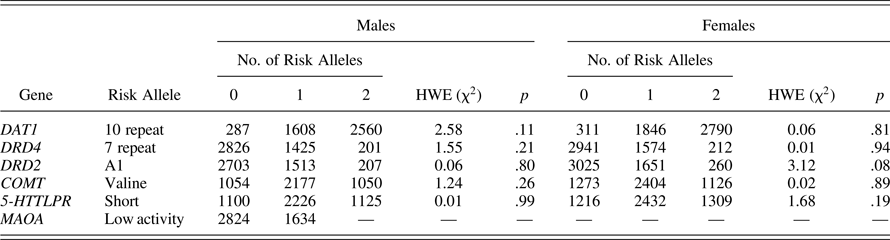
Allele frequencies and Hardy–Weinberg equilibrium (HWE) tests

Step 3. Testing G × E Interactions
After the best fitting model from the GMM was determined and the Add Health MRS was derived, multinomial logistic regressions were conducted separately for males and females to examine the association between Add Health MRS, environmental factors (i.e., supportive parenting and community support), and their interactions on the log-likelihood of ASB class membership relative to the most prevalent (i.e., low) class. All models included a stratification variable (region), sample weights (GSWGT1), and the sampling unit variable (PSUSCID), while also covarying for the effects of household income and peer closeness. Per expert recommendation, all covariate × genotype and covariate × environment cross products were included simultaneously to account for the effects of the covariate on the primary interactions of interest (Keller, Reference Keller2014).
Results
Demographic comparison, principal component analysis, and rGE
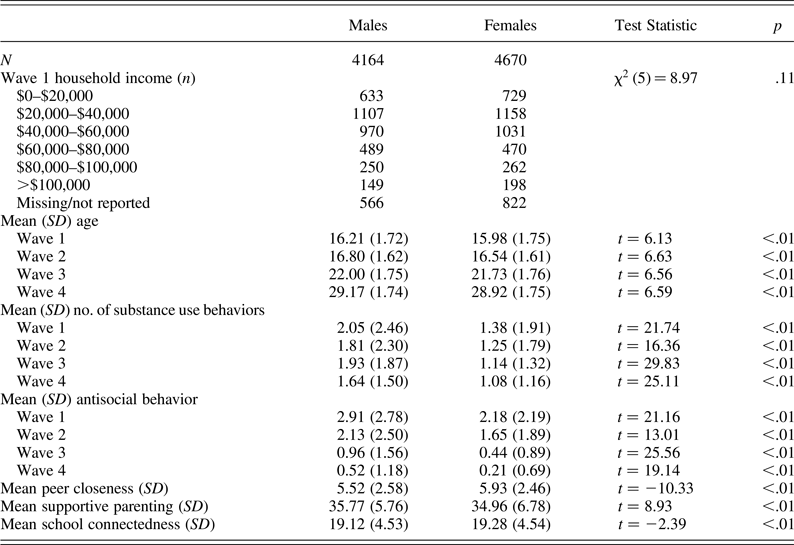
Table 2 displays the mean comparisons between sexes for each of the primary variables in the study. Females were younger in age and reported fewer counts of substance use and ASB across each wave, relative to males. Females also scored lower on supportive parenting and reported slightly higher school connectedness relative to males. There were no sex differences in terms of household income. Genotype distributions did not deviate significantly from Hardy–Weinberg equilibrium (Table 1).
Demographic information of the Caucasian-only genotypic sample by sex
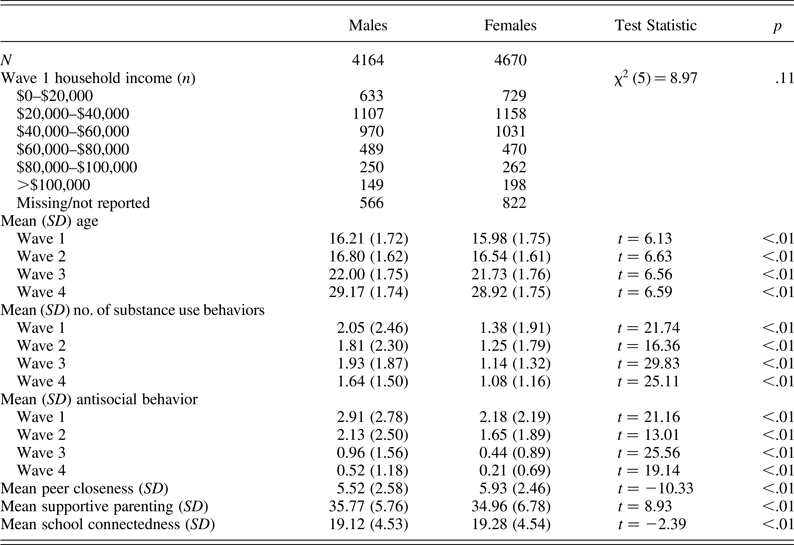
Note: Substance use behaviors included cigarette smoking, heavy alcohol consumption, and marijuana use.
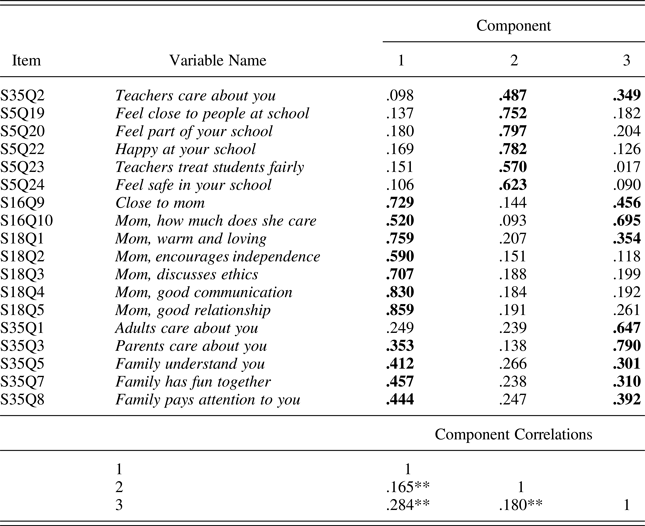
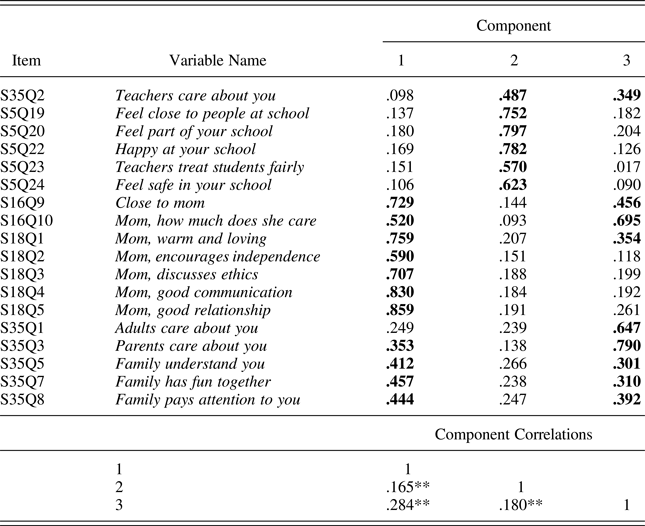
A principal component analysis was performed on all supportive parenting and school connectedness items from the Wave 1 in-home survey data of Add Health (Table 3). Three components had eigenvalues greater than 1, although the first two components accounted for 44% of the total variance and the remaining component only accounted for 5% of the variance. As expected, the first two components differentiated between the items that pertained to school connectedness and supportive parenting, suggesting that both environmental variables constitute separable components for the present analysis. Items with high loadings (i.e., loadings >0.30) on Components 1 and 3 were the supportive parenting items (e.g., “close to mom” and “good communication”). These two components were also strongly correlated (r = .284, p < .001), indicating that they may be reasonably tapping into a similar factor. Component 2 consisted of high loadings on items exclusively related to school connectedness (e.g., “feel close to people at school” and “teachers care about you”).
Principal component analysis of supportive parenting and school connectedness variables in Add Health (oblimin rotation)
Tests of rGE were conducted using multiple linear regression, where each candidate gene was regressed on supportive parenting and school connectedness (as separate models). For males, no significant associations were detected between supportive parenting and DAT1 (β = 0.006, p = .75), DRD4 (β = 0.007, p = .72), DRD2 (β = 0.006, p = .73), COMT (β = 0.001, p = .98), 5-HTTLPR (β = 0.019, p = .30), or MAOA (β = –0.019, p = .29). There were also no significant associations detected for school connectedness and DAT1 (β = 0.02, p = .39), DRD4 (β = 0.015, p = .39), DRD2 (β = –0.010, p = .59), 5-HTTLPR (β = 0.018, p = .30), or MAOA (β = –0.002, p = .91), although a significant association was found for COMT (β = –0.039, p = .03). For females, no significant associations were detected between supportive parenting and DAT1 (β = 0.005, p = .75), DRD4 (β = –0.011, p = .53), COMT (β = 0.007, p = .67), or 5-HTTLPR (β = 0.003, p = .88), but there was an association for DRD2 (β = –0.044, p = .01). There were no significant associations detected for school connectedness and DAT1 (β = –0.025, p = .15), DRD4 (β = –0.003, p = .86), DRD2 (β = –0.035, p = .66), 5-HTTLPR (β = –0.031, p = .07), or COMT (β = 0.020, p = .25). Because of the possibility of an rGE confound, COMT and DRD2 were excluded from the Add Health MRS computation for males and females, respectively.Footnote 3
GMM of ASB and sex differences
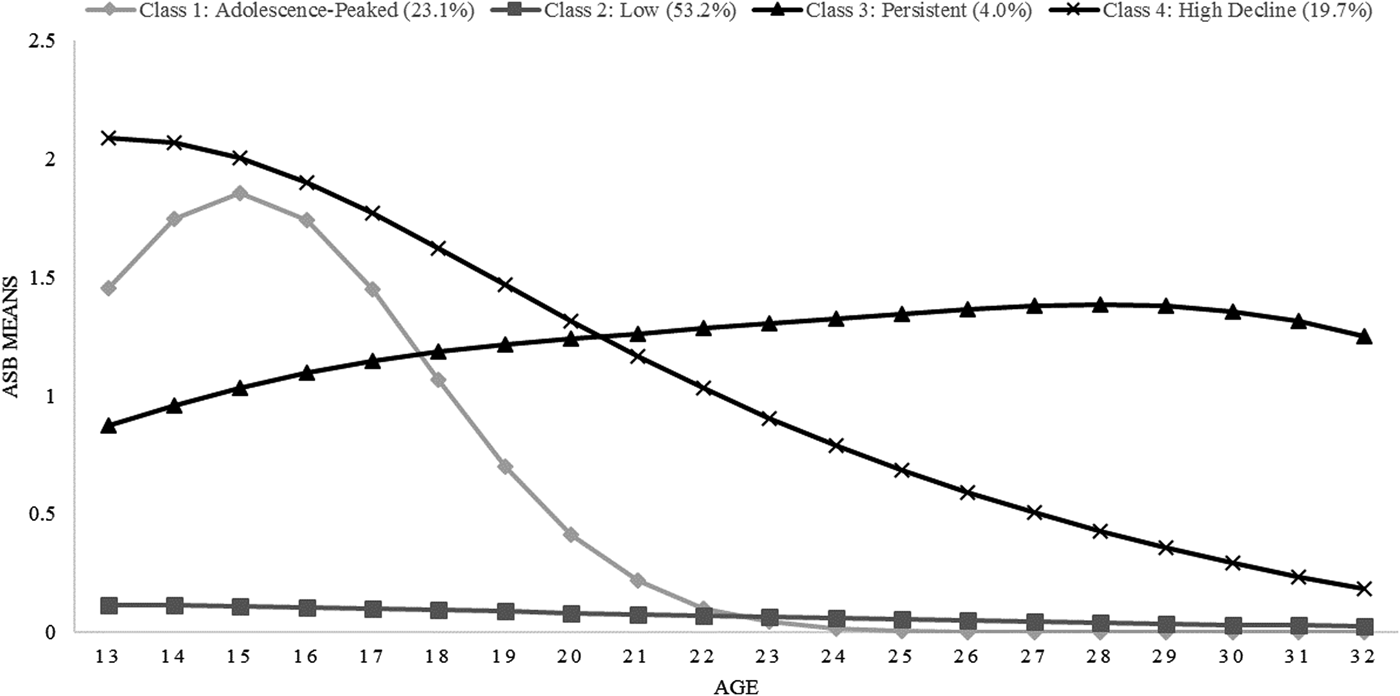
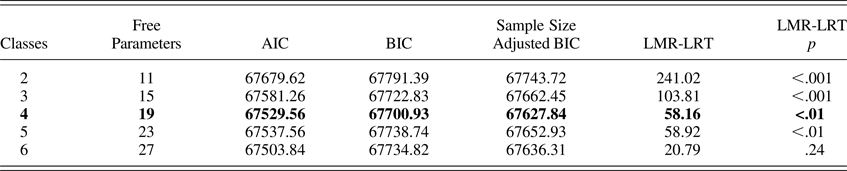
Growth curves of ASB were modeled from age 13 to 32 using GMM (Figure 1). A four-class solution was the optimal model (Table 4). According to the model, most of the sample (53.2% total; 62.6% of females, 42.56% of males) belonged in the low pathway, where rates of mean counts of ASB were uniformly low across the entire age range. An adolescence-peaked ASB pathway also emerged, consisting of 23.1% of the sample (23.9% of females, 22.3% of males). Individuals belonging to this class were characterized by relatively high rates of ASB during middle adolescence (between the ages of 13 and 16) and a steep decline beginning at age 17. By age 22, individuals in the adolescence-peaked pathway were indistinguishable from their low-ASB peers in terms of mean counts of ASB. The persistent ASB pathway represented 4.0% of the sample (2.0% of females, 6.3% of males) and was characterized by a relatively moderate but persistent trend of ASB throughout adolescence and adulthood. The final class that emerged was a high decline ASB pathway, representing 19.7% of the sample (11.5% of females, 28.8% of males). Similar to the adolescent-peaked pathway, high decline ASB individuals showed the highest initial rate of ASB during adolescence, but unlike those in the adolescence-peaked pathway, they exhibited a more gradual decline in mean counts of ASB that extended well into their adult years. Consistent with prior studies (e.g., Ferguson, Reference Ferguson2010; Moffitt et al., Reference Moffitt, Caspi, Harrington and Milne2002), there was a significant overall sex difference in ASB pathway membership (χ2 = 605.42, df = 3, p < .01), such that males were more likely to belong in the persistent and high decline ASB pathways than females, females were more likely to be in the low ASB pathway than males, and males and females did not differ on prevalence of adolescent-peaked pathway membership.
Estimated means of the latent trajectories of antisocial behavior.

Fit statistics for growth mixture model of ASB sum scores from age 13 to 32
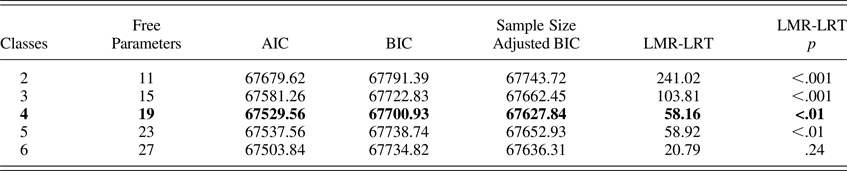
Note: AIC, Akaike information criterion; BIC, Bayesian information criterion; LMR-LRT, Lo–Mendell–Rubin likelihood ratio test for k classes (null) versus k + 1.
Add Health multilocus genetic risk scores
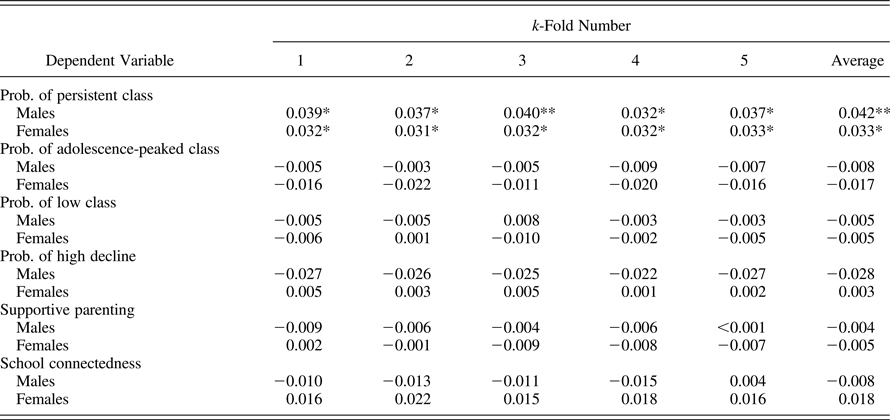
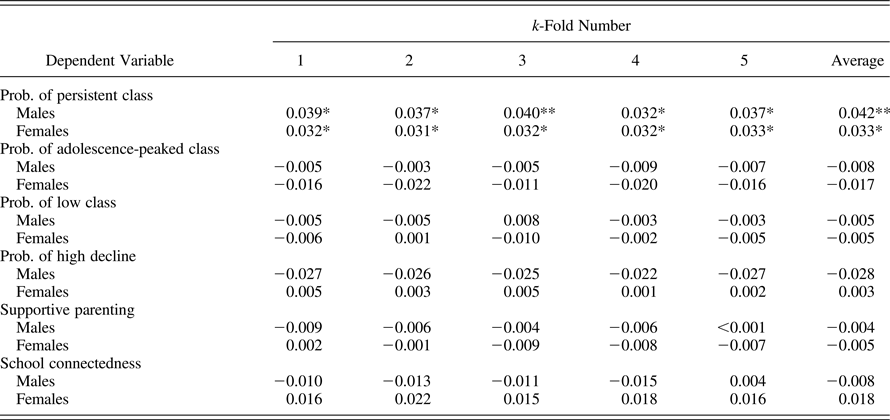
Each genotype was beta regressed on the probability of persistent ASB, controlling for household income and peer closeness, in a fivefold cross-validation analysis. In males, DRD4 genotype was significantly associated with the probability of persistent ASB in four of the five folds, such that carrying a 7R allele was negatively associated with ASB. In females, none of the genotypes conferred a significant main effect on the probability of the persistent ASB pathway. All results, including tables for the male and female cross-validation models, are reported in the online-only supplementary materials.
Prediction estimates used to calculate Add Health MRS were derived from the average of the standardized beta coefficients across the fivefold cross-validation analysis. Tables S.1 and S.2 in the online-only supplementary materials include the histogram of weighted Add Health MRS for males and females. Table 5 presents the results of discrete probabilities of ASB class membership, mean supportive parenting, and mean school connectedness when regressed on weighted Add Health MRS. As expected, Add Health MRS were positively associated with the probability of persistent ASB class membership, but not probabilities for membership in low, adolescence-peaked ASB, or high decline ASB classes. As an additional test of rGE, Add Health MRS were not associated with either supportive parenting or school connectedness, suggesting that the individual's genetic liability for ASB was not simultaneously predictive of the quality of their own environment.Footnote 4
Regressions results from each k-fold cross-validation: Add Health multigenic risk scores predicting discrete probabilities of latent antisocial behavior class membership, supportive parenting, and school connectedness by sex
Note: Estimates as shown are standardized beta coefficients.
*p < .05. **p < .01.
Add Health MRS × Supportive Parenting interaction
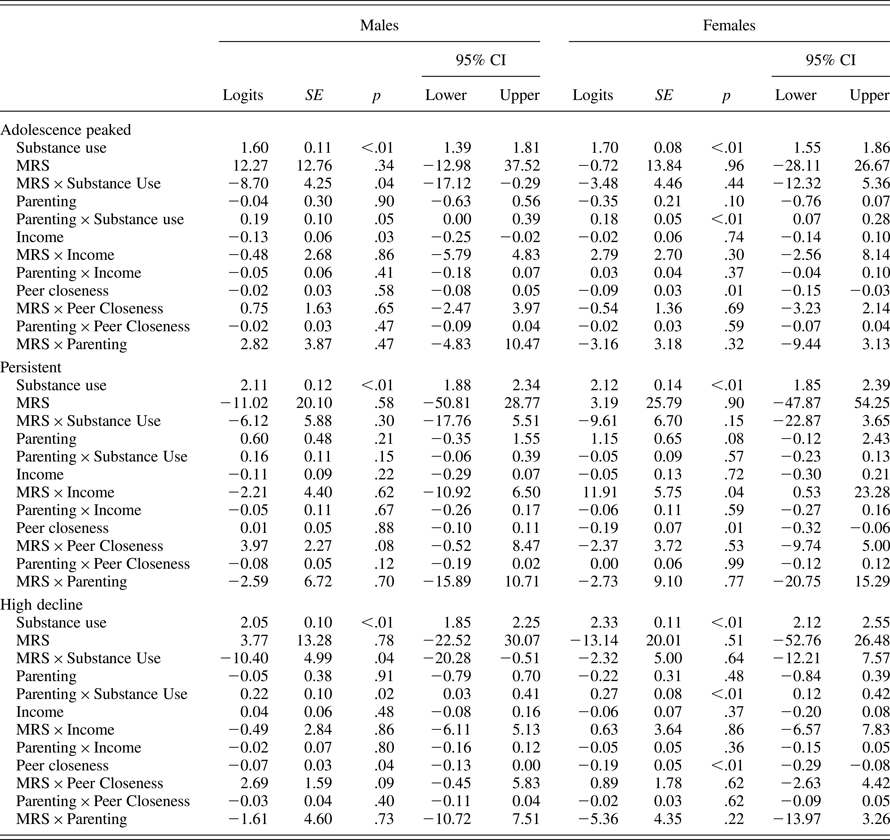
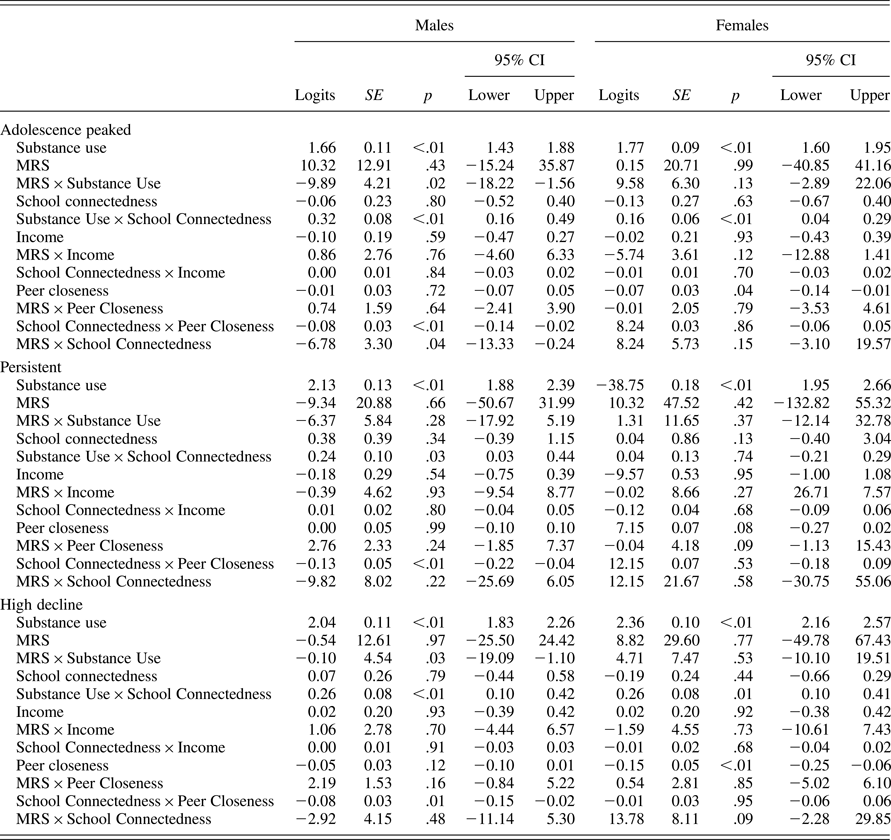
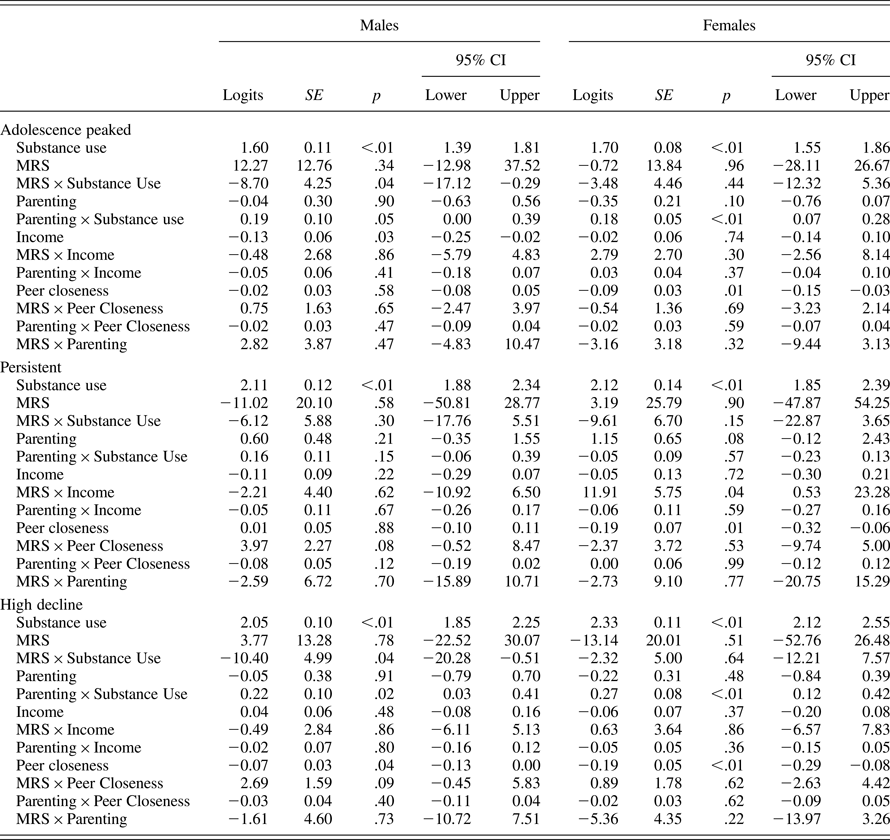
Multinomial logistic regressions were conducted separately for males and females, predicting the log-odds of ASB pathway membership (relative to low ASB) from Add Health MRS, supportive parenting, and their interaction and controlling for household income, average substance use behavior across waves, and peer closeness (see Table 6). For males, no significant interaction was detected between supportive parenting and Add Health MRS in predicting membership in the adolescence-peaked, persistent, and high decline ASB pathways relative to the low ASB pathway. Similarly, in females no significant interactions were detected between supportive parenting and Add Health MRS in predicting membership in the adolescence-peaked, persistent, and high decline ASB pathways compared to the low ASB pathway.
Multinomial logistic regressions: Supportive parenting and multigenic risk scores (MRS)
Note: The low class served as the reference class for the multinomial regressions.
MRS × School Connectedness interaction
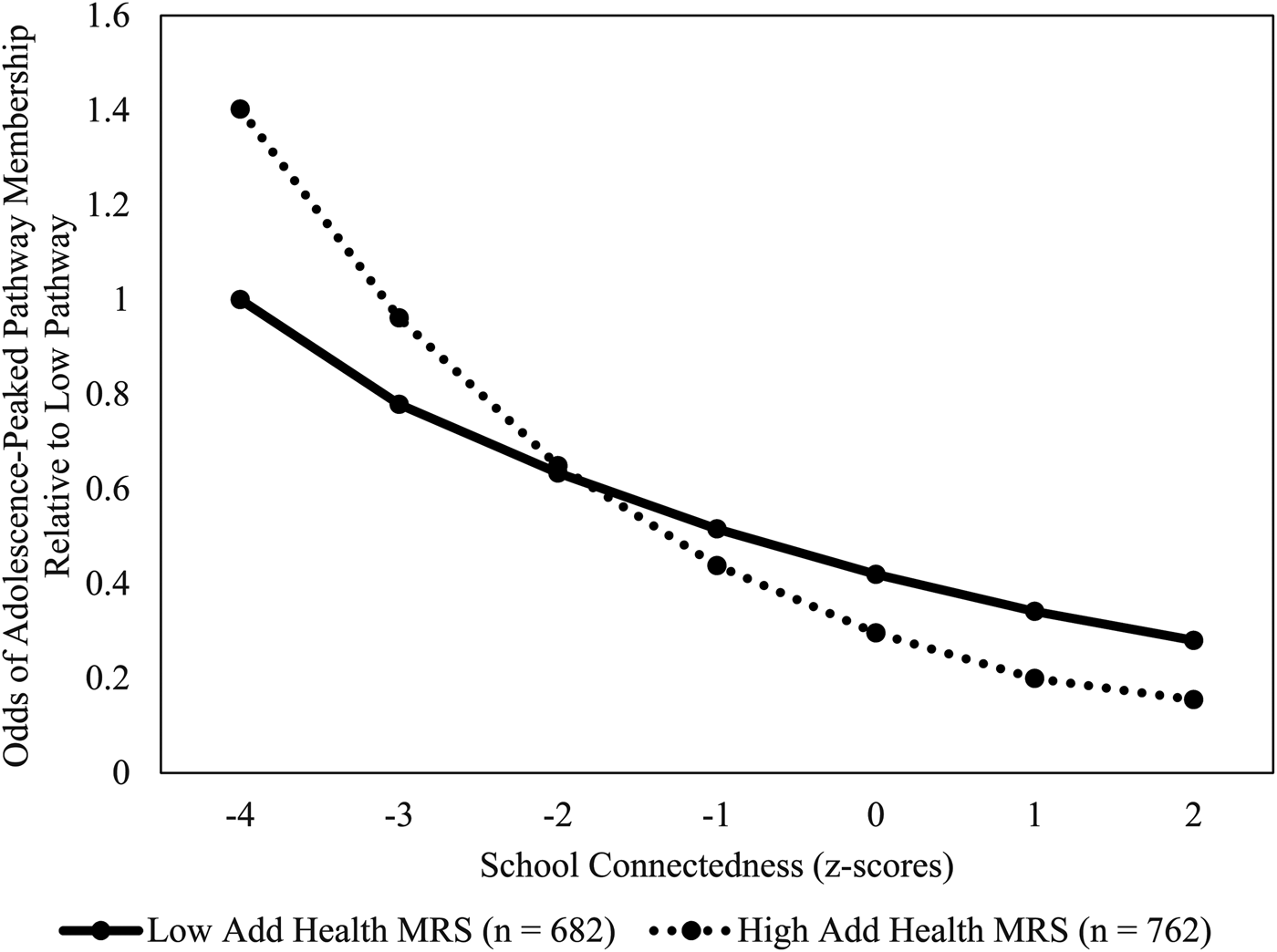
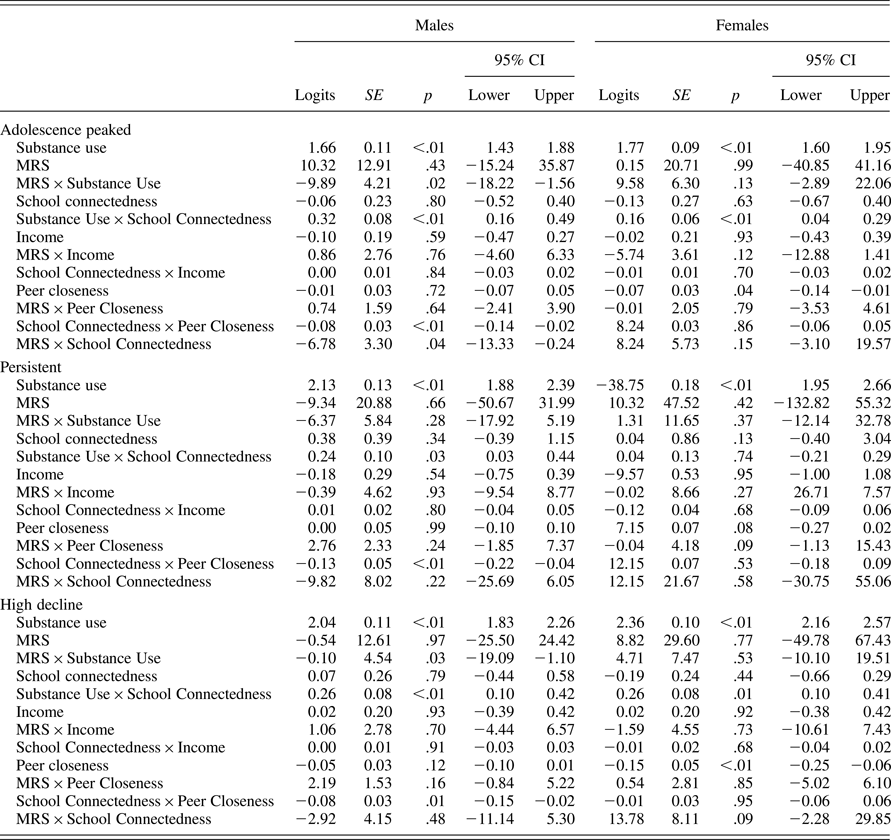
Multinomial logistic regressions were also conducted to predict the log-odds of ASB class membership from Add Health MRS, school connectedness, and their interaction (see Figure 2), controlling for household income, substance use behavior, and peer closeness (see Table 7). In males, a significant interaction was detected between school connectedness and Add Health MRS in predicting membership in the adolescence-peaked ASB pathway (logits = –6.78, SE = 3.30, p = .05) relative to the low class.Footnote 5 In females, no significant interactions emerged between school connectedness and Add Health MRS for females in predicting membership in any of the pathways of the ASB.
School Connectedness × Add Health Multigenic Risk Score interaction predicting odds of adolescence-peaked pathway antisocial behavior membership (relative to low antisocial behavior) in males.

Multinomial logistic regressions: School connectedness and multigenic risk scores (MRS)
Note: The low class served as the reference class for the multinomial regressions.
Using a median split of Add Health MRS (median = 0), post hoc tests of the interaction between school connectedness and Add Health MRS revealed that the association between school connectedness and the log odds of membership in the adolescence-peaked pathway was robust for high (logits = –0.33, SE = 0.08, p < .001, n = 248) and low Add Health MRS (logits = –0.32, SE = 0.07, p < .001, n = 236) males. To assess for differential susceptibility, odds ratios and confidence intervals were assessed “at the margins” of school connectedness (lowest and highest values of the z score) comparing high and low Add Health MRS groups. Nonoverlapping confidence intervals would indicate a significant difference in odds ratios between groups. No evidence of differential susceptibility emerged. High Add Health MRS males who reported the lowest levels of school connectedness (–4 SD) had a 41% increased odds of being in the adolescence-peaked pathway compared to low ASB pathway, odds ratio (OR) = 1.41, 95% confidence interval (CI) [1.13, 1.49], and low Add Health MRS males at the lowest level of school connectedness had no significant increase in odds of belonging to this pathway relative to the low ASB pathway, OR = 1.00, 95% CI [0.89, 1.21]. These odds did not significantly differ from one another, however, given their nonoverlapping CIs. At high levels of school connectedness (+2 SD), both high and low Add Health MRS males were equally protected from being in the adolescence-peaked pathway relative to the low pathway: high Add Health MRS, OR = 0.15, 95% CI [0.04, 0.35]; low Add Health MRS, OR = 0.28, 95% CI [0.14, 0.73].
Discussion
The current study used rigorous quantitative methods to examine the interplay between multigenic and multienvironmental influences on ASB. First, four unique pathways of ASB emerged from the growth mixture analysis: low, adolescence-peaked, persistent, and a high decline ASB classes. The high-decline class accounted for nearly 20% of the total sample. Second, the k-fold cross-validation technique was used to derive robust prediction estimates for ASB across six polymorphisms in dopamine and serotonin genes, such that weighted MRS were predictive of the persistent pathway of ASB in both males and females. Third, a significant G × E effect was detected for male pathways of ASB. Specifically, compared to males with low Add Health MRS, males with high Add Health MRS had somewhat greater odds of adolescence-peaked pathway membership at low levels of school connectedness. No evidence of differential susceptibility was detected, however, such that males with high and low MRS were not differentially protected from membership into the adolescence-peaked pathway at high levels of school connectedness. Furthermore, no interactive effects between MRS and supportive parenting was detected in predicting the developmental pathways of ASB for either males or females.
The adolescent to adult pathways for ASB were highly consistent with those described in the broader developmental literature (D'Unger, Land, & McCall, Reference D'Unger, Land and McCall2002; Moffitt, Reference Moffitt1993; Odgers et al., Reference Odgers, Moffitt, Broadbent, Dickson, Hancox, Harrington and Caspi2008) as well as to those described using a limited subsample from Add Health (e.g., Tung & Lee, Reference Tung and Lee2016; Zheng & Cleveland, Reference Zheng and Cleveland2013). As hypothesized, a high decline ASB pathway was also identified, representing nearly 20% of the total sample. Similar to the adolescence-peaked pathway of ASB, individuals in the high decline pathway exhibited peak rates of ASB during adolescence, but they also had the highest initial rate of ASB (even compared to the persistent class) and a much slower decline in their ASB throughout adulthood relative to the adolescence-peaked pathway. The existence of the high decline ASB class had been previously found for both males and females in a small Add Health subsample and other samples as well, despite focusing only on the first three waves of data (Nagin & Tremblay, Reference Nagin and Tremblay2005; Zheng & Cleveland, Reference Zheng and Cleveland2013, Reference Zheng and Cleveland2015). Prevalence rates were found to be roughly equivalent between sexes in a previous study (12% vs. 11% for males and females, respectively; Zheng & Cleveland, Reference Zheng and Cleveland2013), but the current results differed from the previous finding in that nearly 29% of males belonged in the high decline pathway versus only 12% of females. One reason for the divergence in these results is that the pathways combined aggressive and nonaggressive rule-breaking forms of ASB, which were undifferentiated in the current study.Footnote 6 For instance, Zheng and Cleveland (Reference Zheng and Cleveland2013) reported that high decliner males had consistently high rates of nonaggressive rule breaking and aggressive delinquency over time, whereas female high decliners were primarily characterized by their high nonaggressive rule-breaking behaviors that slowly declined over time. The higher proportion of males in the high decliner pathway may potentially be accounted for by some males who are exclusively aggressive in their ASB, which is very rare in females (Moffitt, Reference Moffitt1993). Although there was no factor analytic evidence of subtypes across time points (i.e., by age group; results available upon request), subsequent studies that differentiate between aggressive and nonaggressive forms of ASB may yet identify unique, potentially sex-specific developmental pathways of ASB.
Weighted MRS for ASB, which were derived from robust prediction estimates of each dopamine and serotonin polymorphism, significantly predicted the persistent pathway of ASB but not the other developmental pathways of ASB. First, it is important to note that the choice of phenotype in the genetic association cross-validation models likely had a significant impact on predictive ability of the resultant Add Health MRS in the full sample (Wray et al., Reference Wray, Yang, Hayes, Price, Goddard and Visscher2013). The current study used the probability of persistent ASB as the outcome choice given that (a) the genetic influences for chronic and aggressive forms of ASB are highest relative to other developmental pathways (Burt, Reference Burt2009; Zhen & Cleveland, 2015) and (b) genetic influences for the persistent ASB pathway may overlap (partially) with other (i.e., nonaggressive) ASB pathways (Burt, Reference Burt2013) and with externalizing problems more generally (Lahey et al., Reference Lahey, Van Hulle, Singh, Waldman and Rathouz2011). Although Add Health MRS significantly predicted the persistent ASB pathway, it did not predict adolescence-peaked or high decline ASB pathways, providing some evidence of a genetic distinction between the developmental pathways, but only with respect to the dopaminergic and serotonergic polymorphisms that were assessed. Thus, it cannot be ruled out that the current results would differ if a different phenotype were selected (e.g., antisocial personality disorder diagnosis and criminal arrest record). As related phenotypes should theoretically tap into similar genetic signals that underlie a single latent trait, future studies should compare the predictive ability of Add Health MRS and assess for the accuracy of the prediction across these related (but different) phenotypes. Second, the current study referred to the extensive literature regarding the risk variant for each polymorphism as it pertained to ASB, yet the results showed that some risk variants were negatively associated with ASB. For example, a negative association between the DRD4 7R allele and the probability of persistent ASB was detected for males, such that carrying more copies of the 7R allele predicted a lower probability of the persistent ASB. Although this contrasts with a large portion of prior literature regarding the risk status of the 7R allele on ASB (e.g., Buchmann et al., Reference Buchmann, Zohsel, Blomeyer, Hohm, Hohmann, Jennen-Steinmetz and Esser2014; Hohmann et al., Reference Hohmann, Becker, Fellinger, Banaschewski, Schmidt, Esser and Laucht2009; Nobile et al., Reference Nobile, Giorda, Marino, Carlet, Pastore, Vanzin and Battaglia2007), some studies found that the 7R allele was associated with less ASB in adolescent samples as well (Beaver et al., Reference Beaver, Wright and Walsh2008; Janssens et al., Reference Janssens, Goossens, Van Den Noortgate, Colpin, Verschueren and Van Leeuwen2015). Studies making assumptions about the risk effect of a certain allele may obfuscate the possibility of a protective effect, particularly given the evidence that serotonergic and dopaminergic systems may have reciprocal effects in relation to ASB (Seo et al., Reference Seo, Patrick and Kennealy2008). Hence, a quantitative approach (e.g., cross-validation analysis) to genetic scoring may potentially provide a better understanding about the interplay between serotonin and dopaminergic function underlying ASB, since the direction and effect size for each SNP can be estimated from a model that simultaneously (rather than independently) incorporates all of the relevant markers in the prediction of ASB. Third, the overall genetic effects on ASB might have been “washed out” given the contrasting direction of allelic effects on ASB in the genetic association cross-validation analysis. Furthermore, others have noted that the combination of positive and negative genetic effects is more biologically realistic (Marcaeu et al., 2016). That this composite score still predicted a certain form of ASB suggests that aggregate genetic effects on ASB are robust.
Add Health MRS interacted with school connectedness in predicting membership into the adolescence-peaked pathway relative to the low ASB pathway. This interaction was evident even after accounting for the possibility of rGE confounds, and controlling for household income, substance use behavior (averaged across adolescence and adulthood), and peer closeness. Furthermore, secondary analysis indicated that the effect of DRD4 genotype on ASB may have been a significant driver of this result, but the weighted Add Health MRS yielded an even stronger signal to detect the G × E effect. Overall, the finding reinforces the pivotal role of nonfamilial influences on ASB during the transitory period of development (i.e., from early adolescence into adulthood) and demonstrate how school-related experiences (independent from peer closeness) during adolescence may have cumulative interactive effects among those with a vulnerable genetic constitution for not only the adolescence-peaked form of ASB, as might be expected from prior literature (Moffitt, Reference Moffitt1993, 2002). Adolescents who feel unaccepted and unsupported at school may be less likely to follow social norms and expectations, resulting in a higher likelihood of engaging in delinquency and aggression into their later adult years (Catalano & Hawkins, Reference Catalano, Hawkins and Hawkins1996). Genetic influences for ASB are likely strengthened under these conditions, as prior behavioral genetic studies have found that genetic factors for externalizing problems (including substance use and ASB) are increased under conditions where the individual has greater access to and affiliation with deviant peers (Harden, Hill, Turkheimer, & Emery, Reference Harden, Hill, Turkheimer and Emery2008; Samek, Hicks, Keyes, Iacono, & McGue, Reference Samek, Hicks, Keyes, Iacono and McGue2016) and is living in a more disadvantaged neighborhood (Burt, Klump, Gorman-Smith, & Neiderhiser, Reference Burt, Klump, Gorman-Smith and Neiderhiser2016; Tuvblad, Grann, & Lichtenstein, Reference Tuvblad, Grann and Lichtenstein2006).
In addition, the interaction between Add Health MRS and school connectedness on adolescence-peaked ASB was only observed for males. There is evidence that genetic and environmental influences differentially contribute to developmental pathways of ASB across sexes (Van Hulle, Rodgers, D'Onofrio, Waldman, & Lahey, Reference Van Hulle, Rodgers, D'Onofrio, Waldman and Lahey2007; Zheng & Cleveland, Reference Zheng and Cleveland2015). Males and females may have different patterns of socialization that affect their engagement in ASB, and others have suggested that socialization processes and familial factors may be more relevant for females than for males (Fontaine, Carbonneau, Vitaro, Barker, & Tremblay, Reference Fontaine, Carbonneau, Vitaro, Barker and Tremblay2009; Zheng & Cleveland, Reference Zheng and Cleveland2015). Hence, the male-specificity of the G × E effect was unexpected, as prior studies have shown that adolescent girls may be more sensitive to social evaluation, acceptance, and connections with teachers and peers as it relates to general mental health outcomes than adolescent boys (Calvete & Cardenoso, Reference Calvete and Cardeñoso2005; Shochet et al., Reference Shochet, Dadds, Ham and Montague2006). Findings have been inconsistent regarding the differential effects of school connectedness for males and females as it pertains to ASB as well (see Batanova & Loukas, Reference Batanova and Loukas2014; Crosnoe et al., Reference Crosnoe, Erickson and Dornbusch2002; Kuperminc & Allen, Reference Kuperminc and Allen2001). Overall, the current findings provide preliminary support for the broader literature regarding the differential contribution of genetic and environmental influences on developmental pathways of ASB across sex, but results should be replicated before making firm conclusions regarding the male-specific G × E effects that were detected.
Contrary to hypotheses, there was no evidence of differential susceptibility, as low levels of perceived school connectedness exacerbated the risk for the adolescence-peaked pathway of ASB among males with high Add Health MRS, but these individuals were not differentially protected by high levels of school connectedness compared to males with low Add Health MRS. First, it should be noted that relatively few studies of differential susceptibility have focused on environments assessed during the adolescent period (for exceptions, see Belsky & Beaver, Reference Belsky and Beaver2011; Latendresse et al., Reference Latendresse, Bates, Goodnight, Lansford, Budde, Goate and Dick2011; Li, Berk, & Lee, Reference Li, Berk and Lee2013; Tung & Lee, Reference Tung and Lee2016), and whether these effects might influence developmental trajectories of ASB measured into adulthood. A large portion of the genetically informed studies of differential susceptibility have focused on early rearing environments, assessed during infancy and the school-age years (see Bakermans-Kranenburg & van IJzendoorn, Reference Bakermans-Kranenburg and van Ijzendoorn2011), but one meta-analysis that focused on 5-HTTLPR did not find any evidence that age moderated the association between the sensitivity genotype (i.e., short–short and short–long carriers) and various developmental outcomes as a function of either adverse or enriched environments (van IJzendoorn, Belsky, & Bakermans-Kranenburg, Reference van IJzendoorn, Belsky and Bakermans-Kranenburg2012). In the case of ASB specifically, other genes may come online at the later stages of development (i.e., genetic innovation; Pingault et al., Reference Pingault, Viding, Galéra, Greven, Zheng, Plomin and Rijsdijk2015, Wichers, Wigman, & Myin-Germeys, Reference Wichers, Wigman and Myin-Germeys2015), but what these genes are, and how these genes operate in the context of G × E is currently unknown. Second, despite having assessed parenting and school connectedness across broad dimensions (i.e., negative to positive support), differential susceptibility in G × E may be difficult to detect nonetheless due to measurement artifacts and sample size. In the current study, it is possible that high levels of school connectedness or supportive parenting may not have been sufficiently rewarding or salient for dopamine activation (Tomer et al., Reference Tomer, Slagter, Christian, Fox, King, Murali and Davidson2014; Tripp & Wickens, Reference Tripp and Wickens2008). This may also explain why studies examining highly aversive environmental stimuli (e.g., stressful life events and maltreatment) have found relatively more consistent G × E effects (see meta-analyses by Byrd & Manuck, Reference Byrd and Manuck2014; Kim-Cohen et al., Reference Kim-Cohen, Caspi, Taylor, Williams, Newcombe, Craig and Moffitt2006; Tielbeek et al., Reference Tielbeek, Karlsson Linnér, Beers, Posthuma, Popma and Polderman2016). A consideration for future studies is to rigorously measure the impact of the environmental criterion in G × E, insofar as the salience of effect at either end of the environment spectrum has a large and inverse effect on the phenotype. Experimental studies of G × E, for example, are powerful tests for differential susceptibility because the salience of the environment (i.e., intervention effects) is manipulated and directly measurable by the researchers (Brody, Yu, Beach, & Philibert, Reference Brody, Yu, Beach and Philibert2015). Another possible explanation for the lack of differential susceptibility effect is that deriving weighted genetic risk scores for ASB may have precluded identification of genetic effects that are contingent upon exposure to environmental conditions (Caspi, Hariri, Holmes, Uher, & Moffitt, Reference Caspi, Hariri, Holmes, Uher and Moffitt2010). Robust genotype-to-phenotype associations detected in studies may not readily guarantee robust G × E findings. One future direction is to characterize genetic variation in phenotypes that are plausibly related to how an individual reacts to environmental factors (e.g., stress sensitivity and social vulnerability; Caspi et al., Reference Caspi, Hariri, Holmes, Uher and Moffitt2010).
Supportive parenting did not moderate genetic risk for developing ASB, which is consistent with behavior genetic findings of reduced familial environmental influences, relative to nonfamilial environmental influences on ASB as a function of age (Ferguson, Reference Ferguson2010; Rhee & Waldman, Reference Rhee and Waldman2002). The findings contrast with at least two previous reports demonstrating the moderating role of supportive parenting on genetic susceptibility for ASB-related phenotypes (i.e., Belsky & Beaver, Reference Belsky and Beaver2011; Tung & Lee, Reference Tung and Lee2016). Both Tung and Lee (Reference Tung and Lee2016) and Belsky and Beaver (Reference Belsky and Beaver2011) used the Add Health sample in their studies as well, but they also employed fewer waves of data, a different method of measuring genetic susceptibility, and a different outcome measure compared to the current study. These are important study differences that may explain nonreplication, but it should also be noted that current study undertook very rigorous steps toward measuring each component of the G × E equation to ensure that the findings (or lack thereof) were robust, including a systematic approach for combining the effects of functionally relevant polymorphisms, assessment of positive and negative dimensions of familial and nonfamilial environmental influences on development, and the use of GMM to assess for age 13–32 trajectories of ASB. The current study focused on a limited set of polymorphisms as well, and it is possible that familial factors may interact with other genetic variants as they pertain to ASB that were not assessed here. Understanding interplay between familial and genetic influences remains a high priority for scientific inquiry because of its potential implications for intervention for adolescents. For instance, Brody, Chen, and Beach (Reference Brody, Chen and Beach2013) conducted a randomized control trial of adolescents involved in a family-centered alcohol prevention program and found that youths who carried the A1 and 7R alleles in the DRD2 and DRD4 genes, respectively, had the greatest increase in alcohol use during a 2-year period if they were in the control condition but were also the most likely to benefit from the prevention program (by virtue of having the smallest increase in alcohol use behaviors) compared to those with fewer risk alleles.
Several study limitations should be noted, in addition to those that were previously mentioned. First, only Caucasians were analyzed in the current analysis, which limits the generalizability of the current findings. However, the advantage of a homogenous racial/ethnic sample is that it minimizes concerns related to population stratification (genotypes were nonrandomly associated with race/ethnicity in the present sampleFootnote 7 ). Future studies should consider the strong possibility that genetic and environmental influences may be specific to certain populations. For example, in the substance use literature recent evidence from GWAS suggest that genetic variants for alcohol dependence differ between African Americans and Caucasians (Gelernter et al., Reference Gelernter, Kranzler, Sherva, Almasy, Koesterer, Smith and Wodarz2014). Although G × E investigations focusing on non-Caucasian samples are still quite rare in the literature (although see Thibodeau et al., Reference Thibodeau, Cicchetti and Rogosch2015, for a recent exception), it is possible that G × E effects may be differ depending on the population being assessed. Second, the Add Health MRS was not cross-validated outside of the Add Health sample (which is why the term “Add Health MRS” rather than simply MRS was used throughout). As such, the Add Health MRS may not predict persistent ASB in a different sample. While the k-fold cross-validation does provide safeguards against overfitting, concerns about the generalizability of the Add Health MRS are warranted in the absence of an independent validation sample. Third, substance use behaviors are also known to covary with dimensions of ASB, such that they may have shared etiologies (Kendler, Prescott, Myers, & Neale, Reference Kendler, Prescott, Myers and Neale2003; Krueger, Markon, Patrick, Benning, & Kramer, Reference Krueger, Markon, Patrick, Benning and Kramer2007). The current investigation included substance use behavior as a covariate in the multinomial logistic models, which partially accounts for the covariation of substance use and ASB pathways in the interpretation of G × E. However, there may be unique genetic and environmental influences on pathways unique to substance use, as well for a “general” factor of externalizing psychopathology that may account for the covariation between the different externalizing dimensions (Caspi et al., Reference Caspi, Houts, Belsky, Goldman-Mellor, Harrington, Israel and Moffitt2014). Fourth, childhood data on ASB were not collected on the sample, since Add Health began collecting data on participants when they were in high school. The absence of this data makes it difficult to compare the pathways derived from the current study to those theorized by Moffitt (Reference Moffitt1993, Reference Moffitt, Lahey, Moffitt and Caspi2003). Fifth, the reliance on self-report for the variables in the study may have confounded the interpretations of the results due to shared method variance. Because ASB was self-reported at each wave, there may have also been underreporting or a biased sample at each subsequent wave since individuals with severe ASB tend to be more difficult to be retained in longitudinal studies (Farrington, Reference Farrington1998; Huizinga & Elliott, Reference Huizinga and Elliott1986). Hence, the use of additional informants or using other sources of ASB, such as official criminal records, may have improved measurement accuracy (Jaffee, Caspi, Moffitt, & Taylor, Reference Jaffee, Caspi, Moffitt and Taylor2004). Sixth, the polymorphisms examined in the current study were limited by what was publicly available in Add Health. A larger set of genotypes with relevance to dopamine and serotonin neurotransmission would have been preferred (Plomin et al., Reference Plomin, Haworth and Davis2009). Similarly, genome-wide information would help to identify several more unique genetic variants (perhaps outside of the dopamine or serotonin system) that may, in aggregate, account for a significant portion of the phenotypic variance in the ASB pathways. Although genome-wide information on the Add Health data set is not yet publicly available (i.e., via dbGap), future studies should consider the interactive role of polygenic risk (derived from GWAS) and environmental influences on the development of ASB and related phenotypes.
The current study provides several important contributions to the literature and directions for future study. First, the findings illustrate the utility of integrating a strong developmental framework toward understanding the role of multiple genetic and environmental influences on pathways of ASB. In psychiatric genetics, a developmental approach is crucial for the study of many psychiatric disorders because genetic/environmental associations for a particular age group may not be generalizable to all age groups (Dick, Reference Dick2011). Employing longitudinal strategies, such as GMM, allows researchers to examine how genetic and environmental influences predict different patterns of development, which is a critical area of focus in the field of developmental psychopathology. Second, this study builds upon the advances in the field of psychiatric genetics by computing weighted genetic risk scores for ASB from a set of previously well-characterized polymorphisms in dopamine and serotonin genes. This approach provided a strong signal to detect a G × E effect and differs from the increasingly common strategy of summing the number of putative risk alleles for each marker by accounting for the differential effects that each marker has on ASB. GWAS-based investigations can now be used to test for enrichment across biological systems in relation to an outcome, potentially providing more targeted investigations for G × E (see Edwards, Bacanu, Bigdeli, Moscati, & Kendler, Reference Edwards, Bacanu, Bigdeli, Moscati and Kendler2016, for a recent example of dopamine-gene pathway analysis for schizophrenia in a GWAS). Biologically based polygenic approaches will likely become more widely implemented in G × E studies as they potentially provide a better understanding about how genes in a targeted biological system and environments interact to influence behavior. Moving forward, more studies are concurrently needed to validate the multitude of genetic scoring strategies that are developed (Derringer et al., Reference Derringer, Krueger, Dick, Saccone, Grucza, Agrawal and Nurnberger2010; Marcaeu et al., 2016).
Supplementary Material
To view the supplementary material for this article, please visit https://doi.org/10.1017/S0954579417001511.