1. Introduction
The study of planning in second language (L2) writing research is heavily influenced by two research domains: (a) early research on cognition in first language (L1) composing processes and (b) second language acquisition (SLA) research. The first research domain has been instrumental in determining the specific systems and processes involved in composing and has led to widely accepted models of L1 writing (Bereiter & Scardamalia, 1987*; Flower & Hayes, Reference Hayes, Flower, Gregg and Steinberg1980*; Hayes, Reference Hayes, Levy and Ransdell1996, Reference Hayes2012) as well as a widely accepted model of the interaction between working memory and L1 writing systems (Kellogg, 1996*; Kellogg, Whiteford, Turner, Cahill, & Mertens, Reference Kellogg, Whiteford, Turner, Cahill and Mertens2013). The influence of these early studies is still felt in process approaches to composition instruction commonly implemented in L1 and L2 writing classes. The second research domain—SLA and more specifically task-based language teaching/learning—has come to view planning as a feature of task complexity that can be manipulated to facilitate the production of language that is complex (syntactically and/or lexically), accurate, and/or fluent (Robinson, 2011*; Skehan, 1998*; Skehan & Foster, Reference Robinson2001). This research timeline traces the study of planning in L2 writing in each of these domains by reviewing key L1 and L2 writing research over the last 30-plus years and by highlighting each study's findings. Prior to presenting the timeline, the following sections provide backgrounds in each of the domains noted above and situate planning within those domains.
2. Cognition in L1 composing processes
Research in this domain is based heavily on the early work of Hayes and Flower (Reference Hayes, Flower, Gregg and Steinberg1980) and Flower and Hayes (Reference Hayes, Flower, Gregg and Steinberg1980*) and their influential model of L1 writing. Though more recently updated by Hayes (Reference Hayes, Levy and Ransdell1996, Reference Hayes2012), much of the research from this perspective examines the three main systems of the writing process identified in Flower and Hayes’ early research: (a) formulation, which can be further broken down into the processes of planningFootnote 1 (i.e., attention to generating ideas, text organization, and goal-setting) and translating (i.e., encoding thoughts into language), (b) execution, the coordination and execution of motor movements to encode language on the page (or computer screen), and (c) monitoring, the comparison of the developing text to the writer's goals. As readers may note from the timeline presented here, much of the early L2 writing research in this area sought to determine whether L2 writers engaged in the same systems and processes as those identified by Flower and Hayes among L1 writers.
Kellogg's extensive research (1987, 1988, 1990*) has led to a clearer understanding of how each of the writing systems and processes tap components of working memory (Baddeley, Reference Baddeley1986), leading to a widely accepted model of working memory in L1 writing (Kellogg, 1996*). According to this model, each of the writing systems and processes make specific demands on one or more components of working memory: (a) the visuo-spatial sketchpadFootnote 2, which is responsible for holding visual and spatial information in an easily accessible form; (b) the phonological loop, which is responsible for holding auditory information in an easily accessible form; and (c) the central executive, which is simultaneously responsible for (a) coordinating the visuo-spatial sketchpad and the phonological loop and (b) aiding in the processing of information should one of the two become overburdened.
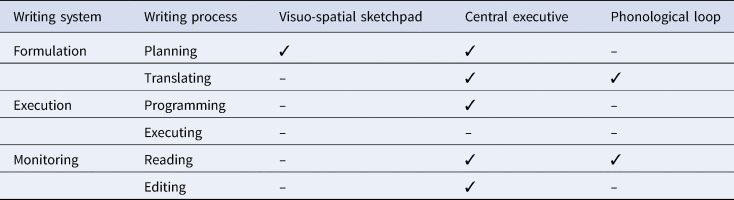
Until relatively recently, Kellogg's model has received little attention among L2 writing researchers. However, L2 writing researchers are increasingly using this model to explain the demands placed on working memory by the writing process. As can be seen in Table 1, in Kellogg's model, the formulation system—comprised of the planning process and the translation process—places the greatest demands on working memory resources, as it makes demands of all three components of working memory. Thus, the two processes—planning and translation—compete for working memory capacity.
Specific demands of the writing process on components of working memory (adapted from Kellogg, 1996*; Kellogg et al., Reference Kellogg, Whiteford, Turner, Cahill and Mertens2013)

Pre-task planning is thought to relieve the demands placed on limited working memory resources so that they may be devoted to the translation of ideas into language. Kellogg's research has demonstrated this to be the case among L1 writers (1987, 1988, 1990*), as pre-task planning—outlining in particular—appears to improve writing fluency, holistic assessment of writing quality, and assessment of language use. However, Kellogg's model does not account for the specific demands of L2 production. For this reason, among others, L2 writing researchers have turned to task-based SLA theories, most notably the limited attentional capacity model (Foster & Skehan, Reference Foster and Skehan1996; Skehan & Foster, Reference Robinson2001) and the cognition hypothesis (Robinson, Reference Robinson2003).
3. Planning as a feature of cognitive task complexity
Recent L2 writing research examines planning for writing as a feature of task complexity, typically focusing on the predictions of two competing theories of task-based language teaching/learning: (a) the limited attentional capacity model (Foster & Skehan, Reference Foster and Skehan1996; Skehan & Foster, Reference Robinson2001) or (b) the cognition hypothesis (Robinson, Reference Robinson2001, Reference Robinson2003, Reference Skehan, Foster and Robinson2005), each of which is described briefly below. In essence, both theories suggest that the provision of planning time will promote complexity, accuracy, and/or fluency of language production. Though they differ in their explanations, each theory attributes increases in syntactic complexity, accuracy, and/or fluency to a reduction in demands placed on working memory/attentional resources through the provision of two types of planning: (a) online—or within-task—planning and (b) pre-task planning.
As the name suggests, the limited attentional capacity model views attentional resources/working memory as a limited capacity system. Simply put, when attentional resources are overburdened by a complex or novel task, the L2 learner is forced to prioritize meaning over accuracy and complexity, thus fluency is favored. When attentional resources are not stressed by the complexity and/or novelty of a task, the L2 learner may prioritize accuracy or complexity over fluency.
In contrast, the cognition hypothesis proposes multiple pools of attentional resources. So long as the complexity of a task does not place multiple demands on the same pool of attentional resources, language production will not be impeded. Robinson's triadic componential framework (2012*) proposes two dimensions of cognitive task complexity: (a) a resource-directing dimension of cognitive task complexity and (b) a resource-dispersing dimension of cognitive task complexity. Resource-directing features of cognitive task complexity direct the L2 learner's attention to features of the language needed to address the complex nature of the task, resulting in greater accuracy and complexity—though decreased fluency—of language produced. Resource-dispersing features of cognitive task complexity disperse the L2 learner's attentional resources from the production of language, resulting in decreased complexity, accuracy, and fluency. In this framework, planning is considered a resource-dispersing feature of cognitive task complexity. Thus, denying the writer planning time is thought to impede the complexity, accuracy, and/or fluency of language production.
4. Planning, cognition, and task complexity in L2 writing
Due to similarities in their conceptions of working memory and/or attentional resources, L2 writing researchers have sought to dovetail Kellogg's model of working memory in L1 writing with the predictions of task-based language teaching. From this trend, three unique properties of the writing process in general and the L2 writing process in particular have emerged: (a) the importance of the time course of cognitive and metacognitive processes when writing, (b) the inter-relationship of planning and translation, and (c) the role of the L1 when composing in the L2.
Though the writing process is by its nature recursive, it plays out over time. Recent L2 writing research—like previous L1 writing research from a dynamic systems orientation—has examined how and when L2 writers devote attentional resources to pre-task planning and online planning and the relationship between planning and translation.
While planning and translation are thought to be distinct processes within the formulation system, Flower and Hayes (1984*) highlight how the two—particularly the idea generation sub-process of planning—may intertwine. The inter-related nature of translation and idea generation presents a potential challenge to the L2 writer, as some ideas are more easily translatable into language than others. L2 writing researchers have examined the role of the L1 in planning among L2 writers to determine (a) how the L1 is—or is not—involved in the planning process (Jones & Tetroe, 1987*; Uzawa & Cumming, Reference Uzawa and Cumming1989; Whalen & Ménard, 1995*) and/or (b) how the L1 aids in planning and translation (Roca de Larios, Murphy, & Manchón 1999*).
The research timeline presented here traces the study of planning in L1 and L2 writing, highlighting (a) the results of empirical research or (b) theoretical explanations of planning and its role in L1/L2 writing. To aid the reader in tracking developments over the course of the timeline, the following codes are used:
- O
= Output
- P
= Process
- OL
= Online planning
- PT
= Pre-task planning
- E
= Empirical research
- OV
= Research overview
- Quant.
= Quantitative evidence
- Qual.
= Qualitative evidence
- MM
= Mixed method
- L1
= L1 writing
- L2
= L2 writing
- TBLT
= Task-based language teaching
- WM
= Working memory
Readers will likely note a good deal of overlap among the coding categories for many of the included studies, as they have examined both online planning and pre-task planning or have sought to better understand working memory in writing and how planning affects written L2 production. Readers will also likely note that—with one or two exceptions—L1 and L2 writing researchers have focused primarily on planning as a window into how writers manage the writing process or as a window into the effects of task complexity on written language production. The following timeline is presented with the hope that readers will better understand the sometimes-contradictory results of writing research in this area.
Mark D. Johnson is associate professor of TESOL and Applied Linguistics at East Carolina University, where he teaches SLA, research methods, and language assessment courses for teachers of English as a second language. His research interests focus on how teachers may improve students’ L2 writing performance and include TBLT in second language writing, the effect of planning on L2 writing, as well as range and development of vocabulary in L2 writing.