INTRODUCTION
Palliating psycho-existential suffering in terminally ill cancer patients is of great importance because such suffering is not uncommon and is related to the quality of life, good death, and depression (Nelson et al., Reference Nelson, Rosenfeld and Breitbart2002), as well as a desire for hastened death, hopelessness, and suicidal ideation (McClain et al., Reference McClain, Rosenfeld and Breitbart2003). Many recent studies have explored effective strategies for alleviating psycho-existential suffering in patients, with particular attention to dignity, meaning, and demoralization (Kissane et al., Reference Kissane, Bloch and Smith2003; Breitbart et al., Reference Breitbart, Gibson and Poppito2004; Chochinov et al., Reference Chochinov, Hack and Hassard2005). Dignity therapy (Chochinov et al., Reference Chochinov, Hack and Hassard2005) is a feasible and promising technique for alleviating psycho-existential suffering among terminally ill cancer patients, but it is not clear whether this therapy is feasible for patients of different cultures.
One promising therapy for alleviating psycho-existential suffering is reminiscence therapy. We refer to reminiscence therapy that is performed individually, includes evaluative discussion, and focuses on both positive and negative memories as a “life review.” In our previous study, we performed standard life review interviews consisting of at least four sessions each. We demonstrated that these sessions had a positive effect on the patients' spiritual well-being, as measured by the Modified Skalen zur Erfassung von Lebensqualitat bei Tumorkranken (SELT-M; Wegberg et al., Reference Wegberg, Bacchi and Heusser1998), but about 30% of the enrolled patients did not complete the sessions due to rapid physical deterioration (Ando et al., Reference Ando, Morita and Tsuda2007b). We have thus developed a novel psychotherapy, the Short-Term Life Review (Ando et al., Reference Ando, Morita and Okamoto2008), composed of two sessions over a single week, and have explored the feasibility and efficacy of this technique using the “pre–post” study design. Over the course of this study, sense of meaning, as measured by the Functional Assessment of Chronic Illness Therapy–Spiritual (FACIT-Sp), improved significantly. In this program, we chose question items by referring to the contents of the standard structured life reviews or the study of autobiographies. However, because the primary concerns of the patients in other countries were unknown, the interviewers were unable to focus on the patients' primary concerns in order to enhance the review of their memories. We thus need to know the primary concerns of terminally ill cancer patients in order to conduct effective life review interviews.
Dignity Therapy, proposed in Canada, is feasible and promising with regard to the alleviation of psycho-existential suffering among terminally ill cancer patients. The purpose of Dignity Therapy is to maintain or improve the dignity of terminally ill cancer patients by preserving a will or words for important people, thereby establishing a legacy for each patient. However, it is not clear that this concept of legacy is well suited to Japanese patients.
To improve the Short-Term Life Review Interview, improving its ability to enhance the spiritual well-being of patients in other cultures, we intend to clarify the primary concerns in Japan, Korea, and the United States through comparison of the results of life reviews conducted in these three countries. We selected Korea because, although it is a close neighbor of Japan, its people seem to have many differences in their religious beliefs and ways of thinking. We chose the United States as a representative of Western cultures.
METHOD
Patients
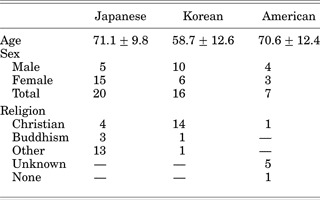
In Japan, 20 terminally ill cancer patients in two hospice wards participated in the present study. In Korea, 16 terminally ill cancer patients in three hospice wards participated, and in America, 7 terminally cancer patients in two hospice wards participated. The inclusion criteria for this study were (1) the patient had cancer, (2) the patient had no cognitive impairment, and (3) the patient was 20 years of age or older. Table 1 shows the basic demographic data.
The background of the participants

Outcome Measurements
We refer to the sense of meaning as measured by the FACIT-Sp (Peterman et al., Reference Peterman, Fitchett and Brady2002; Noguchi et al., Reference Noguchi, Ono and Morita2004) in this study. The FACIT-Sp consists of two domains, meaning of life and religious matters, and we used only the former, which contains about eight items each measured on a five-points scale (range 0–4). Total FACIT-Sp scores ranged from 0 to 32. High scores indicate an elevated sense of life meaning or a peaceful state of mind. To measure levels of anxiety and depression, we used the Hospital Anxiety and Depression Scale (HADS; Zigmond & Snaith, Reference Zigmond and Snaith1983; Kugaya et al., Reference Kugaya, Akechi and Okuyama1998). HADS scores ranged from 0 to 42.
Procedure
The ethical aspect of this study was validated by both the ethical committee of St. Mary's Hospital and St. Mary's College. The Short-Term Life Review Interview consisted of two sessions. The duration of each interview session ranged from about 30 to 60 min., and 1 week elapsed between the first and second sessions. The following questions were asked in the first interview session: (1) “What is the most important thing in your life and why?” (2) “What are the most impressive memories in your life?” (3) “In your life, what was the event or person who affected you the most?” (4) “What is your most important role in your life?” (5) “What is the proudest moment of your life?” (6) “Is there anything about you that your family needs to know? Are there things you want to tell them, and, if possible, are there things you want them to remember?” and (7) “What advice or word of guidance do you wish to pass on to the important people in your life or to the younger generation?” Question Items 6 and 7 were included in order to enable a comparison of Chochinov et al.'s concept of legacy (2005).
The patients' narratives were recorded. After the first session, the interviews were transcribed verbatim and the interviewer then made a simple album. The album included key words from the answers to each question, and the interviewers pasted photos or drawings from various books or magazines related to the patients' words or phrases into the albums in order to make them more beautiful and memory provoking. In the second session, held a week after the first session, the patient and the interviewer viewed the albums together and confirmed their contents. The interviewer tried to get the patient to feel a continuity of self from past to present and a sense of satisfaction with his life. The therapy took a total of 1 week.
Medical staff members (clinical psychologists, medical social workers, and nurses) performed the Short-Term Life Reviews. Each session lasted about 60 min. Both pre- and postintervention, the patients completed oral questionnaires.
Analysis
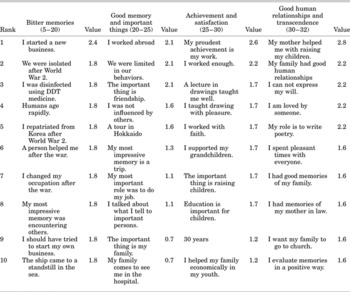
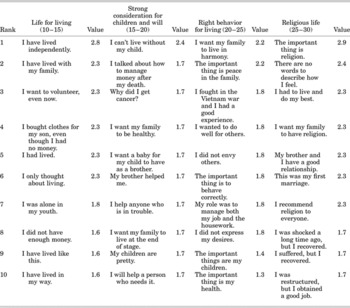
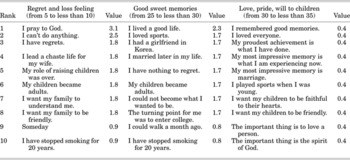
We conducted a qualitative analysis in the present study and will report a quantitative analysis including HADS score on another occasion. For a qualitative analysis, text mining is used to extract specific information from a large amount of textural data. We used Word Miner (Japan Information Processing Service, 2003). For example, when a company requires information on their customers' opinions, questions such as “What are the major concerns?” or “Who wants what?” are asked in a questionnaire. The responses are collected in the form of sentences, which are used as the raw data for text mining. In the first process of text mining, characteristic extraction was performed, that is, the words in each sentence were separated. Words that had the same meaning were counted as the same word, for example, both “mom” and “mother” were counted as “mother.” Moreover, articles or punctuation marks were deleted, leaving only meaningful words. These words are called “fragments.” Text mining elicited fragments that were then subjected to correspondence analysis for chosen effective characteristics. In the present study, we conducted correspondence analysis on fragments pertaining to FACIT-Sp scores. Significance tests to select significant (effective) fragments were conducted after correspondence analysis (Oosumi, Reference Oosumi2006); the highest- and lowest-ranking fragments were subsequently chosen for each category. The selected fragments were shown in Tables 2–4.
Categories related to level of FACIT-Sp score and the significant word in the life review in Japan

Categories related to level of FACIT-Sp score and the significant word in the life review in Korea

Categories related to FACIT-Sp score levels and significant terminology from the life review in the United States

RESULTS
In Japan, because the first concern included such fragments as “My family had good human relationships” and “I had good memories of my family,” we have chosen to refer to it as “Good human relationships and transcendence.” Because the second concern included “My proudest achievement is my work” and “I worked with faith,” we refer to it as “Achievements and satisfaction.” The third concern included such fragments as “My most impressive memory was a trip” and “The most important thing is friendship,” so we refer to it as “Good memories and important things.” Because the fourth concern included “We were isolated after World War II” and “I was disinfected using DDT medicine,” we refer to it as “Bitter memories.”
In Korea, we selected four concerns. The first concern included “The most important thing is religion” and “I want my family to have religion,” so we refer to it as “Religious life.” The second concern included “I want my family to live in harmony” and “I wanted to do good for others,” so we refer to it as “Right behavior for living.” Because the third concern included fragments such as “I can't live without my child” and “I wanted to have a baby for my child,” we refer to it as “Strong consideration for children and will.” The fourth concern included “I have lived independently” and “I had lived”; we thus refer to it as “Life for living.”
In the United States, we selected three concerns. Because the first concern included “I loved everyone,” “My proudest achievement is what I have done,” “I want my children to be friendly,” we refer to it as “Love, pride, will.” The second concern included “I lived good life” and “I had a girlfriend in Korea,” so we refer to it as “Good, sweet memories.” The third concern included “I can't do anything” and “I regret,” and we refer to it as “Regret and feelings of loss.”
DISCUSSION
The first item of note emerging from this study is that the primary concerns elicited in the Short-Term Life Reviews differed by country, despite the fact that the patients all received the same questions. In Japan, “Good human relationships and transcendence” was the primary patient concern, with high FACIT-Sp scores. Because maintaining good human relationships with families or others is an important factor in the spiritual well-being of terminally ill Japanese cancer patients (Murata & Morita, Reference Murata and Morita2006), facilitating a review of good family memories may improve their spiritual well-being. Additionally, Japanese patients who believe in the existence of transcendent matter or things and who believe that transcendent matter controls their own destinies did not try to control their lives and had peace of mind. Moreover, when patients could recall some achievements in their lives, they expressed satisfaction with their lives. However, when they had bitter memories with effects lingering into the present, their levels of spiritual well-being were low.
“Religious life” was a primary concern among Korean patients. Most of the participants in the present study were Christians, and their relationships with God may be important to their lives. A related concept, “Right behavior for living,” was also an important factor. Patients who recalled kind gestures toward other people or doing good for others were satisfied with their lives. This concern may have a Confucian influence. Conversely, patients who reviewed only severe past memories about living or meals that they could not evaluate positively or even in a balanced way showed low FACIT-Sp scores.
In America, “Love, pride, will to children” was the primary concern. Patients wanted to express their love and make their families understand that love. Moreover, patients who were proud of their achievements wanted to tell them to important persons. As for “Good, sweet memories,” patients seemed to evaluate both positive and negative memories with acceptance. However, when they had strong feeling of regret or loss, their FACIT-Sp scores were low.
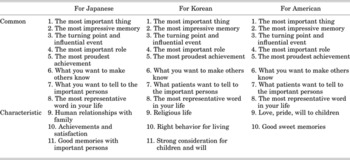
When we compare the primary concerns in the Short-Term Life Review related with spiritual well-being, “Love for the family” or “Good memories” were common concerns for patients with high spiritual well-being in all three countries. Moreover, “Bitter memories,” “Severe memories,” or “Regret” were common concerns among patients with low spiritual well-being in all three countries. However, some characteristics were unique to specific countries. The concern for “humane family relationships” was important for Japanese people, which is supported by a previous study (Ando et al., Reference Ando, Morita and O'Conner2007a). For Koreans, the “religious factor” was important. This is because it was associated with their mental health (George et al., Reference George, Ellison and Larson2002), and religious resources provide a sense of meaning and purpose (Jenkins & Pargament, Reference Jenkins and Pargament1995). “Pride or will” was particularly important for the American patients, which suggests that dignity or legacy may be important in Western cultures and that Dignity Therapy may be effective among these populations (Chochinov et al., Reference Chochinov, Hack and Hassard2005). Few Japanese patients mentioned their legacies for their children in the present study. Thus, we can now present a new variation on the Short-Term Life Review, one that is tailored to cultural differences (Table 5).
A sample of program (question items) of the Short-Term Life Review that is tailored to each country

Although it is very difficult for different kinds of professional researchers to implement the same research protocols within the same limited time periods, the first limitation of this research was the small number of participants from the United States. As a result of this fact, the range of FACIT-Sp scores among American participants was quite narrow, and we wonder if there are other concerns with ranking of FACIT-Sp scores. The second limitation of this study was the lack of a control group. However, despite these limitations, the present study seems very important in clarifying differences in the primary concerns through international comparison.
ACKNOWLEDGMENT
A grant was provided by the Phyzer Health Research Foundation.