Introduction
Intimate partner violence (IPV) is a major international health problem that affects the lives of millions of women and their children. Roughly one in three women in the world who has ever been in an intimate relationship has been sexually or physically assaulted by an intimate partner at some point in their lives (Garcia-Moreno et al., Reference Garcia-Moreno, Jansen, Ellsberg, Heise and Watts2006; Devries et al., Reference Devries, Joelle, Mak, García-Moreno, Petzold and Child2013). Intimate partner violence is widespread in India, where it is seen as justified in some circumstances by more than half of all men and women. Nearly one in five ever-married women in India have experienced a violent attack by an intimate partner and, in at least one state, more than half of ever-married women have been victimized (IIPS & Macro International, 2007).
These women suffer a range of mental, physical and reproductive health problems as a result of IPV (Campbell, Reference Campbell2002). Several studies also report that women subjected to IPV are less likely to use contraception and more likely to experience interference in their efforts to do so (Maxwell et al., Reference Maxwell, Devries, Zionts, Alhusen and Campbell2015), thereby exposing them to increased risks of unwanted pregnancy and childbirth (Pallitto & O’Campo, Reference Pallitto and O’Campo2004; Pallitto et al., Reference Pallitto, Campbell and O’Campo2005; Silverman et al., Reference Silverman, Gupta, Decker, Kapur and Raj2007; Alio et al., Reference Alio, Salihu, Nana, Clayton, Mbah and Marty2011). Aside from the risk of sexual violence, these patterns are thought to indicate the effects of reproductive coercion as some men resort to violence to prevent their partners from accessing contraception, promote pregnancy and impose their fertility preferences on their partners (Moore et al., Reference Moore, Frohwirth and Miller2010; Miller et al., Reference Miller, Decker, McCauley, Tancredi, Levenson and Waldman2010a, Reference Miller, Jordan, Levenson and Silvermanb). These patterns have been observed for both specific methods (e.g. condoms or sterilization) and broad categories of methods (e.g. Hathaway et al., Reference Hathaway, Willis, Zimmer and Silverman2005; Fantasia, Reference Fantasia, Sutherland, Fontenot and Lee-St. John2012; Stephenson et al., Reference Stephenson, Jadhav and Hindin2013).
Despite some empirical support for the connection between violence and contraception, the evidence that IPV consistently impedes contraceptive use is mixed – especially in the developing world where the prevalence of IPV and unmet demand for contraception is high (Dalal et al., Reference Dalal, Andrews and Dawad2012; Stephenson et al., Reference Stephenson, Jadhav and Hindin2013; Raj & McDougal, Reference Raj and McDougal2015). Some studies have observed a positive relationship between violence and contraception, claiming that those experiencing IPV are more likely than other women to try to protect themselves against unwanted pregnancy (Fanslow et al., Reference Fanslow, Whitehead, Silva and Robinson2008; Alio et al., Reference Alio, Daley, Nana, Duan and Salihu2009; Okenwa et al., Reference Okenwa, Lawoko and Jansson2011; Dalal et al., Reference Dalal, Andrews and Dawad2012; Raj & McDougal, Reference Raj and McDougal2015). Positive links between IPV and sterilization and other methods of contraception have also been interpreted as the result of men attacking partners in response to them using contraception (Rao, Reference Rao1997; Kaye, Reference Kaye2006). Others have either failed to find an association between violence and contraceptive use or suggested they are linked only in specific settings or situations (Martin et al., Reference Martin, Kilgallen, Tsui, Maltra, Singh and Kupper1999; Chan & Martin, Reference Chan and Martin2009; Ogunjuyigbe et al., Reference Ogunjuyigbe, Akinlo and Oni2010; O’Hara et al., Reference O’Hara, Tsai, Carlson and Haidar2013; Stephenson et al., Reference Stephenson, Jadhav and Hindin2013).
One plausible explanation for these inconclusive results is that the influence of violence on contraceptive behaviour is not categorical. Without the intention to use contraception, there is little reason to think that experiencing violence should have any effect on whether women start using contraception. In similar respects, men who want children might have an incentive to restrict their partners’ access to contraception, but those who share an interest in limiting births are unlikely to try to prevent their partners from practising effective contraception. The same would apply to women who intend to have children in the future, but plan to use contraception to control the timing of pregnancy. In either case, only those women whose partners are likely to oppose their use of contraception are at risk of their partners trying to prevent them from using contraception. Of course, men might engage in violence even against partners with whom they agree on the use of contraception, the preferred timing of pregnancies or the desired number of children. But their violence is unlikely to preclude those women from accessing contraception. The key determinant of whether violence is likely to prevent women from using contraception is whether their male partners’ fertility preferences and attitudes to contraception contradict their plans to use it.
The purpose of this study is to test the above hypothesis, in the context of India, and help clarify the relationship between IPV and contraceptive use. Specifically, it investigates whether the negative effects of violence on women’s contraceptive use are confined to couples in which women intend to use contraception despite their husbands’ desire for more children – couples with discordant preferences for contraception. There are approximately 31 million married women in India with an unmet demand for contraception, accounting for more of global unmet need than any other country (Sedgh et al., Reference Sedgh, Hussain, Bankole and Singh2007; Alkema et al., Reference Alkema, Kantorova, Menozzi and Biddlecom2013). Prior studies indicate that violence does not consistently undermine contraceptive use in India (Stephenson et al., Reference Stephenson, Jadhav and Hindin2013; Raj & McDougal, Reference Raj and McDougal2015); nonetheless, little is known about the reasons why violence might have inconsistent effects on reproductive health among Indian women.
Methods
Data from the 1998–99 National Family Health Survey (NFHS-2) and a longitudinal follow-up survey conducted in 2002–03 among a subsample of the original respondents were analysed. The NFHS-2 is a national survey of Indian households that incorporates a representative sample of ever-married women of childbearing age (15–49 years) living in 26 states. The follow-up survey was administered to a subsample of the original respondents – rural, married women aged 15–39 who were living in Bihar, Jharkhand, Maharashtra and Tamil Nadu. Of particular importance, the original NFHS-2 survey (i.e. the baseline) included a series of questions about experiences of violent victimization, including violence perpetrated by intimate partners. The combination of these surveys, and the items they measure, enabled the links between IPV and subsequent contraceptive behaviour to be examined.
The analyses were based on the sample of fecund mothers who participated in both surveys, were not already using contraception at baseline, were still married at the time of the follow-up survey and had complete data on the variables of interest (N=2834). The analyses were restricted to women who were not using contraception at the time of the baseline study; hence, they indicate whether women with recent experiences of IPV were less likely than others to subsequently begin using contraception. This is an important advance beyond prior research: in contrast to studies using cross-sectional research designs, any association that might be observed between violence and the use of contraception in couples with divergent fertility preferences cannot be attributed to the possibility that violent men are more likely to abuse partners who begin using contraception against their wishes.
Dependent and key independent variables
Sterilization indicates whether respondents had undergone sterilization at any point between the baseline and follow-up surveys (1=Yes, 0=No). Other method of contraception records respondents who used any modern method of contraception, excluding sterilization, at any stage since the baseline survey (1=Yes, 0=No). Women using traditional contraceptive methods, such as periodic abstinence, were classified as not using contraception. Intimate partner violence indicates whether respondents experienced at least one incident of physical abuse by their husbands in the year preceding the baseline survey (1=Yes, 0=No). Intends to use contraception indicates women who were not using contraception at the time of the baseline interview, but who thought they would use a method to delay or avoid pregnancy in the future (1=Yes, 0=No). No more children (Husband) indicates women who reported their spouses wanted them to discontinue childbearing (1=Yes, 0=Undecided, willing to leave parenthood to chance or intentions unknown). In the absence of any direct measures of men’s attitudes to contraception, men’s desire for children most closely approximates whether they are likely to be opposed to their partners using contraception.
These two variables were interacted with violence to determine if the impact of violence on contraceptive use is conditional on either men’s preferences for more children or women’s intentions to use contraception. The analyses also included an interaction between all three variables (i.e. violence, women’s contraceptive intentions and men’s fertility preferences) to ascertain whether the impact of violence depends on the discrepancy between men’s attitudes to childbearing and women’s desire to control fertility. A third variable, No more children, identified women who said they would prefer not to have any more children at the time of the baseline interview (1=Yes, 0=No). It controls for the impact of women’s fertility preferences on actual contraceptive use. Given that many women may use contraception for spacing, both those who wanted more children and those who did not were included in the analyses.
Other independent variables
The analyses controlled for several factors correlated with contraceptive use, as indicated in previous studies (e.g. Bhat & Zavier, Reference Bhat and Zavier2003; McNay et al., Reference McNay, Arokiasamy and Cassen2003; Morsund & Kravdal, Reference Moursund and Kravdal2003; Dharmalingam & Morgan, Reference Dharmalingam and Morgan2004; Bloom & Griffiths, Reference Bloom and Griffiths2007; Stephenson et al., Reference Stephenson, Koenig, Acharya and Roy2008). Dummy variables indicated whether women had very high, high, medium, low or very low autonomy based on the number of life domains in which they were excluded from making basic decisions (e.g. about what to cook, getting access to health care, buying jewellery and other significant items for the household, and visiting and staying with relatives) by partners or other household members (1=Yes, 0=No). The model also controlled for financial autonomy, based on whether respondents could set aside money to use as they wished (1=Yes, 0=No) and self-employment (1=Yes, 0=No).
A series of dummy variables identified respondents (and their husbands) who had completed primary (1=Yes, 0=No), secondary or post-secondary schooling. Other measures of socioeconomic status included agricultural employment (1=Yes, 0=No), measured separately for respondents and their husbands, the number of household assets (i.e. one, two or three or more of the following: electricity, telephone, running water, radio, television, refrigerator, bicycle, motorcycle and car) and household living standards using the NFHS-2 Standard of Living Index (i.e. low, medium or high living standards). Three dummy variables measuring exposure to media identified respondents with access to TV and radio, either TV or radio, or neither TV nor radio.
Using a series of dummy variables, the analyses also adjusted for parity (i.e. 1–2, 3–4, ≥5 children), living sons (1=Yes, 0=No), whether any of the respondent’s children had died (1=Yes, 0=No) and son preference – whether the respondent’s ideal number of male children exceeded the ideal number of girls (1=Yes, 0=No). To control for the influence of sexual and reproductive health awareness on contraceptive use (Chandra-Mouli et al., Reference Chandra-Mouli, McCarraher, Phillips, Williamson and Hainsworth2014), indicators of whether respondents had seen or heard any messages about family planning through various media (1=Yes, 0=No) or had heard of AIDS (1=Yes, 0=No) were included. Knowledge of HIV/AIDS in particular has also been linked to increased condom use in other developing countries and to factors correlated with violence and contraceptive use in India (e.g. Meekers, Reference Meekers2000; Maharaj & Cleland, Reference Maharaj and Cleland2005; Bloom & Griffiths, Reference Bloom and Griffiths2007). Controls for age and whether respondents were Muslim (1=Yes, 0=No), Scheduled Tribe members (1=Yes, 0=No) or belonged to a Scheduled (1=Yes, 0=No) or Backward Caste (1=Yes, 0=No) were also included.
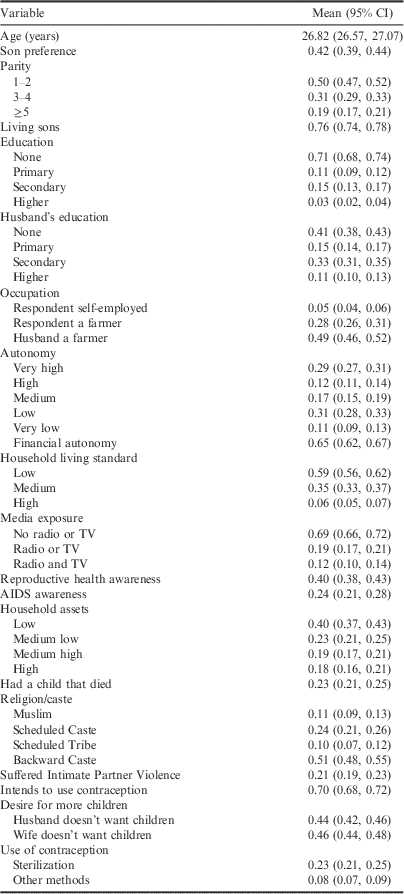
In most cases, the measurement of control variables followed the example of other studies that also used the NFHS-2 (e.g. Bhat & Zavier, Reference Bhat and Zavier2003; Morsund & Kravdal, Reference Moursund and Kravdal2003; Stephenson et al., Reference Stephenson, Koenig, Acharya and Roy2008). All independent variables were recorded at the time of the NFHS-2 baseline survey administered in 1998–1999, whereas dependent variables were measured at the time of the follow-up survey in 2002–2003. Descriptive statistics for all variables are reported in Table 1.
Descriptive statistics of respondent women, N=2834
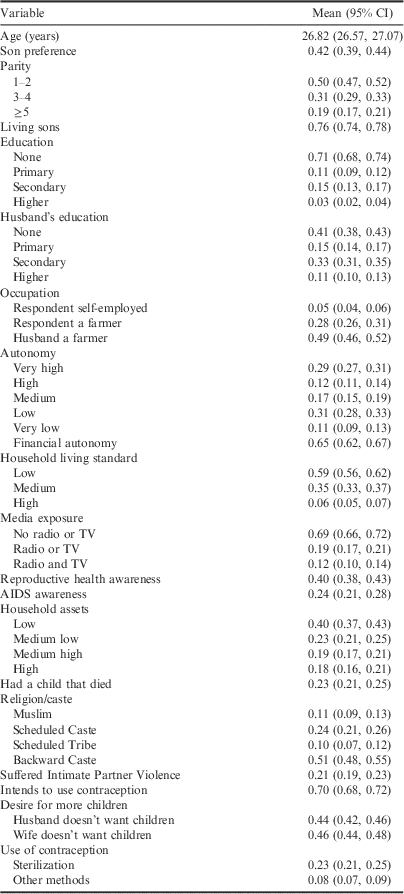
The table reports the mean scores for respondents in the estimation sample on dependent and independent variables (with 95% confidence intervals).
Analytical method
Several logistic regression models were estimated. First, in separate models, the two indicators of contraceptive use were regressed on the measures of IPV, contraceptive intentions and men’s childbearing intentions. Because women who were using contraception at the time of the baseline study were excluded from these analyses, the results indicate the likely effects of IPV on subsequent contraceptive behaviour, net of childbearing aspirations and contraceptive intentions. The analyses were restricted to the initiation of contraceptive use because the most common method of contraception in India is permanent; hence, very few women desist from using contraception. Second, these baseline models were then replicated with two-way and three-way interactions between violence, (women’s) contraceptive intentions and (men’s) childbearing intentions included. The two-way interactions determine whether the effects of violence on contraceptive use depend on either men’s preferences for more children (i.e. violence×men’s childbearing preferences) or on women’s intentions to use contraception (i.e. violence×women’s contraceptive intentions). The three-way interaction (i.e. violence×men’s childbearing preferences×women’s contraceptive intentions) tests whether the impact of violence is conditional on the discrepancy between men’s attitudes to childbearing and women’s desire to control fertility. Thus, the interactions evaluate the central hypothesis by indicating whether the effects of IPV on contraceptive use are conditional on whether women were intending to use contraception, whether their partners desired more children, or both – whether women were intending to use contraception contrary to their partners’ desires to have more children.
Both the baseline and extended analyses controlled for whether respondents wanted additional children as well as known correlates of contraceptive behaviour. All analyses used logistic regression with appropriate sample weights. Estimates of standard errors were adjusted to reflect the use of sample weights and clustering within population sampling units. Categorical variables were included in the models as dummy variables to more easily discern non-linear relationships among variables. To simplify the interpretation of results, the average marginal effects of IPV and selected independent variables on the use of sterilization and other modern methods of contraception are reported in the next section. Average marginal effects reflect the estimated effect of a one-unit increase in each variable on the predicted probability of the outcome (i.e. undergoing sterilization, adopting another method of contraception) for an average respondent (i.e. when the values of other covariates are set to the sample means). Thus, the results of the baseline analyses reveal the effects of IPV on an average respondent (Models 1 and 4), whereas the extended models show the average marginal effects of IPV for an average respondent conditional on her intention to use contraception (Models 2 and 5) and the concordance between her intentions to use contraception and her partner’s desire for more children (Models 3 and 6). Full results, showing the estimated effects of other independent variables, are available on request from the authors.
Results
Despite not using contraception at the time, 70% of the women in the sample intended to use it in the future. Forty-six per cent of women and 44% of husbands did not want more children. Nonetheless, only 23% of women had undergone sterilization and only 8% were using another method of contraception by the time of the follow-up interview. One in five respondents reported at least once incident of IPV within the 12 months preceding the baseline survey (21%). Seventy-one per cent of respondents and 41% of husbands had less than primary schooling. Living standards were low for 59% of respondents – 40% lived in households with limited assets and 69% did not have either a radio or television. Twenty-eight per cent of respondents worked in agriculture and 49% were married to farmers or agricultural workers. Half of all respondents had given birth to between one and two children, 76% had at least one living son and 23% had experienced at least one child death.
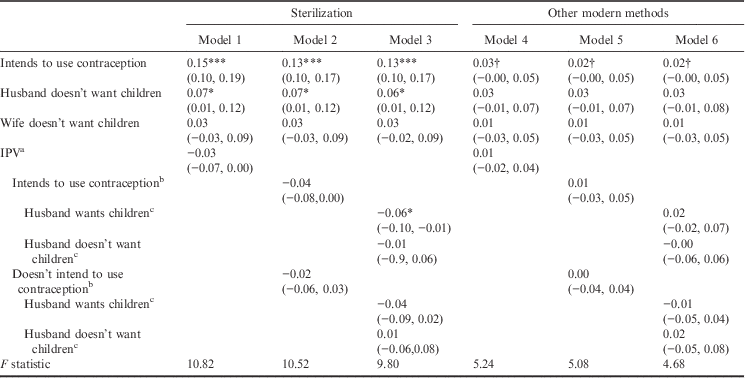
Table 2 presents the results of the logistic regression analyses of contraceptive use. The results suggest that the impact of violence on the probability of undergoing sterilization is weak. Women reporting IPV appeared less likely to have been sterilized, but the estimated effect of violence on contraceptive use was not significant at the conventional level (p=0.08). Violence also failed to affect the probability of using an alternative modern method of contraception. As these results are based on the subsample of women who were not using contraception at the time of the baseline survey, they indicate that women subjected to IPV are not less likely than other women to start using contraception. Whether women began using contraception had more to do with whether they had been intending to use it and whether their partners wanted more children. Respondents intending to use contraception were 15 percentage points more likely to undergo sterilization than women who were not intending to use contraception. Women whose spouses did not want more children were 7 percentage points more likely to have been sterilized than those whose partners wanted them to continue childbearing (or preferred to leave it to chance). It should be noted, however, that the effects of contraceptive and childbearing intentions were confined to sterilization. Although women who were intending to use contraception appeared to be slightly more likely to have started using an alternative method of contraception (other than sterilization), the effect of contraceptive intentions on the use of other modern methods was not significant (p=0.07). Whether their partners wanted more children was also unrelated to the use of other modern methods.
Adjusted average marginal effects of IPV on sterilization and use of other modern methods by respondent women, N=2834
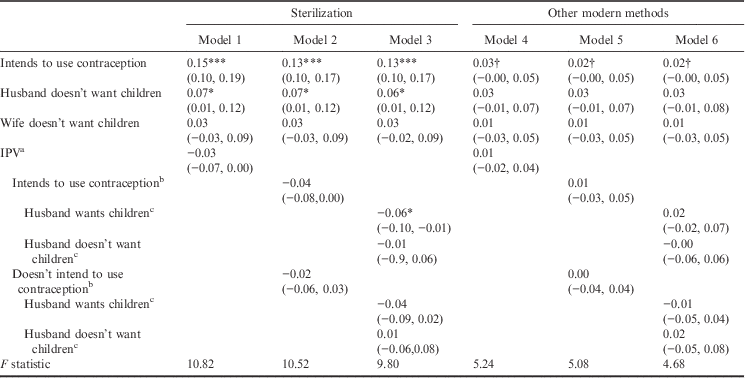
a Models 1 and 4 report the average marginal effect of IPV on an average respondent.
b Models 2 and 5 show the average marginal effects of IPV on an average respondent conditional on whether she intends to use contraception.
c Models 3 and 6 report the effects of IPV on an average respondent conditional on whether she intends to use contraception and whether her partner desires more children.
Clusters=370.
†p<0.075; *p<0.05; **p<0.01; ***p<0.001.
The results of the models containing two-way interactions between violence and contraceptive intentions also fail to support the view that violence has a categorical impact on the use of contraception. Women who were intending to use contraception and who were assaulted by their partners were 4 percentage points less likely to undergo sterilization, but the estimated effect of violence was not significant at conventional levels (p=0.08). Violence also had no effect on the probability of using other modern methods of contraception among those intending to use contraception or on the use of any method among those without plans to use contraception.
Instead, the intention to use contraception emerged as one of the strongest predictors of contraceptive behaviour. On average, women who were intending to use contraception were 13 percentage points more likely to have been sterilized and 2 percentage points more likely to have used an alternative method of contraception. Those effects were significant even after controlling for IPV and were consistent for both women who had been assaulted and those who had not, meaning that intentions matter irrespective of women’s recent experiences of spousal violence. Women whose spouses did not want additional children were 7 percentage points more likely than others to have been sterilized, even after controlling for their fertility preferences, their plans to use contraception or whether they had suffered abuse in the previous year.
The results of the three-way interactions, however, are consistent with the hypothesis that the influence of IPV on sterilization is contingent on whether men’s fertility preferences and women’s plans to use contraception conflict – its effect was confined to women who were planning to use contraception and whose spouses wanted additional children. When exposed to IPV, these women were 6 percentage points less likely to have undergone sterilization than women who had not been victimized. Among other intended users – women whose partners did not want additional children – IPV had no discernible effect on the chances of undergoing sterilization. Their rates of sterilization were already high (and above those of all other groups). Violence also had no effect on the probability of undergoing sterilization among women who were not intending to use contraception, for whom the probability of sterilization remained low irrespective of their experiences of IPV or whether their spouses wanted more children.
There was no evidence that violence had any effect on the probability of using an alternative modern method of contraception. Women who were intending to use contraception and who were exposed to IPV were not less likely to use alternative methods of contraception than other women, irrespective of whether their partners wanted additional children. As in the model of sterilization, contraceptive intentions predicted actual contraceptive use better than any other independent variable. Women who had previously indicated that they intended using contraception were 2 percentage points more likely than other similarly placed women to have started using a modern method of contraception (other than sterilization) between the baseline and follow-up surveys, regardless of whether they had suffered abuse at the hands of their partners.
Discussion
The major finding of this study is that whether IPV alters patterns of contraceptive use depends on whether women intend to use contraception and whether their partners want more children. Women exposed to IPV were less inclined to undergo sterilization, but only if they were already intending to use contraception despite their partners wanting more children. By contrast, violence had no effect on sterilization among women who were not intending to use contraception or whose spouses wished to limit family size. Although violence did not affect the use of other contraceptive methods, its impact on the use of the most popular method of contraception in India is contingent on whether the couples’ attitudes to contraception are likely to conflict.
That is not to say that violence is confined to relationships in which couples disagree about fertility and the use of contraception. Indeed, women who plan to use contraception were not at greater risk of violence even if their husbands wanted them to continue childbearing. However, the results of the current study show clearly that whether violence precludes women from using contraception depends on whether the couple is likely to disagree about its use. Women who do not plan to use contraception are unlikely to use it, irrespective of whether they experience violence at the hands of their partners. Men who do not want children have little reason to oppose the use of contraception. Even if they are prone to violence, therefore, there is little reason to expect that such violence should affect the couple’s use of contraception.
These findings help to clarify the relationship between IPV and contraceptive use, identifying the circumstances in which IPV is most likely to undermine contraceptive use among women. They might also explain why previous studies have reached conflicting conclusions about how IPV influences contraceptive behaviour (e.g. Alio et al., Reference Alio, Daley, Nana, Duan and Salihu2009; Chan & Martin, Reference Chan and Martin2009; Ogunjuyigbe et al., Reference Ogunjuyigbe, Akinlo and Oni2010; Okenwa et al., Reference Okenwa, Lawoko and Jansson2011; Dalal et al., Reference Dalal, Andrews and Dawad2012; Stephenson et al., Reference Stephenson, Jadhav and Hindin2013; Raj & McDougal, Reference Raj and McDougal2015). Given that most couples hold similar childbearing intentions and views about contraception (Becker, Reference Becker1996), the results imply that violence is only likely to alter contraceptive behaviour in a minority of cases – those couples who disagree about their fertility plans and need for contraception. Studies that estimate the average relationship between IPV and contraceptive use may fail to uncover the relationship because the influence of IPV is negligible in most cases. As the percentage of couples with divergent contraceptive or fertility preferences increases, the effects of violence on contraceptive use may become apparent.
It is also possible that IPV increases contraceptive use among women who wish to avoid using contraception and whose partners support its use, which could account for the positive associations observed in some prior studies (Alio et al., Reference Alio, Daley, Nana, Duan and Salihu2009; Okenwa et al., Reference Okenwa, Lawoko and Jansson2011; Dalal et al., Reference Dalal, Andrews and Dawad2012; Raj & McDougal, Reference Raj and McDougal2015). Although violence and contraceptive use were not positively related in this study, violence might enable men who favour using contraception to compel their partners to use it, just as it enables men who probably oppose its use to prevent it. Future studies could investigate this issue further by replicating the current approach and paying attention to the contingent relationships between violence and contraceptive use in other settings, especially those in which more partners disagree or in which pronatal tendencies are stronger among women than men.
These results are consistent with studies documenting IPV as a method of reproductive coercion (Moore et al., Reference Moore, Frohwirth and Miller2010; Miller et al., Reference Miller, Decker, McCauley, Tancredi, Levenson and Waldman2010a, Reference Miller, Jordan, Levenson and Silvermanb). Those studies have shown that, even in the context of consensual sexual relationships, some violent men may resist using contraception, prevent their partners from using it, or sabotage its effectiveness (Moore et al., Reference Moore, Frohwirth and Miller2010; Miller et al., Reference Miller, Decker, McCauley, Tancredi, Levenson and Waldman2010a, Reference Miller, Jordan, Levenson and Silvermanb). Threats of violence may also discourage some women from trying to use contraception, or even lead them to avoid discussing it with their partners, for fear of how their partners might react (Kalichman et al., Reference Kalichman, Williams, Cherry, Belcher and Nachimson1998; Miller et al., Reference Miller, Decker, Reed, Raj, Hathaway and Silverman2007; Moore et al., Reference Moore, Frohwirth and Miller2010). Although the current study did not address the motivations behind violence, other studies have suggested that violent men may engage in a range of controlling behaviours and often use violence to help them maintain that control (e.g. Felson & Messner, Reference Felson and Messner2000). That violence prevents contraceptive use only among women who plan to use it, against the apparent wishes of their husbands, implies that the actions of those men may be deliberate acts of reproductive control, specifically aimed at promoting pregnancy – as some other studies have suggested (e.g. Miller et al., Reference Miller, Jordan, Levenson and Silverman2010b).
These results imply that violence enables some men to resolve marital disputes about fertility and contraception by imposing their preferences on their partners. That is not to say that violence does not occur in other situations nor does it mean that reproductive control is absent from other relationships. Reproductive control may also take the form of men exerting pressure on their partners to conform to their fertility preferences, with or without violence. There is some evidence that men are more likely to dominate reproductive decisions and outcomes in social settings marked by high levels of gender inequality and that individual and family circumstances that increase women’s empowerment can moderate that influence (Bankole, Reference Bankole1995; Mason & Smith, Reference Mason and Smith2000; Hossain et al., Reference Hossain, Phillips and Mozumder2007). The results of the current study merely imply that spousal violence may be part of a broader pattern of inequality that prevents women from controlling their own reproduction and amplifies men’s influence on reproductive outcomes. Eliminating relationship violence is not only likely to protect women from the immediate risks of injury and harm, but may also help increase their autonomy.
These findings have important policy implications. They provide further evidence that programmes aimed at reducing IPV may help boost rates of contraceptive adoption. Violence undermines the capacity of some women to practise contraception; hence, strategies aimed at preventing IPV should be incorporated into family planning programmes that aim to increase contraceptive use among women. Programmes that target couples with discordant fertility preferences and aim to prevent men from using violence to impose their fertility preferences on their partners are likely to have the greatest effect on contraceptive use. Admittedly, the overall influence of violence prevention programmes may be modest – estimates based on the results presented here suggest that reducing violence might only lead to increased contraceptive use among one in fifteen women. In heavily populated states such as Bihar, Maharashtra and Tamil Nadu, however, even these modest improvements could help thousands of women access contraception, prevent thousands of unplanned births every year, and save lives (Ahmed et al., Reference Ahmed, Li, Liu and Tsui2012).
Programmes that seek to reduce unmet need for contraception are likely to be even more successful if they focus on eliminating the more significant obstacles to contraceptive use, especially opposition to family planning among men. The desire for more children among married men was one of the strongest correlates of whether their wives began using contraception, even after controlling for whether their wives wanted to use contraception or whether they wanted additional children. By contrast, whether women wanted more children did not affect their chances of undergoing sterilization or using an alternative modern method independently of whether their husbands wanted children or whether they were planning to use contraception. These results imply that family planning programmes must engage men as well as women to be successful, as others have noted (Becker, Reference Becker1996), and provide some insights into how such programmes ought to respond to the role of men in fertility behaviour. Reducing discord between partners, by reducing the childbearing aspirations of men whose wives want to discontinue childbearing, may be one of the most effective ways of increasing rates of contraceptive use among women in rural India.
The results raise the possibility that conflict between men’s fertility preferences and their wives’ intentions to use contraception conditions the impact of violence on sterilization more than on other methods of contraception. Some methods may be more suited to covert use than sterilization. For example, injections may be relatively easy to hide making it more difficult for partners to interfere with their use, whereas sterilization may require women to involve their husbands more thereby reducing their capacity to resist reproductive control. Sterilization is also a non-reversible method, meaning that conflict over its use in the case of couples with opposing preferences might be more intense. Alternatively, it could be that violence did not affect the use of alternative methods merely because very few women in the sample used methods of contraception other than sterilization. Perhaps future studies will replicate the analyses reported here using samples in which greater proportions of women use a greater variety of methods.
As with any research project, this study has some limitations. The analyses were limited to women who were not using contraception at the time of the baseline survey. This may have led to some underestimation of the effect of violence on contraceptive behaviour and the potential effects of violence on contraceptive use at the time of the baseline survey. Respondents were also not asked about their experiences of specific acts of violence, including sexual violence. Questions that ask about specific types of violence generally provide comparable estimates of prevalence, however, to the kinds of questions used in the NFHS-2 (Devries et al., Reference Devries, Joelle, Mak, García-Moreno, Petzold and Child2013). As for sexual violence, it is much less common than non-sexual physical violence and largely absent from relationships not also characterized by non-sexual physical abuse (Garcia-Moreno et al., Reference Garcia-Moreno, Jansen, Ellsberg, Heise and Watts2006). Measuring IPV in the year preceding the baseline survey might also have exaggerated the relationship between violence and contraceptive use given that more contemporaneous measures are likely to be correlated more strongly.
These caveats aside, the results of this study clearly show that, in specific circumstances, violence can undermine women’s capacity to use contraception; nonetheless, the effects of IPV on contraceptive use are not categorical. Violence only undermines contraceptive use among women who intend to use contraception and whose partners want more children. At some point it seems reasonable to conclude that, at least in some circumstances, IPV is a form of instrumental violence used by men to impose their fertility preferences on their partners.
Acknowledgments
The authors thank Paco Perales, Kerry O’Brien, the journal editor and the journal’s anonymous reviewers for helpful comments on earlier drafts of this article.