Introduction
The theory of cognitive reserve posits that certain life experiences mitigate the impact of brain pathology on cognition by promoting the adaptive use of neural networks (Stern, Reference Stern2002, Reference Stern2009). For example, Stern et al. (Reference Stern, Zarahn, Habeck, Holtzer, Rakitin, Kumar and Brown2008) describe a potential cognitive reserve network characterized by increased expression in superior frontal gyrus and reduced expression in medial frontal gyrus that was associated with task difficulty and proxy variables of reserve, but not task performance. Cognitive reserve is an important variable in explaining why individuals with similar levels of brain pathology perform differently on cognitive tests and differ in time to dementia. However, the precise mechanisms that underlie the protective effects of cognitive reserve are unknown.
The major barrier to studying cognitive reserve lies in its measurement (Jones et al., Reference Jones, Manly, Glymour, Rentz, Jefferson and Stern2011; Satz, Cole, Hardy, & Rassovsky, Reference Satz, Cole, Hardy and Rassovsky2011). Historically, cognitive reserve has been indexed by proxy variables, such as education or occupational attainment. As indices of cognitive reserve, proxy variables are imprecise because they may relate to cognitive performance for reasons other than the “reserve” mechanism (i.e., promoting the adaptive use of neural networks). For example, education correlates with childhood IQ, socioeconomic status, risk of disease, and health behaviors (Reed et al., Reference Reed, Mungas, Farias, Harvey, Beckett, Widaman and DeCarli2010). In addition, the same value on a proxy variable (e.g., 12 years of education) does not reflect the same experience in all people (Jones, Reference Jones2003; Manly, Jacobs, Touradji, Small, & Stern, Reference Manly, Jacobs, Touradji, Small and Stern2002). Thus, the effects of proxy variables cannot be interpreted solely as the effects of cognitive reserve.
A problem with using a single proxy variable is that cognitive reserve is conceptualized as a confluence of life experiences. Thus, any single variable likely fails to measure the entirety of the construct. Factor analytic approaches have been proposed to overcome this shortcoming (Siedlecki et al., Reference Siedlecki, Stern, Reuben, Sacco, Elkind and Wright2009). However, operationalizing reserve as the shared variance between multiple proxy measures (e.g., education, occupational attainment, leisure activities) does not capture the unique contributions of each variable to cognitive reserve. Indeed, studies have shown that the effects of common proxy variables on cognition are independent (Reed et al., Reference Reed, Dowling, Farias, Sonnen, Strauss, Schneider and Mungas2011). Finally, most proxy measures of cognitive reserve are static and cannot be measured over time despite belief by many in the modifiability of cognitive reserve (Borenstein, Copenhaver, & Mortimer, Reference Borenstein, Copenhaver and Mortimer2006).
Previously, our group explored the concept of cognitive reserve in Alzheimer's disease (AD) by isolating the variance in pathophysiological severity independent of clinical status (Stern, Alexander, Prohovnik, & Mayeux, Reference Stern, Alexander, Prohovnik and Mayeux1992; Stern et al., Reference Stern, Alexander, Prohovnik, Stricks, Link, Lenon and Mayeux1995). In these studies, pathophysiological severity was defined as lower cerebral blood flow in parietotemporal cortex, as measured via the 133-xenon inhalation technique (Obrist, Thompson, Wang, & Wilkinson, Reference Obrist, Thompson, Wang and Wilkinson1975). In individuals with AD, higher educational attainment was positively associated with residual variance in pathophysiological severity after accounting for cognitive and functional abilities (Stern, Alexander et al., Reference Stern, Alexander, Prohovnik and Mayeux1992). In other words, individuals with more education exhibited similar clinical symptoms despite more severe pathology. In follow-up studies, occupational attainment and leisure activity were also positively associated with this residual variance (Scarmeas et al., Reference Scarmeas, Zarahn, Anderson, Habeck, Hilton, Flynn and Stern2003; Stern et al., Reference Stern, Alexander, Prohovnik, Stricks, Link, Lenon and Mayeux1995). These findings provided evidence for cognitive reserve and suggested that proxy variables of educational and occupational attainment are independently related to reserve.
Recently, Reed and colleagues proposed an alternative method for quantifying cognitive reserve. Instead of isolating variance in pathological severity independent of clinical status, these authors isolated variance in cognitive performance independent of pathological severity. Specifically, they quantified cognitive reserve as variance in episodic memory performance that remains after accounting for demographic factors and structural brain changes (Reed et al., Reference Reed, Dowling, Farias, Sonnen, Strauss, Schneider and Mungas2010, Reference Reed, Mungas, Farias, Harvey, Beckett, Widaman and DeCarli2011). This “residual” method is in line with a definition of cognitive reserve as the discrepancy between observed performance and expected level of performance based on pathology. In this method, individuals who perform better than predicted will have high cognitive reserve, and individuals that perform worse than predicted will have low reserve. This residual reserve variable differs from a true score because variance related to demographics and brain variables are partialed out, in addition to error.
Reed et al. (Reference Reed, Mungas, Farias, Harvey, Beckett, Widaman and DeCarli2010) presented a series of analyses illustrating the utility of this method in a sample of 305 older adults. Specifically, they demonstrated that a higher level of the residual reserve variable: (1) was associated with lower likelihood of meeting criteria for mild cognitive impairment (MCI) or dementia at baseline, (2) correlated with an independent proxy measure of cognitive reserve (i.e., reading ability), (3) reduced the risk of dementia conversion over 3 years, (4) was associated with less decline on a composite measure of executive functioning over 3 years, and (5) moderated the association between memory performance attributable to brain variables and change in executive functioning over 3 years, as shown by a significant interaction between brain-related variance and residual variance. Follow-up work demonstrated relationships between the residual reserve variable and other proxy measures, including education and leisure activities (Reed et al., Reference Reed, Dowling, Farias, Sonnen, Strauss, Schneider and Mungas2011).
The primary goal of the present study was to extend Reed and colleagues’ methods and findings using a larger, community-based sample. Specifically, we investigated whether the residual reserve variable predicted longitudinal changes in a different cognitive domain (i.e., language). Similar to findings 4 and 5 above (i.e., longitudinal changes in executive functioning), we examined relationships between the variance components and language changes over 3 years. The original model in Reed et al. (Reference Reed, Mungas, Farias, Harvey, Beckett, Widaman and DeCarli2010) did not include age; we added an examination of the relationship between age and the residual reserve variable. Importantly, we compared the ability of the residual reserve variable to predict 3-year dementia conversion to that of age alone. Adding age to the model is essential for determining whether the explanatory capability of the residual reserve variable extends beyond age.
Method
Participants
The 703 older adults in this sample were participants in the Washington Heights/Hamilton Heights Inwood Columbia Aging Project (WHICAP), a prospective, community-based longitudinal study of aging and dementia in a racially and ethnically diverse sample of Medicare-eligible residents of Northern Manhattan. Study procedures and a description of the larger sample have been described previously (Tang et al., Reference Tang, Cross, Andrews, Jacobs, Small, Bell and Mayeux2001). Data were obtained in compliance with the Institutional Review Board of Columbia University Medical Center.
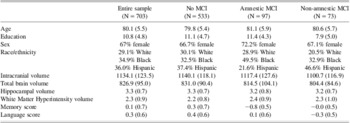
Beginning in 2004, 769 active WHICAP participants who were not demented at their previous visit received high resolution structural magnetic resonance imaging (MRI). These individuals were, on average, 1 year younger than WHICAP participants who refused MRI but had similar demographic characteristics (Brickman et al., Reference Brickman, Schupf, Manly, Luchsinger, Andrews, Tang and Brown2008). The subset of 703 individuals who also underwent a neuropsychological evaluation at the time of their MRI and did not meet criteria for dementia during this evaluation were included in the present study. Thirty-three percent of participants were tested in Spanish. Baseline characteristics of the sample are provided in Table 1.
Sample characteristics at baseline

Magnetic Resonance Imaging
MRI was obtained on a 1.5 Tesla Philips Intera scanner at Columbia University Medical Center and processed by the Imaging of Dementia and Aging Laboratory at the University of California at Davis. Total brain, cranial, and white matter hyperintensity (WMH) volumes were derived from fluid attenuated inverse recovery (FLAIR) T2-weighted images (repetition time [TR] = 11,000 ms; echo time [TE] = 144.0 ms; 2800 inversion time; field of view [FOV] 25 cm, 2 nex (number of excitations), 256 × 192 matrix with 3 mm slice thickness) using previously described procedures (Brickman et al., Reference Brickman, Schupf, Manly, Luchsinger, Andrews, Tang and Brown2008; DeCarli et al., Reference DeCarli, Grady, Clark, Katz, Brady, Murphy and Rapoport1992, Reference DeCarli, Maisog, Murphy, Teichberg, Rapoport and Horwitz1996, Reference DeCarli, Murphy, Tranh, Brady, Haxby, Gillette and Rapoport1995).WMH volumes were log transformed to normalize their distribution. To determine hippocampal volumes, three-dimensional T1-weighted images were acquired in the axial plane (TR = 20 ms; TE = 2.1 ms; FOV 240 cm; 256 × 160 matrix with 1.3 mm slice thickness) and resectioned coronally. Hippocampal boundaries were manually traced from the coronal image. See Brickman et al. (Reference Brickman, Schupf, Manly, Luchsinger, Andrews, Tang and Brown2008) for detailed information on hippocampal boundary determination. Total brain and hippocampal volumes were corrected for total intracranial volume via regression paths in the latent variable model (see Reed et al., Reference Reed, Mungas, Farias, Harvey, Beckett, Widaman and DeCarli2010).
Clinical Evaluation
Participants in WHICAP are interviewed and tested in their preferred language (English or Spanish) every 18–24 months. Assessment procedures at each visit are identical and include general health and functional ability, medical history, physical and neurological examination, and neuropsychological testing (Stern, Andrews et al., Reference Stern, Andrews, Pittman, Sano, Tatemichi, Lantigua and Mayeux1992). Among participants with follow-up data, the average length of time between the first and second assessments was 3.3 years (SD = 0.7). By the time the present analyses were conducted, 26 of these participants had been seen for a third assessment. Dementia status at this third visit was considered in the survival analysis. Due to low sample size, neuropsychological scores from this third assessment were not examined in analyses of language.
After each follow-up visit, dementia diagnoses are made by consensus of neurologists and neuropsychologists based on Diagnostic and Statistical Manual of Mental Disorders, Revised Third Edition criteria (American Psychiatric Association, 1987). Of the 63 participants diagnosed with dementia at a visit subsequent to their MRI scan, 45 were diagnosed with probable AD based on the National Institute of Neurologic and Communicative Disorders and Stroke – AD and Related Disorders Association criteria (McKhann et al., Reference McKhann, Drachman, Folstein, Katzman, Price and Stadlan1984). Six were diagnosed with Alzheimer's with stroke, one was diagnosed with Alzheimer's with Parkinson's, 10 were diagnosed with Alzheimer's with other concomitant disease (such as major depression, traumatic brain injury, etc.), and one was diagnosed with vascular dementia.
Diagnosis of MCI was made retrospectively according to standard criteria (Manly et al., Reference Manly, Bell-McGinty, Tang, Schupf, Stern and Mayeux2005, Reference Manly, Tang, Schupf, Stern, Vonsattel and Mayeux2008; Petersen, Reference Petersen2004). Specifically, MCI classification required (1) memory complaint: endorsement of one or more of 11 items assessing perceived difficulty with memory on the Disability and Functional Limitations Scale and the Blessed Functional Activities Scale; (2) objective impairment in at least one cognitive domain: average score on neuropsychological measures within a domain 1.5-SD below normative level based on age, sex, race/ethnicity, and education; (3) essentially preserved activities of daily living: endorsement by the patient or their caregivers of 2 or fewer items assessing instrumental activities of daily living from the Disability and Functional Limitations Scale; (4) no consensus diagnosis of dementia.
Neuropsychological measures
Following the methods outlined by Reed et al. (Reference Reed, Mungas, Farias, Harvey, Beckett, Widaman and DeCarli2010), a memory composite was used in the decomposition. A language composite was used as the longitudinal outcome to determine whether the findings of Reed et al. (Reference Reed, Mungas, Farias, Harvey, Beckett, Widaman and DeCarli2010) would be replicated in a cognitive domain other than executive function. Language was chosen because it is well-characterized by the WHICAP battery and is sensitive to dementia pathology.
Individual neuropsychological tests of memory and language were combined into memory and language composite scores based on a previously reported exploratory factor analysis (Siedlecki et al., Reference Siedlecki, Manly, Brickman, Schupf, Tang and Stern2010), in which resultant factor structure and factor loadings were found to be invariant across English and Spanish speakers. Composite scores were computed by converting all scores to Z-scores based on baseline mean scores and standard deviations from the larger WHICAP sample and averaging these Z-scores within each of the two domains. Z-scores were not corrected for demographics. The memory composite included the following subscores from the Selective Reminding Test (SRT; Buschke & Fuld, Reference Buschke and Fuld1974): total recall, delayed recall, and delayed recognition. The language composite included the following tests: a 30-item version of the Boston Naming Test (Kaplan, Goodglass, & Weintraub, Reference Kaplan, Goodglass and Weintraub1983), a three-trial letter fluency test, animal fluency, the Similarities subtest of the Wechsler Adult Intelligence Scale – Revised (Wechsler, Reference Wechsler1987), and Repetition and Comprehension subtests of the Boston Diagnostic Aphasia Examination (Goodglass & Kaplan, Reference Goodglass and Kaplan1983). Reading ability, an independent proxy variable for cognitive reserve, was assessed with the reading subtest of the Wide Range Achievement Test, Third edition (WRAT-3; Wilkinson, Reference Wilkinson1993) for English speakers and the Word Accentuation Test (Del Ser et al., Reference Del Ser, Gonzalez Montalvo, Martinez Espinosa, Delgado Villapalos and Bermejo1997) for Spanish speakers. Scores on these reading tests were put on the same scale through Z-score conversion (Cosentino, Manly, & Mungas, Reference Cosentino, Manly and Mungas2007).
Statistical Analyses
Statistical analysis was carried out in Mplus version 7 (Muthén & Muthén, 2007). Syntax and details of the latent variable model are available in Reed et al. (Reference Reed, Mungas, Farias, Harvey, Beckett, Widaman and DeCarli2010). In brief, variance in the memory composite was decomposed into three latent variables: MemD, MemB, and MemR. MemD and MemB are linear combinations of their measured indicators, as in factor analysis. Unlike traditional factor analysis, both MemD and MemB were considered to be caused by their indicators (i.e., formative model). Episodic memory performance was modeled as a reflective indicator of the three latent variables. Because MemR had no measured indicators, it represents only residual variance in the memory composite.
MemD refers to variance in the memory composite explained by demographic factors (i.e., education, sex, race, and ethnicity). MemB refers to variance in the memory composite explained by brain variables (i.e., total brain volume, hippocampal volume, and total WMH volume). Total brain and hippocampal volumes were corrected for total intracranial volume through regression paths within the model. Higher values of MemB reflect better brain-related memory performance (i.e., larger total brain and hippocampal volumes, smaller WMH volume). MemR corresponds to the theoretical construct of cognitive reserve. Correlations between demographic and MRI variables were freely estimated only when variables were found to be related in preliminary analyses. The fit of this model was evaluated using the following commonly used statistics: root mean square error of approximation (RMSEA) < .08, standardized root mean square residual (SRMSR) < .08, Comparative Fit Index (CFI) > .9, and Tucker-Lewis Index (TLI) > .9.
Next, relationships between the memory components and external variables in line with the five major hypotheses outlined in Reed et al. (Reference Reed, Mungas, Farias, Harvey, Beckett, Widaman and DeCarli2010) were evaluated with extensions of the latent variable model. First, ordinal logistic regression was used to determine the relative associations between the three memory components and a dichotomous variable representing MCI status at the time of the MRI session. Second, linear regression was used to evaluate independent associations between the memory components and scores on a measure of reading ability.
Third, Cox proportional hazards modeling was used to determine which memory components predicted dementia conversion over an average of 3 years (maximum of 8 years), regardless of cognitive status (MCI or no MCI) at baseline. Fourth, linear regression was used to examine independent relationships between the memory components and language ability. Baseline scores on the language composite were subtracted from scores at the second evaluation to create a difference score. This difference score was regressed on the three memory components, with baseline score included as a covariate.
Fifth, a latent interaction term was estimated using the XWITH option (Muthén & Muthén, 2007). This interaction term was then added as a separate independent variable to the linear regressions. This test for an interaction between the putative reserve variable (MemR) and the variable reflecting brain integrity (MemB) is the strongest test of the hypothesis that cognitive reserve modifies the impact of brain pathology on future cognitive changes. Maximum likelihood estimation was used in all models except those using ordinal logistic regression, where weighted least squares estimation was used.
Results
The basic latent variable model, identical to that depicted in Reed et al. (Reference Reed, Mungas, Farias, Harvey, Beckett, Widaman and DeCarli2010), fit well (RMSEA = 0.069, 95% confidence interval = 0.045–0.095; SRMSR = 0.026; CFI = 0.981; TLI = 0.929). The variance components MemD, MemB, and MemR accounted for 12%, 6%, and 66% of the variance in episodic memory, respectively. The latent variable model did not allow for a correlation between MemR and the other memory components. Results of tests of specific hypotheses in subsequent models are presented below.
Relationships with Age
Relationships between the three memory components and age were estimated as correlations between age and the latent variables (i.e., MemD, MemB, MemR). Age correlated with MemB (r = −.495; p < .001) and MemR (r = −.202; p < .001) such that older individuals exhibited lower values. Age was not significantly associated with MemD (r = −.044; p = .339). Thus, age was not associated with memory variance that was related to demographics (i.e., sex, race/ethnicity, education). In contrast, age was associated with both brain-related memory variance and residual memory variance.
Relationships with MCI Status
Table 2 presents the results of models in which Reed and colleagues’ five findings were evaluated. As shown, higher values on all three memory components were related to lower likelihood of MCI at the time of the baseline MRI, with MemR showing the largest relationship. Thus, MCI status was uniquely associated with memory performance due to brain variables and demographics. In addition, MCI status was uniquely associated with memory performance that was unrelated to these variables.
Unique associations between the memory components and clinical outcomes

MemD = Demographic component of memory performance; MemB = Neuropathologic component of memory performance; MemR = Residual component of memory performance (i.e., “cognitive reserve”); MCI = mild cognitive impairment.
Similarly, non-amnestic MCI status was regressed onto MemR in a subset of participants without amnestic MCI (N = 606). Again, lower MemR was associated with the presence of non-amnestic MCI (B = −0.32; SE = 0.16; p < .05).
Relationships with Reading Ability
Higher values of MemD and MemR were associated with higher reading ability, with MemD showing the largest relationship. MemB was not associated with reading ability. Thus, brain-related memory variance was not associated with reading ability. In contrast, reading ability was associated with both demographics-related memory variance and residual memory variance.
Relationships with Dementia Conversion
As noted above, 63 of the 703 participants converted to dementia over the course of follow-up. Higher values of all three components were related to lower odds of converting to dementia, with MemR showing the largest relationship. Thus, brain- and demographics-related memory variance each uniquely predicted dementia conversion, as did lower residual memory variance.
Because MemB and MemR both correlated with age in the latent variable model, we sought to determine whether the ability of MemR to predict dementia conversion was independent of age. In a subsequent model, baseline age was added to the Cox model. Results identified older age as a unique predictor of dementia conversion (standardized log odds = 0.269; p = .038). The association between higher MemR and lower odds of dementia conversion remained significant (standardized log odds = −0.691; p < .001).
Additional analyses examined whether MemR predicted conversion to (1) MCI and (2) a worse cognitive state (i.e., MCI or dementia). MemR was found to be an independent predictor of conversion to MCI (standardized log odds = −0.744; p < .001) and to a worse cognitive state (standardized log odds = −0.818; p < .001).
Relationships with 3-Year Language Change
The three memory components were regressed on the baseline language composite and change. Only MemD and MemR were related to the language composite at baseline, with higher values corresponding to better language abilities. All three memory components were related to change in the language composite such that higher values corresponded to less decline. Thus, brain- and demographics-related memory variance each uniquely predicted greater language decline, as did lower residual memory variance.
Interaction between Brain-Related and Residual Memory Variance in Predicting 3-Year Language Change
In a subsequent model, effects of the interaction between MemB and MemR on language were estimated. The interaction effect on change was significant (B = −6.169; p = .002), such that MemB exhibited a stronger effect on language decline in individuals with lower values of MemR. Thus, individuals with lower brain-related memory variance were more likely to exhibit greater language decline if they also exhibited lower residual memory variance (i.e., lower cognitive reserve).
Discussion
This study replicated and extended the findings of Reed et al. (Reference Reed, Mungas, Farias, Harvey, Beckett, Widaman and DeCarli2010). An estimate of cognitive reserve calculated by decomposing episodic memory variance predicted important clinical outcomes in aging research in line with the theory of cognitive reserve. This residual variable is a quantitative measure of reserve because it represents the discrepancy between an individual's predicted memory performance (based on brain structure and demographics) and actual memory performance. This residual reserve variable was associated with higher reading ability (a proxy measure of cognitive reserve), lower likelihood of meeting criteria for amnestic or non-amnestic MCI, lower odds of dementia conversion independent of age, and less decline in language abilities over 3 years. Finally, the residual reserve variable moderated the negative impact of memory performance explained by brain pathology (whole brain, hippocampal, and total white matter hyperintensity volumes) on language decline, as shown by a significant MemB by MemR interaction in the prediction of decline. This last finding represents the strongest test of the hypothesis that cognitive reserve modifies the impact of brain pathology on future cognitive changes.
The present study strengthened previous work by studying a larger (N = 703) sample of older adults who were recruited from among Medicare eligible residents of a racially and ethnically diverse area representative of older adults in the community. In addition, the present study extended previous findings by (1) replicating the protective effects of the residual reserve variable on longitudinal cognitive change in a different cognitive domain (i.e., language), and (2) showing that the relationship between the residual reserve variable and reduced dementia conversion was independent of age.
As summarized above, our findings regarding the residual reserve variable were in line with those of Reed et al. (Reference Reed, Mungas, Farias, Harvey, Beckett, Widaman and DeCarli2010). All three memory components were related to concomitant MCI status. Both the residual reserve variable and demographics-related memory variance, but not brain-related variance, were associated with reading ability. This relationship was substantially higher for demographics-related variance than residual variance. This pattern of results likely reflects the strong association between formal education (captured by demographics-related variance) and reading ability. The fact that education did not fully account for reading ability is in line with the idea that other life experiences (e.g., leisure activities) contribute to reading ability.
Unlike Reed et al. (Reference Reed, Mungas, Farias, Harvey, Beckett, Widaman and DeCarli2010), who found that brain-related memory variance was associated with both decline in executive functioning and baseline executive functioning, we found that brain-related memory variance was associated with decline in language, but not with baseline language. This difference likely reflects the different tests used. While both composites included measures of letter and semantic fluency, the executive composite included multiple measures of working memory (i.e., digit span forward and backward and a list sorting task) (Crane et al., Reference Crane, Narasimhalu, Gibbons, Pedraza, Mehta, Tang and Mungas2008). In contrast, the language composite included measures of confrontation naming, verbal abstract reasoning, repetition, and comprehension (Siedlecki et al., Reference Siedlecki, Manly, Brickman, Schupf, Tang and Stern2010). These latter measures may be less related to or too diverse to show associations with cross-sectional brain volumes in non-demented older adults. Such relationships may have been evident if initially demented participants had been included.
Unlike Reed et al. (Reference Reed, Mungas, Farias, Harvey, Beckett, Widaman and DeCarli2010), we did not include individuals with dementia at baseline. Therefore, our sample had less impairment and fewer brain structural abnormalities at baseline. Thus, that the MRI variables accounted for a smaller proportion of variance in memory performance is not surprising. In addition, the indicators of brain integrity were relatively global and may be more associated with executive functioning than with language abilities or memory. Even the volume of the hippocampus, known to be highly involved in episodic memory tasks, is inconsistently related to memory performance in non-demented adults (Van Petten, Reference Van Petten2004). In this sample, more variance in memory performance was explained by demographics than by brain variables. An important next step with this sample will be to examine how the residual reserve variable changes over time as brain atrophy presumably increases.
The novelty of this method of quantifying cognitive reserve is not that it demonstrates protective effects of cognitive reserve. Substantial previous work using proxy variables has revealed the positive influence of cognitive reserve on important clinical outcomes (e.g., Hall et al., Reference Hall, Derby, LeValley, Katz, Verghese and Lipton2007; Scarmeas, Levy, Tang, Manly, & Stern, Reference Scarmeas, Levy, Tang, Manly and Stern2001; Stern et al., Reference Stern, Gurland, Tatemichi, Tang, Wilder and Mayeux1994). Rather, its novelty and import lies in its potential utility in advancing two key research areas that cannot be adequately studied with proxy measures: (1) mechanisms of cognitive reserve, and (2) efficacy of interventions designed to impart reserve.
First, the putative mechanisms underlying the protective effects of cognitive reserve are best examined with a quantitative, person-specific variable representing the sum of the reserve construct. Proxy measures capture only a fragment of an individual's total cognitive reserve, which reflects a multitude of life experiences that are difficult to measure. Associations between MemR and clinical outcomes independent of MemD demonstrate that education cannot explain all remaining variance in cognitive performance after accounting for brain variables, nor can it fully explain individual differences in cognitive decline or dementia risk. Extracting a quantitative measure of cognitive reserve is a first step toward characterizing the functional reorganization of neural networks hypothesized to underlie its protective effects (Stern et al., Reference Stern, Habeck, Moeller, Scarmeas, Anderson, Hilton and van Heertum2005).
Second, this quantitative measure of reserve can be measured longitudinally. Improvements in cognitive performance following an intervention can potentially reflect a variety of effects. For example, learning, physical leisure activity and cognitive training can change the brain (Bezzola, Mérillat, Gaser, & Jäncke, Reference Bezzola, Mérillat, Gaser and Jäncke2011; Engvig et al., Reference Engvig, Fjell, Westlye, Moberget, Sundseth, Larsen and Walhovd2010, Reference Engvig, Fjell, Westlye, Moberget, Sundseth, Larsen and Walhovd2012; Lövdén et al., Reference Lövdén, Bodammer, Kühn, Kaufmann, Schütze, Tempelmann and Lindenberger2010; Schlegel, Rudelson, & Tse, Reference Schlegel, Rudelson and Tse2012; Takeuchi et al., Reference Takeuchi, Sekiguchi, Taki, Tokoyama, Yomogida, Komuro and Kawashima2010). A residual reserve variable allows researchers to separate effects of an intervention on brain reserve (i.e., structural brain integrity) versus cognitive reserve (i.e., neural network reorganization). Indeed, the ultimate implication of investigations into cognitive reserve is that age-related cognitive decline may be mitigated or postponed with appropriate intervention. Extracting a measure of cognitive reserve that is sensitive to change is a first step toward identifying these potential interventions.
This method may shed light on the interaction between brain pathology and cognitive performance over time. By measuring cognitive reserve at multiple time points, one can characterize individual differences in the depletion of cognitive reserve. Such a longitudinal application may demonstrate that the depletion of cognitive reserve does not always parallel the accumulation of brain pathology. In some cases, advancing pathology may have little impact on memory performance, resulting in little change in the putative reserve variable. Alternatively, advancing pathology may reduce memory performance, resulting in smaller values of the residual reserve variable in line with a depletion of reserve. These scenarios may be evident in different individuals or in the same individual at different points in time. Future studies are needed to explore these hypotheses.
In addition to advancing these key research areas that have the potential to improve clinical practice, the concepts embodied by this method have their own clinical applications. Specifically, clinicians should be aware that there is a large range of clinical presentations associated with the same level of atrophy on MRI. Thus, neuropsychological testing is critical to provide a useful assessment for diagnostic purposes. Clinicians should take note when patients’ cognitive or functional capabilities exceed what they would expect from looking at their MRI. This mismatch may be conceptualized as “reserve,” which may inform diagnostic and prognostic formulations. These issues will become increasingly relevant in the clinical context as additional neuroimaging methods (e.g., imaging of amyloid) become more common and the typical clinical evaluation becomes even more multidimensional.
A potential limitation of this study and that of Reed et al. (Reference Reed, Mungas, Farias, Harvey, Beckett, Widaman and DeCarli2010) pertains to the limited number of brain variables included in the model. Whole brain, hippocampal, and white matter hyperintensity volumes were chosen as general indices of brain integrity, and a substantial body of literature supports the sensitivity of these variables to aging and neurodegenerative disease. However, it should be noted that the magnitude and interpretation of the residual reserve variable depends on the specific brain variables included in the statistical decomposition of cognitive variance. As more high-quality indices of brain pathology are included, the size of the residual reserve variable will likely decrease, and its interpretation as an index of cognitive reserve is more precise. According to the theory of cognitive reserve, residual variance in memory performance will remain no matter how comprehensive a set of structural brain variables is included. Future studies will confirm or refute this prediction.
Another limitation of the present study is that along with subjective complaints, performance on the memory test used in the derivation of the MemB, MemD, and MemR was also considered in the assignment of individuals to the MCI group. It is not surprising that each of these components, which are all adjusted measures of episodic memory, were associated with MCI status. However, lower MemR was also associated with the presence of non-amnestic MCI, which required cognitive impairment in the absence of impairment in episodic memory. Thus, the association between the residual reserve variable and concomitant MCI did not depend on impairment on episodic memory score. In addition, that the residual reserve variable maintained an association with clinical status independent of brain-related memory variance suggests that gray matter atrophy and white matter hyperintensities are not the sole determinants of whether memory impairment reaches the threshold for MCI classification. In fact, the magnitude of the relationship between MCI status and MemR was larger than that between MCI status and MemB. Despite the well-documented relationship between episodic memory and reading ability, brain-related memory variance was not associated with reading in this study and that of Reed et al. (Reference Reed, Mungas, Farias, Harvey, Beckett, Widaman and DeCarli2010), providing further evidence for the conceptual differentiation of the components.
This study only used a verbal episodic memory test to derive the residual reserve variable. Episodic memory was chosen to replicate the methods of Reed et al. (Reference Reed, Mungas, Farias, Harvey, Beckett, Widaman and DeCarli2010), who selected episodic memory because it changes substantially with age, is strongly affected by multiple age-related brain disorders, and may be the most sensitive cognitive measure to a variety of age-related diseases. Reed et al. (Reference Reed, Mungas, Farias, Harvey, Beckett, Widaman and DeCarli2010) replicated their methods and results by separately deriving the residual reserve variable from a measure of semantic memory, showing that their findings did not hinge critically on the use of episodic memory. Future studies are needed to determine whether similar replication is possible with other domains, such as visual memory.
We separated education-related memory variance from the residual reserve variable to replicate the methods of Reed et al. (Reference Reed, Mungas, Farias, Harvey, Beckett, Widaman and DeCarli2010). Higher MemD was uniquely associated with reduced likelihood of dementia conversion and less cognitive decline. These unique associations suggest that the protective effects of education are not entirely mediated by brain volumes. Exclusion of variance related to education in the quantification of cognitive reserve may appear counter-intuitive, given that education is the most-commonly invoked contributor to cognitive reserve. We believe that the choice to exclude this variance should be made based on the research question. For example, this variance should not be excluded in studies examining the functional correlates of cognitive reserve or comparing the relative contributions of difference potential sources of reserve (Reed et al., Reference Reed, Dowling, Farias, Sonnen, Strauss, Schneider and Mungas2011). If the research question pertains to whether an intervention imparts reserve, then variance in cognitive performance related to education should be excluded when calculating changes in the residual reserve variable over time.
To summarize, quantifying cognitive reserve as residual variance in episodic memory performance after accounting for brain and demographic variables has the potential to advance research into the mechanisms and modifiability of cognitive reserve. A key next step in applying this method is to learn how a residual reserve variable interacts with advancing brain pathology over time.
Acknowledgments
The authors thank Drs. Bruce Reed and Dan Mungas for their comments during the development of this manuscript. This work was supported by the National Institute on Aging (grant numbers AG037212, AG034189, AG000261, AG029949) as well as the National Center for Advancing Translational Sciences, National Institutes of Health, through Grant Number UL1 TR000040, formerly the National Center for Research Resources, Grant Number UL1 RR024156. The content is solely the responsibility of the authors and does not necessarily represent the official views of the NIH. The authors report no conflicts of interest.