Introduction
Herbicide resistance threatens the long-term sustainability of production agriculture (CAST 2012; Evans et al. Reference Evans, Tranel, Hager, Schutte, Wu, Chatham and Davis2015; Menalled et al. Reference Menalled, Peterson, Smith, Curran, Paez and Maxwell2016; Rubin Reference Rubin2015; Yu and Powles Reference Yu and Powles2014). The theory of using chemical weed control exclusively in large-acreage agronomic crops is no longer feasible (Westwood et al. Reference Westwood, Charudattan, Duke, Fennimore, Marrone, Slaughter, Swanton and Zollinger2018). Weed species such as Palmer amaranth, tall waterhemp [Amaranthus tuberculatus (Moq.) J. D. Sauer], and Italian ryegrass [Lolium perenne L. ssp.multiflorum (Lam.) Husnot] are not only competitive with many crops, they are also notorious for populations rapidly developing resistance to various herbicide mechanisms of action (Shergill et al. Reference Shergill, Bish, Jugulam and Bradley2018; Tehranchian et al. Reference Tehranchian, Nandula, Jugulam, Putta and Jasieniuk2018; Ward et al. Reference Ward, Webster and Steckel2013).
In Georgia, growers have battled glyphosate-resistant Palmer amaranth for nearly two decades (Culpepper et al. Reference Culpepper, Grey, Vencill, Kichler, Webster, Brown, York, Davis and Hanna2006). During this time, many growers have turned to deep tillage, inverting the soil to bury weed seeds to depths in the soil profile where they cannot germinate or emerge (Keeley et al. Reference Keeley, Carter and Thullen1987). This practice has been extremely effective when used in conjunction with a sound herbicide program (Farmer et al. Reference Farmer, Bradley, Young, Steckel, Johnson, Norsworthy, Davis and Loux2017). However, deep tillage presents immediate and significant challenges, such as increased input costs, labor, wind erosion, and soil erosion (CAST 2012). Thus, it is paramount that an equally or more effective solution be developed without intense tillage while maintaining a diversified management program.
Conservation tillage systems are potentially an alternative to tillage that could improve long-term farm sustainability. Although many southeastern growers use reduced tillage practices such as strip-till planting into a weedy cover, the addition of cover crops could provide many benefits to growers, including a reduction in weed seed emergence, improved weed control, and reduced weed seed production (Price et al. Reference Price, Monks, Culpepper, Duzy, Kelton, Marshall, Steckel, Sosnoskie and Nichols2016). Cover crops assist weed control by altering the microenvironment at the soil surface. Some weed seeds, such as Palmer amaranth, require a phytochrome response for germination; ideal cover crop residues reduce light interception at the soil surface that is required to initiate such a response (Gallagher and Cardina Reference Gallagher and Cardina1998a, Reference Gallagher and Cardina1998b; Teasdale and Mohler Reference Teasdale and Mohler1993). Weeds that do germinate under the residue must penetrate a thick physical barrier provided by the mulch. Growing through the mulch uses energy reserves of the germinating weed seedling, often resulting in its death (Teasdale and Mohler Reference Teasdale and Mohler1993). For example, when cereal rye biomass averaged 6,250 kg ha−1, Palmer amaranth emergence was reduced by up to 50% (Reeves et al. Reference Reeves, Price and Patterson2005; Webster et al. Reference Webster, Simmons, Culpepper, Grey, Bridges and Scully2016). Other benefits associated with cover crops are numerous and include improved soil structure, preservation of soil moisture, reduction of wind and water erosion, improved water infiltration, and reduced runoff of agrichemicals (Teasdale Reference Teasdale1996). Research has even shown cover crops can reduce populations of thrips (Frankliniella ssp.) compared with conventional systems (Knight et al. Reference Knight, Rains, Culbreath and Toews2017). The literature clearly suggests that cover crops have the potential not only to improve management of many pests, as well as soil health, but also reduce production costs, labor requirement, erosion, and runoff (Mirsky et al. Reference Mirsky, Ryan, Curran, Teasdale, Maul, Spargo, Moyer, Grantham, Weber, Way and Camargo2012; Teasdale Reference Teasdale1996).
Cereal rye is a desirable cover crop for the Southeast. It can grow in low-fertility soils, displays extreme cold hardiness and drought resistance, and produces high levels of biomass (Barnes and Putnam Reference Barnes and Putnam1987; Bushuk Reference Bushuk1976). In addition, for a cover crop to effectively suppress weed emergence, it must be stable over time in the environment. Cereal grains, especially rye, can remain stable while covering the soil and suppressing weeds throughout much of the season, regardless of growing region (Wiggins et al. Reference Wiggins, Hayes and Steckel2016).
Although there are many benefits to conservation tillage with cover crops, these systems are not without issues. Cover crop establishment is an additional input cost for growers, and cover crops alone often do not provide season-long Palmer amaranth control (Price et al. Reference Price, Monks, Culpepper, Duzy, Kelton, Marshall, Steckel, Sosnoskie and Nichols2016; Teasdale Reference Teasdale1996; Wiggins et al. Reference Wiggins, McClure, Hayes and Steckel2015, Reference Wiggins, Hayes and Steckel2016). Systems using cover crops still need an aggressive herbicide program that includes residual herbicides as well as timely POST applications (Wiggins et al. Reference Wiggins, McClure, Hayes and Steckel2015, Reference Wiggins, Hayes and Steckel2016). Growers also may have difficulty with stand establishment when growing cotton in a cover crop system. In Georgia, no-till production is rare; most growers use strip tillage before planting cotton into a cover crop. Strip tillage combines the benefits of conservation and conventional tillage. In-row tillage using a ripper shank that penetrates to soil depths of 35 cm eliminates the hard pan, prepares a 20- to 25-cm–wide conventional seedbed, and provides the opportunity to incorporate herbicides in the crop planting zone (Aulakh et al. Reference Aulakh, Saini, Price, Faircloth, van Santen, Wehtje and Kelton2015). Strip tillage reduces compaction for the crop while providing a clean seedbed with soil conditions ideal for PRE herbicide activation (Aulakh et al. Reference Aulakh, Saini, Price, Faircloth, van Santen, Wehtje and Kelton2015). However, in some instances, the strip-till implement causes a depression in the planting strip, often when plant debris, especially large-grass cover crops, becomes entangled on the ripper shank. This is otherwise known as “blowout” (Whitaker et al. Reference Whitaker, Culpepper, Freeman, Harris, Kemerait, Perry, Porter, Roberts, Shurley and Smith2017). Seed planted in the section of the row where this occurs often fails to have proper seed-to-soil contact, potentially reducing cotton stands. Because of high cotton seed cost (greater than 10% of the cost of production), Georgia growers traditionally plant conservative seed populations (J. Hand, Bayer Cropscience, personal communication). Thus, practices ensuring maximum plant emergence is critical. When blowout in the seedbed occurs, impact on yield can be significant. Therefore, research is needed to identify a more effective approach to ensure a uniform cotton seed bed is present at planting if large-scale adoption of conservation tillage using cover crops is to occur.
One possible approach to obtaining a consistently uniform seed bed when strip tilling into cover crops is to use a cover crop–free zone in the crop planting row. The cover crop–free row can be achieved by adjusting the grain drill planting units, leaving a no-planted area approximately 25-cm wide where the cash crop will be planted, or by broadcasting the cover crop and then spraying an effective herbicide under hoods the following spring, removing all plant material from the zone in which the cash crop is to be planted. The cover crop–free zone allows ripper shanks on the strip-till implement to cut through the soil without the obstruction of the cover crop, thereby forming an ideal cotton planting bed. Planting an aggressive cover crop, such as cereal rye, and strip tilling using the rye-free row could provide the benefits of a cover crop while also preparing an ideal planting bed to maximize the cotton stand. Thus, the objectives for this experiment were to evaluate the use of a rye-free zone for improved cotton stand while also evaluating the influence of cover crop and herbicide program on weed control and cotton yield.
Materials and Methods
A large-acreage experiment was conducted on farm at six locations during 2012, 2013, and 2016. Locations were selected across the dominant cotton production areas of Georgia and included sites in Berrien, Colquitt (twice), Macon, Tift, and Worth counties. Site characterization included soil texture, organic matter, pH, and cereal rye biomass (Table 1). Cotton was planted using a strip-till planter system placing two seeds every 23 cm. The two-row planter was attached to the strip-till implement to reduce planting error. Cotton varieties used were selected by the grower cooperator (Table 1). Cultural practices, including fertilization, insect management, and plant growth management, were conducted as recommended by the University of Georgia Cooperative Extension Service (Whitaker et al. Reference Whitaker, Culpepper, Freeman, Harris, Kemerait, Perry, Porter, Roberts, Shurley and Smith2017).
Soil texture, organic matter, pH, cover crop biomass level, and cotton cultivar as influenced by location.

Treatments were arranged in a randomized complete block design with four replications. Plots were six rows wide spaced 90-cm apart, with plot lengths ranging from 30 to 137 m. Treatments included four systems: (1) broadcast drilled rye with 19-cm row spacing and broadcast herbicides; (2) rye drilled with a 25-cm rye-free zone where the cotton crop was subsequently planted with a broadcast herbicide program; (3) rye drilled with a 25-cm rye-free strip for cotton planting, with PPI and PRE herbicides banded in the cotton row; and (4) no cover crop (i.e., weedy cover) with broadcast herbicides.
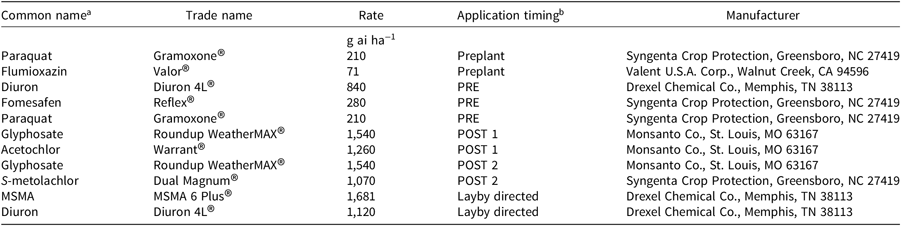
All herbicides were applied using a tractor-mounted sprayer. Herbicides and rates applied in the broadcast-herbicide program are listed in Table 2. The banded system included the same preplant, POST, and layby treatments applied broadcast but included a 25-cm, in-row, banded PPI application of pendimethalin (Prowl H2O, 1,064 g ai ha−1; BASF Corp., Research Triangle Park, NC) plus fomesafen (Reflex, 210 g ai ha−1; Syngenta Crop Protection, Greenville, NC) and a banded PRE application of diuron (Direx 4L, 560 g ai ha−1; Drexel Chemical Company, Memphis, TN) plus fomesafen (Reflex, 175 g ha−1; Syngenta Crop Protection). Both Colquitt County locations and the Worth County site were irrigated and received 1.0 to 2.0 cm of rainfall or irrigation within 5 d of each herbicide application. Access to irrigation was not available at the Tift, Berrien, and Macon County locations. These three locations received the following rainfall amounts within 5 d of each application: preplant, 1.0 to 2.0 cm; PRE, 0.5 to 1.0 cm; POST application 1 (POST 1), 0.6 to 3.5 cm; POST application 2 (POST 2), 0.6 to 1.0 cm; layby, 0 to 0.6 cm. Sprayers were calibrated to apply 140, 262, 206, 140, 140, and 140 L ha−1 for preplant, PPI, PRE, POST 1, POST 2, and layby directed applications, respectively. Nozzles used were flat-fan 11002 for preplant, POST 1, POST 2, and layby directed applications, whereas 8002E and 8003E nozzles were used for PPI and PRE applications, respectively (TeeJet Technologies, Wheaton, IL).
Herbicides used and application timing for treatments receiving a broadcast herbicide program.

a Abbreviations: MSMA, monosodium acid methanearsonate; POST 1, POST application 1; POST 2, POST application 2.
b All preplant, PRE, and Layby directed applications included 1% vol/vol of crop oil concentrate.
At each location, efforts were made to understand the tolerance of Palmer amaranth to glyphosate. Thus, an area of approximately 4 m by 30 m was planted in the rye broadcast system but was not treated with preplant or PRE herbicides. At time of the initial POST glyphosate application, Palmer amaranth plants were counted. Approximately 1 wk after the second glyphosate application, the number of Palmer amaranth plants was counted again, thereby enabling us to determine the percentage of plants surviving sequential glyphosate applications. Because each POST glyphosate mixture included residual herbicides that were activated in a timely manner, newly emerging Palmer amaranth plants were not present at counting.
Cereal rye (cv. ‘Wrens Abruzzi’) was planted with a grain drill (Great Plains Manufacturing, Salina, KS) at a seeding rate of 100 kg ha−1 the November before cotton planting at each location. In early to mid-April, once the cereal rye reached a minimum height of 2 m, it was rolled with a roller-crimper (I & J Manufacturing, Gordonville, PA) in the direction in which cotton would be planted and preplant herbicides were applied. Between late April and early May, cotton was planted. PPI herbicides were applied behind the ripper shank of the strip-till implement just ahead of a set of spider tines used to incorporate the herbicides 5-cm deep; PRE herbicides were applied immediately after planting.
Cotton stand was evaluated by counting the number of skips measuring 0.6 to 1.5 m or greater than 1.5 m between cotton plants. Although cotton can compensate for some skips, Georgia research has shown a poor stand can reduce yields, delay maturity, and allow sunlight penetration through the canopy that can be used by weeds (Whitaker et al. Reference Whitaker, Culpepper, Freeman, Harris, Kemerait, Perry, Porter, Roberts, Shurley and Smith2017). Determining the number of skips allows growers to visualize the impact of a given production practice on cotton production much more effectively than counting the number of cotton plants and averaging that number over a given area. Two sizes of skips were counted to reflect when cotton would likely compensate in favorable production environments (0.6 to 1.5 m) and when it likely would not (>1.5 m). Weed counts were made for the entire plot, with early-season counts separated into weeds present in the row middle and weeds present where the strip-till implement ran, whereas late-season counts were made for the entire plot as a whole. Data presented include measurements made 2 wk after POST 1 and at harvest. Palmer amaranth, pitted morningglory (Ipomoea lacunosa L. IPOLA), yellow nutsedge (Cyperus esculentus L. CYPES), sicklepod [Senna obtusifolia (L.) H.S. Irwin & Barneby CASOB], Benghal dayflower (Commelina benghalensis L. COMBE), and large crabgrass [Digitaria sanguinalis (L.) Scop. DIGSA] were present; location and density information is provided in Table 3. To compare treatment impact on yield, cotton was harvested at each location with a spindle picker modified for plot harvesting.
Weeds and densities present for each location.

a Populations measured from nontreated, nontilled areas where no cover was present at 2 wk after POST application 1.
b Abbreviation: –, weed not present.
Data were subjected to ANOVA using PROC GLIMMIX in SAS, version 9.4 (SAS Institute, Cary, NC). The linear mixed model was used for yield analysis and the negative binomial distribution and log link function were used for the analysis of weed counts and cotton skips. Cotton skips, weed counts, and yield were set as the response variables, and block, year, and location included in the model were the random factors. Cotton skips were separated by location for statistical analysis, owing to differences in environments among locations at planting. The interaction between location and treatment was evaluated for weed counts and yield. Significant interactions were detected between locations because of differing cover crop biomass and weed populations for only Palmer amaranth. Therefore, for Palmer amaranth, data were pooled into two groups: (1) Berrien, Macon, and Tift counties, and (2) both Colquitt County locations and Worth County. All P values for tests of differences between least-squares means were compared and adjusted using the Shaffer-simulated method (α = 0.05).
Results and Discussion
Cotton Skips
In Berrien and Macon counties, no skips of 0.6 m or greater were observed in plots; this was due to ideal planting conditions (Flitcroft Reference Flitcroft2015). These conditions consisted of soil temperatures ranging between 25 and 27 C at seed placement, with adequate moisture for uniform emergence without additional rainfall being needed. In Tift County, conditions were less ideal at planting in regard to soil moisture, with rainfall needed for a uniform emergence. Only 0.4 cm of rainfall occurred in the 5 d after planting, leading to a similar number of skips among treatments (103 skips of 0.6 to 1.5 m ha−1) (data not shown).
In Colquitt County in 2012, the rye was blown down across the planting pattern prior to rolling. Rye laying across the planting pattern is a grave concern, often drastically increasing blowout and reducing cotton stand (Kornecki Reference Kornecki2016). According to previous data, for optimal stand establishment, cover-crop rolling and cotton planting must occur in the same direction (Kornecki et al. Reference Kornecki, Raper, Arriaga, Schwab and Bergtold2009). Similar to the literature, cotton stand in our study was less in the broadcast drilled rye system, with 303 skips of 0.6 to 1.5 m, when compared with the no-rye system, which had 155 skips of this size (Table 4). The addition of the rye-free planting zone eliminated stand issues; both rye-free zone systems had values similar to those of the no cover crop system (103 to 155 skips of 0.6 to 1.5 m). Skips greater than 1.5 m were greater in the broadcast drilled rye (85 skips of >1.5 m) compared with all other treatments (22 to 37 skips of >1.5m). Irrigation was available and used at this location; however, sporadic blowouts from the broadcast drilled rye prevented uniform seed placement.
Effects of rolled rye cover crop on cotton stand.

a Means within a column followed by a different letter are significantly different (α = 0.05). Treatments did not influence cotton stand at the Berrien, Macon, or Tifton County locations; thus, data are not shown for those locations.
b Abbreviation: NS, not significant.
In Worth County, the no-rye treatment had the lowest number of 0.6- to 1.5-m skips (22 skips ha−1) (Table 4). The broadcast drilled rye system had nearly five times more skips of that distance. The addition of a rye-free zone was effective in improving the stand compared with the broadcast drilled rye system, but skips were still 2.4 to 3 times greater than in the no-cover system. For skips greater than 1.5 m, no differences among treatments were noted.
In Colquitt County in 2013, all three rye systems had 55 or fewer skips ha−1 of 0.6 to 1.5 m, which was less than the skips ha−1 in the no-cover crop system (Table 4). Of greatest interest at this location was the lack of moisture noted at planting in the no-cover system when compared with the rye systems. More than 1.25 cm of rainfall occurred after preplant and before planting. The rye that had been rolled and terminated completely covered the ground and preserved soil moisture much more effectively than the no-rye plots. According to Unger and Vigil (Reference Unger and Vigil1998), when cover crops are properly managed, water infiltration and decreased evaporation after termination can be maximized. They also noted that when cover crops are properly managed, water conservation and yield are improved. This rationale is consistent with the highest number of skips occurring in the no-rye treatment in our study. This site demonstrated one of the benefits of a cover crop, which is soil moisture preservation, especially in preparation for planting.
Weed Control After POST 1
Across locations, all weeds except Palmer amaranth were controlled similarly among treatments after preplant, at-plant, and POST 1 herbicide applications were made (data not shown). Morningglory species, nutsedge, annual grasses, and large crabgrass can be controlled effectively with an aggressive herbicide program such as the one included during early season in this experiment, which included paraquat, flumioxazin, diuron, fomesafen, glyphosate, and acetochlor (Burke et al. Reference Burke, Troxler, Wilcut and Smith2008; Everman et al. Reference Everman, Burke, Allen, Collins and Wilcut2007; Sanders et al. Reference Sanders, Joseph and Marshall2017).
For Palmer amaranth control, differences among treatments were not noted at three locations (both sites in Colquitt County and at the Worth County site), whereas treatment differences were noted for the sites in Berrien, Macon, and Tift counties. Different observations within these two groups of locations were primarily a response to Palmer amaranth population (Table 3) and glyphosate-resistance severity. In Berrien, Macon, and Tift counties, the percentage of the Palmer amaranth population surviving sequential glyphosate applications ranged from 90% to 98%, suggesting glyphosate applications resulted in minimal control. In contrast, less than 39% of the Palmer amaranth plants survived similar applications in Worth and Colquitt counties.
When combining data from the Berrien, Macon, and Tift County sites, Palmer amaranth populations in the planting strip were lowest in the broadcast drilled rye (90 plants ha−1) and the rye-free zone with broadcast herbicide treatments (116 plants ha−1). The highest populations in the planting strip occurred when PPI and PRE herbicides were banded or when a cover crop was not used (1,065 to 1,521 plants ha−1) (Table 5). For the middle of rows, 183 to 206 plants ha−1 were observed with the broadcast drilled rye system and the rye-free zone system with broadcast herbicides. The no-cover crop with broadcast-herbicide system was far less effective (1,169 plants ha−1), but the least effective system was the banded herbicide program, consisting of nearly 8,000 plants ha−1. These early-season results show that cover crops can be used to reduce Palmer amaranth emergence on the farm; but overall, an effective system must include not only the cover crop but also a broadcast-herbicide program to control weeds that may emerge through the mulch cover.
Influence of rolled rye cover crop on Palmer amaranth population and seed cotton yield in Berrien, Macon, and Tift counties, GA.

a POST 1, POST application 1.
b Data are averaged over the locations in Berrien, Macon, and Tift counties; means within a column followed by a different letter are significantly different (α = 0.05). Treatments did not influence results at either the Colquitt or in Worth County locations; thus, those data are not shown.
Weed Control at Harvest
Similar to early-season evaluations, no treatment differences were noted for pitted morningglory, yellow nutsedge, sicklepod, and large crabgrass at harvest (data not shown). Herbicide programs with effective preplant, at-plant, sequential POST, and a layby herbicide applications are expected to control these weed species with or without a cover crop (Burke et al. Reference Burke, Troxler, Wilcut and Smith2008; Everman et al. Reference Everman, Burke, Allen, Collins and Wilcut2007; Sanders et al. Reference Sanders, Joseph and Marshall2017).
Again, similar to early-season evaluations, there were no differences in Palmer amaranth control at the Colquitt County and Worth County sites. However, Palmer amaranth control differences among treatments were noted for the sites in Berrien, Macon, and Tift counties (Table 5). At this point in the season, even when counting plants for the plot in its entirety, it was not possible to distinguish if plants had emerged from the planting strip or row middle, so a cumulative number of plants per plot was counted. Similar to early-season control, the most effective systems at harvest were the rye-free zone (538 plants ha−1) and the broadcast drilled rye (695 plants ha−1), with both systems receiving a broadcast herbicide program. The least effective systems continued to include the rye-free zone with banded herbicides (11,249 plants ha−1) and the no-rye cover crop with broadcast herbicide system (3,785 plants ha−1). Of interest is that the number of total plants present at 2 wk after the POST 1 application was comparable to the number of plants present at harvest for each treatment, indicating the importance and impact of cover crops and broadcast herbicides during early season.
Cotton Yield
Seed yield was not influenced by cotton stand but rather by Palmer amaranth control (Table 5). For cotton with gaps less than 1.5 m, cotton’s ability to compensate by growth of adjacent plants is well understood and expected (Hasnam 1985). In contrast, treatment differences in Palmer amaranth control clearly influenced cotton yields. When averaging yields over Berrien, Macon, and Tift counties, the broadcast drilled rye and the rye-free zone, both with broadcast herbicides, resulted in the highest seed yields, ranging from 3,184 to 3,244 kg ha−1 (Table 5). The no cover crop treatment and rye-free zone with banded herbicides treatment resulted in lower seed yields, ranging from 2,713 to 2,896 kg ha−1. Price et al. (Reference Price, Balkcom, Duzy and Kelton2012) noted that banded versus broadcast herbicides, when used in rye, provided similar yields. However, data from their study were generated from Palmer amaranth populations without resistance to glyphosate. Similar to Price et al. (Reference Price, Balkcom, Duzy and Kelton2012), the three locations with low levels of glyphosate resistance in our experiment also resulted in no yield differences detected among treatments (3,010 to 3,180 kg ha−1).
This experiment shows that a rolled rye cover crop can improve Palmer amaranth control and cotton yields. A rye-free crop planting zone within a rye cover system can improve cotton stand by improving soil moisture and soil-to-seed contact. Although the rolled rye cover crop can reduce emergence of Palmer amaranth populations, it must be used in conjunction with a sound herbicide program, with broadcast applications for successful management of substantial glyphosate-resistant Palmer amaranth populations in cotton.
Acknowledgements
The authors thank Cotton Incorporated and the Georgia Cotton Commission for their partial support of this research via cooperative research agreements. No conflicts of interest have been declared.