INTRODUCTION
Giardia is a protozoan parasite found in the intestinal tract of humans and vertebrate animals (de Souza et al. Reference De Souza, Bomfim, Huber, Abboud and Gomes2009), which presents a broad host range, including livestock, companion animals and wildlife (Paziewska et al. Reference Paziewska, Bednarska, Niewegłowski, Karbowiak and Bajer2007). Of the six recognized species of Giardia, Giardia duodenalis is the only one that infects humans (Wielinga and Thompson, Reference Wielinga and Thompson2007), but it also parasitizes wild and domestic animals. Isolates of this species are subdivided into genotypes according to host species, morphology and molecular differences (Thompson et al. Reference Thompson, Hopkins and Homan2000). In this sense, molecular analysis of isolates from the different host species has revealed the existence of eight different G. duodenalis assemblages (A–H), of which assemblages A and B are responsible for the 99·2% of human cases (Sprong et al. Reference Sprong, Caccio and van der Giessen2012). Genotypes A and B have been detected in a wide range of mammalian hosts, whereas assemblages C to G are to some extent host-specific (Cacciò and Ryan, Reference Cacciò and Ryan2008) and assemblage G has only been found in rodents (Monis et al. Reference Monis, Andrews, Mayrhofer and Ey2003). Among others, several genes including the β-giardin (BG), the glutamate dehydrogenase (GDH) and the triose phosphate isomerase (TPI) are commonly used to genetically characterize isolates of G. duodenalis due to the high degree of genetic polymorphism in these loci (Wielinga and Thompson, Reference Wielinga and Thompson2007). The nucleotide sequence of these genes may contribute to the elucidation of different transmission pathways, including the role of animals as reservoirs for human giardiasis. Since the amplification of a single gene may not ensure the correct genotyping, and due to the preferential amplification of some assemblages with the currently available primers, a multilocus approach is currently recommended (Cacciò and Ryan, Reference Cacciò and Ryan2008; Covacin et al. Reference Covacin, Aucoin, Elliot and Thompson2011).
Two invasive Rattus species, the black rat (Rattus rattus) and the Norway rat (Rattus norvegicus), and the house mouse (Mus musculus domesticus) have been introduced to the Canary Islands and nowadays they are known to be widely spread in all these islands. Previous studies have demonstrated the introduction of pathogens together with these rodent hosts to the Canary Islands, including potentially zoonotic species (Foronda et al. Reference Foronda, López-González, Hernández, Haukisalmi and Feliu2011).
At present, there is no information about the occurrence of Giardia in rodents in the Canary Islands. Therefore, the aim of this study was to investigate the prevalence and distribution of giardiasis in rodents from the Archipelago and to determine the level of genetic variation of Giardia isolates through the amplification of the TPI, BG and GDH genes.
MATERIALS AND METHODS
Biological samples and area of study
The study was carried out on the Canary Islands, located 100 km off the NW coast of Africa, between 13°23′ and 18°8′W and 27°37′ and 29°24′N. A total of 284 wild rodents (116 R. rattus, 3 R. norvegicus and 165 M. m. domesticus) were captured during 2007–2011 in all the Canary Islands (La Palma, El Hierro, La Gomera, Tenerife, Gran Canaria, Fuerteventura, Lanzarote) and in a small islet (La Graciosa). The animals were captured alive (Sherman traps) at suburban–rural sites. Traps were set in the afternoon and evening and checked soon after sunrise. The animals were euthanased by cervical dislocation or by CO2 inhalation. Fecal samples were obtained from the rectum of each rodent and stored at 4 °C in 2·5% potassium dichromate.
Ethical statement
All the animal procedures were performed according to the principles of animal welfare in experimental science. Animal trapping and its use were approved by the environmental agencies of the governmental competent entities, the ‘Excmo. Cabildo Insular’ of all the Canary Islands in accordance with the Laws 151/2001, 33/2003, 42/2007 and 4/2010.
Giardia identification
Fecal cysts were concentrated using a modification of the Richie's formaldehyde–ether method (Richie, Reference Richie1948) in sterile conditions and replacing ether with ethyl acetate, as described previously (Young et al. Reference Young, Bullock, Melvin and Sprnill1979). The concentrate was stained with iodine solution and examined for Giardia cysts by light microscopy.
DNA isolation
The DNA was extracted directly from aliquots of positive fecal samples using the Fast Prep (Qbiogene, Illkirch Cedex, France) procedure, after three washing steps with PBS–EDTA to remove potassium dichromate. The DNA released from disrupted cysts was purified using the Fast DNA® Spin kit for Soil (Qbiogene, Illkirch Cedex, France) and stored at 4 °C.
TPI genotyping
Giardia-positive samples were genotyped by the amplification of a ∼530 bp fragment of the TPI gene, on the basis of a nested PCR described previously by Sulaiman et al. (Reference Sulaiman, Fayer, Bern, Gilman, Trout, Schantz, Das, Lal and Xiao2003), using the primary primer pair AL3543 (forward; 5′-AAATTATGCCTGCTCGTCG-3′) and AL3546 (reverse; 5′-CAAACCTTTTCCGCAAACC-3′), and the secondary pair AL3544 (forward; 5′-CCCTTCATCGGTGGTAACTT-3′) and AL3545 (reverse; 5′-GTGGCCACCACTCCCGTGCC-3′). Identical conditions were used for both amplifications: 35 cycles (94 °C for 30 s, 50 °C for 30 s, and 72 °C for 60 s) with an initial hot start at 94 °C for 5 min and a final extension at 72 °C for 10 min. Both primary and secondary PCR were conducted in a 50 μL reaction mixture containing 200 μ m of each dNTP (Bioline, London, UK), 0·2 um of each primer, 2·2 mm MgCl2 (Bioline, London, UK), 0·015 U μL−1 Diamond DNA polymerase (Bioline, London, UK) and 1× PCR buffer (Bioline, London, UK). 2 μL of DNA template and first PCR products were used in the primary and in the secondary PCR, respectively.
BG genotyping
Giardia duodenalis isolates were also genotyped at the BG locus using a semi-nested PCR which amplifies an approximately 292-bp fragment, using the primary primer pair G7 (forward; 5′-AAGCCCGACGACCTCACCCGCAGTGC-3′) and G759 (reverse; 5′-GAGGCCGCCCTGGATCTTCGAGACGAC-3′), and the secondary pair G376 (forward; 5′-CATAACGACGCCATCGCGGCTCTCAGGAA-3′) and the reverse primer G759 (Cacciò et al. Reference Cacciò, De Giacomo and Pozio2002). Identical conditions were used for both amplifications: 35 cycles (95 °C for 45 s, 60 °C for 45 s, and 72 °C for 60 s) with an initial hot start at 94 °C for 5 min and a final extension at 72 °C for 10 min. Both primary and secondary PCR were performed in a 50 μL reaction mixture containing 200 μ m of each dNTP (Bioline, London, UK), 0·4 μ m of each primer, 1·5 mm MgCl2 (Bioline, London, UK), 1·25 units of Taq DNA polymerase (Bioline, London, UK), and 1× PCR buffer (Bioline, London, UK). 2 μL of DNA template and first PCR products were used in the primary and in the secondary PCR, respectively.
GDH genotyping
All positive samples were also analysed using a semi-nested GDH PCR (Read et al. Reference Read, Monis and Thompson2004) which amplifies a 432-bp fragment. Identical conditions were used for both amplifications: 1 cycle of 94 °C for 2 min, 56 °C for 1 min and 72 for 2 min, followed by 55 cycles of 94 °C for 30 s, 56 °C for 20 s and 72 °C for 45 s, with a final extension of 72 °C for 7 min. PCR reaction mixtures consisted of 12·5 ρmol of each primer, 200 μ m of each dNTP, 1·5 mm MgCl2, 1 unit of Taq DNA polymerase (Bioline, London, UK), and 1× PCR buffer (Bioline, London, UK). GDHeF (5′-TCAACGTYAAYCGYGGYTTCCGT-3′) and GDHiR (5′-GTTRTCCTTGCACATCTCC-3′) were used in the primary PCR reaction with 1 μL of genomic DNA. 1 μL of PCR product from the primary reaction was added to the secondary PCR containing primers GDHiF (5′-CAGTACAACTCYGCTCTCGG-3′) and GDHiR.
All the amplifications were carried out in a Labnet thermocycler (Labnet International, Berkshire, UK) and amplification products were analysed on 1·7% agarose gel. PCR products were purified using UltraClean PCR Clean-up kit (MO BIO, Carlsbad, CA). PCR products were sequenced at the Genomic Service of the University of La Laguna and at Macrogen Inc. (Korea). In order to elucidate any similarities in sequences with those previously published in GenBank, a BLAST search was performed.
Phylogenetic analysis
New and previously published sequences were aligned with the multiple alignment program ClustalW as implemented in Mega 5.0 (Tamura et al. Reference Tamura, Dudley, Nei and Kumar2007). Nucleotide substitutions were indicated from the ATG codon of each gene. Isolates were grouped into assemblage B sub-assemblages based on the substitution patterns proposed by Wielinga and Thompson (Reference Wielinga and Thompson2007). The existence of novel substitution positions was examined. Phylogenetic analysis was performed on the aligned TPI, BG and GDH sequences to assess the extent of genetic diversity among Giardia isolates detected in this study and previously published sequences. Neighbour-joining (NJ) was performed with distances calculated with the Kimura 2-parameter (Kimura, Reference Kimura1980) for the three loci. To evaluate the support for inferred topologies, bootstrapping (Felsenstein, Reference Felsenstein1985) was done with 1000 replicates. The quartet-puzzling tree and the intra-assemblages and inter-assemblages distances were determined for both TPI and GDH loci by the analysis of the number of substitutions per nucleotide site, which is estimated by using the HKY model of substitution (Hasegawa et al. Reference Hasegawa, Kishino and Yano1985) with gamma correction (eight categories) as implemented by PUZZLE version 5.2 (Strimmer and Haeseler, Reference Strimmer and Haeseler1996). Parameter estimation was done using the NJ tree. Support for internal nodes was assessed using 1000 puzzling steps. Dendrograms were drawn using TREEVIEW (Page, Reference Page1996).
Protein analysis
Using the amino acid sequences inferred by translation of the open reading frames (ORFs) of individual sequences, substitutions were identified by comparative analysis against three reference sequences of G. duodenalis genotype G: EU781013 (TPI), EU769221 (BG) and AY178748 (GDH).
Data analysis
An SPSS/PC package was used to perform a statistical analysis of the influence of extrinsic host factors (qualitative values) on the prevalence. Chi-square test was used to evaluate parasitological results relative to host, island and season. 95% confidence intervals were measured by the Wilson method. A probability value less than <0·05 was considered as statistically significant.
RESULTS
Prevalence of Giardia in rodents
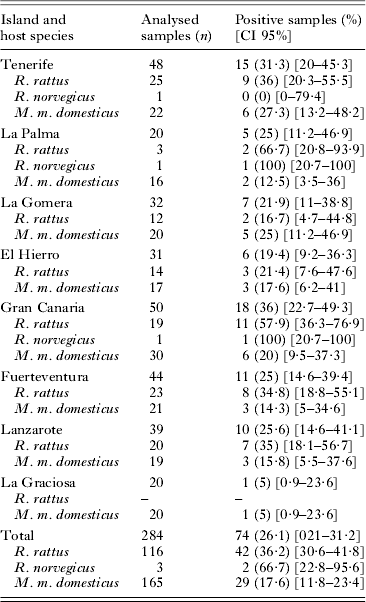
In 72 out of 284 animals (25·4%) Giardia cysts were found by microscopy. Positive samples were detected in all the Canary Islands with a prevalence ranging from 5% to 34% (Table 1), without significant differences in the prevalence among islands. According to the host species, the prevalence was higher in R. rattus than in M. m. domesticus (P-value <0·05), when rodents from Gran Canaria were analysed. No significant differences were observed between R. rattus and M. m. domesticus in the rest of the islands.
Frequency of Giardia in rodents in the Canary Islands

TPI genotyping and estimation of genetic distances
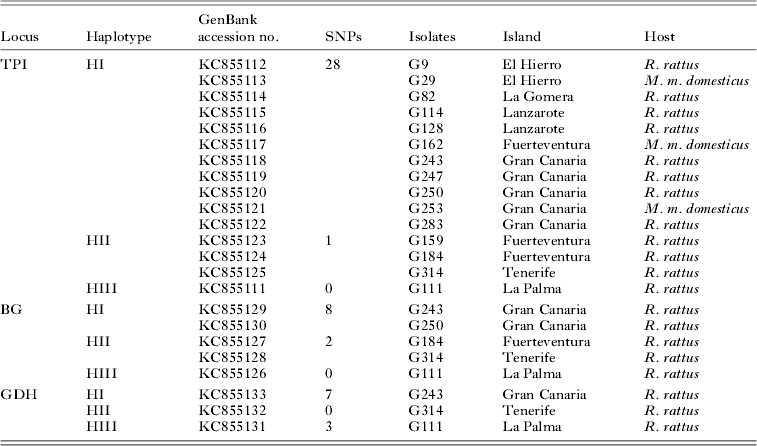
TPI sequences were obtained for 15 samples and submitted to GenBank under the Accession numbers KC855111-KC855125. Three different TPI haplotypes, which we named as HI–HIII, were detected and included in a 433-bp alignment with previously published sequences. Similarity search using BLAST demonstrated that all isolates showed the highest similarity with G. duodenalis assemblage G (GenBank Accession number EU781013) (Table 2) with one (n = 3) (HII) and 28 (n = 11) (HI) SNPs (Table 3), except G111 (HIII), which was identical to G. duodenalis assemblage B (GenBank Accession number JN587446). This isolate was characterized as BIV at the TPI gene in accordance with the substitution patterns proposed by Wielinga and Thompson (Reference Wielinga and Thompson2007).
Giardia duodenalis haplotypes detected in rodents from the Canary Islands for the TPI, BG and GDH loci (SNPs: number of substitutions identified by comparing against G. duodenalis genotype G EU781013 for TPI, EU769221 for BG and AY178748 for GDH)

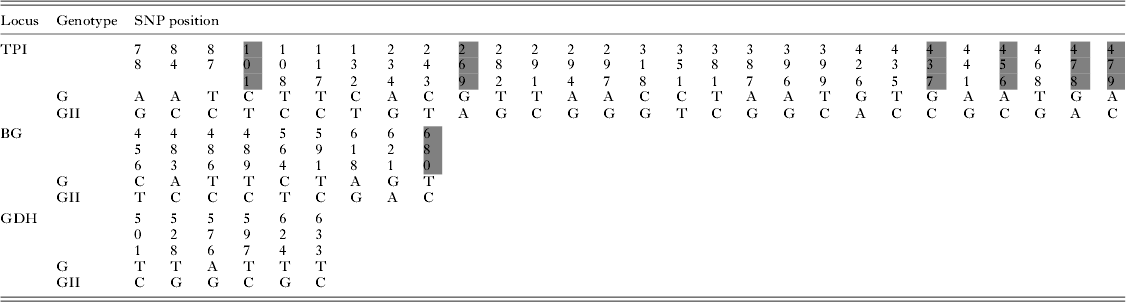
Variable positions of TPI, BG and GDH genes in the new assemblage G sub-genotype (position reference following EU781013 for TPI, EU769221 for BG and AY178748 for GDH). Shaded base numbers indicate non-synonymous substitution sites

According to the haplotype HI, five SNPs caused a conversion of amino acid (P34L, S90N, G146A, K152N and E160T). The evolutionary distance between haplotype HI and assemblage G was 0·078. Considering this high genetic distance, we propose the haplotype HI to be considered as the novel sub-assemblage GII. It was detected in five out of the seven islands in both M. m. domesticus and R. rattus. On the other hand, G159, G184 and G314 (HII) showed one synonymous SNP at position 282 (T to G), which was shared with the proposed novel sub-assemblage GII detected in this study.
The NJ tree based on an alignment of the TPI sequences is presented in Fig. 1. A similar topology was found using the quartet puzzling method (data not shown). Both methods grouped the 11 isolates that belonged to sub-assemblage GII together in one cluster. These trees clustered these isolates into a well-supported monophyletic clade that was closely related to assemblage G. On the other hand, G159, G184 and G314 (HII) were clustered with previously published sequences of G. duodenalis assemblage G. A third node was composed of G111 and assemblage B sequences.
Phylogenetic relationship among assemblages (A to G) of Giardia duodenalis at the TPI locus as assessed by a neighbour-joining analysis of the nucleotide sequence covering a 433-bp region (position 70 to 503 of EU781013) of the gene, using the distance calculated by the Kimura 2-parameter model. Bootstrap values were calculated by the analysis of 1000 replicates. Only bootstraps values >70 are shown.

BG genotyping
We further genotyped at the BG locus those isolates for which TPI sequences were obtained and we used them together with previously published BG sequences to build a 178-bp alignment. The sequences obtained were submitted to GenBank under the Accession numbers KC855126–KC855130. In this case, G111 was also typed as assemblage B, showing 100% identity to a sequence obtained from children (GenBank Accession number FJ971486) (Kosuwin et al. Reference Kosuwin, Putaporntip, Pattanawong and Jongwutiwes2010). At present, polymorphisms are not available to link the BG locus heterogeneity to the GDH and TPI gene sub-assemblage classifications, but position 354 seems to be a promising candidate to distinguish between the sub-assemblage BIII (cytosine) from BIV (thymine) (Levecke et al. Reference Levecke, Geldhof, Claerebout, Dorny, Vercammen, Cacciò, Vercruysse and Geurden2009). However, G111 could not be assigned to a sub-assemblage at the BG gene due to our alignment starting at position 452. On the other hand, while G184 and G314 showed again the highest similarity with G. duodenalis assemblage G (99% BLAST identity) (GenBank Accession number EU769221), G243 and G250, which belonged to haplotype HI, shared more identity with G. duodenalis assemblage F (98%) (GenBank Accession number AY647264) than with G. duodenalis assemblage G (96%). The isolate G243 carried eight synonymous SNPs when compared with G. duodenalis genotype G, whereas G250 showed those SNPs plus one non-synonymous mutation at this locus (V227A).
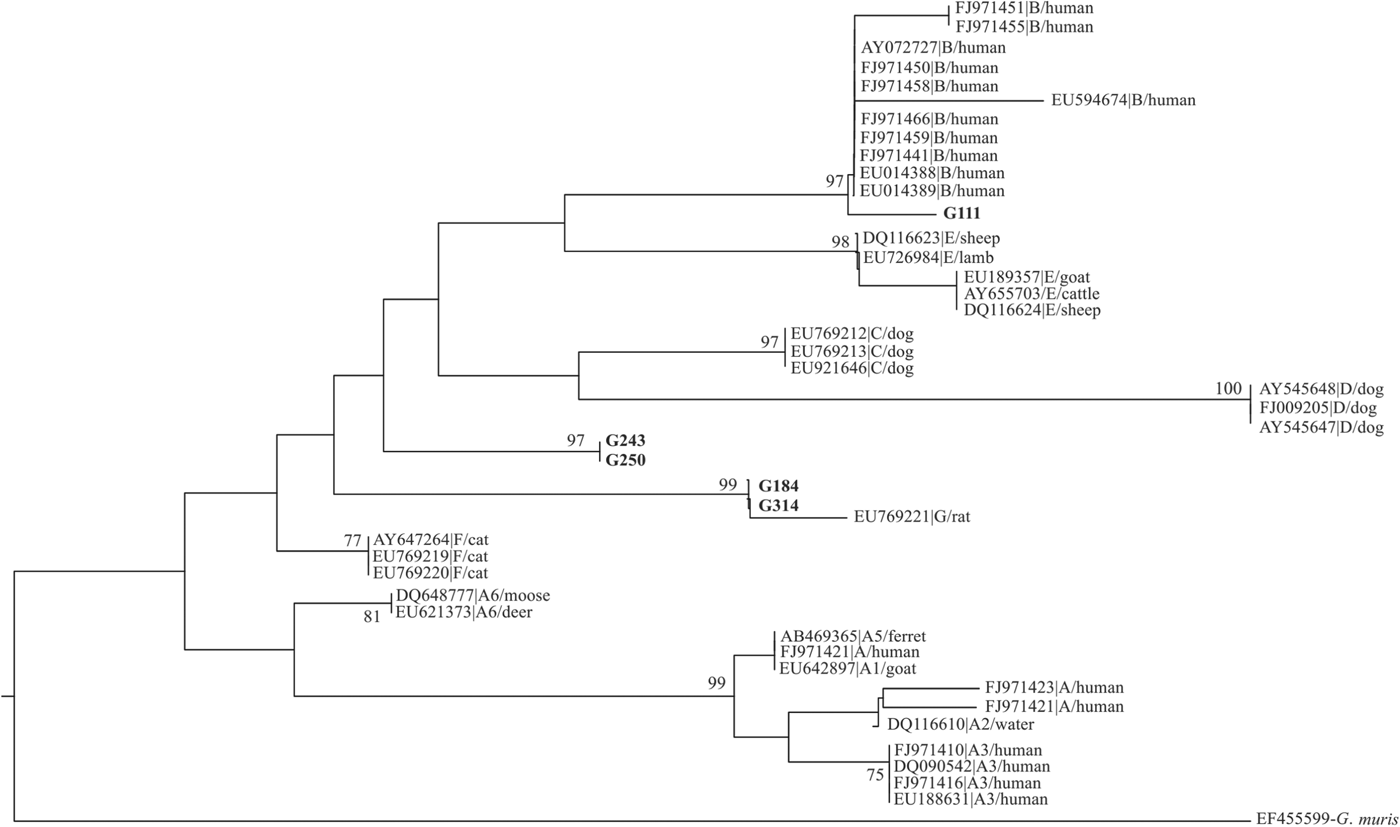
The NJ method grouped G184 and G314 together with G. duodenalis assemblage G in one cluster with high support (99% bootstrap support), whereas G243 and G250 were clustered together in another well-supported group (97% bootstrap support) (Fig. 2). Finally, G111 was grouped with 11 sequences of G. duodenalis assemblage B from humans (97% bootstrap support).
Phylogenetic relationship among assemblages (A to G) of Giardia duodenalis at the BG locus as assessed by a neighbour-joining analysis of the nucleotide sequence covering a 178-bp region (position 422 to 600 of FJ971423) of the gene, using the distance calculated by the Kimura 2-parameter model. Bootstrap values were calculated by the analysis of 1000 replicates. Only bootstraps values >70 are shown.

GDH genotyping
Our results were further confirmed by amplification and sequencing of the GDH gene. Amplicons representing the three haplotypes were sequenced and submitted to GenBank under the Accession numbers KC855131–KC855133. They were used to build a 215-bp alignment with previously published GDH sequences in order to carry out the phylogenetic analysis. The BLAST search revealed that G111 exhibited 99% identity with G. duodenalis assemblage B (GenBank Accession number EU594663) obtained from children, and three nucleotide substitutions were found between G111 and this sequence. This isolate consisted of a combination of BIII (p 447: thymine, 540: cytosine and 561: cytosine) and BIV-like (p 429: cytosine) substitution patterns and it also showed a novel synonymous substitution at position 564 (adenosine) at the GDH gene.
On the other hand, G243 showed the highest similarity with G. duodenalis assemblage G (97% BLAST identity) (GenBank Accession number AY178748), whereas G314 was identical to two assemblage G sequences (GenBank Accession numbers AY178748 and AF069058). Isolate G243 carried seven synonymous SNPs when compared with assemblage G sequences.
The phylogenetic analysis showed that G243 was clustered alone whereas G314 was grouped with the rest of the assemblage G sequences, being supported by a high bootstrap value (99%) (Fig. 3). Estimates for the evolutionary distances among G243, which belongs to haplotype HI, and assemblage G sequences were carried out in order to support the results obtained with the TPI gene (data not shown). In this sense, the number of substitutions per nucleotide site, estimated by the HKY model, was 0·038. The isolate G243 was nearly as divergent from assemblage F as it was from assemblage G (0·046), whilst the genetic distance found between assemblage G and F was nearly twice the distance observed between assemblage G and assemblage GII (0·092).
Phylogenetic relationship among assemblages (A to G) of Giardia duodenalis at the GDH locus as assessed by a neighbour-joining analysis of the nucleotide sequence covering a 215-bp region (position 179 to 393 of AY178745) of the gene, using the distance calculated by the Kimura 2-parameter model. Bootstrap values were calculated by the analysis of 1000 replicates. Only bootstraps values >70 are shown.

DISCUSSION
To our knowledge, this work constitutes the first extensive study on the presence of Giardia in rodents in the Canary Islands. These results indicate that both mouse and rat infection with G. duodenalis is common and widespread throughout the Archipelago.
The weather in the Canary Islands is strongly influenced by the humid trade winds from the north-east which, in combination with the altitude of the volcanoes and the drier north-west winds blowing at higher levels, produce an inversion zone and marked vegetation belts. Several authors have demonstrated the influence of these variables on the existence and distribution of some parasites of mammal species in the Archipelago (e.g. Foronda et al. Reference Foronda, Del Castillo, Abreu, Figueruelo, Piñero and Casanova2003). However, this effect was not detected for G. duodenalis in our study, since it was found in all the studied microhabitats, probably due to the high ability to support varying environmental conditions of this parasite.
Previous studies of Giardia in rodents have found overall point prevalences between 22·2% and 100%. In this sense, the overall prevalence of Giardia spp. found in the present study was lower than that observed in rodents from other regions, as Belgium (66·3% in Chinchilla lanigera) (Levecke et al. 2011), Poland (58·3% and 93·9% in Myodes glareolus and 48·3%, 74·2% and 87% in Apodemus flavicollis, Microtus arvalis and Ondatra zibethicus, respectively) (Bajer et al. Reference Bajer, Bednarska, Pawelczyk, Behnke, Gilbert and Sinski2002, Reference Bajer, Bednarska, Paziewska, Romanowski and Siński2008; Bednarska et al. Reference Bednarska, Bajer, Sinski, Girouard, Tamang and Graczyk2007; Bajer, Reference Bajer2008) and USA (65·9%, 73·3%, 100% and 100% in O. zibethicus, Myocastor coypus, M. glareolus and M. arvalis, respectively) (Dunlap and Thies, Reference Dunlap and Thies2002; Bitto and Aldras, Reference Bitto and Aldras2009). On the other hand, the mean prevalence observed in our study was similar to those observed in other cases, such as A. flavicollis and Castor canadensis in the USA (33·3% and 33%, respectively) (Dunlap and Thies, Reference Dunlap and Thies2002; Bednarska et al. Reference Bednarska, Bajer, Sinski, Girouard, Tamang and Graczyk2007) and Mesocricetus auratus, Phodopus sungorus, Phodopus campbelli and Phodopus roborovskii in China (22·2%) (Lv et al. Reference Lv, Feng, Qi, Yang, Jian, Ning and Zhang2009).
The genotyping analyses performed in the present study were consistent among the three loci assessed (TPI, BG and GDH) and revealed that rodents from six Canary Islands were infected with G. duodenalis assemblage G and B. The proposed novel sub-genotype GII was not identified in Tenerife and La Palma. However and considering the widespread distribution of this sub-assemblage we believe that it could also be present in these islands. The TPI sequences of these isolates clustered into a well-supported monophyletic clade that was closely related to assemblage G. Taking into account that this haplotype was being shared by R. rattus and M. m. domesticus, it can be concluded that it is not species-specific. Previous studies based on the TPI gene have shown that intra-assemblage distances among Giardia sub-assemblages range between 0·004 and 0·01, while inter-assemblage distances among Giardia genotypes range between 0·11 and 0·41, based on the number of substitutions per nucleotide site (estimated using the HKY model of substitution). In our study, the evolutionary genetic distance observed between assemblage G and the novel sub-assemblage GII was eight times superior to the highest genetic distance found between two sub-assemblages, and it was close to the minimum genetic distance found between two assemblages. It must also be taken into account that the SNPs responsible for this genetic variation were found to cause five mutations at the primary structure level of the TPI protein. Our finding was also confirmed by the high genetic distance found between sub-assemblage GII and assemblage G through the use of the sequences obtained from the GDH locus and the grouping of the sequences belonging to sub-assemblage GII in a well-supported and separate clade when we analysed the BG gene. Both GDH and TPI genotyping of G243 and G250 ratified that these isolates were more similar to previously published assemblage G sequences, although they showed more similarity with assemblage F than with assemblage G when the BG gene was studied. However, assemblage F has a strong host specificity and a narrow host range, since it has only been found in cats, one pig (Armson et al. Reference Armson, Yang, Thompson, Johnson, Reid and Ryan2009) and seven humans (Gelanew et al. Reference Gelanew, Lalle, Hailu, Pozio and Cacciò2007). In this sense this BLAST analysis could be limited by the use of different primers that amplify different portions of the BG gene, with only a partial overlap (178 bp) among our and previously published sequences. Previous studies have highlighted the necessity of a multi-locus approach, due to the occurrence of heterogeneous templates with the consequent difficulty in assigning some isolates to a specific assemblage (Cacciò and Ryan, Reference Cacciò and Ryan2008).
The species-specificity of G. duodenalis assemblage G and the high degree of isolation of both hosts and parasite in this Archipelago could have led to the deep separation between genotype G and sub-assemblage GII. This event has been found in other parasites of rodents, such as Hymenolepis diminuta in the Canary Islands (Foronda et al. Reference Foronda, López-González, Hernández, Haukisalmi and Feliu2011). Nevertheless, another hypothesis could indicate a colonization of murid species carrying G. duodenalis sub-assemblage GII from the source population, which remains unknown. This possibility is supported by the wide distribution of this haplotype, which was found in five out of the seven islands analysed.
In the past, G. duodenalis assemblage B was thought to be largely restricted to humans, and it represents the most frequent Giardia assemblage in human studies (Amar et al. Reference Amar, Dear, Pedraza-Diaz, Looker, Linnane and McLauchlin2002). Recently, this genotype has been reported in beavers (Fayer et al. Reference Fayer, Santín, Trout, DeStefano, Koenen and Kaur2006), cattle (Coklin et al. Reference Coklin, Farber, Parrington and Dixon2007; Mendonça et al. Reference Mendonça, Almeida, Castro, de Lurdes Delgado, Soares, da Costa and Canada2007), dogs (Read et al. Reference Read, Monis and Thompson2004; Traub et al. Reference Traub, Monis, Robertson, Irwin, Mencke and Thompson2004; Lalle et al. Reference Lalle, Pozio, Capelli, Bruschi, Crotti and Cacciò2005), horses (Traub et al. Reference Traub, Wade, Read, Thompson and Mohammed2005), monkeys (Itagaki et al. Reference Itagaki, Kinoshita, Aoki, Itoh, Saeki, Sato, Uetsuke, Izumiyama, Yagita and Endo2005), muskrats (Sulaiman et al. Reference Sulaiman, Fayer, Bern, Gilman, Trout, Schantz, Das, Lal and Xiao2003), rabbits (Sulaiman et al. Reference Sulaiman, Fayer, Bern, Gilman, Trout, Schantz, Das, Lal and Xiao2003) and sheep (Castro-Hermida et al. Reference Castro-Hermida, Almeida, Gonzalez-Warleta, Correia da Costa, Rumbo-Lorenzo and Mezo2007). This study constitutes the first description of G. duodenalis assemblage B in R. rattus, which is not surprising since it has been found previously in other rodent species (beavers and muskrats) by characterization of TPI and BG loci (Sulaiman et al. Reference Sulaiman, Fayer, Bern, Gilman, Trout, Schantz, Das, Lal and Xiao2003). Nowadays, in order to increase the accuracy of genotyping of isolates at this level, subtypes from two or three loci are combined to define multi-locus genotypes (MLGs) (Sprong et al. Reference Sprong, Caccio and van der Giessen2012). However, a previous work has demonstrated that isolates genotyped with BG, GDH and TPI genes can be considered as potentially zoonotic when all three markers were found to be zoonotic individually (Sprong et al. Reference Sprong, Caccio and van der Giessen2012). These authors consider that an alternative approach for the identification of potential zoonotic MLGs is to combine the zoonotic information of subtypes of individual markers. MLG tools are further being used to answer the question of the infectivity of some host-adapted assemblages (such as assemblage G) in humans. In our study, all three loci confirmed that G111 belonged to assemblage B. Thus, this finding could be relevant from a zoonotic point of view, especially due to the presence of this rodent in a rural and inhabited area. The available data about giardiasis in humans demonstrated that 4–12 year-old children from all the Canary Islands were infected with G. duodenalis with prevalences that ranged from 11·6% to 24·8% among the islands (Valladares et al. Reference Valladares, Lopez-Roman, De Armas and Gijon1983).
Subgrouping within this zoonotic assemblage is of interest as there may be a link between specific assemblage B subgroups and their hosts, with particular attention on those that may affect humans. It is therefore important to establish the specific subgroups, based on their intra-genotypic substitution patterns (Wielinga and Thompson, Reference Wielinga and Thompson2007). The isolate G111 was classified as BIV at the TPI gene, but consisted of a combination of BIII and BIV-like substitution patterns at the GDH gene. However, it displayed a novel intra-assemblage B substitution site at this locus, although this substitution pattern found at the GDH gene must be confirmed with other assemblage B isolates.
In conclusion, our results establish a basis to identify the sub-genotype GII as a novel sub-genotype in the process of becoming a new genotype, which has evolved from G. duodenalis assemblage G. The further finding of an assemblage B isolate in an inhabited area poses a risk for transmission of giardiasis and should be used by Canarian public health authorities to build an effective control strategy.
ACKNOWLEDGEMENTS
We thank ‘Excmos. Cabildos Insulares’ of Tenerife, La Palma, La Gomera, El Hierro, Gran Canaria, Fuerteventura and Lanzarote. We also thank M. Hernández-Ferrer for his help in the phylogenetic analysis.
FINANCIAL SUPPORT
This work was supported by projects ‘Programa Nacional de Biodiversidad, Ciencias de la Tierra y Cambio Global: Subprograma de Biología de Organismos y Sistemas’ (CGL 2006-04937 and CGL2009-07759BOS) of the ‘Ministerio de Ciencia y Educación’ and Canary Government (A. M. A., grant number TESIS20100083).