



1 Introduction
Recently, in [Reference Dong, Li, Molnár and Wong4], considerable attention was given to the problem of characterizing those maps between the positive definite cones of unital
 $C^{*}$
-algebras that preserve the norm of a given Kubo-Ando mean. We recall that a binary operation
 $\sigma $
on the positive definite cone
 $\mathcal B(H)^{++}$
of the algebra
 $\mathcal B(H)$
of bounded operators on the Hilbert space H, is called a Kubo-Ando connection if it satisfies the following properties:
-
(i) If
 $A \leq C$
and
$B \leq D$
, then
$ A \sigma B \leq C \sigma D $
.
-
(ii)
$ C (A \sigma B) C \leq (CAC) \sigma (CBC) $
. -
(iii) If
$ A_n \downarrow A$
and
$ B_n \downarrow B $
, then
$ A_n \sigma B_n \downarrow A \sigma B$
(We write
$A_n\downarrow A$
when
$(A_n)$
is monotonic decreasing and SOT-convergent to A).


A Kubo-Ando mean is a Kubo-Ando connection with the normalization condition
 $I\sigma I=I$
. The most fundamental connections are:
-
• the sum
$(A,B)\mapsto A+B$
, -
• the parallel sum
$(A,B)\mapsto A:B=\left (A^{-1}+B^{-1}\right )^{-1}$
, -
• the geometric mean
$$\begin{align*}(A,B)\mapsto A\sharp B=A^{{\scriptscriptstyle \frac{1}{2}}}\,\left(A^{{\scriptscriptstyle -\frac{1}{2}}}BA^{{\scriptscriptstyle -\frac{1}{2}}}\right)^{{\scriptscriptstyle \frac{1}{2}}}A^{{\scriptscriptstyle \frac{1}{2}}}.\end{align*}$$


The domain of definition can easily be extended from
 $\mathcal B(H)^{++}$
to the positive semi-definite cone
 $\mathcal B(H)^{+}$
. For details, refer to the introduction section in [Reference Chetcuti and Healey3].
In [Reference Kubo and Ando7, Theorem 3.2], it is shown that there is an affine order isomorphism from the class of Kubo-Ando connections onto the class of operator monotone functions via the map
 $f(xI) = I \sigma (xI)$
for
 $x>0$
. Moreover, it is also shown that
 $f(A)=I\sigma A$
for every
 $A\in \mathcal B(H)^{+}$
, which implies that
 $$\begin{align*}A\sigma B=A^{{\scriptscriptstyle \frac{1}{2}}}\,f\left(A^{{\scriptscriptstyle -\frac{1}{2}}}BA^{{\scriptscriptstyle -\frac{1}{2}}}\right)A^{{\scriptscriptstyle \frac{1}{2}}}, \quad \forall \, A \in \mathcal B(H)^{++}, B \in \mathcal B(H)^{+}. \end{align*}$$
The function f is called the representing function of
 $\sigma $
. We further recall that if
 $\sigma $
is a Kubo-Ando connection with representing function f, then the representing function of the “reversed” Kubo-Ando connection
 $(A,B)\mapsto B\sigma A$
is the transpose
 $f^\circ $
, defined by
 $f^\circ (x):=xf(x^{-1})$
. The Kubo-Ando connection is said to be symmetric if it coincides with its reverse; that is, a Kubo-Ando connection is symmetric if and only if the representing function f satisfies
 $f=f^\circ $
as shown in [Reference Kubo and Ando7, Corollary 4.2]. The Kubo-Ando means are precisely the Kubo-Ando connections whose representing function satisfy the normalizing condition
 $f(1)=1$
.
Since every finite Borel measure on
 $[0, \infty ]$
is regular (i.e., a Radon measure), we have that operator monotone functions correspond to positive finite Borel measures on
 $[0,\infty ]$
by Löwner’s Theorem (see [Reference Donoghue5]). To every operator monotone function f corresponds a unique positive and finite Borel measure m on
 $[0,\infty ]$
such that
 $$ \begin{align} f(x) & =\,\int_{[0,\infty]}\frac{x(1+t)}{x+t}\,\mathrm{d}m(t) \nonumber\\ &=\,m(\{0\})\,+\,x\,m(\{\infty\})\,+\,\int_{(0,\infty)}\frac{1+t}{t}(t:x)\,\mathrm{ d}m(t)\quad(x>0). \end{align} $$
It is easy to see that
 $f(0+)=m(\{0\})$
,
 $f^\circ (0+)=m(\{\infty \})$
. Finally, by [Reference Kubo and Ando7, Theorem 3.4], there is an affine isomorphism from the class of positive finite Borel measures on
 $[0,\infty ]$
onto the class of Kubo-Ando connections. This is given by the formula
 $$ \begin{align} A \sigma B = \alpha A + \beta B + \int_{(0, \infty)} \frac{1+t}{t} (tA:B) \, \mathrm{d} m(t) \quad A, B \in \mathcal B(H)^{+} \end{align} $$
where
 $\alpha = m(\lbrace 0\rbrace )$
and
 $\beta =m(\lbrace \infty \rbrace )$
. In the case of a symmetric Kubo-Ando connection,
 $ \alpha = \beta $
. For further details on the provenance of the integral representation (2), the reader is referred to [Reference Kubo and Ando7, Theorem 3.2].
After the exposition on general Kubo-Ando means, we can now define the property under study for symmetric Kubo-Ando means.
Definition 1 Let
 $\sigma $
be a Kubo-Ando mean and let
 $\mathcal {A}$
and
 $\mathcal {B}$
be unital
 $C^{*}$
-subalgebras of
 $\mathcal B(H)$
. A surjective map
 $\phi $
between the positive definite cones of
 $\mathcal {A}$
and
 $\mathcal {B}$
is said to preserve the norm of
 $\sigma $
if
 $$\begin{align*}\left\| A \sigma B \right\| = \left\| \phi(A) \sigma \phi(B) \right\| , \quad \forall \, A, B \in \mathcal{A}^{++}. \end{align*}$$
A natural question to ask is whether a surjective map
 $\phi : \mathcal {A}^{++} \rightarrow \mathcal {B}^{++}$
preserving the norm of a symmetric Kubo-Ando mean is an order isomorphism. By an order isomorphism, we mean a map
 $\phi $
such that
 $A \leq B \iff \phi (A) \leq \phi (B)$
where
 $A, B \in \mathcal {A}^{++}$
. Let
 $A, B \in \mathcal {A}^{++}$
. Then by [Reference Chetcuti and Healey3, Theorem 6],
 $$ \begin{align} \begin{aligned} A \leq B &\iff \left\| A \sigma X \right\| \leq \left\| B \sigma X \right\| , \quad \forall \; X \in \mathcal{A}^{++} \\ &\iff \left\| \phi(A) \sigma \phi(X) \right\| \leq \left\| \phi(B) \sigma \phi(X) \right\| , \quad \forall \; X \in \mathcal{A}^{++} \\ &\iff \phi(A) \leq \phi(B). \end{aligned} \end{align} $$
Moreover,
 $\phi $
is norm preserving. This can be seen by recalling [Reference Kubo and Ando7, Theorem 3.3] and noting that
 $$ \begin{align} \left\| A \right\| = \left\| A \sigma A \right\| = \left\| \phi(A) \sigma \phi(A) \right\| = \left\| \phi(A) \right\| , \quad \forall \, A \in \mathcal{A}^{++}. \end{align} $$
The question we now tackle is whether a surjective map preserving the norm of a symmetric Kubo-Ando mean extends to a Jordan
 $\ast $
-isomorphism. Let us recall that a Jordan
 $\ast $
-isomorphism is a bijective linear map
 $J: \mathcal {A} \rightarrow \mathcal {B}$
such that
 $J(A^{*}) = J(A)^{*}$
and
 $J(AB + BA) = J(A)J(B) + J(B)J(A)$
for
 $A,B \in \mathcal {A}$
. The problem under study has been stated explicitly in the open problem section of [Reference Molnár9], and we reformulate it here to its most general form.
Problem 1 Do surjective maps between positive cones of unital
 $C^{*}$
-subalgebras of
 $\mathcal B(H)$
that preserve the norm of a symmetric Kubo-Ando mean extend to Jordan
 $\ast $
-isomorphisms?
The above problem has been solved for the arithmetic mean [Reference Dong, Li, Molnár and Wong4, Theorem 2.4] and the geometric mean [Reference Chabbabi, Mbekhta and Molnár2, Theorem 1], but for the harmonic mean, it has been solved in the case of
 $AW^{*}$
-algebras [Reference Dong, Li, Molnár and Wong4, Theorem 2.16]. Our aim is to provide a complete answer for to the above problem for general symmetric means in the setting of
 $AW^{*}$
-subalgebras of
 $\mathcal B(H)$
.
2 Preliminary Considerations
Let us first recall [Reference Dong, Li, Molnár and Wong4, Lemma 2.3] and provide the proof here for completeness’ sake.
Lemma 2 Let
 $\mathcal {A}, \mathcal {B}$
be unital
 $C^{*}$
-algebras and
 $\phi : \mathcal {A}^{++} \rightarrow \mathcal {B}^{++}$
a surjective norm preserving order isomorphism. Then
 $\phi (tI) = tI$
for
 $t> 0$
.
Proof Given that
 $ \left \| \phi (tI) \right \| = \left \| tI \right \| = t$
, it follows that
 $\phi (tI) \leq tI$
. Furthermore, there exists
 $A \in \mathcal {A}^{++}$
such that
 $\phi (A) = tI$
. Since
 $ \left \| A \right \| = \left \| \phi (A) \right \| = t$
, we have that
 $A \leq tI$
. Hence, we have
 $tI = \phi (A) \leq \phi (tI)$
. This proves the lemma.
Moreover, by [Reference Dong, Li, Molnár and Wong4, Lemma 2.8],
 $\psi _{\epsilon }(A) = \phi (A+ \epsilon I) - \epsilon I$
is a surjective norm preserving order isomorphism between the positive semi-definite cones of
 $\mathcal {A}$
and
 $\mathcal {B}$
for some
 $\epsilon> 0$
such that
 $\psi _{\epsilon }(tI) = tI$
for all
 $t> 0$
. Let us provide the proof here for completeness’ sake.
Lemma 3 Let
 $\mathcal {A}, \mathcal {B}$
be unital
 $C^{*}$
-algebras and
 $\phi : \mathcal {A}^{++} \rightarrow \mathcal {B}^{++}$
a surjective norm preserving order isomorphism. Define
 $\psi _{\epsilon }: \mathcal {A}^{+} \rightarrow \mathcal {B}^{+}$
by
 $\psi _{\epsilon }(A) = \phi (A + \epsilon I) - \epsilon I$
where
 $\epsilon> 0$
, then
 $\psi _{\epsilon }$
is a surjective norm preserving order isomorphism such that
 $\psi _{\epsilon }(tI) = tI$
for all
 $t> 0$
.
Proof Let
 $A, B \in \mathcal {A}^{+}$
, and
 $\epsilon> 0$
. Then
 $$ \begin{align*} \begin{aligned} A \leq B &\iff A + \epsilon I \leq B + \epsilon I \\ &\iff \phi(A + \epsilon I) \leq \phi(B + \epsilon I) \\ &\iff \phi(A + \epsilon I) - \epsilon I \leq \phi(B + \epsilon I) - \epsilon I \\ &\iff \psi_{\epsilon}(A) \leq \psi_{\epsilon}(B) \end{aligned} \end{align*} $$
which implies that
 $\psi _\epsilon $
is an order isomorphism. We next show that
 $\psi _{\epsilon }$
is surjective. Let
 $B \in \mathcal {B}^{+}$
. Then there is some
 $A \in \mathcal {A}^{++}$
such that
 $\phi (A) = B + \epsilon I$
. Since
 $\phi (A) \geq \epsilon I = \phi (\epsilon I)$
, we have
 $A \geq \epsilon I$
, which allows us to conclude that
 $\psi _{\epsilon } (A - \epsilon I) = \phi (A) - \epsilon I = B $
. Therefore,
 $\psi _{\epsilon }$
is surjective. Since
 $ \left \| \psi _{\epsilon }(A) \right \| = \left \| \phi (A + \epsilon I) - \epsilon I \right \| = \left \| \phi (A + \epsilon I) \right \| - \epsilon = \left \| A + \epsilon I \right \| - \epsilon = \left \| A \right \| $
, we have that
 $\psi _{\epsilon }$
is norm preserving. Finally,
 $\psi _{\epsilon }(tI) = \phi ( (t + \epsilon ) I) - \epsilon I = (t + \epsilon ) I - \epsilon I = tI$
.
Before recalling [Reference Mori10, Lemma 3.1], let us provide some definitions. For a unital
 $C^{*}$
-algebra
 $\mathcal {A}$
we define
 $E_t(\mathcal {A}) := \lbrace 0 \leq A \leq tI \rbrace $
, where t is a positive real number. We recall that
 $E_1(\mathcal {A})$
is called the effect algebra associated with
 $\mathcal A$
. Let
 $$\begin{align*}\Delta_t(\mathcal{A}) := \lbrace (a, b) \in E_t(\mathcal{A}) \times E_t(\mathcal{A}): a \wedge b = 0 \rbrace\end{align*}$$
where
 $a \wedge b$
denotes the infimum of
 $a, b$
in
 $\mathcal {A}^{+}$
. Endow
 $\Delta _t(\mathcal {A})$
with the order relation
 $(a_1, a_2) \leq (b_1, b_2) \iff a_1 \leq b_1$
and
 $b_2 \leq a_2$
, where
 $(a_1, a_2), (b_1, b_2) \in \Delta _t(\mathcal {A})$
. Finally, denote the set of projections of
 $\mathcal {A}$
by
 $P(\mathcal {A})$
. We recall that for any non-empty family of projections in
 $\mathcal {A}$
, if the infimum in
 $P(\mathcal {A})$
exists, then this will be also the infimum of the family, taken in
 $\mathcal {A}^{+}$
.
Lemma 4 Let
 $\mathcal {A}$
be a unital
 $C^{*}$
-algebra. Then the following conditions are equivalent:
-
(1) P is a projection.
-
(2) The pair
$(P, Q)$
is maximal in
$\Delta _1(\mathcal {A})$
for some
$Q \in E_1(\mathcal {A})$
.


Proof (1)
 $\Rightarrow $
(2). Suppose that P is a projection. Consider the pair
 $(P, I-P)$
. Let
 $A \in \mathcal {A}^{+}$
such that
 $A \leq P$
and
 $A \leq I-P$
. Then
 $(I-P) A (I-P) \leq (I-P) P (I-P) = 0$
. Similarly,
 $PAP = 0$
which implies
 $A = (I-P)AP + PA(I-P)$
, but since
 $(I-P)A=A$
, and
 $PA =A$
, we have
 $A = 2A$
, so
 $A=0$
.
Suppose
 $(P, I-P) \leq (A, B)$
where
 $(A, B) \in \Delta _1(\mathcal {A})$
. Since
 $P \leq A \leq I$
, we have
 $AP = P$
. Thus,
 $(I-P)AP = 0 $
and
 $PA(I-P) = 0$
. Since
 $A = P + (I-P)A(I-P)$
, we have
 $(I-P)A(I-P) \leq A$
and
 $(I-P)A(I-P) \leq (I-P) \leq B $
which implies that
 $(I-P)A(I-P) = 0$
. Therefore,
 $A=P$
, and, similarly, it can be concluded that
 $B = I-P$
.
(2)
 $\Rightarrow $
(1). Suppose
 $(P, Q)$
is maximal in
 $\Delta _1(\mathcal {A})$
. The function
 $f: [0,1] \rightarrow [0,1]$
defined by
 $f(0):= 0$
and
 $f(t) = 2(1+t^{-1})^{-1}$
is strictly increasing and surjective. In particular, f is continuous. The function
 $A \rightarrow f(A)$
is an order isomorphism of
 $E_1(\mathcal {A})$
onto itself. Therefore,
 $(f(P), f(Q)) \in \Delta _1(\mathcal {A})$
. Since
 $t \leq f(t)$
for every
 $t \in [0,1]$
, we have
 $(P, Q) \leq (f(P), f(Q))$
. This implies that
 $(P, Q) = (f(P), f(Q))$
. By the spectral mapping theorem,
 $\text {sp}(P) \subseteq \lbrace 0, 1 \rbrace $
, so P is a projection.
Remark 1 Let
 $\mathcal {A}, \mathcal {B}$
be unital
 $C^{*}$
-algebras and let
 $\psi : \mathcal {A}^{+} \rightarrow \mathcal {B}^{+}$
be a surjective order isomorphism such that
 $\psi (tI) = tI$
. Then
 $(A, B)$
is maximal in
 $\Delta _t(\mathcal {A})$
iff
 $(\psi (A), \psi (B))$
is maximal in
 $\Delta _t(\mathcal {B})$
. In particular,
 $P \in P(\mathcal {A})$
iff
 $\psi (P) \in P(\mathcal {B})$
by Lemma 4.
Lemma 5 Let
 $\mathcal {A}, \mathcal {B}$
be unital
 $C^{*}$
-algebras. If
 $\psi : \mathcal {A}^{+} \rightarrow \mathcal {B}^{+}$
is a surjective order isomorphism such that
 $\psi (tI) = tI$
for all
 $t> 0$
, then for any projection P in
 $\mathcal {A}$
,
 $\psi (t P) =t \psi (P)$
for all
 $t> 0.$
Proof We claim that
 $(P_1, P_2)$
is maximal in
 $\Delta _1(\mathcal {A})$
if and only if
 $(tP_1, tP_2)$
is maximal in
 $\Delta _t(\mathcal {A})$
. Let
 $(P_1, P_2)$
be maximal in
 $\Delta _1(\mathcal {A})$
. That
 $P_1 \wedge P_2 = 0$
 $\iff $
 $tP_1 \wedge tP_2 = 0$
is clear. Suppose
 $(A, B) \in \Delta _t(\mathcal {A})$
such that
 $(tP_1, tP_2) \leq (A, B)$
, then
 $(P_1, P_2) \leq (t^{-1}A, t^{-1}B )$
and
 $(t^{-1}A, t^{-1}B ) \in \Delta _1(\mathcal {A})$
which by maximality of
 $(P_1, P_2)$
implies that
 $(P_1, P_2) = (t^{-1}A, t^{-1}B )$
, so
 $(tP_1, tP_2) = (A, B)$
. Similar arguments are used to prove the reverse implication.
Let
 $t> 0$
. Since
 $(P, (I-P))$
is maximal in
 $\Delta _1(\mathcal {A})$
, we have that
 $(tP, t(I-P))$
is maximal in
 $\Delta _t(\mathcal {A})$
which implies that
 $(\psi (tP), \psi (t(I-P)))$
is maximal in
 $\Delta _{t}(\mathcal {B})$
by Remark 1. Subsequently,
 $(t^{-1}\psi (tP), t^{-1}\psi (t(I-P)))$
is maximal in
 $\Delta _{1}(\mathcal {B})$
, so
 $(t^{-1}\psi (tP), t^{-1}\psi (t(I-P))) \in P(\mathcal {B}) \times P(\mathcal {B})$
.
If
 $t> 1$
, then
 $(\psi (P), \psi (I-P)) \leq (\psi (tP), \psi (t(I-P)))$
. Since
 $\text {rng}(\psi (P)) \subseteq \text {rng}(\psi (tP)) = \text {rng}(t^{-1}\psi (tP))$
and
 $\text {rng}(\psi (I-P)) \subseteq \text {rng}(t^{-1}\psi (t(I-P)))$
, we can conclude that
 $(\psi (P), \psi (I-P)) \leq (t^{-1}\psi (tP), t^{-1}\psi (t(I-P)))$
, so by maximality
 $\psi (P) = t^{-1} \psi (tP)$
.
If
 $t < 1$
, then
 $(\psi (tP), \psi (t(I-P))) \leq (\psi (P), \psi (I-P))$
. Since
 $\text {rng}(t^{-1}\psi (tP)) =\text {rng}(\psi (tP)) \subseteq \text {rng}(\psi (P))$
and
 $\text {rng}(t^{-1}\psi (t(I-P))) \subseteq \text {rng}(\psi (I-P))$
, we have
 $ (t^{-1}\psi (tP), t^{-1}\psi (t(I-P)) \leq (\psi (P), \psi (I-P))$
, so by maximality
 $\psi (P) = t^{-1} \psi (tP)$
.
Let
 $\mathcal {A}$
be a unital
 $C^{*}$
-algebra, and let
 $0 < \epsilon _1 < \epsilon _2$
. Consider maps
 $\psi _{\epsilon _1}, \psi _{\epsilon _2}$
of the type stated in Lemma 3. Let
 $\phi $
also denote the map as specified in Lemma 3. Then
 $$\begin{align*}\phi(tP + \epsilon_1I) \leq \phi(tP + \epsilon_2I), \quad \forall \, P \in P(\mathcal{A}), \, t> 0. \end{align*}$$
By Lemma 5,
 $$\begin{align*}t\psi_{\epsilon_1}(P) + \epsilon_1I \leq t \psi_{\epsilon_2}(P) + \epsilon_2I, \quad \forall \, P \in P(\mathcal{A}), \, t> 0. \end{align*}$$
As
 $t \rightarrow \infty $
,
 $$ \begin{align} \psi_{\epsilon_1}(P) \leq \psi_{\epsilon_2}(P), \quad \forall \, P \in P(\mathcal{A}). \end{align} $$
Moreover, we claim that
 $\psi _{\epsilon _1} (P) = \psi _{\epsilon _2}(P)$
. Let
 $Q = \psi _{\epsilon _2}(P) - \psi _{\epsilon _1}(P)$
. Then Q is a projection which is orthogonal to
 $\psi _{\epsilon _1}(P)$
. Furthermore,
 $\psi _{\epsilon _2}^{-1}(Q) = R \leq P$
, which implies that
 $\psi _{\epsilon _1}(R) \leq \psi _{\epsilon _1}(P)$
. By Remark 1, R is a projection, so (5) implies
 $\psi _{\epsilon _1}(R) \leq \psi _{\epsilon _2}(R) = Q$
which implies that
 $ \psi _{\epsilon _1}(R) = 0$
. Since
 $\psi _{\epsilon }(0) = 0$
for any
 $ \epsilon> 0$
, we have
 $Q = 0$
, and the claim is proved.
Let
 $P \in P(\mathcal {A})$
. Then
 $$\begin{align*}\left\| A \sigma \big( P + \epsilon I \big) \right\| = \left\| \phi(A) \sigma \big( \psi_{\epsilon}(P) + \epsilon I \big) \right\| , \quad \forall \, \epsilon> 0. \end{align*}$$
Since
 $\psi _{\epsilon }(P) = S$
for all
 $\epsilon> 0$
, we can use [Reference Chetcuti and Healey3, Remark 1(i)] to conclude that as
 $\epsilon \rightarrow 0$
, we have
 $$ \begin{align*} \left\| A \sigma P \right\| = \left\| \phi(A) \sigma S \right\|. \end{align*} $$
This implies that the above can be written as
 $$ \begin{align} \left\| A \sigma P \right\| = \left\| \phi(A) \sigma \psi_\epsilon(P) \right\| , \quad \forall \, \epsilon> 0. \end{align} $$
Furthermore, if
 $A = T + \delta I$
for some
 $T \in P(\mathcal {A})$
and
 $\delta> 0$
, then
 $$ \begin{align} \left\| \big( T + \delta I \big) \sigma P \right\| = \left\| \big( \psi_{\epsilon}(T) + \delta I \big) \sigma \psi_{\epsilon}(P) \right\| , \quad \forall \, \epsilon> 0. \end{align} $$
3 Results
Let
 $\mathcal {A}, \mathcal {B}$
be
 $AW^{*}$
-subalgebras of
 $\mathcal B(H)$
, and
 $\phi : \mathcal {A}^{++} \rightarrow \mathcal {B}^{++}$
be a surjective map which preserves the norm of a symmetric Kubo-Ando mean
 $\sigma $
. We shall show that there exists a Jordan
 $\ast $
-isomorphism
 $J : \mathcal {A} \rightarrow \mathcal {B}$
which extends
 $\phi $
, i.e.,
 $\phi (A) = J(A)$
holds for all
 $A \in \mathcal {A}^{++}$
. If f is the representing function of
 $\sigma $
, then the proof shall be split into the cases when
 $f(0+) = 0$
and
 $f(0+)> 0$
. The proof for when
 $f(0+)=0$
requires the characterization of surjective positive homogenous order isomorphisms. By
 $\phi $
being positive homogenous, we mean that
 $\phi (tA) = t \phi (A)$
for
 $A \in \mathcal {A}^{++}$
and
 $t> 0$
.
Theorem 6 [Reference Molnár8, Theorem 13]
Let
 $\mathcal {A}$
,
 $\mathcal {B}$
be unital
 $C^{*}$
-algebras. The map
 $\phi : \mathcal {A}^{++} \rightarrow \mathcal {B}^{++}$
is a surjective positive homogenous order isomorphism if and only if it is of the form
 $$ \begin{align} \phi(A) = C J(A) C, \quad \forall \, A \in \mathcal{A}^{++} \end{align} $$
where
 $C \in \mathcal {B}^{++}$
and
 $J: \mathcal {A} \rightarrow \mathcal {B}$
is a Jordan
 $*$
-isomorphism.
It is clear in this theorem that if
 $\phi (I)=I$
then
 $C=I$
. We further recall the following characterisation of Kubo-Ando connections with representing function f satisfying
 $f(0+) = 0$
.
Proposition 7 [Reference Molnár9, Lemma 2]
Let
 $f:(0, \infty ) \rightarrow (0, \infty ) $
be a non-trivial (i.e., not affine) operator monotone function satisfying
 $f(0+)=0$
and let
 $\sigma $
denote the Kubo-Ando connection associated with f. For
 $A\in \mathcal B(H)^{++}$
and non-zero projection
 $P\in \mathcal B(H)$
 $$\begin{align*}\left\| A\sigma P \right\| =f^\circ\left(\frac{1}{\max\{\lambda\ge0:\lambda P\le PA^{-1}P\}}\right).\end{align*}$$
Since the geometric mean is a symmetric mean with representation function f such that
 $f(t) = t^{1/2}$
, we have
 $$ \begin{align} \left\| A \# P \right\| ^{2} = \frac{1}{\max\{\lambda\ge0:\lambda P\le PA^{-1}P\}}. \end{align} $$
Therefore,
 $$ \begin{align} \left\| A \sigma P \right\| = f^{\circ} ( \left\| A \# P \right\| ^{2}). \end{align} $$
We shall also require the following result.
Proposition 8 [Reference Chabbabi, Mbekhta and Molnár2, Lemma 11]
Let
 $\mathcal {A}$
be an
 $AW^{*}$
-algebra and
 $\sigma $
a symmetric Kubo-Ando connection with corresponding representation function
 $f $
such that
 $f(0+)=0$
. For
 $A, B \in \mathcal {A}^{++}$
, we have
 $$\begin{align*}A \leq B \iff \left\| A \sigma P \right\| \leq \left\| B \sigma P \right\| , \quad \forall \, P \in P(AW^{*}(I, A^{-1}-B^{-1})). \ \end{align*}$$
Proof Let
 $T = A^{-1}- B^{-1}$
and consider
 $AW^{*}(I, T)$
. Let us first recall that any commutative
 $AW^{*}$
-algebra is algebra
 $\ast $
-isomorphic to some
 $C(X)$
where X is compact, Hausdorff, and extremally disconnected. By an extremally disconnected set we mean a set such that the closure of every open set is open. [Reference Berberian1, Theorem 1 and Section 7].
Therefore, let
 $f_T$
be the corresponding function of T in
 $C(X)$
. If T is not positive then the spectrum
 $\sigma (T)$
contains some negative number, so there is some
 $\epsilon $
such that
 $\sigma (T) \cap ]-\infty , -\epsilon [ \neq \emptyset $
. Consider the projection
 $P_\epsilon $
associated with
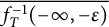 $\overline {f_{T}^{-1}(-\infty , -\epsilon )}$
. Since
 $f_T ( \overline {f_{T}^{-1}(-\infty , -\epsilon )} ) \subseteq \overline {f_T ({f_{T}^{-1}(-\infty , -\epsilon )} )} \subseteq (-\infty , -\epsilon ]$
, we have
 $P_\epsilon T P_\epsilon \leq -\epsilon P_{\epsilon } $
, so
 $P_\epsilon A^{-1} P_\epsilon + \epsilon P_{\epsilon } \leq P_\epsilon B^{-1} P_\epsilon $
. Therefore, for
 $\lambda> 0$
 $$\begin{align*}\lambda P_\epsilon \leq P_\epsilon A^{-1} P_\epsilon \implies (\lambda + \epsilon)P_\epsilon \leq P_\epsilon B^{-1} P_\epsilon. \end{align*}$$
Furthermore, since
 $ \left \| A \# P \right \| \neq 0$
for any
 $P \in P(\mathcal {A})$
, by (9), (10), and the injectivity of f, it can be concluded that
 $ \left \| B \sigma P_{\epsilon } \right \| < \left \| A \sigma P_{\epsilon } \right \| $
which is a contradiction.
For
 $f(0+)> 0$
, we shall require the characterization of order isomorphisms which are norm preserving and orthogonality preserving in both directions. A map
 $\psi : \mathcal {A}^{+} \rightarrow \mathcal {B}^{+}$
is said to be orthogonality preserving in both directions when
 $AB = 0 \iff \psi (A) \psi (B) =0$
for
 $A, B \in \mathcal {A}^{+}$
.
Lemma 9 [Reference Dong, Li, Molnár and Wong4, Lemma 2.3]
Let
 $\mathcal {A}, \mathcal {B}$
be
 $C^{*}$
-algebras such that at least one is unital, and let
 $\psi : \mathcal {A}^{+} \rightarrow \mathcal {B}^{+}$
be a surjective order isomorphism such that
 $\psi $
is norm preserving and orthogonality preserving in both directions. Then
 $\psi $
extends to a Jordan
 $\ast $
-isomorphism
 $J: \mathcal {A} \rightarrow \mathcal {B}$
.
Before proceeding with the proof, let us recall [Reference Chetcuti and Healey3, Lemma 1].
Lemma 10 Let
 $f:(0, \infty ) \rightarrow (0, \infty ) $
be an operator monotone function and let m denote the positive and finite Borel measure associated with f via (1). For every Borel subset
 $\Delta $
of
 $[0,\infty ]$
satisfying
 $m(\Delta )>0$
, the function
 $f_\Delta $
defined on
 $(0,\infty )$
by
 $$\begin{align*}f_\Delta:x\mapsto\int_{\Delta}\frac{x(1+t)}{x+t}\,\mathrm{d}m(t)\end{align*}$$
is operator monotone. In particular, if
 $m((0,\infty ))\neq 0$
, the function h defined by
 $$\begin{align*}h(x):=\int_{(0,\infty)}\frac{x(1+t)}{x+t}\,\mathrm{d}m(t)=f(x)-f(0+)-f^\circ(0+) x\quad(x>0)\end{align*}$$
is operator monotone. If f is symmetric, then so is h.
We are now in a position to prove the main result of this article.
Theorem 11 Let
 $\mathcal {A}, \mathcal {B}$
be
 $AW^{*}$
-subalgebras of
 $ \mathcal B(H)$
. A surjective map
 $\phi : \mathcal {A}^{++} \rightarrow \mathcal {B}^{++}$
preserves the norm of a symmetric Kubo-Ando mean
 $\sigma $
if and only if there is a Jordan
 $\ast $
-isomorphism
 $J : \mathcal {A} \rightarrow \mathcal {B}$
which extends
 $\phi $
, i.e.,
 $\phi (A) = J(A)$
holds for all
 $A \in \mathcal {A}^{++}$
.
Proof Sufficiency is trivial. The proof shall be split into two cases depending on the behaviour of the representation function f at
 $0$
.
Case 1:
 $f(0+)=0$
. Let
 $A \in \mathcal {A}^{++}$
,
 $P \in P(\mathcal {A})$
, and
 $ \epsilon> 0$
. Then by (6)
 $$\begin{align*}\left\| A \sigma P \right\| = \left\| \phi(A) \sigma \psi_{\epsilon}(P) \right\|. \end{align*}$$
By (10) and the fact that f is injective,
 $$ \begin{align} \left\| A \# P \right\| = \left\| \phi(A) \# \psi_{\epsilon}(P) \right\|. \end{align} $$
Let
 $t> 0$
,
 $$ \begin{align} \left\| tA \# P \right\| = t^{1/2} \left\| A \# P \right\| = t^{1/2} \left\| \phi(A) \# \psi_{\epsilon}(P) \right\| = \left\| t\phi(A) \# \psi_{\epsilon}(P) \right\|. \end{align} $$
 $$\begin{align*}\left\| \phi(tA) \# \psi_{\epsilon}(P) \right\| = \left\| t\phi(A) \# \psi_{\epsilon}(P) \right\|. \end{align*}$$
By Proposition 8, we can then conclude that
 $t\phi (A) = \phi (tA)$
which proves that
 $\phi $
is positive homogenous. Therefore, by Theorem 6, we conclude that
 $\phi $
extends to a Jordan
 $\ast $
-isomorphism.
Case 2:
 $f(0+)>0$
. Let
 $P, Q \in P(\mathcal {A})$
be two orthogonal projections, and consider
 $(Q + \delta I) \sigma P$
where
 $\delta> 0$
. By (7), for maps of the type in Lemma 3 the following equation is obtained
 $$ \begin{align} \left\| \big(Q + \delta I\big) \sigma P \right\| = \left\| \big(\psi_{\epsilon}(Q) + \delta I \big) \sigma \psi_{\epsilon}(P) \right\| , \quad \forall \, \epsilon> 0. \end{align} $$
We shall show that
 $\psi _{\epsilon }$
is orthogonality preserving in both directions. If
 $m((0,\infty ))\neq 0$
, by Lemma 10 we can denote by
 $\sigma _h$
the symmetric Kubo-Ando connection corresponding to
 $h(x) = f(x) - \alpha - \alpha x$
where
 $\alpha = f(0+)$
. Let
 $\tau $
denote the Kubo-Ando connection on
 $\mathcal B(H)^{+} \times \mathcal B(H)^{+}$
defined by the equation
 $$\begin{align*}A \tau B = \int_{(0, \infty)} \frac{1+t}{t} (tA:B) \, \mathrm{d} m(t).\end{align*}$$
Since
 $$\begin{align*}h(xI) = \int_{(0, \infty)} \frac{x(1+t)}{(x+t)}I \, \mathrm{d} m(t) = \int_{(0, \infty)} \frac{1+t}{t} (tI: xI) \, \mathrm{d} m(t) = I \tau (xI), \end{align*}$$
we have
 $\sigma _h = \tau $
by [Reference Kubo and Ando7, Theorem 3.2]. Therefore, by (2) we can decompose
 $(Q + \delta I) \sigma P$
in the following way
 $$\begin{align*}(Q + \delta I) \sigma P = \alpha(Q + \delta I + P) + (Q+\delta I) \sigma_h P. \end{align*}$$
Since
 $P(Q + \delta I)^{-1}P = P\big ( (1+\delta )^{-1}Q + \delta ^{-1}(I-Q)\big )P = \delta ^{-1}P $
, by Proposition 7 it can be concluded that
 $$\begin{align*}\left\| \big(Q + \delta I\big) \sigma_h P \right\| = h(\delta) \quad \text{since} \quad \max\{\lambda\ge0:\lambda P\le P(Q+ \delta I)^{-1}P\} = \delta^{-1}. \end{align*}$$
Therefore,
 $$ \begin{align} \begin{aligned} \left\| (Q + \delta I) \sigma P \right\| & = \left\| \alpha(Q + \delta I + P) + (Q + \delta I) \sigma_h P \right\| \\ & \leq \left\| \alpha(Q + \delta I + P) + \left\| (Q + \delta I) \sigma_h P \right\| I \right\| \\ & \leq \left\| \alpha(Q + \delta I + P) + h(\delta) I \right\|. \end{aligned} \end{align} $$
Furthermore,
 $$ \begin{align} \begin{aligned} \left\| \big(\psi_{\epsilon}(Q) + \delta I \big) \sigma \psi_{\epsilon}(P) \right\| =& \left\| \alpha \big(\psi_{\epsilon}(Q) + \delta I + \psi_{\epsilon}(P)\big) + (\psi_{\epsilon}(Q)+\delta I) \sigma_h \psi_{\epsilon}(P) \right\| \\ \geq& \left\| \alpha(\psi_{\epsilon}(Q) + \psi_{\epsilon}(P)) \right\| \end{aligned} \end{align} $$
where the above follows because
 $ (\psi _{\epsilon }(Q)+\delta I) \sigma _h \psi _{\epsilon }(P) $
is a positive operator. Therefore, by using the inequalities (14) and (15) in equation (13),
 $$\begin{align*}\left\| \alpha(Q + \delta I + P) + h(\delta) I \right\| \geq \left\| \alpha(\psi_{\epsilon}(Q) + \psi_{\epsilon}(P)) \right\|. \end{align*}$$
By letting
 $\delta \rightarrow 0$
and using the fact that
 $h(0+) = 0$
, it can be concluded that
 $$ \begin{align} 1 \geq \left\| Q + P \right\| \geq \left\| \psi_{\epsilon}(Q) + \psi_{\epsilon}(P) \right\|. \end{align} $$
Since by Remark 1
 $\psi _{\epsilon }(Q)$
and
 $\psi _{\epsilon }(P)$
are projections, we have that they are orthogonal to each other. Moreover, if
 $ m((0,\infty ))= 0$
, then
 $\sigma $
is the arithmetic mean and it is clear that (16) holds.
Let
 $A, B \in \mathcal {A}^{+}$
be such that
 $AB = 0$
and
 $\max \lbrace \left \| A \right \| , \left \| B \right \| \rbrace = t$
. Furthermore, denote by
 $P_A$
and
 $P_B$
the range projections corresponding to A and B. The range projections are elements of
 $P(\mathcal {A})$
by [Reference Frank6, Theorem 7]. Since
 $\text {img}(B) \subseteq \text {ker}(A)$
, we can conclude that
 $ A P_B = 0$
; similarly,
 $P_A P_B = 0$
. Since these are orthogonal, we have
 $\psi _{\epsilon }(P_A) \psi _{\epsilon }(P_B) = 0$
. Furthermore,
 $A \leq t P_{A}$
, so
 $\psi _{\epsilon }(A) \leq t\psi _{\epsilon }(P_A)$
by Lemma 5. Thus,
 $\text {rng}(\psi _{\epsilon }(A)) \subseteq \text {rng}(\psi _{\epsilon }(P_A)) \subseteq \text {ker}(\psi _{\epsilon }(P_B)) \subseteq \text {ker}(\psi _{\epsilon }(B)) $
, so
 $\psi _{\epsilon }(A) \psi _{\epsilon }(B) = 0$
. By Remark 1, similar arguments can be used to show that if
 $\psi _{\epsilon }(A)\psi _{\epsilon }(B)=0$
, then
 $AB=0$
. Thus, by Lemma 9,
 $\psi _{\epsilon }$
extends to a Jordan
 $*$
-isomorphism.
Let
 $A \in \mathcal {A}^{+}$
, and
 $\epsilon _2> \epsilon _1 > 0$
. Then
 $$ \begin{align*} \begin{aligned} \psi_{\epsilon_2}(A) &= \phi \big( (A + (\epsilon_2 - \epsilon_1) I) + \epsilon_1 I \big) - \epsilon_2 I \\ &= \psi_{\epsilon_1} \big( (A + (\epsilon_2 - \epsilon_1) I) \big) + \epsilon_1 I - \epsilon_2 I \\ & = \psi_{\epsilon_1}(A) \end{aligned} \end{align*} $$
where we used the fact that
 $\psi _{\epsilon _1}$
is linear and unital. Therefore, the family of maps
 $ \lbrace \psi _{\epsilon } \rbrace _{\epsilon> 0}$
is just one map
 $\psi $
which extends to a Jordan
 $*$
-isomorphism. Let
 $A \in \mathcal {A}^{++}$
be such that
 $A \geq \epsilon I$
. Then
 $$\begin{align*}\psi(A) = \psi(A - \epsilon I) + \psi(\epsilon I) = \phi(A), \end{align*}$$
so
 $\phi $
extends to a Jordan
 $\ast $
-isomorphism.



