Introduction
Recent controversy surrounding mixed findings on bilingual advantages in cognitive control (for a review, see Folke, Ouzia, Bright, De Martino, & Filippi, Reference Folke, Ouzia, Bright, De Martino and Filippi2016, and Paap, Johnson & Sawi, Reference Paap, Johnson and Sawi2015) highlights the need to study potential individual differences within bilinguals (Valian, Reference Valian2015), because the cognitive outcomes of bilingualism can be modulated by widely complex bilingual experiences (Yang, Hartanto & Yang, Reference Yang, Hartanto and Yang2016). In this vein, growing evidence suggests that various aspects of bilingual profiles – such as frequency of language switching (Prior & Gollan, Reference Prior and Gollan2011; Verreyt, Woumans, Vandelanotte, Szmalec & Duyck, Reference Verreyt, Woumans, Vandelanotte, Szmalec and Duyck2016); interactional context of verbal exchanges (Hartanto & Yang, Reference Hartanto and Yang2016a); and language immersion (e.g., Sullivan, Janus, Moreno, Astheimer & Bialystok, Reference Sullivan, Janus, Moreno, Astheimer and Bialystok2014) – are critical for the study of bilingualism. Although these efforts to identify various linguistic conditions among bilinguals have extended our understanding of discrepant findings in the bilingualism literature, more research is needed to fully understand the impact of bilinguals’ linguistic profiles on cognitive outcomes.
With that goal in mind, we set out to examine whether various combinations of different scriptal systems (biscriptal, or different script, vs. monoscriptal) in a bilingual's language pair hone attentional regulation – i.e., executive attention, which plays an important role in a regulatory system for goal-directed attentional behavior in the presence of distraction (Posner & Peterson, Reference Posner and Petersen1990). To this end, we focused on script variation, which is deemed to be a critical aspect of language typology, since script variation yields an idiosyncratic feature that readily categorizes languages in terms of how scripts are decoded into sound and meaning (Katz & Frost, Reference Katz, Frost, Frost and Katz1992).
Most previous studies have argued that bilingual advantages in cognitive control can be attributed to bilinguals’ language coactivation, which places the two languages in constant competition for selection while simultaneously requiring inhibitory control to suppress substantial interference from the nontarget language (e.g., Bialystok, Craik & Luk, Reference Bialystok, Craik and Luk2012; Green, 1988; Kroll & Bialystok, Reference Kroll and Bialystok2013; Kroll, Bobb, Misra & Guo, Reference Kroll, Bobb, Misra and Guo2008; Marian & Spivey, Reference Marian and Spivey2003). Thus, earlier studies in the literature have been devoted to the empirical comparison of bilinguals and monolinguals on a wide range of tasks of cognitive control capacities, such as inhibitory control, shifting, and working memory. However, little attention has been paid to the potential role script variation in a bilingual's languages can play in shaping cognitive outcomes. Only a few studies have reported a potential relation. For instance, Yang and Lust (Reference Yang and Lust2007) found preliminary evidence for beneficial effects of biscriptal bilingualism. Specifically, when they compared four bilingual groups – Korean–English, Chinese–English, French–English, and Spanish–English – biscriptal bilinguals who spoke dissimilar languages (i.e., Korean–English and Chinese–English) outperformed monoscriptal bilinguals who used two similar Roman scripts (Spanish–English and French–English) in terms of processing efficiency (i.e., faster response time [RT] and more efficient executive control) on the Attention Network Test (ANT), which assesses different aspects of complex attentional processes (Fan, McCandliss, Sommer, Raz & Posner, Reference Fan, McCandliss, Sommer, Raz and Posner2002).
More recently, Coderre and van Heuven (Reference Coderre and van Heuven2014) compared monolinguals to three bilingual groups with varying script similarity between their two languages: (a) German–English (GE) bilinguals with high script similarity; (b) Polish–English (PE) bilinguals with moderate script similarity; and (c) Arabic–English (AE) bilinguals with low script similarity. They found that GE and PE bilinguals with high or moderate script similarity performed better (i.e., faster global RT) on the Simon task than AE bilinguals with low script similarity. The authors argue that similar-script (monoscriptal) bilingualism is more beneficial for efficient cognitive control than dissimilar-script (biscriptal) bilingualism, because a large orthographic overlap between two languages is more likely to enable bilinguals to respond to greater demands on language coactivation and cross-linguistic interferences. In contrast, Paap, Darrow, Dalibar, and Johnson (Reference Paap, Darrow, Dalibar and Johnson2014) performed an exploratory analysis of their own database, and found no group differences in global RT on the Simon task across same-alphabet, different-script, or logographic bilingual groups. They also found that global RT on the Simon task was positively correlated with script similarity, which contradicts Coderre and van Heuven's finding. Morevoer, Paap et al. highlighted the substantial inconsistencies in Coderre and van Heuven's results (e.g., smaller interference effects on the L1-Stroop task in favor of dissimilar-script AE bilinguals over similar-script bilinguals) and challenged their conclusion.
In addition, previous studies’ methodological drawbacks in some instances do not permit definitive conclusions. Specifically, prior studies have focused solely on script similarity vs. dissimilarity as represented in a printout of a bilingual's two languages without controlling for other linguistic aspects, such as literacy skills and immersion experiences. Literacy skills, however, can closely reflect how bilinguals have internalized their use of both L1 and L2 scripts and mastered the principles associated with reading and writing each script (Davidse, Jong & Bus, Reference Davidse, Jong and Bus2013). Literacy skills also play a critical role in testing the impact of script variation. Mere comparison of monoscriptal and biscriptal bilinguals, without factoring in literacy skills, does not necessarily reflect the true impact of a bilingual's script variation, since the observed group differences can be attributed to other linguistic aspects rather than to bilinguals’ actual use of similar or dissimilar scripts.
Immersion experiences should also be carefully considered along with literacy skills in examining script effects, because bilinguals’ attainment of literacy skills can largely depend on immersion experiences. Generally, bilinguals’ dominant language is the mainstream (official) language of their country of residence (Gathercole & Thomas, Reference Gathercole and Thomas2009). If the schools in the community do not offer good immersion language programs for bilinguals’ nondominant language (e.g., mother tongue), this can lead to unbalancedness in bilinguals’ command of the two languages (Grosjean, Reference Grosjean, Silva-Corvalán and Treffers-Daller2016). For instance, most public and private schools in the US offer relatively good immersion in Spanish by teaching it in school from kindergarten through the 12th grade (Rhodes & Pufahl, Reference Rhodes and Pufahl2011). However, according to Ma and Li (Reference Ma and Li2016), Chinese–English bilinguals in the US often possess lower Chinese literacy proficiency, partly due to weak immersion support for Chinese. In contrast, Singapore, due to its implementation of the Bilingual Policy in 1966 (Tan, Reference Tan2006), mandates bilingual immersion for students in primary and secondary schools. With English as the main medium of education, Singapore conducts well-established and comprehensive Chinese education programs (De Souza, Reference De Souza, Afendras and Kuo1980). Therefore, when contrasting bilinguals of varying scriptal systems recruited from two different regions of immersion education (US and Singapore), participants’ immersion experiences can potentially influence bilinguals’ literacy skills. Therefore, we consider immersion experience as an important factor in identifying the impact of script variation in a bilingual's language pair.
Hence, we set out to examine understudied factors such as script variation, literacy, and immersion experience in modulating bilinguals’ cognitive outcomes. We recruited monoscriptal Spanish–English bilinguals from the US as well as three biscriptal Chinese–English bilingual groups with varying literacy levels (high vs. low) and immersion experiences (US vs. Singapore). Compared to monoscriptal Spanish–English bilinguals who use similar scripts (i.e., Roman alphabets) that create similar phonemic and phonological foundations for both L1 and L2, biscriptal Chinese–English bilinguals are required to master not only different orthographic complexity in L1 and L2 scripts, but also associated dissimilar principles of reading and writing (e.g., phonemic decoding and sublexical analysis). Literacy skills as a conduit of internalized scriptal knowledge, as well as interconnected reading and writing, make it feasible to examine script effects more fully than other factors. Accordingly, monoscriptal Spanish–English and biscriptal Chinese–English groups – whose members were highly proficient in both L1 and L2 literacy, while their proficiency in all other linguistic aspects of both languages were closely controlled for – were compared. Three a priori contrast analyses were performed to test specific hypotheses related to the effects of script, literacy, and immersion experiences on executive attention performance, which was assessed by the ANT in terms of three global measures – inverse efficiency, RT, and accuracy – and three local measures of network efficiency scores – alerting, orienting, and executive control. Below, we detail our rationale for each planned contrast.
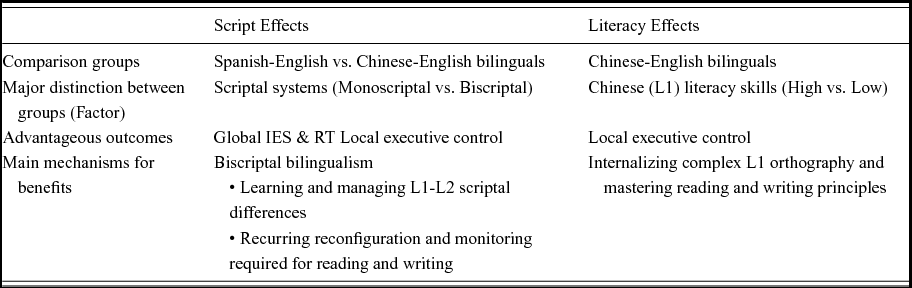
First, we examined the effect of script variation (monoscriptal vs. biscriptal) by contrasting a Spanish–English bilingual group of high L1 literacy with matched Chinese–English bilinguals from Singapore (Contrast 1-SCRIPT). Prior studies assume that bilinguals are homogeneous regardless of their different languages pairs; thus, few studies have considered cross-linguistic variations as a possible modulating factor for bilingual advantages in executive processes (e.g., Coderre & van Heuven, Reference Coderre and van Heuven2014). Through Contrast 1, we aimed to examine script variation (i.e., language pair) effects on attentional processing, particularly when all other important factors, such as proficiency and balancedness, were controlled for by matched sampling. We expect that biscriptal Chinese–English bilinguals will show greater advantages in executive attention than monoscriptal Spanish–English bilinguals. Learning and mastering distinct scripts with varying complexity of visuospatial configuration and different decoding systems would be cognitively more taxing than processing similar scripts. Ultimately, the recurring need to reconfigure between two sets of distinct forms (logographic-alphabetic scripts) can result in more efficient attentional processing for biscriptal bilinguals than monoscriptal bilinguals (see Table 1 for specific mechanisms involved in script effects).
Main mechanisms for script and literacy effects.

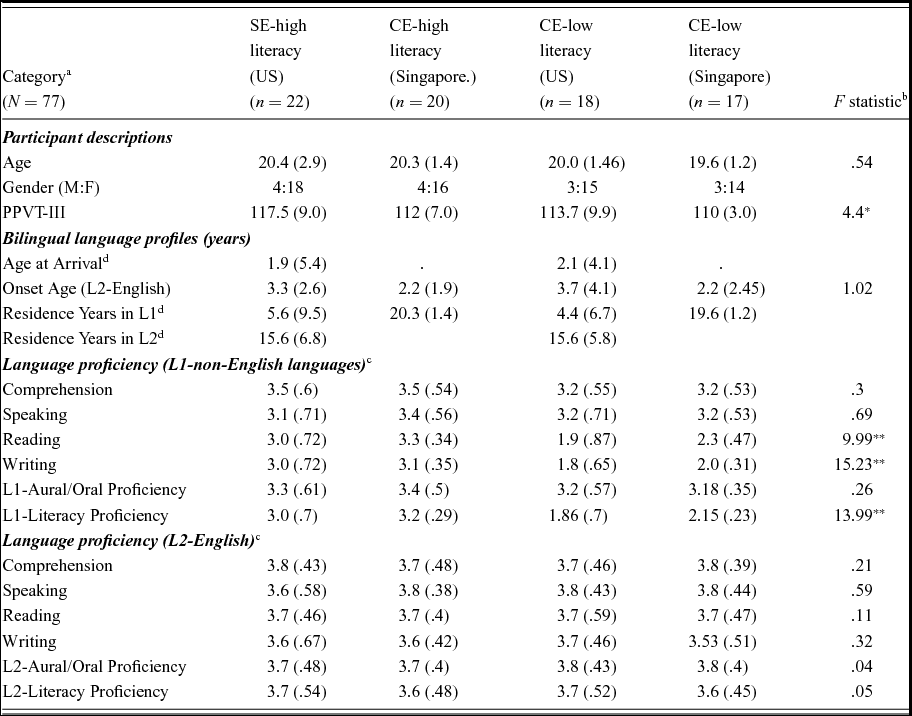
Participant descriptions, bilingual language profiles, and levels of language proficiency (SDs).

a SE: Spanish-English; CE: Chinese-English; US: United States; S'pore: Singapore
b Results were based on a one-way analysis of variance with Group as a factor.
c Peabody Picture Vocabulary Test-III was used to measure English lexical knowledge.
Aural/Oral skills refers to comprehension and speaking skills, and literacy skills refer to reading and writing.
d F-tests for these bilingual profile factors (i.e., age at arrival, residence years in L1 and L2) were not performed because they do not apply to Singaporean bilinguals.
e The Likert scale for language proficiency ranged from 1 (limited proficiency) to 4 (native-like proficiency).
** p < .001, * p < .05.
Alphabetic (English and Spanish) and logographic (Chinese) scripts differ in their visual complexity and how meaning is retrieved from their visual forms. Both Spanish and English use Roman alphabets that consist of a set of 26 (English) or 27 (Spanish) letters, while Chinese logographic characters consist of hundreds of radicals and their variants (i.e., 214 Kangxi radicals – such as strokes, dots, hooks, curves, raise, slant, etc. – and 800 phonetic and 200 semantic radicals and their variants; Hoosain, Reference Hoosain1991). For both Spanish and English, which differ in some graphemes and phonetic values, lexical access is more closely associated with processing a phonological code. In contrast, logographic scripts depend heavily on visual routes that use morphological, configurational, and componential processing (e.g., Briggs & Goryo, Reference Briggs and Goryo1988). In a related vein, Green, Rickard Liow, Tng, and Zielinski (Reference Green, Rickard Liow, Tng and Zielinski1996) have shown that not only processing demands but also visual search functions (e.g., alphabetic letter or nonalphabetic symbol search) vary according to the nature of the script. Given the different processes that operate in alphabetic and logographic scripts, biscriptal bilinguals who have integrated two vastly different script systems likely undergo unique processing demands that are not necessarily involved in monoscriptal bilinguals’ script processing. This is because long-term practice in managing scriptal differences should demand more cognitive effort and controlled attention than managing similar scripts – or even complex logographic scripts alone, as in Chinese monolinguals.
In view of scriptal similarities between the two alphabetic languages, the literature demonstrates cross-language transfer of word-reading accuracy for Spanish–English bilingual children in Grades 1 and 2 (Pasquarella, Chen, Gottardo & Geva, Reference Pasquarella, Chen, Gottardo and Geva2015). Similarly, Spanish–English bilinguals in Grades 2 and 3 showed cross-language orthographic transfer from L1-Spanish to L2-English in reading and spelling (Sun-Alperin & Wang, Reference Sun-Alperin and Wang2011). However, due to scriptal dissimilarities, such cross-language transfer was absent in Chinese–English bilingual peers (Pasquarella et al., Reference Pasquarella, Chen, Gottardo and Geva2015). Additionally, empirical evidence from the literature on second-language acquisition supports wider cross-linguistic differences between L1 and L2 make second-language learning difficult, and are known to be associated with poorer final L2 attainment across several domains, such as comprehension and production (e.g., Jia, Aaronson & Wu, Reference Jia, Aaronson and Wu2002). Taken together, Chinese–English biscriptal bilinguals’ attainment of high literacy skills in both L1 and L2, despite difficulties in learning highly dissimilar languages, could have honed and sharpened more rigorous and efficient command of executive attention in managing two different scriptal systems.
Second, to investigate whether high L1-Chinese literacy skills can independently yield positive effects on executive processing, we conducted Contrast 2 (LITERACY) by comparing two Singaporean Chinese–English bilingual groups whose L1-literacy skills varied (high vs. low) but who were matched for other aspects of L1-L2 proficiency. Reading and writing in Chinese placed high demands on visual recognition and control. Therefore, bilinguals who are skilful at complex orthographic representation and processing can better maneuver visually oriented attention. We used self-reported L1-literacy in reading and writing as an index of a bilingual's internalization (i.e., mastery) of scripts, because high literacy skills reflect not only one's knowledge of a letter or character's visual configuration – which is a surface-level representation – but also a good grasp of mapping principles between forms and phonemes. According to self-reported L1-literacy skills, our bilinguals were further divided into either high- or low-literacy groups; note that all bilinguals were equal in other linguistic aspects, such as L1-aural/oral skills and L2-overall English proficiency (aural/oral and literacy skills). We hypothesized that if L1-literacy (high vs. low) substantiates mastery of script knowledge and associated specialized deployment of attentional processing, Chinese–English bilinguals with high L1-literacy skills should outperform their counterpart Chinese–English bilinguals with low L1-literacy skills.
Lastly, we examined the effect of immersion experience on executive attention (Contrast 3-IMMERSION) by contrasting two groups of Chinese–English bilinguals recruited from two different immersion environments (US vs. Singapore) while holding script (i.e., biscriptal bilinguals) and literacy (i.e., low) constant. Immersion for Chinese is much weaker in the US than Singapore, where both English and Chinese are actively spoken in all public settings.
Method
Participants
Seventy-seven college students participated in exchange for either extra course credit or payment ($5). Twenty-two Spanish–English bilinguals with high L1-Spanish literacy (SE-high-US) and 18 Chinese–English bilinguals with low L1-Chinese literacy (CE-low-US) were recruited from a private university in the US. The groups were carefully matched in terms of immigration status and language background (e.g., age of arrival, onset of L2-English acquisition, and residence years in L1 and L2 countries; see Table 1). Because the L1-literacy of Chinese–English bilinguals in the US was not on par with that of their Spanish–English counterparts, we recruited an additional 37 Singaporean Chinese–English bilinguals from a local private university in Singapore that is comparable to the US university in terms of admissions standards and international reputation (Times Higher Education World University Rankings, 2015–2016). Singapore is a bilingual society with four official languages – English, Mandarin Chinese, Malay, and Tamil (Tan, Reference Tan2006); among them, English is spoken as the main medium of instruction in schools (Gopinathan, Reference Gopinathan, Gopinathan, Pakir, Ho and Saravanan1998). In Singapore, Chinese–English bilinguals comprise 76.8% of the population (Tan, Reference Tan2006), and they grow up exposed to both English and Chinese at home and in public and educational settings.
Nevertheless, many aspects of Singapore's social and educational systems have been reshaped based on Western influences (Ang & Stratton, Reference Ang and Stratton1995), which uniquely positions Singapore as a hub in which East and West can harmoniously coexist. Given this immersion environment, the additional 37 Singapore bilinguals we recruited were matched to their counterpart bilinguals in the US based on particular aspects of script, literacy skills, and bilingual immersion. Specifically, 20 Singaporean Chinese–English bilinguals with high L1-literacy (CE-high-S'pore) were matched with US Spanish–English bilinguals with high L1-literacy (SE-high-US). In addition, 17 Singaporean Chinese–English bilinguals with low L1-literacy (CE-low- S'pore) were matched with Chinese–English bilinguals with low L1-literacy from the US (CE-low-US). With this matched-participant design, the effects of script, literacy, and bilingual immersion were investigated independently while controlling for their influences on one another.
Mean age of the participants was 20.1 (SD = 1.94), with no significant group differences when a one-way analysis of variance (ANOVA) by language group was performed. Bilingual profiles were measured in terms of age on arrival, residence length in non-English and English-speaking countries (US bilinguals only), and onset age of English. Self-reported aural/oral (comprehension/speaking) and literacy (reading and writing) skills were measured on a 4-point Likert scale ranging from 1 (limited proficiency) to 4 (native-like proficiency).Footnote 1 The only significant difference among the four bilingual groups appeared in L1-literacy in reading, F(3, 73) = 18.28, p = .001, = .43, and writing, F(3, 73) = 30.33, p = .001, η2p = .56 (see Table 1). The two high-literacy samples (SE-high-US and CE-high-S'pore) were equivalent in literacy skills, but had acquired significantly higher L1-literacy skills than their low-literacy counterparts (CE-low-US and CE-low-S'pore), ps < .01. Because English was used as the medium of instruction, all of the bilingual groups had higher L2-English proficiency (M SE-high-US = 3.68, SD = .5; M CE-low-US = 3.7, SD =.46; M CE-high-S'pore = 3.69, SD =.45; M CE-low-S'pore = 3.7, SD =.39) than L1-proficiency (M SE-high-US = 3.15, SD =.6; M CE-low-US = 2.5, SD =.57; M CE-high- S'pore = 3.3, SD =.34; M CE-low-S'pore = 2.7, SD =.2). Self-reported L2-English proficiency scores in all four domains – comprehension, speaking, reading, and writing – were equivalent across the four bilingual groups. Similarly, their L1-aural/oral skills did not differ, ps = ns.
Tasks
Peabody Picture Vocabulary Test-3rd Edition (PPVT-III; Dunn & Dunn, 1997)
The PPVT-III was employed to measure receptive vocabulary for L2-English, which was the main medium of instruction for all bilingual groups. The PPVT is a standardized test with a mean of 100 and standard deviation of 15. The PPVT-III was also used to roughly approximate participants’ cognitive-linguistic abilities, since it has been shown to be highly correlated with the Wechsler Adult Intelligence Scale-III (r = .4, p < .01; Bell, Lassiter, Matthews & Hutchinson, Reference Bell, Lassiter, Matthews and Hutchinson2001).Footnote 2
Attention Network Test (ANT; Fan et al., Reference Fan, McCandliss, Sommer, Raz and Posner2002)
The ANT consists of four cues and three flanker types, which were designed to probe attentional performance at both global and local levels across several dimensions. In the task, participants were asked to press one of two response keys on a keyboard to match the direction of a central target arrow, which was flanked by four other arrows on each side. Combinations of cue-by-flanker types yielded a total of 12 different conditions and 288 trials, which were presented over one training (24 trials) and 3 experimental blocks (88 trials each).
Global indices of attentional processing include measures of RT, accuracy, and inverse efficiency, which controls for speed-accuracy trade-offs. Local indices of attentional processing were reflected in measures of three network efficiency scores – alerting, orienting, and executive control (see Figure 1). Alerting scores (i.e., vigilance for target processing) were obtained by subtracting RTs for double-cue types (two cues simultaneously appear with both above and below the fixation mark) from those for no-cue types. Scores for orienting, which entails tuning into cues to detect the target, were computed by subtracting RTs for spatial cues (in which a cue is presented at the same location of an upcoming target) from those for central cues (in which a cue is presented in the center of the screen, where a fixation mark also appears). Scores for executive control – which facilitates the resolution of conflicts between target and distraction – were obtained by subtracting RTs on congruent flanker types from those on incongruent flanker types.
Schematic representation of the Attention Network Test (ANT).

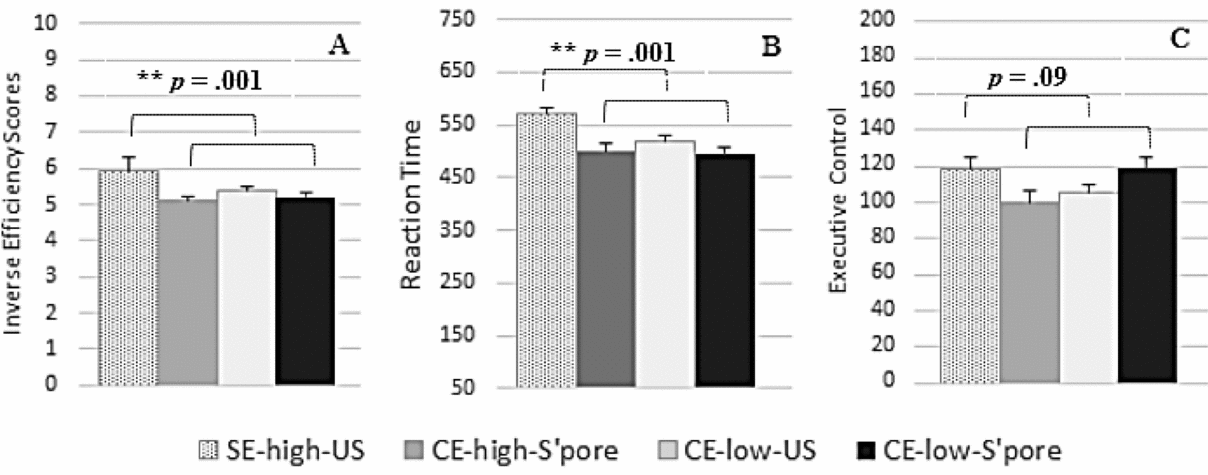
The effects of script variation on the IES, RT, and executive control measures.

Procedures
Participants met with English-speaking experimenters in a quiet room. The English PPVT-III and Attention Network Test (ANT) were administered in a random order. Upon completion, a self-reported language questionnaire was administered to ascertain the nature of their bilingualism. All instructions were given in English.
Results
Incorrect trials and RTs that deviated from the conventional range (200 < RT < 1,200Footnote 3; Tao, Marzecová, Taft, Asanowicz & Wodniekca, Reference Tao, Marzecová, Taft, Asanowicz and Wodniecka2011) were excluded during data preprocessing for the ANT. The proportion of outliers removed from each group is as follows: SE-high-US = 3.67%; CE-low-US = 3.62%; CE-high-S'pore = 2.95%; CE-low-S'pore = 4.97%. When a chi-square test was performed to examine group differences in the number of outliers, a significant difference emerged, χ²3 = 11.46, p < .05, which may reflect latent group differences associated with different bilingual profiles in scripts, literacy, and immersion.
Initial analyses revealed that all sociodemographic factors, such as age and gender, were consistent across the four bilingual groups. Therefore, those variables were dropped for subsequent analyses. Hypotheses were tested using three repeated contrasts within the one-way ANOVA model: We first compared the performance of all four groups on dependent measures, followed by three contrast analyses in which two groups at a time were further compared for script, literacy, and immersion effects. Although this is a nonorthogonal contrast that allows repeated statistical testing, a Bonferroni correction was not applied because only a small number of planned comparisons were performed, and a particularly conservative p-value could increase the chance of type II error (Armstrong, Reference Armstrong2014; Streiner & Norman, Reference Streiner and Norman2011).
To investigate the SCRIPT effect (Contrast 1), we compared monoscriptal (similar-script: Spanish–English) and biscriptal (dissimilar-script: Chinese–English) language combinations by contrasting the SE-high-US group with the matched CE-high-S'pore group, both of which possess high L1-literacy. The literacy effect (Contrast 2) was examined by contrasting CE-high-S'pore with CE-low-S'pore; thus, for the literacy contrast, script variation was held constant. Lastly, the immersion effect (Contrast 3) was examined by contrasting CE-low-S'pore with CE-low-US, while script variation and (low) literacy skills were held constant. In addition, we performed a set of regression analyses to assess the unique influence of each factor (script, literacy, and immersion) on performance on the ANT.
Peabody Picture Vocabulary Test (PPVT-III)
The four bilingual groups differed significantly in level of receptive vocabulary for English, F(3, 73) = 4.39, p = .007,  $\eta \frac{2}{p}$= .15. Planned contrasts revealed a significant SCRIPT effect, t(73) = 2.3, p < .03, d = .67, which indicates that monoscriptal bilinguals (SE) are at an advantage. The immersion effect was significant as well, t(73) = −2.04, p = .045, d = .76, indicating that the Chinese–English bilinguals living in the US had greater vocabulary knowledge than their counterparts (CE-low-S'pore) in Singapore. However, no literacy effect was found, which indicates that receptive vocabulary for English did not vary by L1 (Chinese) literacy skills. Moreover, PPVT scores did not correlate with any of the attention measures, all rs < .17, ps = ns; thus, we did not consider PPVT scores as a covariate in analyses of performance on the ANT.
Attention Network Test (ANT)
Global inverse efficiency scores (IES)
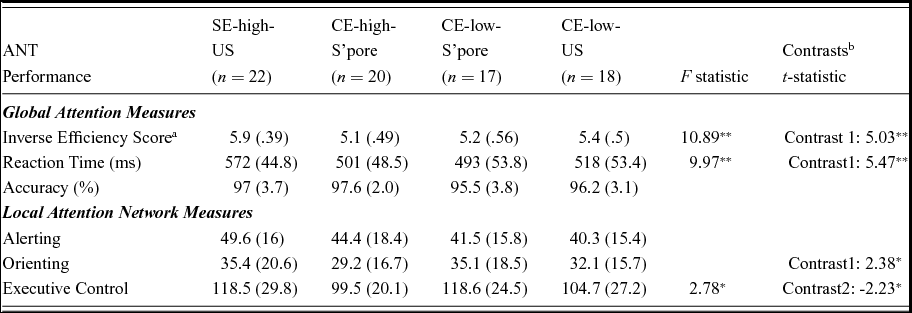
A significant group difference emerged when global IES – which is a combined measure of RT and accuracy – was submitted to a one-way ANOVA, F(3, 73) = 10.89, p = .001,  $\eta \frac{2}{p}$= .31. Planned contrasts showed a significant script effect, t(73) = 5.03, p = .001, d = 1.69. This result supports the effect of bilinguals’ script variation on attentional processing at a global level, in favor of biscriptal bilinguals who speak languages with dissimilar scripts. The other planned comparisons – literacy and immersion effects – were not significant, indicating that once the same script system is shared and all other linguistic aspects are controlled for, L1-literacy skills and immersion experiences did not exert significant variation on global processing efficiency in attention.
Global reaction time (RT)
The same ANOVA on RT scores yielded a significant group difference, F(3, 73) = 9.97, p = .001,  $\eta \frac{2}{p}$= .29. Consistent with our results for IES, planned contrasts showed a significant SCRIPT effect, t(73) = 4.46, p = .001, d = 1.44, which illustrates the modulating role of script variations in attentional functioning. However, literacy and immersion effects on global RT were not found. These results suggest that when Chinese orthography was held constant, literacy (high and low) and bilingual immersion (US and Singapore) did not play a significant role in attentional processing.
Global accuracy
The four groups did not differ in accuracy. Given that we tested college students at the peak of their cognitive performance, all groups achieved close to ceiling performance in overall accuracy rate, and thus the absence of any interesting effects can be attributed to the lack of variance across groups.
Local network efficiency
The same ANOVA was performed on positive values of the three individual network efficiency scores for alerting, orienting, and executive control. Out of 189 data points, 6 negative values (n = 3 for alerting and n = 3 for orienting) were dropped, following the conventional procedure (Rueda, Fan, McCandliss, Halparin, Gruber, Lercari & Posner, Reference Rueda, Fan, McCandliss, Halparin, Gruber, Lercari and Posner2004). A significant group difference was found in the network of executive control, F(3, 73) = 2.78, p = .047, = .10. Planned contrasts yielded significant effects of script, t(73) = 2.38, p = .02, d = 3.47, and literacy, t(73) = −2.24, p = .028, d = 1.07. The results indicate, respectively, that biscriptal Chinese–English bilinguals are more effective at executive control than their monoscriptal Spanish–English bilinguals and that high-literacy Chinese–English bilinguals in Singapore display better executive control skills than their low-literacy Chinese–English counterparts. No other effects were significant.
Regression analysis
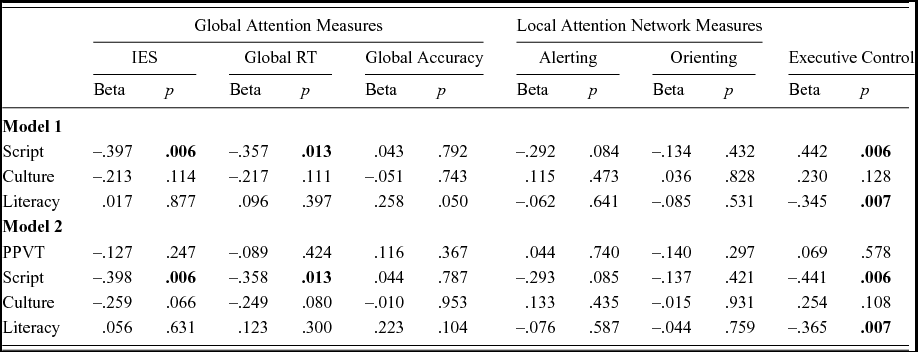
Multiple regression analyses were conducted in SPSS (version 23) with respect to global and local measures as criterion variables to assess the unique effects of script, literacy, and immersion on ANT performance. We tested two regression models in which script was dummy coded to compare orthographically similar monoscriptal bilinguals (coded 1) to orthographically dissimilar biscriptal bilinguals (coded 0), and immersion was dummy coded to compare bilingual immersion in Singapore (coded 1) to the absence of immersion in the US (coded 0).
Furthermore, literacy was operationalized as a continuous variable to ensure the robustness of the results by not dichotomizing a continuous variable. In the first model, script, literacy, and immersion were simultaneously included in the model to predict global IES, global RT, global accuracy, and local network efficiency scores for alerting, orienting, and executive control. In the second model, we also included standardized PPVT scores to control for potential variation in receptive vocabulary.
In line with our planned contrast, we found that script significantly predicted IES and executive control network scores when literacy and immersion were controlled for (Table 3). Notably, their significance held true when PPVT scores were controlled for. Similarly, we found that literacy significantly predicted executive control network scores after controlling for script and immersion (model 1) and script, immersion, and PPVT (model 2). This suggests that bilinguals’ L1-literacy skills can robustly predict executive control skills regardless of script variation and bilingual immersion.
Global Measures of ANT Performance (SDs) and Network Efficiency.

a Higher inverse efficiency scores (i.e., RT divided by accuracy) indicate poorer processing efficiency, and smaller values imply greater efficiency.
b Contrast 1 (SCRIPT: monoscriptal vs. biscriptal); Contrast 2 (LITERACY: high Chinese literacy vs. low Chinese literacy); Contrast 3 (IMMERSION: US vs. Singapore)
* p < .05, ** p < .001.
Summary of Multiple Regression Analyses to Predict Global Attention Measures and Local Attention Network Measures of ANT.

Discussion
Using both a priori contrast and multiple regression analyses, the effects of script variation, L1-literacy skills (reading and writing), and bilingual immersion on executive attention were examined in four bilingual groups (SE-high-US, CE-high-S'pore, CE-low-S'pore and CE-low-US,) that were matched on L1-aural/oral skills and overall L2 (English) proficiency in all four domains – comprehension, speaking, reading, and writing. In terms of English lexical knowledge, as measured by the PPVT-III, we identified a script effect in favor of monoscriptal Spanish–English bilinguals over biscriptal Chinese–English bilinguals. We also found an immersion effect on lexical knowledge, indicating that Chinese–English bilinguals who grew up in the US (CE-low-US) outperformed their Singaporean counterparts (CE-low-S'pore). Consistent with the literature (see Bialystok et al., Reference Bialystok, Luk, Peets and Yang2010), immersion effects on lexical knowledge may be due to differences in the amount of exposure to English (L2). Although English is an official language in both the US and Singapore, largely monolingual settings in the US could have been conducive for bilinguals to acquire better lexical knowledge of English than their counterparts in Singapore – a bilingual society in which diverse languages proliferate.
Script effects were evident in global processing efficiency (IES and RT), as well as on the local measure of executive control network scores, in favor of biscriptal Chinese–English bilinguals of high L1 literacy over matched monoscriptal Spanish–English bilinguals. Indeed, our multiple regression corroborated that script significantly predicted both global processing efficiency and executive control network efficiency, especially when literacy, immersion, and PPVT scores were controlled for in the models. These results imply that script variation similarly strains two aspects of regulatory attention-system processing: global-monitoring and local conflict resolution. Both literacy and immersion effects were generally attenuated on global processing when L1-scripts were held constant among Chinese–English bilinguals with varying literacy skills (high vs. low) and immersion experience (US vs. Singapore). Notably, we found that literacy significantly enhanced executive control network efficiency: Chinese–English bilinguals of high L1 literacy from Singapore were better at working with conflicts and interferences than their counterparts with low Chinese literacy from Singapore. However, immersion effects were not significant in executive control processing when both script and literacy levels were held constant. It is premature, however, to draw conclusions about the extent of the impacts of immersion, because it could still have affected attentional processing if a wide range of immersion experiences and proficiency levels, as well as their precise quantification among bilinguals was considered. Together, these results are in line with those of multiple regression analyses in which both script and literacy (but not immersion) significantly predicted executive control network efficiency.
Given that script variation and L1-literacy skills affected different aspects of controlled attention (global vs. local), it is plausible that different mechanisms may underlie those effects. Script effects are rooted in biscriptalism – learning and managing two dissimilar scriptal systems – whereas literacy effects are driven by internalizing complex Chinese orthography and mastering the principles of reading and writing. Biscriptal bilinguals with high literacy skills in both L1 and L2 face unique challenges and high processing demands in reconfiguring and monitoring the different strategies and principles implicated in reading and writing (e.g., Wang, Perfetti & Liu, Reference Wang, Perfetti and Liu2005). Neuroimaging studies shed light on different neural and structural outcomes of processing varying scripts. Nelson, Liu, Fiez, and Perfeti (2005, 2008) conducted fMRI studies in which Chinese–English biscriptal bilinguals were compared with English speakers who had spoken Chinese only for 1 year and English and Chinese monolinguals. They found that Chinese–English biscriptal bilinguals, and even English learners of Chinese, revealed bilateral activation in the fusiform gyrus when recognizing English words or Chinese characters, while English monolinguals showed left-lateralized fusiform activation. Jamal, Piche, Napoliello, Perfetti, and Eden (2012), on the other hand, found that when balanced monoscriptal Spanish–English bilinguals’ word reading in both L1 and L2 was examined using fMRI, a left-lateralized activation was mainly observed for languages that share the same scriptal system: left inferior frontal and left middle temporal gyri for Spanish and the left inferior frontal, middle frontal, and fusiform gyri and superior temporal sulcus for English. These results imply that biscriptal bilinguals, as opposed to monoscriptal bilinguals, engage in additional neural structures (e.g., the right fusiform gyrus) and bilateral activity, presumably due to greater processing demands to more adaptively manage dissimilar scripts.
Relatedly, L1-literacy skills in our planned analyses exerted a significant effect on executive control among Chinese–English bilinguals who differed in literacy levels (high vs. low). The results of multiple regression analyses in which literacy was treated as a continuous variable also revealed that L1-literacy is a significant predictor of executive control processing. The mechanisms that underlie the positive effect of L1-literacy may be more closely related to the bilingual's internalization of complex L1 orthography and L1 literacy proficiency. Mastery in Chinese L1 literacy denotes memorizing a myriad of radicals and their phonetic and semantic codes, as well as understanding the principles of mapping between Chinese characters and morphemes (Shu & Anderson, 1997), all of which are quite different from processing alphabetic languages. Due to the inherent complexity of Chinese logographs’ visual characteristics and their distinct mapping principles, recognizing Chinese characters is more taxing visually than Roman alphabets. Apt skills in Chinese literacy, therefore, facilitate visual recognition for more accurate mapping between forms and meanings. For instance, McBride (Reference McBride2016) uses the example of the Chinese character ‘ロ,’ which signifies the mouth and consists of three strokes (丨,フ, ). Chinese–English bilinguals with low literacy skills may be unable to accurately use their visual attention to dissect the diverse elements of compound Chinese characters or to easily access lexical meanings.
On the other hand, Chinese–English bilinguals with high literacy skills may have an advantage in attentional processing due to their knowledge of and sensitivity to subtle visual features, which would be required to analyze different characters and detect semantic meanings. In addition, a number of studies have shown that reading and writing Chinese logographs strain visuospatial processes much more than reading alphabet letters (e.g., Tavassoli, Reference Tavassoli2002). Tan, Liu, Perfetti, Spinks, Fox, and Gao (Reference Tan, Liu, Perfetti, Spinks, Fox and Gao2001) found that brain areas that are activated to configure visually complex Chinese characters are routinely implicated for spatial working-memory skills and intensive analysis of visuospatial information. Taken together, the primary mechanisms that underlie the positive impact of high L1-Chinese literacy can be attributed to the acquisition and mastery of complex logography.
We argue, however, that the positive effects of scripts (i.e., biscriptal bilingualism) are not solely driven by knowledge of Chinese orthography (L1-Chinese literacy skills) for two reasons. First, our findings are consistent with those of prior studies that tested other biscriptal bilinguals (e.g., Korean–English and Japanese–English bilinguals). Specifically, Yang and Lust (Reference Yang and Lust2007) compared the performance of biscriptal and monoscriptal bilinguals on executive attention on the same measure used in this study. They found that Korean–English biscriptal bilinguals (M = 507) outperformed their monoscriptal French–English and Spanish–English counterparts (M = 523) in global RT and a local measure of executive control (M = 97 as opposed to M = 114). Moreover, Linck, Hoshino, and Kroll (2008) found greater inhibitory control abilities in favor of biscriptal Japanese–English bilinguals on the Simon Task than monoscriptal Spanish–English bilinguals. Although neither study controlled for bilinguals’ L1 literacy skills, as we did in this study, similar patterns of findings across different biscriptal bilinguals lend further support for the critical role of biscriptal bilingualism in modulating efficient executive processing.
Second, in our new literacy contrast, we compared only Singaporean biscriptal (Chinese–English) bilinguals who differed in their Chinese literacy skills (high vs. low). We found that literacy effects influenced only local executive control, while script effects influenced both global (IES and RT) and local measures. If script effects were simply due to the acquisition of logographic scripts, we should have observed the same pattern of advantages for local executive control alone and not for global measures; however, script effects were apparent on both global and local measures. Hence, script effects, compared to literacy effects, are likely based on mechanisms above and beyond the use of logographic scripts.
An interesting question arises as to whether the mechanism that underlies bilingual advantages in executive attention is associated with either the use of Chinese logographs itself (which would confer benefits on Chinese monolinguals) or bilinguals’ internalization of dissimilar scripts (alphabetic and logographic systems). The answer is not straightforward, because the potential benefits of bilinguals’ use of dissimilar scripts are closely intertwined with those conferred by the use of complex orthography. Few empirical studies have directly addressed this question, and their findings are not entirely consistent. Xie and Dong (Reference Xie and Dong2015) compared Chinese monolinguals with Chinese–English bilinguals who were learning public speaking in either Chinese (L1) or English (L2). They found that bilinguals and monolinguals did not differ in terms of flanker effects (i.e., RT difference between congruent and incongruent trials) that index inhibitory control at a local level, but bilinguals who were learning public speaking in L1 or L2 performed better than Chinese monolinguals in terms of monitoring (i.e., global RT), as assessed by the flanker and number Stroop Tasks, and flexibility, as assessed by the Wisconsin Card Sort Task. Although these discrepant findings are largely due to different bilingual experiences (e.g., proficiency, dominance), it seems that biscriptal experience and mastery of complex Chinese orthography lead to different executive processing outcomes through potentially different mechanisms. In other words, bilingual experience of dissimilar scripts seems to confer unique benefits on executive control, as opposed to cognitive benefits conferred by monolingual experience with complex Chinese orthography.
Notably, we caution that our findings do not necessarily contradict the findings of Coderre and van Heuven (Reference Coderre and van Heuven2014). Although they contend that similar-script bilingualism enables more effective executive functioning than dissimilar-script bilingualism – which is contrary to our finding – it is noteworthy that their comparison was based on typological distance between similar alphabetic languages (German, Polish, and Arabic), whereas our comparison is based on typologically distinct alphabetic and logographic languages (Spanish and Chinese). Moreover, given our finding of significant L1-literacy effects among matched bilingual groups (in terms of script and immersion), our findings further highlight the importance of those understudied factors and their potentially significant impacts on executive processing. Future research is therefore warranted to investigate how typological distance within a similar or dissimilar language family modulates executive processing.
Some caveats should be noted. First, although our comparison was based on the combination of two distinct script variations (monoscriptal bilingualism of two similar Roman alphabets vs. biscriptal bilingualism of logographic-alphabetic systems), a more quantifiable measure of script variation among bilinguals’ languages and an objective measure of literacy skills would broaden our understanding of the impact of script variation and literacy levels on executive attention. Such measures would be useful for our understanding of the impact of typological distance within the same language family (for a proposed metric, see Paap et al., Reference Paap, Johnson and Sawi2015). Moreover, script variation is complex in itself and difficult to operationalize for testing, especially because its effects on aspects of executive attention are not completely independent of other linguistic parameters, such as syntax, semantics, lexicon, phonology, and pragmatics. Nevertheless, our study suggests that script variation between alphabetic and logographic language combinations is closely linked to executive attention.
Second, although our findings suggest a link between script variation in a bilingual's language pair and executive attention, we acknowledge that generalizing our findings to similar language families should be undertaken with caution. For instance, although Japanese uses Chinese characters, it uses fewer Chinese characters and in forms that have been simplified from the original Chinese version. Moreover, given that Japanese also uses syllabaries, called kana, Japanese–English bilinguals might not reap the same cognitive benefits unless they have a more extensive knowledge of and actively use Chinese characters. At the same time, further testing of various biscriptal bilingualism with appropriate controls on literacy skills (e.g., Korean as L1 and English as L2) is warranted to investigate whether the impact of dissimilar L1-L2 scripts on executive attention would be robust. For instance, the nonlinear orientation of Korean orthography, Hangul, possesses visual complexities similar to those of Chinese characters, requiring spatially more precise processing skills for correct phonemic and semantic mapping and more efficient reading (Wang, Park & Lee, Reference Wang, Park and Lee2006). That is, the spatial configuration of the Korean consonants (C) and vowels (V) is clustered in a square-like syllable block (e.g., 닭 /dak/- ㄷ(C)ㅏ(V) – upper cluster, ㄹ(C)ㄱ(C) – lower cluster, together meaning “chicken”) and requires focused attention to segment the letters for reading and comprehension. Replicating script effects in a variety of biscriptal bilingualism with varying L1-literacy skills could more clearly explicate the mechanisms involved in script effects and identify the source of these increased effects – e.g., the complexity of L1 script alone as opposed to the acquisition of biscriptal proficiency.
Third, given the potential effects of socioeconomic status (SES), IQ, and working memory (WM) on attentional processing, we acknowledge that the absence of these direct measures is a shortcoming of the study. However, we believe that it is unlikely that SES, IQ, or WM have confounded our findings of script and literacy effects, for the following reasons. Most importantly, given that we tested college students who were at their peak cognitive capacity, SES – which has been found not to correlate with inhibitory control (Paap & Greenberg, Reference Paap and Greenberg2013) – does not necessarily confound the effect of bilingualism (see also Bialystok, 2009). We recruited our participants from two prestigious universities that are comparable in many respects, despite their geographical distance; both schools (Cornell University in the US and the National University of Singapore) are ranked quite highly (19th and 25th, respectively), according to the Times Higher Education World University Rankings 2014–16. This indicates that our participants had already overcome any socioeconomic adversities and successfully navigated a rigorous admissions process in a highly competitive academic domain.
In a related vein, given that these two institutions are well known for their academic excellence and students’ competence, our participants’ IQ scores are likely above, or at least similar to, the national average. Therefore, although direct measures of SES or IQ were absent, extensive evidence and our use of schools that are comparable in academic ranking lessen the risk that SES or IQ would confound the groups’ performance on the ANT. Also, although some have argued that WM implicates attentional processing (Gray, Chabris & Braver, Reference Gray, Chabris and Braver2003; Redick & Engle, Reference Redick and Engle2006), little evidence exists that WM has confounded bilingual advantages on the ANT. Bilingual advantages in WM have been found to be particularly evident when WM tasks place greater demands on controlled processing, such as simultaneous coordination of multiple tasks or attentional shifting between competing tasks that involve substantial interference (Yang & Yang, Reference Yang and Yang2015). Given that the ANT was developed to measure relatively purer aspects of attentional processing – i.e., focusing on the central stimulus in the face of flankers – without implicating high demand on controlled processing, it is unlikely that our finding of bilingual advantages on the ANT are confounded by bilingual advantages in WM.
Finally, due to an absence of Chinese monolingual participants (either in the US or Singapore) for comparison, the study is limited in its ability to shed light on the effect of logographic script on executive control. Therefore, it is imperative that we identify whether the exclusive use of distinct scripts, such as Chinese logographs by Chinese monolinguals, can afford the same level of benefits for biscriptal Chinese–English bilinguals. Future studies should examine this issue with a more refined design and sophisticated analysis (e.g., propensity-score matching; Hartanto & Yang, Reference Hartanto and Yang2016b); testing Chinese monolinguals might complicate their comparison with Chinese–English bilinguals in both the US and Singapore, for the following reasons. First, given Chinese monolinguals’ typically higher linguistic competence (in terms of literacy, vocabulary, comprehension, writing, and other language skills) than their bilingual counterparts in both the US and Singapore, it is challenging to match the language groups on their Chinese verbal abilities, which can have potentially different impacts on executive control abilities. Hence, a further study with a refined design and more sophisticated statistical analysis (e.g., propensity-score matching) is warranted to examine this issue.
Second, Chinese monolinguals in China are uniquely different from Chinese–English bilinguals in the US or Singapore in many respects, including geographic regions, SES, academic motivation and attainment, political and cultural environments, family and household structure, and so on. Therefore, comparing Chinese–English bilinguals in either the US or Singapore with Chinese monolinguals in China may not necessarily address or identify the mechanisms that underlie the effect of logographic scripts. Third, and more importantly, given that our primary focus was on script variation among diverse bilingual groups, comparison across different bilingual groups without monolingual counterparts has distinct advantages, and does not necessarily undermine our method's appropriateness or otherwise qualify our findings. However, our conclusion should not be interpreted to suggest that script variation is the underlying mechanism that leads to bilinguals’ advantages relative to monolinguals. It is also important to further inform how script effect may contribute to monolingual-bilingual differences in executive function.
Our study opens up potential avenues for future research on critical variables of script variation, literacy, and immersion in the study of bilingual advantages in executive processing. Overall, our study suggests that script variation between dissimilar language combinations is closely linked to executive attention at both global and local processing levels. However, we argue that the sources of script effects should not be limited to competing demands for coactivated language processing and cross-linguistic interference (see Coderre & van Heuven, Reference Coderre and van Heuven2014, for a review); it could instead be a combined and interactive effect of both processing demands due to monitoring complex visuospatial configuration of different scripts, language coactivation, cross-linguistic interference, and mastery of different script systems, as reflected by literacy skills. More systematically designed experimental studies, along with more powerful analytic techniques, are warranted to investigate the depth and breadth of script effects on executive processes across several domains, such as language processing, scripts, and writing systems.
To conclude, our study contributes to recent literature that emphasizes the complexity of bilingual experiences in considering the cognitive benefits of bilingualism (Yang et al., Reference Yang, Hartanto and Yang2016). Specifically, it demonstrates that not only bilingual proficiency, as measured by vocabulary size (Friesen, Luo, Luk & Bialystok, Reference Friesen, Luo, Luk and Bialystok2015); balanced bilingualism (Yow & Li, Reference Yow and Li2015); and bilinguals’ interactional contexts (Yang et al., Reference Yang, Hartanto and Yang2016), but also script variation in bilinguals’ language pairs and literacy skills should be viewed as one of the important factors that delineate bilinguals’ language profiles and, in turn, modulate bilingual advantages in executive attention.