1. Introduction
In this paper, we analyse the role of culture in the variation of economic institutions across countries and time. By economic institutions, we refer to the formal rules of the game that govern how nations conduct trade, regulate business and protect property and investments. We measure economic institutions using the Fraser Institute's Economic Freedom of the World (EFW) index (Gwartney et al., Reference Gwartney, Lawson, Hall and Murphy2019). The EFW index gauges the quality of institutions along a classical liberal tradition; therefore, countries with higher economic freedom scores generally have smaller governments, lower risk of state expropriation, freer trade and less burdensome regulation. The baseline EFW data cover 162 countries observed between 1970 and 2017. In our work, we supplement baseline data with a recent extension over 1950–1970 provided by Murphy and Lawson (Reference Murphy and Lawson2018), leaving us with the longest time horizon in related literature to date.
While it is widely accepted that ‘institutions matter’ for economic development, more recent work suggests gaps in institutional quality between countries have narrowed over time, possibly contributing to the observed conditional income convergence across countries. Using large cross-county samples, Savoia and Sen (Reference Savoia and Sen2016) and Hall (Reference Hall2016) report that the EFW institutional gap has closed by 0.7–0.8% per year since about 1980, holding constant for several social, political and economic factors. While these studies attempt to quantify the speed of institutional convergence, in this paper we are primarily interested in whether and how culture—a society's shared system of values, beliefs and norms of behaviour regarding how the world works (Roland, Reference Roland, Scott and Kosslyn2015)—influences the feasibility and pace of economic freedom reform across countries.
We contribute to this literature in two ways: first, we estimate the effect of several cultural dimensions on the growth of economic freedom within countries. In doing so, we make use of the newly constructed EFW index over 1950–1970, extending the longitudinal analysis of economic institutions throughout most of the post-war period. Second, we test linkages between cultural and institutional distance between countries, both in cross-sectional and longitudinal settings. Jointly, these two approaches allow for examining (i) which cultural attributes, if any, are associated with accelerated or dampened institutional reform and (ii) whether countries' cultural proximity predicts institutional dispersion.Footnote 1
We use Hofstede (Reference Hofstede2001) dimensions to measure culture: individualism/collectivism, power distance, uncertainty avoidance, masculinity/femininity, long-/short-term orientation and indulgence/restraint. Hofstede dimensions have been shown to be robust predictors of socio-economic outcomes across countries, such as governance quality, corruption and innovation. We first relate Hofstede dimensions to 5-year changes in the EFW index in up to 80 countries between 1950 and 2015 in a series of pooled OLS models. Our main finding is that culture has little effect on the growth of economic freedom when operating in isolation, though there is strong evidence that a sense of individualism is associated with higher growth in the EFW index among more democratic countries. We also find a positive correlation between a country's cultural proximity to the US and growth in its EFW index.
To further test whether culture matters for institutional dispersion, we analyse up to 3,003 unique country dyads. Here we find that EFW dispersion has been on the decline since 1980, and that cultural distance between two countries is a strong predictor of their institutional distance, independently of geographic, demographic, and economic measures of bilateral relatedness. Because cultural differences between countries are persistent, this finding suggests a reduced likelihood of a globally uniform distribution of economic freedom in the short run. Overall, our results follow the previous literature in concluding that culture is an important determinant of institutional change.
2. Theoretical considerations
Institutions consist of formal rules and informal norms that lend stability and predictability to human interaction and behaviour (North, Reference North1989; Reference North1990). They do so by providing incentives and constraints that jointly determine the set of permissible choices, the relationships among individuals, and ‘who may do what to whom’ (Bromley, Reference Bromley1989). Like other human constructs, institutions can and do change, and the factors underpinning this change have been the subject of a large body of social science literature.
North (Reference North1989, Reference North1990) further emphasises the role of ideas and tastes in shaping institutions. Changes in either can alter societal preferences about existing institutions as well as beliefs about how the world works or should work. North brings up the example of slavery, whose abolition in several parts of the world was eventually brought about by voting, which more easily channelled shifting social preferences regarding the institution (North, Reference North1989, p. 241). In North's framework, institutional change is achieved by actions of political and economic entrepreneurs holding these beliefs, who work to change existing institutions to their benefit.
Development economists often gauge the impact of ideas through the lens of ideology and culture.Footnote 2 The premise is culture determines the kinds of ideas and beliefs that can take root. Williamson (Reference Williamson2000) notably identifies informal norms, customs, traditions, and beliefs as the most socially embedded of all institutions. These ‘Level 1’ institutions then constrain the development of ‘Level 2’ institutions where formal rules of the game lie. In a similar vein, Roland (Reference Roland2004) proposes the distinction between ‘slow-moving’ and ‘fast-moving’ institutions, arguing that changes in the latter likely come about through the process of slow but continuous evolution of culture, beliefs and norms. Cultural persistence can thus explain the existence of multiple institutional equilibria, not all of which are considered ‘efficient.’
What is the mechanism by which culture affects institutions? The evolutionary view is that new institutions arise in a decentralised fashion, and those that minimise transaction costs will emerge and survive (Kingston and Caballero, Reference Kingston and Caballero2009). Culture can thus inspire the process of random or deliberate change in formal rules, and the most efficient rules for a given cultural context tend to be the ones that succeed. Thus, the prediction of the evolutionary approach is that the most efficient institutions arise deterministically. Yet economic policies encompassed within the EFW index come about as a process of collective choice directed by some political body such as the parliament.
Under the collective choice framework, institutional equilibria arise from the interaction between supply (government) and demand (constituents) of institutional change (Alston, Reference Alston, Alston, Eggertsson and North1996). The direction and the intensity of institutional change depend on the relative bargaining powers of the two sides. Democracy is one such gauge of bargaining power: when governments are responsive to citizens, institutional change moves in the direction of, in part, the cultural ‘consensus.’ In the total absence of democracy, institutional supply are the unelected elites. In either situation, culture shapes the cost of establishing particular institutional arrangements (Ruttan, Reference Ruttan2006). This suggests a crucial role for political and legal processes in shaping institutions. We thus model institutional (EFW) change as being conditioned culture, democracy levels, and the interaction between democracy and culture, among other covariates. This approach implies that the impact of culture on institutions depends on democracy levels (which capture the bargaining power of constituents (the median voter—institutional demand)), and that the impact of democracy likewise depends on culture.
We are not the first to propose an interaction between culture and (formal) institutions as a promising explanatory variable for institutional change. Cline and Williamson (Reference Cline and Williamson2017) interact democracy with individualism, arguing that culture determines preferences over the level of contract regulation, and democracy serves to aggregate those preferences and channel them into policy on contract enforcement. Davis and Williamson (Reference Davis and Williamson2016) find that individualism has a stronger impact on decreasing the regulatory burden of start-up entry in common law jurisdictions. Davis and Williamson (Reference Davis and Williamson2018) find a similar result when explaining the regulation of entry by foreign firms. Ang and Fredriksson (Reference Ang and Fredriksson2018) further show individualism decreases the rigidity of labour market regulations more so in common law countries.Footnote 3
Notably, democracy itself may depend on the levels of individualism within a country. Gorodnichenko and Roland (Reference Gorodnichenko and Roland2020) argue that individualistic cultures exhibit lower aversion toward institutional innovation. Once these societies overcome their collective action problems, transition to democracy is more likely to ensue. This stands in contrast to collectivist cultures that value conformity and usually transition from predatory to non-predatory autocracies. The implication is that a culture of individualism is thus causally linked to democracy.
The common argument of the literature surveyed above is that certain cultures and political and legal systems co-determine policy outcomes. Davis and Williamson (Reference Davis and Williamson2016) term this the Interdependent Institutions Hypothesis, whereby culture determines social policy preferences while institutions such as democracy or legal origins determine the extent to which culture can influence economic policy. Once social preferences are sufficiently aggregated within given political systems, culture's impact is magnified and reform is more likely to succeed if the prevailing culture and the direction of institutional reform are compatible. This notion echoes that of Pejovich's (Reference Pejovich1999) Interaction Thesis according to which transaction costs of maintaining, enforcing, and protecting new formal rules will be lower if formal and informal institutions are in harmony. Along a similar vein, Bisin and Verdier (Reference Bisin and Verdier2017) argue that depending on whether culture and institutions are complements or substitutes, their co-evolution may either mitigate or magnify their effects on socio-economic outcomes.
Why is individualism found to be robustly associated with ‘good-for-development’ outcomes? Greif (Reference Greif1994) uses a game-theoretic approach to find individualistic cultural beliefs are more likely to foster institutions that support anonymous exchange and innovation, thus enabling faster growth. Gorodnichenko and Roland (Reference Gorodnichenko and Roland2017) also find individualistic countries tend to innovate more because of the social status and recognition conferred to innovators.
3. Data
EFW index
The EFW index measures the quality of countries' economic policies and institutions on a 0–10 scale. The composite score is an aggregate of five broad dimensions of economic freedom: the size of government, legal system and protection of property rights, access to sound money, freedom to trade internationally and regulation of business, labour and credit. A growing cross-country empirical literature shows that EFW correlates positively with higher income levels and growth, reported happiness and life expectancy (Hall and Lawson, Reference Hall and Lawson2014), while it also correlates with higher income inequality (Bergh and Nilsson, Reference Bergh and Nilsson2010).
Although the EFW index measures institutions in line with the ideals of small government, large governments are not necessarily ‘bad’ for economic development. Indeed, countries with large public sectors and high overall levels of economic freedom (e.g. Sweden) have nearly identical levels of development compared to economically free countries with smaller governments. To explain this phenomenon, Bergh (Reference Bergh2020) introduces the concept of Hayekian welfare state which combines a large fiscal apparatus, rule of law, and the ability to both implement policies (state capacity) and alter them based on past experiences.
According to Bergh, the development effect of government size is moderated by the amount of knowledge available to the state when engaging in planning and fiscal interventions. If knowledge needed is relatively low, even large public expenditures (e.g. pension schemes) do not generally inhibit economic growth. If knowledge needed is considerable, interventions tend to be less successful and wasteful. The knowledge problem itself may be partly overcome with sufficient state capacity and the ability to learn from past policy failures. This implies that the relationship between government size and economic outcomes is not monotonic, and that it warrants a closer look into the types of interventions governments conduct.
The EFW scores we employ (version 2018) are assigned to countries every 5 years between 1970 and 2000 and annually over 2000–2017. Murphy and Lawson (Reference Murphy and Lawson2018) extend the composite index back to 1950 for 54 countries and to the 1960s for up to 95 countries. They do so by reconstructing two separate economic freedom ratings for 1950–1980: one based on a set of eight available variables, and the other obtained by backcasting baseline data using autoregressive modelling. The two new measures are then combined in a regression model used to fit the final EFW values over 1950–1970. This paper merges the 1950–1970 extension with the original EFW data to obtain economic freedom ratings over 1950–2015.Footnote 4
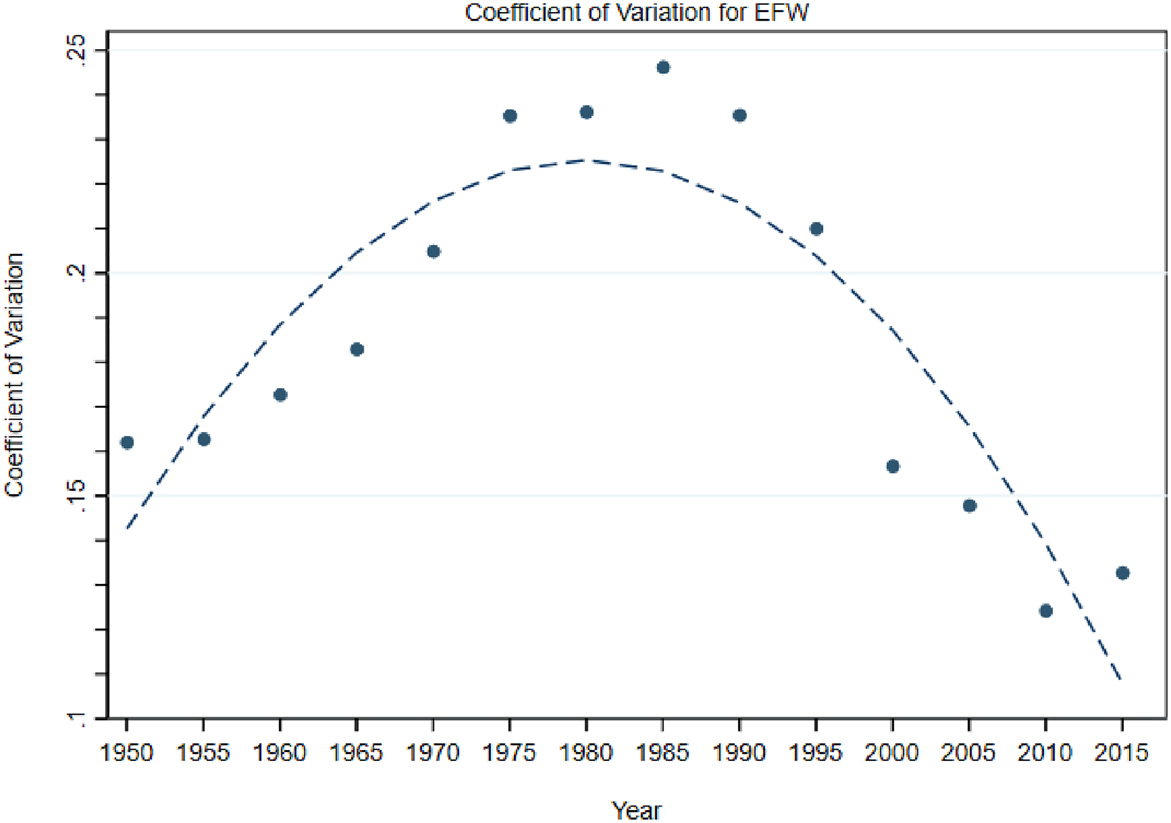
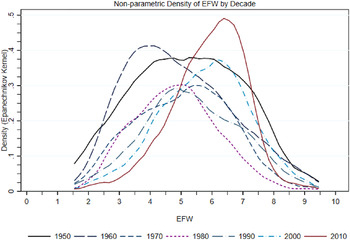
Figure 1 shows the coefficient of variation for the EFW index from 1950 through 2015. The figure suggests countries were becoming more dissimilar with regard to economic freedom until the 1980s, after which a large contraction in institutional disparities occurred. The general trends over the last 25 years indicate a decrease in cross-country dispersion in economic freedom has occurred. Figure 2 shows the same shrinking dispersion of the density by decade. However, the mass of the EFW distribution also concentrates at higher levels of EFW over time, indicating not only are economic institutions becoming more similar, but also increasingly liberalised.
EFW coefficient of variation (std. dev. over mean) over time.

EFW kernel density over time.

Culture indices
We rely on the widely-used Hofstede indices to measure national culture. The six dimensions are described below:Footnote 5, Footnote 6
-
Individualism/collectivism encompasses two extremes of the role of autonomy. Individualism corresponds to a sense of primacy of personal choice, autonomy and responsibility toward self and immediate family. On the opposite spectrum, a collectivist culture relegates personal responsibility to the in-group and demands loyalty toward the community to which individuals belong (familial, tribal or national).
-
Power distance refers to a society's relationship with hierarchy and authority. In high-power-distance cultures, less powerful members of society accept or prefer an unequal dispersion of power, and exhibit an emotional dependence on and deference toward authority figures. Alternatively, in low-power-distance cultures, rigid hierarchies are open for challenge and authority figures are considered as fundamentally equal.
-
Uncertainty avoidance measures the level of discomfort society feels when confronted by ambiguous or unknown situations. Cultures with higher levels of uncertainty avoidance react negatively to changes in the established orthodoxy and attempt to exert tighter control over the future.
-
Countries with a predominant long-term orientation dimension exhibit greater focus on thrift, patience, and future. Long-term-oriented cultures place a lower importance on traditions and view societal change with less suspicion. Short-term orientation is associated with less pragmatism and a greater emphasis on meritocracy and personal achievement.
-
The masculinity/femininity dimension describes the degree to which societies expect and enforce distinct emotional gender roles. In more ‘masculine’ cultures, men are expected to exhibit assertiveness, ambition and recognition, while women are expected to display cooperation, modesty and tenderness. A ‘feminine’ society, on the other hand, allows for overlap of such traits across genders.
-
Indulgence/restraint refers to the level of gratification societies allow themselves. Greater emphasis on indulgence correlates with laxer social rules, greater focus on enjoyment and greater overall happiness. Restrained societies exhibit relatively more cynical worldviews and place greater importance on the maintenance of order.
Control variables
We account for the wide variety of countries' socio-economic characteristics that plausibly affect the institutional quality: real per capita income (output side, Penn World Tables 9.1), population size (Penn World Tables 9.1), incidence and intensity of armed conflict (Marshall, Reference Marshall2017), human capital (average years of schooling for working-age population, 15–64; Barro and Lee, Reference Barro and Lee2010), legal origins (British and socialist tradition; La Porta et al., Reference La Porta, Lopez-de Silanes, Shleifer and Vishny1999), ethno-linguistic fractionalisation (Esteban et al., Reference Esteban, Mayoral and Ray2012), geography (latitude and continent fixed effects), dominant religion and year fixed effects.
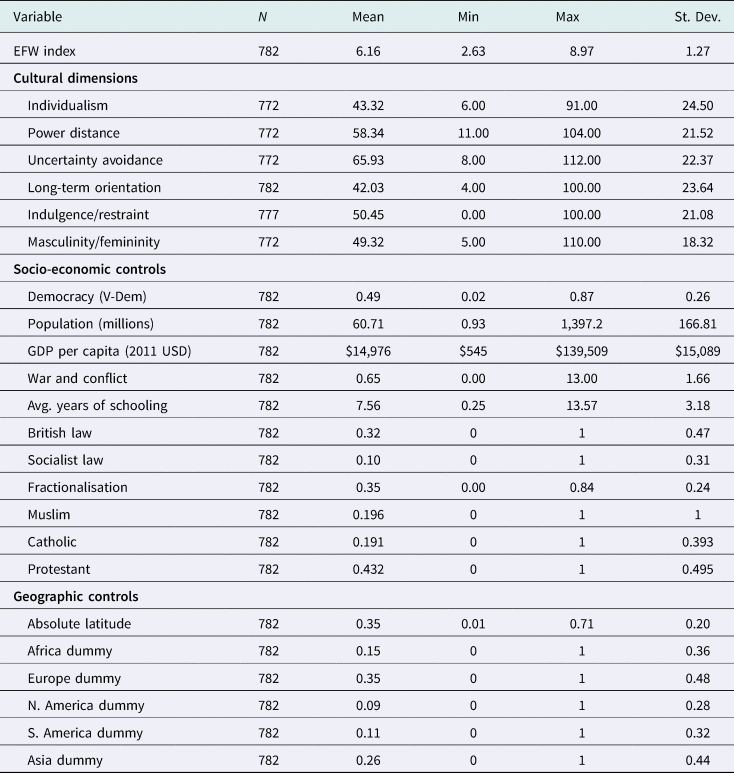
Another major independent variable is a democracy, measured using the Varieties of Democracy (V-Dem) index (Coppedge et al., Reference Coppedge, Lindberg, Skaaning and Teorell2016). Our aim is to capture democracy purely as the rule by the people. Though by no means novel, this conceptualisation satisfies the condition of citizens exercising power through freely elected officials while simultaneously discarding any normative implications regarding economic freedom reform. The idea is to ‘let culture speak’ and use democracy only as a vehicle for cultural preferences. While Polity IV and Freedom House measures have received criticism on grounds of being too narrow, not sensitive enough to changes in democracy, or reflecting concepts other than democracy (Munck and Verkuilen, Reference Munck and Verkuilen2002), the multidimensionality of the V-Dem data allows for moving beyond the minimalistic view of democracy as the mechanism for removing the executive, as well as those varieties of democracy with a potentially normative or local flavor.Footnote 7 Table 1 reports summary statistics for these variables.
Summary statistics, largest regression subsample

4. Methodology
We begin by running the following monadic regression:

where ΔEFW i,t is the 5-year difference in the EFW index, Democ.i,t is the simple average between electoral and participatory democracy indices for country i in year t, Cult.i is any of six Hofstede cultural dimensions, X is a vector of country-specific controls and δ t are year fixed effects. Equation (1) has 782 observations across 80 countries when all controls are present. We estimate separate regressions for each cultural dimension.
Because Hofstede indices are cross-sectional, we interact them with time-varying democracy levels. In doing so, we implicitly assume that culture's impact on economic freedom depends on whether a country is democratic, and that democracy's impact depends on the underlying culture. Due to this interaction, the coefficient on culture, γ, and the coefficient on democracy, β, should not be interpreted as unconditional effects. Rather, the impact of culture is now conditional on the country's level of democracy:

and the impact of democracy is conditioned on the prevalence of a particular cultural orientation:

Thus, if a cultural dimension promotes economic freedom, we expect $\hat{\phi } > 0$ ; i.e. the positive effect on reform should be stronger in more democratic countries (equation (2)), while democratisation in the said cultural environment should stimulate reform (equation (3)). We choose to observe the effect of culture primarily through the marginal effect of democracy in equation (3). We do so to exploit the longitudinal variation in the marginal effect of democracy that Hofstede culture indices lack.
We report our results using pooled OLS rather than within estimates. We do so for two reasons: first, country-fixed effects would subsume the time-invariant Hofstede indices, potentially biasing ϕ. Second, we model the variation in EFW more richly by drawing from information on between-country differences in culture. To deal with omitted variables, we control for a large number of time-invariant factors, which plausibly correlate with some of the variation captured by country fixed effects.
Next, we collapse all six cultural dimensions into a single metric for cultural distance to compare each country's ‘overall culture’ to that of a reference country. We choose the US as the benchmark, due to its long history of having liberal economic institutions. Thus, the hypothesis is that increased cultural distance from the US negatively correlates with ΔEFW ($\hat{\phi } < 0$ ). Our first measure of cultural distance is based on the standard Euclidean metric for the distance between two points in n-dimensional space:

where D represents one of k = 6 Hofstede dimensions and Vk is the in-sample variance of the kth dimension (Kogut and Singh, Reference Kogut and Singh1988). To minimise bias, cultural distance is computed only for those country pairs that have observations across all six dimensions.
We also employ a generalised form of the Euclidean distance called Mahalanobis distance, which corrects for the covariances between different cultural dimensions and provides for more accurate estimates (Kandogan, Reference Kandogan2012). The general formula for Mahalanobis distance is given by the following equation:

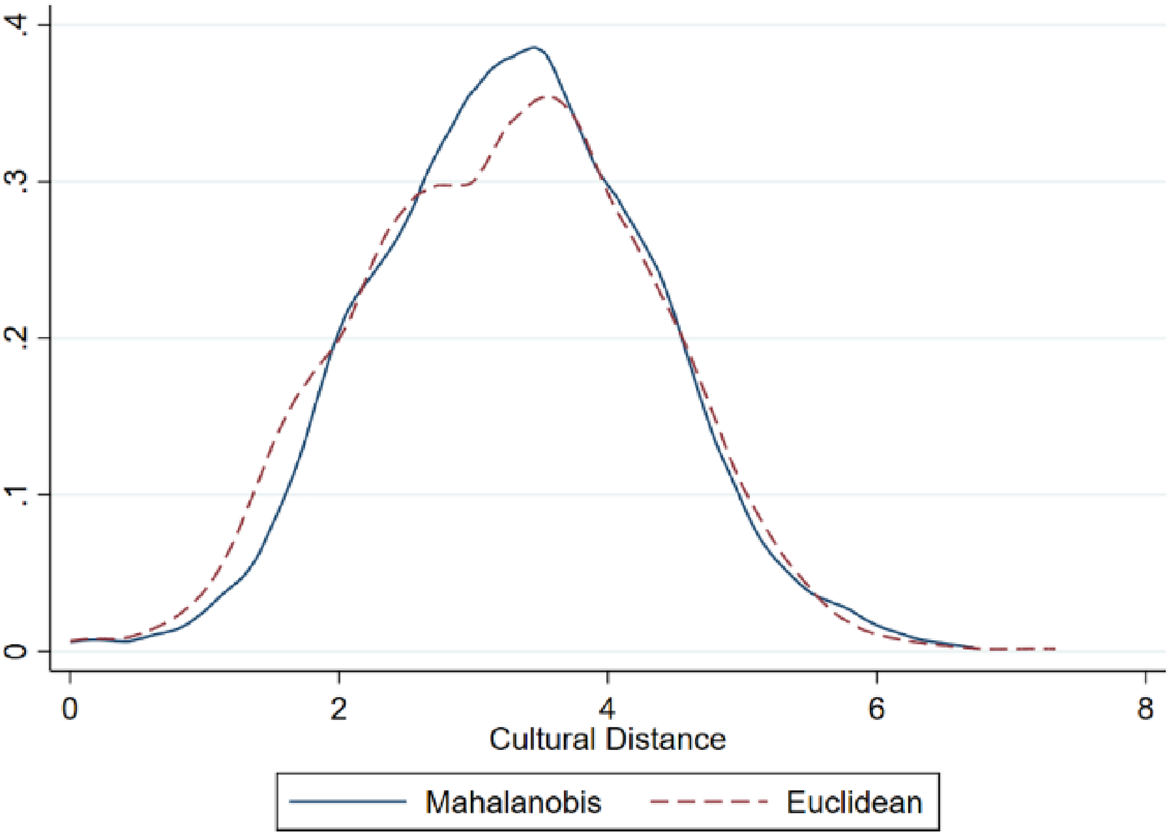
where D is a vector of k cultural dimensions and S is the variance-covariance matrix. Note when S is a diagonal matrix, Mahalanobis collapses into Euclidean distance. In our sample, the correlation between Euclidean and Mahalanobis distance is r = +0.904, and the comparison of densities is shown in Figure 3.
Densities of different measures of cultural distance.

One typically examines the temporal dispersion of a longitudinally observed variable by regressing its cross-sectional measure of variation (such as standard deviation or coefficient of variation) against a time trend. However, such a specification would not allow us to condition institutional dispersion on a set of country-specific covariates. We therefore model institutional dispersion as a function of cultural distance between countries in a dyadic model:

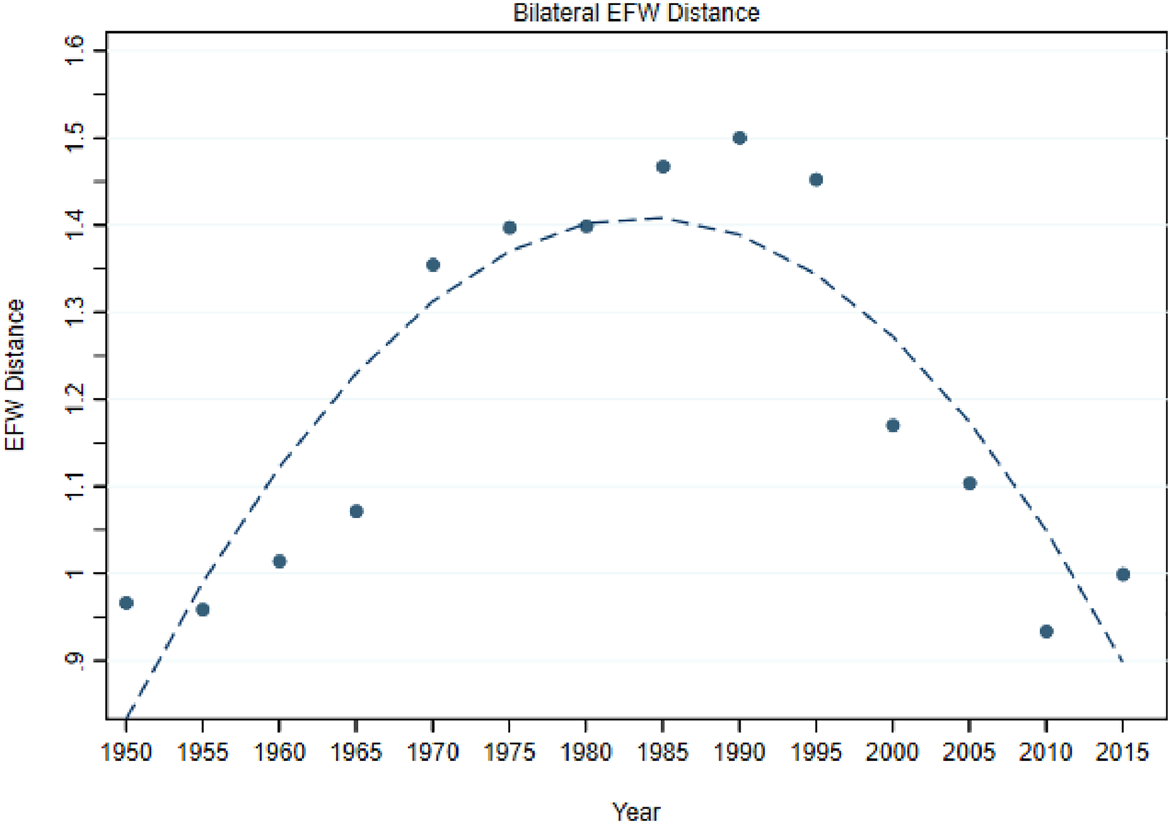
where Cult.Dist.i,j is a Euclidean (or Mahalanobis) cultural distance between countries i and j, and Xi,j is the vector of various measures of country-pair differences and similarities. The absolute bilateral difference in countries' EFW scores conforms remarkably well with the coefficient of variation of EFW for our sample (Figure 4), and serves as a reasonable proxy for cross-sectional variation in economic freedom.
Average EFW distance over time.

In bilateral specifications, we use a modified set of covariates to control for bilateral similarity (or distance) along institutional, economic, and demographic, lines. We transform time-varying independent variables and latitudes from equation (1) into absolute pairwise differences, and add dummy variables for common legal origins (French, British or socialist), continent, coloniser and for whether countries in the dyad were the same nation, in a colonial relationship or contiguous. To this, we add (log) geodesic distance (between most populated cities), and weighted religious, linguistic and genetic distances.Footnote 8
To further test the robustness of our results, in bilateral models we also employ replicated Hofstede dimensions developed by Beugelsdijk et al. (Reference Beugelsdijk, Maseland and Van Hoorn2015). The replicated dimensions are created from WVS data collected over 1981–2008. The authors assign a Hofstede dimension score each of the two non-overlapping age cohorts within countries: older cohort, born in 1941 on average (in 1902–1958) and younger, born in 1971 on average (after 1958). We exploit the generational variation in Hofstede indices to add a temporal dimension to our dyadic models.
We then re-estimate equation (6) as a two-period (unbalanced) panel with variables observed in 1980 and 2015. The idea is to take two sufficiently distant points in time to which we can assign separate generational Hofstede scores. For 1980, we use the older generations' scores to calculate bilateral cultural distance; for 2015, the younger. Though we recognise this approach will not perfectly capture prevailing cultural distances at different times, it may well provide a reasonable approximation: in 1980, the majority of the population in many countries were likely individuals from the older cohort; by 2015, the majority likely flipped.
5. Results
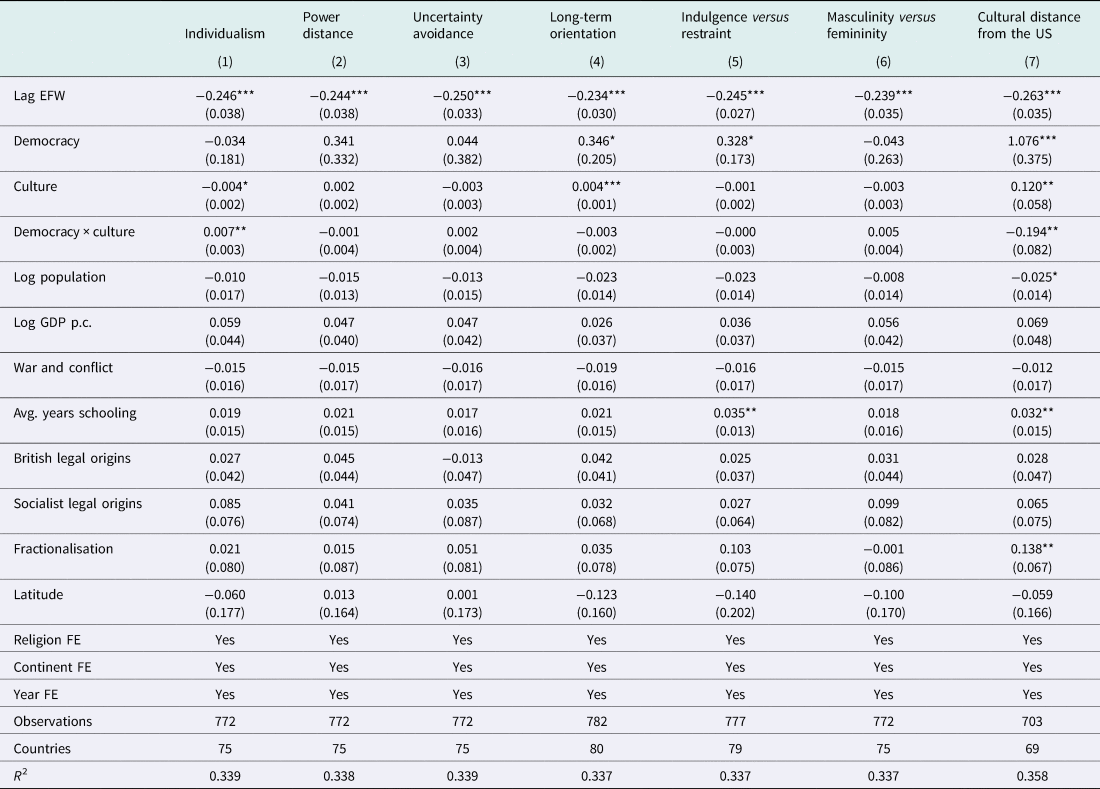
Table 2 presents results from estimating equation (1), showing how democracy and each of the six different Hofstede measures (columns 1–6), as well as the cultural distance from the US (column 7), affect growth in institutional quality as measured by EFW (the dependent variable for each model is the 5-year difference in the EFW index) over 1950–2015.Footnote 9 Each model controls for the covariates mentioned above, and all standard errors are clustered at the country-level. Rows 2–4 represent the effects of democracy and the cultural measures of institutional quality.
The effect of culture on economic freedom reform 1950–2015, pooled OLS estimates

Note: Dependent variable is 5-year difference in composite EFW index. Standard errors are clustered at the country level. Intercept term estimated, but not reported. cultural distance with the US is Euclidean. *p < 0.1, **p < 0.05, ***p < 0.01.
Row 2 shows that the isolated effect of democracy is generally statistically indistinguishable from zero. For long-term orientation and indulgence/restraint, we show a positive own coefficient, significant at the 10% level, suggesting there may be some positive association between democracy and the average extent of reform through culture. Row 3 shows the own effect of culture on EFW growth for each of the six measures. The own effect is, again, generally statistically insignificant, with exceptions for individualism and long-term orientation dimensions.
Row 4 displays our coefficients of interest. Here, we consider the joint effect of culture and democracy on EFW growth. If the sign of the interaction term is significant, then higher (lower) levels of both democracy and the cultural dimension are associated with faster (slower) reform, suggesting culture and democracy are complementary determinants of economic institutions. If the interaction is significant while culture is not, that would suggest culture influences institutional growth mainly through democracy. In row 4, the interaction between democracy and power distance, uncertainty avoidance, long-term orientation, indulgence/restraint and masculinity/femininity is all statistically insignificant, while the interaction between democracy and individualism and cultural distance from the US is statistically significant at the 5% level. The positive coefficient on the interaction between individualism and democracy indicates that democratisation correlates with faster reform in the cultural milieu of strong individualism.Footnote 10 Furthermore, the negative coefficient on the interaction with cultural distance suggests that cultural proximity to the US is also associated with faster reform.
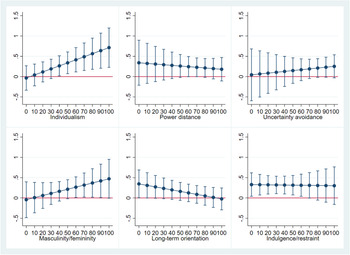
To fully explore the joint effect of culture and democracy on institutional quality, we present, with 90% confidence interval bands, the average marginal effect (AME) of democracy conditional on the six dimensions of culture shown in Figure 5. For measures of power distance, uncertainty avoidance, long-term orientation and masculinity/femininity, the AME is generally never statistically different from zero. For moderately high levels of individualism, the AME of democracy is positive and statistically different from zero. This suggests democratic actions may not have the leverage to produce an institutional change in societies where loyalty and group-oriented action dominates. However, democracy does improve institutional quality for those countries where individualism takes precedence; a standard deviation increase in individualism (by 24.50 points) increases the AME of democracy by +0.149, or 26% of a standard deviation of ΔEFW.
Conditional marginal effect plots for democracy levels.

These results are both consistent with the literature, as well as a significant contribution.Footnote 11 A culture of individualism corresponds to a stronger sense of individual achievement, recognition and advancement (Gorodnichenko and Roland, Reference Gorodnichenko and Roland2011).Footnote 12 Thus, a governments' prospects to remain in power may well improve after the enactment of economic reforms that protect private property and wealth accumulation, promote competition and expand the sphere of private decision-making when society is broadly individualistic. In line with other related studies, we show that individualism–collectivism cleavage may be the primary cultural channel through which institutional quality is affected. However, we further show that neglecting the compounding effects of democracy risks obscuring the true effects of individualism and democracy on institutional growth. Societies that, on the margin, value more highly promoting the objectives of individuals over those of large groups see the largest gains from democracy, suggesting that democracy may have little power to spur economic freedom in cultures where the collective need is paramount.
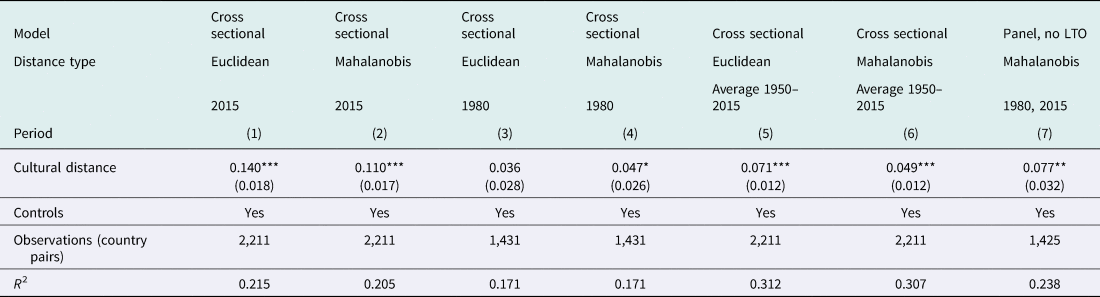
Table 3 presents results from estimating equation (6). In this table, we report on how bilateral cultural distances affect institutional dispersion, measured as the absolute pairwise difference in countries' EFW scores. Our expectation is that as societies become more similar culturally, the distance between their economic institutions narrows. Note that as certain cultural attributes may be associated with lower EFW scores, cultural similarity need not necessarily imply an improvement of institutions; rather, only that countries become institutionally more similar, whether at the high or low ends of the institutional quality spectrum. Thus, Table 3 examines one measure of institutional dispersion, providing additional context to Figures 1 and 2.
The effect of cultural on institutional distance, OLS estimates

Note: Dependent variable is absolute difference in the composite EFW index between countries i and j. Heteroskedasticity-consistent standard errors are in parentheses. Intercept term estimated, but not reported. Controls include log geodesic distance, absolute differences in levels of democracy, log population, log real per capita income, political violence, ethno-linguistic fractionalisation, average years of schooling and latitudes; dummies for common legal origins (French/civil, British or socialist) and continent, for whether countries were ever the same country, for whether countries were in a colonial relationship after 1945, for whether countries had a common coloniser, for whether countries were ever in a colonial relationship, for whether countries are contiguous; and weighted religious, linguistic and genetic distances. Panel specification (7) additionally includes a time dummy and cluster-robust standard errors. *p < 0.1, **p < 0.05, ***p < 0.01.
Columns (1)–(6) test the effect of cultural distance in a cross-sectional setting in 1980, 2015, and where all time-varying covariates are averaged over 1950–2015. Here we use the original Hofstede measures to create both the Euclidean and Mahalanobis bilateral cultural distances . The positive coefficients across all six columns indicate that as cultural distance shrinks, so too does institutional distance. This result holds true after controlling for important confounders, such as differences in GDP per capita, differences in rates of human capital attainment and differences in geographic, religious, linguistic and genetic distances. Not only does this provide evidence for a decrease in institutional dispersion across countries, but it also shows this relationship is statistically robust, and on an order of magnitude with the aforementioned confounders.
Column (7) tests cultural distance (Mahalanobis only) in a panel setting. While the original Hofstede measures are time-invariant, the measures of culture in the panel specification have been extended to represent cohorts of individuals born in 1941 on average (the older cohort), and 1971 on average (the younger cohort). Cultural attitudes may be shifting over time, and we wish to capture this in our specifications. However, these updated measures do not encompass the same breath as the original Hofstede scores, resulting in a significant loss in the number of observations. We therefore exclude long-term orientation when calculating cultural distance to increase the size of sample by over 300%.
Moreover, since we only measure culture for two groups that differ in age but which exist at similar points in time, we present two periods in which we assign country-level cultural values to the younger (in 2015) and older (in 1980) cohorts. We choose 1980 as the initial point for two reasons. First, the average distance in age between the two cohorts is 30 years on average, which roughly approximates the difference between 1980 and 2015. An average member of the younger cohort was likely too young to influence policy on reform in 1980, while by 2015 this population comprises the bulk of the adult demographic. Second, choosing 1980 (as opposed to an earlier year) greatly increases the number of country-pairs in the sample.
Regardless of whether we use a cross-section or a panel, we find robust evidence that the narrowing of institutional dispersion is predicted by culture in all but one specification. In column (1), one standard deviation increase in cultural distance corresponds to about 18% of the standard deviation in the EFW distance. Notably, in column (7), as the cultural distance between countries decreases over time, so too does institutional distance. This result demonstrates that shifting cultural norms could play a part in the ability of countries to reform and harmonise institutions. Once again, these findings hold after controlling for important confounding effects, and all are statistically significant at the 5% level.
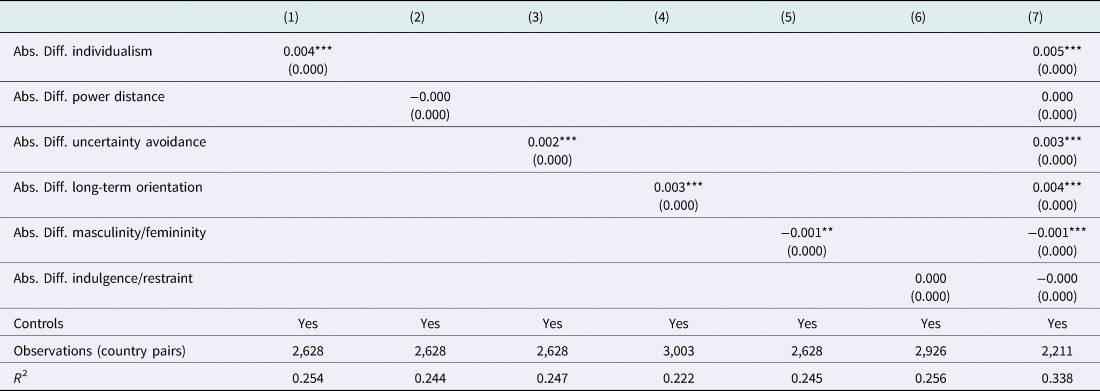
Finally, in Table 4, we disaggregate cultural distance into absolute differences in the six individual dimensions. Consistent with earlier findings, pairwise differences in individualism have the largest explanatory power in terms of economic significance. Other statistically significant dimensions are long-term orientation and uncertainty avoidance, while, interestingly, we find the increased distance in masculinity/femininity is associated with more similar institutions, though the effect is small.
The effect of bilateral differences in cultural dimensions on the EFW distance (average over 1950–2015), OLS estimates

Note: Dependent variable is absolute difference in the composite EFW index between countries i and j. All time-variant variables collapsed to averages over 1950–2015. Heteroskedasticity-consistent standard errors in parentheses. Intercept term estimated, but not reported. Controls include log geodesic distance, absolute differences in levels of democracy, log population, log real per capita income, political violence, ethno-linguistic fractionalisation, average years of schooling and latitudes; dummies for common legal origins (French, British or socialist), continent, for whether countries were ever the same country, for whether countries were in a colonial relationship after 1945, for whether countries had a common coloniser, for whether countries were ever in a colonial relationship, for whether countries are contiguous; weighted religious, linguistic and genetic distances. *p < 0.1, **p < 0.05, ***p < 0.01.
We note that all results presented here are robust to various measures of the quality of economic institutions analysed over different time frames. Utilising measures of the quality of economic institutions from Kunčič (Reference Kunčič2014), as well as the International Country Risk Guide Quality of Government Index, we find the sign, magnitude and significance of results are generally stable across data source, time frame of analysis and measure of institutions.Footnote 13
While none of our results establish a strictly causal relationship going from culture to institutions, we nevertheless echo the findings of a growing empirical literature that shows that culture is an important predictor of institutions. For recent work that examines causal linkages between culture and economic freedom, see Nikolaev and Salahodjaev (Reference Nikolaev and Salahodjaev2017), who use the two-stage least squares approach to show that areas historically prevalent with infectious diseases provided more fertile grounds for xenophobia, openness and ethnocentrism which became, over time, associated with collectivism which predicts economic freedom. Also see Cai et al. (Reference Cai, Murtazashvili, Murtazashvili and Salahodjaev2020), who employs a similar approach, and find that pathogen prevalence predicts collectivism, which, in turn, explains reforestation rates across countries. According to this narrative, individualism promotes experimentation with property rights institutions and better governance of the commons.
6. Conclusion
Economic freedom around the world has been on the rise since the 1980s, largely driven by institutional catch-up by less developed nations. In this paper, we examined the empirical linkages between several dimensions of national culture, measured by Hofstede indices, and the evolution of Fraser Institute's Economic Freedom of the World index between 1950 and 2015. Our principal finding is individualism has the strongest impact on economic freedom among the considered cultural measures, and that the positive effects of democracy on reform are amplified in societies having higher levels of individualism. We also find that the cultural similarity between countries directly correlates with their institutional similarity. These results show that culture is a significant determinant of institutions, and that it affects cross-national institutional variation by influencing both the pace of economic reform within countries and the dispersion of economic freedom between countries.
Our work likewise speaks to the growing literature on the relationship between political and economic institutions. We confirm the findings of earlier and related research on culture arguing that the context of democratisation matters, and that the outcomes of political freedoms may well depend on the underlying culture that shapes preferences for different economic policies. We extend this conclusion for a greater number of countries and over a longer time span. In that respect, we contribute to earlier literature that finds democratic countries tend to favour economic liberalisation by offering one possible perspective as to why, as well as a caveat.
Although this and other studies find that individualism is associated with ‘good-for-development’ outcomes, we caution against interpreting these results in a normative way. Rather, the intent of this empirical investigation was to improve our understanding of the quantitative factors that underlie the institutional evolution across countries and over time.