Introduction
Korsakoff syndrome (KS) is a chronic neuropsychiatric condition, characterized by a severe memory disorder resulting from acute Wernicke's encephalopathy mostly secondary to chronic alcohol abuse and concomitant thiamine deficiency. In the Netherlands, there are specialized long-term care facilities (LTCFs) for patients with KS. Many institutionalized patients with KS show challenging behavioral symptoms like lack of awareness of the illness, aggression, sexual disinhibition, and apathy. These symptoms may lead to prescription of psychotropic drugs and put a heavy strain on caregivers. From studies of nursing home patients with dementia, it is known that a large percentage of patients have at least one behavioral symptom and despite modest effects and the risk of adverse effects, psychotropic drugs such as benzodiazepines, antipsychotics, and antidepressants are commonly prescribed in the LTCF setting (Pitkala et al., Reference Pitkala, Laurila, Strandberg and Tilvis2004; Gobert and D’Hoore, Reference Gobert and D'Hoore2005; Sink et al., Reference Sink, Holden and Yaffe2005; Ballard and Howard, Reference Ballard and Howard2006; Lovheim et al., Reference Lovheim, Sandman, Kallin, Karlsson and Gustafson2006; Schneider et al., Reference Schneider, Dagerman and Insel2006; Selbaek et al., Reference Selbaek, Kirkevold and Engedal2007; Eggermont et al., Reference Eggermont, de Vries and Scherder2009; Kleijer et al., Reference Kleijer2009; Nijk et al., Reference Nijk, Zuidema and Koopmans2009; Wetzels et al., Reference Wetzels, Zuidema, de Jonghe, Verhey and Koopmans2011). Prevalence rates for behavioral symptoms and the use of psychotropic drugs in patients with KS residing in LTCFs might be even higher.
However, institutionalized patients with KS have not been studied separately and extensively before and limited literature is available on the long-term care and course of this group of patients. Prevalence studies are out-of-date or scarce (Blansjaar et al., Reference Blansjaar, Horjus and Nijhuis1987; Harper et al., Reference Harper, Gold, Rodriguez and Perdices1989; Kopelman, Reference Kopelman1995; Schepers et al., Reference Schepers, Koopmans and Bor2000; Kopelman et al., Reference Kopelman, Thomson, Guerrini and Marshall2009; Draper et al., Reference Draper, Karmel, Gibson, Peut and Anderson2011; Wijnia et al., Reference Wijnia, van de Wetering, Zwart, Nieuwenhuis and Goossensen2012). Once institutionalized, the care needs of patients with KS are often not recognized adequately (Schepers et al., Reference Schepers, Koopmans and Bor2000). Often clear diagnostic criteria for KS are missing (Oslin et al., Reference Oslin, Atkinson, Smith and Hendrie1998; Galvin et al., Reference Galvin, Brathen, Ivashynka, Hillbom, Tanasescu and Leone2010) and current diagnostic criteria for KS are mainly on clinical judgment. There is accumulating evidence that patients with KS have impairments in executive functioning. The Diagnostic and Statistical Manual of Mental Disorders IV (DSM-IV) (American Psychiatric Association, 1994) criteria for “alcohol-induced persisting amnestic disorder” do not take this into account (Oort and Kessels, Reference Oort and Kessels2009). The term alcoholic dementia is controversial and has generally been superseded by the concept of alcohol-related dementia, encompassing a broader definition of alcohol-related cognitive deficits (Victor, Reference Victor1994; Oslin et al., Reference Oslin, Atkinson, Smith and Hendrie1998; Gupta and Warner, Reference Gupta and Warner2008). Some authors consider cases of alcohol-related dementia to be, in fact, KS (Victor, Reference Victor1994; Oslin et al., Reference Oslin, Atkinson, Smith and Hendrie1998; Kopelman et al., Reference Kopelman, Thomson, Guerrini and Marshall2009).
The aim of this study was therefore: (a) to describe baseline characteristics and comorbidity and (b) to describe the use of psychotropic drugs in patients with KS residing in special care units in Dutch LTCFs.
Methods
Participants
In this cross-sectional descriptive study, 556 residents of ten special Korsakoff units in Dutch LTCFs were included. These facilities cooperate in a centre, which strives for developing knowledge, practice, and skills in the widest possible sense for patients with KS. This centre is called “the Dutch Korsakoff Knowledge Centre.” Participants were included when they had the following diagnoses reported in the medical chart: KS, Wernicke-Korsakoff encephalopathy, alcohol-induced persisting amnestic disorder, persistent cognitive impairment due to alcohol, alcohol-induced persisting dementia, and/or alcoholic dementia.
Data collection
All patient data were collected by one researcher (the first author) by means of a retrospective chart review. The investigation was performed on an arbitrary reference date during the period August 2011 to May 2012. The following data were retrieved from patients’ electronic administration files and medical charts: demographic data, patients’ representatives (legal and/or informal caregivers), admission dates, somatic and psychiatric comorbidity, and use of psychotropic drugs. The date of last admission was used in case there were multiple records. Somatic comorbid conditions were classified as follows: COPD, cardiovascular diseases, hypertension, diabetes mellitus, cerebrovascular accident, epilepsy, and malignancy. Psychiatric comorbid conditions were classified as: mental retardation, psychotic disorders, mood disorders, anxiety disorders, personality disorders, other substance use disorders, and others. Suicide attempts, though not a DSM-disorder, were also registered. The prescribed psychotropic drugs were derived from patients’ prescription records and classified into three major categories: antipsychotics, antidepressants, and benzodiazepines. “As needed” (PRN) medication was not included. The use of these psychotropic drugs was compared to the prevalence of psychiatric diagnoses, which were mentioned in the medical charts.
Analysis
All demographic data, patients’ representatives (legal and/or informal caregivers), admission dates, somatic and psychiatric comorbid conditions, and prescriptions of psychotropic drugs were entered into a spreadsheet, using Microsoft Office Excel, version 14.1.0, 2010. The resulting database enabled descriptive analyses such as grouping and summarizing all data, calculating the mean and standard deviation (SD) and creating frequency tables and figures.
Ethical and legal considerations
Information about this study was provided to the patients or their representatives, the local client advisory boards and the management of the participating nursing homes. Although requesting patients’ informed consent was not necessary because of the retrospective nature of this study using only data from patients’ charts and processing these data anonymously into a large study group, patients or their representatives could refuse to participate. The local Research Ethics Committee at the Medical Centre of Leeuwarden approved the study.
Results
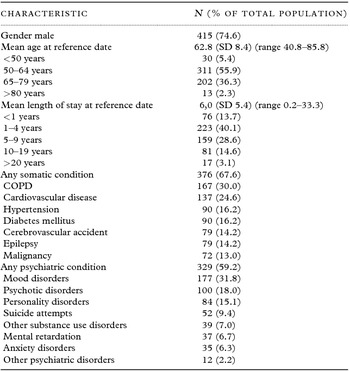
In this study, no patients or representatives refused to participate. Baseline data was available for 556 patients with KS and are presented in Table 1. Mean age on admission was 56.7 years (SD 8.9, range 29.8–85.3) and most patients were men (75%). Mean age at reference date was 62.8 years (SD 8.4, range 40.8–85.8). The mean length of stay was 6.0 years (SD 5.4, range 0.2–33.3).
Patients’ characteristics (n = 556)

Fifty-three percent of patients were divorced, 25% single, 9% still married, and 10% widowed. Nearly one-fifth of patients (19%) had a trustee or mentor as a legal representative. In only 3% of cases, the trustee or mentor was a family member. 75% of patients had a relative as informal representative (partner 9%, child 26%, brother or sister 34%, nephew or cousin 2%, parent 4%, 6% a non-family member, and 2% no-one).
Sixty-eight percent of patients suffered from at least one somatic comorbid condition. COPD (30%) and cardiovascular disease (25%) were common. Other comorbid conditions were: hypertension (16%), diabetes mellitus (16%), cerebrovascular accident (14%), epilepsy (14%), and malignancy (13%). Twenty-two patients (4%) had a malignancy of the oropharynx; 4 patients (1%) suffered from a lung carcinoma.
More than half of the patients had at least one psychiatric comorbid condition (59%) as shown in Table 1. About twice as many had a mood disorder (32%) compared to the number with a psychotic disorder (18%). Personality disorders were mentioned in the medical charts in 15%. Suicide attempts were mentioned in 9%, mental retardation in 7%, and anxiety disorders in 6%. In addition to the alcohol abuse, there were also other substance use disorders (7%). Other comorbid conditions, which were found, were somatoform and eating disorders (2%).
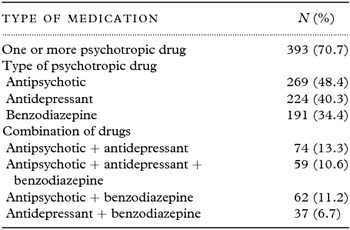
Table 2 shows the percentages of patients of the total group who were prescribed psychotropic drugs at reference date. Altogether nearly 71% of the residents were prescribed one or more psychotropic drugs. Twenty-nine percent used one type, 31% two types, and 11% at least three types of psychotropic drugs. Forty-eight percent of all patients used an antipsychotic drug, 40% an antidepressant drug, and 34% a benzodiazepine. Forty-two percent of all patients used a combination of two or three psychotropic drugs. In particular, the combination of an antipsychotic drug and an antidepressant drug was the most frequently prescribed combination (13%).
Prevalence of psychotropic drug use (n = 556)

Note: All values in brackets are presented as a percentage of the total group.
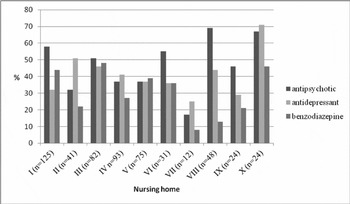
Figure 1 shows the different prescription patterns of psychotropic drugs in the 10 LTCFs. The use of antipsychotics, antidepressants, and benzodiazepines varies per nursing home. Particularly in nursing homes VIII en X, nearly 70% of patients with KS used an antipsychotic drug. This contrasts with nursing home VII where only 17% of patients used an antipsychotic drug. The percentage of antidepressant users ranges between 25% (nursing home VII) and 71% (nursing home X). The percentage of benzodiazepine users ranges from 8% (nursing home VII) to 48% (nursing home III). In nursing home X, the percentages both of antipsychotic users (67%), antidepressant users (71%), and benzodiazepine users (46%) are high in contrast to nursing home VII (17%, 25%, and 8%, respectively). In general, antipsychotics were most frequently prescribed. Of the prescribed psychotropic drugs benzodiazepines were the least prescribed.
Psychotropic drug use in percentages per nursing home.

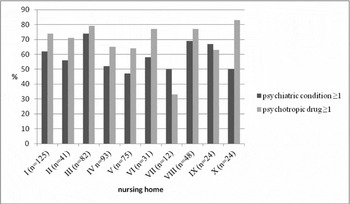
Figure 2 combines percentages of patients with at least one psychiatric condition with the percentages of at least one prescribed psychotropic drug per nursing home. The percentage of at least one prescribed psychotropic drug ranges from 33% (nursing home XII) to 83% (nursing home X). In contrast the percentage of patients with at least one psychotic disorder ranges from 47% (nursing home V) to 74% (nursing home III). The differences between the percentage of at least one prescribed psychotropic drug and the percentage of patients with at least one psychotic disorder strongly varies between nursing homes.
Patients with ≥1 psychiatric condition and psychotropic drug use in percentages per nursing home.

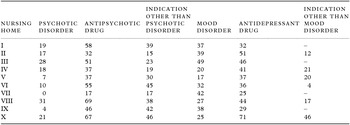
In Table 3 the difference between percentages of users of a psychotropic drug and percentages of patients with a psychotic and a mood disorder are further specified per nursing home. Again, large differences are found between users of a psychotropic drug and patients with a psychiatric condition. For psychotic disorders, the differences between users of an antipsychotic drug and the disorder vary from 15% (nursing home II) to 46% (nursing home X). This suggests that patients with KS in nursing home X were prescribed antipsychotic drugs with an indication other than psychotic disorder more often than in nursing home II.
Use of a psychotropic drug in relation to indication in percentages per nursing home (n = 556)

All values are presented as a percentage of patients per nursing home.
For mood disorders, the differences are less striking. In four nursing homes, percentages of users of an antidepressant are even lower than percentages of patients with a mood disorder. Despite mood disorders occurring more often than psychotic disorders overall, antipsychotic drugs were prescribed more often than antidepressant drugs.
Discussion
This study describes baseline characteristics, comorbidity, and the use of psychotropic drugs in a large group of patients with KS residing in special care units in Dutch LTCFs. In our study, all the reported patients had a history of chronic alcohol use and were relatively young, single men. The main finding in our study is the high percentage of prescribed psychotropic drugs and large differences in the prescription patterns among the participating nursing homes.
Previous studies have reported a high comorbidity between psychiatric disorders and alcoholism (Petrakis et al., Reference Petrakis, Gonzalez, Rosenheck and Krystal2002; Kranzler and Rosenthal, Reference Kranzler and Rosenthal2003; Kessler, Reference Kessler2004). We are aware of only one other study that reported psychiatric disorders in institutionalized patients with KS (Wijnia et al., Reference Wijnia, van de Wetering, Zwart, Nieuwenhuis and Goossensen2012).
The high percentage of users of a psychotropic drug in our study and differences in prescription patterns among the nursing homes can be partly explained by the percentage of patients with a psychiatric condition. Antipsychotics in particular were prescribed very often and more than one might expect on the basis of the available percentages of patients with a psychotic disorder. From experience, we know that behavioral symptoms, like agitation or aggression, are common in patients with KS. Behavioral symptoms and comorbid psychiatric conditions can be distressing to patients themselves and their environment. Several studies showed that behavioral symptoms in cognitively impaired nursing home patients are very common and that this leads commonly to more psychotropic drug use (Zuidema et al., Reference Zuidema, Derksen, Verhey and Koopmans2007; Wetzels et al., Reference Wetzels, Zuidema, de Jonghe, Verhey and Koopmans2011). More specifically, studies indicate that between 47% and 75% of nursing home residents with a DSM-established dementia diagnosis are prescribed some type of psychotropic drugs (Pitkala et al., Reference Pitkala, Laurila, Strandberg and Tilvis2004; Selbaek et al., Reference Selbaek, Kirkevold and Engedal2007; Eggermont et al., Reference Eggermont, de Vries and Scherder2009). In the recent studies by Zuidema and Wetzels, patients were considered for inclusion provided they met the DSM-IV-TR criteria for dementia. There is the possibility that patients with KS were included in these studies and were not considered separately. Unfortunately in our study, a reliable description of behavioral symptoms was not possible since the participating nursing homes did not use assessments for behavioral symptoms in their charts.
The effect of psychotropic drugs in the treatment of behavioral symptoms in patients with KS is largely unknown. Also behavioral symptoms can present as side effects of antipsychotics. Caregivers often experience behavioral symptoms of patients with KS as challenging and providing optimal management in which respect for the patient's dignity is maintained requires expertise, empathy, and self-reflection. Our findings might indicate an overuse of psychotropic drugs to manage behavioral symptoms in patients with KS.
One limitation of this study is the variation of criteria used in the facilities to diagnose KS. Moreover, because of uncertainty about diagnostic criteria, not all patients had been diagnosed with KS according to the DSM-disorder “alcohol-induced persisting amnestic disorder.” The term “alcohol-related dementia” or “alcohol-related brain damage” may cover this group, confirming the debate in the literature about the nosology of alcohol-related cognitive disorder (Gupta and Warner, Reference Gupta and Warner2008; Jauhar and Smith, Reference Jauhar and Smith2009; Kopelman et al., Reference Kopelman, Thomson, Guerrini and Marshall2009; Zahr et al., Reference Zahr, Kaufman and Harper2011). It is suggested that the alcohol amnestic (Korsakoff) syndrome forms a spectrum with other types of alcohol-related brain injury and thiamine depletion injury interacting with alcohol neurotoxicity resulting in “alcohol-related brain damage” (Gupta and Warner, Reference Gupta and Warner2008; Jauhar and Smith, Reference Jauhar and Smith2009; Kopelman et al., Reference Kopelman, Thomson, Guerrini and Marshall2009; Zahr et al., Reference Zahr, Kaufman and Harper2011). The diagnosis KS requires increased validation through research and the development of diagnostic guidelines is necessary.
Another limitation is the lack of diagnosis of cooccurring psychiatric disorders according to DSM-criteria. Furthermore, diagnosing psychiatric disorders in patients with KS is difficult because of the cognitive deficits. A valid diagnostic interview or assessment is not available. Careful psychiatric assessment in patients with KS is important, not only from the perspective of scientific knowledge, but also because of clinical implications like treatment and prognosis.
A strength of this study are the large sample size and the fact that the sample only concerns nursing-home patients with KS residing in special care units.
Conclusion
This study shows baseline characteristics, comorbid conditions and use of psychotropic drugs in patients with KS residing in special care units in ten Dutch LTCFs. The use of psychotropic drugs is extensive with a great variation in prescription between the different nursing homes. More research is needed on the prevalence of behavioral symptoms and psychotropic drug prescription in patients with KS. Further research might develop the specific needs of care and experienced quality of life of this patients group.
Conflict of interest
None.
Description of authors’ roles
This study was initiated and designed by both authors. I. Gerridzen collected the data and wrote this paper. I. Gerridzen and A. Goossensen undertook the data analysis and interpretation. A. Goossensen was responsible for critical revision of the manuscript.
Acknowledgments
Atlant Care Group, Nursing Home Markenhof, Beekbergen, the Netherlands, and the Dutch Korsakov Knowledge Centre supported this study. We would like to give special thanks for her comment to Ruth B. Veenhuizen, MD, PhD, VU University Medical Center, Amsterdam, the Netherlands.