Implications
In most pig producing countries, lactating sows are placed in farrowing crates to avoid crushing of the suckling piglets by the sow, even though crates place behavioural restrictions on the sow. The current study showed that housing sows in free farrowing pens (FF-pen) led to increased piglet mortality compared with crates. Therefore, additional research is needed before the FF-pen can be implemented without increasing piglet mortality.
Introduction
The majority of sows are confined in crates during farrowing and lactation. From an economic perspective, there are several advantages of this type of farrowing accommodation as crates are space- and labour-saving, facilitate high levels of hygiene in the pen, and are designed to ensure piglet survival. However, restricting sows in farrowing crates has been shown to influence the behaviour and physiology of the sow negatively (Jarvis et al., Reference Jarvis, D’Eath, Robson and Lawrence2006; Baxter et al., Reference Baxter, Lawrence and Edwards2012). With a growing societal concern for animal welfare, there is an increasing interest in abolishing farrowing crates. Nevertheless, uptake of non-crated farrowing systems by pig producers has been limited, mainly due to fear of increased piglet mortality. This concern has been addressed in several studies, but so far with equivocal results. For example, Cronin et al. (Reference Cronin, Lefebure and McClintock2000), Weber et al. (Reference Weber, Keil, Fehr and Horat2007) and KilBride et al. (Reference KilBride, Mendl, Statham, Held, Harris, Cooper and Green2012) suggested that piglet mortality did not differ between pens and crates, whereas for instance Blackshaw et al. (Reference Blackshaw, Blackshaw, Thomas and Newman1994), Weary et al. (Reference Weary, Phillips, Pajor, Fraser and Thompson1998) and Marchant et al. (Reference Marchant, Rudd, Mendl, Broom, Meredith, Corning and Simmins2000) showed greater piglet mortality in pens compared with crates.
There is a public interest in abolishing the farrowing crate, but, for instance, the European Food Safety Authority has expressed caution when it comes to implementing farrowing pens because of the risk of higher levels of piglet mortality (European Food Safety Authority, 2007). Piglet mortality is affected by numerous factors like pen design, genetics, management and litter size (Weary et al., Reference Weary, Phillips, Pajor, Fraser and Thompson1998; Andersen et al., Reference Andersen, Tajet, Haukvik, Kongsrud and Boe2007). Currently, the average litter size in Denmark is 16.6 total born piglets per litter (Vinther, Reference Vinther2012), which is considerably higher than reported in previous studies comparing piglet mortality in pens and crates. A free farrowing pen (FF-pen) needs to function for sows with large litters, and consequently an FF-pen was developed in a joint research project between several parties of the pig industry, the Danish Animal Welfare Society, and Aarhus University (Anonymous, 2011; Baxter et al., Reference Baxter, Lawrence and Edwards2012). The FF-pen was designed to fit the modern day sow and to fulfil the sow’s requirement for space and freedom to move around (Moustsen et al., Reference Moustsen, Lahrmann and D’Eath2011). At the same time, the FF-pen was designed with consideration to the piglets’ needs for heat and protection against dangerous situations. The objective of this study was to compare levels of preweaning piglet mortality in traditional farrowing crates and FF-pens in commercial production herds with both types of systems. The hypothesis tested was that preweaning mortality did not differ between farrowing crates and FF-pens.
Material and methods
The study was conducted in accordance with the guidelines of the Danish Ministry of Justice with respect to animal experimentation and care of animals under study. The piggeries in this study were selected because they had chosen the FF-pen as part of their farrowing unit and had been using the pens for at least a year when the data collection started. From 2010 to 2012, data were collected in three commercial Danish piggeries (Herd A, B and C) with 400, 580 and 640 sows, respectively. All herds had more traditional farrowing crates than FF-pens, so consequently only a subset of the farrowing crates was used for data collection.
Housing
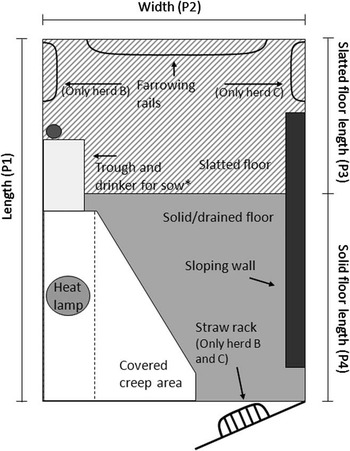
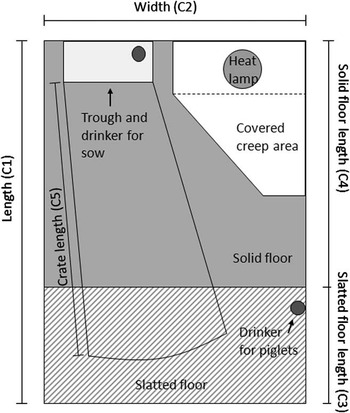
In all three herds, sows were housed in individual stalls for 4 weeks in the mating unit. During gestation, the sows were housed in groups with floor feeding in Herd A and in individual stalls in Herds B and C. One week before expected parturition, the sows were moved to the farrowing unit and randomly allocated to either farrowing crates or pens. The layout of the farrowing pens was similar in the three herds (Figure 1), apart from a few minor details. The floor consisted of two-thirds solid or drained floor (<10% void) and one-third fully slatted (>40% void) cast iron flooring. The creep area for piglets was placed adjacent to the aisle to allow easy access to piglets for inspection and handling. The creep area had floor heating and a 150 W heat lamp installed in the cover. The creep entrance as well as the cover of the creep was adjustable. The front of the creep was fitted with six fingers to prevent the sow from closing the piglets inside the creep in situations where the sow laid down in front of the creep entrance. On the wall between the creep and the back wall there was a trough and a drinker for sows and piglets. The pen wall opposite the creep was fitted with a sloping wall to support the sow when lying down and to protect the piglets from crushing (Damm et al., Reference Damm, Forkman and Pedersen2005; Damm et al., Reference Damm, Moustsen, Jorgensen, Pedersen, Heiskanen and Forkman2006). The sloping wall was placed 20 cm above the floor and at the bottom it was 20 cm away from the pen wall so that piglets were able to pass behind and escape underneath. The back wall of the pen was fitted with a farrowing rail 20 cm above the floor as a piglet protection feature. The layout of the pens with farrowing crates was also similar in all three herds (Figure 2). The pens had traditional farrowing crates as well as two-thirds solid floor and one-third fully slatted floor. In the adjustable cover of the creep, a 150 W heat lamp was fitted. A separate drinker for piglets was located at the slatted floor.
Layout of free farrowing pen (FF-pen) in Herds A, B and C. Dimensions: Herd A: P1=270 cm, P2=198 cm, P3=120 cm, P4=150 cm; Herd B: P1=280 cm, P2=185 cm, P3=160 cm, P4=120 cm; Herd C: P1=300 cm, P2=210 cm, P3=118 cm, P4=182 cm. *In Herd A, the trough was placed in the corner between P1 and P2.

Layout of pen with farrowing crate in Herds A, B and C. Dimensions: Herd A: C1=245 cm, C2=140 cm, C3=95 cm, C4=150 cm, C5=195 cm; Herd B: C1=257 cm, C2=156 cm, C3=100 cm, C4=157 cm, C5=190 cm; Herd C: C1=260 cm, C2=156 cm, C3=100 cm, C4=160 cm, C5=200 cm.

In Herd A, there were 54 traditional farrowing crates and 39 individual farrowing pens. The FF-pens were constructed in an existing building in the farrowing unit. All sections of the farrowing unit were ventilated with an equal pressure system with a desired temperature of 20°C to 22°C. The FF-pens in Herd A had an area of 5.4 m2, and the creep covered an area of 0.86 m2. The floor in the lying area of the pen was solid and the trough was placed close to the corner at the back wall of the pen. In Herd A, there was no straw rack on the pen gate. In Herd A, the pens with farrowing crates measured 3.4 m2, of which the creep covered an area of 0.42 m2. In Herd B, there were 146 traditional crates and 12 individual farrowing pens. The farrowing unit was diffuse ventilated with a preferred temperature of 20°C to 22°C. The FF-pens, which were constructed in an existing building, measured 5.2 m2, and the creep area was 1.15 m2. The floor in the lying area was drained (<10% void), and the trough was placed next to the creep. Furthermore, there was an additional farrowing rail between the trough and the back wall and the pen gate was fitted with a straw rack. The pens with farrowing crates in Herd B had an area of 4.0 m2, and the creep area in the pens with crates was 0.89 m2. Herd C had 136 traditional farrowing crates and 14 individual farrowing pens. The farrowing units had a desired temperature of 21°C and were diffuse ventilated. The FF-pens measured 6.3 m2 of which the creep area covered 0.96 m2. There was solid flooring in the lying area of the pens, and the trough was placed next to the creep. Moreover, there was an additional farrowing rail between the sloping wall and the back wall of the pens, and the pen gate was fitted with a straw rack. The pens with traditional farrowing crates in Herd C had an area of 4.1 m2 and the creep area in the crates was 0.41 m2.
Animals and management
Data from 1416 Danish Landrace×Danish Yorkshire sows and their litters were collected. All sows had been artificially inseminated with semen from Duroc boars (Hatting KS, Horsens, Denmark). All management routines were conducted in accordance with the normal practices of the herds, and there was no difference in the handling of the sows and litters placed in crates and of those housed in pens. The pens were placed in existing buildings, so number of pens did not necessarily equal batch size and/or reproduction cycle of the sows. Therefore, the sows did not farrow in the same system at consecutive farrowings. Within herds, sows placed in crates and pens were fed the same diets formulated to fulfil the requirements for this genotype of animals. In all diets, barley, wheat and soya bean meal were the main ingredients, but compositions differed between herds. Herds A and C used a dry feed system, whereas Herd B used a liquid feeding system. The sows were fed two times a day, and both sows and piglets had ad libitum access to water via drinking nipples.
Litters were equalized by cross-fostering piglets born within the same 12 to 24 h when it was expected that all piglets had consumed colostrum. First-parity sows were equalised to 14 piglets per litter, whereas older sows were entrusted 13 piglets per litter unless the sows had fewer functional teats. If there were surplus piglets after litter equalisation, these were fostered to nurse sows that were not part of this study. Piglets deemed weak and unable to survive throughout lactation if ignored were fostered to nurse sows. Traumatized, diseased or piglets that for other reasons were believed unable to survive to weaning were euthanized by blunt-force trauma. All piglets had iron injections, were tail docked, and males were surgically castrated on days 3 or 4 after farrowing.
Records
Within herd, data were collected from sows farrowing in both crates and pens. As the study focused on the potential for pens, a higher number of sows farrowing in pens than in crates was included.
When the sow was placed in the farrowing unit, the date and parity were recorded. Farrowing date was logged when the onset of farrowing was observed, and the number of stillborn and live-born piglets was noted when the farrowing was finished after expulsion of the placenta. Obstetric aid was performed when deemed necessary and was noted on the sow card. The date of litter equalisation was recorded together with the number of piglets that were taken away from or added to a sow. Dead piglets were not subjected to postmortem examination, but were recorded with a date and a cause of death judged by the staff. All piglets that were found dead when termination of farrowing was recorded were enumerated as stillborn.
Calculations and statistical analysis
All statistical analyses were performed using SAS ver. 9.3 (SAS Institute Inc., Cary, NC, USA) with each litter or sow as the experimental unit and statistical significance accepted at P<0.05. Piglet mortality was analysed in two periods: before and after litter equalisation. Litter size differed in these periods, and this changed the basis for calculating percentages of dead piglets. The effect of housing on total born (stillborn+live-born piglets), live-born and equalised litter size was analysed univariately by the GLM procedure of SAS, with housing (pen or crate), herd (Herd A, Herd B or Herd C), parity of the sow (parity 1, parity 2, parities 3 to 4 or parities 5 to 8), and the corresponding interaction terms included in the model.
Data on stillborn piglets, number of live-born piglets that died before litter equalisation, and mortality before and after litter equalisation were discrete. A GLM with an underlying Poisson distribution was fitted to these traits using the GENMOD procedure, which is a transformation of data to a linear regression with a logarithmic function. Housing, herd, parity and the corresponding interaction terms were included in the model. For stillborn, live-born deaths and piglet mortality before litter equalisation, litter size (total born) was included as a covariate. Piglet mortality after litter equalisation was analysed with the same model, but with equalised litter size as a covariate. If an interaction term was not significant (P>0.05), it was removed from the model. Estimated least-squares means are presented for the normally distributed data. For the Poisson distributed data, the back-transformed values are presented.
Sows were divided into two groups (low and high mortality) based on their piglet mortality both before and after litter equalisation. The purpose was to analyse the proportions of sows that performed well in the pens. The threshold for low mortality was set according to the median value for the sows housed in crates. Before litter equalisation, sows were grouped as low mortality before equalisation (piglet mortality⩽11%) or high mortality before equalisation (piglet mortality>11%). After litter equalisation, sows were divided into low mortality after equalisation (piglet mortality⩽7%) and high mortality after equalisation (piglet mortality>7%). Differences in the proportions of low and high mortality sows were analysed by use of χ 2 analyses.
Results
During the 2-year period, information regarding 1416 farrowings in the three herds was collected. Of these farrowings, 48 litters were removed from the statistical analyses because of insufficient quality of the data. The results therefore represent information from 735 farrowings in loose pens and 633 farrowings in crates. The analysis of sow parity showed an interaction between herd and housing (P=0.024). In Herd C, the sows in pens were younger than the sows in crates (crates: 3.4±0.11, pens: 2.9±0.13, P=0.004), whereas there was no difference in sow parity between pens and crates in Herds A (crates: 3.4±0.23, pens: 3.0±0.12, P=0.087) and B (crates: 3.4±0.12, pens: 3.6±0.12, P=0.453).
Piglet mortality before litter equalisation
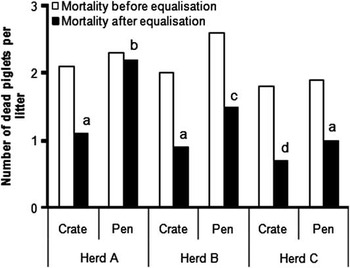
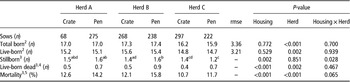
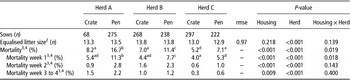
Results on piglet mortality before litter equalisation are presented in Table 1 and Figure 3. There was no effect of housing system on the number of total born piglets (P=0.772) or on the number of live-born piglets (P=0.529). The number of stillborn piglets was greater among sows housed in pens compared with crates (P=0.041) in Herd B, whereas housing had no effect on the number of stillborn piglets in Herd A (P=0.706) and Herd C (P=0.077).
Piglet mortality, expressed as numbers, in crates and pens in Herds A, B and C. White bars=mortality before litter equalisation, black bars=mortality after litter equalisation. P-value for herd×housing interactions: mortality before equalisation: P=0.107; mortality after equalisation: P=0.031. Black bars with different superscripts differ (P<0.05).

The effect of housing sows in farrowing crates and free farrowing pens in three herds on production results and piglet mortality before litter equalisationFootnote 1

a,b,c,dValues in a row without a common superscript differ (P<0.05).
1 Analysed using generalised linear models, with housing, herd, parity of the sow and the corresponding interaction terms included in the model.
2 Values are least-squares means.
3 Discrete data analysed using a generalised linear model with an underlying Poisson distribution. Consequently back-transformed values are presented.
4 Live-born piglets dying before litter equalisation.
5 Sum of stillborn and live-born piglets dying before litter equalisation.
The number of live-born piglets that died before litter equalisation was greater (P<0.001) in pens (0.8) than in crates (0.5). Overall piglet mortality before litter equalisation expressed as numbers was also greater (P<0.001) in pens (2.3) compared with crates (2.0). Expressed as percentage, overall piglet mortality before litter equalisation remained higher (P<0.001) in pens (13.7%) than in crates (11.8%). The proportion of sows with high piglet mortality (mortality>11%) before litter equalisation was greater in pens (66%) compared with crates (52%; P=0.001) in Herd B. In Herd A (pens: 58%, crates: 47%; P=0.110) and Herd C (pens: 45%, crates: 44%; P=0.773), the percentage of sows with high piglet mortality was not different between pens and crates.
Piglet mortality after litter equalisation
Results on piglet mortality after litter equalisation are presented in Table 2 and Figure 3. As planned, equalised litter size did not differ between FF-pens and crates (P=0.218). Overall piglet mortality after litter equalisation was higher in pens compared with crates in all herds. Nonetheless, there was an interaction between housing and herd (P=0.019), as the increase in piglet mortality in the pens compared with the crates was dissimilar in the different herds. In Herd A, mortality in pens was 8.5 percentage points higher than mortality in crates and in Herds B and C the corresponding numbers were 4.4 percentage points and 1.9 percentage points, respectively.
The effect of housing sows in farrowing crates and free farrowing pens in three herds on production results and piglet mortality after litter equalisationFootnote 1

a,b,c,dValues in a row without a common superscript differ (P<0.05).
1 Analysed using GLM, with housing, herd, parity of the sow and the corresponding interaction terms included in the model.
2 Values are least-squares means.
3 Discrete data analysed using a generalised linear model with an underlying Poisson distribution. Consequently back-transformed values are presented.
4 Piglet mortality after litter equalisation.
The 1st week after litter equalisation piglet mortality was greater in pens than in crates in Herd A (P<0.001) as well as in Herd B (P<0.001) and Herd C (P=0.013). Again, the magnitude of the difference in mortality in FF-pens and farrowing crates was greater in Herd A and Herd B compared with the difference in Herd C expressed as an interaction between housing and herd (P=0.018). In the 2nd week, after litter equalisation mortality remained greater (P<0.001) in pens (1.8%) compared with crates (1.0%), and this was also the case in weeks 3 to 4 with a mortality of 1.2% in pens v. 0.8% (P=0.009) in crates. The proportion of sows with high piglet mortality after equalisation was greater in pens (77%) than in crates (62%; P=0.012) in Herd A. The same pattern was found in Herd B where 74% of sows in pens had high piglet mortality and 51% of sows in crates had high piglet mortality (P<0.001). In Herd C, there was no difference in the proportion of sows with high mortality in pens (52%) and crates (46%; P=0.175).
Parity and litter size
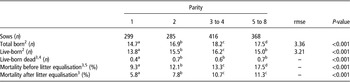
No significant interactions were detected between housing and parity or housing and litter size for any of the analysed variables. As expected, the number of total born piglets increased with sow parity (P<0.001) as did the number of live-born piglets (P<0.001) (Table 3). The number of stillborn piglets increased with increasing parity of the sows in all herds, but an interaction between herd and parity (P=0.013) showed that this increase was dissimilar between herds. Moreover, the number of stillborn piglets increased with increasing number of total born piglets (P<0.001). With increasing parity of the sow, there was an increased number of live-born deaths as well as an increase in overall mortality before and after equalisation (Table 3). A higher number of total born piglets also increased the number of live-born deaths (P<0.001) as well as overall mortality before equalisation (P<0.001). The equalised litter size decreased with increasing parity but with different patterns in the three herds (P=0.023). When equalised litter size increased, there was an increase in piglet mortality after equalisation calculated as numbers (P<0.001).
Effects of sow parity on number of total and live-born piglets, live-born dead and overall piglet mortality before and after litter equalisationFootnote 1

a,b,c,dValues in a row without a common superscript differ (P<0.05).
1 Analysed using GLM, with housing, herd, parity of the sow and the corresponding interaction terms included in the model. Effects of housing and herd illustrated in Tables 1 and 2.
2 Values are least-squares means.
3 Discrete data analysed using a generalised linear model with an underlying Poisson distribution. Consequently back-transformed values are presented.
4 Live-born piglets dying before litter equalisation.
5 Sum of stillborn and live-born piglets dying before litter equalisation.
Piglet mortality in the 1st week was lower among the younger (parities 1 to 2) sows (P<0.001). The effect of parity in the 2nd week differed between herds (P=0.001). In Herd A and Herd B, older sows (parity 3 or more) had a higher piglet mortality than younger sows, but this was not the case in Herd C.
Discussion
Preweaning mortality
Overall piglet mortality was greater in FF-pens than in crates before litter equalisation, and the same was seen after litter equalisation. These results contradict previous studies on preweaning mortality in commercial herds where it has been reported that piglet losses in pens were not greater than in crates (Weber et al., Reference Weber, Keil, Fehr and Horat2007; KilBride et al., Reference KilBride, Mendl, Statham, Held, Harris, Cooper and Green2012). In our study, the total number of piglets born in a litter was 17.0, 17.4 and 16.0 piglets in herds A, B and C, respectively. This corresponds to the current national Danish average (Vinther, Reference Vinther2012), but is considerably larger than the average litter size of 11.0 piglets in Weber et al. (Reference Weber, Keil, Fehr and Horat2007) and KilBride et al. (Reference KilBride, Mendl, Statham, Held, Harris, Cooper and Green2012). Moreover, Weber et al. (Reference Weber, Keil, Fehr and Horat2007) only included litters with 3 to 19 piglets in their data and only litters where no piglets had been added or removed for fostering. Cross-fostering is a standard procedure in Danish herds with large litters, and disregarding litters that were cross-fostered would not yield representative data. These differences imply that the conditions in the current study were different from the conditions in Weber et al. (Reference Weber, Keil, Fehr and Horat2007) and KilBride et al. (Reference KilBride, Mendl, Statham, Held, Harris, Cooper and Green2012), and this could have affected the production and hence results on piglet mortality.
Some of the studies that investigated piglet mortality in pens and succeeded in achieving rates of piglet mortality comparable to those in farrowing crates were conducted in pens that were larger than 5 m2 (Weary et al., Reference Weary, Phillips, Pajor, Fraser and Thompson1998; Andersen et al., Reference Andersen, Tajet, Haukvik, Kongsrud and Boe2007; Weber et al., Reference Weber, Keil, Fehr and Horat2007). Subsequently, it has been suggested that high levels of piglet losses could be avoided if pens were larger than 5 m2 (Weber et al., Reference Weber, Keil, Fehr and Horat2007; Wechsler and Weber, Reference Wechsler and Weber2007). Levels of mortality in FF-pens were in this study higher than in crates, even though pen size exceeded 5 m2 in all three herds (5.3 to 6.3 m2). To our knowledge, the influence of pen size on piglet mortality has not yet been studied experimentally, but results from this study indicate that not only the size of the pen is of importance when aiming at a reduction in piglet losses. It is reasonable to assume that for the sow to perform certain behaviours, a certain minimum space is required (Baxter et al., Reference Baxter, Lawrence and Edwards2011), but it may be equally important to consider the dimensions of the pen.
The proportion of sows with high mortality after litter equalisation was higher in pens than in crates in Herds A and B and equal in Herd C. Nevertheless, a proportion of the sows in pens had levels of mortality that were similar to the levels of sows in farrowing crates, which suggests that there are sows that perform well in the FF-pen. Previous work has demonstrated that sow behaviour influenced piglet mortality and that certain movements are more risky than others in relation to piglet crushing (Weary et al., Reference Weary, Pajor, Fraser and Honkanen1996; Marchant et al., Reference Marchant, Broom and Corning2001; Danholt et al., Reference Danholt, Moustsen, Nielsen and Kristensen2011). It is likely that individual differences in sow behaviour and temperament could explain why a large proportion of sows did not perform well in the pens. In a review of lying down and rolling behaviour of sows, Damm et al. (Reference Damm, Forkman and Pedersen2005) suggested that farrowing pens should be designed with supportive surfaces the sow can lean against when lying down. The pens in this study were fitted with a sloping wall, which has been shown to be an attractive form of support when lying down (Damm et al., Reference Damm, Moustsen, Jorgensen, Pedersen, Heiskanen and Forkman2006). Nonetheless, a high proportion of the sows had higher levels of mortality, which indicates that the design features of the pen only to a certain extent were able to reduce piglet mortality.
In a recent study of confinement of lactating sows, Moustsen et al. (Reference Moustsen, Hales, Lahrmann, Weber and Hansen2013) housed the animals in a swing-side system. Moustsen et al. (Reference Moustsen, Hales, Lahrmann, Weber and Hansen2013) showed that piglet mortality was higher when sows were kept loose throughout the experimental period than when sows were kept in crates after farrowing. However, the pens in the study by Moustsen et al. (Reference Moustsen, Hales, Lahrmann, Weber and Hansen2013) did not fulfil all design recommendations to meet the biological needs of loose-housed farrowing and lactating sows (Baxter et al., Reference Baxter, Lawrence and Edwards2011). Our results showed that even though the design of the pen was more satisfactory and actually incorporated more of the recommendations made by Baxter et al. (Reference Baxter, Lawrence and Edwards2011) it was still not possible to achieve the same level of mortality as in farrowing crates. In our study, the difference in mortality between pens and crates was greatest in the 1st week after farrowing. The issue is thus to reduce mortality in the early part of lactation, and it may be that confining the sow for a few days after farrowing in this designed pen would render levels of mortality similar to those that can be obtained in farrowing crates.
Influence of parity on piglet mortality
The results in the current study showed that mortality increased with increasing parity both before and after litter equalisation. Previous studies have established a similar unfavourable relationship between increased parity and preweaning survival (Jarvis et al., Reference Jarvis, D’Eath and Fujita2005; Weber et al., Reference Weber, Keil, Fehr and Horat2009; Andersen et al., Reference Andersen, Naevdal and Boe2011). In the present study, first-parity sows gave birth to fewer live-born piglets than older sows. Increased litter size has a negative impact on piglet mortality (Andersen et al., Reference Andersen, Naevdal and Boe2011) and a greater number of piglets in the pen make more piglets available for crushing when the sow lies down (Weary et al., Reference Weary, Phillips, Pajor, Fraser and Thompson1998). However, there were no difference in the number of live-born deaths between sows of parities 2, 3 to 4 and 5 to 8, indicating that not only the number of piglets caused older sows to have a higher piglet mortality. In addition, results from the current study showed that older sows were the ones that were equalised to the smallest litters, and yet mortality after equalisation was higher in older sows. It seems that older sows did not perform as well as younger sows, and this also indicates that maternal and behavioural differences between young and old sows influence piglet mortality. Another thing to consider is that older sows in the FF-pens were likely to have farrowed in crates in their previous parities and did as such not have any experience with the free farrowing system. Previous housing experience can influence sow behaviour during early lactation (Cronin et al., Reference Cronin, Simpson and Hemsworth1996; Weng et al., Reference Weng, Edwards and Hsia2009) and this can also explain why older sows seemed to perform worse than younger sows. Our results also showed that older sows had more stillborn piglets; but this might be linked to the higher number of total born piglets of older sows (Pedersen et al., Reference Pedersen, Jorgensen, Heiskanen and Damm2006). However, older sows did not perform worse in pens than in crates in comparison to younger sows in our study.
Influence of litter size on piglet mortality
An increase in the number of total born piglets was in this study shown to increase piglet mortality before litter equalisation independent of housing system. Accordingly, a higher number of total born piglets has been shown to have negative effects on preweaning survival in both pens and crates (Pedersen et al., Reference Pedersen, Jorgensen, Heiskanen and Damm2006; Weber et al., Reference Weber, Keil, Fehr and Horat2009). Piglets that are born in larger litters are more likely to have a lighter birth weight (Quiniou et al., Reference Quiniou, Dagorn and Gaudre2002; Wolf et al., Reference Wolf, Zakova and Groeneveld2008), and light birth weight is associated with risk factors such as lower viability (Baxter et al., Reference Baxter, Jarvis, D’Eath, Ross, Robson, Farish, Nevison, Lawrence and Edwards2008; Hales et al., Reference Hales, Moustsen, Hansen and Nielsen2013), increased risk of hypothermia (Herpin et al., Reference Herpin, Damon and Dividich2002) and increased sibling competition at the udder (Andersen et al., Reference Andersen, Naevdal and Boe2011). An investigation into indicators of survival in non-crated systems established that piglets that were born in large litters had increased risk of dying the 1st day after farrowing and that surviving piglets had a higher birth weight than dying piglets (Hales et al., Reference Hales, Moustsen, Hansen and Nielsen2013). However, increased sibling competition could also influence the mortality of piglets (Andersen et al., Reference Andersen, Naevdal and Boe2011), which is in accordance with our results as piglet mortality after litter equalisation increased with increasing equalised litter size. Equalised litter size might also affect piglet survival, as proposed by Weary et al. (Reference Weary, Phillips, Pajor, Fraser and Thompson1998), because more piglets are ‘available’ for crushing.
Conclusion
This study showed that loose farrowing in the FF-pen is not yet robust under commercial situations as piglet mortality was higher in FF-pens than in crates. However, a proportion of sows in FF-pens had a level of piglet mortality similar to that of the sows in farrowing crates, indicating that the FF-pens have the capability to deliver the same performance as farrowing crates.
Acknowledgements
The project was funded by the Pig Levy Foundation, The Danish Rural Development Program 2007-2013/The European Agricultural Fund for Rural Development and the Department of Large Animal Sciences, University of Copenhagen. The authors thank the owners and staff of the participating piggeries for their collaboration on this project. In addition, they are grateful to Pia Brandt, Jens Martin Strager, Ann Edal and Julie Krogsdahl for their help with collection of data.