Introduction
Delirium is a common and potentially serious condition, which affects a large percentage of hospitalized older patients (Chong et al., Reference Chong, Chan, Kang, Han, Sing and Tan2011). The four key features of delirium include disturbance of consciousness, attention, cognition, and perception with an acute and fluctuating course (American Psychiatric Association, 1994). Serious complications and poor prognostic implications exist in delirious patients (McCusker et al., Reference McCusker, Cole, Dendukuri, Belzile and Primeau2001; Bhat and Rockwood, Reference Bhat and Rockwood2002; Fick et al., Reference Fick, Agostini and Inouye2002). A recent meta-analysis assessing the association between delirium in older patients and long-term poor outcome found evidence of increased risk of death, institutionalization, and dementia (Witlox et al., Reference Witlox, Eurelings, de Jonghe, Kalisvaart, Eikelenboom and van Gool2010).
Phenomenological differences between DsD versus DaD remain poorly understood. A cohort study found that delirium symptoms overshadow dementia symptoms apart from severity of cognitive impairment; suggesting a deleterious effect of DsD (Trzepacz et al., Reference Trzepacz, Mulsant, Dew, Pasternak, Sweet and Zubenko1998).
A study found that DsD patients suffered more psychomotor agitation, perceptual disturbances, and disorientation compared to DaD patients (Cole et al., Reference Cole, McCusker, Dendukuri and Han2002). In addition, a prospective study on cancer patients concluded that DsD patients tend to present with increased disturbance in consciousness and multiple cognitive domains compared to patients with DaD (Boettger et al., Reference Boettger, Passik and Breitbart2009). A more recent study comparing symptom profile of patients with postoperative delirium after femoral neck fracture found that DsD patients more often had hyperactive and pure emotional symptoms. In contrast, DaD patients more often had pure hypoactive and psychotic symptoms (Lundström et al., Reference Lundström, Stenvall and Olofsson2012). Further studies report no significant differences between DsD and DaD (Liptzin et al., Reference Liptzin, Levkoff, Gottlieb and Johnson1993; Dasgupta and Hillier, Reference Dasgupta and Hillier2010). These studies have been limited to postoperative, rehabilitative and oncology patients.
Another interesting area of study is the concept of cognitive reserve that may account for variations in susceptibility to age-related and pathologic brain changes in manifesting cognitive symptoms. It is believed that education level, literacy, verbal IQ, and leisure activities may reduce the risk of developing Alzheimer's dementia. Studies have found that 25%–67% of non-demented patients fulfilled pathological criteria for dementia at autopsy (Tucker and Stern, Reference Tucker and Stern2011). Hence, there is growing evidence suggesting that high cognitive reserve may provide resilience for cognitive failure (Jones et al., Reference Jones2010; Stern, Reference Stern2012).
Thus, we aimed to look at phenomenological differences in delirium symptoms (cognitive and non-cognitive) between DsD and DaD in an acute geriatric care setting. We also compared delirium recovery trajectories between groups to understand the role of cognitive reserve in prognosticating recovery and to potentially aid in appropriate discharge planning for hospitalized older persons with delirium.
Methods
Study design
We conducted a prospective study of older patients with delirium admitted to the GMU, Department of Geriatric Medicine, Tan Tock Seng Hospital, Singapore between December 2010–August 2012.
Inclusion/exclusion
Patients aged 65 years or above who were determined to have delirium (established in accordance with the Confusion Assessment Method (CAM)) (Inouye et al., Reference Inouye, VanDyck, Alessi, Balkin, Siegal and Horwitz1990), were considered for admission to GMU. A study coordinator (with appropriate training in administration and interpretation of CAM) would further screen all referred patients eligibility of GMU stay. Patients were excluded if they had medical illnesses which required special monitoring (e.g. telemetry); were assessed to be dangerously ill, in coma or had terminal illness; uncommunicative or with severe aphasia; severely combative behavior with high risk of harm; and contraindications to bright light therapy. Patients with respiratory or contact precautions, or those with verbal refusal of GMU admission were also excluded. Finally, patients who were prematurely transferred out of GMU (for reasons such as instability of medical conditions requiring intensive monitoring or when new contact precautions must be instituted), and those admitted from a long-term care facility were excluded from subsequent analysis.
Setting
GMU is a five-bed unit with specific elder-friendly room design and lower staff-patient ratios. Core interventions adopted from HELP program (standardized protocols for managing cognitive impairment, sleep deprivation, immobility, visual impairment, hearing impairment, and dehydration) were systematically administered. Bright light therapy (2000–3000 lux) was administered via lights installed in the ceiling and turned on from 6–10pm daily. Sleep hygiene principles were also practiced. All interventions were adhered to via a semi-structured protocol by trained geriatric nurses in GMU, with 100% compliance achieved.
The GMU has a dynamic system for transfers whereby patient flow is effected once they are assessed to have met entry or discharge criteria. GMU patients were either discharged directly home or to the general wards to continue their medical management. Beyond the acute hospital stay, patients who require further rehabilitation or institutionalization were transferred to an appropriate sub-acute care facility. Descriptions of the GMU and its effectiveness have previously been published (Chong et al., Reference Chong, Chan, Kang, Han, Sing and Tan2011; Reference Chong, Tan, Tay, Chan, Wong and Ancoli-Israel2013; Reference Chong, Chan, Tay and Ding2014). Ethics approval for the study was obtained from the National Healthcare Group (NHG) Domain Specific Review Board (DSRB) and consent obtained from primary caregivers or a legally acceptable representative.
A patient was deemed to have recovered from delirium and discharged from GMU once the CAM criteria for definite delirium was no longer met, with diagnosis of recovery being indicated by improvement in cognitive and/or delirium severity scores (based on DRS-R98 (Trzepacz et al., Reference Trzepacz, Mittal, Torres, Kanary, Norton and Jimerson2001) and CAM-severity scores), as well as input from the multidisciplinary team.
Determination of underlying dementia
All patients were evaluated by the consultant geriatrician (subspecialty interest in cognition and memory disorders) upon admission to GMU. A diagnosis of dementia was made during the current admission if a reliable corroborative history suggested the presence of cognitive symptoms consistent with DSM-IV criteria for dementia (American Psychiatric Association, 1994), in accordance with the standardized process for cognitive evaluation (Chong and Sahadevan, Reference Chong and Sahadevan2003).
We collected data on patient demographics, comorbidities and severity of illness (using modified Charlson's comorbidity index (Charlson et al., Reference Charlson, Pompei, Ales and MacKenzie1987) and modified severity of illness index (Wong et al., Reference Wong, Sahadevan, Ding, Tan and Chan2010), respectively), and precipitating causes of delirium. As dementia is included among the comorbidities captured on Charlson's comorbidity index, yet being the same variable for classification of our groups of interest (delirium in presence or absence of dementia respectively), we removed dementia from the Charlson's comorbidity index when comparing between DsD and DaD. Cognitive status was assessed using locally validated Chinese Mini-Mental State Examination (CMMSE) (Sahadevan et al., Reference Sahadevan, Lim, Tan and Chan2000), and functional status scored on modified Barthel Index (MBI) (Mahoney and Barthel, Reference Mahoney and Barthel1965). Being a mechanical restraint-free unit, no patients in GMU had been subject to physical restraint.
Delirium assessment
Delirium severity was assessed daily using the DRS-R98 (a 16-item scale with 13 severity items and 3 diagnostic items), which is a well-validated tool (Trzepacz et al., Reference Trzepacz, Mittal, Torres, Kanary, Norton and Jimerson2001). It has a total scale score of 46 points and a maximum severity score of 39 points, with higher scores indicating higher severity. The 13-item severity scale is more easily repeated at shorter intervals for treatment studies or to elucidate what symptom changes constitute the characteristic waxing and waning of delirium during a 24-h period. The 13 severity items include non-cognitive symptoms (sleep-wake cycle disturbance, perceptual disturbance, delusions, lability of affect, language problems, thought process abnormalities, motor agitation, and motor retardation) and cognitive symptoms (disorientation, inattention, short-term memory loss, long-term memory loss, and visuospatial disability). The remaining three diagnostic items include temporal onset of symptoms, fluctuation of symptom severity and physical disorder.
There is presently no consensus on how to define delirium subtypes. In this study, we classified patients upon admission to GMU based on their psychomotor activity as personally observed by the clinician or reported by the nursing staff in the 24 hours following delirium onset. This follows the clinical global impression based on description of psychomotoric features, with no explicit criteria or requisite for minimum features as per the criteria by Lipowski (e.g. increased activity levels, restlessness, wandering, hallucinations among features for hyperactive delirium and decreased activity, speech, apathy, hypersomnolence among features of hypoactive delirium, and the combination of features from both hyperactive and hypoactive delirium being classified as mixed), supported by severity ratings in the two DRS-R98 motoric items (Meagher, Reference Meagher2009). The preceding 24 hours period would have allowed for the fluctuating symptom profile.
Statistical analysis
We evaluated clinical characteristics, cognitive assessment scores, and functional status, followed by comparing differences between DsD and DaD patients, using independent sample t-test (for parametric variables), Mann–Whitney U-test (for ordinal variables or non-parametric continuous variables), and χ 2 test (for categorical variables). Delirium-specific measures of DRS-R98 (and DRS-sev) and CAM (and CAM-sev) scores were analyzed. Additionally, we examined recovery trajectory by measuring rate of improvement (change in scores between admission and discharge divided by the duration of delirium) in cognitive and delirium severity scores and by plotting DRS-sev trajectory over five days. DRS-R98 items and DRS-sev scores (on admission and discharge) were plotted on a radar chart. We looked at delirium recovery by plotting total DRS-R98 scores along with cognitive and non-cognitive sub-scores.
To examine the independent effect of dementia on recovery trajectories in delirium, we performed multiple linear regression for the outcome variables of cognitive and delirium severity score change, adjusted for significant baseline differences observed on univariate analyses. Lastly, we looked at differences in clinical outcomes of pressure ulcer incidence, incident nosocomial infection rate and discharge destination.
Statistical analyses were performed using SPSS software (Version 19.0; SPSS, Inc., Chicago, IL, USA). Statistical significance was taken to be p < 0.05.
Results
Baseline characteristics
Two hundred and seventy seven (n = 277) patients were admitted to the GMU during the two-year study period. Two hundred and thirty four (n = 234) patients were included for analyses. We excluded forty three patients (41 were prematurely transferred out of GMU due to changes in their medical condition, 1 whose family requested GMU transfer out and 1 with early transfer out due to extremely combative behavior).
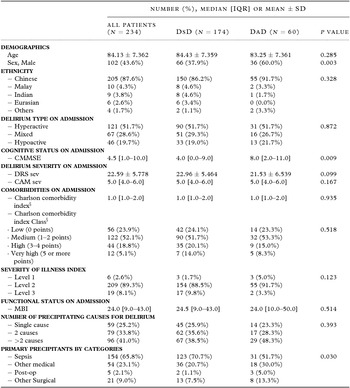
The majority of patients admitted to the GMU had hyperactive delirium (51.7%). No differences in age, ethnicity, delirium subtype, severity of delirium, functional status, Charlson's comorbidity index (excluding dementia), or severity of illness index were observed (Table 1). There were significantly fewer male patients in DsD compared with DaD (37.9% vs. 60.0%, p = 0.003). Moreover, sepsis was significantly more prevalent as a primary precipitant of delirium in DsD compared with DaD patients (70.7% vs. 51.7%, p = 0.03).
Baseline characteristics of patients admitted to the geriatric monitoring unit

Note: Abbreviations: AMI, acute myocardial infarction; ARU, acute retention of urine; CAM, confusion assessment method; CCF, congestive cardiac failure; CMMSE, Chinese Mini-Mental State Examination; DaD, Delirium in the absence of Dementia; DRS, delirium rating scale-98; DsD, delirium superimposed on dementia; MBI, modified Barthel index; SD, standard deviation.
§Excludes “dementia” diagnosis from the Charlson Comorbidity Index total score.
Baseline and recovery phase delirium phenomenology
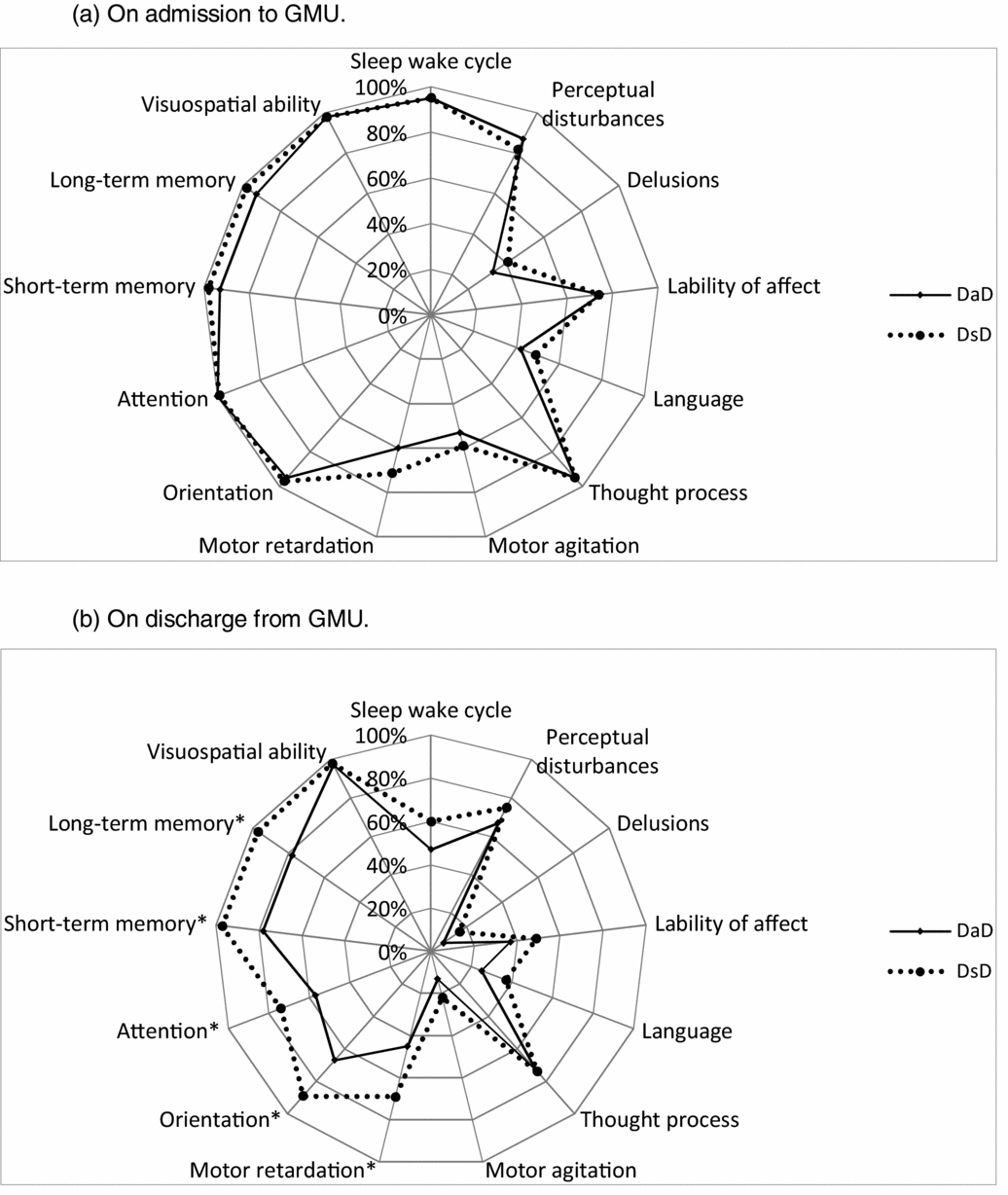
The five commonest delirium symptoms at baseline in DsD patients consist of cognitive items (inattention, long-term memory loss, visuospatial impairment, short-term memory loss, and disorientation) (Figure 1a). Short- and long-term memory loss were less common in DaD patients. It was also noted that perceptual disturbances appear to develop more frequently in DaD patients (87% vs. 82%).
Frequency of delirium symptoms based of DRS-R98. (a) On admission to GMU. (b) On discharge from GMU.

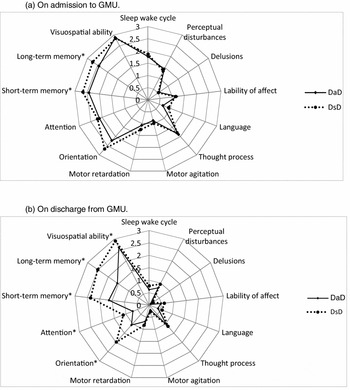
The severity of short- and long-term memory loss at baseline were noted to be significantly pronounced in DsD patients (DRS-sev 2.68 ± 0.66 vs. 2.43 ± 0.93, p = 0.028 and 2.74 ± 0.59 vs. 2.43 ± 0.91, p = 0.003, respectively) (Figure 2a). Although, DsD patients appear to show increased severity in language impairment and disorientation compared to DaD patients (DRS-sev 0.90 ± 1.05 vs. 0.65 ± 0.88 and 2.67 ± 2.37 vs. 2.22 ± 0.90, respectively), these findings were not statistically significant.
Severity of delirium symptoms based on DRS-sev. (a) On admission to GMU. (b) On discharge from GMU.

At recovery from delirium, motor retardation was prolonged in DsD patients (69.0% vs. 45.0%, p = 0.001) (Figure 1b). Cognitive symptoms were also noted to be prolonged in DsD patients, which include disorientation (88.5% vs. 66.7%, p < 0.001), inattention (73.6% vs. 56.7%, p = 0.014), short-term memory loss (96.6% vs. 78.3%, p < 0.001), and long-term memory loss (96.6% vs. 78.3%, p < 0.001). We found that prolonged short- and long-term memory loss remained high in both groups despite resolution of delirium. In particular, DsD patients continued to have significantly more severe cognitive symptoms of delirium (disorientation (DRS-sev 1.98 ± 1.03 vs. 1.07 ± 0.99, p < 0.001), inattention (DRS-sev 1.11 ± 0.91 vs. 0.70 ± 0.74, p < 0.002), short-term memory loss (DRS-sev 2.37 ± 0.84 vs. 1.63 ± 1.10, P < 0.001), long-term memory loss (DRS-sev 2.51 ± 0.77 vs. 1.55 ± 1.08, p < 0.001), and visuospatial disturbances (DRS-sev 2.91 ± 0.44 vs. 2.62 ± 0.74, p < 0.001)) compared to the DaD patients (Figure 2b). No differences in psychotic symptoms during the course of delirium were found between patients.
Recovery trajectories of delirium
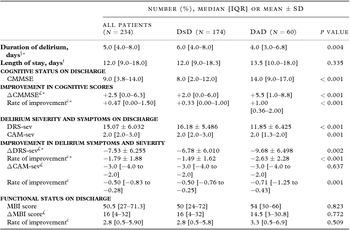
The median duration of delirium was 5.0 (4.0–8.0) days with a longer duration observed in DsD patients (6.0 (4.0–8.0) vs. 4.0 (3.0–6.8), p = 0.004) (Table 2). Both DsD and DaD groups achieved significant improvements in cognitive performance on CMMSE upon delirium resolution (Wilcoxon Signed Ranks test – DsD: Z = −6.535, p < 0.001; DaD: Z = −5.863, p < 0.001), although patients with DaD exhibited significantly greater magnitude of improvement in cognitive performance compared with their DsD counterparts (CMMSE change, measured as difference in scores between GMU admission and GMU discharge was +5.5 (1.0–8.8) vs. +2.0 (0.0–6.0), p < 0.001). In addition, DaD patients achieved significantly greater improvement in delirium severity scores with delirium resolution compared with DsD (DRS-sev change −9.68 ± 6.498 vs. −6.78 ± 6.010, p = 0.002). More importantly is the slower rate of improvement in cognitive and delirium severity scores observed in DsD patients (0.33 (0.00–1.00) vs. 1.0 (0.36–2.00) increase in CMMSE per day, p < 0.001, and 1.49 ± 1.62 vs. 2.63 ± 2.28 decrease in DRS-R98 severity per day, p < 0.001). Functionally, the rate of improvement in MBI scores was no different.
Cognitive and functional outcome at discharge from the geriatric monitoring unit

NOTE: Abbreviations: CAM, confusion assessment method; CMMSE, Chinese Mini-Mental State Examination; DaD, delirium in the absence of dementia; DRS, delirium rating scale-98; DsD, delirium superimposed on dementia; MBI, modified Barthel index; SD, standard deviation; sev, severity.
§Duration of delirium is equivalent to length of stay in GMU as patients are transferred out of GMU once assessed to have recovered from delirium.
ƗLength of hospital stay is equivalent to total length of stay in hospital, including time spent in general ward.
£ΔCMMSE, ΔCAM-sev, ΔDRS-sev, ΔMBI refer to the difference in scores between GMU admission and GMU discharge.
¢Rate of improvement is equivalent to the difference in scores between GMU admission and GMU discharge divided by the duration of delirium.
*Remained statistically significant after adjusting for gender and primary precipitant for delirium.
We performed multiple linear regression analysis, adjusting for gender and primary precipitant as these were significant baseline differences between DsD and DaD. We found that statistical significance in delirium duration, change in CMMSE (and rate of improvement), and change in DRS-sev (and rate of improvement) between groups continued to exist.
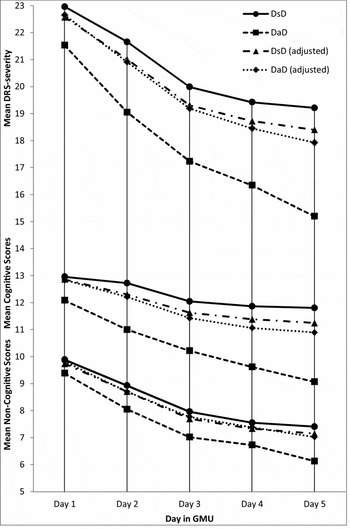
Figure 3 shows different recovery trajectories in delirium severity between DsD and DaD. We plotted mean DRS-R98 total severity, cognitive and non-cognitive scores for the first five days of GMU stay, adjusted for baseline differences in gender and precipitating causes of delirium. In unadjusted analyses, patients with DaD followed a steeper improvement in severity of delirium symptoms leading to significantly lower DRS-sev scores at day five of delirium (15.20 ± 8.07 vs. 19.21 ± 6.17, p < 0.001). When cognitive and non-cognitive sub-scores of DRS-R98 were examined separately, we observed steeper recovery in both sub-scores in DaD patients. There was relative early plateauing of improvement in the cognitive sub-scores of patients with DsD, evident by the stability beyond day 3, compared with patients with DaD in whom cognitive sub-scores showed continued progressive improvement.
Delirium recovery trajectory (in delirious patients with or without underlying dementia) in the first 5 days (corresponds to median delirium duration of study cohort) of admission to the geriatric monitoring unit (GMU) as reflected by mean daily delirium rating scale-revised-98 (DRS-R98) total severity, cognitive, and non-cognitive score. Adjusted for gender and primary precipitant.

After adjusting for gender and the primary precipitant for delirium, differences in recovery trajectories of delirium severity were less disparate. However, we evidenced separation in DRS-sev trajectories beyond day 4 of delirium, such that continued improvement persisted in DaD despite having plateaued in DsD, with significantly lower DRS-sev at day 5 in DaD compared with DsD (17.93 ± 0.86 vs. 18.40 ± 0.77, p < 0.001). In addition, divergence in cognitive sub-scores of DRS-R98 between DaD and DsD was evident beyond day 3 of delirium (at day 4: 11.06 ± 0.81 vs. 11.39 ± 0.79, p = 0.007; at day 5: 10.90 ± 0.62 vs. 11.25 ± 0.61, p < 0.001). There was no difference in recovery trajectories with respect to DRS-R98 non-cognitive sub-scores.
Clinical outcomes
Data on clinical outcomes found no difference in incident pressure ulcer rates or nosocomial infection rates between groups. A significantly larger proportion of DsD patients were discharged to long-term facilities (17.2% vs. 8.3%). Inversely, DaD patients were more likely to be transferred to a community hospital or a sub-acute facility (31.7% vs. 11.5%), p = 0.002.
Discussion
Based on our data, we found specific phenomenological differences that deserve much attention. All cognitive symptoms on the DRS-R98 were more prolonged in DsD patients, especially for both short- and long-term memory loss. We demonstrated that the presence of short- and long-term memory loss remained substantially high in DaD patients despite recovery from delirium. The severity of all cognitive symptoms of delirium was more pronounced in DsD patients, even at discharge from GMU. Similar to Boettger et al., we found that the cognitively-impaired hospital older adults tend to present with greater impairments in delirium symptoms, namely in cognitive items (Boettger et al., Reference Boettger, Passik and Breitbart2009). Hence, this suggests that delirious patients with underlying dementia have poorer cognitive reserves, and that these cognitive functions are likely to deteriorate markedly if delirium arises.
Reports on disturbance in level of consciousness appear to be inconsistent. Boettger et al. revealed increased severity in level of disturbance of consciousness in DsD patients (Boettger et al., Reference Boettger, Passik and Breitbart2009). However, this was not demonstrated in other studies (Liptzin et al., Reference Liptzin, Levkoff, Gottlieb and Johnson1993; Trzepacz et al., Reference Trzepacz, Mulsant, Dew, Pasternak, Sweet and Zubenko1998). Our study revealed significantly less occurrence of disturbance in level of consciousness (closely represented as “inattention” on the DRS-R98 scale, although they do not fully represent it) at resolution of delirium in DaD patients (57% vs. 74%, p = 0.014). Additionally, a more significant improvement in severity of inattention was noted in DaD patients at resolution of delirium as well (Figure 2).
Recent work on sleep disturbance by Meagher et al. revealed that approximately 73% of delirious patients experienced at least moderate disturbance of sleep-wake cycle (Meagher et al., Reference Meagher2007). A further study identified some sleep disturbance in 99% of DaD patients (Mattoo et al., Reference Mattoo, Grover, Chakravarty, Trzepacz, Meagher and Gupta2012). Our study revealed that 95% of patients, both in DsD and DaD patients, experienced some degree sleep-wake cycle disturbance. It is therefore evident as to why the new Diagnostic and Statistical Manual of Mental Disorders, Fifth Edition (DSM-5) criteria for delirium has incorporated sleep disturbance into the criteria (American Psychiatric Association, 2013).
When recovery trajectories were compared between groups, significant improvements in CMMSE and DRS-sev in DaD patients were observed. Functional improvement in MBI scores between groups was not significant. This evidences the role of rehabilitation in older adults with delirium, regardless of baseline cognitive status (Bee Gek Tay et al., Reference Bee Gek Tay, Chew Chan and Sian Chong2013). We also demonstrated a significantly greater improvement in attention, short-term memory loss, long-term memory loss, and visuospatial ability in DaD patients. Interestingly, the severity of visuospatial disability continued to worsen in DsD patients. This led us to look into possible associations with incident stroke during hospitalization, which yielded negative findings. Hence, this finding merit further studies.
Plotting recovery trajectories by separating DRS-R98 into cognitive and non-cognitive sub-scores clearly demonstrates significantly greater improvements in DaD patients, with an early plateau of recovery in cognitive sub-scores of DsD patients. In trajectories adjusted for baseline differences in gender and primary precipitant for delirium, only cognitive sub-scores of DRS-R98 differed significantly between DsD and DaD beyond day 3 of delirium, with no discernible difference in the non-cognitive sub-score trajectories. Hence, there may be great utility in clinical practice in scoring overall cognitive and non-cognitive symptoms separately rather than obtaining a discrete global score to allow for better prediction of recovery trajectory.
Our sample groups were limited to patients admitted to the GMU. The exclusion criteria for GMU admission would have implied that patients who were overly aggressive and/or violent were excluded from our study cohort, thereby limiting generalizability of our study findings. However, there was only one patient who had to be prematurely transferred out of GMU due to extremely combative behavior during our study period, and no patient had been declined admission to GMU owing to behavioral disturbances. As the intervention was uniform in all patients, the phenomenological differences observed are likely to be reflective of the true cognitive state.
Another limitation is that data on baseline cognitive and physical functioning of all patients were not captured. While our lack of data on premorbid cognitive performance precluded our ability to ascertain the differential impact of delirium on aggravation of cognitive symptomatology among delirious patients with and without underlying dementia, the significant, albeit lower, improvement on bedside cognitive performance test (CMMSE) in DsD patients despite persistence of cognitive symptoms at delirium recovery, support the detrimental effect of delirium on baseline cognition, especially when superimposed on dementia.
Despite these limitations, we were able to consolidate on what we know from previous studies. First, impairment in the cognitive domain is more severe and prolonged in DsD patients. Secondly, no significant differences were found with non-cognitive symptoms. And lastly, despite the fact that DsD patients did not demonstrate increased severity in motor retardation, it appeared to be significantly prolonged in DsD patients. Additionally, our study adds credence to previous studies, suggesting that there exists significant differences in severity and persistence of short- and long-term memory loss between patients; and that these symptoms appear to persist even within large proportion of DaD patients. Hence, this “novel” finding suggests that short- and long-term memory loss symptoms of delirium may play a vital role in predicting long-term cognitive decline.
In summary, there are phenomenological differences between DsD and DaD patients in an acute care setting. In particular, slower cognitive symptom recovery in DsD patients suggest cognitive reserve play a role in delirium syndrome development and recovery, and merit further studies to potentially aid in appropriate discharge planning and to identify potential pharmacological and non-pharmacological cognitive interventions for hospitalized older persons with delirium.
Conflict of interest
None.
Description of authors’ roles
E. Chong formulated the research questions, designed the study, carried out data analysis, and wrote the paper. L. Tay supervised the data analysis and wrote the paper. M.S. Chong formulated the research questions, supervised the data analysis and wrote the paper.
Acknowledgments
We would like to thank Wong Yoke Moi, RN; the GMU nurses, and the GMU multidisciplinary team. This study was funded by FY2010 Ministry of Health Quality of Improvement Funding (MOH HQIF) “Optimising Acute Delirium Care in Tan Tock Seng Hospital” (HQIF 2010/17). L Tay is funded by National Healthcare Group (NHG) Clinician Scientist Career Scheme (CSCS) 2013/13001 and MS Chong is funded by NHG CSCS 2012/12002.