


Universities have recently become targets of illiberal governments in many countries. From Turkey and Hungary to the United States, political actors have sought to curtail the autonomy of higher education institutions, reshape their curricula, or brand them as ideological threats to the nation. This trend raises pressing questions: How do illiberal governments use state power to coerce autonomous, high-profile, liberal-aligned higher educational institutions, and how do students and faculty respond?
This article explores these questions through a comparative analysis of three emblematic cases: Boğaziçi University in Turkey, Central European University in Hungary, and elite US universities such as Harvard University and Columbia University under the Trump administration. Despite stark differences in regime type and political context, these cases illustrate how universities can become flashpoints in broader ideological struggles. We selected Boğaziçi University, Central European University, and elite US universities as most illustrative cases because each represents a prominent instance in which state intervention in higher education has signaled broader trends in democratic backsliding and contestation over academic autonomy. The framework developed in this study is most applicable to high-profile institutions with significant symbolic capital, relative autonomy, and international visibility. It is less suited to peripheral institutions characterized by high state dependence, where the dynamics of capture and resistance differ substantially.
According to V-Dem’s Academic Freedom Index (Friedrich-Alexander-Universität Erlangen-Nürnberg and V-Dem Institute 2025), Turkey’s score dropped sharply from 0.42 in 2012 to approximately 0.12 by 2024, indicating a severe decline in academic autonomy. Hungary’s index fell from about 0.60 in 2012 to roughly 0.30 in 2024, reflecting significant erosion. The US’s score declined from 0.92 in 2012 to around 0.68 in 2024, signaling increased concerns about academic freedoms.
These countries were selected not only for their global visibility but also for the variation in their regime types. The V-Dem Institute classifies countries into four regime types: liberal democracy, electoral democracy, electoral autocracy, and closed autocracy. Turkey and Hungary both fall into the electoral autocracy category, while the US has officially lost its status as a liberal democracy for the first time in over 50 years and is now classified as an electoral democracy (Nord et al. Reference Nord, Altman, Fernandes, God and Lindberg2026). While both Turkey and Hungary are classified as electoral autocracies, they occupy different positions within that category. Recent developments in Turkey—including politically motivated trials and the imprisonment of opposition leaders—suggest a trajectory toward closed autocracy, whereas Hungary remains a paradigmatic case of electoral autocracy (Nord et al. Reference Nord, Altman, Fernandes, God and Lindberg2026). The three cases thus capture a spectrum of regime contexts: one trending toward closed autocracy, one embodying electoral autocracy, and one recently downgraded from liberal to electoral democracy.
Yet the US case differs fundamentally from Turkey and Hungary: rather than direct intervention, pressures on academic institutions have operated primarily through discursive delegitimation, selective regulatory measures, and targeted funding cuts. We therefore include the US not as a case of autocracy, but to illustrate how illiberal pressures on universities can emerge within formally democratic systems. Despite these regime differences, all three countries have, in recent years, been governed by leaders widely described as populist figures who claim exclusive representation of “the people” while portraying opponents as corrupt elites or agents of foreign influence (Mudde and Kaltwasser Reference Mudde and Kaltwasser2017).
In autocracies, power is concentrated in the hands of a leader or a small elite that lacks constitutional accountability to the public, while political pluralism, civil liberties, and institutional checks are severely constrained (Linz Reference Linz2000; Van den Bosch and Lindstaedt Reference Van den Bosch and Lindstaedt2025). Electoral autocracies maintain the formal architecture of elections but systematically undermine liberal principles such as judicial independence, media freedom, and minority protections, while invoking majoritarian rhetoric to legitimize consolidation of executive power (Levitsky and Way Reference Levitsky and Way2010; Schedler Reference Schedler2006). Elections in such systems are neither free nor fair, yet opposition forces retain a genuine, if structurally disadvantaged, chance of electoral success. Electoral democracies, by contrast, feature free and fair elections and relatively robust civil liberties but exhibit significant weaknesses in governance, institutional trust, and political culture that limit the effective functioning of democratic institutions (Nord et al. Reference Nord, Altman, Fernandes, God and Lindberg2026).
Throughout this paper, we use the term “illiberalism” to describe a substantive ideology and political practice rather than a regime type per se. Specifically, illiberalism refers to a contextually specific ideological reaction to the perceived liberal hegemony of high-profile universities.Footnote 1 We argue that illiberalism manifests when governments deploy state power against universities they view as bastions of liberal hegemony and partisan opposition. Because illiberalism operates along the dimension of ideology rather than regime type, it can emerge in authoritarian contexts such as Turkey and Hungary as well as in democratic ones such as the US. Our case selection and terminology thus aim to capture both regime characteristics and ideological dynamics across this spectrum. The comparative logic rests not on regime equivalence but on shared tactics and mechanisms of control—coercion, legal displacement, and discursive delegitimation.
Through cross-case analysis, we argue that universities are targeted not simply for their liberal orientation but because, in certain contexts, they function as semiautonomous institutions that shape public discourse, foster dissent, and challenge government narratives. We make three contributions. First, we offer a conceptual reframing of universities as inherently political institutions whose autonomy and epistemic authority place them in structural tension with authoritarian and illiberal projects while also recognizing that universities can themselves be instrumentalized by governments pursuing ideological consolidation. Second, we provide comparative insights across divergent regime types, identifying shared patterns and context-specific dynamics in state–university relations and systematizing the control mechanisms governments deploy: coercion, legal displacement, and discursive delegitimation. Third, we theorize student and faculty responses to political interference, analyzing how campus activism varies across mobilization, fragmentation, and withdrawal as a function of domestic political opportunity structures, institutional culture, and the intensity of repression. The article thus positions the university as a contested political institution, contributing to debates on democratic backsliding, authoritarian populism, and the politics of knowledge production.
Why Universities? Theoretical Reflections
Illiberal governments consolidate power through a combination of legal, institutional, and cultural strategies designed to diminish opposition and maintain control over society. Central to this process is the erosion of democratic norms and institutions, often achieved through the co-optation of the judiciary, undermining of independent media, and suppression of civil society organizations (Berman and Snegovaya Reference Berman and Snegovaya2019; Levitsky and Way Reference Levitsky and Way2010; Reference Levitsky and Way2020; Svolik Reference Svolik2012). By reshaping institutions, regimes create a facade of legitimacy while neutralizing opposition forces. The education sector, notably higher education, becomes a key target in this process as it plays a crucial role in the legitimization or delegitimization of the leadership.
In both theory and practice, universities are rarely neutral institutions; they are often embedded in broader political struggles over authority, legitimacy, and the production of truth. Political scientists have long argued that institutions are seldom ideologically impartial (Bourdieu Reference Bourdieu and Collier1988; March and Olsen Reference March and Olsen1983). Universities can function as semiautonomous sites of epistemic authority, youth socialization, and institutional pluralism—three characteristics that can challenge efforts to centralize power or impose ideological conformity.
First, universities produce knowledge that can challenge authoritarian rule. As Antonio Gramsci (Reference Gramsci, Hoare and Smith1971) observed, cultural hegemony requires control over intellectual institutions. Universities often uphold liberal, cosmopolitan, or critical traditions that serve as counterweights to state propaganda and ideological orthodoxy. The transnational networks of scholars, ideas, and norms sustained by universities may amplify challenges to official narratives beyond national borders (Keck and Sikkink Reference Keck and Sikkink1998). Universities thus occupy an inherently ambivalent position: depending on their governance and orientation, they can either reinforce or erode the infrastructure of legitimacy that political leaders seek to construct and maintain. It is precisely this ambivalence that makes them sites of political contestation.
Second, universities play a central role in political socialization, particularly among youth, shaping political preferences and behavior (Easton and Dennis Reference Easton and Dennis1969; Niemi and Hepburn Reference Niemi and Hepburn1995). Higher education exposes students to diverse perspectives, encourages critical thinking, and cultivates norms such as pluralism, tolerance, and participatory governance, though the extent of this influence varies across contexts. For regimes that rely on conformity or majoritarian populism, such intellectual emancipation can be destabilizing. The political threat of the university thus lies less in faculty scholarship than in students’ capacity to mobilize and dissent (Altbach Reference Altbach1989), making control over higher education a priority for illiberal governments.
Third, universities often embody a model of governance that contrasts sharply with the hierarchical logic of authoritarian rule. They are typically governed by norms of collegiality, deliberation, and academic freedom—principles that both reflect and reproduce democratic ideals (Shils Reference Shils and Grosby1997; Slaughter and Rhoades Reference Slaughter and Rhoades2004). Even within authoritarian regimes, universities may retain pockets of relative autonomy, serving as refuges for dissenting voices. This semiautonomy can make them particularly intolerable to leaders who equate dissent with disloyalty—and who therefore seek to integrate universities into the hierarchical political order they are working to consolidate.
These characteristics—epistemic autonomy, youth political activation, and democratic governance—help to explain why universities are perceived as threats by regimes seeking ideological control. But the nature of this threat is not only structural; it is also symbolic and strategic. Politicians often instrumentalize universities as scapegoats in broader culture wars, presenting them as bastions of elitism, decadence, or foreign influence. This populist framing enables leaders to garner support among constituencies that have been alienated by globalization, multiculturalism, or intellectual elitism (Brown Reference Brown2015; Mudde Reference Mudde2007).
Yet the empirical record complicates any straightforward equation of universities with democratic resistance. Research shows that autocratic regimes often expand and regulate higher education not only to suppress dissent but also to cultivate loyal elites and compliant middle classes—offering educational credentials, employment, and social mobility in exchange for political acquiescence (Hanson and Sokhey Reference Hanson and Sokhey2021; Perry Reference Perry2015). In Russia and Kazakhstan, for instance, performance-based funding mechanisms, state-directed research priorities, and legal-bureaucratic oversight have been used to align academic agendas with regime interests and suppress critical scholarship (Hanson and Sokhey Reference Hanson and Sokhey2021). Universities are thus neither reliable agents of emancipation nor passive instruments of control, but contested institutions whose political valence is determined by the interplay of institutional autonomy, state capacity, and the broader regime context.
Through an analysis of government pressures toward universities and student and faculty responses, this study bridges political science literature with the growing literature on comparative higher education. Recent scholarship has explored how universities across diverse regimes navigate pressures of political instrumentalization (Callender, Locke, and Marginson Reference Callender, Locke and Marginson2020; Dobbins, Knill, and Vögtle Reference Dobbins, Knill and Vögtle2011; Goedegebuure et al. Reference Goedegebuure, Kaiser, Maassen, Meek, van Vught and de Weert2014). Comparative studies have also investigated how governance models, funding structures, and policy reforms shape academic freedom and institutional resilience in both democratic and authoritarian contexts (Mok and Lo Reference Mok and Eric2002; Trakman Reference Trakman2008). To contribute to these literatures, this paper examines how universities function as political actors embedded within broader systems of power and how they respond creatively to authoritarian encroachment.
Student and faculty politics occupy a central place in university life and in the broader dynamics of political contention. College students have historically been at the forefront of resistance movements (Crossley Reference Crossley2008), and responses to authoritarian encroachments on universities are no exception (Altbach Reference Altbach1989; Reference Altbach and Altbach1991; Reference Altbach, James and Altbach2006; [1997] Reference Altbach2018; Morgan and Davis Reference Morgan and Charles2019). Student and faculty activism can take multiple forms: organized protests, digital campaigns, solidarity networks, and symbolic acts of defiance. Yet mobilization is not the only or inevitable response. Fragmentation—the dispersal of activist energy across competing agendas or identities—and withdrawal—the retreat from public engagement into private or apolitical life—emerge as alternative responses shaped by political opportunity structures, institutional culture, and the severity of state repression.
When authoritarian control intensifies, students and faculty often mobilize to defend academic freedom and institutional autonomy (Smith Reference Smith1997). In highly repressive environments, students may adopt subversive yet less visible forms of dissent—such as underground organizing, decentralized activism, and informal networks—that help resistance to persist despite significant risks (Boren [2001] Reference Boren2019). Otherwise, sustained repression can lead to political withdrawal, with students disengaging from activism altogether (Buckner Reference Buckner2025).
A key aspect of student and faculty resistance is its symbolic power (Kim Reference Kim2010). In challenging state narratives, student movements and faculty often expose contradictions within autocracies and flawed democracies and offer counternarratives rooted in pluralism, solidarity, and democratic values. Yet the toll of repression—disciplinary actions, surveillance, arrests—often dampens momentum over time, fragmenting movements or pushing them into dormancy.
The cases from Turkey, Hungary, and the US illustrate the interplay between illiberal impulses and the defense of institutional autonomy, as well as the forms of resistance that university communities mount in response. Across these contexts, governments have deployed calculated strategies to suppress dissent and subordinate academic institutions to political control, though the form and intensity of these interventions vary across regime types. These cases reveal both the structural vulnerabilities of universities under illiberal pressure and the creative, if often constrained, capacities for resistance that remain.
Boğaziçi University: Academic Autonomy and Authoritarian Intervention in Turkey
Turkey has undergone the consolidation of an increasingly centralized authoritarian political order, accelerating particularly after the 2016 coup attempt. Recep Tayyip Erdoğan’s government systematically eroded institutional checks and balances and curtailed civil liberties through emergency decrees, mass dismissals of public employees, and sweeping restrictions on press freedom (Esen and Gumuscu Reference Esen and Gumuscu2016). In this process, the government subordinated previously autonomous spheres—including the judiciary, media, and academia—to executive authority, using legal and institutional mechanisms to legitimize its consolidation of power (Castaldo Reference Castaldo2018; Yılmaz and Turner Reference Yılmaz and Turner2019). Universities were central to this transformation. Through amendments to higher education law, Erdoğan significantly expanded executive control over university governance, including the appointment of university presidents (Doğan and Selenica Reference Doğan and Selenica2022). By 2020, most universities had been brought under tight government oversight—with Boğaziçi University representing a notable exception, having retained a degree of institutional autonomy that would soon make it a focal point of political confrontation.
Boğaziçi University—founded in 1863 as Robert College and reconstituted as a public institution in 1971—has long been a symbol of academic excellence, intellectual autonomy, and liberal culture in Turkey. With its English-language instruction, meritocratic ethos, and reputation for openness, it has stood apart from the more centrally controlled and ideologically aligned segments of Turkish higher education.
In January 2021, Erdoğan bypassed customary academic procedures by appointing Melih Bulu, a former AKP parliamentary candidate with no prior affiliation to Boğaziçi, as rector. The imposition of an external political appointee sparked one of the most sustained university-based protest movements in Turkey’s recent history (Yackley Reference Yackley2021). Students and faculty mobilized under the slogan “We don’t want a trustee rector” and organized near-daily protests, teach-ins, and symbolic acts of defiance. Faculty members held silent vigils, turning their backs on the rector’s office every day at noon, while students created protest art and organized open forums on academic freedom (Alemdaroğlu and Babül Reference Alemdaroğlu and Babül2021; Buckner Reference Buckner2025). In the words of a faculty member at Boğaziçi University, Erdoğan targeted the “anti-hierarchical, horizontal organization” of the institution. This faculty member’s sentiments demonstrate how the faculty saw their resistance against the government: “We do not want to become one of those places where you can only do research and get promoted if you keep silent and obedient while trying to retain good relations with the rector as a power figure. We are not used to such an authoritarian way of rule” (quoted in Wilks Reference Wilks2021).
The government’s response was swift and repressive. Over 560 students were detained in connection with the protests; on February 1, 2021, alone, 159 students were arrested after police raided the campus, with another 104 detained in solidarity demonstrations across Istanbul (Human Rights Watch 2021). By mid-year, over eight hundred protest-related detentions had occurred nationwide. At least 27 students were placed under house arrest, and nine were held in pretrial detention (Amnesty International 2021). Protesters faced surveillance, nighttime police raids, and electronic monitoring such as ankle bracelets. LGBTQ+ students were especially targeted. Four students were arrested for displaying a Pride flag during a protest, and government officials—including Interior Minister Süleyman Soylu—publicly denounced LGBTQ+ activists as “deviant” (Wilks Reference Wilks2021).
Erdoğan himself referred to the student protesters as “terrorists,” using rhetoric reminiscent of earlier state crackdowns on dissent (Wilks Reference Wilks2021). Government-aligned media depicted Boğaziçi as a corrupt, Westernized enclave disconnected from national values. This discursive framing turned the university into a symbolic target—not simply as an academic institution, but as an alleged hub of cosmopolitan elitism and moral decline. In this way, Boğaziçi became a battlefield in the broader culture war waged by the Erdoğan government against liberalism, pluralism, and institutional autonomy (Arat Reference Arat2021; MacDonald Reference MacDonald2021).
By mid-2021, Melih Bulu was unexpectedly dismissed as rector, a decision widely interpreted as an attempt to defuse tensions without substantial concessions to institutional autonomy (Hürriyet Daily News 2021). However, his replacement, Naci İnci—another government-appointed figure—further entrenched the government’s control over Boğaziçi. İnci’s administration initiated legal and disciplinary actions against protesting students and faculty members, including terminations, police investigations, and the banning of campus activities (Human Rights Watch 2022). Administrative policies under İnci restricted key academic freedoms, including the capacity for departments to independently elect chairs, a practice previously central to Boğaziçi’s meritocratic culture. Despite these measures, resistance persisted, with faculty continuing their symbolic vigils, and students organizing protests and digital campaigns to defend academic freedom and institutional independence (Duvar English 2021).
Student responses initially reflected remarkable courage and creativity. Protest-art exhibitions, public statements, solidarity campaigns, and digital organizing kept the momentum alive for months (Kirişci, Eder, and Arslanalp Reference Kirişci, Eder and Arslanalp2022). Faculty members, who often remained silent under pressure at other Turkish universities, took visible and consistent stands (Buckner Reference Buckner2025). Over time, however, the toll of repression became increasingly evident. Some students and faculty members faced disciplinary proceedings or contract terminations. Student organizations were fragmented or went dormant. A climate of surveillance and fear made open political engagement riskier. While some students continued their resistance underground or shifted to more informal methods, others continued to protest openly even five years after İnci’s appointment as president (Oksijen 2025). The public largely supported student protests. According to a nationwide survey in 2021, 67% of the general public supported the student protests, including 35% of those who identify as “ultra-religious” (Arat Reference Arat2021).
The Boğaziçi case illustrates both the symbolic power of the university and the costs of authoritarian encroachment. Erdoğan’s intervention aimed not only to control a single university, but also to send a message: no institution, no matter how autonomous or prestigious, is immune from government authority. Yet the response also revealed the university’s latent potential, under favorable conditions, as a site of political agency. In resisting the appointment, Boğaziçi students and faculty offered a counternarrative to authoritarianism—one grounded in deliberation, solidarity, and principled defiance. The liberal culture at Boğaziçi helped to mobilize student protests and sustain them, while state repression gradually constrained their scope and visibility.
While our analysis focuses on Boğaziçi University as the most prominent and extensively documented case, similar dynamics also unfolded elsewhere. Istanbul Şehir University was forcibly closed by government decree in 2020 (MEE Staff 2020) and Istanbul Bilgi University faced increasing regulatory and administrative pressures that led to its closure by the government in May 2026, though it was reopened days later after public protests (Reuters 2026).
Central European University: Illiberalism, Sovereignty, and Legal Displacement
Over more than a decade (2010–26), Hungary has experienced an authoritarian shift under Prime Minister Viktor Orbán. After returning to power in 2010, Orbán and his Fidesz party systematically centralized political power, weakened judicial independence, and restricted press freedom (Szelényi Reference Szelényi2022). Through constitutional changes, the takeover of regulatory agencies, and limits on civil society, Orbán created what he called an “illiberal democracy,” emphasizing national sovereignty and traditional values over pluralism and liberal institutions (Scheppele Reference Scheppele2022; Suuronen Reference Suuronen2025; Toomey Reference Toomey2018). This authoritarian change also affected higher education, with universities—especially those promoting critical thinking and international perspectives—becoming key targets for government intervention and control (Majtényi and Ryder Reference Majtényi and Ryder2024). The relocation of the Central European University (CEU) occurred within this political environment.
CEU, founded in 1991 with support from Hungarian-American investor and philanthropist George Soros, became a regional hub for liberal arts and open-society values in postcommunist Europe. Based in Budapest from 1993 until its expulsion to Vienna in 2019, CEU attracted an international faculty and promoted critical inquiry—qualities that increasingly drew the ire of Viktor Orbán’s illiberal regime. While Orbán gradually increased his control over the universities (Majtényi and Ryder Reference Majtényi and Ryder2024), the real threat to CEU came in April 2017 when the Hungarian government passed the so-called Lex CEU, a higher education amendment requiring foreign-accredited universities to maintain a campus in their home country—a criterion CEU could not meet despite its US accreditation (Karasz Reference Karasz2017). Although CEU negotiated with Bard College in New York to fulfill the requirement, the Hungarian government refused to ratify the agreement (Enyedi Reference Enyedi2018; Sedelmeier Reference Sedelmeier2017). The legislation applied broadly but was designed to target CEU specifically—the only university affected in practice.
On December 3, 2018, CEU announced that it would relocate its US-accredited programs to Vienna, effective September 2019 (Novak Reference Novak2019; Redden Reference Redden2018). The move disrupted faculty research, fractured the student body, and severed CEU’s physical connection to Hungary’s intellectual community (Enyedi Reference Enyedi2018; Santora Reference Santora2018). In October 2020, the European Court of Justice ruled that the Lex CEU violated European Union law by restricting academic freedom and discriminating against CEU.Footnote 2 But the judgment arrived too late to reverse the damage. By 2020, less than 20% of CEU’s programs remained in Budapest (CEU 2020). By then, CEU had established a new campus in Vienna and had reconstituted itself as a US-Austrian-accredited institution, effectively becoming a university in exile (Enyedi Reference Enyedi2018). Furthermore, the Orbán government did not reverse the legal changes following the European Court of Justice’s ruling, and the outcome illustrates the effectiveness of legal displacement as a mechanism of institutional control. As of 2026, CEU offers all of its degree programs in Vienna, while its Budapest presence has been reduced to a research institute and community engagement hub operating primarily through its Democracy Institute and alumni programs. Crucially, no degree-seeking programs remain in Hungary. The university survives institutionally but has been effectively expelled from the national higher education system—achieving, from the government’s perspective, the functional equivalent of closure without the reputational cost of outright suppression.
Orbán’s campaign against CEU was as ideological as it was legal. Government officials and state-aligned media framed CEU as a node in Soros’s “network,” alleging that the university promoted migration, multiculturalism, and liberal values that threatened Hungarian sovereignty (Bayer Reference Bayer2017; Majtényi and Majtényi Reference Majtényi and Majtényi2016). CEU was portrayed as a foreign, elitist outpost—unrepresentative of national identity and opposed to the regime’s vision of a Christian, illiberal democracy. The government’s targeting of CEU became a flashpoint in Hungary’s broader culture war, symbolizing the struggle between cosmopolitan liberalism and nationalist, conservative values (Enyedi Reference Enyedi2022). The rhetoric surrounding CEU’s expulsion echoed Orbán’s efforts to define Hungarian identity in opposition to Western “globalist” influences, casting the university as a threat to traditional society and national cohesion. In this way, the campaign against CEU was part of a concerted effort to reshape the cultural landscape of Hungary, pushing back against institutions seen as bastions of pluralism and open society (Enyedi Reference Enyedi2022).
Student and faculty resistance initially took the form of public protests, petitions, and solidarity campaigns. Tens of thousands joined rallies in Budapest to oppose the law and support CEU’s autonomy, such as the “March of Science” in April 2017, which included students, faculty members, and alumni of CEU (DW 2018; Reuters 2017). Students organized round-the-clock sit-ins on campus, coordinated teach-ins about academic freedom, and galvanized international support—from open letters signed by Nobel laureates to partnerships with universities across Europe. The university’s student union continued to host solidarity events and information sessions, even as the prospect of remaining in Budapest diminished (Tait Reference Tait2017). However, as legal and political avenues closed, the protests gradually lost momentum. The exodus fractured the CEU community: some students and faculty members relocated to Vienna with the university; others stayed behind in a weakened institutional environment.
CEU’s forced departure illustrates how illiberal governments can suppress dissenting institutions not by overt coercion but through legal displacement. Unlike the direct police repression seen at Boğaziçi, the Hungarian state’s legalistic approach rendered resistance more difficult to sustain. By targeting CEU’s legal status rather than its members, the government made resistance harder. It disarmed protest not by criminalizing it, but by removing the institutional locus that made protest possible. This strategy fragmented the CEU community and disempowered student resistance. Faculty, students, and staff found themselves stripped of their institutional home, and solidarity efforts lost vital momentum in the absence of a physical campus. As a result, the university community was scattered, student organizing was fractured, and the broader movement for academic autonomy was left deteriorated without a single activist needing to be arrested.
Elite US Universities under Trump: Culture Wars, Conservative Populism, and Discursive Assaults
Although the US has not experienced the regime transformations that characterize Turkey and Hungary, the Trump administration has exhibited illiberal tendencies with direct implications for higher education, including discursive attacks on university legitimacy, targeted regulatory pressure, and the withdrawal of federal funding. The US case is nonetheless categorically distinct: interventions have operated indirectly, without the forced leadership appointments, institutional expulsions, or accreditation manipulations that define the Turkish and Hungarian cases. This distinction is analytically significant and illustrates how illiberal pressures on universities can operate through softer mechanisms of control even within formally democratic institutional frameworks.
President Trump’s leadership has exhibited hallmark features of illiberal governance. The administration has pursued sustained delegitimation of independent institutions, including the free press, electoral administration, and the federal bureaucracy, while questioning the integrity of the democratic processes (Levitsky and Way Reference Levitsky and Way2025). Through executive orders, inflammatory rhetoric, and selective law enforcement, it has worked to centralize political authority, erode institutional checks and balances, and polarize public discourse (Tait Reference Tait2025). Universities have increasingly been cast as adversaries of the national interest in this environment—dissenting institutions to be disciplined rather than autonomous spaces to be protected.
By casting universities as out of touch, elitist, and hostile to national identity, the Trump administration has tapped into long-standing anxieties about the place of intellectuals in American democracy (Merkley Reference Merkley2020; Nichols [2017] Reference Nichols2024). This discursive assault has both undermined the legitimacy of higher education and mobilized support among groups who have felt excluded from the benefits of elite institutions. Institutions such as Harvard and Columbia have become recurring symbols in the culture war, portrayed as bastions of liberal ideology, elite privilege, and un-American values. Similar to Turkey or Hungary, the Trump administration has also used an anti-intellectualist discourse and utilized regulatory tools and limitations on government funding to control universities. On the one hand, the administration has relied on discursive delegitimation, legal harassment, and symbolic politics to undermine the social authority of universities; on the other, it has employed government funding cuts and restrictive regulations to curtail their autonomy and influence.
The culture wars in higher education are not new (Hartman [2015] Reference Hartman2022; Skocpol and Williamson Reference Skocpol and Williamson2011), but the Trump era has intensified their stakes (Samuels Reference Samuels2024). President Trump and his allies have frequently depicted higher education as a site of indoctrination and moral decline. Speaking at the 2020 Republican National Convention, President Trump warned that the “radical Left” and “radical professors” had taken over education (Trump Reference Trump2020). His administration issued Executive Order 13950, which banned federal agencies and contractors from conducting diversity training that mentioned “systemic racism,” “white privilege,” or “critical race theory” (Office of the President 2020). Though later rescinded, the order had a chilling effect on academic and administrative programming. During the COVID-19 pandemic, the Trump administration attempted to revoke visas for international students enrolled in online-only courses—a move widely perceived as punitive toward elite institutions that shifted to remote learning early (Whitford Reference Whitford2020). Litigation over affirmative action further politicized elite universities. The Department of Justice sued Yale University in 2020, claiming discrimination against white and Asian American applicants, and supported Students for Fair Admissions in its lawsuit against Harvard’s race-conscious admissions policies (Saito Reference Saito2021). While framed as civil rights enforcement, these actions aligned with broader conservative narratives portraying Ivy League schools as exclusionary, antimeritocratic, and hostile to conservative values.
After Trump started his second term as president in January 2025, the landscape of higher education and campus activism has grown even more politically charged. The administration has sought to intensify its oversight of elite universities, sharpen federal intervention in campus affairs, and amplify its rhetorical assault on institutions perceived as bastions of the “radical Left” (Damiano and Burns Reference Damiano and Burns2024). Federal engagement with higher education has shifted from symbolic contestation and legal challenges toward more direct regulatory intervention. During the second Trump administration, federal funding has been withheld or revoked from universities that the administration has accused of tolerating campus protests—particularly those critical of US foreign policy—and of perpetuating civil rights violations through diversity, equity, and inclusion programs (Binkley Reference Binkley2025; Kim Reference Kim2025). These interventions have operationalized discursive delegitimation through financial coercion, using funding conditionality as a mechanism of political discipline.
Among the most significant developments was the government’s reaction to the growing influence and visibility of Palestinian activism on American campuses in the wake of the Hamas attacks on Israel in October 2023 and Israel’s war in Gaza in the aftermath—a movement that would come to shape policy debates, administrative crackdowns, and the broader public conversations about academic freedom and dissent (Offenhartz and Marcelo Reference Offenhartz and Marcelo2025). While major campus protests related to Gaza preceded the Trump administration’s second term, the Trump administration later instrumentalized the protests to justify regulatory and funding interventions. The administration has expanded efforts to revoke or deny visas for international students and scholars participating in activism that is deemed disruptive or contrary to “national interests,” often citing demonstrations related to Palestinian rights (Ma and Hussein Reference Ma and Hussein2025). The government has investigated institutions such as Harvard and Columbia, characterizing their responses to campus protests as failures of institutional governance, indicative of antisemitism, and evidence of ideological bias. The administration has cut funding to institutions seen as permitting or failing to sanction Palestinian solidarity actions and as implementing diversity, equity, and inclusion programs, using Title VI of the 1964 Civil Rights Act as justification (Casey Reference Casey2025).
As scholars have documented, universities, when faced with external pressure, oscillate between strategies of accommodation, resistance, and adaptation (Giroux Reference Giroux2014; Slaughter and Rhoades Reference Slaughter and Rhoades2004). Some universities, under pressure from federal and state authorities, have adopted stricter codes of conduct and disciplinary measures targeting protest organizers. In these settings, administrative priorities have shifted toward risk management and institutional self-preservation, sometimes at the expense of open dialogue and academic freedom (Hughes Reference Hughes2025). Student groups critical of government policy or vocal in their advocacy—particularly those supporting Palestinian solidarity or racial justice—have found their activities more closely scrutinized, with increased oversight of campus events and restrictions on protest spaces. Conversely, other universities, such as Harvard University and Princeton University, have sought to resist external pressures, reaffirming their commitment to the principles of free expression and the right to dissent (Powell Reference Powell2025). Leaders of these institutions have issued public statements defending academic freedom, organized forums for debate on contentious topics, and provided legal support to students and faculty members facing disciplinary action for their activism (Finnegan Reference Finnegan2025).
The reactions of faculty and students to these developments have been marked by uncertainty and ambivalence. Faculty and staff have faced difficult choices, balancing their roles as educators and mentors with the risks associated with political engagement. As one professor put it, they were “in the midst of a deliberate, strategic campaign of generating fear and anxiety” (quoted in Quinn Reference Quinn2025). Student responses have been mixed. At Columbia, Harvard, and other elite campuses, students have mobilized around racial justice, immigrant rights, climate change, and antiwar protests regarding the war in Gaza. The 2020 Black Lives Matter protests and protests against Israel gained widespread appeal across the US. At the same time, concerns about ideological conformity, cancel culture, and administrative overreach have led some students—particularly centrists and libertarians—to express quietist or disillusioned attitudes. The climate of suspicion and regulatory scrutiny in the second Trump term has led many student organizations to adapt their tactics, balancing visibility with personal and institutional risk. While some activists have continued their protests, others, wary of surveillance or potential repercussions, have withdrawn from public activism (Lopez, Moore, and Montanaro Reference Lopez, Moore and Montanaro2025), leading to fragmentation and fatigue within activist networks. Other students have completely withdrawn from activism.
Comparative Analysis: Strategies of Control, Sites of Resistance
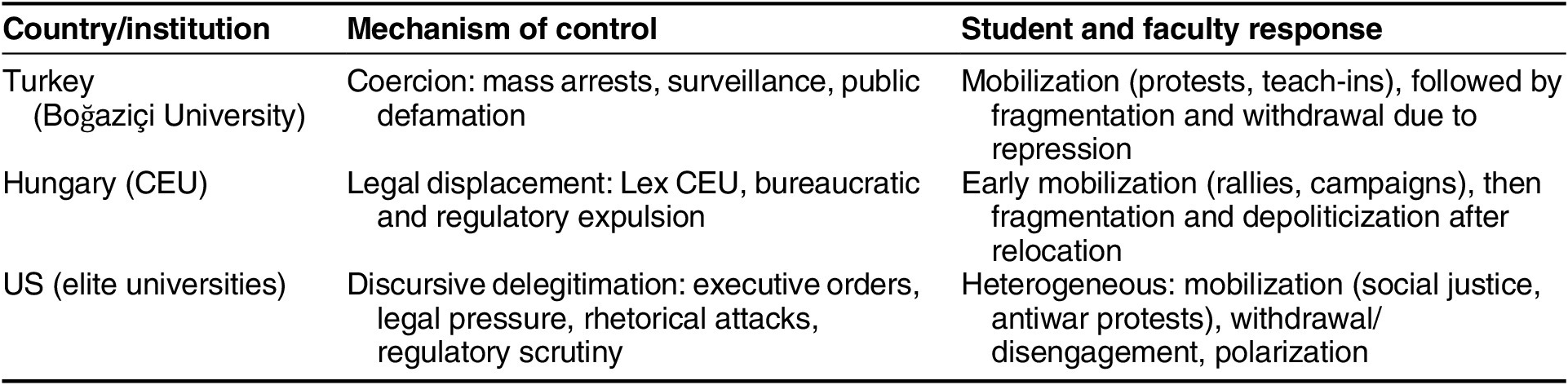
Despite differences in regime type and institutional structure, the cases of Turkey, Hungary, and the US reveal a convergence in the mechanisms through which governments seek to discipline higher education, as well as in the diverse ways students and faculty respond to such interventions. These three cases exhibit three principal mechanisms of control—coercion, legal displacement, and discursive delegitimation—and three patterns of student and faculty response—mobilization, fragmentation, and withdrawal (table 1).
Mechanisms of Government Control and Student and Faculty Responses

Table 1 Long description
The table consists of three columns and three rows of data.
Row 1: Turkey (Boğaziçi University). Mechanism of control: Coercion including mass arrests, surveillance, and public defamation. Student and faculty response: Mobilization through protests and teach-ins, followed by fragmentation and withdrawal due to repression.
Row 2: Hungary (C E U). Mechanism of control: Legal displacement via Lex C E U and bureaucratic or regulatory expulsion. Student and faculty response: Early mobilization through rallies and campaigns, followed by fragmentation and depoliticization after relocation.
Row 3: U S (elite universities). Mechanism of control: Discursive delegitimation through executive orders, legal pressure, rhetorical attacks, and regulatory scrutiny. Student and faculty response: Heterogeneous reactions including mobilization for social justice and antiwar protests, withdrawal or disengagement, and polarization.
As a control mechanism, coercion involves the use of force or intimidation—mass arrests, surveillance, disciplinary proceedings—to silence dissent within universities. Legal displacement relies on legislative and regulatory instruments to curtail or eliminate institutional rights, including expulsion or the imposition of restrictive accreditation conditions. Discursive delegitimation deploys rhetoric and public messaging to erode universities’ credibility, framing them as threats to national values and thereby undermining their public legitimacy and political support. Governments in Turkey, Hungary, and the US have each drawn on distinct mechanisms while producing functionally analogous outcomes. In Turkey, authorities employed overt coercion against Boğaziçi University through mass arrests, surveillance, disciplinary actions, and the imposition of a government-aligned rector. Hungary’s approach centered on legal displacement: through the Lex CEU, the government engineered the university’s effective expulsion from the national higher education system without resorting to direct physical force. In the US, the decentralized structure of higher education has precluded direct intervention of this kind; instead, the federal government has deployed discursive delegitimation alongside targeted regulatory pressure and funding conditionality to frame elite universities as ideological threats to national values and erode their public standing.
Student and faculty responses to government interventions demonstrate a dynamic trajectory across contexts. Mobilization refers to collective action taken by students and faculty, such as organizing protests, demonstrations, or advocacy campaigns. Fragmentation occurs as these movements break into smaller groups, weakening their impact. Withdrawal is when students and faculty disengage from activism due to ongoing pressure or disillusionment. In Turkey, Boğaziçi students and faculty initially mounted sustained resistance, organizing demonstrations and teach-ins to defend academic freedom and institutional autonomy. Similarly, at CEU in Hungary, early mobilization took the form of rallies and public campaigns that forged solidarity and drew international attention. However, sustained repression in Turkey led to activist fatigue and fragmentation among students and faculty, while CEU’s forced relocation to Vienna dismantled the physical spaces that enabled collective resistance, dispersing students and weakening support networks. In the US, responses ranged from protest participation to withdrawal, with some students and faculty members expressing disillusionment or disengagement amid polarization or administrative overreach.
These cases reveal how the form of state intervention shapes both the possibilities and limits of student and faculty activism. Coercion provokes immediate mobilization but can erode unity over time; legal displacement undermines resistance by disrupting institutional continuity and community; discursive delegitimation fosters polarization and mixed responses within relatively autonomous institutions. Across all these three cases, universities often emerge as contested spaces where the struggle over knowledge, identity, and authority plays out not only through formal policy but also through the everyday actions and choices of students and faculty.
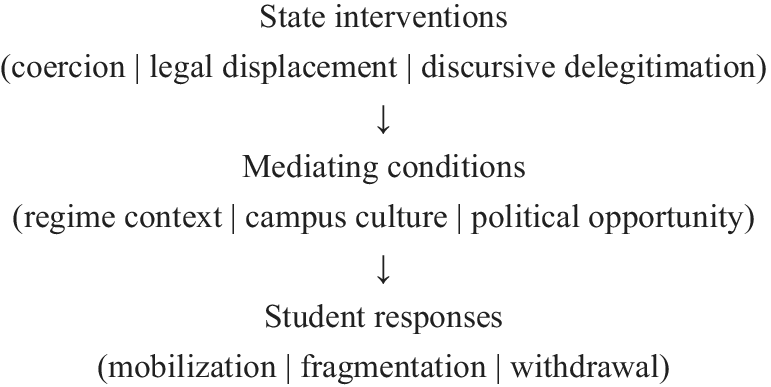
We acknowledge that the three mechanisms of state intervention—coercion, legal displacement, and discursive delegitimation—are ideal types. In practice, governments combine these strategies in varying configurations, and their relative salience shifts across time and political context, as the Turkish case illustrates most clearly. Similarly, the patterns of student and faculty response—mobilization, fragmentation, and withdrawal—are analytically distinct categories rather than sequential stages. Mobilization may persist under repression, fragmentation may coexist with localized resistance, and withdrawal may reflect strategic disengagement rather than political apathy. Regime context, campus culture, and political opportunity structures mediate which responses predominate in any given case, accounting for the variation documented across Turkey, Hungary, and the US (figure 1).
State Interventions, Mediating Conditions, and Student Responses

Despite their differences, Turkey, Hungary, and the US have exhibited strikingly similar patterns in how populist governments have deployed culture war narratives and illiberal policies. In each case, universities were framed as threats to national sovereignty, collective identity, and the moral order envisioned by those in power. Boğaziçi University was depicted by Turkish officials and progovernment media as a Westernized, elitist enclave that rejected national values. CEU was portrayed by Hungarian authorities as a foreign agent of liberal globalism—embedded, in official rhetoric, in George Soros’s philanthropic network—and therefore incompatible with the ethnonationalist project of the Hungarian state. In the US, elite universities were attacked as out-of-touch, anti-American bastions of “wokeness.”
The illiberal leaders are inspired and influenced by one another’s policies targeting higher education. For instance, the policies enacted in the US under the Trump administration drew notable inspiration from Viktor Orbán’s orchestrated campaign against universities in Hungary (Fischer Reference Fischer2025). Orbán’s government set a precedent by deploying alarmist rhetoric to undermine academic autonomy and portray universities as threats to national interests. By framing elite US universities as ideological threats and accusing them of bias and hostility toward “American values,” the Trump administration mirrored Orbán’s playbook of symbolic vilification (Burns and Damiano Reference Burns and Damiano2025).
These developments have profound implications for academic freedom. Professors now face mounting challenges in the classroom amid intensifying government scrutiny of higher education. In this political environment, faculty must navigate discussions with greater caution, aware that their perspectives may attract attention—and sometimes disapproval—from government officials and regulatory bodies. Increasingly, faculty encounter pushback not only from students or the broader public but also through direct governmental efforts to discipline or constrain academic views deemed politically contentious, dissenting, or deviant. This scrutiny fosters an atmosphere of caution and, at times, self-censorship, as both professors and students may hesitate to express dissenting opinions for fear of institutional or governmental reprisal. While civic education in universities has long served to promote political engagement, today the classroom has become a front line for academic freedom itself (Jacoby Reference Jacoby2017; Neundorf, Niemi, and Smets Reference Neundorf, Niemi and Smets2016).
While our analysis focuses on Turkey, Hungary, and the US, parallel developments in other contexts further illustrate the spectrum of state–university relations. The forced relocation of Belarus’s European Humanities University to Vilnius, Lithuania, following the revocation of its license by the Belarusian Ministry of Education in 2004—officially citing campus unsuitability but widely understood as retaliation for its independent curriculum and openness to dissent—offers an earlier instance of legal displacement achieving the functional equivalent of institutional closure (Eurasia Foundation 2012). Similarly, the academic exodus from Russia since 2022—driven by the criminalization of free speech on the Ukraine war, severed international ties, and the persecution of antiwar scholars and students—illustrates how legal and administrative instruments can devastate academic communities without formally closing universities (Matveev and Roshchin Reference Matveev and Roshchin2025).
In democracies, episodes in India and Brazil demonstrate that universities can be subject to politicization and ideological capture even within formally democratic institutional frameworks. Under the Modi government, Jawaharlal Nehru University has faced repeated budget cuts, the arrest of student activists on sedition charges, and pressure on faculty members perceived as critical of state policies (Chowdhury Reference Chowdhury2025). In Brazil, public universities experienced significant funding reductions under President Bolsonaro—with half of the country’s 68 federal institutions sustaining cuts of up to 50%—alongside politically motivated leadership appointments that bypassed established democratic selection processes, sparking nationwide protests (Baiocchi and Silva Reference Baiocchi and Silva2020). These cases highlight the varied pathways through which academic autonomy is contested, whether through overt authoritarian measures or subtler forms of political influence operating within formally democratic settings.
Conclusion: The Political Life of the University
Illiberal tactics and policies against universities have recently intensified not only in electoral autocracies but also in established democracies. In Turkey, Hungary, and the US, governments have employed a variety of strategies ranging from overt coercion to legal displacement and discursive delegitimation to assert greater control over higher education. Universities are not only producers of knowledge and civic engagement but also institutions that, in certain contexts, are capable of shaping national identity and challenging or conforming to dominant power structures. Thus, attempts to control, undermine, or reshape universities are symptomatic of deeper authoritarian and illiberal impulses. The cases of Boğaziçi University, CEU, and elite US institutions illustrate how the control of higher education has become central to culture wars, populism, illiberal politics, and democratic backsliding across a spectrum of regime types.
This article has advanced three interconnected arguments. First, universities with significant symbolic capital and relative autonomy are especially likely to become targets of illiberal governments, because their epistemic authority and deliberative governance norms pose both structural and symbolic challenges to centralized power. Second, the mechanisms of state intervention—coercion, legal displacement, and discursive delegitimation—are functionally distinct but combinable, and their relative salience is shaped by regime type and institutional context. Third, the form of intervention conditions the form of resistance: coercion tends to provoke mobilization that erodes under sustained pressure; legal displacement fragments resistance by dissolving its institutional basis; and discursive delegitimation generates polarized, ambivalent responses within institutions that retain formal autonomy.
It bears emphasizing that the US case remains categorically distinct from Turkey and Hungary: it is included not as a case of autocracy but to illustrate how illiberal pressures on universities can operate through softer mechanisms—discursive delegitimation, selective regulatory pressure, and funding conditionality—even within formally democratic institutional frameworks. Its inclusion thus extends the framework’s analytical reach beyond autocratic contexts while underscoring that the form and intensity of state intervention differ substantially across regime types.
While the tactics and mechanisms of control vary, the underlying motivations and logics converge. In all three cases, political actors have sought to discipline universities that have challenged populist ideologies, produced dissenting publics, or threatened to disrupt government narratives. Crucially, these strategies do not operate in isolation from one another. As the Turkish case shows most clearly, coercion and discursive delegitimation reinforce each other: arrests legitimate the government’s framing of students as threats, while the framing legitimates the arrests. And as the cross-case comparison reveals, illiberal leaders actively learn from and adapt one another’s tactics: the Trump administration’s discursive assault on elite universities drew explicit inspiration from Orbán’s campaign against CEU.
Student and faculty responses across these cases have ranged from mass mobilization to fragmentation and withdrawal, shaped by the intensity of repression, the degree of institutional autonomy, and the availability of discursive and physical space for protest. Coercion provokes immediate mobilization but erodes unity over time as the personal costs of dissent accumulate; legal displacement dissolves the institutional infrastructure that makes collective action possible, producing fragmentation without a single arrest; discursive delegitimation generates polarized responses, producing ambivalence and self-censorship alongside continued activism. Yet even where protests diminished or failed to reverse state action, they revealed the capacity of universities, under certain conditions, to foster political agency. In each case, the university became a site of contestation—not just over curriculum or governance, but also over the meaning of democracy, citizenship, and public reason.
Several limitations of the present analysis warrant acknowledgment. The framework is most applicable to high-profile universities with significant symbolic capital, relative autonomy, and international visibility; it is less suited to peripheral institutions with high state dependence, where the dynamics of capture and resistance differ substantially. The three cases, while analytically productive, are not fully representative of the range of state–university conflicts globally, and the framework’s generalizability should be tested against additional cases—including those in which universities have been more successfully co-opted, and those in which institutional resistance has more durably succeeded. Future research might also examine how the transnational diffusion of illiberal tactics shapes the conditions of possibility for university resistance, and whether the international networks of scholars, institutions, and advocacy organizations that have supported Boğaziçi faculty, CEU students, and targeted American academics constitute an emergent countermovement with its own political logic.
What emerges from this comparative analysis is a deeper understanding of the university as a political institution that, in certain contexts, is capable of shaping political subjectivities, contesting hegemonic narratives, and modeling alternative forms of authority. The fate of universities in politically volatile contexts is not simply a matter of academic freedom or institutional survival; it is a window into broader transformations in state–society relations, democratic backsliding, and the contested politics of knowledge production. Recognizing this role carries both risks and responsibilities. For scholars, it demands awareness that the spaces in which they teach, research, and mentor are increasingly entangled with ideological battles beyond the classroom. For university leaders, it necessitates strategic reflection on how to defend institutional autonomy while avoiding both the comfort of technocratic neutrality and the peril of direct confrontation with the state. And for students, it raises pressing questions about political engagement, the meaning of education, and generational responsibility in an era when the university itself has become a political stake. Indeed, the April 2026 Hungarian parliamentary election, in which Péter Magyar’s Tisza Party won a two-thirds supermajority and ended Viktor Orbán’s 16-year rule, raises precisely these questions in real time. Whether the new government will reverse the legal and institutional changes that drove CEU from Budapest—and whether CEU, now firmly established in Vienna, could or would return—remains an open question that will test the reversibility of illiberal policies targeting higher education and the durability of their institutional consequences.
Ultimately, the political life of universities is inseparable from the political life of the societies in which they are embedded. As authoritarian and populist pressures intensify—and as illiberal governments increasingly coordinate their strategies across borders—the fate of the university becomes a bellwether for the health of democratic institutions more broadly. To defend the university in these contexts is not only to safeguard academic freedom but also to protect the very possibility of dissent, deliberation, and a future not yet foreclosed.

 Open access

