

Law has to be rendered visible. . .
Goodrich, ‘Screening Law’ (2009)
1. The experiment and its world
Between 1935 and 1937, the International Missionary Council conducted the Bantu Educational Kinema Experiment (the Bantu Experiment). It received financial support from the Carnegie Corporation and the Colonial Development Fund and was carried out in co-ordination with the British Colonial Office and the colonial governments of the British protectorates and mandates in Tanganyika (today Tanzania), Kenya, Uganda, Northern Rhodesia and Nyasaland (today Zambia and Malawi). Headed by John Merle Davis, an American Congregationalist missionary, author of an influential report on the effects of mining on Central African societies, Modern Industry and the African (1933), and director of the International Missionary Council's Department of Social and Industrial Research, the Bantu Experiment’s objective was the production of silent educational films to be screened to ‘native’ people in mobile cinemas with commentary in local languages, either with the help of pre-recorded disks or local translators.
The films aimed to familiarize colonial subjects with modern techniques of agricultural production and public administration, public health issues, the nuances of modern sociality and emotions, the value of savings and economic proficiency, and the glory of the British Empire, all through unchallenging, familiar faces and locations.Footnote 1 To this end, they used local actors and settings, and their pedagogical content was selected and delivered according to the presumed needs and cognitive capacity of ‘natives’. Their intentionally formulaic plots endeavoured to capture ‘the native point of view’ by resorting to what I identify here as an ‘ethnographic sensitivity’ towards local cultures and concerns.Footnote 2 As the project's motto – included on its official letterhead – made clear, the aim was to produce ‘Films of Africans, Made in Africa, for Africans’.Footnote 3
In embracing this ethnographic sensitivity, resulting from a recently developed attention to ‘native culture’ within anthropological and colonial administrative circles, the project saw its films as articulating and advancing the ethos of the international order inaugurated after the First World War.Footnote 4 This post-colonial order in gestation aimed to shape, through culturally attuned norms and institutions, the daily life of peripheral peoples in terms of emerging ideas of economic self-sufficiency and political self-rule. These ideas were clearly evidenced in the League of Nations’ Mandates System and in more general discussions about the need to move away from old forms of imperialism during a time of great global reconfiguration. As Antony Anghie has argued, the objective during this time became not ‘merely’ to qualify the rights of subjects, but to actually create sovereign entities, both individual and collective.Footnote 5 Importantly, this was an order that had to work now, as much as possible, from within. As Davis put it in his funding request to the Carnegie Corporation, ‘[s]ince the actors would be native, the speech native, the setting and motifs native, the lessons they are to derive from the films would come naturally and not from without as something imposed by the foreigner’.Footnote 6 Thirty-five films were produced during the two years of the Bantu Experiment, of which only three survive.
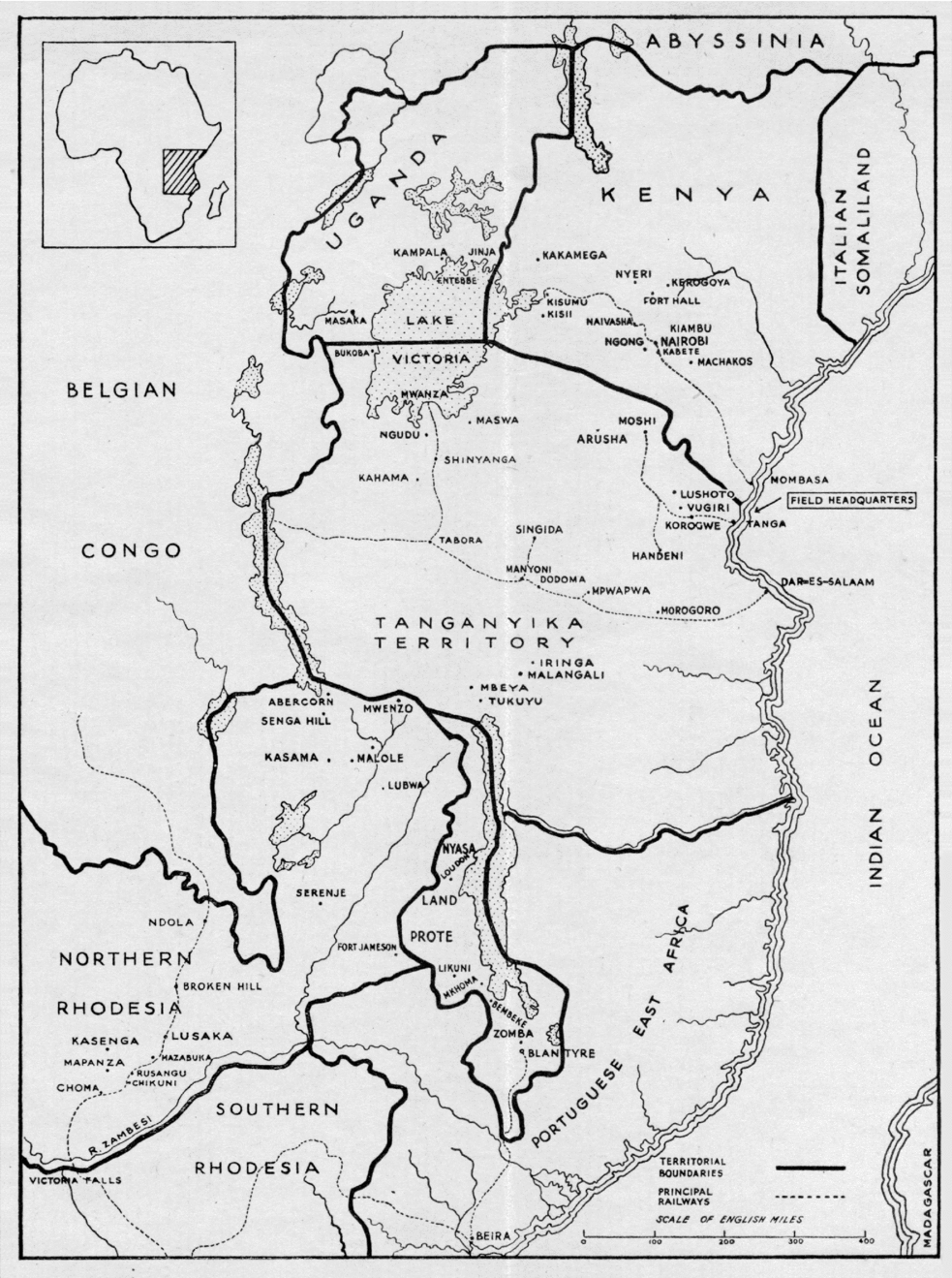
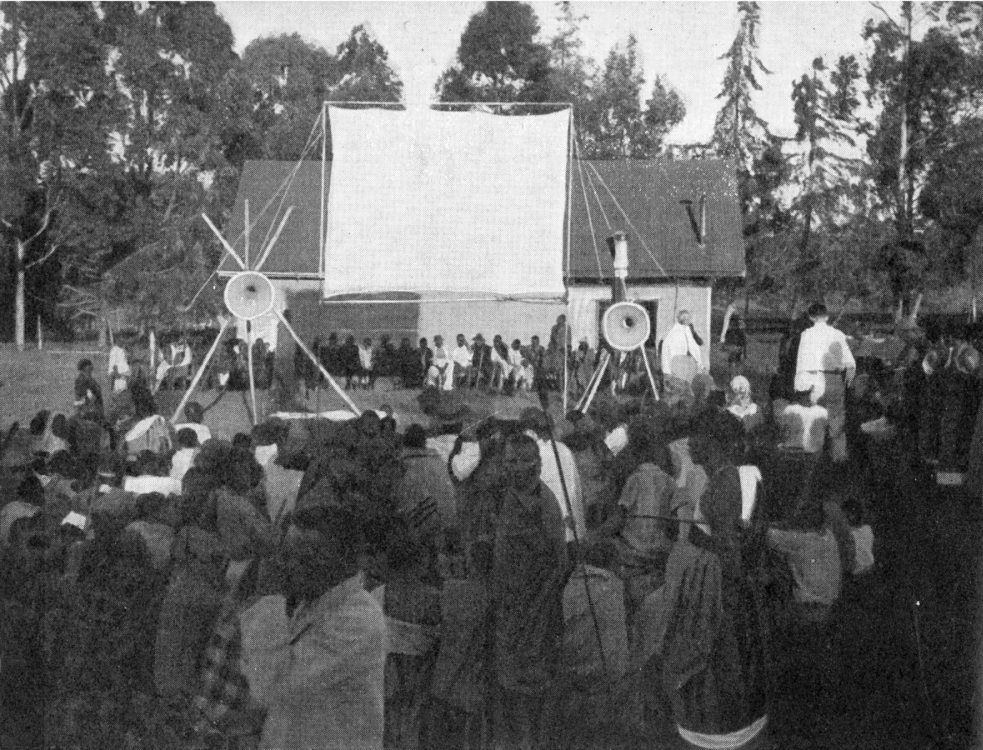
Although it failed to raise new funds for its continuation after 1937 and was criticized for not using local (human or financial) resources to their fullest potential, the experiment was extremely successful in many other respects. Apart from mobilizing a large number of key stakeholders, governmental entities at various levels, and funding sources dispersed across the globe for its film production, it screened these films to thousands of local viewers spread out over thousands of kilometres (see Figures 1 and 2). The experiment also left a detailed archival legacy of its practices and techniques, and a trail of positive evaluations showing how its films had been perceived by ‘different classes of natives – the educated, the semi-detribalized and the raw villagers’.Footnote 7 The result was to consolidate an intense interest, among colonial authorities throughout Africa, in cinema's ‘enormous possibilities for education and healthy entertainment’.Footnote 8 This interest soon generated an abundance of publicly funded films intended to train a new type of colonial subject and to counter what was believed to be the ‘often distorted presentation of the life of the white races’ in the American and European commercial films already circulating in Africa.Footnote 9 The Bantu Experiment thus inaugurated the official use of cinema as an ‘instrument of modernization’ in late colonial administration, an effort which had started in the 1920s but was only formalized and expanded by the British Colonial Film Unit between 1939 and 1955. The eventual end of the Colonial Film Unit, and of formal colonial cinematography more broadly, came to signal the moment when old imperialism was finally superseded by the decolonization movement, which broke away from yet closely followed the vision and forces underpinning the Bantu Experiment.Footnote 10 As Davis wrote when he first approached the Colonial Office about the Bantu Experiment, ‘. . . in addition to the service which this project would render Bantu Africa, the results of [it will] have a bearing on the problems of the development of backward people in many other parts of the world’.Footnote 11
Places at which films were made and displayed. Source. Notcutt and Latham, The African and the Cinema (1937), Appendices. Pull-out map.
Show at Ngong, near Nairobi. Source. Notcutt and Latham, The African and the Cinema (1937).
In this article, I approach the Bantu Experiment, therefore, as a telling instance through which to examine – and to see and experience – the mobility and scattered nature of late imperial locations. I suggest that this mobility and geographical multiplicity invites us to think beyond static and bounded understandings of the spatial and human dimensions of late imperialism and its past and present history. The dynamic, disaggregated mode of imperialism embodied and transmitted through the Bantu Experiment exemplifies the system of modern international administration that emerged during the interwar period. No longer predicated on formal top-down mechanisms of control over neatly defined territories and peoples, this system used versatile and decentralized forms of rule that were to be internalized by subjects who, along with their territories, were now immersed within an ‘international’ order. The premises and operation of this system continue to characterize the workings of today's global order, indicating the key role that ‘indirect rule’ continues to play in its functioning.
As I have mentioned, the Bantu Experiment was conducted at the very moment at which European empires were refiguring their operations in the aftermath of the First World War. In this context, the idea of using local variables to infuse practices of self-rule in peripheral subjects – later transformed into the exercise of self-determination – emerged on the normative and political horizon. As we shall see, the Bantu Experiment encapsulated with this the principle of indirect rule and the oblique, more dispersed and individually-based forms of international administration this idea came to support. Indirect rule – the idea of administering colonial territories and subjects through their own authority and volition, from within as it were – was powerfully advocated by, among many other influential colonial figures, Sir Frederick Lugard (1858–1945). Born in Madras and raised in Worcester, Lugard was a soldier, mercenary and explorer in Africa before serving as military administrator of Uganda (1890–1892), high commissioner of the Protectorate of Northern Nigeria (1900–1906), governor of Hong Kong (1907–1912), governor general of Nigeria (1912–1919), British representative to the League of Nations Permanent Mandates Commission (1922–1936), founder and long-term chairman of the International Institute of African Languages and Cultures (today the International African Institute) (1926–1945)Footnote 12 and chairman of the Bantu Experiment. In all these posts, in particular in Nigeria and then at the League, at the International Institute of African Languages and Cultures and in the context of the Bantu Experiment, Lugard was able to advance and render into pedagogical form his view on how to update colonial relations, via indirect rule, in the modern world.
In light of all this, as the following pages suggest, the Bantu Experiment and its films should be seen as part of the theatrum juridicum – a rendition of the law, as Peter Goodrich would put it – that marked late imperial practices and the system of modern international administration that resulted from them.Footnote 13 Indirect rule emerges from this reading as a resilient but often unrecognized feature of international law – a ‘silent principle’ of our non-imperial yet perhaps never fully post-colonial international order.
Using the Bantu Experiment as a lens, in the sections that follow I explore three interrelated and enduring features of the international order that emerged during the first half of the twentieth century. First, I discuss what the experiment reveals about the diversity of interests, actors, jurisdictions and levels of government that the idea of indirect rule brought together for the purpose of operationalizing a ‘modern’ international administration in the inter-war period. As we shall see, through the Bantu Experiment it is possible to grasp the hugely important role that indirect rule came to play at this time, in particular in synchronizing a vast and fast-changing imperial assemblage for the instruction of ‘native’ communities and individuals in the conditions of self-rule. During the interwar years the question of imperial rule became, as Sir Edward Twining, governor of Tanganyika from 1949 to 1958, eventually came to put it, ‘when [to] pass out from the phase of control into the phase of influence’.Footnote 14
The next section describes how the Bantu Experiment throws into sharp relief the rationale, as well as the tensions, involved in the construction of colonial peoples as self-ruled subjects. At this level, the experiment demonstrates how the very idea of self-rule came to be born into a landscape mined with profound asymmetries of political, economic and cultural power. Using one of the experiment's three surviving films as an example, I discuss how indirect rule made this already jagged situation an even more treacherous condition from which to try to escape.
Finally, I examine how the Bantu Experiment can help us conceptualize not only the inherent mobility and multiplicity of late imperial locations but also the larger relation between international law and imperialism that still exists today. The mobility and multiplicity of locations promoted through the Bantu Experiment were compounded by the production and circulation of films during the late 1930s and 1940s, and especially during the transition to decolonization through the work, for example, of the Colonial Film Unit. As with the Bantu Experiment, these later films enable a sort of reversed ethnography, or what we might call a critical ethnography. They offer us a gaze that we can direct at the official ‘ethnographic sensitivity’ which the makers of these films understood them to be embracing. As I will show, this late colonial cinematography, and the use of radio and then television during the following postcolonial period, reveals less about the (post-)colonial subjects who were their direct object of attention than about the metropolitan ideas and geopolitical and economic interests and institutions that came to create today's expansive, indirectly ruled international order. If we pay attention to such mediums, and those that have come later, it is possible to appreciate how today's modern subjects, belonging now to ‘self-ruled’, ‘self-determined’ and ‘sovereign’ nation-states, remain the moving, always somehow entrapped, locations of empire.
2. The empire of indirect rule
One of the most salient features of the Bantu Experiment was the large number of actors, institutions and governmental entities brought together for its design and execution. Religious and philanthropic organizations, private agents, local communities, ‘native chiefs’, the Colonial Office, the British Film Institute, the colonial governments where the experiment was conducted and the League of Nations’ Permanent Mandates Commission (especially in the case of Tanganyika, a British mandate from 1922 to 1946) all played important roles in the project. In a letter of 5 November 1935 to the UK's Colonial Office on Downing Street, Davis reported with great enthusiasm from the field on this plurality of actors and their active collective efforts towards the implementation of the experiment's first stage:
Letters received from Major [Leslie] Notcutt and Mr [Geoffrey] Latham [respectively the project's field director and educational director] indicate that the Bantu Kinema Experiment has made an excellent start . . . By the end of August the first experimental programme was completed and on September 5th [the educational director] and four native assistants, set out with lorry and trailer on a 3,000 mile display tour through Tanganyika, N. Rhodesia and Kenya. Mr Latham reports that widely differing types of native audiences received the pictures with enthusiasm. The attention of the primitive, as well as the sophisticated, natives is instantly caught and held by films portraying black men and women in the familiar medium of African life. On the Copper Belt audiences numbering as high as 1,900 natives gave the closest attention to the pictures and followed every detail with interest . . . [I]nvaluable assistance has been given by Government officials, missionaries, planters and native Chiefs, in the planning and setting-up of sets for filming, in working out details of scenarios and in lending natives for acting.Footnote 15
The multiplicity of sites of interest and people involved in the Bantu Experiment speaks to the growing complexity of colonial relations after the First World War. The reasons for this more complex system included the League of Nations’ call for self-rule and its institutionalization of colonial administration through the Mandates System, the emergence of colonial peoples as active political and economic subjects both in colonial discourse and in effective terms (for example, as workers and tax payers), the European ‘civilizing mission’ being updated by the US with its growing geopolitical interests, a more general ‘internationalization’ of global relations, and a widespread preoccupation with the financial cost of imperial administration.Footnote 16 In response to these changes and concerns, lay colonial subjects and ‘chiefs’, together with missionaries, technicians, funding bodies and colonial officers, became part and parcel of one large imperial assemblage.
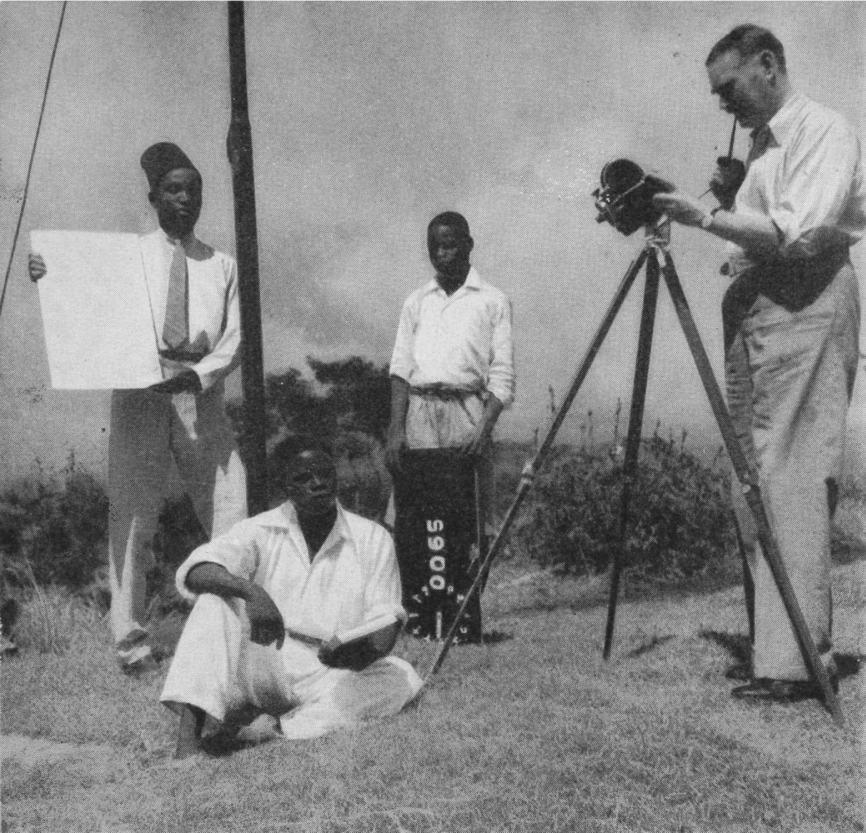
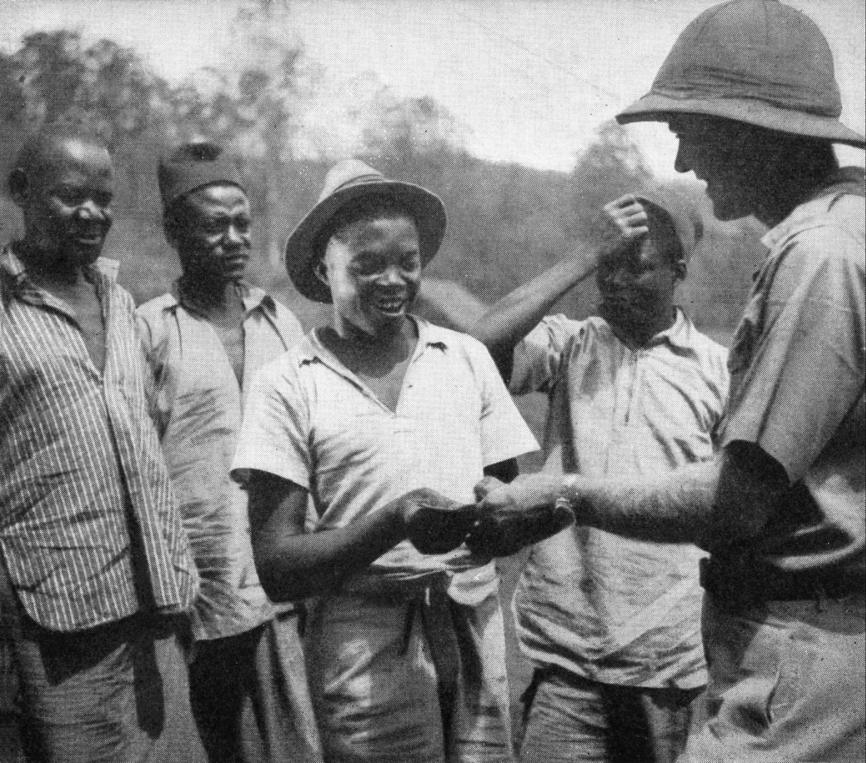
Regardless of the number, jurisdictional hierarchy and diverse range of interests of the actors involved in the Bantu Experiment, however, the aim of instructing Africans in modern standards of civility and productivity was what brought them all together. In particular, their efforts were synchronized by centring their attention on the African ‘native’: a subject understood as being in need of a specific kind of instruction, locally furnished yet European in outlook (see Figures 3 and 4). Crucially, this instruction was conceived not only as a scientific and pedagogical task but as a universal and legitimate duty towards peripheral populations. For Davis this was clear:
The frankly experimental nature of the project, with its endeavor to adapt scientific technique and educational content to peculiar tastes, values and patterns of life seems to possess a universal value wherever illiterate peoples are faced with the complicated task of understanding and participating in the life of the modern world.Footnote 17
Checking exposure before shooting a close-up. Source. Notcutt and Latham, The African and the Cinema (1937).
The prize winner from using modern agricultural practices. Scene from Improved Agriculture. Source. Notcutt and Latham, The African and the Cinema (1937).
The directors of the Bantu Experiment, Notcutt and Latham, shared this reading of the African subject. For Notcutt (who had begun experimenting with educational films as a plantation manager in East Africa in the mid-1920s) and Latham (a former director of native education in Northern Rhodesia), the need to instruct Africans about Western developments through African customs and variables, and in their own languages and their own communities was obvious. For both men, the mobile cinema offered an ideal way to maintain ‘native’ institutions and norms which, like many other colonial officials, missionaries and intellectuals at the time, they saw as indicators of a kind of ‘raw’ civility or ‘consciousness’ and, in this sense, as useful containers to be refilled, surrounded and guided by European principles.Footnote 18
As Glenn Reynolds has noted in his detailed study of colonial cinema, there was a shift in thinking among colonial authorities in the interwar period. They began to react against the old demonization of tribal ways, embracing instead modern science, particularly an anthropological sensitivity, in the education of ‘natives’.Footnote 19 ‘The 1920s and 1930s’, as Frederick Cooper has stressed, ‘were the golden age of ethnography’.Footnote 20 This was the spirit behind the desire of Notcutt and Latham, like that of Davis, the British Colonial Office and other colonial governments involved in the Bantu Experiment, to offer ‘natives’ a constructive cinematic experience through familiar modes and themes. Their aim was to inculcate ‘modern’ attitudes while counteracting what they saw as the contamination of otherwise good and productive African minds by migration to urban areas (in particular mining towns) and the rapid arrival of commercial films all over the continent.Footnote 21 In the words of Notcutt and Latham:
If . . . governments would take control before it is too late and see that cinema is used constructively for the benefit of the African, then there is no limit to the influence for good which this great force could wield . . . [R]eflection will convince any unprejudiced person that, with backward peoples unable to distinguish between truth and falsehood, it is surely our wisdom, if not our obvious duty, to prevent, so far as is possible, the dissemination of wrong ideas . . . We can prevent the destructive use of the cinema and we can use it constructively in a hundred ways.Footnote 22
This understanding of the nature of colonial subjects and the role of cinema in the modernization process reflected new ideas about the proper conduct of colonial administration. Of particular importance was the incorporation of the idea of indirect rule into legal and institutional practices at the international level: the principle of governing and educating colonial subjects through their own authorities and laws and according to their own will and ‘stage of development’ – as Article 22 of the Covenant of the League of Nations described it.Footnote 23 For example, the International Institute of Educational Cinematography (IIEC) – a League of Nations body that operated in Benito Mussolini's Rome between 1928 to 1937 – shared Notcutt and Latham's view that cinema had a key instructive function to play, especially in the ‘intellectual and spiritual elevation’ of ‘backward races’.Footnote 24 Films could achieve this, according to the IIEC, by embracing and mobilizing the nuances of local cultures for the service of colonial instruction.Footnote 25 Julien Luhaire, director of the League's Institute of Intellectual Cooperation – which oversaw its educational and cultural matters – had expressed a similar faith in the value of cinema for the advancement of a new international order in 1924. According to Luhaire: ‘This new and extraordinarily efficient instrument of intellectual action is intrinsically international’.Footnote 26
By the time the Bantu Experiment began, the idea of indirect rule was already rooted in the lexicon and practice of international administration. It had been a component of British imperial administration since at least the final quarter of the nineteenth century. By the mid-1930s it had been adopted by France, Belgium, Portugal, Italy and Japan, each in their own distinctive way, in response to the challenges of administering colonial territories and to a changing set of ideas about the nature of colonial rule and native development, as outlined above.Footnote 27 Although still contested by adherence of more traditional versions of imperial rule (as advanced, for example, by many white settlers) this turn to less ‘direct’, more pedagogical and more oblique forms of administration came to be crystallized in the Mandates System and in the broader ‘Wilsonian’ spirit that the League of Nations came to symbolize.Footnote 28 The new prominence of the US in international affairs after the post-First World War geopolitical reshuffle only reinforced this trend.
The Mandates System set up ‘native’ self-rule as the ultimate objective of imperial presence, and indirect rule was an ideal framework for colonial administrators to materialize this objective. The aim was to make it possible for colonial peoples, again following Article 22 of the Covenant, ‘to stand by themselves under the strenuous conditions of the modern world’.Footnote 29 While in principle established for mandates overseen by the League, this objective came to reflect an increasing sense of what the road ahead should be for other colonial territories in Africa, Asia and the Pacific. Behind this insistence on self-rule lay not only the League's Wilsonian spirit but also, and perhaps more importantly, the concept's enthusiastic reception by local political figures across the colonial world.Footnote 30 Crucially, this turn was not monopolized by the US and its vision for the world; self-rule, and soon self-determination, was also espoused by other central powers, especially Bolshevik Russia, although not necessarily with the same political intentions.Footnote 31
It was in this context that indirect rule became a key referent of colonial intellectual and practical discussion during the first half of the twentieth century, both implicitly and explicitly.Footnote 32 Lugard, who systematized and promoted indirect rule in British territories and at the international level through his position at the League's Permanent Mandates Commission, offered his most thorough account of the principle in his book The Dual Mandate in British Tropical Africa (1922).Footnote 33 As a celebrated colonial administrator and diplomat, Lugard gained first-hand knowledge of both the daily running of the British Empire and the internal mechanics of the Mandates System, on which he came to exercise a great influence.Footnote 34 His book – more than 600 pages ranging from his reflections on Britain's acquisition of colonial territories, to anthropological annotations on the nature of colonial subjects, to views on economic development, taxation, labour, trade and land tenure in the colonies – is one of the most complete exposés of the institutional dynamics of late colonial and modern international administration.
In The Dual Mandate, Lugard draws out what he, like many others, saw as the reciprocally beneficial nature of colonial administration. This double benefit – this ‘dual mandate’ – understood Europeans to be bringing civilization and modernity to the colonies (their ‘mandate’ towards the colonized world), and as being for this reason morally entitled to extract the raw materials needed to expand their own metropolitan industries and open colonial markets to the rest of the world (the second part of the mandate, ‘owed’ to their own metropolitan citizens). In Lugard's account, this was a legitimate transaction based on Europeans’ historical duty to ‘civilize’, develop and train the colonial world for self-administration while ensuring the efficient running of homeland economies and the welfare of their populations. This arrangement, he writes, was supported by the international legal framework set up by the Berlin Conference (1885), the Brussels Conference (1890) and, most thoroughly, the League of Nations.Footnote 35
For Lugard, indirect rule – through local chiefs, laws, decentralized administration, co-operative relations with natives, and models of education, taxation and labour relations geared towards generating self-disciplined individuals and self-governing territories – was the most appropriate and efficient way to administer colonies and ‘natives’ within the framework of this dual mandate. In his words, the British commitment to the liberty and development of native populations and of British subjects could be best secured by ‘leaving [natives] free to manage their own affairs through their own rulers, proportionately to their degree of advancement, under the guidance of the British staff, and subject to the laws and policy of administration’.Footnote 36
Lugard saw indirect rule, as a result, as the most suitable vehicle for solving contemporary questions about the practical impossibility of ensuring an even imperial presence across the vast colonies, managing the growing costs associated with running the Empire, and overseeing the proper welfare of ‘natives’. In The Dual Mandate he argued, for example, that his proposals were able to address recent concerns raised by the Labour Party that:
“the white man's burden” was already growing too heavy for [Britain] to bear, that the British taxpayer was being called on to support the ambitions of chauvinists, and that the native races were misgoverned and robbed of their lands and their proper profits by the greed of exploiters.Footnote 37
Lugard felt instead that the Empire had been ‘the greatest engine of democracy the world has ever known’Footnote 38 and British control of the tropics, rather than ‘a charge on the British taxpayer’, had been ‘a source of very great gain’. Footnote 39
Against this background, indirect rule emerged as a new form of ‘colonial governmentality’, as Mahamood Mamdani has put it.Footnote 40 As a new logic of government, its associated ideas and institutions reinterpreted the history of colonial peoples in a way that sought to make them agents, no longer just objects, of the colonial project. Difference between colonizers and colonized was thus no longer something to be overcome but to understand and manage. For this reason the advent of indirect rule widened rather than narrowed, somewhat counter-intuitively, the scope and degree of colonial intervention. The aim now was to ‘shape the subjectivities of the colonized populations and not simply of their elites’.Footnote 41
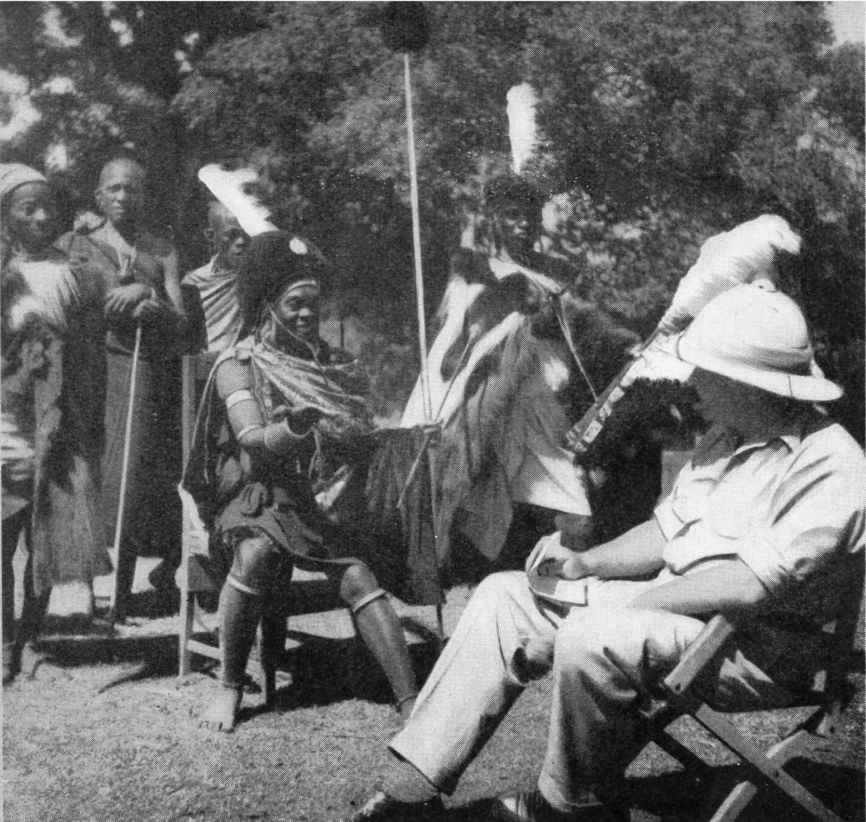
In the context of official colonial and international discourse, then, self-rule – or ideas of self-determination and sovereignty – did not erupt as a radical call for ‘self-definition’.Footnote 42 On the contrary, its objectives were confined within a particular and already existing ‘order of things’.Footnote 43 The practices of indirect rule can be understood, from this point of view, as testament to the re-articulation and transformation of old imperial formations and modes of extraction, at the start of the twentieth century, into a plethora of oblique administrative practices that used ‘native’ lands, bodies and political structures as units through which to channel the circulation of foreign forms of authority and the expansion of global economic relations. The Bantu Experiment, as a didactic articulation of indirect rule, expressed this significant turn in colonial administration, which started to use native ‘culture’ as a new open-ended space of intervention (see Figure 5).Footnote 44
Kikuyu chief consulting an agricultural officer. Scene from the film Marketing Export Native Maize. Source. Notcutt and Latham, The African and the Cinema (1937).
The Bantu Experiment put into practice, in this sense, what Bronislaw Malinowski, one of anthropology's founding fathers, and others at the influential International Institute of African Languages and Cultures (as mentioned above, also founded and directed by Lugard), understood as a ‘practical anthropology’: a ‘scientific’ approach to the ‘facts’ of native life aimed at advancing colonial interests.Footnote 45 For Malinowski, as for Lugard, David, Notcutt and Latham, ‘a scientific study of facts . . . would reveal clearly that “direct rule” means in the last issue forced labour, ruthless taxation, a fixed routine in political matters, the application of a code of laws to an entirely incompatible background’,Footnote 46 in other words, ‘the making of the African into a caricature of the European’.Footnote 47 With this in mind, only indirect rule and culturally attuned exercises of colonial administration could succeed. The Bantu Experiment was inspired then by the Malinowskian and Lugardian idea that ‘it is infinitely preferable to achieve [social development] by a slow and gradual change coming from within’.Footnote 48 This reflected, in turn, the larger principle that ‘the government of any race consists . . . in implanting in them ideas of right, of law and order, and making them obey such ideas’ – an exercise that required controlled calibration and ethnographic knowledge and patience to achieve change in the inner-self of colonized individuals.Footnote 49 For the directors of the Bantu Experiment, as well as for the cinematographic community around it, the movies it produced were inspired by this rationale: one that sought to train colonial audiences in self-rule rather than relinquishing rule altogether. For Latham indirect rule permitted a ‘balance . . . between the competing enthusiasms for western culture and for African customs and traditions’, the final aim being ‘to absorb all that is best in western culture into a culture evolved from all that is best in the mental and spiritual make-up of the African’.Footnote 50 The British Film Institute's famous magazine, Sight and Sound, endorsed this approach in its review of the Bantu Experiment:
The first task is to help the African community to an intelligent adjustment to modern life . . . This will be done by using African actors, scenes and backgrounds, and by relating the new regime to the old in an intelligible sequence.Footnote 51
In hindsight, of course, the subjects resulting from this exercise were far from being factual holders of self-rule. They, and the many others targeted by similar practices of indirect rule at the time, became carriers instead of a post-imperial promise enacted within the confines of a system crisscrossed by increasingly oblique forms of control and profound asymmetries of power. The countless disaggregated subjects that resulted from this exercise were the new moving locations of empire.
3. The agonies of indirect rule
African Peasant Farms, the eighteenth film of the Bantu Experiment, provides a good chance to observe in motion the workings and tensions of indirect rule.Footnote 52 Made in 1936, African Peasant Farms (or Peasant Holdings, as it is referred to in the project documents) narrates the story of a nameless African man exploring a farming scheme undertaken by the government of Tanganyika in Kingolwira, a settlement near the city of Morogoro, in the southern highlands of today's Tanzania. The Kingolwira scheme, set up in 1933 with financial aid from Britain's Empire Cotton Growing Corporation and conducted under the supervision of the Tanganyikan Agricultural Department, aimed at clearing out the tsetse fly (the carrier of sleeping sickness) by assigning 14-acre plots of land to locals who had to follow, in return, close instruction from colonial officers on what types of crop to cultivate and their distribution.Footnote 53
Kingolwira, like similar experiments set up at the time in Tanganyika (for example, in Uzinza and Ukiriguru), was part of the emergence of ‘cooperatives’ in the changing terrain of colonial administration as indirect rule arrived.Footnote 54 According to Lugard, ‘[t]he fundamental principle of the (cooperative) system [was] identical with that of Indirect Rule – which could be better named “Cooperative Rule” – the essential aim of both being to teach personal responsibility and initiative’.Footnote 55
The Kingolwira scheme requested that holders plant an acre of cassava around each hut, as a famine crop, and four acres of pasture when the area was tsetse-free. The rest of the land (nine acres) was to be used for cotton production on a mixed-farming basis. The aim of this system of land distribution and use was to ensure that the soil remained productive, reduce expenditure on labour and manuring, and make cotton an increasingly ‘homogeneous part’ of local agriculture, which was the final aim of the Empire Cotton Growing Corporation.Footnote 56
Colonial subjects’ internalization of imperial public health concerns, the promotion of modern techniques of mixed farming and the mainstreaming of cash crops beneficial for the Empire's economy were thus all issues woven into the Kingolwira scheme and, in turn, into African Peasant Farms. In focusing on the instruction of ‘natives’, the scheme and the film brought together the agendas of several different actors. Following the overarching strategy of the Bantu Experiment, African Peasant Farms advanced the interests not simply of the government of Tanganyika and the pedagogical agenda of the International Missionary Council, but also of the League of Nations, at that time paying great attention to sleeping sickness in East Africa.Footnote 57 The film also advanced the interests of the Empire Growing Cotton Corporation. Established in 1921 and empowered through the British Cotton Industry Act of July 1923 to collect a levy on all cotton purchased by spinners in Britain in order to develop fields across the empire, the Corporation had been ‘clearing and laying out the land’ for experiment stations in Tanganyika and investing in the production and commercialization of African cotton.Footnote 58 These actions were part of the Corporation's ambitious plans for Britain to control the global production and trade of cotton, in particular by increasing the internal supply of raw materials. The US Senate was made aware of this plan as early as 1925, when it was reported that:
the British spinning industry, which is an important part of the economy itself of the nation, is dependent for a large proportion of its raw materials upon a foreign nation, while large areas within the Empire are suitable for growing cotton, and the particular types of cotton which would do much to relieve its dependence upon the American crop . . . For at least 20 years [therefore] the English have been making an organized effort to lessen their dependence upon [us].Footnote 59
All these agendas, as well as the ethos of indirect rule, underpin the content and cinematic effect of African Peasant Farms. The 9-minute film opens with the statement that in the Kingolwira scheme ‘agriculture is adapted to native tradition, but improved methods are introduced by stages’. Following this, in the first scene, the main ‘native’ actor encounters a signpost indicating the way to Kingolwira, which he follows, walking with an efficient modern pace and dressed in standard civil colonial clothes of matching khaki shorts and tucked-in shirt. On his way, however, he is stopped at a fly-post where a native official inspects him, eventually finding a tsetse fly on his back and readily catching it with a handheld net. After this episode, the protagonist arrives at Kingolwira, where he meets a white European officer, evidently in charge of the scheme, who invites him to take a look around. The film then takes the viewer step by step through the stages then being used in Kingolwira to introduce locals to cotton production and mixed farming. First, the protagonist visits a new settler who shows him his recently made hut. The settler informs him that he received free materials to build his hut and that setting up a latrine was compulsory. Then the protagonist, taken to see another settler who has started farming, is informed that free food is issued until the first crops are harvested and that land is cleared communally, with beer as a reward. Visiting this settler, the protagonist notices that his house is different – apparently because he is from a different tribe. The settler also takes the time to demonstrate, by drawing on the ground, how land should be distributed and the logistics of crop rotation as taught by the scheme's officers (see Figure 6). After this, the protagonist checks a plot of land that has been already cleared of tsetse flies and that is in the process of cultivation and production, taking a special interest in how the soil is being tilled by oxen. He then witnesses brick-making, the construction of cattle sheds, efficient transport and use of manure, and a communal dispensary. After completing his visit and appearing convinced of the project's value, the main character is seen back at the entrance of Kingolwira applying to the European officer for a farm of his own. The final scene shows the satisfied officer taking a notebook out of his pocket and noting down the man's request.
Map drawn on the ground illustrating the layout of farm holdings and rotation of crops. Used in three films. Source. Notcutt and Latham, The African and the Cinema (1937).

As this description illustrates, African Peasant Farms wholeheartedly embraced the idea of indirect rule with its attempt to train colonial subjects from within: producing their internal realization, with the help of a didactic tone and pace, of the benefits of modernity. Articulating this through local imagery and referents, the film underscored the idea of re-centring the colonial project on ‘natives’ themselves, with the aim of transforming them into able modern subjects. The paramount role played by education in this task had been explained by Lugard few years earlier:
In Africa the object in view is to enable the African to ‘find himself’ – to emerge from the habit of mind which has through centuries marked him out as the slave of other races; to show him the higher rungs of the ladder which lead from mere obedience to co-operation, from servile imitation to individual initiative and a sense of personal responsibility – in short, ‘a new way of life,’ higher standards of duty and of efficiency. This . . . is no new creed . . . What may perhaps be claimed as new is the effort to translate the creed into terms of practical action.Footnote 60
The idea that ‘natives’ should be taught the details of Western sociality and economy in a locally attuned and incremental manner was, of course, an expression of specific assumptions about the cultural specificity and cognitive capacity of African individuals. In Kingolwira individuals were brought together, for example, in a productive ‘community’ because they were considered essentially ‘communalistic’ and thus wishing to live in such a way.Footnote 61 Benchmarked against Europeans, local populations were also judged to be cognitively immature and culturally unfit, a reading that corresponded with the still-prevalent discourse of European civilizational superiority and African racial inferiority.Footnote 62 This was a theme that had also occupied Lugard for many years and that he had tackled in his infamous essay ‘The Colour Problem’.Footnote 63 Institutionally, as we saw above, these ideas were expressed by the League of Nations in the context of the Mandates System, through the more sanitized discourse of ‘stages of development’ and the role of indirect rule in calibrating colonial administration according to these ‘stages’. Interestingly, this language had already penetrated colonial cinema more generally by 1931, when the Colonial Office asked the Rockefeller Foundation to help the British government assess the effects of educational films in the colonies, on the basis that films ‘have been shown with valuable results to native races at various stages of development’.Footnote 64 The Advisory Committee on Education in the Colonies still possessed this interest in cinema's capacity to negotiate the ‘backwardness’ of ‘native races’ in 1936, and saw the Bantu Experiment as a leading illustration of the possibilities for incremental, ‘self-determined’ education.Footnote 65
This understanding of how to most effectively approach the civilization of ‘natives’ (by stages) was accompanied by deep-rooted assumptions about what types of knowledge and political economy were valid in the colonies.Footnote 66 In the case of African Peasant Farms, we can observe, for example, a call for traditional agricultural practices to be replaced by Western cultivation techniques and the mainstreaming of cash crops.Footnote 67 Behind these options lay broader, and older, colonial policies that aimed at economic specialization, increased productivity and continuing white political rule.Footnote 68 In the Kingolwira scheme, driving communities towards cotton production was thus a far cry from being a neutral bet on ‘progress’. The reorientation it fostered directly served the interests of the Empire Cotton Growing Corporation and the British colonial administration, which was thirsty to engage more ‘natives’ in producing ‘taxable’ cash crops, especially after the Great Depression hit commodities prices.Footnote 69 The co-operatives system, of which Kingolwira was a part, was hence an economical way of widening colonial presence across Africa while increasing colonial subjects’ contribution to the maintenance of the Empire.Footnote 70 In the long run, this system linked local communities to an economic system that eventually drove them to full monoculture farming and total reliance on export crops.Footnote 71 As colonial film historian Tom Rice has argued in a review of African Peasants Farms, the end result was land erosion, widespread malnutrition and increasing vulnerability in the agricultural sector, contributing to devastating famines in the 1920s and the 1940s in Tanganyika.Footnote 72 Making local communities look and behave like ‘moderns’ involved, as Arturo Escobar, James C. Scott, Timothy Mitchell and Tania Murray Li have phrased it, ‘enframing’ local life in terms of a system that was not necessarily compatible with their interests.Footnote 73
In stark contrast to the story of individual self-realization, economic productivity, technical progress and racial harmony narrated in African Peasants Farms, the actual operation of indirect rule in the Bantu Experiment films involved, therefore, not just the reaffirmation of long-standing prejudices towards Africans but also the implementation of problematic economic and social policies. Significantly, the very fact that these prejudices and policies were articulated under the heading of indirect rule created a new and peculiar set of harms. For example, essentialist views about non-European individuals came increasingly to be discussed as ‘scientific facts’, as in the language employed by Malinowski. As ‘scientific facts’, various social traits, laws and worldviews, as well as communities’ needs and political difficulties, became amenable to classification, intervention and experimentation, all conceived as a depersonalized, objective exercise for the service of humankind – a ‘duty’ as Lugard explained in The Dual Mandate. Ultimately, in keeping with this turn to the legitimizing language of science, the Bantu Experiment was indeed an experiment. Conceived as such, it was allowed to trial its views about ‘natives’ with ‘natives’ and on ‘natives’ during the production and screening of its films. The outcome at an institutional level was a spiral of self-reinforcing views about Africa and Africans, with little room for self-criticism or more detailed insights into the nuances of local life. Official reports of the project's reception focus either on bulk emotional responses, misunderstandings and apprehensions on the part of ‘natives’, or what VIP white settlers or educated Africans – invited to screenings, in effect, as the project's external examiners – thought of these ‘native’ reactions.Footnote 74 As G.C. Baker put it in his review of the official summary of the Bantu Experiment for the journal Africa, although the project had an ‘unsuccessful conclusion’, it ‘advanced a concrete scheme [for] the future development [of colonial cinema] for which [it] had cleared the way’.Footnote 75 Herbert Blumer, a US sociologist and leading figure of social constructionist and symbolic interactionism, echoed Baker's endorsement of the experiment's final report in his review for the American Journal of Sociology:
Those responsible for [this experiment] felt that cinema might be employed in an illiterate population as an effective device to make clear to the native different phases of their life and the new world which was confronting them. [Although much] attention is given [in the report] to the difficulties encountered in this undertaking . . . there seems to be substantial agreement on the part of administrators, mission people and interested observers that the venture holds great possibilities . . . While, unfortunately, it does not contain much information on the experience of the natives as they witnessed such pictures, occasional hints thrown out point to very interesting facts of acculturation.Footnote 76
The ‘scientific’ approach adopted by the Bantu Experiment, and the prejudice and objectification of Africans this enclosed, was further reflected in the mostly rudimentary quality and low cinematographic value of the films produced. Notcutt and Latham were well aware of these shortcomings, but considered them important variables associated with the task of determining an adequate cinematic experience for ‘natives’. Given that the experiment's starting point was their inferior intellectual capacity and limited exposure to cinema, it had intended to produce unpretentious films: films able to transmit a discrete yet important message within budget and according to the audience's presumed cognitive abilities. When discussions arose about the need to produce better films, they were framed, as a result, in terms of the experiment's main objective: not to entertain but to reorganize the ‘within’ of ‘natives’. According to Notcutt and Latham, ‘the people who know more about the African peasant and less about films were not worried by the admitted technical imperfections’. Moreover, in their experience they had found:
that the rural native at present takes very little account of quality. Provided the picture is sufficiently good to be intelligible, the subject and the method of presentation are all that really matter. This a very important point when considering the methods and economics of production for the future.Footnote 77
In the view of Notcutt and Latham, therefore, the subjects of indirect rule did not necessarily deserve a fully rounded modern cinema experience.Footnote 78 A watered-down cinematography, and a more generally watered-down version of modernity, as Olufemi Taiwo has put it, was assumed sufficient to help Africans to jump on the train of progress.Footnote 79 This logic, of course, only reinstated old asymmetries between colonized and colonizers, this time, however, mobilizing a ‘scientific’ assessment of the function and value of local cultures and their relation to individuals’ intellectual capacities.
Finally, the idea of indirect rule also shaped the solutions to Africa's problems that were offered through the Bantu Experiment films. Given that the operative logic of the experiment was the transformation of ‘backwards’ peoples into ‘modern’ and hence ‘self-ruled’ subjects, the pre-set answer to local problems – in terms of health, education or living standards – was that subjects comply, by their own volition and through locally rooted variables, with colonial policies.Footnote 80 These policies were presented as the roadmap to progress, and the possibility that they may have produced the problems they purported to solve did not arise. The films contributed with this to the naturalization of a very particular political and economic structure not just over, but also around and within, these colonial subjects. As Reynolds has argued, the Bantu Experiment’s driving assumption was that ‘Western education had to be adapted to fit the needs of traditional societies, but spectators were also expected to absorb the lessons of the West, and ultimately, to adapt comfortably to the dictates of modernity’.Footnote 81
This arrangement generated multiple forms of resistance, as I will discuss in the next section. However, the strategy of communicating the promise of self-rule through local actors and scenes in the very locales where it was to be instituted was powerful. Davis, the experiment's director, knew this well. For him, colonial cinema was successful because it used ‘the flank rather than the frontal attack’.Footnote 82 Getting to subjects’ minds indirectly, it was possible not only to reinstate standard colonial views about Africans and advance a particular political economic model, but also to insist that peripheral subjects had to re-organize their larger horizon of possibilities in a particular way. For example, all Bantu Experiment sessions concluded with a clip of various ‘scenes of life in Great Britain’, which ‘arouse immense interest’ in the native public.Footnote 83 According to Notcutt and Latham, ‘pictures of the Royal Family, Buckingham Palace, scenes of London streets and buildings, or of large crowds of white folk – all [were] in demand’,Footnote 84 and for that reason, their last report recommended that these clips continue to be produced and screened across the Empire. Though fragile and contested, the exercise of indirect rule helped, in this way, to slowly sediment a world order over, around and within colonial (soon to be postcolonial) subjects.
4. Empire on the move
In the previous section, we saw how looking back with a critical eye at colonial films like African Peasants Farms demonstrates that the terrain of collective and individual emancipation set up by indirect rule was deeply contradictory. This reverse ethnographic function enabled by colonial cinema demonstrates how indirect rule promised individual and collective recognition not only in political terms, but also in economic and cultural terms. This promise was advanced, however, while at the same time seeking to control subjects through increasingly circuitous forms of bodily discipline, political supervision, and economic and cultural subservience. In leaving European standards and political and economic interests in place while promising emancipation, indirect rule emerged in this process as a sort of ‘conduct of conduct’, in Foucault's language – as a logic of governing from ‘within’ populations and places now located in large structures of governance.Footnote 85 ‘Indirectly self-ruled subjectivity’, if we can identify it as such, was an enabling formula that came to organize a dynamic, multi-located international system that was neither imperial nor fully post-colonial.
This apparently convoluted arrangement was embodied not just in the Bantu Experiment but in the wider use of cinema during and after the Second World War, by which time rethinking imperial formations had become imperative. In 1948, for example, Kenneth William Blackburne, director of information services at the Colonial Office, affirmed at a British Film Institute conference entitled ‘The Film in Colonial Development’ that ‘[t]hroughout our Colonial Office policy we are working at one main thing . . . trying to teach the people of the Colonies to run the show themselves and doing precisely that thing in the film world as in every other field’.Footnote 86
This position mirrored the mandate of the Colonial Film Unit, which after 1939 institutionalized the efforts commenced by the Bantu Experiment.Footnote 87 Initiated as part of the wartime British propaganda machine, the Colonial Film Unit soon began to concentrate its energies on setting up and training film units in the territories of the British Empire. According to Rice, its work, like the wider efforts to decentralize functions and responsibilities from London to colonial administrations at this time, evidenced a ‘moment of transition, one marked by . . . the alacrity and extent to which power would be transferred’ a few years later in what was increasingly understood as the unstoppable process of devolution to the colonies.Footnote 88 After the war, when the objective of ensuring African support for the Allies’ efforts on the battlefield waned, the Colonial Film Unit thus clearly came to mirror ‘the broader processes of decolonization’ through a more decentralized administrative organization and its films’ insistence on the modernity achieved by many Africans.Footnote 89
Interestingly, the events depicted in these later colonial films promoted ‘an increasing autonomy in African political life’, but still within a ‘largely traditional formal structure’, revealing the ‘still tentative and reactionary nature of the British government's moves towards decolonization’.Footnote 90 In this sense, these films again reveal the ambivalences that accompanied the closing of formal imperialism and, most importantly, the beginning of what Louis and Robinson have identified as the ‘imperialism of decolonisation’.Footnote 91 Facing US financial and military power and its preference for ‘“independence” and covert influence over colonialism’, the USSR's attempt to expand its influence over the South, and the intensification of resistance in the colonies and at the level of the UN General Assembly, imperial officials in Britain and beyond came to accept that ‘[i]t was increasingly urgent to exchange colonial control for informal empire’.Footnote 92
Amid rapid decolonization, especially from the mid-1950s, European empires still made every effort to maintain possession of at least some of their colonial territories – France clutching on to Algeria being perhaps the most iconic case.Footnote 93 In Britain, the emergence of the Commonwealth of Nations formally constituted in the London Declaration of 1949, exemplifies the hesitations accompanying decolonization. For Queen Elizabeth II, the Commonwealth was a significant development for re-organizing international relations, since the UK would now be an equal partner to the other nations involved. Yet there were still territories and subjects considered backwards, not ready for independence and therefore still in need of training, cinematographic and otherwise, in the routines of self-government.Footnote 94
But such was the force of decolonization and the promise of self-rule, now clearly identified with self-determination and national sovereignty, that the European empires dissolved rapidly. The decolonization movement demonstrated that colonial subjects had the capacity to revolt against orderly historical transitions and exercises intended to numb their political impulses – as colonial cinema and more controlled diplomatic calls for independence had clearly attempted. According to Latham and Notcutt, for example, one objective of the Bantu Experiment, and colonial cinema in general, was to pacify the nationalist claims present across colonial territories:Footnote 95
One of the greatest hindrances to peace is the ignorance of one another which blinds the peoples of the world. If they could know the ways of living of other peoples and realize that in the mass they are simple peace-loving humans beings like themselves instead of the vampires and thieves that “nationalist” propaganda makes them out to be, the prospects of peace would be much brighter. Well-thought-out films are the best means of countering such propaganda and of spreading the necessary knowledge, especially among the illiterate populations of Africa and Asia.Footnote 96
Decolonization shook the foundations of this entrenched European hubris. However, as many have argued, it was still a story of continuation. This is particularly the case when we take into account how the postcolonial nation-state and its elites came to often be seen and used as new vessels of indirect rule, although no longer identified as such.Footnote 97 In the late 1940s, British and US officials agreed, for example, that the best strategy for Western powers was to ‘keep out of the limelight’ and ‘pull the strings whenever necessary’.Footnote 98 Economic dependence after political independence now became the new underlying logic of imperialism and a clear, although silent, re-enactment of indirect rule. As the official US-UK paper ‘Combatting Communist Influence in Tropical Africa’ put it, dependencies had to evolve ‘towards stable self-government or independence’ as rapidly as possible ‘in such a way that these [successor] governments are willing and able to preserve their economic and political ties with the West’.Footnote 99
So just as the directors of the Bantu Experiment had dreamed, ‘newly independent’ peoples found themselves locked into precisely the ‘modern’ legal and economic structures they had been offered as their next stage of development. We now know that the next step for these people was not necessarily living in pacified communities, gradually modernizing, ruled by their own laws while following their metropoles. Instead of this outcome, suggested by classical readings of indirect rule and the ‘standard of civilization’, history still brought for populations of the Global South the nation-state form and its promises of citizenship and ‘development’, both part of a very particular legalized and institutionalized international order. We can see a clear testament to this in the UN's Declaration on the Granting of Independence to Colonial Countries and Peoples of 1960.Footnote 100 Although remarkable in its call for ‘recognizing the yearning in all dependent people and the decisive role of such peoples in the attainment of their independence’, it embraces the nation-state, international legal structures and the language of ‘development’ as the means through which to secure these peoples a place in a new (post-colonial) world order. The training in self-rule offered by the Bantu Experiment was transformed, through this process, into evaluations of peoples’ capacity for ‘successful’ statehood, now increasingly benchmarked by developmental metrics like Gross Domestic Product, Unsatisfied Basic Needs or today's Fragile State Index and Sustainable Development Goals. Sundhya Pahuja has explained the agony involved in this turn of events:
The price of audibility [paid by decolonizing societies after independence] was . . . the nation state form and, crucially, the universal historical narrative in which that form was situated. Beyond the nation state form, this narrative limited the possible outcomes of independence more generally, and opened the way for the project of the wholesale transformation of the decolonizing societies to be both internationalized and institutionalized through the concept, discourse and machinery of development.Footnote 101
International institutions and increasingly formalized mechanisms and expert knowledge such as sovereign loans, IMF conditionalities, monitoring schemes and trade pacts came, in this way, to replace the ‘old’ imperial discourses and structures, leaving peripheral societies and lands inscribed within a newly recharged international order.Footnote 102
The transition from colonial subjects and territories to citizens and nations can accordingly be seen as the fulfilment of the idea of a world order organized according to the logic of indirect rule. The modern form of international administration that emerged in the interwar period, and that drove the Bantu Experiment, was in this sense very successful. It eventually brought into being a world in which direct commands have largely been replaced by a plethora of tightly supervised processes of social and territorial self-disciplining, which are increasingly decentralized, localized and individualized. At the same time, it generated an increasingly dynamic and multi-located system in which relations of command continue to occur, but in such way that the chains of causality have become more difficult, if not impossible, to define.Footnote 103
Interestingly, the rationale for shutting the Bantu Experiment down speaks to this long-term success. Towards the end of the project, Lugard, Davis, Notcutt and Latham applied for more funds, insisting on its great achievements. Yet the Colonial Office argued that the experiment had not achieved all it could have had it only been more dynamic, more locally rooted and, in this way, even more discrete and more permeating.Footnote 104 The clunkiness of the films and the difficulties of moving around the display units (see Figure 7), together with the project's amateurish inability to secure funding and support from local authorities and companies, were used as evidence that a more versatile system was needed to bring ‘natives’ into the realms of modernity. At this point, it also became evident that commercial films were gaining prominence not only as preferable entertainment but as expressions of an empire more interested in producing and accumulating capital through trade and circulation, and the rise of an increasingly urbanized and consumerist culture in the colonies. Openly pedagogical projects like the Bantu Experiment were thus confronted with the reality of an international (economic, legal and cultural) order where traditional distinctions between public and private, and the political and the economic, were quickly fading.
The travelling display unit in trouble in Tanganyika. Source. Notcutt and Latham, The African and the Cinema (1937).

Colonial subjects emerged in this transition even more clearly as economic subjects, whose needs and desires had to be understood and attended to in order for capital to continue expanding and for their nations to start ‘developing’.Footnote 105 This was precisely the task assigned now to postcolonial national bureaucracies and the ‘ethos’ that core nations and international institutions wanted to instil in them via the ‘education’ of their elites and the delivery of ‘technical advice’.Footnote 106 Formal imperialism further contracted, during these years, as ‘it had once expanded, as a variable function of integrating countries into the international capitalist economy’.Footnote 107 Through this process, the old imperial system became ‘nationalized’ and ‘informalized’, and the remnants of top-down centre-periphery relations were replaced by a new system of ‘alliances’, with ‘free’ trade and ‘free’ institutions as their new mediators.Footnote 108 In the agitated scenario of the Cold War, some countries aligned with the Soviet bloc, but the US and its Western allies remained largely in control of this new order of things.
The response to the need for a medium of mass communication and instruction equal to the challenge of this post-1945 imperial environment came in the form of radio and, not long afterwards, television.Footnote 109 The job of the Bantu Experiment was thus taken up, via these new technologies, throughout the British Empire but also by governments of newly independent states all over the world during the 1950s, 1960s and 1970s.Footnote 110 As the new post-Second World War international order was consolidated through the actions of the UN and the Bretton Woods institutions, new national – as well as private – broadcasting companies emerged in the postcolonial world to proliferate the discourse of development and modernization, as well as the logic of consumption that came to mark the second half of the twentieth century.Footnote 111 The task of these new public and private radio and television stations was to help national governments and elites educate national citizens into the routines of nationhood and industrial production – a task even present in the Soviet model, although with different undertones and horizons.Footnote 112
This process has continued to this day, although in new mediums and forms, and not just in the Global South.Footnote 113 We – the viewers of these images, on the television, on billboards, on screens and mobile phones – are the moving locations of a world order that is neither imperial, nor perhaps fully post-imperial. Yet images, and their accompanying soundscapes, remain multifarious, contradictory and contested – perhaps today more than ever. They embody our current complex global order and, for this reason, they are part of our own theatrum juridicum.Footnote 114 But these images can also speak, in the way they have always spoken, of many other possible worlds. This other history of images, alternative internationals and post-imperial worlds must be told elsewhere.Footnote 115



