1. Introduction
In this article, I compare three creole languages that have a Dutch lexical base: Skepi Dutch (Skepi), Berbice Dutch (Berbice), and Negerhollands from the 18th and 20th centuries, the latter two being treated as two distinct languages. This study goes beyond Stolz Reference Stolz1986, Bruyn & Veenstra Reference Bruyn and Veenstra1993, and Robertson Reference Robertson1989 in that both lexical and grammatical features are discussed from the synchronic and diachronic perspectives. Despite the considerable grammatical differences among the varieties, all three are clearly creoles; that is, the languages have acquired many new structural traits following an apparent stage of simplification, during which the bulk of Dutch morphological and syntactic properties were filtered out. One of the creoles, Berbice, has a substantial African (Eastern Ijo) component, which also underwent significant simplification, compared to its source language: The Ijo lexical and inflectional elements have been reduced in number and function.
I first introduce the three creoles in sections 2 to 4. In sections 5 and 6, I compare the three creoles, both from a lexical and a structural-typological point of view. I use computational tools developed in evolutionary biology to make automatized comparisons between the different languages. For a typological comparison of the Dutch creoles, I examine Negerhollands spoken during two different time periods, and I treat the two varieties as separate languages.
2. 18th-Century Negerhollands versus 20th-Century Negerhollands
Negerhollands has been documented for a period of 250 years. It was formerly spoken in the Danish West Indies. The first documents available in the language are letters written in Negerhollands by slaves in the 1730s. The last speaker, Alice Stevens, who died in 1987 and had learned the language from her grandparents, had worked with linguists who made tape recordings of her speech. Van Rossem & van der Voort (Reference Rossem and van der Voort1996) produced a valuable anthology of texts covering two and a half centuries. That book has since been supplemented by publications of new text materials and analyses by Stein (Reference Stein2010a,Reference Steinb), Sprauve (Reference Sprauve2010), Van Sluijs (Reference Robbert van2011), and Sabino (Reference Sabino2012), among others.
It has long been known that there are considerable differences between 18th-century Negerhollands and 20th-century Negerhollands. Stolz (1988) discussed some of the differences. Sabino (Reference Sabino2012) found the differences so great, that she decided to accept only the 20th-century materials as genuine records of Negerhollands. Nevertheless, despite considerable differences between 18th-century records and 20th-century records, a number of studies on Negerhollands blend early sources with newer sources, as if the structure of the language had remained intact throughout 250 years. This gives a potentially distorted picture of the structural features of the language.
Linguists have dealt with this discrepancy between older and newer periods of documentation in very different ways. Bickerton (Reference Bickerton1981:74–75) did not include Negerhollands in his studies of creole languages because he did not want to rely on written sources alone. Sabino (Reference Sabino2012) does not consider the older missionary sources as completely authentic because they are affected by grammatical prescriptivism, and therefore the older sources differ from the more reliable 20th-century sources. Some authors use both modern and old data in the same study, without distinguishing between the different periods of its documentation (Van Diggelen Reference Miep van1978, Bakker et al. Reference Bakker, Post, van der Voort, Arends, Muysken and Smith1994, De Kleine Reference De Kleine, Holm and Patrick2007).
Some creolists have attempted to map the diachronic developments (Stolz 1987; Muysken Reference Muysken1995, Reference Muysken, Koster and van Riemsdijk2003; Hinskens Reference Hinskens, Adrienne and Jacques1998; see also Van Rossem & van der Voort Reference Rossem and van der Voort1996). Sørensen & Bakker (Reference Casper and Bakker2003) pointed out that there is productive reduplication in 20th-century Negerhollands, but that reduplication is not attested in the 18th-century sources. If reduplication is typical for creole languages, in contrast to their lexifiers and pidgins (see, for example, Bakker Reference Bakker2003, Kouwenberg Reference Silvia2003, Bakker & Parkvall Reference Bakker, Parkvall, Hurch and Mattes2005), then this development may be seen as movement away from Dutch and toward a creole profile.
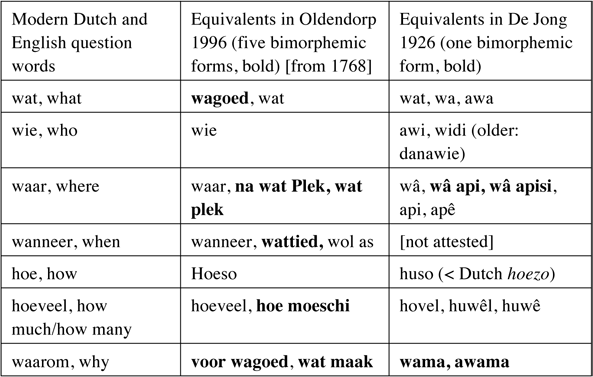
At the same time, other diachronic Negerhollands data suggest a loss of features commonly associated with creoles. For example, bimorphemic question words of the type what-reason for why or what-place for where have long been seen as typical for creoles (see Bickerton Reference Bickerton1981, Muysken & Smith Reference Muysken and Smith1990, Holm & Patrick 2007). Negerhollands, however, had more bimorphemic question words in the 1700s than were encountered in 20th-century texts, as can be seen in table 1 below. Forms like awa, awi, and awama are polysyllabic but not bimorphemic because the initial a- has no added meaning. Bimorphemic forms that are not directly derived from Dutch are shown in bold.
In this paper, I deal with Negerhollands in a distinct way: Whenever possible, I distinguish two or three different time periods and treat Negerhollands spoken during each of these periods as a distinct variety or language.
Question words in two different varieties of Negerhollands.

3. Berbice
Until recently Berbice has been spoken by people settled at Wiruni Creek, and formerly also along the Berbice River in Guyana, and perhaps elsewhere. Robertson (Reference Robertson1983) mapped the known locations of Dutch creole speakers in Guyana in the 1800s, and they can be found along five rivers. It is not known whether they were speakers of Berbice, Skepi, or a third, undocumented variety. Dutch settlers and plantation owners had established themselves there from the early 1600s. There are several aspects of Berbice in which it deviates from all other known creoles of the world in a unique way; perhaps there are some other aspects, in which this language differs from noncreoles as well. Grant (Reference Grant2012:263) roughly characterized the language as one that is exceptional in so many respects, being “a creole upon which one can always rely upon if one needs to controvert any aprioristic theorizings about constraints or presuppositions about diffusible elements.”An overview of the major deviant structural aspects of Berbice compared to other creoles can be found in Kouwenberg Reference Kouwenberg1992.
The basic lexicon of Berbice is derived from two different main sources, which is rather unusual among creoles. With 38% of the Swadesh list from Eastern Ijo (Kouwenberg Reference Kouwenberg1992:264) rather than the main lexifier Dutch, only Saramaccan (English and Portuguese) and Angolar (Portuguese and KiMbundu) have comparable numbers of words from a second lexifier in the Swadesh list. In other creoles, African items are almost exclusively found in more peripheral areas of the vocabulary (see articles in Bartens & Baker Reference Bartens and Baker2012 for a number of recent studies on a range of creoles).
The nature of the lexical mixture is also different from most creoles in that the basic lexicon is mixed. All languages are lexically mixed to some extent, creoles probably less so than noncreoles, but Berbice is also mixed in basic lexical domains such as person, kinship, and body parts (Kouwenberg Reference Kouwenberg1994, Reference Kouwenberg2012). No other creoles, and probably no noncreoles either, display etymologies from two different sources in these areas.
Creoles have often been characterized as languages with little morphology. Seuren (Reference Seuren1998:292–293), for instance, claimed: “If a language has a Creole origin it is SVO, has TMA [tense-mood-aspect] particles, has virtually no morphology.” Similarly, McWhorter (Reference McWhorter1998) claimed that creoles are languages with little or no inflection. Here, Berbice differs from most creoles in that it has several inflectional affixes. In verbal morphology, one finds an imperfective suffix (a(rɛ)) and a perfective suffix -tɛ, and in nominal morphology a plural affixapu, in addition to some derivational suffixes and reduplication.
Furthermore, Berbice has a few cliticized personal pronouns that occur quite frequently, and object clitic pronouns are quite unusual among creoles (Kouwenberg Reference Kouwenberg, Byrne and Holm1993, Reference Kouwenberg1994). Asian Portuguese creoles also have inflectional morphemes, and Palenquero Spanish creole uses a Bantu plural prefix, but Berbice is unique in the number of inflectional morphemes and the fact that the morphemes are found in both, nominal and verbal domains. Also, it should be noted that all of the inflectional and derivational suffixes are from Ijo, not from Dutch. Of course, the functions of these elements in Ijo and Berbice are not completely identical. For instance, the plural marker is generalized from a marker limited to human nouns in Ijo to one also marking nonhuman animates and inanimate nouns in Berbice (Kouwenberg Reference Kouwenberg2012:141), but the fact remains that there are no Dutch affixes. The Ijo suffixes are used with both Ijo and Dutch nouns. The number and nature of African-derived affixes has no parallel in other creoles.
A third point in which Berbice differs from all creoles is the fact that the African component is from Ijo, and only from Ijo. Ijo is a group of languages spoken in southern Nigeria, formerly considered part of the Niger-Congo stock, but Dimmendaal (2011) considers the Ijoid languages as a separate family. In other Caribbean or South American creole languages, no words from this language group are found, almost without exception. The overview in Bartens & Baker Reference Bartens and Baker2012:281–282 lists percentages of African words in 22 creoles. Berbice has 100% from Ijo, most have 0% from Ijo, and three languages have 1% or 2% of the African component from Ijo. However, scrutiny of the chapters in Bartens & Baker for Ijo words reveals that many of the possible Ijo words have identical forms and meanings in other non-Ijoid African language groupings as well. In fact, there may not be a single word that is unambiguously from Ijo in the other Atlantic creoles, which thus contrasts greatly with Berbice.
The fact that there is such a significant Ijo lexicon is also mysterious on other grounds. During the Berbice slave uprising of 1763–1764, the rebels were known to have spoken the languages of or identified with ethnic groups from Ghana, Kongo, and Angola but not from the Ijo area (implicit in, for example, Kars Reference Kars2009). However, Berbice slaves did continue at least one Ijo practice, the worship of Mingi Mama, a water goddess (Browne Reference Browne2009, Gill Reference Gill2009, Robertson Reference Robertson, Allsopp and Rickford2012), even when they were of Kongo origin or from what is today Ghana. Ijo is spoken in the Niger River delta in Nigeria, but no trace of Ijo, or of any other Nigerian language group for that matter, is mentioned in the documentation. The Ijo words must have come from Ijo, but how did these Ijo elements enter the Berbice creole language?
Finally, even though the Berbice language has components of a European language (Dutch), an African language (Ijo) and an Amerindian language (Lokono, of the Arawakan family), the last generation of speakers were almost all Amerindians or of mixed Amerindian descent. How have these Amerindians adopted, or developed, a language with African and European elements? No solution for these mysteries is provided here. In sections 5 and 6, I compare Skepi, Berbice, and (different varieties of) Negerhollands with respect to their lexical and typological characteristics.
4. Skepi
Skepi is unfortunately not documented to an extent that would allow a structural analysis. It developed along the Essequibo River in what is now Guyana. When Ian Robertson did fieldwork among the very last speakers, or rememberers, the state of the knowledge was such that no full documentation of the language was possible. The published materials are limited to a handful of sentences (Robertson Reference Robertson1983; see Appendix) and a list of 200 words (Robertson Reference Robertson1989). As the language is now extinct, there is very little chance that more information on it will surface. It is known that British missionaries learnt Skepi in the 1830s, used the language in their church services (Veness Reference Veness1869) and even produced descriptive manuscripts such as a dictionary of Skepi creole (Veness Reference Veness1869:85), but the whereabouts of the manuscript is unknown. Also, a “word list submitted by a German veterinary surgeon” (pointed out by an anonymous referee) is considered lost.
Therefore, I am only able to make a lexical comparison between Skepi and the other creoles, but no comprehensive structural comparison. As for the grammar, the few sentences available for scrutiny suggest that it is a creole language structurally like other creoles, with a preverbal TMA system, SVO word order, no gender distinction, no inflectional morphology in verbs or nouns, and no inversion—all of which are features that Skepi shares with other creoles but not with Dutch. Lexically, it does not have the African component so prevalent in Berbice. As some of the sentences are not readily available, I list them in Appendix. Based on these limited data, I attempt a sketchy structural comparison.
5. The Dutch Creoles: Lexical Comparison
In this section, I compare the Dutch creoles, using computational tools developed for tracking evolution, where appropriate (SplitsTree; Huson & Bryan Reference Huson and Bryant2006). The results are visualized in trees or networks. These tools are increasingly being used in linguistics, almost always confirming groupings and evolutionary patterns suggested by the comparative method (see, for example, McMahon & McMahon Reference McMahon and McMahon2003 for English dialects, Greenhill & Gray Reference Greenhill, Gray, Adelaar and Pawley2009 for Austronesian, Daval-Markussen & Bakker Reference Aymeric and Bakker2011 for English-lexifier creoles). These tools have been evaluated very positively, and even “exceptionally well” in linguistic research (Greenhill & Gray Reference Greenhill, Gray, Adelaar and Pawley2009:16). For more information on the use of these models in linguistics, see Schnoebelen Reference Schnoebelen2009 and Nichols & Warnow Reference Johanna and Warnow2008. These tools have also been used for mapping structural features (Dunn et al. Reference Dunn, Stephen, Lindström, Reesink and Terrill2008), including in creoles (Bakker et al. Reference Bakker, Aymeric, Mikael and Ingo2011).
If one defines creoles roughly as languages restructured after a stage of rather severe simplification, then there are exactly three Dutch-based creoles: Skepi, Berbice, and Negerhollands. Afrikaans is, in my view, not a result of expansion after severe reduction, and therefore not taken into account here. On the one hand, Skepi is not sufficiently documented and therefore excluded from one comparison concerning the grammatical domain. On the other hand, Negerhollands is so different in the different stages of its documented history that I take into account two different varieties of Negerhollands: the late 18th-century and 20th-century Negerhollands. Occasionally, when the earliest documents, that is, the slave letters, provide sufficient information, I also consider early 18th-century Negerhollands.
I compare them on the basis of lexical choice (which language etymons come from, and, if they come from Dutch, whether the same or different Dutch words provide source for the same meanings), and on the basis of lexical phonology (at the level of individual words and general processes). In section 6, the comparison is done on the basis of the typological properties in the realm of morphology and syntax, where one can abstract away from the forms themselves. See Daval-Markussen & Bakker Reference Aymeric and Bakker2011 for a comparable method used for tracking the connections among the Atlantic English creoles.
5.1 Etymology
As a point of departure for the lexical comparison, I used Robertson's (Reference Robertson1989) word list of ca. 200 English meanings collected for Skepi. In his list, he also gives the meaning equivalents of the same meanings in Berbice and Negerhollands. I have not been able to provide additions to the Skepi word list, as it is the only source available for the language. However, I have supplemented Robertson's list with additional Berbice and Negerhollands words that come from other sources. The Berbice words were compared with the words given by Kouwenberg (Reference Kouwenberg1994), who has a few additional items and who provides etymological information. Information on the African component can also be found in more detail in Kouwenberg Reference Kouwenberg2012. The Negerhollands data were checked against the texts and vocabulary published in De Jong Reference Jong and de Josselin1926, in which more than a few additional words were located and added to the lexical database. As some English meanings have several translation equivalents, the total number of words for each language is slightly more than 200. The revised list is available from the author at request.
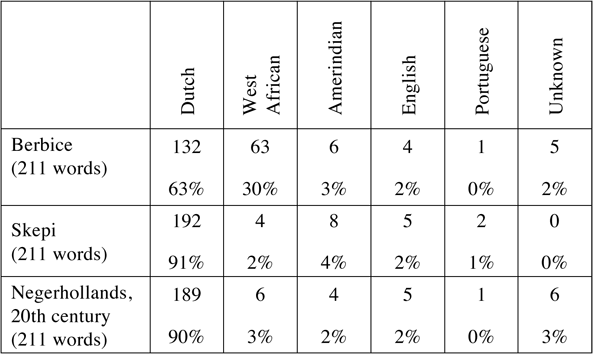
Table 2 shows the etymological sources of the retrieved words for the three languages. There are a few gaps for Berbice and Negerhollands, and those obviously do not contribute to the numbers in table 2. Some of the gaps are due to the presence of a word with unknown etymology; but more often gaps appear because no meaning equivalents could be retrieved for these two creoles, both of them now extinct and thus irretrievable. Table 2 makes it immediately clear that, as far as the origin of the lexicon is concerned, Skepi and Negerhollands are much more similar to one another than they are to Berbice. In Berbice, only 63% of the 211 words of the 200-meaning list are from Dutch, compared to 91% and 90% in Skepi and Negerhollands, respectively. The presence of this significant African component of Berbice has been known since at least Smith et al. Reference Smith, Robertson and Williamson1987. The Berbice list has 30% of West African words, compared to 2%–4% in the other creoles (see, for example, Mufwene Reference Salikoko1993 and Bartens & Baker Reference Bartens and Baker2012 for assessments of African components of creoles).
Two remarks must be made on these lists. First, these are not Swadesh lists but rather a selection that covers some basic terms, some more specialized vocabulary, and some local lexicon. Thus, these numbers are only valid for this particular list, not for the whole lexicon or a Swadesh list. Second, the numbers differ from those given in Robertson Reference Robertson1989 mostly due to the fact that more information on the etymology of Berbice items became available, and because my lists are more extensive than Robertson's lists, especially for Negerhollands.
Graphically, the lexical distances between the three creoles can be presented as in figure 1 below. Figure 1 does not represent an evolutionary pattern; the computational technique is only used as a means to make a graphic representation of distances. Berbice creole is quite distinct from the other two solely because of the presence of many West African roots. The length of the branches (or edges) in figure 1 represents the lexical distance between the three Dutch creoles in this respect. Negerhollands and Skepi are much closer to one another because they have a similar number of roots from the different source languages, notably Dutch.
The next step in my lexical comparison is a comparison of the etymological sources of the Dutch words in the three creoles, based on shared etymologies. If a Skepi word, a Negerhollands word, and a Berbice word all have the same Dutch word as their source, the three words are counted as the same, even if their form is different. If the etymons are different Dutch words, then the creole words are counted as two or three distinct ones. Where no Dutch word was available for a particular meaning in Robertson's list in one of the languages (this would most often happen in Berbice creole, when an Ijo word was used), that word was not included in the count.
Etymological sources for a 200-word lexicon from each of the three Dutch creoles.
Lexical similarities between Skepi, Berbice, and Negerhollands, based on a word list with 211 items.
132 of the meanings in the list yield words with Dutch etymologies in all three languages, and in 39 of the cases (30%) a different Dutch word is the etymological source in at least one of the languages, against 92 words (70%) with the same etymology. Examples include the word for “back:” in Skepi it is lɛnt, from Dutch lende, in Berbice atri from Dutch achter and in Negerhollands rigi from Dutch rug. Here all three forms are different, but sometimes two forms have the same etymology. Where Berbice and Negerhollands have a form for “beneath, under“ from Dutch onder (ondro and ondə respectively), Skepi has a form derived from beneden, dialectal benere: bɛnɛr. And Negerhollands is the deviant one in “cup:” Skepi and Berbice have mok resp. mok(u) (Dutch mok), Negerhollands has kopi (Dutch kop or diminutive koppie, kopje).
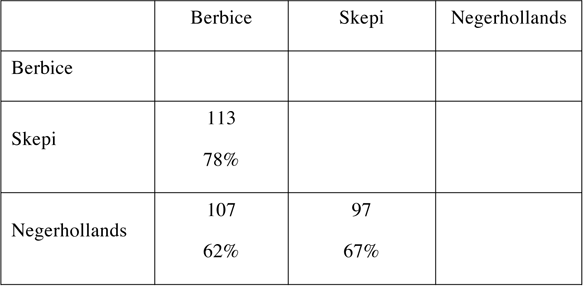
Taking all the 144 available words with a Dutch etymology in from the word lists of the three creoles (that is, including those words where more than one translation equivalent of the English meanings is available), it appears that Negerhollands is the most deviant. Table 3 shows that Negerhollands has 62% (107) common roots with Berbice and 67% (97) with Skepi, and Berbice is the language with most common roots with Skepi (78%, or 113). For five words, all three languages have different etymologies. This result is not surprising considering the different histories of the three colonies, with Berbice and Skepi geographically close.
Shared Dutch etymologies (common roots) between the three Dutch creoles.
The next step is to indicate deviations in form from the other languages. This is done in the next section. For reasons of space, I focus on phonotactics only.
5.2 Phonotactics
For methodological reasons, the phonotactic patterns compared in this section are based only on the list of words generated from the 200 meanings found in Robertson 1998. In table 4 below, I only present clusters found in this restricted data set, thus avoiding a bias toward the better-documented Berbice and Negerhollands, for both of which at least 5 times as many words are attested as for Skepi. Robertson's (1998) list is supplemented with Berbice forms from Kouwenberg Reference Kouwenberg1994 and Negerhollands forms from De Jong Reference Jong and de Josselin1926. I mention a few clusters and diphthongs found outside of this limited lexical corpus.
The Ijo elements in Berbice almost all follow a CV pattern, but there are a number of exceptions. There are a few words with initial stop + w combinations (bw-, tw-, gw-), one word beginning in sw-, one word beginning in kj- and one beginning in mj-. The only consonant allowed word-finally is -n, often going back to Kalabari Ijo words that end in -n. There are two words with a -tw- cluster in the middle. Word-medially, combinations of nasals and homorganic stops (-mb-, -nt-, -ng-, -nd-) and a fewstop + r clusters (-kr-, -rk-, -rd-, -br-,-pr-, -rm-) occur. Two words have three consecutive consonants (nangwa, namblu). There are only a few vowel sequences (-ui-, -ai-, -ia-,-iɛ-). These patterns are fairly close but by no means identical to the modern Kalabari patterns, but I do not discuss possible changes and adaptations here. These phonotactic patterns can be compared with those in the Dutch component of Berbice.
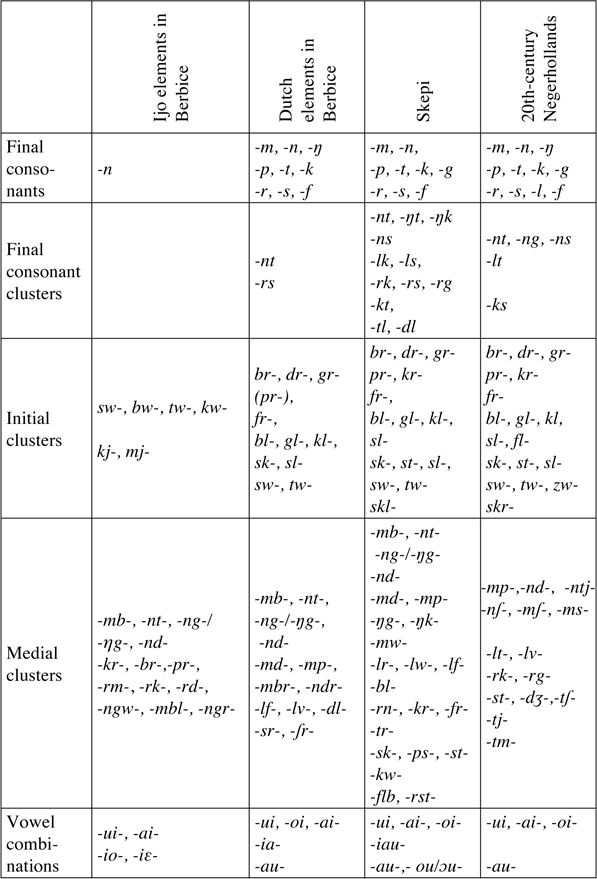
Table 4 lists all the clusters and vowel combinations found in the 200-word list for each of the three creoles. As the sample is restricted to 200 words, some forms will certainly be missing. For example, some of the clusters missing in table 4 but attested in Berbice are initial spr- (springhan, but compare pringi from Dutch springen) and str- (strafu), medial -gr- (swagri) and -sl- (stisli) and the vowel sequence -uei in duei. The last form is from Ijo, the others are from Dutch.
In table 4, Berbice sounds and sound combinations of the Dutch origin and of the Ijo origin are presented separately. The Ijo words clearly have the least complex phonotactics. It appears that Berbice words with Dutch etymons have a rather different phonotactic structure, especially with respect to the initial and final consonants: Only one final consonant is found in words with Ijo etymons, compared to eight found in words with Dutch etymons; and the initial clusters show fairly little overlap.
Phonotactic patterns beyond (C)V in the Dutch creoles.
Table 4 also shows clearly that all creoles allow vowel combinations and consonant clusters and combinations, as well as word-final consonants. The presence of diphthongs and a large number of consonant clusters is not normally associated with prototypical creoles. All three creoles have a fairly “Dutch” phonotactic structure, but with important modifications. What I do not deal with here is epenthetic vowels inserted in etymological consonant clusters, paragogic vowels at the end of words, and consonants inserted before words that etymologically start with vowels. These processes are quite frequent in all three creoles, and they indicate that the phonotactic patterns have not been inherited from Dutch.
In general, Berbice has the lowest number of phonotactic possibilities (the lowest number of final consonants, final consonant clusters, medial clusters, and vowel combinations). In some areas, Negerhollands has more possibilities than Skepi (a wider range of final consonants, word-initial consonant clusters, vowel combinations), but sometimes Skepi has a wider range of word-medial and word-final consonant clusters. An explanation on the basis of different substrates would be one to explore, even though it is clear that the Ijo influence on Dutch in Berbice was limited, because the phonotactic patterns for Ijo- versus Dutch-related words seem to differ in Berbice.
6. Typological Comparison
6.1. Three Varieties of Negerhollands versus Berbice
If one wants to look at similarities between languages that go beyond particular word forms, one must take typological features into consideration, such as the order of nouns and modifiers, the presence of prepositions versus postpositions, the presence or absence of gender, and the like. Previous studies that examined the typological features of creoles have shown that creoles clearly differ from noncreoles, based on a world-wide sample of noncreole languages. Creoles also differ from their lexifiers and substrates (Bakker et al. Reference Bakker, Aymeric, Mikael and Ingo2011; see Szmrecsanyi & Kortmann Reference Szmrecsanyi and Kortmann2009 for English creoles). Examination of creoles (as defined independently by creolists) in terms of features—identified by typologists as either being typical for creoles or characteristic of world languages in general—invariably points to the structural distinctness of creoles vis-a-vis noncreoles.
Phylogenetic models can help in showing links between different creoles. I have selected a number of features with respect to which the Dutch creoles are known to differ from one another. When used in different constellations, they may reveal closer links as well as differences among the Dutch creoles. I limit my analysis to morpho-syntactic features. Apart from the word list containing some 200 words, less than a handful of sentences are available for Skepi—insufficient to infer anything beyond a statement that Skepi looks like a common creole and differs significantly from Berbice. However, I examine separately the known innovated structural features of Skepi (that is, where Skepi differs from Dutch) and then compare those with the structural features of the other creoles and Dutch.
For the typological comparison, I selected a number of features that previous research had shown to have different values in different time periods for Negerhollands. Hence, the selected features can shed light on temporal developments (and typological connections with other Dutch creoles, in this case Berbice, and with Dutch). The features selected should not be taken to be representative of a typological profile of any sort. Note also that the single value of a typological feature that is chosen summarizes a complex reality in a single value, but that does exclude the possibility that some structural features may also be found in alternative constructions of lesser frequency. For Dutch, one could argue, for instance, that there are also a few bimorphemic question words (hoeveel ‘howmuch’, hoezo ‘how’, lit. ‘how so’), reduplication, though not productive (tiktak, imitation of sound of a clock), some postpositions beside many prepositions (voor het schip uit ‘moving in front of the ship’, lit. ‘before the ship out’; de brug over ‘(movement) over the bridge’), and the possibility for double negatives (nooit niet lit. ‘never not’), as suggested by one referee. Here I focus on the most general values of the selected features. These features were taken as a point of departure, and data from Dutch and Berbice were added. Such data could both shed light on the diachronic development of Negerhollands and possibly reveal typological similarities between Negerhollands and Berbice. It may be mentioned here that, based on a typological comparison of 18 creoles in Bakker et al. Reference Bakker, Aymeric, Mikael and Ingo2011, these two creoles do not form a cluster, despite having the same lexifier.
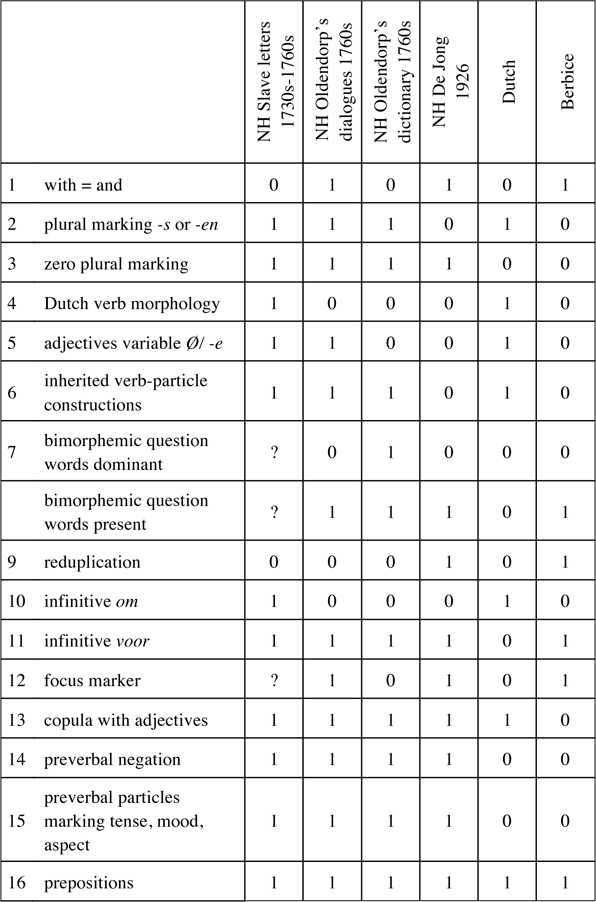
For Negerhollands, I used four different types of sources from three time periods. For the first (the earliest) period, I used slave letters written between 1732 and 1760. For the second period, I used two types of sources from the 1760s: Oldendorp's dictionary, including the example sentences therein, and Oldendorp's dialogues between masters and slaves. The reason for taking these two contemporary sources separately is the impression that these sources were grammatically different, one of them perhaps closer to the vernacular of the slaves, which could thus be verified. This study shows that the differences are very small. For the third period (the 20th century), De Jong's (Reference Jong and de Josselin1926) primary materials were investigated.
The principle based on which the features were selected was adopted from Stolz Reference Stolz1986 and Sabino Reference Sabino2012, among others. I selected the following features, not all of which are logically independent of one another. For example, features 2 and 3 both relate to plural marking, one relating to presence of some plural suffixes, the other to presence of zero markers. Some of the chosen features find their origin in creoles, others in Dutch, and all have been chosen because I am aware of differences between the creoles, or between Dutch and (some of) the creoles.
1. Is the word meaning “with” (Dutch met /mɛt/, Berbice mɛt, Negerhollands mit) also used to connect noun phrases and/or sentences?
2. Are Dutch plural markers -s and -en used on some nouns (for example, kinder-s ‘children’, stuver-s ‘five-cent coins’, mens-en ‘people’)? These were only counted as plural markers if they conveyed plural meaning; that is, the corresponding form without those markers had singular meaning. In other words, are distinctive plural markers from Dutch used on at least some nouns?
3. Is there zero plural marking? This question differs from the preceding one because some (but not many) nouns may have more than one plural form, including zero plurals. If a significant number of nouns have zero-marked plural forms, this is noted. This feature is based on frequency in the materials at hand. Dutch scores zero because one cannot just say hond is mensenvriend ‘dog is a friend of human’. The generic use of the definite article de in de hond is al eeuwen de trouwste mensenvriend, literally more or less ‘the dog is for centuries the truest friend of people'is not relevant for overt plural marking.
4. Is Dutch verbal morphology used on the verb, for instance, past particle markers ge-V-t, or 3rd person singular inflection -t or the plural -en? This feature is based on text frequency.
5. In Dutch, adjectives may have two forms, depending on the grammatical context:-Ø or -e (schwa), for example, een klein-e man ‘a little man’, een klein huis ‘a little house’. Do adjectives in the Dutch creoles display the same variation?
6. In Dutch, like in English, there are a great number of verb-particle constructions, for example, eet op ‘finish eating this’ (lit. ‘eat up’), doe dicht ‘close’(lit. ‘do closed’). The meanings are highly irregular, and there are syntactic complexities in that the particles sometimes are preverbal (opeten, dichtdoen) and sometimes postverbal and separated from the verb (ik eet het liever morgen op‘I rather eat it tomorrow’). Does one find such constructions in Negerhollands or Berbice? I specifically lookedfor verb-particle constructions inherited from Dutch. 20th-century Negerhollands has quite a few of verb-particle constructions, but all of them seem to be calques from English and not inherited from Dutch, and thus were not counted.
7. The fact that many creoles have bimorphemic question words of the type what-place for where is well known. Are most of the question words innovated (that is, newly created and not inherited from Dutch) and bimorphemic? This question relates to whether the bimorphemic question words are dominant.
8. Not all of my sources provide sufficient information about question words. However, even when tokens of question words are found, at some stage a creole may have no bimorphemic question words at all. The question is thus: Are there bimorphemic question words present at all? This feature is different from the one in 7 in that it addresses presence and not dominance.
9. Reduplication is present in many creoles but is not productive in any of the lexifiers, including Dutch. Is it present in the Dutch creoles?
10. Dutch uses an infinitival particle om in certain contexts. Is om used in the Dutch creoles?
11. Creoles typically use an infinitival element derived from a preposition meaning “for” (Dutch voor) to introduce certain complement clauses. Do the Dutch creoles use this element as well?
12. To mark a focused element in the beginning of the sentence, a particle may be used. Is there a focus particle in the Dutch creoles?
13. In many creoles, adjectives are indistinguishable from verbs. For example, adjectives can have tense markers. In contrast, European languages typically use copulas with adjectives. Do the Dutch creoles use copulas with adjectives?
14. In Dutch, the negative marker niet follows the verb in main clauses (ik kom niet ‘I am not coming’, lit. ‘I come not’), and precedes the verb in subordinate clauses (dat ik niet kom ‘that I am not coming’, lit. ‘that I not come’). In most creoles, the negative particle precedes the verb and tense-mood-aspect markers, and in some creoles there is a sentence-final negation (Dieck 1977), including Berbice creole (Kouwenberg Reference Kouwenberg1994). Do the Dutch creoles have preverbal negation?
15. Creoles, with few exceptions only, mark tense, mood, and aspect with preverbal particles rather than with morphological elements. Is that the case in the Dutch creoles?
16. Dutch has mostly prepositions and a few postpositions. Do the Dutch creoles have prepositions?
17. Do the Dutch creoles have postpositions?
18. Modern standard Dutch does not allow double negation, but many creoles do. Dialectal Dutch, however, allows double negatives, and double negatives were also more frequent in earlier stages of Dutch. Do the Dutch creoles use double negatives, as in some forms of colloquial English, as in I don't see nobody?
19. Possession can be expressed in Dutch with the preposition van ‘of’, as in het huis is van Jan ‘this house is Jan's’ (lit. ‘this house is of Jan’) Do the Dutch creoles allow the construction of the form possessed van possessor?
20. In colloquial Dutch, possession can be expressed as in Jan zijn huis ‘Jan's house’, lit. ‘John his house’, and also as in Jan's huis. Is the construction of the form possessor–possessive marker–possessed possible in the Dutch creoles?
21. Are juxtaposed nouns used for indicating possession, as in Jan huis ‘Jan's house’?
22. Finally, many Atlantic creoles use serial verbs. Do the Dutch creole have serial verbs?
These 22 grammatical properties were checked against different data sets for Negerhollands. For the first period, the slave letters written in Negerhollands between 1732 and 1760 were studied. The following letters were taken into consideration: Peter 1738, Lenathge 1740, Catarina 1752, Cornelius 1753, Nathanael 1760, all of which can be found at http://corpus1.mpi.nl/qfs1/media-archive/NEHOL(last accessed December 2013; see also https://corpus1.mpi.nl/ds/imdi_browser/, last accessed on April 27, 2014). For the second period, as said above, missionary materials from the 1760s were taken into consideration and for the 20th century, De Jong's (Reference Jong and de Josselin1926) materials were investigated. In addition, modern Dutch was also included (including dialectal sources), as well as Berbice.
Table 5 shows the scores given for the different features found in the sources from the three different varieties of Negerhollands, as well as in Dutch and Berbice. Here, yes scores 1, no scores 0, and a question mark indicates that no answer could be provided based on the available data.
Structural features for four sources of Negerhollands, for Dutch, and for Berbice.
These data were analyzed using the computational tools devised for phylogenetic research that had been successfully applied in creole studies (see Bakker et al. Reference Bakker, Aymeric, Mikael and Ingo2011, Daval-Markussen & Bakker Reference Aymeric and Bakker2011, Reference Aymeric, Bakker, Butt, Carpendale, Penn, Prokić and Cysouw (ACL)2012). The results are shown in figure 2. A network approach was chosen as it allows one to show not only the inherited features but also borrowing and contact.
A network of Dutch, Berbice, and three varieties of Negerhollands, based on typological data.
Figure 2 shows that the language of the slave letters is the closest to Dutch, followed by the language of Oldendorp's materials (two different kinds), and followed by the 20th-century language of De Jong's materials. These results support my claim that the three varieties of Negerhollands are quite distinct languages. Interestingly, even though Berbice is much more deviant from Dutch than 20th-century Negerhollands is, based on the examination of these typological features the two appear to be almost equally removed from Dutch.
A rooted tree, with Dutch as the first taxon, is shown in figure 3. Figure 3 could be interpreted as a diachronic development away from a form of Dutch and toward 20th-century Negerhollands, in an evolutionary framework, where Berbice develops parallel to Negerhollands.
Rooted tree with Dutch, Berbice, and three varieties of Negerhollands, based on typological data.
Figure 3 confirms that Berbice and 20th-century Negerhollands are furthest removed from Dutch, Negerhollands of the slave letters is the closest to Dutch, and the Negerhollands varieties documented by Oldendorp fall in between.
6.2. Skepi, Berbice, and 20th-Century Negerhollands
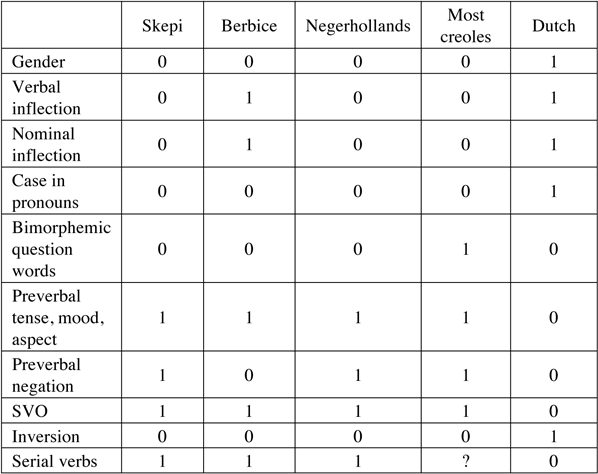
Very little is known about the structural features of Skepi. Not even a dozen sentences have been published. Still, even when it is difficult to generalize, a few properties can be extracted from this limited material. For example, one can make generalizations regarding the question word system based on one question word only. With these considerations, the structural properties of Skepi, and their equivalents in Berbice, Negerhollands and a vaguely defined category “most creoles” are presented in table 6, roughly based on the data in Holm & Patrick 2007. Here too, binary scores are applied, for presence (1) or absence (0).
Structural features of Skepi compared with structural features of other creoles and Dutch.
By feeding these data into the SplitsTree software, the results shown in figure 4 were obtained.
A network of structural properties of the Dutch creoles.
Figure 4 shows that Skepi and Negerhollands are structurally very similar to one another and close to other creoles, whereas Berbice is closer to Dutch, no doubt because of the presence of inflection in both Dutch and Berbice. Longer branches represent more distance between languages. The closeness of Berbice and Dutch is somewhat misleading, because the inflectional morphemes in both are from different source languages.
7. Conclusion
I have compared the Dutch creoles along a number of lexical and grammatical parameters: etymological composition of the lexicon, words inherited from Dutch, phonological deviations from Dutch, and typological features. Even if one disregards the African component of Berbice, the creoles are quite distinct from Dutch, and, where comparable, they are, in fact, even more different from one another.
Taking into account only the Dutch cognates shared by Negerhollands, Berbice, and Skepi, there is no reason to assume that any one of these creoles is derived from any of the others, or that any of them go back to the creolized ancestor. The phonotactic patterns of the three creoles are quite different, and a significant minority of meanings across the three languages (between 22% and 38%) have different Dutch etymons, including a few cases, where a particular meaning has a distinct Dutch etymon in each creole.
The typological features of the Dutch creoles show that Skepi and Negerhollands are quite close to one another and to other (Atlantic) creoles, but they are distant from Dutch, whereas Berbice is placed in between them. However, on the basis of a different, more elaborate set of features, Berbice is most distant from Dutch. These differences are exposed through the selection of particular features. The data from the three varieties of Negerhollands suggest a development over time away from Dutch and toward a more creole-like profile.
All this indicates that an independent genesis of the three creoles is the most likely scenario, with only very moderate and superficial contact between Berbice and Skepi. This is the first structural comparison that includes the limited Skepi data. The phylogenetic tools used show again how powerful this technique is. The results corroborate what has been suggested before about the possible connections and the differences among the Dutch creoles, and the development of Negerhollands.
APPENDIX
Skepi sentences, with Berbice and Dutch equivalents.
Sources: Holm Reference John1989:335, based on Robertson Reference Robertson1983; Evenhuis Reference Marco1997 for Zealandic equivalents. Standard Dutch translations are mine.
(1)

(2)
(3)
(4)
(5)
(6)
(7)
(8)
(9)
(10)
The final sentence was found in a letter written in Skepi in 1780. The interpretation is mine, but I am much obliged to Margot van den Berg and Cefas Van Rossem for the groundwork. See also http://stemmenvanafrika.nl/skepi-nederlands-is-dit-geen-moye-taal/ and http://www.hum.leidenuniv.nl/onderzoek/brieven-als-buit/over/brief-van-de-maand-december-2013.html.
(11) en sok kum kloeke dagka van Noom di sitte bi Warme lantta
en zoek komen mooi dag van Oom die woont in warm land
en als umkom Weeran bi Bikkelante
en als hem kom terug in wittenland
ham sel brangk van die 4 blabba moye Goeto
hem zal breng van die 4 kind mooie goet.
‘en probeer te komen een mooie dag naar oom die in een warm land woont en als hij terug komt in Nederland zal hij voor de 4 kinderen mooie goederen meebrengen’ (modern Dutch)
‘…and try to come one beautiful day to Uncle who lives in a warm country, and when he comes back to the country of the White people, he will bring nice things for the four children.’
Blaba could be an Akan word for child. Bikke is a widespread African word for European, found in French and English creoles, originating in Benuic (that is, Igbo) and Ijoid languages, compare Ijo bɛkɛ (see Bartens & Baker Reference Bartens and Baker2012:128).