Introduction
The boll weevil, Anthonomus grandis grandis Boheman (Coleoptera: Curculionidae), is considered one of the main pests of cotton, Gossypium hirsutum Linnaeus (Malvaceae), in the Americas (Azambuja and Degrande Reference Azambuja and Degrande2014; Miranda and Rodrigues Reference Miranda, Rodrigues and Bélot2015; de Oliveira et al. Reference de Oliveira, Oliveira-Neto, Moura, de Macedo, Arraes and Lucena2016). The pest mainly uses cotton fruiting bodies (buds and bolls) in which to lay eggs (Gabriel Reference Gabriel2002; Showler Reference Showler2007; Azambuja and Degrande Reference Azambuja and Degrande2014; Bélot et al. Reference Bélot, Barros and Miranda2016) and has a series of strategies to remain in the environment when cotton plants are absent (Summy et al. Reference Summy, Cate and Bar1993; Showler and Scott Reference Showler and Scott2004; Showler Reference Showler2006, Reference Showler2007). In tropical regions, these strategies often consist of using alternative food resources (Cuadrado and Garralla Reference Cuadrado and Garralla2000; Showler and Scott Reference Showler and Scott2004; Ribeiro et al. Reference Ribeiro, Sujii, Diniz, de Medeiros, Salgado-Labouriau and Branco2010; Macêdo et al. Reference Macêdo, Castellani, Santos, Oliveira and Maluf2015) or remaining inside dry cotton bolls (Guerra et al. Reference Guerra, Garcia, Bodegas V. and De Coss F.1984; Summy et al. Reference Summy, Cate and Bar1993; Greenberg et al. Reference Greenberg, Showler, Sappington and Bradford2004; Showler Reference Showler2006; Ribeiro et al. Reference Ribeiro, Castellani, da Silva, Melo, Silva, do Vale and Santos2015, Reference Ribeiro, da Silva, de Novais, do Vale, Silva and Melo2020; Pires et al. Reference Pires, Pimenta, da Mata, Souza, Paula, Sujii and Fontes2017). Inside dry bolls, boll weevils are protected from the heat and desiccation that occurs on the soil surface, from pesticide applications, and from natural enemies (Summy et al. Reference Summy, Cate and Bar1993; Greenberg et al. Reference Greenberg, Showler, Sappington and Bradford2004; Showler and Scott Reference Showler and Scott2004; Macêdo Reference Macêdo2014), allowing them to survive to infest the next cotton crop (Summy et al. Reference Summy, Cate and Bar1993; Greenberg et al. Reference Greenberg, Showler, Sappington and Bradford2004; Showler Reference Showler2007; Pires et al. Reference Pires, Pimenta, da Mata, Souza, Paula, Sujii and Fontes2017).
Legislated measures in the primary cotton-producing regions have attempted to establish periods without cotton plants (sanitary voids) where the boll weevil is present (Santos Reference Santos and Bélot2015a; Torres et al. Reference Torres, Vivian, Bastos, Barros and Freire2015; Bélot et al. Reference Bélot, Barros and Miranda2016; Texas Department of Agriculture 2019). The measures aim to cause the main host of the boll weevil to be unavailable for key periods, thereby interrupting the insect’s reproduction and reducing the number of weevils available to infest the next cotton crop. Despite these efforts, high populations of boll weevil continue to be observed in these cotton-producing regions (Showler Reference Showler2006, Reference Showler2007; Azambuja and Degrande Reference Azambuja and Degrande2014; Miranda and Rodrigues Reference Miranda, Rodrigues and Bélot2015; Bélot et al. Reference Bélot, Barros and Miranda2016; de Oliveira et al. Reference de Oliveira, Oliveira-Neto, Moura, de Macedo, Arraes and Lucena2016). Because of this, additional control measures are used to reduce the weevil’s survival during the cotton-free period. In this sense, strategies that help to reduce the number of dry bolls remaining in a field hold promise.
Some studies indicate that dry bolls form as a result of inadequate nitrogen fertilisation, phytopathogens, and mechanical injury of the cotton plant’s reproductive structures by phytophagous arthropods (Mailhot et al. Reference Mailhot, Marois and Wright2007; Praça Reference Praça2007; Osekre et al. Reference Osekre, Wright, Marois and Funderburk2009; Srivastava et al. Reference Srivastava, Mailhot, Leite, Marois, Wright and Nichols2010; Ferrari et al. Reference Ferrari, Furlani Junior, Ferrari and Alberton2012). Genetic variability among cultivars and the plasticity of cotton plants, as a function of the sowing configuration, can also cause changes in the plant’s morphological, physiological, and production characteristics (Fowler and Ray Reference Fowler and Ray1977; Bednarz et al. Reference Bednarz, Shurley, Anthony and Nichols2005, Reference Bednarz, Nichols and Brown2006). Cotton cultivars have been adapted to different sowing configurations (Fowler and Ray Reference Fowler and Ray1977; Jost and Cothren Reference Jost and Cothren2000; Bednarz et al. Reference Bednarz, Nichols and Brown2006; Khan et al. Reference Khan, Han, Xing, Feng, Wang and Wang2020). However, the influence of cultivars and their different sowing configurations on the formation of dry bolls and on boll weevil survival inside these structures during cotton fallow has not been reported. The objectives of this study were to evaluate this influence – to assess how different cotton cultivars and their sowing densities affect dry boll formation and the survival of boll weevils inside dry bolls.
Materials and methods
Area characteristics
The study was performed at the Agricultural Experimental Field and at the Laboratory of Agricultural Entomology at the Universidade Estadual do Sudoeste da Bahia (UESB), Vitória da Conquista, Bahia, Brazil (14° 53' 24" S, 40° 47' 51" W; 928 m above sea level), from January 2015 to April 2016. According to the Köppen–Geiger climate classification, the climate of the experimental area is classified as subtropical highland, with an average annual rainfall of 734 mm that is concentrated in November to March (Superintendência de Estudos Econômicos e Sociais da Bahia 1999). From January to August 2015, the average minimum and maximum temperatures were 16.3 ºC and 25.8 ºC, respectively (Instituto Nacional de Meteorologia 2015). The soil of the experimental area is a typical yellow latosol of medium texture and smooth–wavy relief (Vieira et al. Reference Vieira, Nascimento and Paz1998).
Experimental design
A split plot design with randomised blocks in an area of 2000 m2 was used. The plots (3 m wide × 25 m long) consisted of five cotton cultivars: BRS 368 RF (Embrapa, Campina Grande, Paraiba, Brazil), Delta Opal (Deltapine Brasil, Uberlândia, Minas Gerais, Brazil), DP 555 BGRR (Deltapine Brasil), FM 975 WS (BASF SA, São Paulo, São Paulo, Brazil), and FM 993 (BASF SA). These cultivars are among the most cultivated in the cotton-producing regions of Brazil. Delta Opal and FM 993 are conventional cultivars, whereas the BRS 368 RF, DP 555 BGRR, and FM 975 WS cultivars are transgenic. The subplots (3 m wide × 5 m long) had five sowing densities (7, 9, 11, 13, and 15 plants m–1), with four replicates, totalling 100 subplots. Each plot contained one cultivar and five densities with four sowing rows (two central rows for evaluation and two external rows as borders) that were spaced 0.75 m apart. A buffer space of 0.75 m was left between plots.
Area preparation and plant management
The soil was ploughed by harrowing in opposite directions. Fertilisers were applied according to previous soil analyses and following the technical recommendations of the crop (Borin et al. Reference Borin, Ferreira and Carvalho2014). A total of 95 kg ha–1 of nitrogen (15 kg ha-1 of base and two coverage applications of 40 kg ha–1 at 34 and 71 days after sowing), 90 kg ha–1 of phosphorus (single dose), and 60 kg ha–1 of potassium (20 kg ha–1 of base and two coverage applications of 20 kg ha–1 at 55 and 71 days after sowing) were applied. Fertilisers were urea (45% nitrogen), phosphorus pentoxide (18% P2O5), and potassium chloride (60% K2O; Fertilizantes Heringer SA, Paulínia, São Paulo, Brazil). Sowing was manually performed on 15 January 2015, with seedlings emerging 10 days later. During drought periods, sprinkler irrigation was used. Pest and disease control was conducted as needed, based on continuous monitoring (Santos Reference Santos and Freire2015b). Two sprayings of acephate at 562.5 g active ingredient ha–1 of commercial formulation (750 g active ingredient kg–1, soluble powder, Sipcam Nichino Brasil S.A., Uberaba, Minas Gerais, Brazil) were applied at 32 and 69 days after sowing to manage Aphis gossypii Glover (Hemiptera: Aphididae). Trifloxystrobin + tebuconazole at 60 + 120 g active ingredient ha−1 of commercial formulation (100 + 200 g active ingredient L–1, suspension concentrate, Bayer S.A., São Paulo, São Paulo, Brazil) was sprayed at 47, 67, and 87 days after sowing to manage diseases caused by Colletotrichum gossypii Southworth (Glomerellaceae) and Ramularia areola G.F. Atkinson (Mycosphaerellaceae). Moreover, cypermethrin at 62.5 g active ingredient ha–1 of commercial formulation (250 g active ingredient L–1, emulsifiable concentrate, Sumitomo Chemical Brasil Industria Quimica S.A., Maracanaú, Ceará, Brazil) was sprayed at 89, 112, and 138 days after sowing, and malathion at 1.3 kg active ingredient ha–1 of commercial formulation (1 kg active ingredient L–1, emulsifiable concentrate, FMC Química do Brasil Ltda, Campinas, São Paulo, Brazil), at 102, 125, and 150 days after sowing to manage A. grandis. All pest and disease control was carried out across the total experimental area.
Number of dry bolls and viable fruiting bodies
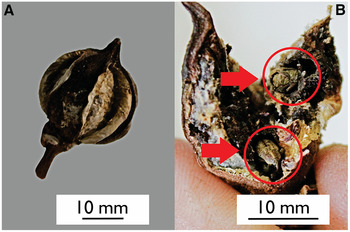
At the end of the cultivation cycle, all bolls (including green and dry bolls) were manually collected from 10 consecutive cotton plants in the same sowing row in each subplot. Both dry and deformed bolls were considered dry bolls (Fig. 1A). The material was then placed in identified plastic bags and sent to the laboratory for quantification.
Dry and deformed cotton reproductive structures, which are known as dry bolls. A, General view of a dry boll. B, Anthonomus grandis grandis adults (indicated by red arrows and circles) occupying pupal cells inside the dry bolls.

Number of empty pupal cells, emergence holes, and boll weevils
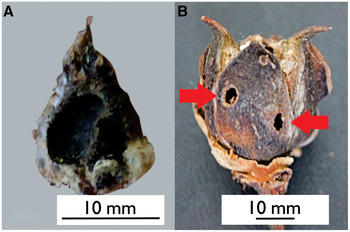
Dry bolls were placed in Kraft paper bags (11.5 × 7.0 × 22.5 cm) and kept in a climate-controlled room (25 ± 3 °C; 70% ± 20% relative humidity; 12:12 hours photoperiod) for 10 weeks, which is slightly longer than the duration of cotton fallow in Brazil’s main cotton-producing regions (Instituto de Defesa Agropecuária de Mato Grosso 2016; Agência de Defesa Agropecuária da Bahia 2018). At the end of the 10 weeks, the dry bolls were dissected and the number of boll weevils, alive and dead, and the weevils’ life states were recorded. Empty pupal cells and boll weevil emergence holes were also counted. The characteristic oblong spaces that are created by the boll weevil larvae inside the dry boll, where they remain during the pupal and adult stages, were called “pupal cells” (Figs. 1B, 2A). The term “emergence holes” refers to the openings made by adult boll weevils from the inside of the boll to the outside, by which the weevils emerge from the dry bolls (Fig. 2B). The term “emergence” was used to characterise the exit of the adult boll weevils from the dry bolls.
The oblong space created by the boll weevil larvae inside the dry boll where they remain during the pupal and adult stages, which is called the pupal cell. A, The individual view of an empty pupal cell. B, Openings (indicated by red arrows) created by Anthonomus grandis grandis adults that provide access to the external environment from inside the dry boll, which are called “emergence holes.”

Boll weevil survival
Boll weevils that were found alive inside the dry bolls were placed in transparent plastic containers (6.0 cm diameter × 4.5 cm high), covered with organza screens (90 µm), and fed with Hibiscus rosa-sinensis Linnaeus (Malvaceae) floral buds and a small wad of cotton wool that was moistened with distilled water. Boll weevil survival was assessed every 72 hours after their removal from the dry bolls, when the floral bud and the moistened cotton wool were replaced, until the death of all the weevil individuals. A boll weevil was considered dead if it did not move when the rostrum or abdomen were lightly pressed with tweezers. Hibiscus flower buds were used because they are known to be rich sources of pollen and nectar, belong to the same family as cotton, and are often used in the boll weevil survival tests (Pimenta et al. Reference Pimenta, Mata, Venzon, Cunha, Fontes, Pires and Sujii2016; Pires et al. Reference Pires, Pimenta, da Mata, Souza, Paula, Sujii and Fontes2017; Ribeiro et al. Reference Ribeiro, da Silva, de Novais, do Vale, Silva and Melo2020).
Statistical analysis
Numbers of viable fruiting bodies (bolls + green bolls) and dry bolls were transformed using log(x); the number of empty pupal cells and emergence holes were transformed in sqrt(x) and sqrt(x + 0.5), respectively. Then, these variables were compared among the treatments using a linear mixed-effects model (lmer function of the lme4 package in R; Bates et al. Reference Bates, Mächler, Bolker and Walker2015). Numbers of living and dead boll weevil larvae, pupae, and adults were log(x + 1)-transformed and analysed for treatment effects using a generalised linear mixed-effects model (glmer function of the lme4 package in R; Bates et al. Reference Bates, Mächler, Bolker and Walker2015) with Poisson error distribution. Cultivars and densities were always considered as fixed factors. Means were separated across the treatments using general linear hypothesis testing (glht function of the lsmeans package in R; Lenth Reference Lenth2016). Boll weevil survival was analysed using the Cox regression with time-dependent covariates (coxph function of the survival package in R; Therneau Reference Therneau2015). Treatment means were grouped by stepwise deletion of nonsignificant terms in the model (Crawley Reference Crawley2012). The Kaplan–Meier test was used to plot the survival curves (Kaplan and Meier Reference Kaplan and Meier1958). All analyses were performed using the R statistical software (R Core Team 2018).
Results
Dry bolls and viable fruiting bodies
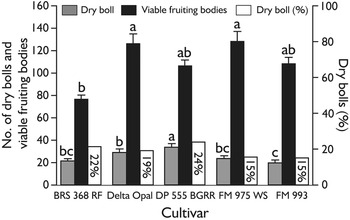
The number of dry bolls present in the 10 consecutive cotton plants from the same sowing row in each subplot was influenced by the cotton cultivar (linear mixed effects, χ 2 = 21.03, df = 4, P < 0.001) but not by sowing density (linear mixed effects, χ 2 = 0.73, df = 4, P = 0.950) nor by the interaction between cultivar and sowing density (linear mixed effects, χ 2 = 11.23, df = 16, P = 0.795). Furthermore, the greatest number of dry bolls was observed in the cultivar DP 555 BGRR (33.8 ± 3.2; Fig. 3, grey bars). The number of viable fruiting bodies was also influenced by cultivar (linear mixed effects, χ2 = 14.96, df = 4, P = 0.004) but not by sowing density (linear mixed effects, χ 2 = 4.21, df = 4, P = 0.378) nor by the interaction between cultivar and sowing density (linear mixed effects, χ 2 = 9.55, df = 16, P = 0.889). The greatest number of viable fruiting bodies was observed in the FM 975 WS (129.6 ± 7.3) and Delta Opal (126.2 ± 8.6) cultivars, in relation to BRS 368 RF (77.7 ± 2.7; Fig. 3, black bars).
Number (mean ± SE) of dry bolls (grey bars) and viable fruiting bodies (bolls + green bolls; black bars) as a function of the five cotton cultivars. Bars of the same colour with different letters indicate significant differences among the treatments (P < 0.05). Proportion (%) of dry bolls (white bars; scale to the right of the figure) relative to the total number of reproductive structures that were formed by 10 plants of five cotton cultivars.

Empty pupal cells and emergence holes
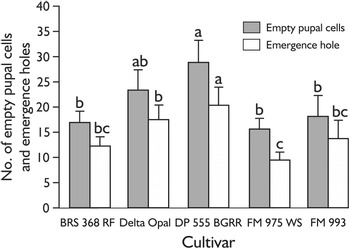
The number of empty pupal cells in dry boll formed was influenced by the cotton cultivar (linear mixed effects, χ 2 = 11.77, df = 4, P = 0.019) but not by sowing density (linear mixed effects, χ 2 = 1.45, df = 4, P = 0.836) nor by the interaction between cultivar and sowing density (linear mixed effects, χ 2 = 16.23, df = 16, P = 0.437). Furthermore, the cultivar DP 555 BGRR presented the greatest number of empty pupal cells (28.9 ± 4.3), which did not differ from the cultivar Delta Opal (23.4 ± 4.1; Fig. 4, grey bars). The number of emergence holes was also influenced by the cotton cultivar (linear mixed effects, χ 2 = 11.45, df = 4, P = 0.022) but not by the sowing density (linear mixed effects, χ 2 = 0.88, df = 4, P = 0.927). No interaction between cultivar and sowing density was detected (linear mixed effects, χ 2 = 16.78, df = 16, P = 0.400). The greatest number of emergence holes was observed in the cultivar DP 555 BGRR (20.4 ± 3.6; Fig. 4, white bars).
Number (mean ± SE) of empty pupal cells (grey bars) and emergence holes (white bars) that were present in dry bolls formed by the 10 plants of five cotton cultivars. Bars of the same colour with different letters indicate significant differences among the treatments (P < 0.05).

Boll weevils inside dry bolls
After 10 weeks inside dry bolls, the numbers of larvae, pupae, and adults – dead and living – were not affected by the treatments. On average, 0.52 (± 0.09) dead larvae were found within the dry bolls formed by each group of 10 plants, regardless of cultivar (generalised linear mixed-effects model, χ 2 = 2.88, df = 4, P = 0.578), sowing density (generalised linear mixed-effects model, χ 2 = 3.12, df = 4, P = 0.537), and interaction between cultivar and sowing density (generalised linear mixed-effects model, χ 2 = 9.47, df = 16, P = 0.892). Likewise, the number of dead pupae – on average, 0.27 (± 0.08) per group of 10 plants – was not influenced by cultivar (generalised linear mixed-effects model, χ 2 = 2.74, df = 4, P = 0.602), sowing density (generalised linear mixed-effects model, χ 2 = 1.42, df = 4, P = 0.841), or interaction between cultivar and sowing density (generalised linear mixed-effects model, χ 2 = 6.84, df = 16, P = 0.976). In addition, an average of 3.37 (± 0.29) dead adults was observed, regardless of cultivar (generalised linear mixed-effects model, χ 2 = 3.12, df = 4, P = 0.537), sowing density (generalised linear mixed-effects model, χ 2 = 4.93, df = 4, P = 0.295), and interaction between cultivar and sowing density (generalised linear mixed-effects model, χ 2 = 20.57, df = 16, P = 0.196). Finally, 0.98 (± 0.15) live adults were found, regardless of cultivar (generalised linear mixed-effects model, χ 2 = 3.97, df = 4, P = 0.411), sowing density (generalised linear mixed-effects model, χ 2 = 5.23, df = 4, P = 0.265), and interaction between cultivar and sowing density (generalised linear mixed-effects model, χ 2 = 15.16, df = 16, P = 0.513).
In absolute numbers, no live boll weevil larvae or pupae were found during the dissection of the 2551 dry bolls, of which 81 (3.2%) contained live adult boll weevils. When dissecting dry bolls 10 weeks after collection in the field, 79 immature boll weevils (dead larvae + dead pupae) and 435 adult boll weevils were found, of which 98 individuals (22.5% of adults) were alive. Most dead immature weevils and adults showed signs of desiccation. No weevils were found inside the Kraft paper bags; based on this, weevils did not emerge from the dry bolls when kept under climate-controlled conditions.
Boll weevil survival
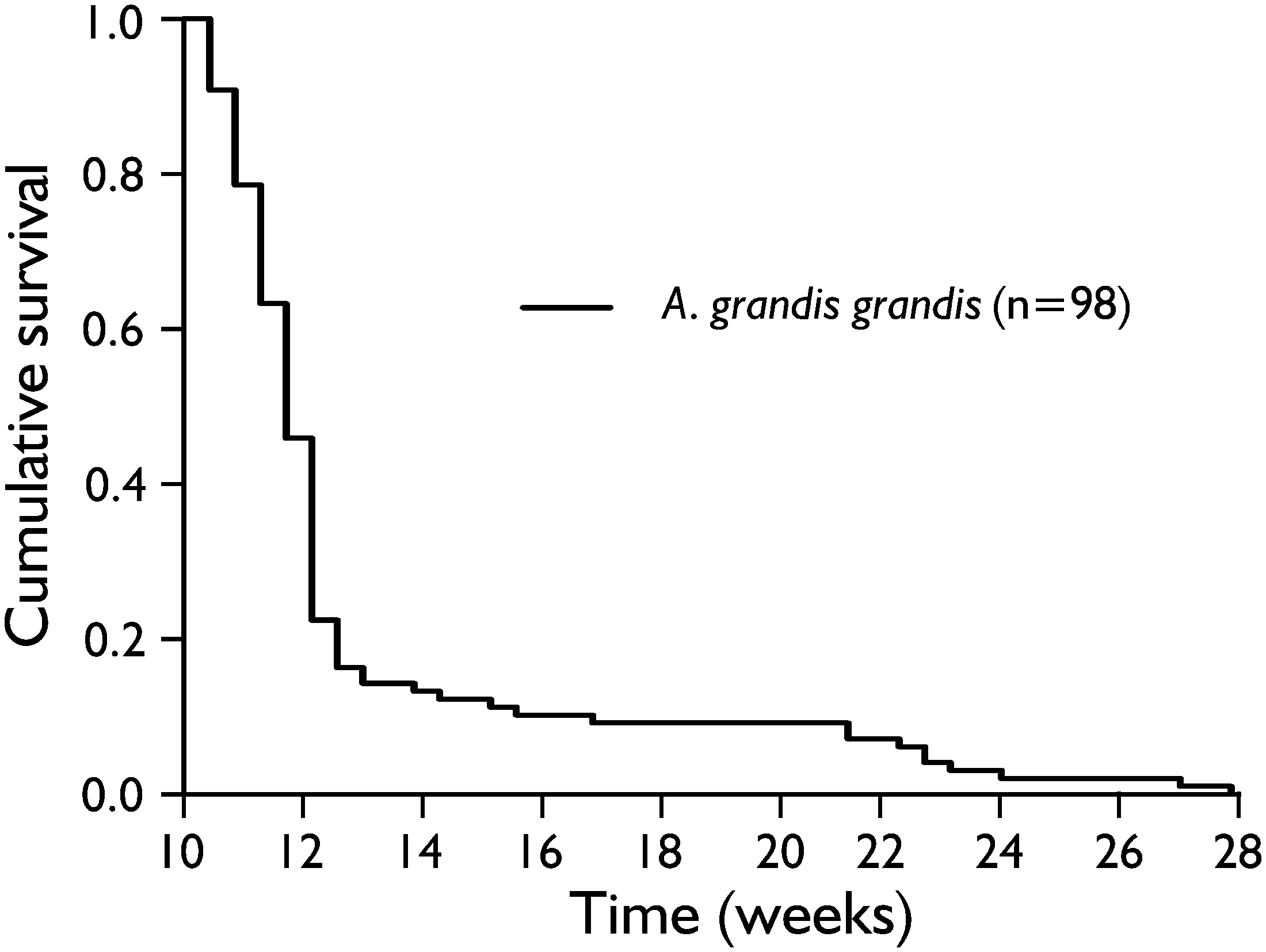
No significant difference was observed in the survival of boll weevils as a function of the cultivar (hazard ratio 1.101, 95% confidence interval: 0.560–2.166, P = 0.780), the sowing density (hazard ratio 1.013; 95% confidence interval: 0.820–1.252, P = 0.904), or the interaction between cultivar and sowing density (hazard ratio 1.001, 95% confidence interval: 0.941–1.066, P = 0.966). The longest observed longevity was 123 days (17.6 weeks) after the dissection of the dry bolls. However, 85 individuals (87%) died four weeks after dissecting the dry boll structures (Fig. 5).
Survival of Anthonomus grandis grandis adults from dry bolls. The adults of A. grandis grandis were removed from the dry bolls, after remaining inside for 10 weeks under laboratory-controlled conditions (25 ± 3 °C, 70% ± 20% relative humidity and 12:12-hour photoperiod).

Discussion
Because cultivars influenced the numbers of dry bolls produced, the choice of cotton cultivars with a greater propensity for formation of dry bolls might favour survival of the boll weevil during fallow periods. Furthermore, substantial numbers of boll weevils survived inside the dry bolls for periods longer than the fallow period. The protection of boll weevils within dry bolls can therefore support the pest’s perpetuation from one planting season to the next (Guerra et al. Reference Guerra, Garcia, Bodegas V. and De Coss F.1984; Summy et al. Reference Summy, Cate and Bar1993; Greenberg et al. Reference Greenberg, Showler, Sappington and Bradford2004; Showler Reference Showler2007; Macêdo Reference Macêdo2014; Ribeiro Reference Ribeiro2015). We would also suggest that dry bolls support boll weevil infestations throughout the current cropping season because some boll weevils have been found to have emerged before the end of the cotton cycle, opening exit holes and abandoning their pupal cells.
Because dry bolls are fruiting bodies that have not developed properly and because the number of cotton fruiting bodies is influenced by plant genotype (Fowler and Ray Reference Fowler and Ray1977; Bednarz et al. Reference Bednarz, Shurley, Anthony and Nichols2005, Reference Bednarz, Nichols and Brown2006; Khan et al. Reference Khan, Hassan, Marwat, Batool, Makhdoom and Khan2009), formation of dry bolls appears to be associated with cultivar effects. Environmental and crop management conditions can also influence the number of reproductive structures produced by cotton plants (Fowler and Ray Reference Fowler and Ray1977; Jost and Cothren Reference Jost and Cothren2000; Bednarz et al. Reference Bednarz, Shurley, Anthony and Nichols2005, Reference Bednarz, Nichols and Brown2006; Siebert et al. Reference Siebert, Stewart and Leonard2006; Khan et al. Reference Khan, Han, Xing, Feng, Wang and Wang2020); therefore, crop management factors, such as appropriate nitrogen fertilisation, can reduce the formation of dry bolls (Ferrari et al. Reference Ferrari, Furlani Junior, Ferrari and Alberton2012). Other factors that hinder cotton boll development, such as injuries caused by phytophagous arthropods and microorganisms, may cause the formation of dry bolls (Mailhot et al. Reference Mailhot, Marois and Wright2007; Praça Reference Praça2007; Osekre et al. Reference Osekre, Wright, Marois and Funderburk2009; Srivastava et al. Reference Srivastava, Mailhot, Leite, Marois, Wright and Nichols2010). We did not detect an influence by sowing density on numbers of dry bolls and visible fruiting bodies, possibly because the densities used in our study did not deplete nutrients, water, and light availability to the plants sufficiently to exacerbate dry boll formation.
Boll weevils emerging from dry bolls during the cotton growing season can infest and damage new reproductive structures in cotton, causing additional damage to cotton plants. Boll weevils that emerge from dry bolls only at the end of the growing season can often survive the cotton fallow by feeding on alternative food resources in the surrounding native vegetation, then infest and reproduce in the subsequent cotton crop (Summy et al. Reference Summy, Cate and Bar1993; Cuadrado and Garralla Reference Cuadrado and Garralla2000; Showler Reference Showler2006, Reference Showler2007; Showler and Abrigo Reference Showler and Abrigo2007; Ribeiro et al. Reference Ribeiro, Sujii, Diniz, de Medeiros, Salgado-Labouriau and Branco2010; Macêdo Reference Macêdo2014; Ribeiro Reference Ribeiro2015; Macêdo et al. Reference Macêdo, Castellani, Santos, Oliveira and Maluf2015). A smaller number of emergence holes relative to the number of empty pupal cells in a dry boll suggests that adults from multiple pupal cells within an infested dry boll might use the same emergence hole; we found that pupal cells in a dry boll were often connected by internal galleries.
In our study, the DP 555 BGRR and Delta Opal cultivars formed greater numbers of dry bolls and empty pupal cells, which might enhance boll weevil populations. Dry bolls are related to loss of quality and reduced commercial value of the cotton fibre produced (Praça Reference Praça2007; Ferrari et al. Reference Ferrari, Furlani Junior, Ferrari and Alberton2012; Azambuja and Degrande Reference Azambuja and Degrande2014; Bélot et al. Reference Bélot, Barros and Miranda2016); therefore, cultivars that form more dry bolls have disadvantages compared to cultivars that produce fewer dry bolls.
The absence of living boll weevil larvae and pupae inside dry bolls may be due to desiccation mortality; the integument of these immature individuals was often intact, showing signs of dehydration. Generally, the main mortality factors affecting the boll weevil larvae, pupae, and adults in fallen cotton fruiting bodies (flower buds and green bolls) include parasitism, desiccation, and predation (Fillman and Sterling Reference Fillman and Sterling1983; Sturm and Sterling Reference Sturm and Sterling1990; Ramalho and Silva Reference Ramalho and Silva1993; Greenberg et al. Reference Greenberg, Showler, Sappington and Bradford2004; Cardoso et al. Reference Cardoso, Castellani, Forti, Menezes, Moreira and Colmenarez2009). However, predators and parasitoids would be expected to have greater difficulty accessing weevils inside the dry bolls due to the physical barrier created by the dead and rigid tissue of this plant structure. This may be why no natural enemies preying on boll weevils inside dry bolls have been reported to date. Boll weevils inside the dry bolls may have a greater likelihood of survival compared to those that remain outside of the dry bolls on the soil surface because the dry bolls would have protected them from natural enemies as well as providing relative protection from heat and desiccation (Greenberg et al. Reference Greenberg, Showler, Sappington and Bradford2004).
Based on the experimental conditions of the present study, in which <1 (0.98) living adult was found in dry bolls that had formed on every 10 plants, in a population of 146 667 plants ha–1 (13 plants m–1), it is expected that 14 373 boll weevils will have survived inside dry bolls to the end of the cotton fallow period. However, under field conditions, this number is likely to be lower because of the effects of environmental factors, such as natural enemies, desiccation, pesticide application, and postharvest cotton operations (Summy et al. Reference Summy, Cate and Bar1993; Greenberg et al. Reference Greenberg, Showler, Sappington and Bradford2004; Showler and Scott Reference Showler and Scott2004; Ribeiro Reference Ribeiro2015). We did not determine the proportion of adult boll weevils inside dry bolls that was capable of emerging from the lignified and dry structures, but we hypothesise that such bolls can be hydrated during short periods of precipitation, softening tissues and contributing to adult emergence. Because boll weevils inside dry bolls are protected from insecticide applications (Showler and Scott Reference Showler and Scott2004; Ribeiro et al. Reference Ribeiro, Castellani, da Silva, Melo, Silva, do Vale and Santos2015; Pires et al. Reference Pires, Pimenta, da Mata, Souza, Paula, Sujii and Fontes2017), culture tactics such as cotton stalk destruction and postharvest tillage practices might reduce the number of boll weevils that survive the fallow period by sheltering in dry bolls (Greenberg et al. Reference Greenberg, Showler, Sappington and Bradford2004; Ribeiro et al. Reference Ribeiro, Castellani, da Silva, Melo, Silva, do Vale and Santos2015). However, further research is needed to evaluate the emergence dynamics of boll weevils that shelter inside dry bolls under field conditions and during cotton fallow; this information could be used to guide management strategies for when weevil emergence is more frequent.
Acknowledgements
The authors thank Dr. T.L. Melo and Dr. O.O. Santos for technical support in the experimental conduction. They are also grateful to Bahia Research Support Foundation (FAPESB), Coordination for the Improvement of Higher Education Personnel (CAPES) for scholarships and financial support. This study was financed in part by Coordenação de Aperfeiçoamento de Pessoal de Nível Superior – Brasil (CAPES) (Finance Code 001). W.S.V. was supported by the Social Demand Programme – DS, CAPES/CNPq – Brazil, and M.A.C. was supported by FAPESB and CNPq.