Implications
In pig production, most entire male pigs are castrated due to the problem with boar taint. In many European countries, however, there is a trend towards a prohibition of surgical castration of male pigs for animal welfare reasons. This experiment showed that one of the main contributors to boar taint, skatole, decreased when entire male pigs were fed Jerusalem artichoke during a short period before slaughter. Feeding Jerusalem artichoke also had a positive influence on the microflora in the hindgut. Thus, adding Jerusalem artichoke to diets contributes to solving the boar taint problem in entire male pigs.
Introduction
In pig production, raising entire male pigs gives advantages due to better growth performance and leaner carcasses. In most European countries, however, surgical castration of male pigs is routine in meat production industry, mainly due to the problem with boar taint. This unpleasant odour is most obvious when meat is heated, and is primarily caused by the lipophilic skatole (3-methylindole) and androstenone accumulating in adipose tissue. The production of both substances increases during sexual maturity (Zamaratskaia, Reference Zamaratskaia2004). Skatole is produced in the hindgut by fermentation of the amino acid l-tryptophan (Yokoyama et al., Reference Yokoyama, Carlson and Holdeman1977; Zamaratskaia, Reference Zamaratskaia2004), whereas androstenone is produced in the testes (Bonneau, Reference Bonneau1982). Skatole is thus produced in both sexes, but increased accumulation is observed in some entire male pigs with increasing age probably due to reduced metabolism in the liver (Babol et al., Reference Babol, Squires and Lundström1999; Zamaratskaia et al., Reference Zamaratskaia, Babol, Andersson and Lundström2004b). Owing to animal welfare reasons, surgical castration is controversial in many countries. In Norway, a law prohibiting surgical castration of all male pigs was supposed to pass in 2009, but is temporarily postponed due to lack of other feasible and efficient methods to reduce the problems with boar taint in entire male pig production (Norwegian Ministry of Agriculture and Food, 2008). Skatole production in the hindgut of pigs can be affected by the diet. Earlier studies report that feeding pigs diets supplemented with carbohydrates not enzymatically hydrolysed in the small intestine, but fermented in the hindgut, can reduce skatole levels in the hindgut (Jensen et al., Reference Jensen, Cox and Jensen1995a; Jensen and Hansen, Reference Jensen and Hansen2006; Øverland et al., Reference Øverland, Kjos, Fauske, Teige and Sørum2011) and the accumulation in adipose tissue (Zamaratskaia et al., Reference Zamaratskaia, Babol, Andersson, Andersson and Lundström2004a; Hansen et al., Reference Hansen, Mejer, Thamsborg, Byrne, Roepstorff, Karlsson, Hansen-Møller, Jensen and Tuomola2006; Pauly et al., Reference Pauly, Spring, O'Doherty, Ampuero Kragten and Bee2008).
Inulin-type fructans are carbohydrates that include all β (2←1) linear fructans (Roberfroid, Reference Roberfroid2007). They are resistant to hydrolysis by enzymes in the small intestine, but are easily fermented by certain bacteria in the hindgut (primarily bifidobacteria; Flamm et al., Reference Flamm, Glinsmann, Kritchevsky, Prosky and Roberfroid2001; Kleessen et al., Reference Kleessen, Schwarz, Boehm, Fuhrmann, Richter, Henle and Krueger2007; Kolida and Gibson, Reference Kolida and Gibson2007). Ingestion of inulin-type fructans has been given attention in recent years due to its beneficial health effects in humans (Kleessen et al., Reference Kleessen, Schwarz, Boehm, Fuhrmann, Richter, Henle and Krueger2007; Kolida and Gibson, Reference Kolida and Gibson2007; Ramnani et al., Reference Ramnani, Gaudier, Bingham, van Bruggen, Tuohy and Gibson2010) and animals (Apanavicius et al., Reference Apanavicius, Powell, Vester, Karr-Lilienthal, Pope, Fastinger, Wallig, Tappenden and Swanson2007; Hansen et al., Reference Hansen, Phillips, La, Hernandez, Mansfield, Kim, Mullan, Hampson and Pluske2010; Jensen et al., Reference Jensen, Mejer, Mølbak, Langkjær, Jensen, Angen, Martinussen, Klitgaard, Baggesen, Thamsborg and Roepstorff2011). Inulin-type fructans are found in several fruits and vegetables, but industrially, production is mainly based on chicory (Compositae family; Roberfroid, Reference Roberfroid2005). Experiments investigating Jerusalem artichoke (Helianthus tuberosus) as a source of inulin-type fructans are recently published (Kleessen et al., Reference Kleessen, Schwarz, Boehm, Fuhrmann, Richter, Henle and Krueger2007; Ramnani et al., Reference Ramnani, Gaudier, Bingham, van Bruggen, Tuohy and Gibson2010). There is an increased interest among farmers to cultivate Jerusalem artichoke. It shows that good frost and drought tolerance, is resistant to diseases and can achieve a high yield of biomass (Slimestad et al., Reference Slimestad, Seljaasen, Meijer and Skar2010). Thus, Jerusalem artichoke may become a new feed ingredient for pigs. To our knowledge, however, no studies have evaluated the effect of Jerusalem artichoke as a diet ingredient for entire male pigs on skatole levels. Øverland et al. (Reference Øverland, Kjos, Fauske, Teige and Sørum2011) concluded that inclusion of 3%, 6% and 9% chicory-inulin resulted in a dose-dependent reduction of skatole in the hindgut and backfat of entire male pigs; therefore, the present experiment was based on these results.
The main objectives of the present experiment were to investigate the effect of different levels of dried Jerusalem artichoke in diets for entire male pigs 1 week before slaughter on skatole in the hindgut and adipose tissue, and the effect on microflora and short-chain fatty acids (SCFA) in the hindgut.
Material and methods
One feeding experiment was conducted at the Experimental Farm of the Norwegian University of Life Sciences, Ås, Norway.
Dietary treatments
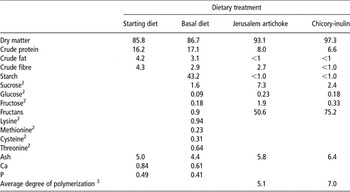
The dietary treatments were (i) negative control: basal diet on the basis of wheat and soyabean meal (low fibre content); (ii) positive control: basal diet + 9% chicory-inulin (6.3% pure inulin); (iii) basal diet + 4.1% dried Jerusalem artichoke (2.1% pure inulin); (iv) basal diet + 8.1% dried Jerusalem artichoke (4.2% pure inulin); and (v) basal diet + 12.2% dried Jerusalem artichoke (6.3% pure inulin). The calculated content of pure inulin in the diets was based on analyses of the Jerusalem artichoke product and on reported values from Orafti, Belgium. The basal diet was formulated to meet the requirements for all nutrients (National Research Council (NRC), 1998). The analysed chemical composition of the diets, the Jerusalem artichoke product and the chicory-inulin is given in Table 1.
Analysed chemical composition of the starting diet, basal diet, dried Jerusalem artichoke product and chicory-inulin product (g/100 g)Footnote 1

1 Eurofins Norsk matanalyse AS, PO Box 3055, 1506 Moss, Norway.
2 Eurofins AB, PO Box 737, 53117 Lidköping, Sweden.
3 Average degree of polymerization, PlantChem, PO Box 3082, Ganddal, Norway.
Experimental animals
A total of 55 entire male pigs (Norwegian Landrace × Yorkshire) × (Norwegian Landrace × Duroc) from 11 litters were used. Average initial weight was 25.3 kg and average final weight was 111.7 kg. A randomized block design was used. The experimental animals were blocked by litter and by live weight and divided into five dietary treatments (n = 11).
Experimental procedure
The experimental period lasted for an average of 91 days. The experimental animals were fed a commercial diet (starting diet) for an average of 61 days, then the basal diet for 23 days, followed by a 7-day-period where the different dietary treatments were added to the basal diet as a top dressing. Pigs were kept in pens designed for individual feeding. Residual feed was collected after every feeding to determine average daily feed intake. The pigs were fed twice daily consistent with a restricted Norwegian feeding scale (Øverland et al., Reference Øverland, Granli, Kjos, Fjetland, Stokstad and Steien2000), and had free access to drinking water at all times. Body weight was recorded once a week to determine average daily weight gain. The average room temperature was 16.1°C. Saw dust was used in the pens.
Sample collection
Uncontaminated faecal samples from each animal were collected from rectum 1 day before slaughter to determine content of skatole, indole and SCFA. The samples were frozen at −20°C pending analysis.
The pigs were slaughtered at a commercial slaughterhouse within 2 h after receiving the last meal. The entire digestive tract was taken out at the slaughter line, and the collection of uncontaminated samples from colon ascendens and rectum started immediately. Digesta from colon ascendens was collected to investigate skatole, indole, pH and selected groups of cultivable bacteria, and digesta from rectum was collected for bacterial examination. The samples from colon ascendens were taken 20 cm distal to the ileocaecal opening and from rectum approximately 5 to 10 cm proximal to the anus. All samples were kept on ice before either being frozen at −20°C pending analyses or incubated for bacterial examination. For the microbiological examination, 0.5 g samples were diluted in 4.5 ml 0.9% saline, and further serially diluted. From the dilution, 0.1 ml was placed on four selective media. All sampling were completed within 3 h after slaughtering, and all samples were processed for bacterial cultivation within 4 h after collection.
Samples of adipose tissue from the neck region were collected to determine levels of skatole, indole and androstenone. The samples were kept frozen at −20°C until being analysed. Carcass weight and carcass lean percentage were measured at the slaughterhouse.
Bacterial counts from intestinal samples
Lactic acid-producing bacteria (LAB) were grown on MRS-lactobacillus agar (MERCK 10660, Darmstadt, Germany) aerobically at 37°C for 72 h. Enterococcus spp. were grown on Slanetz & Bartley agar (Oxoid CM377, Cambridge, UK) aerobically at 37°C for 72 h. Coliforms were grown on MacConkey agar (MERCK 5465, Darmstadt, Germany) aerobically at 37°C for 24 h. Clostridium perfringens was grown on TSC agar (Oxoid CM0587 Cambridge, UK) anaerobically at 37°C for 48 h with MERCK Anaerocult A (Darmstadt, Germany).
The figures from the bacterial counts were recorded as colony-forming units (CFU)/g digesta (Swanson et al., Reference Swanson, Busta, Peterson and Johnson1992). In a few cases, the dilution ranges chosen for isolation (coliforms in colon ascendens and rectum 10−3, 10−4 and 10−5; enterococci in colon ascendens and rectum 10−2, 10−3 and 10−5; LAB in colon ascendens and rectum 10−5, 10−6, 10−7) were either under- or overestimated. It was not practical to use undiluted or 10−1 diluted digesta for spreading on agar plates because of consistency of the material. When the bacterial concentrations were lower than our minimal detection level (10−2), a log10 of 1.9 was registered. In cases of higher bacterial counts, compared with the dilutions permitted to count, a log10 value of 1 higher than the highest dilution was set as the count value.
Analytical methods
Dry matter (DM; EU Dir. 71/393), crude protein (Kjeldahl-N × 6.25; EU Dir. 93/28), crude fat (EU Dir. 98/64), crude fibre (EU Dir. 92/89) and ash (EU Dir. 71/250) contents were analysed in the starting diet, the basal diet, the dried Jerusalem artichoke product and the chicory-inulin product. In addition, the starting diet and the basal diet were analysed for Ca and P (NS-EN ISO 11885), and the basal diet for starch (AOAC 996.11), sucrose, glucose and fructose (LidVit.0A.26 Dionex), fructans calculated as inulin (AOAC 997.08) and the amino acids lysine, methionine, cysteine and threonine (SS-EN ISO 13903 : 2005). The Jerusalem artichoke product and the chicory-inulin product were analysed for fructans calculated as inulin (AOAC 997.08). Degree of polymerization (DP) was estimated on material hydrolysed in acid (200 mg in 10 ml pH 1.1 H2SO4, 100°C, 1 h). Fructose, glucose and rest sucrose were measured by using HPLC with evaporative light scattering detection (HPLC-ELSD), and intact inulin/fructo-oligosaccharides were extracted and analysed by using HPLC-ELSD as described by Asp (Reference Asp1993).
Skatole and indole in extracted fat were determined by using HPLC with fluorescence detection as described by Gibis (Reference Gibis1994). The detection limit for both compounds was 0.005 μg/g. Androstenone in adipose tissue was analysed by using a time-resolved fluoroimmunoassay (Tuomola et al., Reference Tuomola, Harpio, Knuuttila, Mikola and Lövgren1997), modified by using antiserum described by Andresen (Reference Andresen1974). The digesta from intestine and faeces were analysed for skatole and indole by HPLC as outlined by Jensen and Jensen (Reference Jensen and Jensen1994), with chromatographic conditions described by Hansen-Møller (Reference Hansen-Møller1994). The SCFA in faeces were analysed by using a modified method of capillary gas chromatography (Jensen et al., Reference Jensen, Cox and Jensen1995a).
Calculation and statistical analysis
Differences among the dietary treatments in skatole, indole and androstenone in adipose tissue and in pH, skatole, indole, DM, SCFA and microbiota in intestinal contents were tested using analysis of variance (ANOVA) by the GLM procedure of SAS Institute (1990). In addition, the Ryon–Einot–Gabriel–Welsch multiple range test was used to separate means. Polynomial orthogonal contrast was performed to compare differences between the positive control group and the dietary treatment with 12.2% Jerusalem artichoke. Orthogonal polynomials were used to test linear responses of increased levels of Jerusalem artichoke in the diets. Pearson correlation coefficient (r) was used to evaluate co-variance between skatole and androstenone and between skatole and indole in adipose tissue. In addition, the co-variance between digesta and adipose tissue for skatole and indole, respectively, was measured. P < 0.05 was set as level for significant difference among dietary treatments, and P-value between 0.05 and 0.10 was defined as a tendency.
Results
Analysed chemical composition of the starting diet, basal diet, dried Jerusalem artichoke product and chicory-inulin product revealed differences between the dried Jerusalem artichoke and the chicory-inulin in fructan content (50.6% v. 75.2%) and in average DP (5.1 v. 7.0: Table 1).
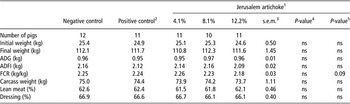
Jerusalem artichoke in diets for entire male pigs had in general no effect on growth performance and carcass traits (Table 2). A trend towards decreased feed conversion ratio was, however, noted (linear, P = 0.09).
Effects of increasing levels of Jerusalem artichoke on growth performance and carcass traits of entire male pigs

ADG = average daily weight gain; ADFI = average daily feed intake; FCR = feed conversion ratio.
1Dried Jerusalem artichoke, containing 50.6% inulin-type fructans.
29% chicory-inulin, Raftifeed®IPE (Orafti, Tienen, Belgium).
3Pooled s.e.m.
4P-value, GLM, all groups included.
5P-value, linear contrasts with increasing levels of Jerusalem artichoke (positive control omitted).
P-value: **P < 0.01; * P < 0.05; ns (non-significant) P > 0.05.
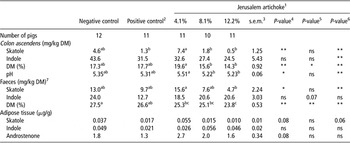
Feeding increasing levels of Jerusalem artichoke to pigs significantly reduced skatole in digesta from colon ascendens and faeces (linear, P < 0.01; Table 3). ANOVA showed that pigs fed 8.1% and 12.2% Jerusalem artichoke had lower skatole levels in colon ascendens than those fed 4.1%. Indole content in digesta from colon ascendens was reduced when increasing amounts of Jerusalem artichoke was fed (linear, P < 0.01), whereas no such effect was observed in faeces. Feeding Jerusalem artichoke to pigs resulted in a decreased DM content in both colon ascendens and in faeces, as well as a decreased pH in colon ascendens (linear, P < 0.01). According to ANOVA, the DM content and pH in colon ascendens were significantly lower in pigs fed 8.1% and 12.2% Jerusalem artichoke compared with pigs fed 4.1%. The faecal DM content in the 12.2% Jerusalem artichoke group was lower than the positive control group (23.8% v. 26.6%). In adipose tissue, the variation in skatole between individuals within each experimental group was large. The mean values were in general low, ranging from 0.010 to 0.055 μg/g. There was, however, a tendency towards decreased levels of skatole with increasing levels of Jerusalem artichoke added (P = 0.06). In addition, there was a significant positive correlation between skatole and androstenone (r = 0.499, P < 0.001) and between skatole and indole (r = 0.367, P < 0.01) in adipose tissue. Significant correlations in skatole content between faeces and colon (r = 0.451, P < 0.001), between faeces and adipose tissue (r = 0.458, P < 0.001) and between colon and adipose tissue (r = 0.523, P < 0.0001) were observed. No such correlations were found for indole (P > 0.05).
Effects of increasing levels of Jerusalem artichoke on skatole (mg/kg DM), indole (mg/kg DM), DM (%) and pH in hindgut content and on skatole, indole and androstenone in adipose tissue (μg/g) of entire male pigs

DM = dry matter.
a,b,cSignificant differences between dietary treatments using Ryon–Einot–Gabriel–Welsch multiple range test.
1Dried Jerusalem artichoke, containing 50.6% inulin-type fructans.
29% chicory-inulin, Raftifeed®IPE (Orafti, Tienen, Belgium).
3Pooled s.e.m.
4P-value, GLM, all groups included.
5P-value, orthogonal contrast, positive control v. 12.2% Jerusalem artichoke.
6P-value, linear contrasts with increasing levels of Jerusalem artichoke (positive control omitted).
7n = 11 in negative control group.
P-value: **P < 0.01; *P < 0.05; ns (non-significant) P > 0.05.
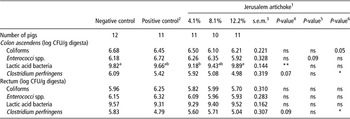
Pigs fed increasing amounts of Jerusalem artichoke had a tendency to reduced levels of enterobacteria in colon ascendens (linear, P = 0.05), whereas no such relationship was observed in rectum (Table 4). The levels of Enterococci spp. were not influenced by the dietary treatments. For LAB, a difference among the dietary treatments was observed in colon ascendens contents, ranging from 9.18 in the 4.1% Jerusalem artichoke group to 9.89 in the 12.2% group (log CFU/g). This effect was not observed in the rectum contents. Levels of C. perfringens were reduced in both colon ascendens and rectum (linear, P < 0.05).
Effects of increasing levels of Jerusalem artichoke on microbiota in colon ascendens and rectum of entire male pigs (log CFU/g digesta)

CFU = colony-forming unit.
a,bSignificant differences between dietary treatments using Ryon–Einot–Gabriel–Welsch multiple range test.
1Dried Jerusalem artichoke, containing 50.6% inulin-type fructans.
29% chicory-inulin, Raftifeed®IPE (Orafti, Tienen, Belgium).
3Pooled s.e.m.
4P-value, GLM, all groups included.
5P-value, orthogonal contrast, positive control v. 12.2% Jerusalem artichoke.
6P-value, linear contrasts with increasing levels of Jerusalem artichoke (positive control omitted).
P-value: **P < 0.01; * P < 0.05; ns (non-significant) P > 0.05.
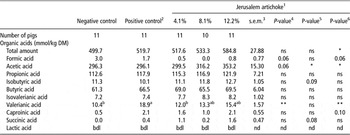
The effect of increasing levels of Jerusalem artichoke on SCFA content in faeces is reported in Table 5. There was an increase in total amount of SCFA (linear, P < 0.05), acetic acid (linear, P < 0.05) and valerianic acid (linear, P < 0.01) with increasing amounts of Jerusalem artichoke added. According to ANOVA, the 4.1% group was similar to the negative control but lower than the positive control for valerianic acid, whereas the 8.1% and 12.2% Jerusalem artichoke group were similar to both the positive and negative control (P < 0.01).
Effects of increasing levels of Jerusalem artichoke on SCFA (mmol/kg DM) in faeces of entire male pigs

SCFA = short-chain fatty acids; DM = dry matter; bdl = below detection level.
a,bSignificant differences between dietary treatments using Ryon–Einot–Gabriel–Welsch multiple range test.
1Dried Jerusalem artichoke, containing 50.6% inulin-type fructans.
29% chicory-inulin, Raftifeed®IPE (Orafti, Tienen, Belgium).
3Pooled s.e.m.
4P-value, GLM, all groups included.
5P-value, orthogonal contrast, positive control v. 12.2% Jerusalem artichoke.
6P-value, linear contrasts with increasing levels of Jerusalem artichoke (positive control omitted).
P-value: **P < 0.01; * P < 0.05; ns (non-significant) P > 0.05.
Discussion
A major objective in the present experiment was to investigate the effect of adding the fructan-rich Jerusalem artichoke in diets for entire male pigs during a short period before slaughter on skatole formation in the hindgut and further deposition in adipose tissue. Our results showed that increasing levels of Jerusalem artichoke in the diet resulted in a dose-dependent decrease in skatole levels in the hindgut and a corresponding trend for skatole in adipose tissue. In agreement with the present experiment, several studies with pigs reported reduced skatole levels in intestinal content, plasma or adipose tissue when fermentable carbohydrates were fed (Knarreborg et al., Reference Knarreborg, Beck, Jensen, Laue, Agergaard and Jensen2002; Jensen and Hansen, Reference Jensen and Hansen2006; Øverland et al., Reference Øverland, Kjos, Fauske, Teige and Sørum2011). Hansen et al. (Reference Hansen, Mejer, Thamsborg, Byrne, Roepstorff, Karlsson, Hansen-Møller, Jensen and Tuomola2006) added crude and dried chicory and chicory-inulin in diets for pigs (25% of total energy intake) during different periods before slaughter, ranging from 1 to 9 weeks. They concluded that adding dried chicory for as little as 3 days reduced skatole in plasma. The optimal feeding period and dietary level of inulin-type fructans are, however, not stated. Skatole is produced in the hindgut by specialized bacteria by fermentation of the amino acid l-tryptophan (Yokoyama et al., Reference Yokoyama, Carlson and Holdeman1977; Zamaratskaia, Reference Zamaratskaia2004). Carbohydrates that escape digestion in the small intestine serve as an energy substrate for bacteria in the large intestine (Gibson and Roberfroid, Reference Gibson and Roberfroid1995; Kolida and Gibson, Reference Kolida and Gibson2007). When carbohydrates are used as energy by bacteria, the demand for N from amino acids will increase due to higher microbial protein synthesis. Thus, if sufficient amounts of fermentable carbohydrates are available, l-tryptophan will probably be incorporated into the bacteria to a larger extent. On the other hand, if the amount of fermentable carbohydrates in the hindgut is insufficient, l-tryptophan will be used as energy source for proteolytic bacteria with skatole as a possible end product.
The significant correlations between skatole in hindgut and adipose tissue observed within individual animals in the present experiment indicate that the amount of skatole deposited in adipose tissue is, to some extent, determined by the amount produced in the hindgut. This is in accordance with an earlier study by Knarreborg et al. (Reference Knarreborg, Beck, Jensen, Laue, Agergaard and Jensen2002), reporting highly correlated skatole concentrations between faeces and blood. Jensen et al. (Reference Jensen, Cox and Jensen1995a) also reported correlation between skatole in hindgut and adipose tissue, but large individual differences among animals were observed. The high correlation between skatole and androstenone in adipose tissue observed in the present experiment is in accordance with a study by Zamaratskaia et al. (Reference Zamaratskaia, Babol, Andersson and Lundström2004b), reporting high correlations between skatole and androstenone in plasma in older pigs (20 weeks). This may be caused by the inhibitory effect of the increased levels of sex steroids on the enzymes involved in skatole metabolism at this age (Babol et al., Reference Babol, Squires and Lundström1999; Doran et al., Reference Doran, Whittington, Wood and McGivan2002; Whittington et al., Reference Whittington, Nute, Hughes, McGivan, Lean, Wood and Doran2004).
The decreased DM content in faeces of pigs fed Jerusalem artichoke is possibly due to an osmotic effect caused by non-absorbed sugars in the gut lumen. The lower DM content in faeces of pigs fed 12.2% Jerusalem artichoke compared with those fed the positive chicory inulin-based control, despite the similar dietary level of inulin-type fructans of 6.3%, may be caused by the shorter DP in inulin-type fructans from Jerusalem artichoke compared with those from chicory (5.1 v. 7.0). This could result in an increased osmosis into the gut lumen due to elevated numbers of particles, explaining the lower DM content.
The reduced pH in the large intestine of pigs fed increasing amounts of Jerusalem artichoke may be explained by the increased SCFA levels. Addition of fermentable carbohydrates to diets for pigs has shown to raise SCFA production in the hindgut (Claus et al., Reference Claus, Lösel, Lacorn, Mentchel and Schenkel2003). Reduced protein fermentation due to increased microbial protein synthesis may also result in less NH3, and thus contribute to the decline in pH. It is possible that pH in the hindgut is an environmental factor that can reduce the amount of skatole-producing bacteria present or alter the metabolic activity in the bacteria towards indol production at the expense of skatole. A study on 3-methylindole production in Clostridium scatologenes ATCC 25775 by Doerner et al. (Reference Doerner, Cook and Mason2009) found that skatole production decreased if pH was reduced from 7 to 5, and they further suggested that skatole production can be downregulated because it is not an essential metabolic function. A study by Jensen et al. (Reference Jensen, Cox and Jensen1995b) measuring skatole and indole formation from l-tryptophan in pig faecal slurries in vitro, reported that the amount of l-tryptophan converted to skatole at the expense of indole was increased at pH 5 compared with pH 8.
The inhibitory effect of inulin-type fructans on C. perfringens observed in the present experiment is also reported in earlier studies evaluating Clostridium spp. (Gibson et al., Reference Gibson, Beatty, Wang and Cummings1995; Xu et al., Reference Xu, Hu and Wang2002). Bacteria reported as skatole producers often belong to the genus Clostridium (Jensen et al., Reference Jensen, Cox and Jensen1995b; Attwood et al., Reference Attwood, Li, Pacheco and Tavendale2006; Doerner et al., Reference Doerner, Cook and Mason2009). The amount of C. perfringens in the digesta can potentially be used as an indicator on the amount of bacteria from the genus Clostridium present (H. Sørum, personal communication). Thus, it may be hypothesized that adding inulin-type fructans in feed results in reduced growth of the genus Clostridium in general, resulting in reduced skatole synthesis. Studies using methods that can identify the bacteria-producing skatole in the hindgut of pigs, however, as well as the magnitude of the skatole production in these bacteria will be necessary to further confirm this hypothesis.
In the present experiment, we observed a significant effect of diet on total SCFA, acetic acid and valerianic acid content in faeces. This increase can be explained by fermentation of inulin-type fructans to SCFA. The higher levels of valerianic acid when inulin-type fructans was added in the diet are in agreement with a study by Øverland et al. (Reference Øverland, Kjos, Fauske, Teige and Sørum2011), adding chicory-inulin in diets to entire male pigs. Earlier studies report that feeding easily fermentable carbohydrates as raw potato starch to pigs results in higher butyrate production in the hindgut (Claus et al., Reference Claus, Lösel, Lacorn, Mentchel and Schenkel2003; Mentschel and Claus, Reference Mentschel and Claus2003). Increased butyrate in the hindgut has been suggested to inhibit apoptosis of colonic mucosal cells (Hass et al., Reference Hass, Busche, Luciano, Reale and Engelhardt1997; Mentschel and Claus, Reference Mentschel and Claus2003), and is implied as an explanation to lower skatole production in the hindgut due to less substrate for skatole production (Claus et al., Reference Claus, Lösel, Lacorn, Mentchel and Schenkel2003). In the present experiment, there was no effect of diet on butyrate concentration in the hindgut. The sampling method used in the present experiment, however, may be limited. Faecal samples should ideally be frozen immediately after sampling and with no exposure to O to preserve the authentic amount of SCFA. The faecal samples in the present experiment were exposed to O in the test containers that may have influenced the butyrate concentration. In addition, the faecal collection process took 1 h, and the samples were not frozen before sampling from all test animals was completed. Thus, it is possible that further metabolism of SCFA into CO2 and H2O in the bacteria might have occurred. In addition, SCFA are, to a large extent, absorbed in the hindgut in humans, as discussed by Kleessen et al., (Reference Kleessen, Schwarz, Boehm, Fuhrmann, Richter, Henle and Krueger2007). Faecal concentration of SCFA may thus not be representative for the true levels in the hindgut. The faecal level of butyric acid and other SCFA in the present experiment may thus have been underestimated and thereby masking the possible dietary effect.
In conclusion, adding dried Jerusalem artichoke to diets for entire male pigs 1 week before slaughter may be an effective method to reduce skatole levels in hindgut and adipose tissue. Inclusion of Jerusalem artichoke in the diet resulted in a dose-dependent decrease in C. perfringens and increase in SCFA with subsequent reduction in pH.
Acknowledgements
We thank Linda Andreassen and the rest of the staff at the pig house for technical assistance and animal care. We also thank Aud Kari Fauske and the rest of the staff at the microbiological laboratory for their help. We also extend our thanks to Frank Sundby and Nicole Frost Nyquist for technical assistance in sampling at the slaughterhouse. This work was supported financially by Bioforsk, Norway and The Research Council of Norway.