




No CrossRef data available.
Article contents
- Abstract
- ARE THE KILNS “OUT BACK”?
- FINE CERAMIC PRODUCTION ASSOCIATED WITH TIKAL GROUP 4H-1
- ETHNOGRAPHIC ANALOGY
- SAGGER KILNS: A POSSIBLE ALTERNATIVE?
- THE BAJO: A LAND OF OPPORTUNITY
- CLUES TO HOUSE LOT CONFIGURATION AND FIRING LOCATIONS:
- DISCUSSION
- CONCLUSIONS AND DIRECTIONS FOR FUTURE RESEARCH
- ACKNOWLEDGMENTS
- APPENDIX: NOTES ON PRE-HISPANIC FIRING AREAS
- References
A CLASSIC-PERIOD BARRIO PRODUCING FINE POLYCHROME CERAMICS AT TIKAL, GUATEMALA: Notes on ancient Maya firing technology
Published online by Cambridge University Press: 11 July 2003
Article contents
- Abstract
- ARE THE KILNS “OUT BACK”?
- FINE CERAMIC PRODUCTION ASSOCIATED WITH TIKAL GROUP 4H-1
- ETHNOGRAPHIC ANALOGY
- SAGGER KILNS: A POSSIBLE ALTERNATIVE?
- THE BAJO: A LAND OF OPPORTUNITY
- CLUES TO HOUSE LOT CONFIGURATION AND FIRING LOCATIONS:
- DISCUSSION
- CONCLUSIONS AND DIRECTIONS FOR FUTURE RESEARCH
- ACKNOWLEDGMENTS
- APPENDIX: NOTES ON PRE-HISPANIC FIRING AREAS
- References
Abstract
Significant indirect evidence suggests that one of the Classic-period residential groups at Tikal was the residence of a family of potters who produced high-quality painted wares. Delineation of the borders of residential Group 4H-1 at Tikal led me to postulate that the bajo was a major resource zone for ceramic manufacturing rather than a spatially limiting feature. This family of upscale ceramic producers used the adjacent bajo as a source of clay and fuel for firing pottery. The configuration of other groups near Group 4H-1 suggests not only that the people occupying the several groups on this peninsula were related, but that they were all involved in the production, painting, and distribution of fine ceramics. These several residential groups, located on adjacent house lots, define a barrio within Tikal whose occupants formed an extended kin unit sharing an economic focus on the production of high-quality ceramics. A consideration of the contents of trash deposits that were used by the Maya for building fill and a study of the middens found adjacent to residential groups at Tikal provide clues to the location of a specific kiln, or firing area. Broken pottery in the structure fill tells us more than architectural history. In this example, pottery indicates how other aspects of one or more house lots were organized and used. In particular, these data suggest that a barrio-like cluster of households at Tikal, with its own ritual center (Group 5G-I), housed families of ceramic producers who had specifically located their residences in direct proximity to the bajo. The search for the firing facilities associated with the production of ceramics in Group 4H-1 is now a major research focus. “Kilns,” or firing facilities, should be among the various architectural features found “out back,” or located on the margins of a house lot. Kilns may have been of the trench type or free-standing small buildings, possibly within sheds, and are expected outside the perimeter formed by the main buildings of the residential group. The structures facing a plaza or series of plazas that are the most obvious elements of a single household tend to attract archaeological attention. Location of structures “out back,” or peripheral to the residential core buildings, could help define the configuration of household lots.
Information
- Type
- Research Article
- Information
- Copyright
- © 2003 Cambridge University Press
At many ancient Maya sites clusters of buildings, building platforms, and other architectural elements that are visible from the surface have long enabled us to recognize that each of these groups represents a single house (Wauchope 1934). Each aggregate of structures represents only the most visible aspect of a residential-agricultural complex. Hereafter, the term “house” will be applied to each group or cluster of proximal and presumably related structures. The buildings and related features that form such a house are what Thomas Killion (1992) describes as the “structural core” of a residential site. The cleared area, or open space surrounding each house, was used by the residents of a group as garden or growing area (Johnston and Gonlin 1998:159). These areas are seldom mentioned and rarely tested by archaeologists, but they merit attention. The configuration of the boundaries of each of these areas, or each house lot, may help us to determine why some architectural groups may be located extremely close together while many other groups are spaced at considerable and regular distances (Becker 2001). For the evaluation of the many facets of these residential groups, the important work of Luis Barba and Linda Manzanilla (1987) is essential reading.
Although the archaeology of the house has long been a major focus in historic as well as prehistoric archaeology, attention to the gardens, yards, and grounds surrounding each house has only recently become of primary importance (Allison 1999; Becker 2001). As the archaeology of households and the specific activities associated with them become more common foci for research programs, attention remains targeted toward the principal structures associated with the group. Recognition of the complexity of Classic Maya society is associated with the belief that some level of occupational specialization was common in residential groups, such as those identified at Tikal (Becker 1973) and Copan (Bill 1997). Now greater attention can be directed toward understanding how individual household units functioned and whether any specialized crafts can be linked with them.
One of the specialized crafts of interest is that of ceramic manufacture, or fabrication. Pottery has long been used as a means of evaluating site chronology. Now pottery production, or all those processes involved in commissioning, firing, decoration, and gift or sale of finished wares (Bey and Pool 1992; Blinman and Wilson 1992), have become subjects of considerable archaeological interest. The intrinsic beauty of many pieces and the skills of production needed to create high-quality examples also reflect the complex society in which the Classic-period Maya lived (Costin 2001a:273; Inomata 2001:321; Stark 1985). For the ancient Maya, we have direct evidence of the use of high-quality ceramics during the Classic period but little direct evidence of how they were produced. Ancient production areas often are inferred based on finds of pottery. Ethnographic data also suggests locations of possible “production areas” (Arnold 1991; Reents-Budet 1998), and helps to link the manufacture and distribution of these ceramics to our inferences regarding complex socioeconomic and political considerations (Ball 1993; Blackman et al. 1993).
ARE THE KILNS “OUT BACK”?
A vast range of structures that relate to “industrial” as well as to domestic or agrarian functions must have stood in and around the core group of structures (plaza group) that formed most ancient Maya houses. The locations of structures such as kilns might be expected to be in open spaces at the far margins of a potter's house lot, but we have yet to decode the configuration of such residential plots. Linda Manzanilla's (1987) reviewed the importance of recognizing individual habitation units and the functions for the separate structures within them. Barba and Manzanilla (1987) expanded these studies by examining the Classic-period activity areas within several residential areas at Coba.
Evaluation of the pottery found in association with a structure has long been used to infer a building's function. Robert E. Smith (1971), while working at Mayapan, attempted to identify the functions of specific structures primarily based on the ceramic fragments found in direct association. Those structures identified by Smith as “kitchens,” and a wide range of structure platforms that he identified as ordinary dwellings, did seem to have a preponderance of utilitarian (unpainted) ceramic wares associated with their debris. However, the functions of the “elaborate dwellings” and large, supposedly religious structures were not clearly identified by associated pottery (Leventhal and Baxter 1988:54–55). The difficulties in this line of research into the function of individual structures that make up a house may derive from the failure to differentiate among structures on the basis of form or group membership (Becker 2002; Rivera Dorado 2001). These considerations of structure function have been of concern to many archaeologists, and in particular to ethnoarchaeologists interested in ceramic production (Longacre 1991).
Discussions of the origins of ceramic technology, whether in Mesoamerica (Clark and Gosser 1995) or anywhere else in the world, treat most firing as an extremely simple process. High-quality painted wares characterize the Maya Classic period and suggest the use of a complex firing technology such as that achieved using a true kiln. True kilns provide better control over the firing process, but as Philip Arnold (1999:112) points out, they are time-consuming to erect and maintain. Some modern potters Arnold has worked with prefer to use a neighbor's kiln. But this still requires that a kiln be built. Arnold also notes that an open firing has advantages even though it produces fewer vessels. All of the vessels produced in Arnold's study area were quite simple, and none resemble the hard-fired decorated wares of the Classic Maya.
A few definitions relating to pottery technology will help readers understand ceramic production in general. The term “kiln” can be applied to any oven, furnace, or heated enclosure used to process ceramics by firing (Pool 1997:149, 2000). The term “kiln” has been variably applied in the Maya literature, often including simple, open firing locations where pots are placed within a pile of fuel placed directly on the ground surface. Usually, the term “kiln” refers to a construction that has a firebox separated from a chamber or oven with a heat-resistant lining, commonly with a perforated “floor separating the two chambers” (Carter 2000:124). Since the term “kiln” often is applied to any firing system, I will use the term “true kiln” to describe those firing systems employing a separate firebox, no matter how crude. The term “sagger” refers to a crudely made, simply fired box or container made of fire clay, often of cylindrical shape, into which delicate ceramic pieces are placed to be fired. Saggers provide additional protection and separation for pots placed within the firing chamber of a kiln. Saggers are most commonly associated with true kilns, but a possible alternative method of use will be discussed later.
A pit kiln is simply a pit into which fuel is laid and pottery to be fired is placed on top or within the combustibles. A similar effect is achieved by simply piling brush and wood on the ground and placing pots among these firing materials, but a pit offers both insulation as well as some regulation of draft (also, see later). A trench kiln is simply a trench that is dug out of the ground, often into a slope, oriented along the direction of the prevailing winds. Pottery to be fired is placed downwind, and brush or other materials are placed windward in the trench. No formal separation is made of the pottery and the firing materials (see Purcell 1992). In theory, a pit or trench kiln could be divided into a firebox and separate oven that would act as a true kiln. The most simple updraft kiln directly resolves the dynamics of heat flow, whereas a trench kiln would depend on a sloping floor or prevailing winds to control the temperature of the pottery. Sandra López Varela and her colleagues (1999:230–233) also report the discovery in conjunction with these “kilns” of a number of possible tools for working pottery, themselves being made of ceramics, possibly reused sherds. Rice has suggested to me that she would expect ancient Maya kilns to have been located “below” ground. Stark's (1985) important paper on ceramic production, cited earlier, provides a basis for this line of research.
Olivier Gosselain's (1992) important observations on pottery-making processes are critical to this study. Gosselain studied the temperatures associated with five types of firing. These are (1) open firing (on the ground); (2) open firing with sherds covering the mass (see Stark [1985:174] regarding Tlacotalpan and other places where sherds are used as “kiln” furniture); (3) pit firing; (4) pit firing with sherds covering the mass; and (5) updraft “kiln” firing in which a rudimentary updraft system is created by piling pots above the fuel but not employing a separate firebox and oven. The first four all generate temperatures in the 600–950°C range. Number one is associated with the widest range of temperatures, while the number four has the tightest control. Only the updraft system, although it employs no separate oven chamber, can reach nearly 1100°C. Of equal importance to these critical data are Gosselain's notes on the use of these data. His goal was to cast doubt on the value of temperature tests, but his evidence shows that the most simple updraft system can generate temperatures higher than any of the other techniques. Regarding firing temperatures, Gosselain (1992:243) states that:
[a] brief review of the archaeometric analyses containing this kind of information shows how poorly they have been exploited: in most cases, the identified temperatures are not included in any archaeological reasoning.
Simple testing of sherds from our sites could tell us a great deal about the possible types of firing systems that were used. Our failure to conduct such tests reflects Gosselain's (1992) note that we need to integrate scientific findings into archaeological interpretations.
The Maya archaeological record does not include reports of saggers or other kiln furniture, suggesting that no true kilns were in use. At sites such as Tikal, the apparent absence of kilns may, however, relate to the principal focus of excavations on elite and ritual structures. Marilyn Beaudry and Andres Ciudad (2001) make the important observation that, even at the huge urban center of Teotihuacan, open firing was the rule. Where kiln furniture such as saggers does appear, it may not be recognized, or it may be evaluated as large, coarseware censers. Note should be made of Lisa Ferree's observation (1972:197) that in the development of “censer technology,” the most important development “was the adoption of volcanic ash temper, in place of carbonate temper, toward the end of the Early Classic period.” Ferree believes that this finer, lighter ash renders clay “more workable and provides a more even distribution of heat during firing than does the heavy, coarser carbonate.” Ferree suggests that this technological change allowed the production of a new “form” of censer that was not technologically possible before this development. The idea of a “more even distribution of heat during firing” and changes in form might also be applied to saggers (Iglesias 2003). Many of the vessels that Ferree identified as censers may have been saggers. I suggest that saggers, or this “vessel” type, had a specific use—if not dual uses—in the firing process. I propose the term “sagger-kiln” to describe a firing process in which fine wares are placed into some type of sagger, then placed in a pit or any other firing context where no true kiln has been built.
Kiln wasters may be recycled as “kiln furniture” (Arnold et al. 1999:65; Stark 1985:165, 174). Wasters, defined as any vessels or objects broken or damaged in the production process, can be used as saggers, supports, or other types of “kiln” furniture. Wasters from true kilns commonly reflect warping, cracking, or blistering associated with high-temperature firing errors (Rye 1981:110–113). At times, the term “waster” only is applied to pieces distorted and blistered during the firing process. O. S. Rye observed (1981:118) that “firing loss” or breakage from open firing can be about 27% of the total, while losses from firing in a true kiln are lower, or about 20% (also see Arnold 1991:56). Rye's more general “firing loss” may be the more accurate description. Stark's (1985:174–176) data on waster rates should be noted. Dean Arnold and his colleagues suggest that every (built) kiln can be expected to have an associated waster pile, such as that beneath Tikal Structure 4H-2 (see later), but they suggest that “abandoned kilns have no waster piles” (Arnold et al. 1999:66). This may reflect the level of production, because it is not true for Pennsylvania's colonial potteries, where waster piles remain evident 300 or more years after a kiln was abandoned (Becker 1988). In the Maya Lowlands, wasters and other materials had their own value, particularly at a site such as Tikal, where even fill material was valuable and constantly recycled (Costin 2001a:322; Hayden and Cannon 1983; Moholy-Nagy 1997).
The nine architectural groups at Tikal that are on a peninsula jutting into the bajo Santa Fe (Becker 1999) form a naturally defined barrio within which the occupants produced and distributed finely painted ceramics. Group 4H-1, at the far tip of the peninsula, served as the residence and production center for the actual potters involved in the working of clay and the firing process. Important to the interpretation of social dynamics within this proposed ceramic-producing barrio at Tikal is Arnold's (1991:87–91) ethnographic study focusing on the description of the actual firing facilities and the tools used, linked with the results of the firing process. Essential are Arnold's (1991:99) observations on the spatial organization of ceramic production. His important note that variations in firing relate to spatial pressures at the household level are congruent with the limited evidence from Tikal, and it will be even more significant when examining areas where less space is available to the local potters. Quite possibly, fine pottery was produced only where space and resources were abundant.
Many archaeologists have inferred the general areas at a site where ceramics may have been made (for Copan, see Bill 1997:421). Of interest is an approach to ceramic-production sites used by some archaeologists that ignores or downgrades the direct archaeological evidence and relies on speculative evaluations based on indirect evidence. The paucity of direct evidence for kilns or any type of firing location leads us to consider the indirect evidence for pottery production (Bill 1997:465–476). Lisa Lucero (1992:144–145) considers five clues to ceramic-production areas. Her first three factors derive from the presence of fine polychromes rather than any evidence for their actual production. The presence of “kilns,” wasters, and molds in a group is the fourth factor on her list of indicators, and sherd density is the fifth. Lucero suggests that sherd densities may provide clues to possible firing locations. But even “specific” areas of production rarely have been identified, leaving Lucero and others to infer that numbers and distribution within sites, such as in graves, may reveal approximate points of origin. The focus of the following essay is on the documentation of fundamental data regarding ceramic production in the Maya area and the immediate socioeconomic aspects reflected by this “industry.” Before we look at the evidence, we should note the important statement of Gary Feinman and Andrew Balkansky (1997:129) regarding the lack of evidence for a simple evolution of firing technology from open firing to more complex systems. They repeat George Foster's (1967) observation that in ancient Mesoamerica, and particularly Mexico, a considerable array of firing techniques were employed, reflecting the wide diversity of cultures. Whether these techniques included true updraft kilns prior to about a.d. 900 remains to be verified.
FINE CERAMIC PRODUCTION ASSOCIATED WITH TIKAL GROUP 4H-1
Despite all we know about pre-Hispanic Maya ceramics, their specific production sites remain elusive. In fact, pottery “firing” areas are most commonly “identified” through sherd counts and identification of other materials presumed related to pottery production (Feinman and Balkansky 1997). Jacques Bordaz (1964) identified an actual kiln site in coastal Nayarit, Mexico, some 40 years ago (see the Appendix), but examples in the Maya region have been identified only recently. Although we now have evidence for several Lowland Maya structures that have been interpreted as kilns, most date from the Terminal and Postclassic periods. T. Patrick Culbert, Prudence M. Rice, and other scholars remain unconvinced that true kilns were used during the Classic period or that we can easily determine what an ancient Maya firing system might look like (Appendix).
Excavations at Group 4H-1 at Tikal in 1962 produced extensive indirect evidence for nearby ceramic manufacturing (Becker 1973, 1999:15–39, Figures 12–33). The primary clue was the discovery that fills beneath Structure 4H-2 in this group incorporate at least one huge waster pile, more than 1 m deep, composed almost exclusively of pieces of high-quality Classic-period polychrome ceramics. Very little earth infiltrated among these sherds. The extent of this large heap, covering an area at least 6 m × 12 m, is so great that it formed the entire foundation for Structure 4H-2. After the construction of Structure 4H-2, essentially over this sherd pile, the dump continued to build up behind the structure and extend out into the bajo (Becker 1999; Figure 2). Excavation of this group was briefly diverted to the “mining” of the ceramic dump when it was determined to be a stratified pile that had been used throughout much of the Classic period. Most significant is Culbert's observation (personal communication 2002) that his study of these sherds did not identify any “kiln-produced” (warped, blistered) wasters. Rye's data on “firing loss” noted earlier help explain the vast quantities of sherds from the Group 4H-1 dump. Because this deposit consists of nearly pure ceramic materials and runs along the entire north retaining wall of the group's platform (Becker 1999; Figures 2 and 4), the term “pottery dump” might provide a more appropriate description of these “wasters” from a large manufacturing system (Toll 2001).
The several pieces of indirect evidence for ceramic production in the immediate area of Group 4H-1 at Tikal that have been recovered to date are worth listing. Note should be made that once the volume and quantity of ceramics noted in this first item listed became known, the materials were directed to the Tikal Project ceramicist, T. Patrick Culbert, for analysis and review (Culbert 1993). Given the wide range of uses for broken ceramic materials, of which seven categories are listed by Michael Deal and Melissa Hagstrum (1995:114–115, 123), the accumulation in Group 4H-1 is particularly impressive (Stark 1985; Staski and Sutro 1991). Philip Arnold (1991:120, 122, 123) reviews disposal patterns for wasters among modern potters firing simple wares, noting surface distribution of artifacts as well as discrete refuse areas. Dean Arnold and colleagues (1999) suggest that waster fragments also might serve as “toilet paper,” among many possible uses, and that such sherds may be found toward the “rear of house lots” (Becker 2001).
- Recovery of a huge volume (ca. 25 of an estimated 75 m3) of extremely high-quality sherds (fine or “elite” ceramics) from a vast waster pile, much of which had been incorporated into the basal platform of Structure 4H-2 (Becker 1999:15–16). Study of these ceramics, mostly dated to about a.d. 550–700 (Culbert 1993), suggest that they were not fired in a true kiln, as they show no warping, cracking, or other indications of firing errors.
- The presence of fragments from a unique pair of decorative ceramic “masks” representing the face of the “Long Nosed” god. These ceramic masks appear to have been mounted on the facade of Structure 4H-4. These ceramic features are comparable in form, but not size, to stucco masks commonly adorning the facades of major temples at Tikal.
- Fragments of five Classic-period molds for forming ceramic objects (1 censer and 4 figurine) were found in Group 4H-1, or 46% of the total of 11 found by the Tikal Project in excavations throughout the site (Greene 2000; McClung and Aguilar 2001). The Proyecto Nacional Tikal (PNT) has identified only three “figurine” fragments, all of Imix date and all at Group 7C-IX (María Josefa Iglesias and Juan Pedro Laporte, personal communication 1999).
- Elevated numbers of what had been identified as censer fragments, relative to any other residential area of Tikal. H. Moholy-Nagy (personal communication 1999) thinks of these as “remnants of ceremonial behavior.” In the case of Group 4H-1 a “ritual” explanation for their presence seems less likely, given this location on the margins of the site (Figure 1) as well as the other information suggesting these are part of ceramic production. Whether some of these fragments represent saggers or are another type of ceramic product made at or near Group 4H-1 has not been explored.
- Winged candeleros (formerly called “candlesticks”) are items identified as incense burners by Ferree (H. Moholy-Nagy, personal communication 1999). The numbers of these, plus large numbers of wall inserts or objects that look like flaring jar necks specially made and painted to be plastered to the insides of doorways where they were used to tie door hangings, suggest the range of painted wares made here. The numbers appear in very large quantities, far beyond any numbers that would be used “in a small structure group” (T. Patrick Culbert, personal communication 2000).
- Inferred presence of clay sources in the adjacent Bajo Santa Fe.

Group 4H-1 at Tikal, the residence of ceramic producers (from Becker 1999). Scale 1:400.
We do not expect the survival of wooden tools, gourds, or other perishable items noted in the ethnographic record such as scrapers and other shaping tools used to decorate pottery surfaces. String used to cut clay is unlikely to survive. However, we might expect certain materials to be present in the archaeological record. Not evident among the artifact assemblage at this locus, but that would be expected in the household of potters producing fine quality wares, are the following:
- Polishing or burnishing tools in the form of smooth stones or sherds, or even reused celts (Foster 1967; Stark 1985:179). Foster also notes that many of these tools also can be used in making baskets.
- Evidence for pigment processing or production (Inomata 2001:326–329; Inomata and Stiver 1998). Although these may have been found associated with other groups on this peninsula (Figure 3), none has been specifically identified.
- Tools that can be used in the application of paints.
- Concentrations of fragments of burned daub, believed to represent clay used to seal a firing container or “kiln.” Examples have been noted by Christopher Pool (1997) in association with what I call the sagger kilns from Middle Classic-period Matacapan (Arnold 1989).
Identification in the area of Group 4H-1 of six of these ten possible material traits associated with pottery production is impressive evidence for the proximity of a ceramic production area (Arnold 1991). This constellation of traits is not described for any other Mesoamerican location, even from those few archaeological contexts that are in “direct” association with those pottery production sites now known from the Maya area (see later). Furthermore, the very location of Group 4H-1 at Tikal conforms to what Robert Fry (1969) predicted regarding the placement of pottery-production areas on the peripheries of that site. The potential for evaluating clay sources from this immediate area and comparing the chemical and mineralogical results with tests of the pottery from this dump should find them all of relatively homogenous composition (Reents-Budet et al. 2000). Group 4H-1 at Tikal merits excavation to bedrock to pursue the archaeological evidence indicating the production of polychrome pottery by its residents (Figure 1).
Excavations in the area of Group 4H-1 identified nine architecturally similar groups of structures, each conforming to the same Plaza Plan (PP) identified as PP2 (Becker 2002). PP2 groups at Tikal are characterized by a relatively small, relatively tall, relatively square “shrine” situated on the eastern side of the group's central plaza. The thesis that fine ceramics were a product of the householders in Group 4H-1 (Balkansky et al. 1997 on field methods) was elicited from the excavation data long after the excavations had been completed (Sillar 2000). The direct archaeological evidence from artifact assemblages in PP2 groups (Becker 1999) needs to be compared with assemblages from other groups, such as those that conform to PP3 (Haviland 2003; Haviland et al. 1985). In addition to the artifactual evidence, the residential complexes on the peninsula where Group 4H-1 is located appear to parallel the extended household plan described by Isabelle Druc (2000; Figure 2) for her site in modern Puebla. Druc depicts two households that face each other, noting that both were pottery-producing locations, and she infers that these groups served as residences for related families. Barbara Stark (1992) points out that the settlement patterns in southern Veracruz are similar to those noted from the Maya Lowlands but that the ecological setting is very different. The Maya settlement pattern follows a basic set of rules despite local environments, suggesting that the locations of outbuildings may be similar from region to region.

Section A–A' through Structure 4H-2, built over a “waster” pile (from Becker 1999). Scale 1:50.
ETHNOGRAPHIC ANALOGY
Arnold's (1991:51) important ethnographic ceramic-production data from the area of Los Tuxtlas, in which several small settlements were studied, indicates that the common mode was to fire “in the open or use a simple updraft kiln.” In fact, kiln (horno) firing was employed only at San Isidro, and only the simplest “above-ground, updraft facilities” were used (Arnold 1991:54). True kilns were used at San Isidro, but they are rudimentary structures made of a few stones, adobe, and clay. Scrap metal was used to separate the firebox from the firing chamber, producing what technically may be identified as a true kiln even though the average external diameter is only 103.75 cm. The archaeological remains of such a kiln, excluding the metal that is a late introduction into this area, would be little more than a pile of burned stones not terribly distinct from the remains of a lime burner's activities (also see Abrams and Freter 1996).
Other ethnographic evidence from Mesoamerica (Arnold 1988:359) suggests that the firing of ceramics was a dry-season activity. More significant are Arnold's (1990:926–927) findings on modern producers of simple domestic wares. At Los Tuxtlas in the twentieth century, ceramic firing was achieved using open fires in open-air sites that could be set up rapidly according to wind direction and other local conditions—or, in a single case, using a fixed location kiln. Arnold's observation that no ceramic producer used both systems is significant. This suggests that technology is a longstanding trait that is utilized within descent lines, an aspect not explored by Arnold.
Arnold's (1999) ethnographic research in the Tuxtla Mountains of Mexico leads him to suggest that the availability of space determines whether potters will use kilns or open firing systems in their ceramic production. This may be a choice available only when coarse wares are being produced, but Arnold suggests that the space variable also applies to pottery production at ancient Matacapan and Comoapan. “The archaeological site of Matacapan sprawls over seven square kilometers in the upper Rio Catemaco Valley” (Pool and Santley 1992:209). Arnold's data suggest that ancient potters who had limited space available in their residential groups would be more likely to use a fixed kiln system (Arnold 1999:113). But at Tikal and other Lowland Maya sites, potters had a great deal of area available for making ceramics (Figures 3, 4, and 5). They may have used flexible, open firing systems. Closed kilns provide vastly better control of the firing process and may be essential to the production of what are called elite painted wares in the Maya area, but known examples of these systems may be a post–1500 introduction.

House lots at Tikal divided according to Model A: the Contiguous (Thiessen style) type (Becker 2001:446, Figure 1).

House lots at Tikal divided according to Model B: the Commons type (Becker 2001:447, Figure 2).

House lots at Tikal divided according to Intermediate Model, or Model C: the Open type (Becker 2001:449, Figure 3).
Of particular note in the search for Maya kilns is Wesley Bernardini's (2000:365) work on “kiln firing groups” pointing out “the importance of searching for archaeological evidence of production beyond residential areas.” There is a large, flat, open area to the west of Structure 4H-1 in Tikal Group 4H-1 (Figure 4), a feature that suggests to me that this is an area that might be searched profitably for evidence of firing, if not an actual kiln site. Rice's suggestion (personal communication 2000) that firing areas would lie to the west of the producer's household is supported by Arnold's data (1991). I agree with Rice that the firing of these polychromes took place outside the group, and possibly “downwind.” The prevailing winds at Tikal are roughly from the east, so the firing space may have been in the wide, level area to the west of Structure 4H-1 (Figure 1; Carr and Hazard 1961). The possible location of kilns—or, at least, firing areas—near Group 4H-1 at Tikal has intrigued me for forty years, with recent research projects “refiring” my interest in this subject (Becker 2001). How were the fine ceramics found in Group 4H-1 produced? What are we searching for when looking for the actual location of the kiln or firing area? Raymond H. Thompson (1958) indicated that modern Yucatecan potters fired near the edges of their property. There is a great range of possibilities that no single location for testing can be inferred from extant data, but Stark (1985:173) summarizes a number of the early reports that relate the locations of suspected firing sites to houses that may be the residences of potters.
Ethnoarchaeological data may be of some use in suggesting a pottery-production site within Tikal Group 4H-1 (Arnold 1998; Bill 1997:421–444; David and Kramer 2001:273, 305–322). At modern Chinautla (Reina 1960), the simple pots that were produced for regional sale were fired in bonfire-like pyres in the courtyards of the households. This method burns the surface of the ground, perhaps leaving archaeologically detectable traces (Payne 1982:6; Stark 1985:173). However, open firing cannot produce the high temperatures and the control needed to make fine pottery. The inference that Classic-period Maya potters fired fine ceramics in open pyres has long been regarded as unlikely by anyone familiar with the production of high-quality vessels with elaborate polychrome painting. To date we have no direct evidence for the use of enclosed firing chambers in the Maya Lowlands until the end of the Classic period or later. A review of data relating to procedures used in producing fine pottery and notes regarding what is now known about firing technology in ancient Mesoamerica (Appendix) provide clues to the methods that may have been used by residents in this barrio at Tikal during the Classic period.
The massive ceramic dump beneath Tikal Structure 4H-2 continued to be used after the structure was built on it by discarding sherds behind the structure. The quality and general surface treatment of the polychrome pottery from this pile, like those fine wares common during the Late Classic period, reveal that these vessels were not fired in open pits surrounded by brush and other fuel (Reina and Hill 1978:24, 106–107). Open-pit firing is adequate for coarse and unpainted wares, but it produces uneven clay colors, clouded surfaces, and uncontrolled variations in painted surfaces. Ethnographic evidence from the Maya Highlands provides some extremely interesting data on production and distribution of utilitarian ceramics, particularly unslipped coarse wares (Reina 1960), but slipped wares also are noted (Reina and Hill 1978). Therefore, as Rice points out, fine wares require the controlled conditions of a true kiln to be made correctly—or, at least, they need to be fired while they are within saggers.
Polychrome production must have involved considerable use of pigments, which are primarily derived from inorganic sources and therefore are likely to survive in archaeological contexts. No evidence for pigments or for grinding or storing equipment was recovered from the limited excavation within and around the various structures of Group 4H–I. Note should be made of the impressive collection of objects relating to pigment preparation and paint application recovered from limited locations at Aguateca (Inomata and Stiver 1998). At Aguateca, “elite” residences appear to have been burned and abandoned, leaving in place a vast array of artifacts that reveal the types of activities that may have taken place. The authors note that pigments could have been used for pottery painting as well as for making written records, for wall or body painting, for ornamenting jade and other artifacts, and for application to almost any imaginable surface.
SAGGER KILNS: A POSSIBLE ALTERNATIVE?
Rice (1997) provides a useful listing of the variety of known kiln types, all of which are built structures that conform to modern definitions as structures that are used to control heat (Kingery 1997). Although the use of large kilns had been postulated as the most efficient means by which Classic-period Maya pottery could be produced, other technology may have been employed, because there is a paucity of identified ancient Maya firing sites (Arnold and Santley 1993:328–329). Note should be made of Druc's (2000:Figure 10) description of a modern and permanent kiln from Puebla, Mexico, specifically because the form appears, to me, to resemble a large example of the “kiln” units described from Matacapan. Note also may be made that multiple firings may have been needed to produce polychrome wares. Clemency Coggins (1975) suggests that even the production of certain types of resist decorated wares may have required multiple firings, and such firing techniques would require significant control over the firing process.
Experimental refiring by E. Christian Wells (2000:33) provides important clues to the process of pottery production, but a number of questions are not well answered by the limited “direct” evidence now at hand. Ethnoarchaeological evidence from this area has been collected by Arnold (2000), who also provides an impressive and honest critique of the evidence as well as an excellent bibliography (Hayden and Cannon 1983). Given the dearth of direct evidence for kilns or even firing sites for ceramics in the Maya area, the modern Mexican Matacapan “kilns” discussed at length by Pool (1997) take on considerable importance. The configuration of the “fireboxes” identified at Matacapan are smaller than any true kilns known from the Old World.
If not in true kilns, then how was this fine-quality painted pottery at Tikal fired? Rice (1987:343–345, 427–429) suggests that an oxidizing kiln would be ideal for firing the high-quality ceramics known from the Classic period (Shepard 1976:104–107). A similar effect may be produced using sagger kilns as a means of controlling the firing process. Prudence Rice (personal communication 2000) suggests that ceramics ready for firing could have been placed within individual saggers or other coarse vessels to be placed in any type of firebox or trench. Today, vertical-walled, specialized types of saggers are in common use, but any oversize pot would serve the purpose. Ethnographic research among the Shipibo-Conibo of the upper Amazon in 1970 found that “pots are fired nearby, often singly in a bottomless pot that may be specially made for this purpose” (David and Kramer 2001:3; DeBoer and Lathrap 1979). Among the Maya, one fine vessel may have been placed in each sagger. Fragments of large, coarse vessels used as saggers might therefore be seen as “overfired,” but they might also be excellent indicators of the location of a firing station.
The use of small sagger kilns would be very much like the open system employed for firing any coarse wares in terms of the archaeological evidence that they might leave behind, with portable “fire boxes” being sufficiently small to allow them to be moved into locations seen as favorable to firing conditions on any given day. Sagger kilns may be an intermediate for ceramic production in other areas of the world. If sagger kilns were used in the Maya Lowlands to fire the fine wares that form such an impressive part of the Maya ceramic inventory, they would be exactly what Rice predicted. For interesting comparative data on small firing units, possibly in the size range of the units at Matacapan, see Karen Vitelli's (1997) useful work.
THE BAJO: A LAND OF OPPORTUNITY
Rather than viewing the bajos adjacent to Lowland Maya sites as hostile zones confining the local population, or acting as a barrier border, one may see bajos as providing access to valuable resources as well as providing communication routes to other sites for trade and exchange. In the lowlands, any bajo could provide both the clay and the fuel for this production of fine pottery. The periodic flooding of the bajo La Justa and others, rarely as extensive in this century as has been recently witnessed (Vilma Fialko, personal commumicantion 2000), acts to concentrate silts and form useful clay deposits. The specific deposits of clay used in the production of pottery in the Maya area remain as poorly known as the locations of firing areas. Reents-Budet and colleagues (2000) provide particularly useful data on the uniformity of ceramic paste recipes, and point out notable exceptions for “special purpose ceramics.”
Cassandra Bill (1997:496) notes that a wide range of clay types, each with a different composition, are available in the area immediately surrounding Copan, Honduras, and that some are still used by local potters. Eleanor Mather King (2000:Figures 32 and 34) indicates that several types of clays can be found in and around the swamps in the area of Colha, Belize. Locating clay sources may have been the least of the problems Maya potters faced. Wells (2000:34–35) has produced useful information on the relative locations of clay sources to kilns and residences, and that important line of research is expanding rapidly (Arnold et al. 2000; Culbert and Schwalbe 1986; Glowacki and Neff 1999). Dean E. Arnold and his colleagues studied contemporary potters in Yucatan during the period 1964–1994. Using neutron-activation analysis (NAA) to study “the link between behavior and compositional patterning” of contemporary ceramics (Arnold et al. 1999:64) they were able to trace procurement of raw materials such as clays and tempers. Their work sets the stage for more complex archaeological studies of markets and regional distribution patterns only hinted at in previous studies (Bill 1997).
Proximity to clay sources throughout antiquity must have been a fundamental concern of potters. Arnold and colleagues (1999:66) note that most of the modern potters whom they had observed used local clay sources. However, after 1992 some of them worked clays that had been dug from deposits located up to 80 km from their homes and that had been transported to them by truck. Druc (2000:79) also discusses modern ceramic-paste production by potters and notes that clay is now purchased from traders who haul it in trucks from considerable distances. That this clay trade is a very recent development is suggested by evidence from nineteenth-century producers of redware pottery in Pennsylvania who often relocated their homes and set up a new kiln simply to be closer to clay sources (Becker 1988).
Perhaps one of the more important discoveries associated with ceramic production at Matacapan is Pool's (1997:163–164) suggestion that palm leaves and stalks now are the fuel of choice and may have been so in the past. Virginia Greene (personal communication 2002) photographed pottery firing using palm leaves in 1962 at the village of Abrantes, outside Bahia, Brazil. Various types of palms dominate the plants found in the bajo. They provide the massive quantities of fuel needed by the Classic Maya potters, generating nutrient-rich ash that was a valuable byproduct of ceramic production. On modern fuel used at San Isidro, Los Tuxtlas, see Arnold (1991:59–60). Ruben Reina and Robert Hill (1978:123, 127) note the amounts of wood used by modern potters in Guatemala. Data on the use of bajo palms as fuel also may be tied to another observation made at Tikal. We have long been aware that PP2 groups constitute 14% of all known plaza groups at the site (Becker 1982). Individual PP2 groups appear randomly scattered throughout Tikal except for the nine examples that occupy the peninsular cluster (Becker 1971, 1999) and another recently identified cluster. Juan Pedro Laporte and María Josefa Iglesias (2001) report that a second “cluster” of PP2 groups lies in the southwestern part of Tikal (Laporte 2002). What is notable about this second cluster is that it is located adjacent to a bajo (Fry 1969). Possibly some of the extended families occupying PP2 groups at Tikal pursued occupations relating to resources extracted from bajos. Resources found in the bajo include high-quality pottery clays, firewood for household use, wood for stoking kilns, plants for food and fibers (McClung and Aguilar 2001), and wild animals for meat, skins, and feathers. The value of these resources may have generated economic advantages for families with immediate access to them. Thus, the recent discovery at Tikal regarding PP2 groups is of importance with regard to social and economic hierarchy. Although I doubt that there is any relationship between PP2 and ceramic production at other sites, where PP2 groups often form the majority of identified forms, the coincidence at Tikal in these two cases is worth noting.
Culbert suggests that parts of the bajos were farmed during the dry season. Extending our thinking and research goals beyond the architecture or individual buildings within each house lot provides a view of the Maya family that better reflects the social and economic organization of ancient Maya society. Recognizing how the bajo was used may be essential to our interpretation of the ethnographic data from the Maya Lowlands, particularly in the area of northern Peten. The importance of the bajo as a resource area was first considered in detail by Peter Harrison (1978), who recognized that bajos form a vital part of the Lowland Maya environment during the Classic period, and probably before. Other, similar zones exist in the Maya area, such as the wooded swamps (acalche) in the area of Coba (Kintz 1990:18) and the year-round “wetlands, referred to locally as sabanas” of the Yalahua region of northern Quintana Roo (Fedick 1998:111; Pohl 1990). Intensive work by Fedick and his team in this interesting wetland region (Fedick et al. 2000) has enormous potential for answering questions about the use of the bajos in the Tikal area and elsewhere.
CLUES TO HOUSE LOT CONFIGURATION AND FIRING LOCATIONS:
Are Potters' Houses in Tikal Different?
Cathy Lynne Costin (2001a:288–293) provides a useful review of the technological complexities and organizational (spatial and social) aspects of craft production. Land-use systems employed by specific Classic-period Maya families may reflect occupational specialization as well as distinct types of household organization. Some clues to the organization of households may be reflected in the three types of boundaries that may have been used to delineate the borders of house lots (Becker 2001). Model A (Figure 3), the “Contiguous” or Thiessen Type, has no shared “open space” between groups, suggesting a closely integrated, kin-related community in which the members have free and unrestricted access to passage across neighboring properties as well as to the resources owned by the extended kin group. Fence lines might not be needed to delineate land holdings in Model A or were erected to provide barriers to animals—to keep them either in or out. Model A would require the least material and least upkeep to indicate house-lot borders. Use of the Contiguous Model A system would enable us to infer which chultunes can be associated with specific residential groups. Model B (Commons, Figure 4) would identify only the immediate area around the house complex by fences, leaving no room for structures “out back” unless they were shared by two or more families. Model B leaves most space beyond the immediate group as a “commons.” This may be what Cynthia Robin (1999) found in her pioneering study of small groups in Belize. Chultunes are not easily assigned to specific groups in this model. Model C, the Open or Intermediate type (Figure 5), delineates much of the land to specific household groups but still leaves considerable space for common resource use and forested access routes.
The recent discovery of a second clustering of PP2 groups at Tikal is notable for the location at the margins of the site's urban core (Laporte and Iglesias 2001). This second “cluster” of residential groups conforming to PP2 reinforces the idea that group plans may be used at Tikal to reconstruct aspects of sociocultural integration. The clustering of PP2 groups in two areas of Tikal and the apparent middle-class status of the occupants, as suggested by group size and quality of burial goods, warrants further attention. The possibility that the people in these two areas were cultural “outsiders” and that their residences at the margins of “central” Tikal is a reflection of exclusion has been suggested (Becker 2001). These people may be members of a kin-based craft guild producing ceramics, but whether they represent a class or caste needs further consideration. The people in the nine contiguous groups with Group 5G-I at its center are certainly economically distinct from the apparently lower-middle-class folk occupying Tikal Groups 4F-I and II (Haviland et al. 1985). The people of these two adjacent 4F groups worked shells, fashioned chert and obsidian tools, and may have made simple clay figurines. The arrangement and sizes of the structures in the 4F groups are far more simple than those of the PP2 groups noted. Both Group 4H-1 and II have been identified as conforming to PP3 (Becker 1999). No special structure within either of these groups appears to have been devoted to the production of specialized goods.
Social Dynamics and the Economics of Pottery Production
Arnold's (1991) classic ethnographic study of ceramic production in Mesoamerica includes an introductory chapter devoted to theories relating to ceramic production and a concern with the identification of specific production areas. Identification of these areas, or what Rice (1981:219) calls “microprovenience” studies, are important to understanding the relationship between production and distribution of ceramics (Rice 1987, 1997; Rice [editor] 1997; Rye 1981). Understanding these relationships would reveal a great deal about ancient Maya economics and political organization (Inomata 2001:323–324). Arnold (1991:1) points out studies indicating patterns of production as well as consumption that “aid in the identification of production loci.” This is only theoretical and distantly related to archaeological situations. Antonia Foias (1996; Foias and Bishop 1997) examines ceramic production and distribution in the Petexbatun region and makes important statements about the implications of this production–distribution system for political organization during the Classic period (Deal 1988; Feinman 1982). Theoretical concerns relating to the “socioeconomic and political implications” of Classic-period Lowland Maya ceramic production have garnered a great deal of attention (Ball 1993; Reents-Budet 1998; Reents-Budet et al. 2000), while actual production sites have continued to elude us. Despite a century of excavations, we have remarkably little direct evidence for the production of the abundant ceramics that form the basis of most archaeological chronologies in Mesoamerica.
The sociopolitical “context” of craft production is nicely outlined by Costin (2001a:293). Possible correlations between specific residential PPs and sociocultural status or occupational categories has been noted elsewhere (Becker 1999). Understanding dynamics within residential groups may aid in recognizing and defining what Costin (2001b:335) calls the “artisan identity” of these people. The nine groups on this peninsula, a geologically demarcated entity, all appear to represent houses of middle-class inhabitants of the site. Class is suggested by building size and burial goods. The residents of these nine groups appear to represent members of an extended kin unit that formed a craft guild producing high-quality ceramics (Becker 1973). Residents within each of the nine groups may have focused on one aspect of production, such as clay gathering and potting, painting, or firing. Even collecting and processing ash may have been a specialized activity, because ashes from firing make excellent raw material used as temper for certain types of pottery, lye for processing maize, and potash for fertilizer (Stark 1985:174). I believe that the nine groups on this peninsula (Becker 1999) belonged to a single extended kin unit forming their own barrio involved in the production, painting, distribution, and marketing of fine-quality polychrome ceramics. The integration of their lineage, or what Susan Gillespie (2000) calls a “house,” was economic as well as social, and I would predict that the Contiguous boundary type (Figure 3) was employed to delineate family house lots.
At Tikal, as elsewhere in the lowlands, each family (household group), or lineage, may have linked the resources of its house lot with those of its kin, in some cases supplementing these resources with bajo products. Beyond this economic base, the few imported luxury goods (high-quality stone, jade) may have been secured through the marketing of surplus food, woven cotton goods, bajo and forest products, or many other products. Lists of these products, most of which are perishable, have been identified in the much later tribute lists known from the Valley of Mexico. The “workshop industry” level of ceramic production noted by Arnold (1991:93–94) requires some space for drying as well as firing vessels, but exactly how much space is needed remains unstudied. The smoke from the firing process might lead potters to locate their activities at the margins of an urban cluster rather than toward the more densely packed city centers. One might even infer that the actual firing at Group 4H-1 took place at some location within the bajo, perhaps some distance from the actual residential area.
The archaeological evidence from Tikal Group 4H-1 suggests that fine pottery was a local product. Most if not all types of fine wares were made within the Group 4H-1 complex, as represented by the sherds. The volume of fine vessels represented suggests that this type of pottery was produced in huge quantities and may have been among the exports from Tikal. These goods may have sustained a thriving economy with a very shallow base—an economy that was easily disrupted by warfare or any number of factors that disturb the socioeconomic balance of any region. Replication experiments to reveal techniques of firing fine painted wares have not been undertaken by scholars interested in the processes used to produce these wares, except perhaps by a vast network of forgers. Kilns remain rare, but we might search for trench “kilns” such as those reported for the American Southwest by Eric Blinman and Clint Swink (1997). The indirect evidence greatly enhances our understanding of production details and yields clues to Maya ceramic technology. The findings associated with Tikal Group 4H-1 provide important hints regarding where we might look to discover evidence of ceramic technology in the Maya Lowlands during the Classic period.
DISCUSSION
Ancient Maya urban centers evolved to provide services for the people who chose to live there as well as for the rural population. Most of the occupants of these central zones were themselves living a largely rural life but within the “urban” core area that provided political organization beyond the kin group, organized defense, and ideological cohesion and reinforcement to an increasingly diverse population. The occupants of each residential group formed a largely self-sufficient single kin unit, integrated within its house lot into an ecological mosaic like that described by Daniel Potter and E. King (1995). Only 20 years ago, even the most basic data on ceramic manufacturing in the Maya area was largely speculative (Beaudry 1984). Extensive production of ceramics of any type can be used to infer aspects of production and of consumption patterns (see Stark 1985 for basic data on consumption and Arnold 1991:61–79 for related ethnographic data). Most “manufacturing areas” have been “identified” on the basis of indirect evidence alone (Stark 1992:188–194), but actual evidence of any specific kiln or other modes of firing remains scant. Not only is the evidence for firing sites for high-quality ceramics still missing, but only a few actual firing sites now known from the Maya area have strong associated evidence for the types of ceramics supposedly produced in them (Reents-Budet et al. 2000). Bill (1997:421–444) reviews and distills theories relating to craft production (Inomata 2001). I infer that at Tikal during the Classic period, the production system was very close to what Arnold (1991:61–79) describes as a “workshop industry” level of manufacture involving men working full time at pottery-production centers. How the Tikal potters fired their wares is a question that remains to be answered.
Group 5G-I is the largest of nine groups located on one small peninsula at Tikal. Group 5G-I is unique in having a large temple that functioned as the center for the entire barrio. Group 5G-I also includes the only two structures, Structures 5G-4 and 5G-9, interpreted as having had administrative or ritual functions (Becker 1999). Although these factors alone reveal a great deal about social organization on this peninsula, verification of these relationships needs to be sought by other means (Becker 1975). DNA studies of the skeletal population might provide one possibility of identifying kin relationships. Another approach might be the study of boundary walls to determine whether Group 5G-I is separated from its neighbors and if that separator is different from the kinds of boundaries that delineate other groups on this peninsula (Becker 2001).
During the Classic period, pottery of every quality was produced in the Maya Lowlands for local markets. Fine painted wares were made by special order by the elite and used as grave offerings and as gifts to elites at other cities (Inomata 2001). The relatively limited data on markets among the Classic-period Maya (Jones 1996) has led Rice (1987:77) to suggest that the market system was not strongly developed (Potter and King 1995:23–24). Yet large, formal “market” areas now have been identified as several Maya sites. The extent to which formal markets operated within Maya sites may reflect the position of individual cities in the regional economy. Major cities might be expected to have had large and frequent markets, held at locations marked by formal and specific structures (Becker 2002; Jones 1996). Smaller market areas at smaller cities may be less easily identifiable or represented by only an “open” area, but pottery of all types must have been available to all who could afford to buy it at any market location.
The possibility that Maya firing techniques shifted around a.d. 600 may be considered in the light of the changing quality of ceramics that parallels the general shift in technology marking the transition to the Late Classic period. At Tikal, continuities are noted in the “manufacturing tradition for both polychrome and red ware in the Late Classic period” yet the data “suggest that the polychrome industry changed in some manner between the Manik and Ik periods” (Schwalbe and Culbert 1988:680). No suggestion is offered regarding the nature of the change. Bill (1997) suggests that the diversity of ceramic production at Copan increased during the Classic period, reflecting innovations and improvements in ceramic technology along with the changes in other aspects of the cultural traditions. The evidence for kilns, however, remains elusive. Those few true kilns now identified from the Maya realm or nearby in Honduras appear to me to date from the Terminal or Postclassic period. A temporal correlation suggesting that developments in ceramic technology may parallel innovations in metallurgical pyrotechnology elsewhere in the region.
As recently as 10 years ago, Lucero (1992) concluded that complex firing kilns were never built in Mexico before their introduction by the Spanish, and she believed that no evidence to the contrary had been found. Whether the Classic-period Maya ever used pottery-firing systems that were more sophisticated than the sagger-kiln system proposed here is another question. Rice has doubted for years that the Maya ever perfected the use of Old World–style kilns. The evolution of early ceramic-firing facilities in the Near East and Europe (Wilson 2000a, 2000b:352–355) provides some insights into what we might find in the New World. A directed search in the area surrounding Group 4H-1 at Tikal might reveal whether trench kilns or some other simple system was employed in the making of high-quality polychrome ceramics, or whether the simple kiln types reported from areas distant from this lowland site had reached the Maya heartland before the decline of the Mayas' complex political structure in the eight and ninth centuries a.d.
CONCLUSIONS AND DIRECTIONS FOR FUTURE RESEARCH
- True kiln technology has not yet been demonstrated at Tikal, but some firing system was in use that facilitated the production of high-quality wares.
- Abundant indirect evidence indicates a specific area for the firing of ceramics associated with Group 4H-1 at Tikal. The possibility that trench kilns or built up (above ground) “trench” kilns were used should be considered.
- Locating examples of the actual firing system that produced the wares associated with Tikal Group 4H-1, possibly by surface survey using magnetometry (Stine 2000), would be an important means of resolving questions regarding the kinds of kilns that were operating in the area around this residential group.
- The ceramic-production systems used by the Maya at Tikal may have included some variant of a sagger-kiln technique using a trench system in which fine pots could be fired when placed in saggers.
- Experimental firings to duplicate Classic-period Maya pottery would be instructive.
- Large, fixed-updraft kiln technology was introduced into the region by the Spanish after a.d. 1500. The few known Classic-period Maya equivalents of updraft kilns generally appear to have been small, or less than 150 cm in internal diameter.
Importantes muestras de evidencia indirecta indican que uno de los grupos residenciales del período clásico de Tikal fue la residencia de una familia de alfareros que producían artículos pintados de alta calidad. La demarcación de los límites residenciales del Grupo 4H-1 a Tikal me conduce a postular que el “bajo” servía de importante zona para sacar recursos para la producción cerámica más bien que de rasgo para limitar el espacio. Esta familia de alfareros de alta calidad ha empleado el área del “bajo” circundante para sacar la arcilla y también para proveer el combustible para cocer la cerámica. La configuración de otros grupos cerca del Grupo 4H-1 sugiere que la gente que pertenecía a los varios grupos de esta península no sólo estaban emparentados, sino que todos ellos estaban involucrados en la producción, pintura y distribución de cerámica fina. Ahora se cree que estos varios grupos residenciales hacían parte de un “barrio” dentro de Tikal, cuyos ocupantes formaban un grupo familiar extendido que compartía el mismo enfoque económico en la producción de cerámica de alta calidad.
La búsqueda de los lugares de cocción asociados a la producción alfarera del Grupo 4H-1 constituye ahora un enfoque principal de la investigación. “Hornos” o lugares de cocción y otras características puede que sean entre los sitios hallados “afuera” o “más allá”, o localizados al margen del área del grupo residencial. Entre éstas pueden incluirse chozas o pequeños edificios situados afuera del perímetro formado por los edificios principales o grupo de estructuras frente a la plaza o series de plazas que constituyen los elementos más obvios de un caserío.
Un análisis del contenido de los depósitos de basura usados por los maya para construir un relleno, y un estudio de los restos arqueológicos encontrados al lado del grupo residencial de Tikal nos dirigen hacia el lugar de un horno o área de cocción específico. Los tiestos en el relleno de la estructura nos revelan más que la historia arquitectónica. En este ejemplo la cerámica indica la manera cómo otros aspectos de uno o más caseríos eran organizados y usados. En modo particular estos datos sugieren que a Tikal un conjunto de casas semejante en un “barrio”, con su centro ritual propio (Grupo 5G-I), llegó a alojar familias de productores de alfarería que habían establecido su residencia en directa proximidad del “bajo”.
ACKNOWLEDGMENTS
This paper derives from a presentation at the April 2000 meetings of the Society for American Archaeology in Philadelphia. My sincere thanks to Anne Pyburn for her kind invitation to participate in these meetings and for her support of this project. The research relating to this paper was conducted while the author was a Fellow in Anthropology and a Research Associate in the University Museum at the University of Pennsylvania. Thanks also to Jeremy Sabloff for his specific encouragement to continue research relating to the ancient Maya and his support of these many projects. Thanks to Erminnio Braidotti, Benjamin P. Carter, Arlen Chase, T. Patrick Culbert, Elin Danien, Scott L. Fedick, Vilma Fialko, Ann Corinne Freter, Charles Golden, Virginia Greene, Peter Harrison, Joseph Iglesias Ponce de Leon, Ellen R. Kintz, Juan Pedro Laporte, Allan Maca, Patricia McAnany, Dorie Reents-Budet, Cynthia Robin, Patricia Urban, David L. Webster, and E. Christian Wells for their generous sharing of data. Special thanks to Takeshi Inomata, Prudence M. Rice, Norman B. Schwartz, and Dianne Wayman for reading and commenting on earlier versions of this manuscript and for their considerable advice and many useful exchanges of information on this and other projects.
The important and detailed commentaries on the submitted version of this text by Philip Arnold, Marilyn Beaudry-Corbett, Hattula Moholy-Nagy, and Christopher Pool and their many valuable suggestions are most gratefully acknowledged. Support during the period of this study was provided in part by a small grant from the Frank and Mary Ellen Gillon Foundation. The ideas expressed in this paper as well as any errors of presentation or interpretation are the responsibility of the author alone.
APPENDIX: NOTES ON PRE-HISPANIC FIRING AREAS
Excellent summaries of the ethnographic and archaeological record for ceramic production have been provided by Stark (1985:160–167, Table 7.1) and updated by Beaudry-Corbett and Ciudad (2001). Discussions of Classic-period “ceramic production” in Mesoamerica tend to focus on indirect evidence (Stark 1985:159) and inferences derived from refuse, because no direct evidence for firing had yet been identified (Santley and Kneebone 1993). This lack of evidence for firing may be a function of previous excavation strategies that tended to focus on large ritual or elite residential structures. Direct evidence for ceramic production, contexts in which supposed “kilns” are found, and where ceramic production took place generally lie beyond the areas of focus of most excavators. The term “kiln” used here is placed in quotes because the various authors reporting on firing activities use the term in a general sense. Only recent findings from La Sierra in the Naco Valley of Honduras (Carter 2000) seem to provide direct evidence for true kilns, but I believe that these all date from the Postclassic period. Benjamin Carter (2000:118–128) also has surveyed the literature, generating a useful review paralleling that offered here. The absence of archaeological drawings or even clear photographs hampers an evaluation of many reported “kiln” constructions. The reporting from these contexts differs considerably from the detailed archaeological reports relating to true kilns in the Old World (Wilson 2000b:352).
Simple types of “kilns” have been identified in pre-Hispanic Peru (Rice 1994), yet their presence in Central America is not well documented. Trench kilns are known from sites in the Southwestern United States and may have been used in Mesoamerica as well. Recent reports of “kiln” excavations from several sites in Mexico include few details. Feinman and Balkansky (1997) note continuities in the use of pit firing from the prehistoric to modern periods. Deal's (1988) ethnoarchaeological approach to “domestic pottery production” also should be noted. Findings from firing sites can be linked with increasingly sophisticated studies of ceramic technology, including clay analysis, and complemented by experimental firing projects. The finds of actual firing locations provide research targets that are more useful in extrapolating data on the economics and ancient politics associated with these industries.
Belize
A recently discovered pottery-production area at K'axob in northern Belize (López Varela et al. 1999) includes what the excavators describe as a double-chambered enclosure and other, simpler features, all dating to about a.d. 550–700. They cautiously interpret all these features as pit kilns, and I suspect that the feature described as double-chambered is actually two distinct features.
Guatemala
Laporte indicates that no actual kiln site has ever been located at Tikal; nor has the mapping and surface testing in the Dolores region revealed any pottery-firing stations. Reports of a possible kiln from Tikal relate to excavations in 1984 by the Proyecto Nacional Tikal beneath Structure 3D-43, the major temple of the North Group at the site. This work located a vaulted structure buried intact under the west flank of the later massive temple construction. The buried structure had curved walls and is believed to be a sweatbath (Becker 2001). The curved walls and bóveda were said to be completely smoke-stained, according to Juan Pedro Laporte (personal communication 1999), who did not visit this excavation. Maria Josefa Iglesias is believed to have seen this structure during excavation This structure is the one that Peter Harrison (personal communication 1999) had heard was a “kiln.” Because Harrison believes that the temple is Early Classic in date, this supposed “kiln” must be from that era, although Laporte (personal communication 1999) suggests an early Late Classic date. We remain uncertain as to how lime was burned at huge sites such as Tikal, and the possibility that this structure was not generating ceramics should be considered.
Andrés Ciudad Ruiz (2000:40–41, Figure 5) notes the discovery of a ceramic-firing location at Agua Tibia, Totonicapan, Guatemala (Beaudry-Corbett and Ciudad 2001). This “built up” variation on a trench kiln may date from the latter part of the Late Classic period or later. This important find, together with their data on wind direction and drainage, may be critical in the search for the firing location associated with Group 4H-1 at Tikal.
Honduras
L. R. Joesink-Mandeville (1987, 1997) published brief notes on three Preclassic structures at Yarumela, Honduras, that Carter (2000:120) cautiously notes as “kiln-like.” Carter searched for all relevant data and summarizes the little that is available. A report on a supposed pottery kiln from Sula-Ulua, possibly Postclassic in date (Stone and Turnbull 1941), represents one of the earliest publications describing a possible firing site in Central America. Bordaz (1964:56) suggests that the thin-walled structure described by Stone and Turnbull actually represents a sweat house. Carter (2000:119–120) cautiously leans toward Stone and Turnbull's interpretation, but the thin walls lead me to support Bordaz's interpretation. Carter (2000:121–122) also reviews the important data relating to the kiln identified at Chichicaste near the Talgua Valley, Honduras (Beaudry-Corbett et al. 1997). Two aspects of Beaudry-Corbett's find are of particular importance. First, the direct architectural evidence for this feature as a kiln is supported by associated archaeological evidence for wasters. Second, an archaeological date of a.d. 890–905 provides greater precision for the period of use than for any other suspected kiln in Central America
The small site of La Sierra in the Naco Valley to the northeast of Copan in Honduras has produced evidence for true kilns. Two ceramic workshops at the northern edge of the site are associated with a kiln and borrow pit (Operation 31). Edward Schortman and colleagues (2001:316–317) describe “sizable stone-lined kilns” with diameters of 5 m and 6 m. Carter (2000:112–113, 118) suggests that the Operation 31 kiln could fire at least 150 pots some 15 cm in diameter. A second, smaller kiln noted by Schortman and another borrow pit (Operation 43) closer to the center of the site are associated with utilitarian wares. Both kilns have cobble foundations and wattle-and-daub superstructures with vents and stoke holes (Wells 2000). Associated with the Operation 31 kiln are “incense burners” and decorated pottery, but Bell (personal communication 2001) indicates that sherds of Classic-period date were found in the venting and other orifices. I suggest that these are post-abandonment intrusions and that the construction is Terminal Classic in date or later. Supporting this evaluation is the finding that the last firing in the kiln has been Carbon-14-dated to a.d. 1250 (Urban et al. 2001), while the site in general is dated a.d. 500–950.
The kiln in Operation 31 at La Sierra measures some 6 m in diameter and was published by Schortman and Urban (1991:18) a decade ago (Urban et al. 1997). This thick-walled structure is what Wells (1998:59) identified as a circular kiln (also Wells 1996:Figure 3.7). Wells (1998:56, Figure 4) also identifies a second kiln (Structure 43-2 of Operation 43) that is approximately 4 m in diameter, and suggests that a third kiln may be nearby (Wells 1996:85). More recently, Schortman and colleagues (2001:318–320) described possible kilns or firing facilities from Operations 36, 43 and 471 at the site and noted 29 figurine molds recovered from Operation 337 (Schortman et al. 2001:316).
Beaudry-Corbett and Ciudad (2001) note the presence of a true beehive-shaped kiln from Catacamas in which many warped and spalled wasters were found. Their excavations did not reveal a definitive chronological position for this construction. Thermoluminescence and other studies may help this feature.
René Viel (personal communication 2000) notes that a possible ceramic-production facility was discovered recently at Copan. This feature consists of a circle of stone inside of which were apparent wasters. How this “kiln” relates to the “ovens” also noted by Viel is not known. This stone circle might indicate a variation of open firing in which a single firing takes place in a purpose built “circle.” Ann Freter (1996) suggests that three distinct locations for manufacturing utilitarian pottery are associated with Site 32D-19-1 at Copan.
Mexico
The three kilns found by Bordaz (1964) at the Postclassic site of Peñitas in the state of Nayarit, northwestern Mexico, date from about a.d. 1000–1300. Wasters in association, possible borrow pits, and other traits indicate that these are true kilns (Carter 2000:123). Carter (2000:123–124) reviews the evidence for a pre-Hispanic updraft kiln at Monte Alban, Oaxaca, roughly dated to a.d. 450–950 by M. C. Winter and W. O. Payne (1976). Carter notes the ambiguity of the date while indicating similarities with known Romano-British kilns. Abundant wasters are associated with this kiln (Stark 1985:175), which I suspect dates from a.d. 950 or even later.
The rapidly growing evidence of actual ceramic production at Mexican sites needs further effort to interpret the data. In Oaxaca, Feinman and Balkansky (1997) point to an excellent candidate for investigation that dates from the same general period as the Monte Alban kiln just noted but that probably represents a pit kiln. A pit kiln is also reported from the Classic-period site of Ejutla in the Oaxaca Valley region (Balkansky et al. 1997). Healan (1989:254, 2000:105) makes note of “a kiln apparently used to fire ceramic drain tubes” found at Tula, Hidalgo, Mexico, but no further data have been published. The Ejutla data and the “ceramic-production area” of the Comoapan “complex” of structures at the southern edge of Matacapan (Arnold et al. 1993) are other examples of recently reported firing sites.
Santley and Kneebone (1993) focus their interest on ancient firing sites at Matacapan, a Middle Classic site northwest of Comoapan, Veracruz. The Comoapan area (Sierra de los Tuxtlaz, Veracruz) includes “several of these features” (Arnold et al. 1993:183) and is believed to have been a center for large-scale and intensive ceramic production. Their evidence is supported by the availability of clay deposits, as well as other factors. Perhaps the most important evidence (Santley and Kneebone 1993) are objects that Arnold and colleagues (1993:182) describe as “kilns” with an average internal diameter given as 150 cm, but other figures suggest a range from 109 cm to 138 cm. Contemporary kilns from San Isidro have diameters of less than 1 m (Arnold 1991). One example is illustrated (Arnold et al. 1993:183, Figure 6). Pool (2000:Figure 4) provides the best illustration of one of the site's “kilns,” of which about 40 Middle Classic-period examples (sherd-dated) now are suspected based on indirect evidence (Arnold 1999:113). At least seven examples of these areas have been excavated, but only one kiln (Comoapan Kiln 3) has a clearly identifiable firing chamber and separating floor qualifying it as a true, or updraft, kiln. This example also may be of Early Classic date (Pool 1997:151). Carter (2000:125–126) offers a useful summary of these data, but detailed descriptions and accurate drawings of the best examples should be published, because these data are critical to the study of the development of New World ceramic technology.
Santley and Kneebone (1993:50, Figure 5) identify three areas at ancient Matacapan as “kilns and waster dumps,” located 300 m to 400 m apart from each other in the site's southern suburbs. “Kilns at Matacapan were circular double-chambered constructions, with a lower fire box where the fuel was placed and an upper firing chamber where the vessels were set prior to firing” (Santley and Kneebone 1993:50; Santley et al. 1989). They suggest that some modern potters at Los Tuxtlas use the same system (Arnold 1987, 1991). Pool (2000) believes that this type of “updraft” kiln, as well as “open” firing methods, have been in use in the Tuxtlas region for 1,700 years (for “production” details using this type of kiln, see Arnold and Santley 1993:229–230).
A few other Classic-period ceramic-production areas are now inferred. The site of La Quemada in south-central Zacatecas, dated to the “Epiclassic” period (or a.d. 600–900), is believed by Wells (2000) to be a pottery-production area. Analysis of nearby clay sources provides useful direct evidence for production and distribution of ceramics, but in most cases the firing sites are only inferred.
Dan Healan's (1989:256–257, Figure II,1) “kiln” for firing ceramic “drain” tubes, found at ancient Tula, is located within a house complex. This kiln appears similar to Roman hypocaust heating systems used in houses, and at Tula it may also have served to heat the house. Alternatively, a kiln may have been built into a house and fired only during the winter when the incidental heating would provide a luxury. Note should also be made that Ronald L. Bishop is reported to have seen a kiln in a road cut (T. Patrick Culbert, personal commumicantion 2001), but no written comments or published report is known.
References
REFERENCES
Abrams, Elliot M., and
Ann Corrine Freter
1996
A Late Classic Lime-Plaster Kiln from the Maya Centre of Copan,
Honduras.
Antiquity
70(268):422–428.Google Scholar
Allison, Penelope M. (editor)
1999
The Archaeology of Household Activities.
Routledge, New York.
Arnold, Dean E.,
H. Neff, and
M.D. Glascock
2000
Testing Assumptions of Neutron Activation Analysis, Communities,
Workshops and Paste Preparation in Yucatán, Mexico.
Archaeometry
42:301–316.Google Scholar
Arnold, Dean E.,
H. Neff,
Ronald L. Bishop, and
M.D. Glascock
1999
Testing Interpretive Assumptions of Neutron Activation Analysis:
Contemporary Pottery in Yucatán, 1964–1994. In
Material Meanings: Critical Approaches to the Interpretation of
Culture, edited by
Elizabeth S. Chilton, pp.
61–84.
University of Utah Press,
Salt Lake City.
Arnold, Philip J., and III
1987
The Household Potters at Los Tuxtlas: An Ethnoarchaeological Study
of Ceramic Production and Site Structure.
Ph.D. dissertation,
Department of Anthropology, University of New Mexico,
Albuquerque.
Arnold, Philip J., and III
1988
Household Ceramic Assemblage Attributes in the Sierra de los
Tuxtlas, Veracruz, Mexico.
Journal of Anthropological Research
44(3):357–383.Google Scholar
Arnold, Philip J., and III
1989
Prehispanic Household Ceramic Production Variability at Matacapan,
Veracruz, Mexico. In
Households and Communities: Proceedings of the Twenty-first Annual
Conference of the Archaeological Association of the University of
Calgary, edited by
Scott MacEachern,
David J.W. Archer, and
Richard D. Garvin, pp.
388–397.
University of Calgary Archaeological Association,
Calgary, Alberta, Canada.
Arnold, Philip J., and III
1990
The Organization of Refuse Disposal and Ceramic Production within
Contemporary Mexican Houselots.
American Anthropologist
92:915–932.Google Scholar
Arnold, Philip J., and III
1991
Domestic Ceramic Production and Spatial Organization: A Mexican
Case Study in Ethnoarchaeology.
Cambridge University Press,
New York.
Arnold, Philip J., III
1998
Ceramic Ethnoarchaeology: Caught between “Coming of Age”
and “Showing Its Age.”
Reviews in Anthropology
27(1):17–32.Google Scholar
Arnold, Philip J. III,
1999
On Typologies, Selection, and Ethnoarchaeology in Ceramic
Production Studies. In
Material Meanings: Critical Approaches to the Interpretation of
Culture, edited by
Elizabeth S. Chilton, pp.
103–117.
University of Utah Press,
Salt Lake City.
Arnold, Philip J., III
2000
Working without a Net: Recent Trends in Ceramic Ethnoarchaeology.
Journal of Archaeological Research
8:105–133.Google Scholar
Arnold, Philip J., III, and
Robert S. Santley
1993
Household Ceramics Production at Middle Classic Period Matacapan.
In
Prehistoric Domestic Units in Western Mesoamerica: Studies of the
Household, Compound and Residence, edited by
Robert S. Santley and
K. Hirth, pp.
227–248.
CRC Press,
Boca Raton, FL.
Arnold, Philip J., III,
Christopher A. Pool,
Ronald R. Kneebone, and
Robert S. Santley
1993
Intensive Ceramic Production and Classic-Period Political Economy
in the Sierra de los Tuxtlas, Veracruz, Mexico.
Ancient Mesoamerica
4:175–191.Google Scholar
Balkansky, Andrew K.,
Gary M. Feinman, and
Linda M. Nicholas
1997
Pottery Kilns of Ancient Ejuetla, Oaxaca, Mexico.
Journal of Field Archaeology
24(2):139–160.Google Scholar
Ball, Joseph W.
1993
Pottery, Potters, Palaces, and Politics: Some Socioeconomic and
Political Implications of Late Classic Maya Ceramic Industries. In
Lowland Maya Civilization in the Eighth Century a.d., edited by
Jeremy A. Sabloff and
John S. Henderson, pp.
243–272.
Dumbarton Oaks Research Library and Collection,
Washington, DC.
Barba Pingarron, Luis, and
Linda Manzanilla
1987
Estudio de Areas de Actividad. In
Cobá, Quintana Roo. Análisis de dos unidades
habitacionales Maya del Horizonte Clásico, edited by
Linda Manzanilla, pp.
69–115.
Instituto de Investigaciones Antropológicas No. 82.
Universidad Nacional Autónoma de México,
Mexico, DF.
Beaudry, Marilyn P.
1984
Ceramic Production and Distribution in the Southeastern Maya
Periphery.
BAR International Series 203.
British Archaeological Reports,
Oxford.
Beaudry-Corbett, Marilyn P., and
Andres Ciudad Ruiz
2001
Archaeological Pottery Kilns in Central America: Discovery, Context,
Ethnographic Comparisons.
Paper presented at the Ceramic Ecology XV Symposium,
American Anthropological Association,
Washington, DC.
Beaudry-Corbett, Marilyn P.,
J.E. Brady,
B. Dixon,
P. Gomez,
G. Hasemann, and
D. Reents-Budet
1997
North Central Honduras: A Maya Landscape? In
Proceedings of the 1995 and 1996 Latin American Symposium,
edited by
A. Cordy-Collins and
G. Johnson, pp.
49–66.
San Diego Museum Papers No. 34.
San Diego Museum,
San Diego, CA.
Becker, Marshall Joseph
1971
The Identification of a Second Plaza Plan at Tikal, Guatemala and
Its Implications for Ancient Maya Social Complexity.
Ph.D. dissertation, Department of Anthropology, University of
Pennsylvania.
University Microfilms,
Ann Arbor, MI.
Becker, Marshall Joseph
1973
Archaeological Evidence for Occupational Specialization among the
Classic Period Maya at Tikal, Guatemala.
American Antiquity
38:396–406Google Scholar
Becker, Marshall Joseph
1975
Moieties in Ancient Mesoamerica: Inferences on Teotihuacan Social
Structure. Parts I and II.
American Indian Quarterly 2:217–236,
315–330.Google Scholar
Becker, Marshall Joseph
1982
Ancient Maya Houses and Their Identification: An Evaluation of
Architectural Groups at Tikal and Inferences Regarding Their
Functions.
Rivista Española de Antropología Americana
12:111–129.Google Scholar
Becker, Marshall Joseph
1988
Archaeological Clues to Southeastern Pennsylvania's Redware
Pottery Tradition.
New Jersey Folklife
13:22–28.Google Scholar
Becker, Marshall Joseph
1999
Excavations in Residential Areas of Tikal: Groups with Shrines. Tikal Report No. 21. University Museum Monograph 104.
University Museum, University of Pennsylvania,
Philadelphia.
Becker, Marshall Joseph
2001
Houselots at Tikal Guatemala: It's What's Out Back That
Counts. In
Reconstruyendo la Ciudad Maya: El Urbanismo en las Sociedades
Antiguas, edited by
Andrés Ciudad Ruiz,
Maria Josefa Iglesias Ponce de León,
and
M. Carmen Martínez Martínez,
pp.
427–460.
Publicaciones de la SEEM No. 6.
Sociedad Española de Estudios Mayas,
Madrid.
Becker, Marshall Joseph
2002
Plaza Plans at Tikal: A Research Strategy for Inferring Social
Organization and Processes of Culture Change at Lowland Maya Sites. In
Tikal: Dynasties, Foreigners, & Affairs of State, edited by Jeremy Sabloff, pp.
253–280.
SAR Press,
Santa Fe, NM.
Bernardini, Wesley
2000
Kiln Firing Groups: Inter-Household Economic Collaboration and
Social Organization in the Northern American Southwest.
American Antiquity
65:365–377.Google Scholar
Bey, George J., III, and
Christopher A. Pool (editors)
1992
Ceramic Production and Distribution.
Westview Press,
Boulder, CO.
Bill, Cassandra R.
1997
Patterns of Variation and Change in Dynastic Period Ceramics and
Ceramic Production at Copán, Honduras.
Ph.D. dissertation,
Department of Anthropology, Tulane University,
New Orleans, LA.
Blackman, M. James,
Gil J. Stein, and
Pamela B. Vandiver
1993
The Standardization Hypothesis and Ceramic Mass Production:
Technological, Compositional, and Metric Indexes of Craft
Specialization at Tell Leilan, Syria.
American Antiquity
58:60–80.Google Scholar
Blinman, Eric, and
Clint Swink
1997
Technology and Organization of Anasazi Trench Kilns. In
The Prehistory and History of Ceramic Kilns, edited by
Prudence M. Rice, pp.
85–102.
Ceramics and Civilization Vol. VII.
American Ceramic Society,
Westerville, OH.
Blinman, Eric, and
C. Dean Wilson
1992
Ceramic Production and Exchange in the Northern San Juan Region
a.d. 600–900. In
Ceramic Production and Distribution, edited by
G.J. Bey and
C.A. Pool, pp.
155–173.
Westview Press,
Boulder, CO.
Bordaz, Jacques
1964
Pre-Columbian Ceramic Kilns at Peñitas, a Post-Classic Site
in Coastal Nayarit, Mexico.
Ph.D. dissertation,
Department of Anthropology, Columbia University,
New York.
Carr, R.F., and
J.E. Hazard
1961
Map of the Ruins of Tikal, El Petén, Guatemala.
Tikal Report No. 11.
University Museum, University of Pennsylvania,
Philadelphia.
Carter, Benjamin P
2000
Reconstructing Kilns: Late Classic Ceramic Production in the North
Cluster of La Sierra, Naco Valley, Northwestern Honduras.
Master's thesis,
Department of Anthropology, Washington University,
St. Louis, MO.
Ciudad Ruiz, Andrés
2000
Después del fuego: el uso del espacio en una unidad
habitacional del Clásico Tardío en Guatemala.
Mayab
13:34–45.Google Scholar
Clark, John E., and
Dennis Gosser
1995
Reinventing Mesoamerica's First Pottery. In
The Emergence of Pottery: Technology and Innovation in Ancient
Societies, edited by
William K. Barnett and
John W. Hoopes, pp.
209–221.
Smithsonian Institution Press,
Washington, DC.
Coggins, Clemency
1975
Painting and Drawing Styles at Tikal: An Historical and
Iconographic Reconstruction.
Ph.D. dissertation, Department of Fine Arts, Harvard University,
Cambridge, MA.
University Microfilms,
Ann Arbor, MI.
Costin, Cathy Lynne
2001a
Craft Production Systems. In
Archaeology at the Millenium: A Sourcebook, edited by
T. Douglas Price and
Gary M. Feinman, pp.
273–327.
Kluwer Academic/Plenum Press,
New York.
Costin, Cathy Lynne
2001b
Comments on “The Power and Ideology of Artistic
Creation,” by Takeshi Inomata.
Current Anthropology
42(3):321–349.Google Scholar
Culbert, T. Patrick
1993
The Ceramics of Tikal: Vessels from the Burials, Caches and
Problematical Deposits.
Tikal Report No. 25. Monograph No. 81.
University Museum, University of Pennsylvania,
Philadelphia.
Culbert, T. Patrick, and
L. A. Schwalbe
1986
X-Ray Fluorescence Survey of Tikal Ceramics.
Journal of Archaeological Research
14:635–657.Google Scholar
David, Nicholas, and
Carol Kramer
2001
Ethnoarchaeology in Action.
Cambridge University Press,
Cambridge.
Deal, Michael
1988
An Ethnoarchaeological Approach to the Identification of Maya
Domestic Pottery Production. In
Ceramic Ecology Revisited, 1987: The Technology and Socioeconomics
of Pottery, edited by
Charles C. Kolb, pp.
111–142.
BAR International Series 436, Part II.
British Archaeological Reports,
Oxford.
Deal, Michael, and
Melissa B. Hagstrum
1995
Ceramic Reuse Behavior among the Maya and Wanka. Implications for
Archaeology. In
Expanding Archaeology, edited by
James M. Skibo,
William H. Walker, and
Axel E. Nielsen, pp.
111–125.
University of Utah Press,
Salt Lake City.
DeBoer, W.R., and
D.W. Lathrap
1979
The Making and Breaking of Shipibo-Conibo Ceramics. In
Ethnoarchaeology: Implications of Ethnography for Archaeology,
edited by
Carol Kramer, pp.
102–138.
Columbia University Press,
New York.
Druc, Isabelle C.
2000
Ceramic Production in San Marcos Acteopan, Puebla, Mexico.
Ancient Mesoamerica
11:77–89.CrossRefGoogle Scholar
Fedick, Scott L.
1998
Ancient Maya Use of Wetlands in Northern Quintana Roo, Mexico. In
Hidden Dimensions: The Cultural Significance of Wetland
Archaeology, edited by
Kathryn Bernick, pp.
107–129.
UBC Press,
Vancouver.
Fedick, Scott L.,
Bethany A. Morrison,
Bente Juhl Andersen,
Sylviane Boucher,
Jorge Ceja Acosta, and
Jennifer P. Mathews
2000
Wetland Manipulation in the Yalahau Region of the Northern Maya
Lowlands.
Journal of Field Archaeology
27:131–152.Google Scholar
Feinman, Gary M.
1982
Patterns of Ceramic Production and Distribution: Periods Early I
through V. In
Monte Alban's Hinterland, Part 1: The Prehispanic Settlement
Patterns of the Central and Southern Parts of the Valley of Oaxaca,
Mexico, edited by
R.E. Blanton,
S.A. Kowalewski,
G. Feinman, and
J. Appel, pp.
181–206.
Memoirs of the Museum of Anthropology No. 15.
University of Michigan,
Ann Arbor.
Feinman, Gary M., and
Andrew K. Balkansky
1997
Ceramic Firing in Ancient and Modern Oaxaca. In
The Prehistory and History of Ceramic Kilns, edited by
Prudence M. Rice, pp.
173–194.
Ceramics and Civilization Vol. VII.
American Ceramic Society,
Westerville, OH.
Ferree, Lisa
1972
The Pottery Censers of Tikal, Guatemala.
Ph.D. dissertation, Department of Anthropology, Southern Illinois
University, Carbondale.
University Microfilms,
Ann Arbor, MI.
Foias, Antonia
1996
Changing Ceramic Production and Exchange Systems and the Classic
Maya Collapse in the Petexbatun Region.
Ph.D. dissertation,
Department of Anthropology, Vanderbilt University,
Nashville, TN.
Foias, Antonia, and
Ronald L. Bishop
1997
Changing Ceramic Production and Exchange in the Petexbatun Region,
Guatemala: Reconsidering the Classic Maya Collapse.
Ancient Mesoamerica
8:275–291.Google Scholar
Foster, George M.
1967
Contemporary Pottery and Basketry. In
Social Anthropology, edited by
M. Nash, pp.
103–124.
Handbook of Middle American Indians, vol. 6.
University of Texas Press,
Austin.
Freter, Ann Corinne
1996
Rural Utilitarian Ceramic Production in the Late Classic Period
Copan Maya State. In
Arqueología Mesoamericana: Homenaje a William T. Sanders, vol.
2, edited by
Guadalupe Mastache,
Mari Carmen Sera,
Jeffery Parsons,
Robert Santley, and
Richard Diehl, pp.
209–229.
Instituto Nacional de Antropología e Historia,
México, DF.
Fry, Robert E.
1969
Ceramics and Settlement in the Periphery of Tikal, Guatemala.
Ph.D. dissertation, Department of Anthropology, University of Arizona,
Tucson.
University Microfilms,
Ann Arbor, MI.
Gillespie, Susan D.
2000
Rethinking Ancient Maya Social Organization: Replacing “Lineage” with “House.”
American Anthropologist
102:467–484.Google Scholar
Glowacki, Donna M., and
Hector Neff (editors)
1999
Ceramic Production and Circulation in the Greater Southwest: Source
Determination by INAA and Complementary Mineralogical
Investigations.
Monograph No. 44.
Cotsen Institute of Archaeology,
University of California at Los Angeles.
Gosselain, Olivier P.
1992
Bonfire of the Enquiries. Pottery Firing Temperatures in Archaeology:
What For?
Journal of Archaeological Science
19:243–259.Google Scholar
Greene, Virginia
2000
Figurines from Tikal, Guatemala: Excavations of The University
Museum, Philadelphia.
Manuscript A,
University Museum, University of Pennsylvania,
Philadelphia.
Harrison, Peter D.
1978
Bajos Revisited: Visual Evidence for One System of Agriculture. In
Pre-Hispanic Maya Agriculture, edited by
Peter D. Harrison and
B.L. Turner, pp.
247–253.
University of New Mexico Press,
Albuquerque.
Haviland, William A.
2003
Settlement, Society, and Demography at Tikal. In
Tikal: Dynasties, Foreigners, & Affairs of State, edited by
Jeremy A. Sabloff, pp.
111–143.
School of American Research,
Santa Fe, NM.
Haviland, William A.,
M.J. Becker,
A. Chowning,
K.A. Dixon, and
K. Heider
1985
Excavations in Residential Groups of Tikal: Groups 4F-1 and 4F-2. Tikal Report No. 19.
University Museum, University of Pennsylvania,
Philadelphia.
Hayden, Brian, and
Aubrey Cannon
1983
Where the Garbage Goes: Refuse Disposal in the Maya Highlands.
Journal of Anthropological Archaeology
2:117–163.Google Scholar
Healan, Dan M.
1989
Appendix II: Description of a Possible Ceramic Tube Kiln in House
VIII, Canal Locality. In
Tula of the Toltecs, edited by
Dan M. Healan, pp.
254–260.
University of Iowa Press,
Iowa City.
Healan, Dan M.
2000
What a Dump! Rapid Abandonment as Seen from the Perspective of
Nonrapid, Impermanent Abandonment at Tula, Hidalgo.
Mayab
13:103–107.Google Scholar
Iglesias Ponce de León, María Josefa
2003
El Uso de urnas en el área Maya.
Unpublished manuscript in the possession of the author.
Inomata, Takeshi
2001
The Power and Ideology of Artistic Creation.
Current Anthropology
42(3):321–349.Google Scholar
Inomata, Takeshi, and
Laura R. Stiver
1998
Floor Assemblages from Burned Structures at Aguateca, Guatemala: A
Study of Classic Maya Households.
Journal of Field Archaeology
25:431–452.Google Scholar
Joesink-Mandeville, L.R.
1987
Yarumela, Honduras: Formative Period Cultural Conservatism and
Diffusion. In
Interaction on the Southeast Mesoamerican Frontier, edited by
E. Robinson, pp.
196–214.
BAR International Series, Vol. 327, Parts I–II.
British Archaeological Reports,
Oxford.
Joesink-Mandeville, L.R.
1997
Programa arqueologica de Yarumela, termporada 1983: Descubrimientos
y análisis importantes.
Yaxkin
15:5–18.Google Scholar
Johnston, Kevin J., and
Nancy Gonlin
1998
What Do Houses Mean? Analytical Approaches to Classic Maya
Commoner Residences. In
Function and Meaning in Classic Maya Archaeology: A Symposium at
Dumbarton Oaks, edited by
Stephen Houston, pp.
141–185.
Dumbarton Oaks,
Washington, DC.
Jones, Christopher
1996
Excavations in the East Plaza of Tikal.
Tikal Reports No. 15. Museum Monograph 92.
The University Museum,
Philadelphia.
Killion, Thomas W.
1992
Residential Ethnoarchaeology and Site Structure: Contemporary
Farming and Prehistoric Settlement Agriculture at Matacapan, Veracruz,
Mexico. In
Gardens in Prehistory: The Archaeology of Settlement Agriculture in
Greater Mesoamerica, edited by
Thomas W. Killion, pp.
119–149.
University of Alabama Press,
Tuscaloosa.
King, Eleanor Mather
2000
The Organization of Late Classic Lithic Production at the
Prehistoric Maya Site of Colha, Belize: A Study in Complexity and
Heterarchy.
Ph.D. dissertation,
Department of Anthropology, University of Pennsylvania,
Philadelphia.
Kingery, David
1997
Operational Principles of Ceramic Kilns. In
The Prehistory and History of Ceramic Kilns, edited by
Prudence M. Rice, pp.
11–20.
Ceramics and Civilization Vol. VII.
American Ceramic Society,
Westerville, OH.
Kintz, Ellen R.
1990
Life under the Tropical Canopy: Tradition and Change among the
Yucatec Maya.
Holt, Rinehart and Winston,
Houston, TX.
Laporte, Juan Pedro
2002
Recent Excavations at Tikal, Guatemala. In
Tikal: Dynasties, Foreigners, and Affairs of State, edited by
Jeremy Sabloff.
SAR Press,
Santa Fe, NM.
In press.
Laporte, Juan Pedro, and
María Josefa Iglesias Ponce de
León
2001
Más allá del Mundo Perdido: Investigación en
grupos residenciales de Tikal.
Mayab
12:32–57.Google Scholar
Leventhal, Richard M., and
Kevin H. Baxter
1988
The Use of Ceramics to Identify the Function of Copan Structures.
In
Household and Community in the Mesoamerican Past, edited by
Richard R. Wilk and
Wendy Ashmore, pp.
51–71.
University of New Mexico Press,
Albuquerque.
Longacre, William A.
1991
Ceramic Ethnoarchaeology: An Introduction. In
Ceramic Ethnoarchaeology, edited by
William A. Longacre, pp.
1–10.
University of Arizona Press,
Tucson.
López Varela, Sandra L.,
Patricia A. McAnany, and
Kimberly A. Berry
1999
Defining Maya Ceramic Production at K'axob: An Experimental
Study. In
Ethno-Analogy and the Reconstruction of Prehistoric Artefact Use
and Production, edited by
Linda R. Owen and
Martin Porr, pp.
225–235.
Urgeschichtliche Materialhefte, No. 14.
Mo Vince Verlag,
Tübingen.
Lucero, Lisa J.
1992
Problems in Identifying Ceramic Production in the Maya Lowlands:
Evidence from the Belize River Area.
Memorias del Primer Congreso Internacional de Mayistas: Mesas
Redondas, Arqueología, Epigrafía
II:143–154.Google Scholar
Manzanilla, Linda (editor)
1987
Cobá, Quintana Roo. Análisis de dos unidades
habitacionales Maya del Horizonte Clásico.
Instituto de Investigaciones Antropológicas 82. Universidad
Nacional Autónoma de México,
México, DF
McClung de Tapia, Emily, and
Boris Aramis Aguilar Hernández
2001
Vegetation and Plant Use in Postclassic Otumba.
Ancient Mesoamerica
12:113–125.Google Scholar
Moholy-Nagy, Hattula
1997
Middens, Construction Fill, and Offerings: Evidence for the
Organization of Classic Period Craft Production at Tikal,
Guatemala.
Journal of Field Archaeology
24:293–313.Google Scholar
Payne, William
1982
Kilns and Ceramic Technology of Ancient Mesoamerica. In
Archaeological Ceramics, edited by
J. Olin and
A. Franklin, pp.
189–192.
Smithsonian Institution Press,
Washington, DC.
Pohl, Mary DeLand (editor)
1990
Ancient Maya Wetland Agriculture: Excavations on Albion Island,
Northern Belize.
Westview Press,
Boulder, CO.
Pool, Christopher A.
1997
Prehispanic Kilns at Matacapan, Veracruz, Mexico. In
The Prehistory and History of Ceramic Kilns, edited by
Prudence M. Rice, pp.
149–172.
Ceramics and Civilization Vol. VII.
American Ceramic Society,
Westerville, OH.
Pool, Christopher A.
2000
Why a Kiln? Firing Technology in the Sierra de los Tuxtlas,
Veracruz (Mexico).
Archaeometry
42:61–76.Google Scholar
Pool, Christopher A., and
Robert S. Santley
1992
Middle Classic Potter Economies in the Tuxtla Mountains, Southern
Veracruz, Mexico. In
Ceramic Production and Distribution: An Integrated Approach,
edited by
G.J. Bey and
C.A. Pool, pp.
205–234.
Westview Press,
Boulder, CO.
Potter, Daniel K., and
E. King
1995
A Heterarchical Approach to Lowland Maya Socioeconomics. In
Heterarchy and the Analysis of Complex Societies, edited by
Robert M. Ehrenreich,
Carole L. Crumley, and
Janet E. Levy, pp.
17–32.
Archaeological Papers No. 6.
American Anthropological Association,
Arlington, VA.
Purcell, D.E.
1992
Pottery Kilns of the Northern San Juan Anasazi Tradition.
Master's thesis,
Department of Anthropology, Northern Arizona University,
Flagstaff.
Reents-Budet, Dorie
1998
Elite Maya Pottery and Artisans as Social Indicators. In
Craft and Social Identity, edited by
Cathy Lynne Costin and
Rita P. Wright, pp.
71–89.
Archaeological Papers No. 8.
American Anthropological Association,
Arlington, VA.
Reents-Budet, Dorie,
Ronald L. Bishop,
Jennifer T. Taschek, and
Joseph W. Ball
2000
Out of the Palace Dumps: Ceramic Production and Use at Buenavista
del Cayo.
Ancient Mesoamerica
11:99–121.Google Scholar
Reina, Ruben E.
1960
Chinautla, a Guatemalan Indian Community: A Study in the
Relationship of Community Culture and National Change. In
Middle American Research Institute, vol. 24, pp.
55–130.
Tulane University,
New Orleans, LA.
Reina, Ruben E., and
Robert M. Hill II
1978
Traditional Pottery of Guatemala.
University of Texas Press,
Austin.
Rice, Prudence M.
1980
Peten Postclassic Pottery Production and Exchange: A View from
Macanche. In
Models and Methods in Regional Exchange, edited by
Robert E. Fry, pp.
67–82.
Occasional Papers of the Society for American Archaeology,
vol. 1.
Washington,
DC.
Rice, Prudence M.
1987
Economic Change in the Lowland Maya Late Classic Period. In
Specialization, Exchange, and Complex Societies, edited by
E.M. Brumfiel and
T.K. Earle, pp.
76–85.
Cambridge University Press,
Cambridge.
Rice, Prudence M.
1994
The Kilns of Moquegua, Peru: Technology, Excavations, and Functions.
Journal of Field Archaeology
21(3):325–344.Google Scholar
Rice, Prudence M.
1997
Introduction and Overview. In
The Prehistory and History of Ceramic Kilns, edited by
Prudence M. Rice, pp.
1–10.
Ceramics and Civilization Vol. VII.
American Ceramics Society,
Westerville, OH.
Rice, Prudence M. (editor)
1997
The Prehistory and History of Ceramic Kilns.
Ceramics and Civilization Vol. VII.
American Ceramics Society,
Westerville, OH.
Rivera Dorado, Miguel
2001
Comments on “The Power and Ideology of Artistic
Creation” by Takeshi Inomata.
Current Anthropology
42(3):321–349.Google Scholar
Robin, Cynthia
1999
Towards an Archaeology of Everyday Life: Maya Farmers of Chan
Nòohol and Dos Chombitos Cik'in, Belize.
2 vols.
Ph.D. dissertation,
Department of Anthropology, University of Pennsylvania,
Philadelphia.
Rye, O.S.
1981
Pottery Technology: Principles and Reconstruction.
Taraxacum Manuals on Archaeology No. 4.
Washington, DC.
Santley, Robert S.,
P.J. Arnold III, and
C.A. Pool
1989
The Ceramic Production System at Matacapan, Veracruz, Mexico.
Journal of Field Archaeology
16:107–132.Google Scholar
Santley, Robert S., and
Ronald R. Kneebone
1993
Craft Specialization, Refuse Disposal, and the Creation of Spatial
Archaeological Records in Prehispanic Mesoamerica. In
Prehispanic Domestic Units in Western Mesoamerica: Studies of the
Household, Compound, and Residence, edited by
Robert S. Santley and
Kenneth G. Hirth, pp.
37–65.
CRC Press,
Boca Raton, FL.
Schortman, E.M., and
Patricia A. Urban (editors)
1991
Sociopolitical Hierarchy and Craft Production: The Economic Bases
of Power in a Southeast Mesoamerican Polity, Part II.
Manuscript on file,
Instituto Hondureno de Antropología e Historia,
Tegucigalpa.
Schortman, Edward M.,
Patricia P. Urban, and
Marne Ausec
2001
Politics with Style: Identity Formation in Prehispanic Southeastern
Mesoamerica.
American Anthropologist
103(2):312–330.Google Scholar
Schwalbe, L.A., and
T. Patrick Culbert
1988
Analytical Measures of Variability and Group Differences in X-Ray
Fluorescence Data.
Journal of Archaeological Research
15:669–681.Google Scholar
Shepard, Anna O.
1976
Ceramics for the Archaeologist.
Carnegie Institution Publication No. 609.
Carnegie Institution of Washington,
Washington, DC.
Sillar, Bill
2000
Shaping Culture: Making Pots and Constructing Households. An
Ethnoarchaeological Study of Pottery Production, Trade and Use in the
Andes.
BAR International Series 883.
British Archaeological Reports,
Oxford.
Smith, Robert E.
1970
The Pottery of Mayapan.
Papers of the Peabody Museum of Archaeology and Ethnology 66.
Harvard University,
Cambridge, MA.
Stark, Barbara
1985
Archaeological Identification of Pottery Production Locations:
Ethnoarchaeological and Archaeological Data in Mesoamerica. In
Decoding Prehistoric Ceramics, edited by
B. Nelson, pp.
158–194.
University of Illinois Press,
Carbondale.
Stark, Barbara
1992
Ceramic Production in Prehistoric La Mixtequilla, South-Central
Veracruz, Mexico. In
Ceramic Production and Distribution, edited by
G.J. Bey and
C.A. Pool, pp.
175–204.
Westview Press,
Boulder, CO.
Staski, Edward, and
Livingston D. Sutro (editors)
1991
The Ethnoarchaeology of Refuse Disposal.
Anthropological Research Papers No. 42.
Arizona State University,
Tucson.
Stine, Roy S.
2000
Finding the Forge: Geographic Visualization in Archaeology.
Historical Archaeology
34(4):61–73.Google Scholar
Stone, D., and
C. Turnbull
1941
A Sula-Ulúa Pottery Kiln.
American Antiquity
7(1):39–47.Google Scholar
Thompson, Raymond H.
1958
Modern Yucatecan Pottery Making.
Memoirs of the Society for American Archaeology No. 15.
Salt Lake City.
Toll, H. Wolcott
2001
Making and Breaking Pots in the Chaco World.
American Antiquity
66:56–78.Google Scholar
Urban, Patricia A.,
E. Christian Wells, and
Marne T. Ausec
1997
The Fires Without and the Fires Within: Evidence for Ceramic
Production Facilities at the Late Classic Site of La Sierra, Naco
Valley, Northwestern Honduras, and in Its Environs. In
The Prehistory and History of Ceramic Kilns, edited by
Prudence M. Rice, pp.
173–194.
Ceramics and Civilization Vol. VII.
American Ceramic Society,
Westerville, OH.
Urban, Patricia A.,
Benjamin P. Carter,
E. Christian Wells, and
Marne T. Ausec
2001
Comments on “The Power and Ideology of Artistic
Creation,” by Takeshi Inomata.
Current Anthropology
42(3):321–349.Google Scholar
Vitelli, Karen D.
1997
Inferring Firing Procedures from Sherds: Early Greek Kilns. In
The Prehistory and History of Ceramic Kilns, edited by
Prudence M. Rice, pp.
21–40.
Ceramics and Civilization Vol. VII.
American Ceramics Society,
Westerville, OH.
Wauchope, Robert
1934
House Mounds of Uaxactun, Guatemala.
Carnegie Institution Publication No. 436. Contributions to American
Archaeology, vol. 2, no. 7.
Carnegie Institution of Washington,
Washington, DC.
Wells, E. Christian
1996
A Preliminary Assessment of the Organization of Ceramic Production at
La Sierra, Honduras: Evidence from the South Group.
Senior honors thesis,
Department of Archaeological Studies, Oberlin College,
Oberlin, OH.
Wells, E. Christian
1998
La organización de la producción de cerámica
en La Sierra y sus implicaciones para la administración
local.
Yaxkin
XVII:37–58.Google Scholar
Wells, E. Christian
2000
Pottery Production and Microcosmic Organization: The Residential
Structure of La Quemada, Zacatecas.
Latin American Antiquity
11:21–42.Google Scholar
Wilson, R.J.A.
2000a
Campanaio—An Agricultural Settlement in Roman Sicily.
Antiquity
74:289–290.Google Scholar
Wilson, R.J.A.
2000b
Rural Settlement in Hellenistic and Roman Sicily: Excavations at
Campanaio (AG), 1994–1998.
Papers of the British School at Rome
68:337–369.Google Scholar
Winter, M.C., and
W.O. Payne
1976
Hornos Para Ceramica Hallados en Monte Alban.
Boletín del Instituto Nacional de Antropología e
Historia
16:37–40.Google Scholar
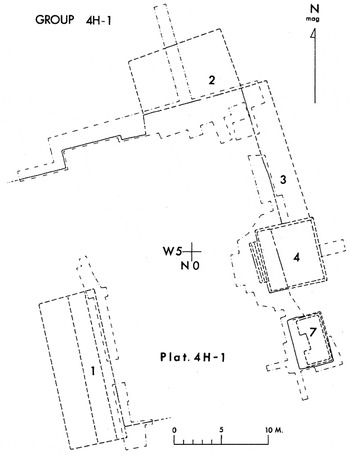
Group 4H-1 at Tikal, the residence of ceramic producers (from Becker 1999). Scale 1:400.
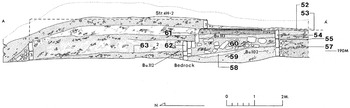
Section A–A' through Structure 4H-2, built over a “waster” pile (from Becker 1999). Scale 1:50.
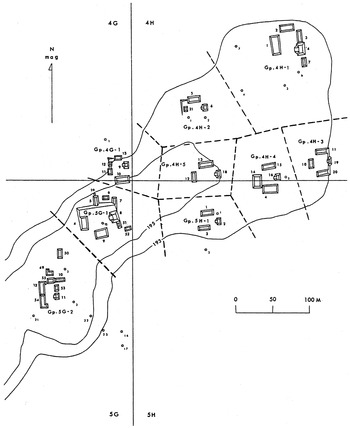
House lots at Tikal divided according to Model A: the Contiguous (Thiessen style) type (Becker 2001:446, Figure 1).
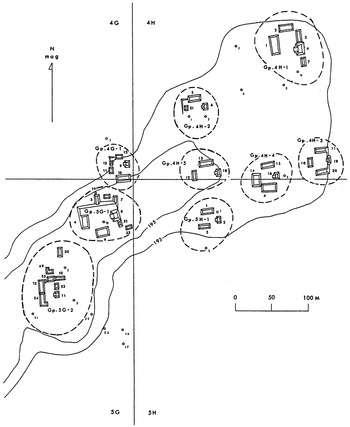
House lots at Tikal divided according to Model B: the Commons type (Becker 2001:447, Figure 2).
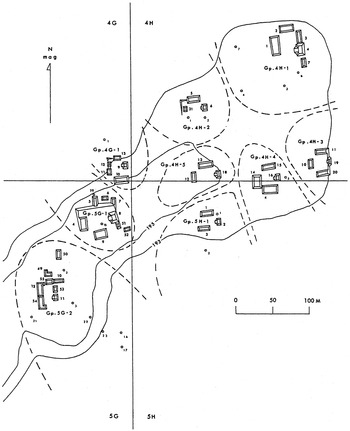
House lots at Tikal divided according to Intermediate Model, or Model C: the Open type (Becker 2001:449, Figure 3).
 You have
Access
- 23
- Cited by