Introduction
Autism spectrum disorder (ASD) is marked by pervasive deficits in implicit and explicit social cognition (Frith and Frith, Reference Frith and Frith2008; Rosenblau et al., Reference Rosenblau, Kliemann, Heekeren and Dziobek2015). Most intervention efforts focus on improving social cognition in children, leaving a significant gap in services for adults with ASD. Given the growing demands for adults with ASD to navigate individual professional schedules and to form social relationships, there is a particular need for flexible, self-paced social-cognitive trainings that are both highly motivating and lifelike. Adults with ASD typically show more subtle social deficits than younger individuals (Bowler, Reference Bowler1992). Those deficits are best captured with naturalistic assessments that resemble unstructured, everyday life settings (Dziobek et al., Reference Dziobek, Fleck, Kalbe, Rogers, Hassenstab, Brand, Kessler, Woike, Wolf and Convit2006, Reference Dziobek, Rogers, Fleck, Bahnemann, Heekeren, Wolf and Convit2008; Zaki and Ochsner, Reference Zaki and Ochsner2009; Rosenblau et al., Reference Rosenblau, Kliemann, Heekeren and Dziobek2015).
Among the few social-cognitive trainings and interventions targeting adults with ASD, very few have been scientifically evaluated. A number of intervention studies show social-cognitive improvement of individuals with ASD following trainings and treatments (e.g. Bolte et al., Reference Bolte, Hubl, Feineis-Matthews, Prvulovic, Dierks and Poustka2006; Golan and Baron-Cohen, Reference Golan and Baron-Cohen2006; Ventola et al., Reference Ventola, Friedman, Anderson, Wolf, Oosting, Foss-Feig, McDonald, Volkmar and Pelphrey2014), but they also illustrate that not all individuals benefit from a specific intervention (Ventola et al., Reference Ventola, Yang, Friedman, Oosting, Wolf, Sukhodolsky and Pelphrey2015; Masi et al., Reference Masi, DeMayo, Glozier and Guastella2017). The remarkable heterogeneity in social behavior and learning styles of individuals with ASD hinders efforts to accurately predict which intervention will be most effective for a given individual. To assess the efficacy of an intervention and improve allocation accuracy on an individual basis, there is a clear need to identify sensitive markers of treatment success in controlled and randomized intervention studies (see Bishop-Fitzpatrick et al., Reference Bishop-Fitzpatrick, Minshew and Eack2013 for a comprehensive review of treatment studies). Neuroscientific measures have the potential to capture differences in (social) cognitive processing of clinical populations more sensitively than behavioral measures (see Carter et al., Reference Carter, Barch, Buchanan, Bullmore, Krystal, Cohen, Geyer, Green, Nuechterlein, Robbins, Silverstein, Smith, Strauss, Wykes and Heinssen2008). As such they are particularly well suited to sensitively capture treatment success and may even improve the precision of treatment assignment by providing objective biomarkers of individuals' treatment responses (Rochon et al., Reference Rochon, Leonard, Burianova, Laird, Soros, Graham and Grady2010; Beauchamp et al., Reference Beauchamp, Kahn and Berkman2016; Sukhodolsky et al., Reference Sukhodolsky, Vander Wyk, Eilbott, McCauley, Ibrahim, Crowley and Pelphrey2016).
Given that ASD is primarily a disorder of brain development, using neuroscientific methods to evaluate intervention success in this group is a key to understanding the extent to which the brain remains malleable in adulthood. The fusiform cortex, amygdala, superior temporal sulcus (STS), temporo-parietal junction (TPJ), posterior cingulate cortex (PCC) and medial prefrontal cortex (MPFC) are crucial for decoding social intentions and show reduced sensitivity to social signals in adults with ASD (Castelli et al., Reference Castelli, Frith, Happe and Frith2002; Pelphrey and Carter, Reference Pelphrey and Carter2008; Yang et al., Reference Yang, Rosenblau, Keifer and Pelphrey2015; Rosenblau et al., Reference Rosenblau, Kliemann, Dziobek and Heekeren2016, Reference Rosenblau, Kliemann, Lemme, Walter, Heekeren and Dziobek2017). These brain regions are thus expected to be impacted by social-cognitive interventions.
The MPFC, in particular the dorsal part, may be a key node in the network of regions supporting social-cognitive improvements of adults with ASD. The dorsal part of the MPFC plays a critical role in making inferences about others' mental states (Ochsner et al., Reference Ochsner, Knierim, Ludlow, Hanelin, Ramachandran, Glover and Mackey2004; Walter et al., Reference Walter, Adenzato, Ciaramidaro, Enrici, Pia and Bara2004; Frith and Frith, Reference Frith and Frith2006; Wolf et al., Reference Wolf, Dziobek and Heekeren2010), as well as in learning from social feedback (Behrens et al., Reference Behrens, Hunt, Woolrich and Rushworth2008; Hampton et al., Reference Hampton, Bossaerts and O'Doherty2008; Garvert et al., Reference Garvert, Moutoussis, Kurth-Nelson, Behrens and Dolan2015; Seid-Fatemi and Tobler, Reference Seid-Fatemi and Tobler2015; Rosenblau et al., Reference Rosenblau, Korn, Pelphrey, Rosenblau, Korn and Pelphrey2018). The anterior insula and the dorsolateral prefrontal cortex (DLPFC) are further prefrontal regions that support learning about others, in particular monitoring others' strategies, while the orbitofrontal cortex and the striatum contribute to learning across social and non-social domains by encoding the magnitude of rewards (see Joiner et al., Reference Joiner, Piva, Turrin and Chang2017).
Two studies so far have evaluated intervention-based neural changes during facial affect recognition in adults with ASD. Their results are promising as they point to ongoing plasticity in brain systems supporting socio-emotional functioning. In a pilot study, Bolte et al. (Reference Bolte, Hubl, Feineis-Matthews, Prvulovic, Dierks and Poustka2006) concluded that an increase in facial affect recognition performance was related to compensatory neuroplasticity in the parietal cortex. In a follow-up study, Bolte et al. (Reference Bolte, Ciaramidaro, Schlitt, Hainz, Kliemann, Beyer, Poustka, Freitag and Walter2015) extended their focus of investigation from purely explicit to inclusion of implicit aspects of facial emotion processing and found that core regions for socio-emotional information processing (including the amygdala, fusiform gyrus, temporal poles, and MPFC) showed changes in magnitude of neural responses due to the training. Another recent pilot study by Yang et al. (Reference Yang, Allen, Abdullahi, Pelphrey, Volkmar and Chapman2018) investigated the extent to which a virtual reality intervention induced changes in biological motion perception and found that while increases in STS activity scaled with improvements in theory of mind, decreases in inferior frontal gyrus (IFG) activity scaled with improvements in emotion recognition. A significant limitation of these studies, however, was either the lack of an active control-intervention group or the lack of a comparison group altogether, which is necessary to inform the specificity of training effects.
In general, current intervention studies suffer from at least one of the three following drawbacks. Firstly, social-cognitive skills are often tested and trained in only one modality – mostly focusing on emotion recognition skills from faces. Such a narrow focus may hinder the generalizability of results to everyday situations, in which individuals are required to integrate information from multiple modalities. Secondly, most studies lack an active control group to rigorously test the specificity of intervention effects. Thirdly, a great number of social-cognitive training targets children or adolescents, leaving a significant gap in services for adults with ASD.
The current intervention study aimed to overcome these drawbacks. Building on previous research showing that the social deficits of high-functioning adults with ASD are mainly detectable using multi-modal, dynamic, tasks that approximate real life (Dziobek et al., Reference Dziobek, Fleck, Kalbe, Rogers, Hassenstab, Brand, Kessler, Woike, Wolf and Convit2006; Zaki and Ochsner, Reference Zaki and Ochsner2009; Dziobek, Reference Dziobek2012; Rosenblau et al., Reference Rosenblau, Kliemann, Heekeren and Dziobek2015), we developed a naturalistic social-cognitive training (SCOTT). The online-based, self-paced training capitalizes on the individuals' interest in technology and computer games to train social-cognitive skills. In the subsequent intervention study, we tested SCOTT-induced neural plasticity in both brain structure and function of adults with ASD. We compared these changes to those induced by a non-social-cognitive control training (NCT).
We expected SCOTT-related improvements in social-cognitive performance on close generalization tasks, i.e. tasks that closely resemble the trained material, and on a distant generalization task, which is naturalistic and dissimilar to the training. We further anticipated SCOTT to induce functional and structural plasticity in prefrontal regions, in particular the MPFC, which plays a crucial role in the development of complex social-cognitive functions (Amodio and Frith, Reference Amodio and Frith2006; Behrens et al., Reference Behrens, Hunt, Woolrich and Rushworth2008; Seid-Fatemi and Tobler, Reference Seid-Fatemi and Tobler2015), and in regions specialized for inferring intentions, such as the STS and TPJ. We expected these neural changes to scale with improvements in social-cognitive performance.
Methods
Study design
Before (pre) and after (post) the training period, participants completed behavioral and MRI tasks. After participants' pre-visits, they were randomly assigned to either the SCOTT training (SCOTT) or the non-social control training (NCT). We used a block randomization procedure with respect to gender to ensure an even distribution of males and females in both training groups. Male and female participants were allocated to one of the training groups via random allocation sequences generated in MATLAB (R2015b, The MathWorks Inc., Natick, MA, USA). To ensure that participants were eligible and committed to participate in the training study, we assigned participants to their respective training group after completing the first assessment visit. Participants completed two behavioral and two MRI visits, one pre-treatment (T1) and one post-treatment (T2).
Behavioral assessment visits
Participants
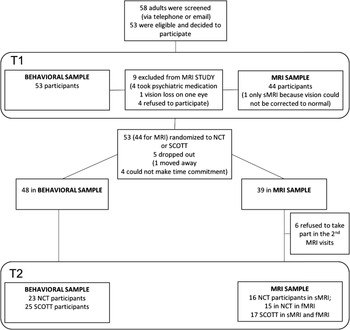
Participants were recruited from the autism outpatient clinic of the Charité-University Medicine Berlin, Germany, or were referred by specialized clinicians. All enrolled participants were diagnosed according to DSM-IV (American Psychiatric Association 1994). The main inclusion criteria were having been diagnosed with ASD and the absence of other neurological or Axis 1 psychiatric comorbidities. Eligible participants (N = 53) were invited to an initial assessment visit (T1). In this visit, participants completed the social-cognitive measures (detailed below). Additionally, verbal and non-verbal IQ were estimated by established procedures via a vocabulary test [Mehrfach-Wortschatz-Test (MWT), Lehrl, 1989] and a strategic thinking test (LPS, subscale 4, Horn, 1983), respectively. Five participants dropped out after this initial visit because they could not make the necessary time commitment to participate in the study. The remaining 48 ASD participants [25 SCOTT (6 female); 23 NCT (10 female); mean age 32.4 years (s.d. = 9.4)] were included into the treatment study and subsequently randomized to the SCOTT or NCT training group (please refer to the flowchart in Fig. 1). The groups did not differ with respect to age, gender, IQ, and symptom severity (see online Supplementary Table S1). For all participants, diagnosis was confirmed by at least one of the two standard diagnostic instruments: the Autism Diagnostic Interview – Revised (ADI-R; Lord et al., Reference Lord, Rutter and Le Couteur1994), if parental informants were available (N = 13), and the Autism Diagnostic Observation Schedule (ADOS, Lord et al., Reference Lord, Rutter, DiLavore, Risi, Gotham and Bishop2012; N = 36).
Flowchart visualizing the inclusion, group allocation, and retainment of study participants.

Behavioral outcome measures
We expected SCOTT-related improvements in social-cognitive performance on different generalization levels. Close generalization effects were assessed with the Face Puzzle (FP)-implicit and -explicit tasks (Kliemann et al., Reference Kliemann, Rosenblau, Bölte, Heekeren and Dziobek2013), which contain similar stimuli to those used in the SCOTT training. More distant generalization was measured with the Movie for the Assessment of Social Cognition (MASC, Dziobek et al., Reference Dziobek, Fleck, Kalbe, Rogers, Hassenstab, Brand, Kessler, Woike, Wolf and Convit2006). Similar to the SCOTT training, the MASC also contains naturalistic film-stimuli. The MASC, however, differs in important aspects from the SCOTT training. It not only requires understanding affective states, but also tracking protagonists' intentions and thoughts as a continuous plot unfolds over several days. The mental state inferences are contingent upon representing personality characteristics of protagonists and context-specific social knowledge. With that, the MASC closely resembles mental state attribution in real-life social interactions. Please refer to the supplement for a more detailed description of the behavioral tasks.
MRI assessment visits
Participants
All ASD individuals that participated in the behavioral experiment were invited to also take part in the MRI assessment if they did not meet exclusion criteria for MRI (e.g. psychotropic medication, pacemaker, claustrophobia). A subsample of the previously described participants completed both functional and structural MRI assessment visits (fMRI: N = 32, 17 SCOTT and 15 control participants; sMRI: N = 33, 17 SCOTT and 16 control participants; for participant selection and drop-out information please refer to the participant flowchart depicted in Fig. 1).
The male-to-female ratio differed significantly between training groups in the scanning sample due to larger drop-out rates of females in the SCOTT group (see online Supplementary Table S1). Only one female remained in the SCOTT fMRI group, relative to five females in the NCT group. There were not enough female participants in either group to statistically separate-out the effects of gender and training group using analysis of covariance (for a technical discussion of this issue see Miller and Chapman, Reference Miller and Chapman2001). To visualize the distribution of identified effects in males and females, we plot color-coded values for males and females for all significant effects. Additionally, we corroborate our results in a homogenous sample of males only in the online Supplementary section.
fMRI paradigms
We assessed participants' cortical thickness and functional activity during two social-cognitive tasks that address the two most prominent social-cognitive deficits of individuals with ASD: a mentalizing task, introduced in a previous study (Rosenblau et al., Reference Rosenblau, Kliemann, Heekeren and Dziobek2015), and a facial affect recognition task (i.e. face task). The tasks are described in detail in the online Supplementary section. The face task did not yield any significant differences between training types (SCOTT v. NCT). Analyses and results of this task are summarized in the online Supplementary section. Participants completed tutorials including practice trials outside the scanner. In the scanner, they were presented with visual and verbal reminders of the task to follow.
Training
A detailed description of both trainings can be found in the online Supplementary section.
SCOTT
In three modules, participants can focus on improving facial affect recognition, emotional prosody recognition, and mentalizing abilities with life-like, dynamic representations of faces, voices, and social interactions of more than 50 actors (see Supplementary Fig. S1).
NCT
This control training consisted of 24 existing online games (e.g. Brain Machine, Roll, Bounce) that involve skills such as numeric computation, visual discrimination, and attention to detail (please refer to online Supplementary Table S2 for an exhaustive list of online games).
FMRI data analysis
The MRI data acquisition protocol and preprocessing procedures for the face and mentalizing tasks are described in the online Supplementary section. All functional MRI analyses are family-wise cluster corrected at a z threshold of 2.3 and a p-threshold of p < 0.001, in line with guidelines for adequate significance levels with the FSL toolbox (Nichols et al., Reference Nichols, Kriegeskorte, Yeo, Kriegeskorte, Milham, Poldrack, Poline and Proal2016; Kessler et al., Reference Kessler, Angstadt and Sripada2017). The supplemental males only analyses were performed at a more lenient threshold (z = 1.7 and a p-threshold of p < 0.005) to test that the whole sample results are not driven by interactions between sex and training group.
Mentalizing task
Preprocessing and single-subject statistical analyses procedures are introduced in length in a previous manuscript (Rosenblau et al., Reference Rosenblau, Kliemann, Lemme, Walter, Heekeren and Dziobek2016) and described in the online Supplementary section. In this intervention study, we were specifically interested in capturing spontaneously occurring mentalizing in naturalistic settings; we investigated mentalizing during the ToM video phases.
To investigate SCOTT-related differences in brain function during mentalizing, we performed mixed-effects group analyses across participants with the between-participant factor group (SCOTT v. NCT). We used the FMRIB local analysis of mixed-effects tool provided by FSL (FLAME, stage 1 and 2) on participants' contrast images (ToM video phases: T2 > T1). To exclude that group differences in activity changes (T2 > T1) were driven by group differences in brain activity at T1, we performed a second group analysis comparing neural activity in ToM video phases at T1 between SCOTT and NCT participants. We visualized possible group by condition interactions for significantly activated clusters by extracting and plotting the parameter estimates for each condition and group.
Structural MRI data analysis
Please refer to the online Supplementary section for information on the initial preprocessing steps. Group differences in CT were analyzed across the whole brain, within a restricted search space focusing on the neural processes indicated to be affected by SCOTT training from the behavioral data; This search space spanned 15 606 mm2 (~25% of total area). Analyses of the rate of change in CT were corrected at a cluster-wise threshold of p < 0.05 using Monte-Carlo simulations (10 000 iterations, two-tailed) in the ‘mri_glm-fit’ tool. Post-hoc correlations were used to test if identified effects of the SCOTT training on CT were related to performance improvements [one-tailed, given directional hypothesis of SCOTT training positively related to CT changes (positive or negative)].
We also tested group differences in CT at T1. An absence of group differences at T1 would suggest that differences in CT change can be ascribed to differences in training type. Longitudinal CT changes (T2 v. T1) were estimated as the percentage rate-of-change, identified using a cluster-wise corrected threshold of p < 0.05 using Monte-Carlo simulations (10 000 iterations, two-tailed) in the ‘mri_glmfit’ tool in the FreeSurfer library (freesurfer.net/). We first analyzed group differences in CT changes (T2 v. T1) across the whole brain. To identify CT changes in regions relevant to the social-cognitive changes observed on the behavioral task, we conducted a post-hoc analysis in a smaller search space. The search space was defined based on a meta-analysis of studies investigating neural processing of facial emotion processing (Sabatinelli et al., Reference Sabatinelli, Fortune, Li, Siddiqui, Krafft, Oliver, Beck and Jeffries2011), and featured the following regions (Destrieux atlas labels are provided in brackets): the dorsomedial prefontal cortex (superior middle frontal label), middle frontal gyrus (caudal and rostral middle frontal labels), middle temporal gyrus (middle temporal gyrus label), IFG (opercularis and triangularis inferior frontal labels), and fusiform gyrus (fusiform gyrus label).
Relationship between neural activity and social-cognitive improvements
Changes in mentalizing-related brain activity as a predictor for behavioral improvements
To determine whether improvements in social cognition correlated with changes in brain activity during mentalizing, we performed a higher-level mixed-effects analysis and added accuracy rates from independent behavioral tasks that showed an interaction effect [group (SCOTT > NCT) by time (T2 > T1)] as a covariate into the model. By entering performance on independent behavioral tasks as a covariate into the fMRI analysis, we ensured that this analysis was not prone to potential non-independence errors. To test whether the interaction between training-specific changes in behavior and brain function explained additional variance above the training group by time interaction, we added the group by time interaction and as a regressor of no interest into this analysis. To visualize the strength and direction of the correlations between changes in neural activity and the behavioral covariate, we extracted parameter estimates from the activated clusters identified in the contrast of interest.
Changes in cortical thickness as a predictor for behavioral improvements
Analyses were conducted across training groups to identify relationships between changes in CT and social-cognitive improvements on the behavioral tasks. This analysis was performed first at the whole-brain level using a regression analysis with qdec. Subsequently, we examined the relationship between improvements in facial affect recognition and CT change in regions, in which the SCOTT group showed changes in CT relative to the NCT group. Specifically, we extracted estimates of CT change in clusters that showed SCOTT-specific changes, and correlated these estimates with changes in task accuracy.
Relationship between functional and structural brain change
To investigate whether changes in cortical thickness occurred in regions that showed SCOTT-specific changes in functional task-based activity, we performed a region of interest (ROI) analysis. Firstly, we created ROIs by drawing a 10 mm sphere around the peak voxels identified in the anatomical group difference analysis. These post-hoc analyses were corrected for multiple comparisons at a statistical threshold of p < 0.05 and z = 2.3.
Results
Training-related changes in social cognition (behavior)
To investigate training-related changes in task accuracy, we used repeated-measure ANCOVAs with the within-subject factor time (T2 v. T1) and the between-subject factor group (SCOTT v. NCT). Because of the growing evidence for sex differences in social cognition of individuals with ASD (Lord et al., Reference Lord, Schopler and Revicki1982; Golan and Baron-Cohen, Reference Golan and Baron-Cohen2006; Hall et al., Reference Hall, Philip, Marwick, Whalley, Romaniuk, McIntosh, Santos, Sprengelmeyer, Johnstone, Stanfield, Young and Lawrie2012; Lai et al., Reference Lai, Lombardo, Pasco, Ruigrok, Wheelwright, Sadek, Chakrabarti and Baron-Cohen2011, Reference Lai, Lombardo, Ecker, Chakrabarti, Suckling, Bullmore, Happé, Murphy and Baron-Cohen2015), we controlled for sex by including it as a covariate in the behavioral analysis. Since variables for the three behavioral tasks were not normally distributed in our clinical sample, we normalized them using the Box–Cox transformation (Sakia, Reference Sakia1992) in MATLAB (R2015b, The MathWorks Inc.). Optimal correction parameter λ for each measure, time point, and group ranged between 1.7 and 2. We therefore corrected all scores with the normalization parameter λ = 2. Significance values for the effects of interest (i.e. interactions of time and group) were corrected for multiple comparisons using the two-stage sharpened method for false discovery rate (FDR, Pike, Reference Pike2011; Storey, Reference Storey2002).
FP-explicit
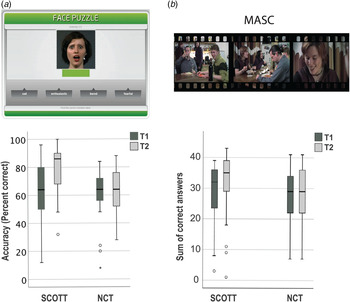
There was a significant group by time interaction, indicating training-related improvements on the task in SCOTT relative to NCT participants [F (1,43) = 7.992; p = 0.007 (p FDR-corrected = 0.007); η 2partial = 0.157; see Fig. 2a and online Supplementary Table S3]. SCOTT and NCT participants showed small differences in accuracy across time points [F (1,43) = 4.346; p = 0.043; η 2partial = 0.092] and there was no main effect of time point (T1 v. T2), indicating a lack of accuracy gains merely through test repetition [F (1,43) = 0. 047; p = 0.830].
(a) Example item for the explicit facial emotion recognition task Face Puzzle-explicit task. Mean accuracy on the Face Puzzle-explicit task significantly increased after the SCOTT v. NCT. (b) Example movie frames from the Movie for the Assessment of Social Cognition (MASC). Sum of correct responses (max = 46) on the MASC increased after the SCOTT v. NCT. SCOTT, social cognition training tool; NCT, non-social control training; T1, time point 1; T2, time point 2.

FP-implicit
The repeated-measures ANCOVA did not reveal a significant group by time interaction [F (1,43) = 0.237; p = 0.629; p FDR-corrected = 0.220]. We found no effect of group indicating equal accuracy scores for SCOTT and NCT participants [F (1,43) = 1.023; p = 0.317] and an effect of time point, suggesting improved performance at T2 [F (1,43) = 4.717; p = 0.035; η 2partial = 0.099] overall participants.
MASC
The MASC is a well-calibrated instrument with subscales for different kinds of inference (e.g. questions about emotions, non-social perceptual contingencies, and intentions). We found a significant group by time interactions for the total MASC score, indicating training-related improvements of SCOTT compared to NCT participants [F (1,41) = 6.766; p = 0.013; p FDR-corrected = 0.007; η 2partial = 0.142; see Fig. 2b and online Supplementary Table S3]. There was no significant main effect of group [F (1,41) = 0.620; p = 0.436] nor time [F (1,41) = 1.254; p = 0.269].
Training-related changes in neural systems underlying social cognition
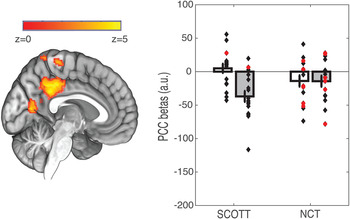
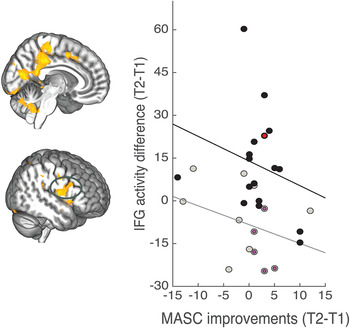
With respect to the mentalizing task, decreases in activity in the PCC, extending into the precuneus cortex and the precentral gyrus, were significantly greater in the SCOTT compared to the NCT group (see online Supplementary Table S4 and Fig. 3). This interaction effect was driven by a significant decrease in brain activity in the SCOTT group in these regions. These results were replicated in the males-only analyses (see online Supplementary section). Additionally, the SCOTT group displayed decreases in activity of prefrontal regions such as the IFG, DLPFC, MPFC, and frontal pole with males and females showing similar changes in parameter estimates. There were no significant pre-to-post changes in BOLD signal response in the NCT and no group differences in brain activity between SCOTT and NCT at T1. Importantly, in the SCOTT v. NCT group, SCOTT training-related decreases in activity in the above mentioned regions, such as the MPFC, were associated with performance improvements on the ToM task (see online Supplementary Table S5 and Fig. 4).
Training-related functional neuroplasticity measured with the mentalizing task. Training-related decreases in PCC activity in the SCOTT group relative to the NCT group. Female participants are depicted in red. SCOTT, social cognition training tool; NCT, non-social control training; T1, time point 1; T2, time point 2; PCC, posterior cingulate cortex.

SCOTT-related changes in functional activity scale with improvements on the mentalizing task. Relationship between decreases in brain activity and increases in accuracy on the MASC in the SCOTT group (black) is greater than in the NCT group (gray). Female participants are depicted in red in the SCOTT group and purple in the NCT group. SCOTT, social cognition training tool; NCT, non-social control training; T1, time point 1; T2, time point 2; IFG, inferior frontal gyrus.

There were no group differences in brain activity changes from pre to post measurement during the facial emotion recognition task (please refer to the online Supplementary section for a description of this task).
Cortical thickness
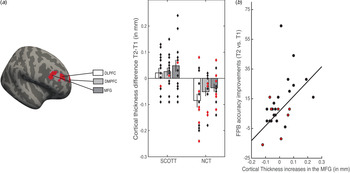
We found significant differences between the SCOTT and NCT group in regions associated with facial emotion processing (this search space was defined based on a meta-analysis of studies investigating neural processing of facial emotion processing, given the improvements observed in facial emotion processing in SCOTT v. NCT participants; see online Supplementary section). Specifically, group differences in cortical thickness changes were found in three clusters: in the DLPFC (x = 33, y = 36, z = 23; Z = 4.25, p cluster = 0.008, size = 377 mm3), in the middle frontal gyrus (MFG: x = 41, y = 27, z = 31; Z = 2.42, p cluster = 0.022, size = 324 mm3), and in the dorsomedial prefrontal cortex (DMPFC: x = 13, y = 57, z = 23; Z = 3.34, p cluster = 0.008, size = 381 mm3) (Fig. 5a). To determine whether group differences in cortical thickness changes relied on one or both groups changing in different directions, we conducted post-hoc one-sample t tests. The NCT group showed significant decreases in cortical thickness in the DLPFC and DMPFC [DLPFC: t (15) = −3.35, p cluster = 0.004; DMPFC: t (15) = −3.34, p cluster = 0.004], while changes in the MFG region reflected both significant increases in cortical thickness in the SCOTT group [t (16) = 2.32, p cluster = 0.034], and decreases in cortical thickness in the NCT group [t (15) = −2.51, p cluster = 0.024]. The cortical thickness estimates for female participants were in the range of those for male participants (see scatterplots depicted in Fig. 5a). There were no significant differences between groups in cortical thickness at T1.
Training-related changes in cortical thickness in SCOTT and NCT participants. (a) Region of interest (ROI) analysis reveals significant group differences (SCOTT v. NCT) in cortical thickness pre-to-post training. The search space of ROIs associated with facial emotion processing was defined based on a meta-analysis of studies investigating the neural processing of facial emotional expressions. (b) Correlation between increases in cortical thickness and performance on the Face Puzzle-explicit task (FPB). Red dots depict data points from female participants in both groups.

CT increases from T1 to T2, as observed in the SCOTT group, scaled with social-cognitive gains (i.e. performance improvements on the FP-explicit (FPB) task; Fig. 5b) overall participants. In a whole-brain analysis, we found a positive relationship between cortical thickness changes in a large cluster extending anteriorly from the supramarginal gyrus (x = 49, y = −18, z = 42; Z = 4.307, p cluster < 0.001, size = 1889 mm3) and performance improvements on the FPB task. Furthermore, cortical thickness increases in the MFG cluster that showed significant cortical thickness increases in the SCOTT relative to the NCT group also predicted performance improvements on the FPB task (r = 0.443, p = 0.012).
Overlap between functional and structural changes
The MFG region that showed SCOTT-specific increases in cortical thickness showed SCOTT-specific reductions in brain function during the mentalizing task (peak MNI coordinates: x = 40, y = 32, z = 34; z score = 2.97; cluster size: 65 Voxel).
Discussion
We evaluated the effectiveness of a newly developed social cognition training (SCOTT), in particular, whether neural measures could sensitively detect SCOTT-related improvements in social behavior of adults with ASD. The training improved participants' facial emotion recognition accuracy on a close generalization task. Participants in the SCOTT group further showed significant improvements in mentalizing abilities compared to the NCT group on a more ecologically valid and training-dissimilar task. On the neural level, we found that the SCOTT training induced functional and structural neuroplasticity in adults with ASD, predominantly in the IFG and MPFC. Importantly, the observed changes in functional brain activity and in cortical thickness scaled with performance gains on the behavioral tasks.
We measured SCOTT-related improvements in performance on different generalization levels. On the close generalization level, we found that the SCOTT training improved individuals' emotion recognition accuracy from dynamic faces compared to the NCT. This finding replicates previous research showing that individuals with ASD improve social-cognitive abilities on close generalization levels, i.e. on training similar tasks (Hadwin et al., Reference Hadwin, Baron-Cohen, Howlin and Hill1996; Bolte et al., Reference Bolte, Hubl, Feineis-Matthews, Prvulovic, Dierks and Poustka2006; Golan and Baron-Cohen, Reference Golan and Baron-Cohen2006). SCOTT participants further showed significant improvements in mentalizing on a distant generalization level. The MASC is a sensitive training-dissimilar, naturalistic social cognition task, which has been used to detect social-cognitive deficits of various psychiatric populations, in particular of individuals with ASD (Dziobek et al., Reference Dziobek, Fleck, Kalbe, Rogers, Hassenstab, Brand, Kessler, Woike, Wolf and Convit2006; Montag et al., Reference Montag, Ehrlich, Neuhaus, Dziobek, Heekeren, Heinz and Gallinat2010, Reference Montag, Dziobek, Richter, Neuhaus, Lehmann, Sylla, Heekeren, Heinz and Gallinat2011; Preissler et al., Reference Preissler, Dziobek, Ritter, Heekeren and Roepke2010). Given that most social-cognitive training introduced so far did not yield any distant generalization effects (e.g. Hadwin et al., Reference Hadwin, Baron-Cohen, Howlin and Hill1996, Reference Hadwin, Baron-Cohen, Howlin and Hill1997; Golan and Baron-Cohen, Reference Golan and Baron-Cohen2006), the effects observed on a distant generalization level in this study are promising, in that they indicate the training's potential to generalize to individuals' everyday social settings. Future studies with further social skill measures and larger sample sizes are needed to conclusively determine whether SCOTT-specific gains in social cognition improve individuals' social communication skills in everyday life.
With respect to brain function, we did not observe training-related changes in brain activity on the facial emotion processing task, but on the more complex mentalizing task. The mentalizing task was possibly more sensitive at picking up training-related changes because it more closely resembled two of three SCOTT training modules, which require multimodal information integration and inferring others' mental states. Our findings that neural systems underlying social information processing of individuals with ASD are malleable through a social-cognitive training are in line with a burgeoning literature (Bolte et al., Reference Bolte, Ciaramidaro, Schlitt, Hainz, Kliemann, Beyer, Poustka, Freitag and Walter2015; Yang et al., Reference Yang, Allen, Abdullahi, Pelphrey, Volkmar and Chapman2018).
The SCOTT group showed significant reductions of activity in the PCC extending into the precuneus cortex relative to the control group. These regions have been repeatedly implicated in social information processing, in particular in building first impressions of other people and dynamic updating of these impressions in the context of mentalizing or social learning (Schiller et al., Reference Schiller, Freeman, Mitchell, Uleman and Phelps2009; Wolf et al., Reference Wolf, Dziobek and Heekeren2010; Mende-Siedlecki et al., Reference Mende-Siedlecki, Cai and Todorov2013; Yang et al., Reference Yang, Rosenblau, Keifer and Pelphrey2015). They have also been implicated in domain general (social and non-social) learning and multimodal information processing (Wilson et al., Reference Wilson, Molnar-Szakacs and Iacoboni2008). Pre-to-post changes in brain activity were driven by significant changes in the SCOTT group only. These changes likely reflect more efficient neural processing of dynamic social cues. In support of this interpretation, we found that, in the SCOTT group, pre-to-post reductions in functional activity in the PCC and prefrontal regions, such as the MPFC and the IFG, were significantly linked to improvements on the MASC. The MASC is a complex mentalizing task that requires participants to assess the relationships between protagonists and understand dynamic changes in these relationships as the plot unfolds. A recent study highlights the roles of the PCC and precuneus in signaling social distance between protagonists (Tavares et al., Reference Tavares, Mendelsohn, Grossman, Williams, Shapiro, Trope and Schiller2015), an aspect that is highly relevant for performance on the MASC. It is conceivable that SCOTT could have facilitated the neural encoding of relationships between protagonists, which led to the observed improvements in task accuracy. Furthermore, a large proportion of mental state inferences in the MASC are concerned with interpreting others' feelings. The correlation between SCOTT-related changes in IFG activity and performance on the MASC are in line with previous studies that highlight the role of the IFG in emotion processing and emotion recognition accuracy (Takahashi et al., Reference Takahashi, Yahata, Koeda, Matsuda, Asai and Okubo2004; Ethofer et al., Reference Ethofer, Anders, Erb, Herbert, Wiethoff, Kissler, Grodd and Wildgruber2006; Sabatinelli et al., Reference Sabatinelli, Fortune, Li, Siddiqui, Krafft, Oliver, Beck and Jeffries2011; Monte et al., Reference Monte, Krueger, Solomon, Schintu, Knutson, Strenziok, Pardini, Leopold, Raymont and Grafman2013; Uono et al., Reference Uono, Sato, Kochiyama, Sawada, Kubota, Yoshimura and Toichi2016). In particular, a recent pilot study reported a similar relationship between intervention-related improvements in emotion recognition and decreases in IFG activity on a social perception task (Yang et al., Reference Yang, Allen, Abdullahi, Pelphrey, Volkmar and Chapman2018). The agreement in results strengthens the hypothesis that reductions in IFG activity underlie training-based improvements in social cognition.
By familiarizing individuals with dynamic, multimodal social cues, SCOTT could have increased the efficiency of neural systems involved in learning and multi-modal information processing (Kelly and Garavan, Reference Kelly and Garavan2005). In support of this notion, various studies examining skill acquisition and practice effects find activation decreases in prefrontal regions corresponding to a sharpening of neural responses through skill acquisition and task practice (Tomasi et al., Reference Tomasi, Ernst, Caparelli and Chang2004; Erickson et al., Reference Erickson, Colcombe, Wadhwa, Bherer, Peterson, Scalf, Kim, Alvarado and Kramer2007; van Raalten et al., Reference van Raalten, Ramsey, Duyn and Jansma2008; Lee et al., Reference Lee, Voss, Prakash, Boot, Vo, Basak, VanPatter, Gratton, Fabiani and Kramer2012). The SCOTT group changed activity in brain areas that are strongly implicated in social cognition and respective deficits in autism such as the MPFC, PCC, precuneus, and IFG (Ochsner et al., Reference Ochsner, Knierim, Ludlow, Hanelin, Ramachandran, Glover and Mackey2004; Dapretto et al., Reference Dapretto, Davies, Pfeifer, Scott, Sigman, Bookheimer and Iacoboni2006; Dziobek et al., Reference Dziobek, Bahnemann, Convit and Heekeren2010; Wolf et al., Reference Wolf, Dziobek and Heekeren2010; Leech and Sharp, Reference Leech and Sharp2014; Rosenblau et al., Reference Rosenblau, Kliemann, Dziobek and Heekeren2017) suggesting that SCOTT alters neural systems specialized for social cognition. The fact that some of these areas are associated with learning and audio-visual integration more broadly, such as the IFG, temporal cortex, and precuneus (Jones and Callan, Reference Jones and Callan2003; Wilson et al., Reference Wilson, Molnar-Szakacs and Iacoboni2008; Szycik et al., Reference Szycik, Jansma and Münte2009; Joiner et al., Reference Joiner, Piva, Turrin and Chang2017), raises the intriguing possibility that SCOTT-related neural plasticity may also alter domain-general learning processes and audio-visual integration.
The SCOTT intervention may have reversed some neurodevelopmental abnormalities by inducing increases in cortical thickness in the MFG. This interpretation is supported by several longitudinal and cross-sectional studies showing that individuals with autism display aberrant reductions in gray matter volume and cortical thickness for regions involved in social cognition (Hadjikhani et al., Reference Hadjikhani, Joseph, Snyder and Tager-Flusberg2006; Mueller et al., Reference Mueller, Keeser, Samson, Kirsch, Blautzik, Grothe, Erat, Hegenloh, Coates, Reiser, Hennig-Fast and Meindl2013; Lai et al., Reference Lai, Lombardo, Ecker, Chakrabarti, Suckling, Bullmore, Happé, Murphy and Baron-Cohen2015; Wallace et al., Reference Wallace, Eisenberg, Robustelli, Dankner, Kenworthy, Giedd and Martin2015; Sato et al., Reference Sato, Kochiyama, Uono, Yoshimura, Kubota, Sawada, Sakihama and Toichi2017). Increases in cortical thickness and reductions in functional activity were found in the same MFG cluster in the SCOTT group. The MFG is a key region of the attention network (Tomasi et al., Reference Tomasi, Ernst, Caparelli and Chang2004), which supports learning (Filippi et al., Reference Filippi, Ceccarelli, Pagani, Gatti, Rossi, Stefanelli, Falini, Comi and Rocca2010; Gu et al., Reference Gu, Hu, Pan, Yang, Wang, Li and Chen2016).
Unexpectedly, NCT was associated with reductions in cortical thickness in the MFG, DLPFC, and DMPFC, which may reflect practice effects associated with the general cognitive training. Although the majority of structural plasticity studies report training-induced increases in gray matter volume or cortical thickness in task-relevant regions (Takeuchi et al., Reference Takeuchi, Taki, Sassa, Hashizume, Sekiguchi, Fukushima and Kawashima2011; Woollett and Maguire, Reference Woollett and Maguire2011; Kühn et al., Reference Kühn, Schmiedek, Noack, Wenger, Bodammer, Lindenberger and Lövden2013), there is a number of reports of training-related reductions in gray matter volume or thickness (for a review see Valkanova et al., Reference Valkanova, Eguia Rodriguez and Ebmeier2014). For instance, in line with our findings, mental calculation tasks have previously been shown to produce reductions in regional gray matter volume in the DLPFC (Takeuchi et al., Reference Takeuchi, Taki, Sassa, Hashizume, Sekiguchi, Fukushima and Kawashima2011). Anatomical changes due to practice effects are challenging to interpret as changes are non-linear, often depending on the type and course of a training, and the brain region in which changes are observed (Kühn et al., Reference Kühn, Schmiedek, Noack, Wenger, Bodammer, Lindenberger and Lövden2013; Metzler-Baddeley et al., Reference Metzler-Baddeley, Caeyenberghs, Foley and Jones2016). The group differences in anatomical changes observed in this study are likely a combination of these different factors. Together with the fMRI results, the observed changes in brain structure indicate that the prefrontal cortex adapts dynamically to social and non-social-cognitive task demands.
In this study, we took an important step toward establishing neuroscience-informed interventions for high-functioning adults with autism. To this end, we developed a social intervention, SCOTT, that is specifically designed for high-functioning individuals with ASD. SCOTT focuses on this population's selective social impairments in real life, leveraging their affinity to online game frameworks. In line with our hypotheses, SCOTT improved social-cognitive performance on training similar and dissimilar tasks. On the neural level, we found SCOTT-related structural and functional neuroplasticity in midline and prefrontal areas of the brain typically associated with social information processing, multi-modal integration, and learning. Our findings thus represent preliminary evidence for the feasibility of identifying neuro-biomarkers for intervention success in high-functioning individuals with ASD that should be replicated in larger samples. Future efforts should be dedicated toward adapting SCOTT for lower-functioning individuals, by simplifying the user interface and changing its focus to adaptive living skills and emotion regulation.
Supplementary material
The supplementary material for this article can be found at https://doi.org/10.1017/S0033291719002472.
Acknowledgements
We thank Dorit Kliemann and the many research assistants and for support with stimulus production, data collection, and analysis. We gratefully acknowledge the actors who participated in the audio recordings and the members of the Computer and Media Service team (CMS) at the Humboldt University for their support with the production and postproduction of the training stimuli. We also thank the participants of this study for their time and commitment.
Financial support
This work was supported by a grant from the German Research Foundation (DFG; EXC 302).
Conflict of interest
None.