Introduction
The history of the parathyroid glands is an extraordinary tale, and an example of the slow progression of science by trial and error and the study of individual cases. We recount the discovery of the glands themselves, and describe the ensuing, laborious investigation into their function and physiology. In order to illustrate this process, we present three patients whose case histories arguably contributed more to the understanding of parathyroid disease than many years of research had done before them.
Discovery of the parathyroid glands
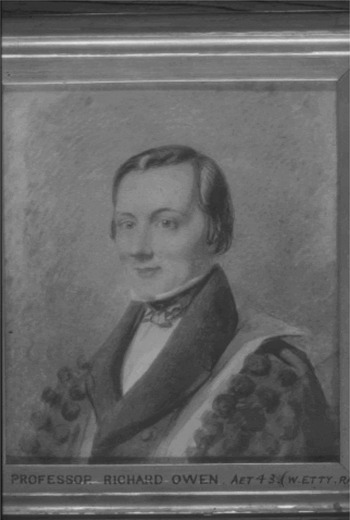
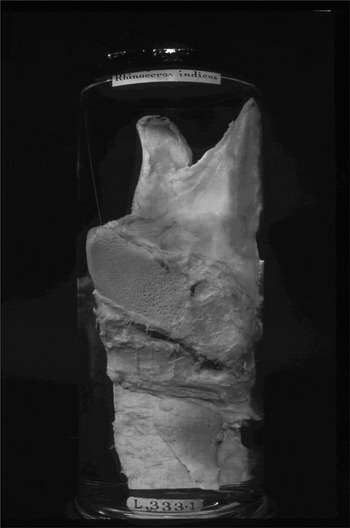
In May 1843, the Zoological Society of London purchased a great Indian rhinoceros (Rhinoceros unicornis) for 1000 guineas. Sir Richard Owen, the Hunterian Professor and Conservator of the Royal College of Surgeons of England (Figure 1), was offered the carcass of the same animal after its death at London Zoo in 1849. There had been a quarrel between the rhinoceros and an elephant, and it was suspected that this had resulted in a broken rib that punctured a lung. Sir Owen dissected the remains of the rhinoceros over the course of two winters, at the end of which the specimen was in an ‘offensive state of decomposition’. In his record of the dissection, he mentioned ‘a small compact yellow glandular body attached to the thyroid at the point where the vein emerged’.Reference Owen1 These findings were initially presented to the Zoological Society of London in 1850. It is believed that this is the first description of the parathyroid glands (Figure 2).
Sir Richard Owen. ©Hunterian Museum at The Royal College of Surgeons of England. Reproduced with permission.

Parathyroid glands of Rhinoceros unicornis. ©Hunterian Museum at The Royal College of Surgeons of England. Reproduced with permission.

Chronologically, the next to comment on the glands was Robert Remak, an embryologist from Berlin, in 1855. He described tissue at the upper pole of a cat thymus, making a distinction between it and lymph node or thymic material.Reference Remak2 In 1863, Rudolf Virchow, the eminent pathologist, also made a passing comment presumed to refer to the parathyroid, acknowledging that it was a unique structure, but he exhibited no further interest in the glands.Reference Virchow3
No further investigation was undertaken and a lull occurred until Ivar Victor Sandström, a 25-year-old medical student from the University of Uppsala in Sweden, discovered what he described as a ‘hemp-seed sized structure which was included in the same capsule of the thyroid but distinguished itself by its brighter colour’ in a dog. Sandström continued to investigate this discovery in a variety of animals before dissecting 50 human cadavers. He named his new find ‘glandulae parathyroideae’, and submitted to a German journal his meticulous, 30 page manuscript which included histological descriptions; however, the paper was rejected with a request for brevity. It was finally accepted by the local Uppsala medical journal in 1880, but the significance of Sandström's discovery went unrecognised internationally.Reference Sandström4, Reference Seipel5 Sandström qualified as a physician in 1887. He had mental health problems, namely depression, exacerbated by the estrangement of his wife and two children. He was also troubled by the unavailability of a professorship and finally committed suicide aged 37.Reference Breimer and Sourander6
Meanwhile, elsewhere in Europe, thyroid surgery was gaining popularity but there was no apparent appreciation of the existence or function of the parathyroid glands. Anton Wolfer first described post-operative tetany, in a patient in whom Theodor Billroth had performed a total thyroidectomy in 1879. The patient recovered after three weeks of convulsions; Wolfer hypothesized that this was due to ‘hyperaemia of the brain’.Reference Wolfer7 There was no suggestion that it may have been secondary to inadvertent parathyroidectomy. This link may have been first understood by Halsted, who made note of the differing techniques and surgical outcomes of two great thyroid surgeons, Billroth and Kocher, whom he was fortunate enough to observe. Interestingly, he reported a larger incidence of post-operative tetany in Billroth's patients and suggested that this was due to a more rapid and less careful technique, compared with Kocher's meticulous subcapsular dissection. However, Halsted did not publish this theory until 1920, some 40 years later.Reference Halsted8
The next few decades produced a slow advancement in knowledge of parathyroid function, through trial and error and rudimentary experiments. Eugene Gley, professor of physiology at the College de France in Paris, experimented on rats and rabbits and found the great majority of subjects died with tetany if their thyroids and parathyroids were excised. He acknowledged Sandström's identification of the parathyroids, and published his own findings in 1891.Reference Gley9, Reference Gley10
In 1896, Giuillo Vassale and Francesco Generali hypothesised that the parathyroid glands were in some way responsible for removal of toxins from the body. They found that test animals died more quickly if the parathyroids alone were resected, compared with both thyroid and parathyroids. The cause, according to their theory, was a slower metabolic rate as a direct result of thyroidectomy, leading to a slower accumulation of toxins. This was the basis for the detoxification (or autointoxification) theory which remained accepted until the mid-1920s.Reference Vassale and Generali11, Reference Vassale and Generali12
William MacCallum was the first to convincingly demonstrate a link between calcium and tetany, in 1909.Reference MacCallum and Voegtlin13 He used dialysis to remove calcium salts from blood, producing tetany in dogs, and concluded that ‘the tetany of parathyroidectomy … is due to lack of calcium’.Reference MacCallum, Lambert and Vogel14 MacCallum's experimental work helped to elucidate the function of the parathyroid glands, but it was not universally accepted until much later in the twentieth century.
In 1891 Frederick von Recklinghausen presented a series of patients with bone disease, published in a Festschrift, a book honouring the respected academic Virchow on his 71st birthday. These cases showed a variety of pathological features, including brown tumours and multiple skeletal cystic abnormalities. This particular group of patients suffered from what was then termed von Recklinghausen's disease of bone; this was synonymous with ‘osteitis fibrosa cystica’, a descriptive term now recognised to refer to the bony changes seen in hyperparathyroidism.Reference von Recklinghausen15
Jacob Erdheim, professor of morbid anatomy at the University of Vienna, confirmed Gley's earlier work with a series of his own experiments in 1906. He was the first to associate diseases of bone with parathyroid abnormality. Erdheim selectively destroyed rat parathyroid glands with cautery and noted tetany. He also noted demineralisation of the constantly growing rat incisors. This demineralisation could be reversed by allografting parathyroid tissue.Reference Erdheim16 He then examined humans who had died with bone diseases, and observed enlarged parathyroid glands. Erdheim concluded that this hyperplasia was compensatory to the bone disease and thus beneficial.Reference Erdheim17 Erdheim's work was sadly misinterpreted; supporters assumed that all parathyroid enlargement was therefore secondary to bone disease.
Earlier, in 1903, the German pathologist Max Askanazy had reported a case of osteitis fibrosa cystica with a coexistent parathyroid tumour in the neck.Reference Askanazy18 The significance of this single gland enlargement in association with bony pathology was missed. However, a spate of further, similar cases was soon reported. It was not until 1915 that Frederick Schlagenhaufer, a professor of pathology in Vienna, suggested that a single enlarged parathyroid could be the underlying cause of bone disease rather than the effect.Reference Schlagenhaufer19 He was the first to suggest excision of a solitary enlarged gland as a treatment for bone disease, but it was not until 1925 that this was first attempted, the consensus of opinion having moved away from Erdheim's hypothesis. Oscar Hirsch, a surgeon in Vienna, explored the neck of a patient in search of a parathyroid adenoma but found none.Reference Mandl20 Later that year in the same city, Felix Mandl successfully performed the first parathyroidectomy.Reference Mandl21
The mainstay of treatment prior to this suggestion of surgery was parathyroid hormone (PTH) extract. The detoxification theory was widely accepted at this time, and increasing the amount of circulating PTH seemed the logical treatment for this. James B Collip (1892–1965), a renowned Canadian biochemist, reported his methods in the Journal of Biological Chemistry in 1925, and successfully patented his extract of PTH.Reference Dolev22, Reference Collip23 In fact, Adolph M Hanson (1880–1959) had published his own, very similar method in the lesser known journal Military Surgeon two years earlier, in 1923.Reference Hanson24 Both treated crushed ox parathyroid glands with dilute hydrochloric acid, which was then evaporated and the pH titrated to neutral.Reference Eknoyan25 Hanson was an independent researcher who worked in his garage, whilst Collip had a large university laboratory and staff at his disposal. Despite Hanson's earlier publication, it was Collip who was widely credited with the discovery; he did mention Hanson in his paper, calling his ‘attempt… worthy of great commendation’.Reference Collip23 The relationship between PTH, calcium and tetany was poorly understood, and there was no consensus of opinion about its use. Indeed, ‘Collip's extract’ was a common treatment at the time for so-called osteitis fibrosa cystica, which we now recognise to be the bony changes secondary to hyperparathyroidism.Reference Thompson26, Reference Hannon, Shore, McClellan and DuBois27
Patients
Albert Gahne
Felix Mandl, who was the protégé of von Eiselberg in Vienna, was working at the Hochenegg clinic when he encountered the patient who would make him famous. Albert Gahne was a 34-year-old tram conductor when he first presented in 1921 to von Eiselberg's clinic with hip and lower extremity pain. He had already survived the First World War, pulmonary tuberculosis and syphilis, but by 1924 he was mobilising only with crutches. From the X-ray appearance, Mandl diagnosed ‘osteitis fibrosa cystica’. Mandl's initial treatment was based on Erdheim's support for the detoxification theory and consisted primarily of Collip's extract. There was no improvement in the patient's condition. In July 1925, Mandl transplanted all four parathyroid glands from a just deceased accident victim into the rectus muscle of Gahne; again, there was no improvement.Reference Richardson, Aub and Bauer28 Having considered the theories of Schlagenhaufer, Mandl next proceeded to a neck exploration on 30 July 1925, in search of a parathyroid tumour.Reference Schlagenhaufer19 Mandl removed a 25 × 15 × 12 mm tumour from the left inferior thyroid region, albeit causing a temporary left recurrent laryngeal nerve palsy. Microscopy confirmed this to be an adenoma. Gahne's condition improved rapidly post-operatively, to the extent that he was able to walk without crutches.Reference Mandl21
Strangely, six years following the successful procedure Gahne re-presented with bone pain and renal stones. Blood tests again showed hypercalcaemia and hypophosphataemia. Mandl re-explored Gahne's neck and upper mediastinum on 18 October 1933, in search of a second adenoma. A subtotal thyroidectomy was performed in addition to the exploration, as Mandl considered an intrathyroidal parathyroid adenoma to be a possibility. Interestingly, Mandl's own account of the resection specimen states that two normal parathyroid glands were found, one within the thyroid tissue itself. No further adenoma was found and yet no post-operative tetany occurred. There was no clinical improvement, and the patient died in 1936. A post-mortem examination failed to find any other parathyroid tissue or tumour.Reference Mandl29 It has been suggested that Mandl may have described the first case of parathyroid carcinoma with occult metastases.Reference Carney30
Charles E Martell
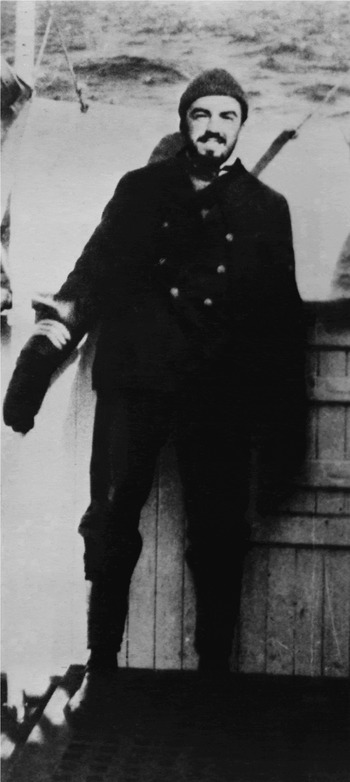
One of the most captivating cases in the history of parathyroid disease is the story of Captain Charles E Martell. He began work in the American merchant navy and his first ship, the SS New York, was mined in the Irish Sea. He survived. Martell's first symptoms began in 1918, aged 22; he developed a severe pain in his right loin following a fall. In early 1919, he developed pain in a number of other sites but was otherwise healthy, and tall at six feet one inch (Figure 3). Later that year, his fellow officers commented that he was becoming shorter and pigeon-breasted. His collar size increased, and he himself noticed cloudy urine and the passage of fine white gravel at the end of urination. He also noticed a general lethargy and muscle weakness but remained at sea until 1922, when his height had decreased to five feet eight and a half inches.
Captain Charles E Martell in 1919. Reproduced with permission of Massachussets General Hospital.

In 1923, Martell fractured his left radius and ulna; radiographs at that time revealed decreased bone density suggestive of osteomalacia. In 1924, he was admitted to the Marine Hospital on Statton Island. In an attempt to combat his loss of height, a Bradford frame with traction was used, which temporarily increased his stature to five feet nine inches. Other unsuccessful treatments Martell endured were high calcium and phosphate diets, cod liver oil, calcium and phosphorous medications, thyroid extracts, adrenaline, heliotherapy, quartz lamp treatment and irradiated milk.
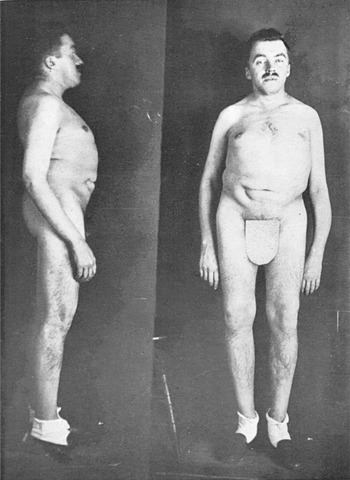
In January 1926, when he was admitted to Bellevue Hospital, New York, under the care of Dr Eugene DuBois, Martell was a different man (Figure 4). Investigations revealed a raised serum calcium level, a low serum phosphate level and hypercalciuria. DuBois noticed that Martell's biochemical abnormalities were very similar to human trial subjects receiving excessive doses of Collip's parathyroid extract. This, combined with the knowledge that the same extract exacerbated Martell's symptoms, led DuBois to deduce correctly that a ‘search for some abnormality of the parathyroid glands was the next step indicated’.Reference Hannon, Shore, McClellan and DuBois27 DuBois transferred Martell to the care of Drs Aub and Bauer at Massachusetts General Hospital for consideration of parathyroidectomy. Unknown to the team, Felix Mandl had already performed a parathyroidectomy on Albert Gahne six months earlier.
Captain Charles E Martell in 1926. Reproduced with permission.27

In 1926, E P Richardson, chief of surgery at Massachusetts General Hospital, explored Martell's neck twice, and removed a normal parathyroid gland from each side. Despite no adenoma being discovered and no change in his biochemistry, Martell was symptomatically better and was discharged.Reference Bauer, Albright and Aub31 He returned to work in 1927 as a marine insurance broker.
A deterioration forced readmission in 1929, when Dr Russell Patterson of New York explored Martell's neck without success. Martell was readmitted to Massachusetts General Hospital in 1932, where Dr Oliver Cope re-explored Martell's neck three more times without locating any disease. Martell was an extraordinary advocate of surgery, as he had read about the variable anatomy of the parathyroid glands in Harvard Medical Library during his many months in Massachusetts General Hospital. He insisted that his mediastinum be explored at a seventh procedure.Reference Spence32 Doctor Edward Churchill had taken over as chief of surgery at Massachusetts General Hospital and performed this mediastinal exploration in October 1932. A 3 × 3 cm, encapsulated tumour was found in the superior mediastinum. Ninety per cent of this tumour was excised; the remaining ten per cent was re-implanted to prevent the anticipated tetany. Despite these efforts, tetany developed on the third post-operative day, requiring Collip's extract and intravenous calcium chloride. Martell made a slow recovery, but six weeks later developed an impacted renal stone which required surgical removal. Tragically, he developed laryngospasm post-operatively and died – a sad end for a man whose case had done much to advance the knowledge of parathyroid disease.Reference Bauer and Federman33, Reference Organ34
Elva Dawkins
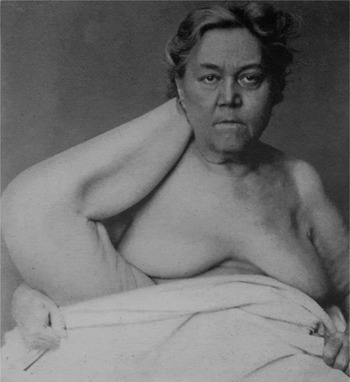
The third illustrative case history is that of Elva Dawkins. Aged 56, she attended Barnes Hospital in 1927 with an inability to walk, urinary frequency and a swelling of the right forefinger. Her symptoms had been present for many years, although she still worked hard on a farm. Her diagnosis, following amputation of the right forefinger, was giant cell sarcoma, nephrolithiasis and unexplained hypotonia of the muscles (Figure 5). David Barr and Harold Bulger were impressed with the similarity between this case and the observations following experimental overdose of Collip's extract in dogs. Dawkins's neck was explored and a 3 cm parathyroid tumour removed. Following severe post-operative tetany requiring ‘heroic doses of parathormone and oral calcium’, Dawkin's symptoms abated and she began to walk again.Reference Barr and Bulger35 Barr and Bulger were the first to strongly suggest that osteitis fibrosa cystica was secondary to ‘hyperparathyroidism’. They were also the first to use the term ‘hyperparathyroidism’, defining it as a distinct entity with five clinical features: rarefaction of bone, multiple cystic bone tumours, muscular weakness and hypotonia, abnormal excretion of calcium in the urine and formation of calcium stones, and abnormally high serum calcium levels.Reference Barr, Bulger and Dixon36
Elva Dawkins. Reproduced with permission.35

Recent developments
Since Barr and Bulger's time, further understanding of the pathology of hyperparathyroidism has slowly evolved, including its classification into primary, secondary and tertiary subsets.Reference Ahmad and Hammond37 The current consensus was reached only in the late 1960s. A further milestone in the diagnosis of hyperparathyroidism was the development in 1963 of a PTH assay. In 1977, Rosalyn Yalow was awarded the Nobel prize for medicine and physiology, for her development of radioimmunoassays of peptide hormones.Reference Berson, Yalow, Aurbach and Potts38
Surgical techniques have evolved over the years, with a preference for smaller and smaller surgical incisions. There are now many advocates of minimally invasive, endoscopic and video-assisted parathyroidectomy, all of which have developed only in the last 10 years.Reference Norman and Chheda39–Reference Gagner41 Localising techniques have also been developed, increasing the success rate of parathyroidectomy. There is a 94 per cent chance of successful localisation if pre-operative sestamibi and ultrasound scans correlate well.Reference Feingold, Alexander, Chen, Libutti, Shawker and Simonds42 Surgical outcomes have also been improved with the use of intra-operative PTH assays and, somewhat contentiously, the use of intra-operative methylene blue and the gamma probe.Reference Irvin and Derison43–Reference Martinez, King, Romshe, Lozano, Morris and O'Dorisio45
Conclusion
Hyperparathyroidism is a condition that has confused and misled clinicians and patients for the last 150 years. Our understanding has developed through chance, trial and error, case reports, laboratory research, and, finally, molecular genetics. We are lucky enough now to be in a position to be able to counsel hyperparathyroid patients with facts learned through costly lessons. We are also able to predict, through genetic typing, some of those who are likely to develop the disease, as in cases of multiple endocrine neoplasia.Reference Chandrasekharappa, Guru, Manickam, Olufemi, Collins and Emmert-Buck46 Compare this to the situation in which the early patients found themselves, where clues were evident to the clinicians but the pathology was misunderstood and the diagnosis unknown. We have indeed progressed from failing to recognise a hyperparathyroid patient to having a clear understanding of the pathophysiology, treatment and even genetic susceptibility of parathyroid disease.
We owe a great debt to the early sufferers of parathyroid disease for their help in advancing our understanding. In return, we must ensure that skilled individuals perform parathyroid surgery in suitable centres.