INTRODUCTION
Tabanids are robust medium-to-large (6–30 mm) biting flies commonly referred to as horse or deer flies (Nevill et al. Reference Nevill, Stuckenberg, Phelps, Thomson and Tustin1994; Service, Reference Service2012). They belong to the family Tabanidae which is further divided into four subfamilies, namely Chrysopsinae, Pangoniinae, Scepsidinae and Tabaninae, comprising of more than 4400 species belonging to 114 genera, with a cosmopolitan distribution (Baldacchino et al. Reference Baldacchino, Desquesnes, Mihok, Foil, Duvallet and Jittapalapong2014a). However, in Africa only members from the subfamilies Chrysopsinae, Tabaninae, and various species of the genus Philoliche from the subfamily Pangoniinae, are of economic, medical and veterinary importance (Nevill et al. Reference Nevill, Stuckenberg, Phelps, Thomson and Tustin1994). In southern Africa there are about 410 species with nine dominant genera (Nevill et al. Reference Nevill, Stuckenberg, Phelps, Thomson and Tustin1994).
The mechanical transmission of various pathogens by tabanid flies has been known for decades (Zumpt, Reference Zumpt1949). This mode of transmission may either occur through contamination of mouthparts or regurgitation (Foil and Gorham, Reference Foil, Gorham, Eldrige and Edman2000; Baldacchino et al. Reference Baldacchino, Muenworn, Desquesnes, Desoil, Charoenviriyaphap and Duvallet2013). Defecation is also significant as pathogens can be ingested and deposited on food or other surfaces, however if the pathogens do not multiply within the alimentary canal of the insect then this is defined as mechanical transmission (Foil and Gorham, Reference Foil, Gorham, Eldrige and Edman2000). Tabanid flies are vectors of most disease-causing bacteria and viruses in animals and humans such as Bacillus anthracis, Listeria monocytogenes, Anaplasma marginale, Coxiella burnetii and rinderpest virus (Chainey, Reference Chainey, Lane and Crosskey1993; Nevill et al. Reference Nevill, Stuckenberg, Phelps, Thomson and Tustin1994; Esterhuizen, Reference Esterhuizen2006; Baldacchino et al. Reference Baldacchino, Desquesnes, Mihok, Foil, Duvallet and Jittapalapong2014a; Hornok et al. Reference Hornok, Fedák, Baska, Hofmann-Lehmann and Basso2014). Protozoan parasites, including the apicomplexan Besnoitia besnoiti and various trypanosome species (Trypanosoma brucei brucei, Trypanosoma congolense, Trypanosoma evansi, Trypanosoma theileri and Trypanosoma vivax), have also been reported to be amongst the haemoparasites disease agents transmitted by tabanid flies (Zumpt, Reference Zumpt1949; Nevill et al. Reference Nevill, Stuckenberg, Phelps, Thomson and Tustin1994; Desquesnes and Dia, Reference Desquesnes and Dia2003a, Reference Desquesnes and Diab, Reference Desquesnes and Dia2004; Ahmed et al. Reference Ahmed, Okiwelu and Samdi2005; Sinshaw et al. Reference Sinshaw, Abeb, Desquesnes and Yoni2006; Baldacchino et al. Reference Baldacchino, Desquesnes, Mihok, Foil, Duvallet and Jittapalapong2014a, Reference Baldacchino, Gardés, de Stordeur, Jay-Robert and Garrosb). These pathogens are mechanically transmitted to susceptible hosts during interrupted feeding by the flies. As a result tabanid flies cause major economic losses to both agriculture and dairy production sectors (Baldacchino et al. Reference Baldacchino, Desquesnes, Mihok, Foil, Duvallet and Jittapalapong2014a).
Most research on the prevalence of Trypanosoma, Besnoitia, Babesia and Theileria parasites has been conducted in South Africa and Zambia (Zumpt, Reference Zumpt1949; Bigalke and Prozesky, Reference Bigalke, Prozesky, Coetzer and Tuskin2004; Hunfeld et al. Reference Hunfeld, Hildebrandt and Gray2008; Yamada et al. Reference Yamada, Konnai, Imamura, Simuunza, Chembensofu, Chota, Nambota, Onuma and Ohashi2009; Namazi et al. Reference Namazi, Oryan and Sharifiyazdi2010; Mwandiringana et al. Reference Mwandiringana, Gori, Nyengerai and Chidzwondo2012; Sahinduran, Reference Sahinduran and Perez-Marin2012; Baldacchino et al. Reference Baldacchino, Desquesnes, Mihok, Foil, Duvallet and Jittapalapong2014a). However, most of these studies were focused on the affected vertebrate hosts or known vectors such as ticks or tsetse flies. There is a knowledge gap in the recent abundance of tabanid flies in South Africa and Zambia. Additionally, there is no data on the occurrence of protozoan parasites in tabanid flies from southern Africa. As a result, in the current study we report on characterization of tabanid flies in South Africa and Zambia. Furthermore this study has conducted molecular detection of protozoan parasites harboured by tabanid flies.
MATERIALS AND METHODS
Study sites
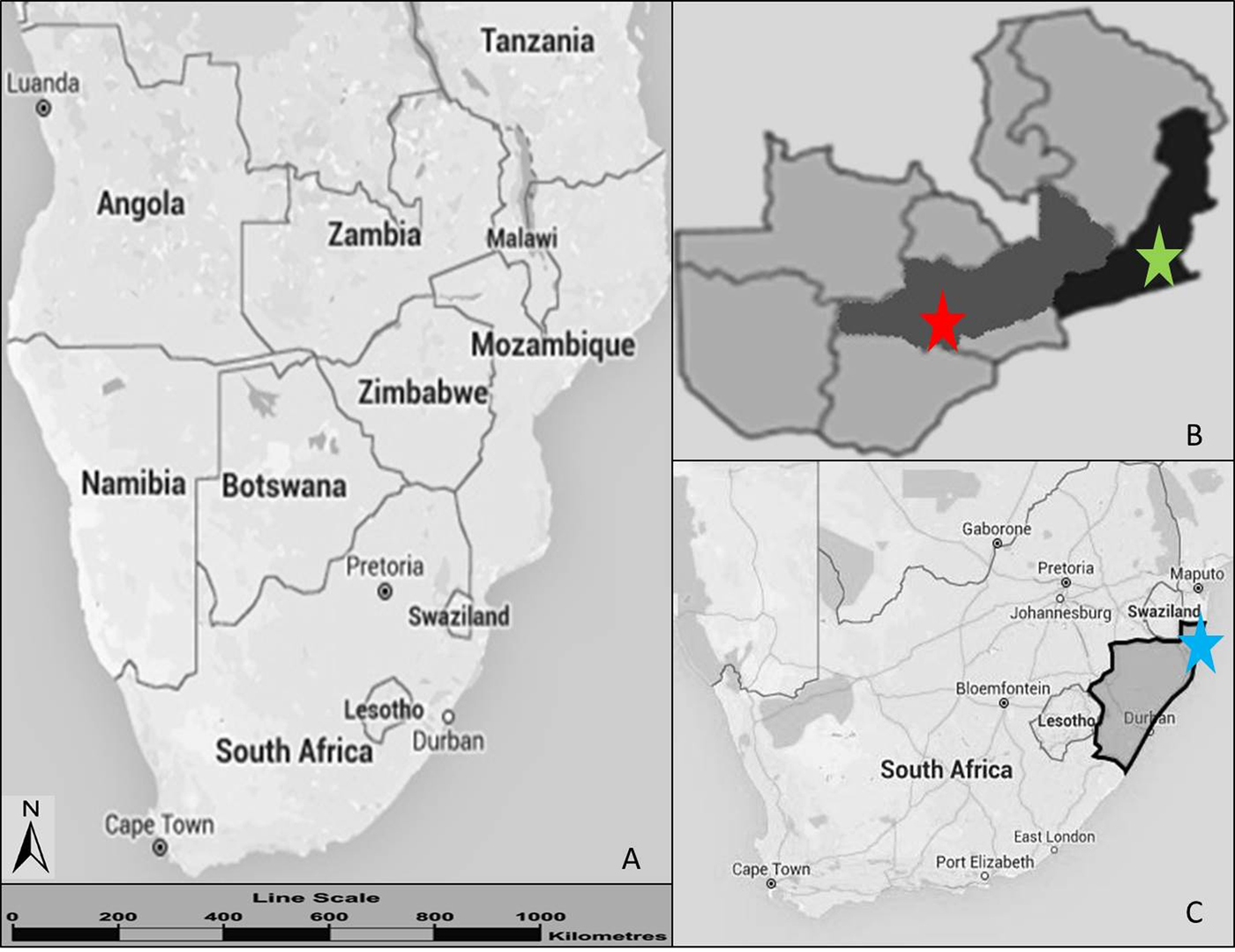
In South Africa tabanid flies were collected from three game reserves in north-eastern KwaZulu-Natal, namely, Charters Creek (28°13′37″S; 032°24′1″E), Hluhluwe-Imfolozi (28°9′50″S; 032°12′15″E) and Phinda Private Game Reserve (27°46′39″S; 032°20′57″E). In Zambia tabanid flies were collected in South Luangwa National Park (13°10′0·2″S, 031°29′59·8″E) in the Mambwe District of the Eastern Province and Kafue National Park (14°28′52·9″S, 026°13′17·7″E) in the Itezhi-tezhi District of Central Province (Fig. 1).
A is the map of southern Africa. B is the map of Zambia highlighting the sampled provinces namely Eastern Province with the Green Star and Central Province with the Red Star. C is the map of South Africa highlighting the sampled province and the Blue star shows where in KwaZulu-Natal Province samples were collected. The maps were created using the ArcGIS online software (https://arcgis.com) with modifications.

Collection of tabanid flies
A total of 18 H-traps (6 traps per game reserve placed at 100 m apart) were used to capture tabanid flies in three game reserves in South Africa in summer (November 2014). In Zambia sampling was done in summer (November 2015) with 11 Biconical traps (11 placed 200 m apart). All traps were kept at each sampling site for 5 days whilst the flies were harvested daily.
Identification and characterization of tabanid flies
Sequential photographs of different features of the flies were captured using a Nikon AZ 100 m multi zoom microscope (Nikon Inc., USA). Tabanid flies were then identified to species level by discerning unique characters that differentiated between species as described by Oldroyd (Reference Oldroyd1954), Yagi (Reference Yagi1968), Veer (Reference Veer1999) and Morita (Reference Morita2008). The distribution and occurrence of tabanids in South Africa was confirmed in accordance with Usher (Reference Usher1972).
DNA extraction
The whole fly was homogenized as described by Diallo et al. (Reference Diallo, Truc and Laveissiére1997), thereafter genomic DNA (gDNA) was extracted using the Zymo insect DNA extraction kit following the manufacturer's protocol (Zymo Research Corporation, USA) and stored at −32 °C until used.
Amplification of tabanid flies DNA by PCR
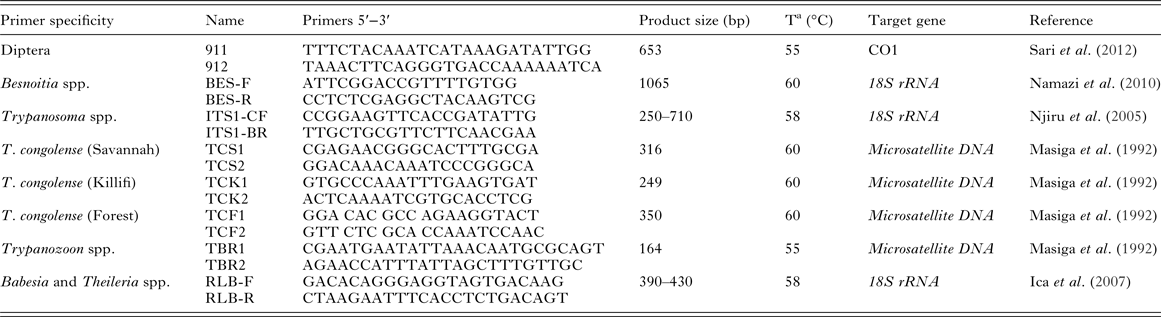
In order to supplement morphological identification of tabanid flies, PCR targeting the CO1 gene was conducted to identify tabanid fly DNA to species level and to further determine their phylogenetic position in comparison to other related taxa. The primers which amplified approximately 653 bp fragment of CO1 gene are shown in Table 1. In a total volume of 25 µL the PCR mixture contained 12·5 µL AmpliTaq Gold® 360 PCR Master Mix [AmpliTaq Gold® DNA Polymerase 0·05 units µL−1, Gold buffer (30 mm Tris/HCl pH 8·05, 100 mm KCl), 400 mm of each dNTP and 5 mm MgCl2] (Applied Biosystems, California, USA), 2·5 mm of each primer, 2 µL of template DNA and double-distilled water (ddH2O) was added to final volume. The gDNA of Glossina morsitans morsitans obtained from a colony of National Research Center for Protozoan Diseases, Obihiro University of Agriculture and Veterinary Medicine was used as a positive control and ddH2O as a no DNA template negative control. PCR conditions were set as described by Sari et al. (Reference Sari, Duran and Bardakci2012).
Primers used in the current study.

a T Indicates the annealing temperature.
Detection of protozoan parasite DNA by PCR
PCR with universal trypanosome primers (Table 1) targeting the internal transcribed spacer 1 (ITS1) gene was used to detect trypanosome DNA from the tabanid flies. The gDNAs of T. congolense (IL 3000); T. b. brucei (GUTat 3·1) and T. theileri (Japan Isolate) were used as positive controls. PCR conditions were set as described by Njiru et al. (Reference Njiru, Constantine, Guya, Crowther, Kiragu, Thompson and Dá Vila2005). Additional species-specific PCR assays described by Masiga et al. (Reference Masiga, Smyth, Hayes, Bromidge and Gibson1992) were conducted to confirm the presence of T. congolense and Trypanozoon species.
The PCR described by Namazi et al. (Reference Namazi, Oryan and Sharifiyazdi2010) with primers (Table 1) amplifying 1065 bp fragment of ITS1-5·8S-ITS2 rDNA gene was conducted for detection of Besnoitia species DNA from tabanid flies. The B. besnoiti donated by University of KwaZulu-Natal was used as positive control.
The PCR assay for amplification of piroplasma DNA (Babesia and Theileria species) was conducted with RLB primers (Table 1) targeting the 390–430 bp fragment of the hypervariable region V4 of the 18S rRNA. The gDNA of Babesia bigemina (Argentina strain) and Theileria parva (Muguga isolate) were used as positive controls. The PCR was conducted according to protocol described by Ica et al. (Reference Ica, Vatansever, Yildirim, Duzlu and Inci2007).
For detection of Trypanosoma, piroplasmas and Besnoitia spp. the PCR mixture was prepared with AmpliTaq Gold® 360 Master Mix (Applied Biosystems, USA) as described above. For all reactions the ddH2O as a no DNA negative control. PCR product detection was done on a 1% gel electrophoresis stained with GelRed DNA stain (Biotium Inc., USA) and visualized under UV light.
Sequencing and Basic Local Alignment Search Tool (BLAST)
The PCR amplicons were purified using the QIAGEN Gel Purification Kit (QIAGEN, USA) according to manufactures protocol. Sequencing was conducted using BigDye® terminator cycle sequencing kit according to the manufacture's protocol (Applied Biosystems, California, USA). Thereafter, the eluent was loaded into a 96 well plate and placed in ABI Prism 3100 Genetic Analyzer, where sequencing electrophoresis occurred using a 36 cm capillary array and POP-7™ polymer (Applied Biosystems, California, USA). Analysis of the data was done using the Sequence Analyzer software version 1.7·1 (Developed by Will Gilbert, http://informagen.com/SA/). Retrieved gene sequences were edited using BioEdit (Hall, Reference Hall1999). To confirm sequences obtained from all PCR analysis nucleotide BLAST (BLASTn) was used (www.ncbi.nlm.nih.gov/blast/). The gene sequences with 80–100% similarity match score were considered as significant.
Phylogenetic analysis
The CO1 gene sequences were aligned by Clustal W using the MAFFT (multiple alignment fast fourier transform) program to conduct multiple and pairwise sequence alignments (Katoh and Standley, Reference Katoh and Standley2013). Thereafter, the aligned sequences were trimmed using TrimAl version 1.4 to remove the uneven ends from the aligned sequences. The trimmed alignment was subsequently transferred to MEGA 6 for Maximum likelihood (ML) and Geneious (Ver. 7·1) bioinformatics software package for Bayesian inference (BI) analyses. The alignment consisted of a total of 51 gene sequences (636 bp long) with 20 sequences resulting from the current study and 31 comparable sequences retrieved from National Center for Biotechnology Information (NCBI) GenBank. For ML analysis 100 000 bootstrap replicates. The BI phylogeny was constructed using MrBayes Ver. 3·2·1 plugin on Geneious (Ver. 7·1) and the parameters were set as described by Morita et al. (Reference Morita, Bayless, Yeates and Wiegmann2016).
Statistical analysis
The prevalence of each parasite species were presented in proportions and summarized tables according to independent variables such as tabanid fly species as well as the locality where the fly was collected. The Kruskal–Wallis χ 2 analysis of variance by ranks at a significance level of 95% was used to determine the significance in the overall distribution of the tabanid flies in the sampled countries. Thereafter, Fisher's Exact Test (FET) was used to determine the difference at P < 0·05 for the prevalence of Besnoitia, Babesia, Theileria and Trypanosoma parasites between infected species and different localities.
RESULTS
Tabanid flies collected from South Africa and Zambia
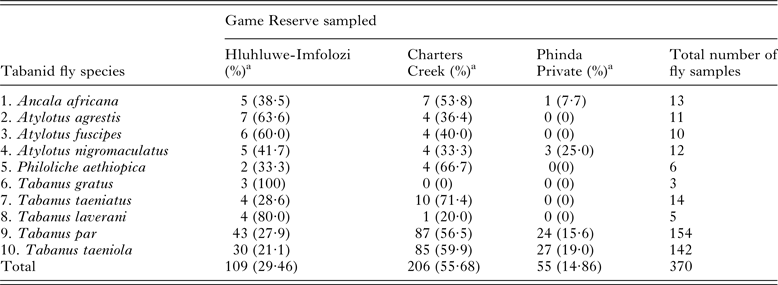
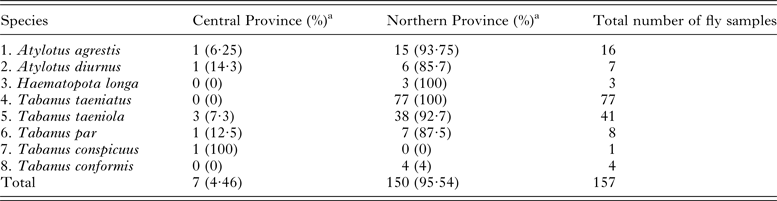
A total of 527 tabanid flies were collected from the two sampled countries with 370 from South Africa (Table 2) and 157 from Zambia (Table 3). Morphological analysis revealed a total of five different genera collected from the sampled areas namely: Ancala, Atylotus, Haematopota, Philoliche and Tabanus with a total of 14 different species including 10 collected from South Africa and eight were from Zambia.
Captured tabanid flies from South Africa.

a Indicates the abundance of the tabanid flies found per sampled game reserves from South Africa in percentages.
Captured tabanid flies from Zambia.

a Indicates the abundance of the tabanid flies found per sampled game reserves from Zambia in percentages.
Tabanid flies captured from South Africa were Ancala africana, Atylotus agrestis, Atylotus fuscipes, Atylotus nigromaculatus, Philoliche aethiopica, Tabanus gratus, Tabanus taeniatus, Tabanus laverani, Tabanus par and Tabanus taeniola (Table 2). The dominant species from the three sampled game reserves were T. par (41·6%) and T. taeniola (38·4%), whilst T. gratus (0·8%) was the least. Charters Creek Game Reserve (55·7%) had the highest species abundance followed by Hluhluwe-Imfolozi Game Reserve (29·4%) and Phinda Private Game Reserve (14·9%) with the least number of flies captured (Table 2). There was significant difference at P = 0·03 (Kruskal–Wallis χ 2 = 7032, d.f. = 2) in the overall distribution of the tabanid fly population throughout the three sampled game reserves in KwaZulu-Natal Province, South Africa.
The tabanid fly species collected from Zambia were A. agrestis, A. diurnus, Haematopota sp., T. taeniatus, T. conformis, T. conspicuus, T. par and T. taeniola (Table 3). The most dominant species captured from the two provinces was T. taeniatus (49·0%) followed by T. taeniola (26·1%) and the least was T. conspicuus (0·6%). The majority of samples were collected from Mambwe District in the Eastern Province (94·3%) and the Itezhi-tezhi District from the Central Province (5·7%) had the smallest sample size (Table 3). There was significant difference at P = 0·01 (Kruskal–Wallis χ 2 = 6·893, d.f. = 1) in the overall distribution of the tabanid fly population throughout the two-sampled provinces in Zambia.
Morphological identification of tabanid flies
We identified tabanid flies species based on their morphological characteristics with reference to the identification keys of Oldroyd (Reference Oldroyd1952, Reference Oldroyd1954), Yagi (Reference Yagi1968), Veer (Reference Veer1999) and Morita (Reference Morita2008).
Ancala africana Gray, 1922
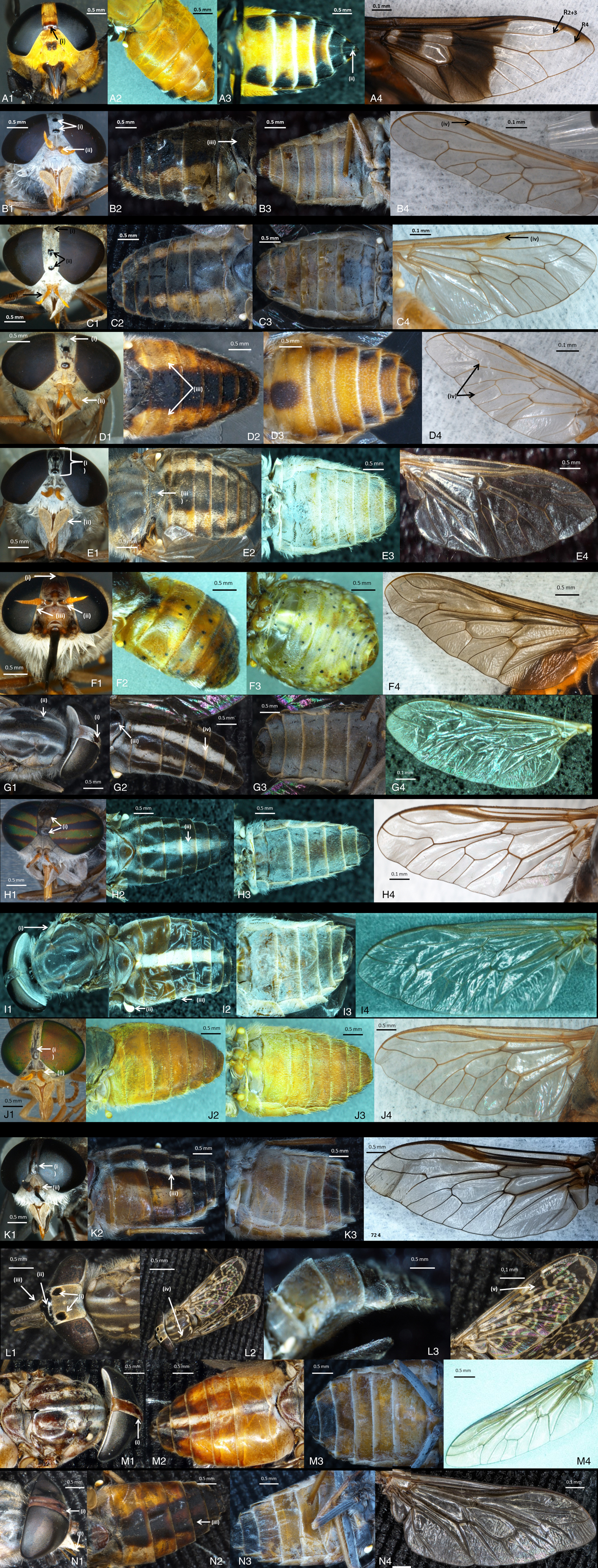
This species was only collected from South Africa. It was identified according to the characteristics described by Oldroyd (Reference Oldroyd1954) and Yagi (Reference Yagi1968). Accordingly, the specimen had a body length of 17 mm. The eyes were greenish with no bands in living specimens and black on dried specimens (Fig. 2A1). The callus was dark brown and had a quadrate shape with a trace of a median extension [Fig. 2A1 (i)]. The facial area was yellow covered with golden hairs. The antennae were blackish in pigmentation. It had an orange yellowish thorax with no patterns (Fig. 2A2). The dorsum of abdomen was orange with black hair patches on the margins of all tergites ventrally and the last segment was completely black with patches of white markings [Fig. 2A3 (ii)]. The wing membrane had broad transverse brown band shading crossing the distal cell but not reaching the hind margin and extends to the tips of the wing veins R2+3 and R4 (Fig. 2A4).
Images of tabanid flies identified in this study, (1) head, abdomen (2) dorsal and (3) ventral and (4) a single wing. A – Ancala africana; B – Atylotus agrestis; C – Atylotus diurnus; D – Atylotus fuscipes; E – Atylotus nigromaculatus; F – Philoliche aethiopica; G – Tabanus taeniatus; H – Tabanus gratus; I – Tabanus laverani; J – Tabanus par; K – Tabanus taeniola; L – Haematopota longa; M – Tabanus conformis; N – Tabanus conspicuus.

Atylotus agrestis Wiedemann, 1828
This species was collected from both South Africa and Zambia. It was identified by characteristics described by Oldroyd (Reference Oldroyd1954), Yagi (Reference Yagi1968) and Veer (Reference Veer1999). The specimen had a body length of 14 mm. The eyes were rusty brown with a trace of a single purple band in dried specimen and reddish black in living specimen (Fig. 2B1). The frons was grey and yellow towards the vertex. The proboscis and first segment of the antennae were light orange in colour and the rest of the antennae were bright yellow [Fig. 2B1 (ii)]. The upper and lower calli were circular and shining brown in colour [Fig. 2B1 (i)]. Face and parafacials were white with long white hairs (Fig. 2B1). The thorax was black with slight traces of four brown longitudinal sublateral stripes. The scutellum was uniformly brownish in colour [Fig. 2B2 (ii)]. The abdomen was black with two orange sublateral stripes and yellow ground colour (Fig. 2B2). The veins and costa of the wings were pale yellow and only the stigma was slightly brownish [Fig. 2B4 (iv)].
Atylotus diurnus Walker, 1850
This species was only collected from Zambia. It was identified by characteristics described by Oldroyd (Reference Oldroyd1954). The specimen had a body length of 15 mm. The eyes were reddish black with no traces of bands on both living and dried specimens (Fig. 2C1). The frons had yellow–grey fine hairs and a fairly large yellowish triangle at the vertex [Fig. 2C1 (i)]. Calli were dark brown with the upper callus was slightly elongated and the subcallus flat [Fig. 2C1 (ii)]. The face and parafacials had yellowish grey tomentum. The antennae were yellowish orange from the scape and more light yellow towards the tips [Fig. 2C1 (iii)]. The proboscis was dark brown and stalky. The thorax had a black mesonotum with no patterns and covered with thin ashy grey hairs. The dorsum of the abdomen was ashy grey with clear patterns made up of black and golden hairs with three longitudinal stripes (Fig. 2C3). The wings were clear with a bit of yellow colouration towards the ends and the stigma [Fig. 2C4 (iv)].
Atylotus fuscipes Ricardo, 1908
This species was only collected from South Africa. It was identified by characteristics described by Oldroyd (Reference Oldroyd1954), Yagi (Reference Yagi1968) and Veer (Reference Veer1999). The body length of this specimen was 14 mm. Eyes of the dried specimen were reddish brown on living and dried specimens (Fig. 2D1). The frons was yellowish grey with a yellow triangular shape at the vertex and a distinct median ocellus [Fig. 2D1 (i)]. The calli were black, ovate to quadrate in shape. The proboscis was brownish. The antennae were pale yellowish at the first segment with black hairs and more orange at the terminal [Fig. 2D1 (ii)]. The thorax was ashy grey with a narrow dark brown median stripe and mere traces of sublateral stripes. The abdomen was dorsum black with two orange sublateral stripes that end on the fifth tergite. The orange stripes were more broad at the first two segments [Fig. 2D2 (iii)] and had golden hairs. The wings were clear with brownish veins [Fig. 2D4 (iv)].
Atylotus nigromaculatus Ricardo, 1900
This species was only collected from South Africa. It was identified by characteristics described by Oldroyd (Reference Oldroyd1954). The specimen had a body length of 13 mm. The eyes were reddish brown on living specimen and yellowish with a trace single purple band on dried specimen. The frons was slightly converted with yellowish grey hairs and large black V-shaped callus at the vertex [Fig. 2E1 (i)]. Hairs around the head were mainly yellow and mixed with some few black ones. The face and parafacials had white fine hairs. The palpi were white and swollen at the base [Fig. 2E1 (ii)]. The proboscis was black–brown in colour. The thorax was black with a thin ashy grey–brown tomentum and fairly distinct narrow yellowish grey longitudinal stripes. The scutellum was ashy grey-brown [Fig. 2E2 (iii)]. The abdomen dorsally, was black–brown with a little reddish colour on the sides of the first two segments with three prominent yellowish grey longitudinal parallel-sided stripes (Fig. 2E2). The wings were clear with pale yellow stigma and yellowish veins that darken towards the margins (Fig. 2E4).
Philoliche aethiopica Thunbrg, 1789
This species was only collected from South Africa. The specimen was identified by characteristics described by Morita (Reference Morita2008). The body length of the specimen was 14 mm. The head was black with black eyes (Fig. 2F1). The frons was strongly divergent towards antennae and mahogany brown in colour [Fig. 2F1 (i)]. The first two segments of the antennae were brown with black hairs. The proboscis was black and equal to the body length [Fig. 2F1 (ii)]. The inner eye margins had an obtuse angle [Fig. 2F1 (iii)]. The thorax was dark brown with no sublateral stripes. The abdomen was bright reddish orange with small blue–black medial spots on the first four tergites dorsally and ventrally (Figs 2F2 and F3). The wings were slightly smoky and darkened slightly at cross-veins (Fig. 2F4).
Tabanus taeniatus Macquart, 1834
This species was collected from both South Africa and Zambia. The specimen was identified by characteristics described by Oldroyd (Reference Oldroyd1954). The body length of this specimen was 12 mm. The eyes were green violet without bands on living specimens but appeared brownish black on dried specimens (Fig. 2G1). The frons was honey-brown with black hairs and yellow hairs towards the margins of the eyes. The upper and lower calli were irregular and black in colour [Fig. 2G1 (i)] and not connected. The proboscis was blackish with orange yellowish palpi. The thorax had ashy black hairs and a faint narrow brown median line [Fig. 2G1 (ii)]. The scutellum was blackish brown with patches of grey on the sides [Fig. 2G2 (iii)]. The dorsum of the abdomen was ashy black with three whitish grey longitudinal stripes. The two sublateral stripes ended on the seventh tergite which was completely greyish. The hairs were black on the dark areas of the abdomen and whitish yellow on the grey stripes. The wings were clear with pale yellow veins and stigma (Fig. 2G4).
Tabanus gratus Loew, 1858
This species was only collected from South Africa. The specimen was identified by characteristics described by Oldroyd (Reference Oldroyd1954). The body length of this specimen was 12 mm. The eyes were green with three crimson bands in both living and dry specimens (Fig. 2H1). The tomentum of the frons was yellowish grey and whitish towards the vertex. The calli were separated whereby, the lower callus was slightly square in shape and upper callus was oval and both were honey brown in colour [Fig. 2H1 (i)]. The first two segments of the antennae were whitish and the rest orange. The face and parafacials were white with whitish hairs. The proboscis was brown (Fig. 2H1). The thorax had dark brown fine hairs with white median and sublateral stripes. The dorsum of the abdomen was dark brown with three clearly defined white stripes (Fig. 2H2). The median stripe was narrow on the second segment, becoming broadest on the hind margin of the forth segment and narrowing again towards the posterior [Fig. 2H2 (ii)]. The wings were clear with yellow veins and an almost invisible stigma (Fig. 2H4).
Tabanus laverani Surcouf, 1907
This species was only collected from South Africa. The specimen was identified by characteristics described by Oldroyd (Reference Oldroyd1954). The body length of this specimen was 14 mm. The eyes were black greenish on dried specimen and banded in living specimen (Fig. 2I1). The tomentum of the frons was light grey with black patches on the vertex and the upper callus. The palpi were covered with white hairs and the proboscis was dark brown. The first two segments of the antennae were reddish and the rest were bright orange with black hairs. The thorax had a dark-brown thin hairs with a pair of faint light grey sublateral stripes which continued across the sides of the scutellum [Fig. 2I1 (i)]. The knobs of the halters were whitish yellow [Fig. 2I2 (ii)]. The dorsum of the abdomen was light brown on the first two tergites and the rest was dark brown with a bold parallel sided whitish median stripe (Fig. 2I2). The lateral margins were greyish with no patterns [Fig. 2I2 (iii)]. The wings were clear with a dark brown stigma [Fig. 2I4 (iv)].
Tabanus par Walker, 1858
This species was collected from both South Africa and Zambia. The specimen was identified by characteristics described by Oldroyd (Reference Oldroyd1954). The body length of this specimen was 12 mm. The eyes were emerald green and without bands on both living and dry specimens (Fig. 2J1). The tomentum of the frons was golden yellow with black hairs. The callus was yellowish brown and broadly united into an elongated, onion shape figure [Fig. 2J1 (i)]. The subcallus, face and parafacials were lemon yellow with yellow hairs. The palpi were yellow with black and pale yellow hairs. The proboscis was yellow orange in colour (Fig. 2J1). The first two segments of the antennae were yellow with yellow hairs and the rest were bright orange [Fig. 2J1 (ii)]. The thorax was without any patterns and scutellum was black in ground colour. The dorsum of the abdomen was orange without any patterns and clothed with a mixture of black and golden yellow fine hairs (Fig. 2J2). The wings were clear with yellow veins and stigma (Fig. 2J4).
Tabanus taeniola Palisto de Beavios, 1807
This species was collected from both South Africa and Zambia. The specimen was identified on characteristics described by Oldroyd (Reference Oldroyd1954). The body length of this specimen was 16 mm. The eyes were reddish brown on dried specimen and dull copper green in living specimens with short and sparse pubescence (Fig. 2K1). The facets were equal in size with no visible bands. The frons was reddish brown with a thin tomentum covered mostly by white hairs. The callus was reddish brown [Fig. 7K1 (i)] and the proboscis was black (Fig. 2K1). The first segment of the antenna was whitish grey, the second a bit reddish with black hairs and the rest were blackish [Fig. 2K1 (ii)]. The thorax was black and the tomentum reddish brown on the sides. The scutellum was dull reddish with grey tomentum on the sides and grey medially. The abdomen was dorsally reddish brown at the first four tergites and the fifth to seventh tergites are dark brown (Fig. 2K2). On the abdomen there were three conspicuous longitudinal whitish stripes (Fig. 2K2). The median stripes were triangular and appeared to be fused [Fig. 2K2 (iii)]. The wings were clear with a pale stigma (Fig. 2K4).
Haematopota longa Ricardo, 1906
This species was only collected in Zambia. The specimen was identified by characteristics described by Oldroyd (Reference Oldroyd1952). The body length of this specimen was 10 mm. Eyes on living and dry specimens were reddish black (Fig. 2L1). The frons was square, pale yellow and slightly grey on the sides. The specimen had circular black-paired spots and not touching the eye margins [Fig. 2L1 (i)]. The callus was transverse, low, without median extensions and black in colour [Fig. 2L1 (ii)]. The first segment of the antennae were cylindrical and elongated and as long as the frons and without subapical notches [Fig. 2L1 (iii)]. The rest of the antennae were reddish brown and the last segment was black. The face and parafacials were whitish grey. The thorax was light brown in colour with greyish brown distinct patterns at the end of sublateral stripes and a median grey stripe [Fig. 2L1 (iv)]. The dorsum of the abdomen was dark brown with pale side margins. The wings were light brown with dark brown to black rosettes covering the whole wing [Fig. 2L4 (v)].
Tabanus conformis Walker, 1848
This species was only collected from Zambia. The specimen was identified by characteristics described by Oldroyd (Reference Oldroyd1954). This specimen was fairly large with a length of 12 mm. The eyes were dark purplish with no bands on both living and dry specimens (Fig. 2M1). Tomentum of the frons was dark brown in the middle and greyish towards the vertex and lower callus [Fig. 2M1 (i)]. Subcallus and parafacials were light brown and the proboscis was black–brown [Fig. 2M1 (ii)]. The thorax had brown fine hairs and an ashy grey pigment towards the edges with faint greyish sublateral stripes (Fig. 2M2). The dorsum of the abdomen was orange with short black hairs which give it a brown colour to the naked eye [Fig. 2M2 (iii)]. There was a grey-yellowish median stripe that is clearly prominent covered with yellow hairs (Fig. 2M3). The wings were smoky grey becoming more brownish towards the margins (Fig. 2M4).
Tabanus conspicuus Ricardo, 1908
This species was only collected from Zambia. The specimen was identified by characteristics described by Oldroyd (Reference Oldroyd1954). The body of this specimen was large with 19 mm in length. The eyes were dark reddish brown with no bands on both living and dry specimens (Fig. 2N1). The tomentum of the frons was yellowish grey to reddish brown [Fig. 2N1 (i)] and the proboscis was black–brown. The thorax had yellow fine hairs with a brown tomentum between lateral stripes [Fig. 2N1 (ii)]. The scutellum was yellow–brown with a red tip [Fig. 2N (iii)]. The dorsum of the abdomen was predominantly yellow with a very broad median stripe with triangles united into a notched stripe and brown in colour giving the appearance of a yellow abdomen with two narrow brown stripes (Fig. 2N2). The wings were slightly smoky with distinct colourings along the veins (Fig. 2N4).
Phylogeny of southern African tabanid flies
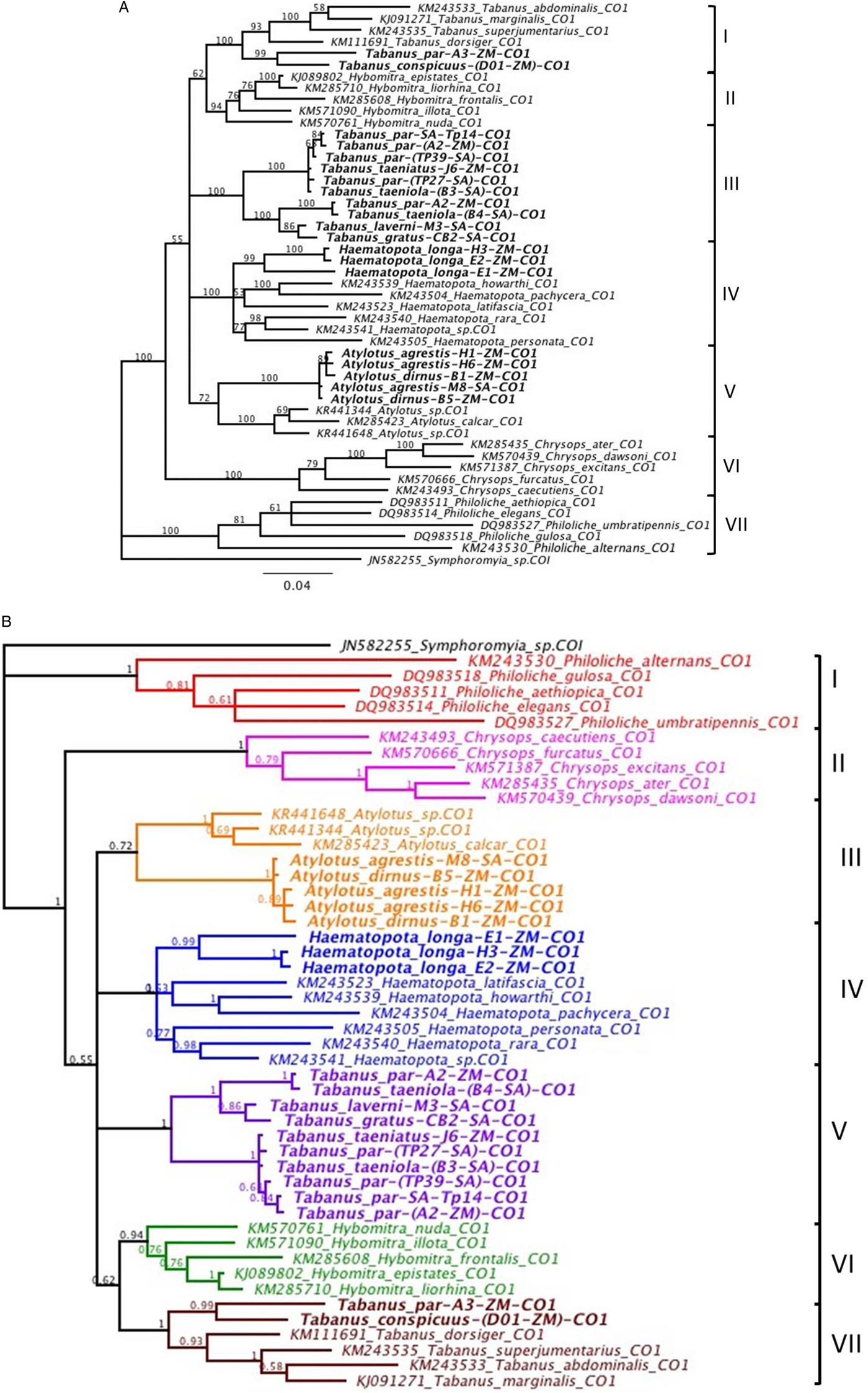
Sequences used for both ML and BI phylogenetic analyses were from members of the genera Atylotus, Hybomitra, Tabanus, Haematopota and Philoliche as well as Chrysops representing three tribes from the family Tabanidae. Symphoromyia [JN582255] from the family Rhagionidae was used as an out-group (Fig. 3A and B). All tabanid CO1 sequences generated from this study clustered with corresponding congener. In both tree topologies monophyly within the family Tabanidae is well supported. The ML (Fig. 3A) revealed seven major Clades (I–VII) with strong bootstrap support values, namely, Clade I – Tabanus 1 spp.; Clade II – Hybomitra spp.; Clade III – Tabanus 2 spp.; Clade IV – Haematopota spp.; Clade V – Atylotus spp.; Clade VI – Chrysops spp. and Clade VII – Philoliche spp. The BI analysis (Fig. 3B) also produced seven clades namely, Clade I – Philoliche spp.; Clade II – Chrysops spp.; Clade III – Atylotus spp.; Clade IV – Haematopota spp.; Clade V – Tabanus 2 spp.; Clade VI – Hybomitra spp. and Clade VII – Tabanus 1 spp., respectively. In both tree topologies, sequences generated in this study are in bold font.
(A) Phylogenetic analysis by Maximum likelihood (ML) method using MEGA 6 (Tamura et al. Reference Tamura, Stecher, Peterson, Filipski and Kumar2013) showing the position of South African and Zambian tabanid flies. The tree shows seven major Clades (I–VII), namely, Clade I – Tabanus 1 spp.; Clade II – Hybomitra spp.; Clade III – Tabanus 2 spp.; Clade IV – Haematopota spp.; Clade V – Atylotus spp.; Clade VI – Chrysops spp. and Clade VII – Philoliche spp. (B) Phylogenetic analysis by Bayesian inference (BI) constructed using MrBayes. Distinct clades are represented in different colours whereby Tabanus spp. 1 is represented by brown, Hybomitra spp. by green, Tabanus spp. 2 represented by purple, Atylotus spp. by orange, Chrysops by pink, Haematopota spp. by blue and members of Philoliche spp. by red colour, respectively.

Occurrence of protozoan parasites from South African tabanid flies
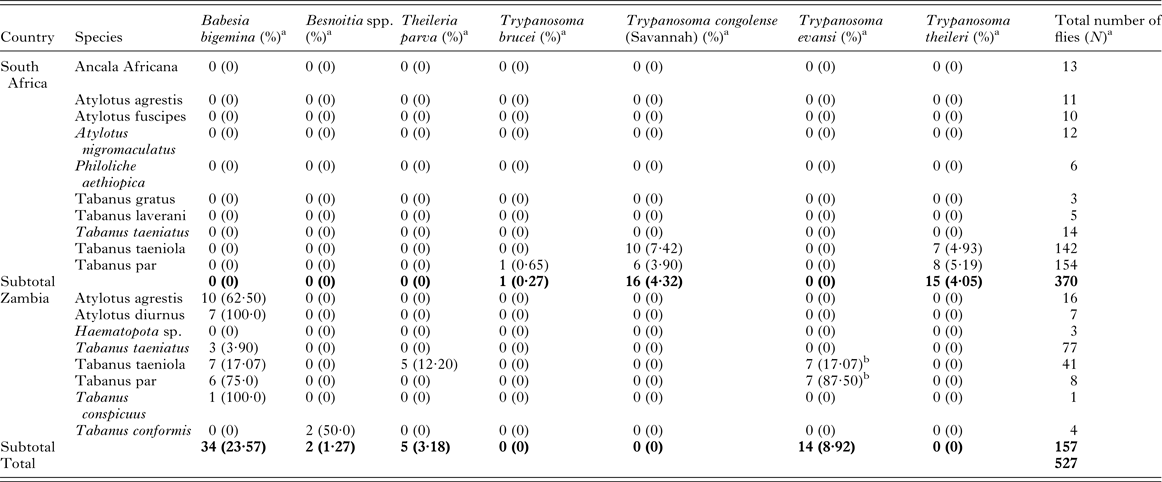
From the 370 South African tabanid flies analysed, none tested positive for the presence of Besnoitia, Babesia and Theileria DNA by PCR. Only 8·38% (31/370) of Trypanosoma DNA was detected from South African tabanid flies (Table 4).
Prevalence of protozoan parasites detected from tabanid flies collected from South Africa and Zambia.

a Indicates the average prevalence of the tested pathogens from the positively tested tabanid flies.
b Indicates the significance for the prevalence of the detected pathogens at P < 0·05 calculated using FET by comparing the positively tested flies per pathogen detected.
Only flies collected from Hluhluwe-Imfolozi 14·7% (16/109) and Charters Creek 7·3% (15/206) game reserves were positive for the presence of trypanosome DNA and none were positive from Phinda Private Game Reserve (Table 4). Only members from T. taeniola 11·97% (17/142) and T. par 9·09% (14/154) were positive. The T. congolense (Savannah), which was further confirmed using TCS primers (S.5) was detected in T. par 3·25% (5/154) and T. taeniola 7·04% (10/142), whilst T. theileri was detected in T. par 5·19% (8/154) and T. taeniola 4·61% (7/142). The T. brucei DNA was detected from only 0·65% (1/154) T. par specimen from Charters Creek Game Reserve (Table 4). There was no significant difference at P = 0·1131 (one-tailed FET) in the prevalence of T. congolense (Savannah) as well as at P = 0·5650 (one-tailed FET) for T. theileri between T. par and T. taeniola from South Africa. Additionally, TBR primers PCR was used to confirm the presence of Trypanozoon species DNA (S.6).
Nucleotide BLAST analysis confirmed the T. congolense (Savannah)-positive samples from T. par had 89–90% identity match with T. congolense LS25 isolate [JX910374] from the NCBI GenBank, whilst those from T. taeniola had 90–97% identity match score with T. congolense isolate TS07210 [JN673389]. The T. theileri parasite detected from T. par and T. taeniola had 80–90% identity match score with T. theileri [ZPU2807] and [JN673396] isolates. The T. brucei gene sequence obtained from T. par matched with T. brucei Suzena strain [AF306775] and with T. evansi isolate 006 [HQ593640] by 93% identity match score (shown in the Supplementary image S. 1). Additionally, neither T. vivax nor mixed infections were detected from the analysed samples. Retrieved trypanosome sequences from South African tabanid flies were deposited to GenBank under the accession numbers KX870078, KX870079 and KX870080.
Prevalence of protozoan parasites from Zambian tabanid flies
From 157 tabanid flies that were collected from Zambia, a total of 35·03% (55/157) tested positive for presence of Besnoitia spp. 1·27% (2/157), Babesia spp. or Theileria spp. 24·84% (39/157) and Trypanosoma evansi species 9·82%1 (4/157) by PCR. Only 1 sample of Tabanus conspicuus collected from Central Province was positive for B. bigemina and the remaining samples from Central Province were negative for the tested parasites. Eastern Province had the highest prevalence of the tested parasites with 34·62% (54/156) from the sampled flies.
Besnoitia spp. DNA was detected only from Tabanus conformis (2/4) flies which were collected from the Eastern Province (Table 4). Due to the low number of positively tested tabanid flies by PCR no statistical analysis was conducted for the prevalence of Besnoitia spp. The Besnoitia spp. PCR-positive samples were sequenced and the BLASTn analysis showed that these gene sequences of the two species matched with B. besnoiti from Israel [DQ227420] with 87% identity match score.
Amplification of the hypervariable region V4 of the 18S rRNA for either Babesia or Theileria parasites using species-specific primers RLB-F2 and RLB-R2 showed that 24·84% (39/157) of tested flies were positive for the presence of B. bigemina with 21·66% (34/157) and T. parva with 3·18% (5/157) (Table 4). All positive samples were from Eastern Province whereby A. agrestis was the most infected at 62·50% (10/16) followed by A. diurnus at 100% (7/7) and T. taeniola at 17·07% (7/41). The T. taeniatus and T. conspicuus were the least infected with 3·90% (3/77) and 100% (1/1), respectively. There was no significant difference at P = 1·0994 (one-tailed FET) in the prevalence of B. bigemina in all positively tested tabanid samples. The BLASTn analysis showed that the B. bigemina sequences obtained in this study matched with B. bigemina isolate MT26 [KU206297] with 90–98% identity match score (shown in the Supplementary image S. 2). Babesia bigemina sequences obtained from Zambian tabanid flies were deposited to GenBank under the accession numbers KX870083, KX870084 and KX870085, respectively.
Only samples from T. taeniola tested positive for the presence of Theileria parasite at 3·18% (5/157) [KX870086]. Due to the fact that only T. taeniola specimens tested positive for the presence of Theileria parasites, no statistical analysis was conducted to test the significance of Theileria parasites in positively tested samples. Analysis from BLASTn confirmed that sequences obtained from this study matches with T. parva isolate KNP102 [HQ684067] and T. parva [KM211712] by 83–86% identity match scores (shown in the Supplementary image S. 3).
A total of 9·82% (14/157) tabanid flies from Zambia tested positive presence of Trypanosoma DNA (Table 4). The trypanosome infections were only detected from samples collected from Eastern Province and detection was from T. taeniola 17·07% (7/41) and T. par 87·50% (7/8). There was a significant difference at P = 0·0007 (one-tailed FET) in the prevalence of Trypanosoma species in all positively tested tabanid samples. The BLASTn results showed that all recovered sequences in this study matched with T. evansi isolate 006 [HQ593640] by 89–99% identity match score (shown in the Supplementary image S. 4) and retrieved sequences were deposited to GenBank [KX870081–KX870082]. A total of 75% (6/7) T. par specimens from Zambia had mixed infections for B. bigemina and T. evansi as summarized in Table 4. None of T. congolense Kilifi and T. congolense Forest primers tested positive in samples from both samples countries.
DISCUSSION
Horse flies belonging to five different genera representing 14 species were recorded in the current study namely: Ancala, Atylotus, Haematopota, Philoliche and Tabanus. The overall number of members from the genus Tabanus was greater than all other genera combined.
The species of Chrysops and Hybomitra, as well as species from the subfamily Scepsidinae were not encountered from the two-sampled countries. In a study of seasonal abundance of horse flies conducted for a period of 4 years in north-eastern KwaZulu-Natal Province by Esterhuizen (Reference Esterhuizen2006), no members from Scepsidinae were recorded. The last record of Scepsidinae members in southern Africa were reported by Usher (Reference Usher1972). Furthermore, Esterhuizen (Reference Esterhuizen2006) recorded only two species from the genus Chrysops from 4 years of sampling, this is an indication that species from the genus Chrysops are uncommon in sampled regions. Likewise, in studies conducted by Okiwelu (Reference Okiwelu1975, Reference Okiwelu1976) on tabanids from Zambia in the Miombo woodlands, Chrysops species were not reported.
Most studies conducted on the seasonal abundance of tabanid flies concluded that high numbers of flies are observed during the summer months or rainy seasons (Barros, Reference Barros2001; Ahmed et al. Reference Ahmed, Okiwelu and Samdi2005; Esterhuizen, Reference Esterhuizen2006; Itina et al. Reference Itina, Noutcha and Okiwelu2013; Baldacchino et al. Reference Baldacchino, Desquesnes, Mihok, Foil, Duvallet and Jittapalapong2014a). The small Zambian sample size in the current study may be due to El Niño phenomenon (2015–2016) during the sampling period as it has resulted in unusually dry summer season which were extremely hot. Hence we also collected the fly samples in summer months in the current study.
Phylogeny of southern African tabanid flies observed in the current study supports monophyly in Tabanidae. Similar observation was reported previously where morphological analysis derived from genitalia and external characters as well as molecular techniques targeting mitochondrial (CO1) and nuclear (28S) genes also supported monophyly in Tabanidae (Lessard and Yeates, Reference Lessard and Yeates2012; Lessard et al. Reference Lessard, Cameron, Bayless, Wiegmann and Yeates2013; Morita et al. Reference Morita, Bayless, Yeates and Wiegmann2016). However, the genus Tabanus was non-monophyletic as there was a split between Tabanus species from different ecozones. The Tabanus species from the current study are from the Afrotropic region and are genetically distinct from those found in the Nearctic and the Neotropical regions (Morita et al. Reference Morita, Bayless, Yeates and Wiegmann2016). Additionally, as observed in Fig. 3A (Clade D), the tribe Tabanini which is composed of members from the genera Atylotus, Hybomitra and Tabanus formed a paraphyletic clade with each other. Findings in this study support observations by Morita et al. (Reference Morita, Bayless, Yeates and Wiegmann2016) whereby, members from the subfamily Chrysopsinae appeared to be paraphyletic as shown in Clade II of Fig. 3A and Clade V of Fig. 3B. The tribe Haematopotini is monophyletic in both ML and BI analyses and these correspond to finding by Morita and colleagues (Reference Morita, Bayless, Yeates and Wiegmann2016). However, A. agrestis [KM111665] and Tabanus nigrovittatus [KT381971] branched on their own. In most phylogenetic analyses of tabanid flies and other closely related species there are normally uncertainties with the position of most species due to weak support observed from internal relationships (Yeates et al. Reference Yeates, Wiegmann, Courtney, Meier, Lambkin and Pape2007; Morita et al. Reference Morita, Bayless, Yeates and Wiegmann2016). Analyses generated in this study show that southern African tabanid flies do form well supported clades with corresponding congener however, they somehow appear to be genetically distinct from other related species.
It is well known that tabanids are vectors of most livestock pathogens causing diseases such as anaplasmosis, anthrax, animal trypanosomiasis, bovine viral leukosis, equine infectious anaemia virus and filarial worms, tularaemia, hog cholera as well as vesicular stomatitis (Zumpt, Reference Zumpt1949; Foil and Hogsette, Reference Foil and Hogsette1994; Esterhuizen, Reference Esterhuizen2006; Service, Reference Service2012; Baldacchino et al. Reference Baldacchino, Desquesnes, Mihok, Foil, Duvallet and Jittapalapong2014a). In the current study, DNAs of four different protozoan genera were detected by PCR, namely, B. bigemina, Besnoitia spp., T. parva, T. brucei, T. congolense (Savannah), T. evansi and T. theileri.
Published literature has widely reported that horse flies (tabanids) and Stomoxys flies do transmit various species of trypanosomes and B. besnoiti (Desquesnes and Dia, Reference Desquesnes and Dia2003a, Reference Desquesnes and Diab, Reference Desquesnes and Dia2004; Bigalke and Prozesky, Reference Bigalke, Prozesky, Coetzer and Tuskin2004; Baldacchino et al. Reference Baldacchino, Muenworn, Desquesnes, Desoil, Charoenviriyaphap and Duvallet2013, Reference Baldacchino, Desquesnes, Mihok, Foil, Duvallet and Jittapalapong2014a; Hornok et al. Reference Hornok, Fedák, Baska, Basso, Dencső, Tóth, Szeredi, Abonyi and Dénes2015). Occurrences of animal trypanosomes and tsetse flies are well reported in both South Africa and Zambia (Van den Bossche, Reference Van den Bossche2001; Mamabolo et al. Reference Mamabolo, Ntantiso, Latif and Majiwa2009; Gillingwater et al. Reference Gillingwater, Mamabolo and Majiwa2010; Mwandiringana et al. Reference Mwandiringana, Gori, Nyengerai and Chidzwondo2012; Motloang et al. Reference Motloang, Masumu, Mans and Latif2014; Nguyen et al. Reference Nguyen, Motsiri, Taioe, Mtshali, Goto, Kawazu, Thekisoe and Inoue2015; Dennis et al. Reference Dennis, Durkin, Horsley Downie, Hamill, Anderson and MacLeod2014; Laohasinnarong et al. Reference Laohasinnarong, Goto, Asada, Nakao, Hayashida, Kajino, Kawazu, Sugimoto, Inoue and Namangala2015; Mbewe et al. Reference Mbewe, Namangala, Sitali, Vorster and Michelo2015; Renda et al. Reference Renda, De Beer, Venter and Thekisoe2016). This is the first report of trypanosome occurrence from tabanid flies in South Africa and Zambia. Studies by Desquesnes and Dia (Reference Desquesnes and Dia2003a, Reference Desquesnes and Diab, Reference Desquesnes and Dia2004) have demonstrated that mechanical transmission of T. vivax and T. congolense by A. agrestis and A. fuscipes. On the other hand T. evansi is well known to be mechanically transmitted by biting flies including Stomoxys and tabanid flies (Sumba et al. Reference Sumba, Mihok and Oyieke1998; Gutierrez et al. Reference Gutierrez, Desquesnes, Touratier and Büscher2010; Desquesnes et al. Reference Desquesnes, Holzmuller, Lia, Dargantes, Lun and Jittaplapong2013). It has been reported that trypanosomes can also develop within the midgut and hindgut of tabanid flies (Krinsky and Pechuman, Reference Krinsky and Pechuman1975; Bose and Heister, Reference Bose and Heister1993). We refer to T. brucei-like and T. evansi-like trypanosomes as these species have not been reported to occur in these countries and require further confirmation.
In the current study, B. besnoiti DNA has been detected in T. conformis collected in Zambia only. This is the first report of the occurrence of B. besnoiti in Zambia and the finding indicates possible circulation of the parasite in wildlife in Zambia. Bovine besnoitiosis has been reported to cause major economic losses in Angola, Cameroon, Botswana, Kenya, Namibia, South Africa, Sudan, Swaziland, Zaire and Zimbabwe (Bigalke and Prozesky, Reference Bigalke, Prozesky, Coetzer and Tuskin2004). In South Africa cases of the disease have been documented from the Free State, KwaZulu-Natal, Limpopo, Mpumalanga, North-West and Western Cape Province, respectively (Bigalke and Prozesky, Reference Bigalke, Prozesky, Coetzer and Tuskin2004).
The current study has detected B. bigemina and T. parva DNA from tabanid flies collected from Zambia only. The occurrence of these tick-borne parasites in livestock and wildlife is well documented in both countries (OIE, 2008; Thompson et al. Reference Thompson, Latif, Oosthuizen, Troskie and Penzhorn2008; Yamada et al. Reference Yamada, Konnai, Imamura, Simuunza, Chembensofu, Chota, Nambota, Onuma and Ohashi2009, Yusufmia et al. Reference Yusufmia, Collins, Nkuna, Troskie, Van den Bossche and Penzhorn2010; Pienaar et al. Reference Pienaar, Potgieter, Latif, Thekisoe and Mans2011; Simuunza et al. Reference Simuunza, Weir, Courcier, Tait and Shiels2011; Terkawi et al. Reference Terkawi, Thekisoe, Katsande, Latif, Mans, Matthee, Mkize, Mabogoane, Marais, Yokoyama, Xuana and Igarashia2011; Mtshali et al. Reference Mtshali, Tsotetsi, Thekisoe and Mtshali2014). We report for the first time the occurrence of B. bigemina and T. parva in tabanid flies in Zambia.
Mechanical transmission of parasites by tabanid flies depends on numerous variables. Firstly, there has to be a high-level parasitaemia in the host blood stream in order to contaminate the tabanid fly when taking a blood meal. Secondly, there must be a high density of potential mechanical vectors and close contact between the host animals and the vector flies (Desquesnes et al. Reference Desquesnes, Biteau-Coroller, Bouyer, Dia and Foil2009). Thirdly, the biology of the flies is another contributing factor, for instance, the size of the fly mouthparts, whereby larger mouthparts of flies mechanically transmit more parasites (Sumba et al. Reference Sumba, Mihok and Oyieke1998; Baldacchino et al. Reference Baldacchino, Muenworn, Desquesnes, Desoil, Charoenviriyaphap and Duvallet2013). Lastly, the duration of parasite survival on the mouthparts is shorter (24 h) as compared with inside the crop and the gut (5–7 days) and this would allow delayed transmission as the flies can regurgitate infected blood into the host (Baldacchino et al. Reference Baldacchino, Muenworn, Desquesnes, Desoil, Charoenviriyaphap and Duvallet2013).
In conclusion, Baldacchino et al. (Reference Baldacchino, Desquesnes, Mihok, Foil, Duvallet and Jittapalapong2014a), state that tabanids are neglected subjects of research but important vectors of disease agents. In the current study 14 different tabanid species were collected from South Africa and Zambia. This is the first report of Besnoitia spp., B. bigemina, T. parva and various trypanosome species from tabanid flies by PCR detection. Further studies on possible transmission of these parasites by tabanid flies in South Africa and Zambia are required as well as sampling the flies in livestock farming areas as only wildlife nature reserves were sampled in the current study. The presence of T. brucei-like and T. evansi-like DNA from South Africa and Zambia respectively needs further confirmation. Control of vectors such as ticks and tsetse flies reduces the prevalence of tick-borne diseases and trypanosomosis, respectively, but these diseases will not be eliminated if tabanid flies are not given the attention they deserve.
SUPPLEMENTARY MATERIAL
To view supplementary material for this article, please visit https://doi.org/10.1017/S0031182017000440.
ACKNOWLEDGEMENTS
The authors thank the Ezemvelo KZN Wildlife for their cooperation. They are grateful to Mr Jerome Ntshangase (ARC-OVI Tsetse station) and Mr Timmy Baloyi (ARC – Small Grain Institute) for their technical assistance. Ms Joanita Viviers and Jani Reeder (NWU Amphibian Group) for taking tabanid fly specimen photos.
FINANCIAL SUPPORT
The first author is supported by DST-NRF Scarce Skills Scholarship Grant UID: 95090. This study was made possible by the National Research Foundation (NRF) Development Grant for Y-rated Researchers (OMMT, Grant number 93399).