Introduction
Vitamin B12 and folate are essential for cellular growth and differentiation from conception.Reference Bohnsack and Hirschi 1 Vitamin B12 and folate are dietary methyl donors, which regulate one-carbon metabolism.Reference Ashworth and Antipatis 2 A growing fetus derives it's nutrition entirely from it's mother. Therefore, any imbalance or deficiency in the maternal diet, or the transport of these vitamins across the placenta, may result in accumulation of homocysteine, abnormalities of fetal growth and development and affect the child's future health.Reference Allen 3
Studies in and around Pune, India, have shown that low plasma vitamin B12 status (subclinical vitamin B12 deficiency) is common in pregnantReference Yajnik, Deshpande and Jackson 4 and non-pregnant women,Reference Yajnik, Lubree and Thuse 5 whereas folate status is adequate. Vitamin B12 deficiency is largely ascribed to the intake of small amounts of animal products; the reasons include religious and personal beliefs, cultural practices and poverty.Reference Antony 6 – Reference Yajnik, Deshpande and Lubree 11 Vitamin B12 deficiency in mothers has been linked with a number of clinical outcomes including recurrent miscarriage, neural tube defects,Reference Ray, Wyatt and Thompson 12 preterm birthReference Ronnenberg, Goldman and Chen 13 and intrauterine growth retardation.Reference Muthayya, Kurpad and Duggan 14 It also manifests as neurological symptoms in early postnatal life, including irritability, failure to thrive, apathy, anorexia and developmental regression.Reference Dror and Allen 8
The placenta actively transports vitamin B12 and folate to the fetus,Reference Schneider and Miller 15 this contributes to the decline of the maternal circulating levels of vitamin B12 and folate concentrations as gestation proceeds. A poor start to vitamin B12 status in pregnancy and feeding with breast milk, which is low in vitamin B12,Reference Taneja, Bhandari and Strand 16 can have far reaching consequences like intrauterine growth restriction,Reference Muthayya, Kurpad and Duggan 14 poor postnatal growth, neurocognitive development, adiposity and insulin resistance.Reference Dror and Allen 8 , Reference Bhate, Deshpande and Bhat 17
A study from Bangalore, with women of a similar plasma folate and vitamin B12 status as the Pune studies, reports that maternal vitamin B12 deficiency predicts intrauterine growth retardation and low birth weight, which was associated with low cord blood concentrations.Reference Muthayya, Kurpad and Duggan 14 , Reference Muthayya, Dwarkanath and Mhaskar 18 A recent study in subjects with low plasma folate and adequate vitamin B12Reference Yajnik, Deshpande and Jackson 4 has shown that pregnancy and cord blood vitamin B12 concentrations predict child's plasma vitamin B12 status at 6 months. In the Pune Maternal Nutrition Study (PMNS), we found that plasma vitamin B12 in pregnancy is an independent predictor of child's vitamin B12 at 6 years (6y)Reference Yajnik, Deshpande and Jackson 4 and neurocognitive function at 9y.Reference Bhate, Deshpande and Bhat 17 Pregnancy folate status predicted child's adiposity and insulin resistance at 6y of age.Reference Yajnik, Deshpande and Jackson 4 Children born to mothers with low plasma vitamin B12 and high folate were the most insulin resistant. The PMNS did not have birth or 2y measurements, and there is a need to understand the time-course of vitamin B12 status in women and children from pregnancy to early childhood. In another prospective longitudinal study that examined the effects of supplementation during pregnancy,Reference Katre, Bhat and Lubree 19 we now have measurements in cord blood and have followed the mothers and their offspring up to 2y of age.
In this study, we investigate the influence of circulating maternal plasma vitamin B12 and folate concentrations during pregnancy on child's vitamins and homocsyteine concentrations at 2y of age.
Method
Subjects and study design
The details of this study were previously described.Reference Katre, Bhat and Lubree 19 This study was carried out at the King Edward Memorial Hospital (KEM) and its Rural Health Centre at Vadu, 50 km from Pune. KEM Hospital is a 550-bed teaching hospital that provides primary and referral antenatal services to women from surrounding areas; ∼1500 women deliver every year. Vadu Rural Health Centre serves surrounding villages and ∼350 women deliver every year. We screened records of over 900 pregnant women who attended the antenatal clinic. After excluding women who were beyond 28 weeks gestation, with multiple pregnancy; congenital anomaly of the fetus or a risk factor such as previous Cesarian section; fetal death; neonatal death; preeclampsia; or a chronic medical condition (diabetes, hypertension, infective illness, etc.), 234 agreed to participate. The study was approved by the KEM Hospital Research Centre's ethics committee, and informed consent was signed by willing participants.
Two hundred and nine of these women delivered at the study centers. Of these, 118 singleton pregnancies with serial measurements at 28 (range 24–30) weeks, 34 (32–36) weeks, at birth and 2y follow-up were analyzed. There were 68 rural, 50 urban and 62.7% primiparous women. The offspring had cord blood, birth anthropometry and 2y measurements.
Materials and methods
Maternal body size measurements included weight (to the nearest 0.005 kg, Conveigh, Electronic Inst. Pvt. Ltd, Mumbai, India) and height (to the nearest 0.1 cm, Harpenden Stadiometer, CMS Instruments, London, UK). Gestation was calculated from the last menstrual period and verified by ultrasonography. If there was a difference of more than 2 weeks, ultrasonographic gestation was used. Birth weight (to the nearest 0.001 kg, ATCO Pvt. Ltd, Mumbai, India), length (to nearest 0.1 cm, using Pedobaby, ETS J.M.B., Brussels, Belgium) and weight of the placenta (to nearest 0.001 kg, ATCO Pvt. Ltd) were measured immediately following birth. The placenta had the membrane removed and was washed to remove clots before weighing. Anthropometric measurements of both mothers and babies were recorded in duplicates by trained observers, using standardized methods. The coefficient of variation between the observers for different measurements was <2%.
Nutritional assessment was done by a trained nutritionist. Maternal diet during pregnancy (28 and 34 weeks) and the child's diet at 2y were assessed using a semi-quantitative food frequency questionnaire based on local practices (investigated by focus group discussions) to obtain the frequency of consumption of foods that contain vitamin B12 and folate. We identified, using Indian food composition tables, 20 , 21 the following foods as relatively high sources of vitamin B12: non-vegetarian foods (eggs, fish, chicken and meat); milk and milk products (ghee, butter, yoghurt, curds and cheese); fermented foods (idli, dosa, uttappa, dhokla, appe). Milk was either cow's or buffalo's milk, and is collectively referred to as cow's milk in this study. Green leafy vegetables (spinach, coriander, fenugreek, colocasia and other locally available green leafy vegetables) were identified as the main source of folate. For each food group, frequency of consumption of individual foods was summed to give a score of frequency per week. Frequent consumption was defined as equal to or greater than twice a week.
At enrollment, the family's socioeconomic status was assessed using the Standard of Living Index devised by the National Family Health Survey. 22
Biochemistry
Fasting blood samples were collected at 28 and 34 weeks of gestation from the antecubital vein, in an ethylene diamine tetraacetic acid vacutainer, and an oral glucose tolerance test was conducted at 28 weeks of gestation. Cord blood was sampled at birth. At 2y, non-fasting blood samples from the mother and child were collected and analyzed. Hemoglobin was measured on a Beckman Coulter Analyzer (Ac. T diff™ Analyzer, Miami, Florida, USA). The remaining blood was centrifuged (4°C, 2500 g × 15 min) within an hour of collection, and plasma was stored at −70°C until further analysis. Plasma glucose was measured using enzymatic method on Alcyon-300 analyzer (Abbott, IL, USA). Plasma vitamin B12 was measured by microbiological assay (MBA) using a colistin sulfate-resistant strain of Lactobacillus leichmanii.Reference Kelleher and Broin 23 , Reference Kelleher, Walshe, Scott and O'Broin 24 Plasma folate was measured by MBA using a chloramphenicol-resistant strain of Lactobacillus casei.Reference Horne and Patterson 25 , Reference Tamura, Freeberg and Cornwell 26 Plasma total homocysteine (tHcy) was measured by fluorescence polarization immunoassay, using Axsym (Abbott, IL, USA). In our laboratory, for plasma vitamin B12, folate and tHcy analysis, between-day coefficients of variations were <8%, <7% and <3%, respectively.
Statistical methods
Data are presented as mean and standard deviation (s.d.). However, maternal vitamin B12 at 34 weeks, cord vitamin B12 and mother and child vitamin B12 and folate at 2y were normalized using natural logarithmic transformations and are reported as median (25th, 75th centiles) or 95% confidence intervals (CI). Categorical variables are reported as numbers and percentages. Associations between variables were assessed using the Pearson correlation coefficients. Determinants of the child's vitamin B12 and tHcy at 2y were systematically examined by multiple linear regression analysis. Independent variables to predict child's vitamin B12 and tHcy status at 2y included child's current diet, duration of exclusive breast feeding and, if currently breastfed, biochemical measures (vitamin B12, folate) and mother's vitamin supplements and circulating levels of vitamin B12 and folate during pregnancy. Statistical analyses were performed using the SPSS 16 (SPSS Inc., Chicago, USA). The level of significance was set at P < 0.05.
Results
Mothers
Of 209 mothers enrolled in the study, serial data were available for 118. The remaining 91 mothers were excluded from this analysis: 15 did not attend the 34-week follow-up; in 43, cord blood was not collected; 23 did not attend 2-y follow-up; and 10 were pregnant at the time of the 2-y follow-up. There were no significant differences in the maternal demographic characteristics, body size and biochemical measurements at 28 and 34 weeks of pregnancy, between the 118 included and 91 excluded mothers, except for vitamin B12 at 34 weeks, which was higher in the excluded mothers (127.1 v. 143.7 pm, P < 0.05).
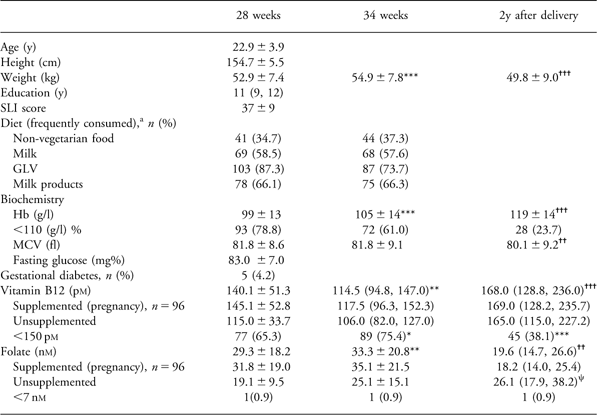
Mothers were short, light and young (Table 1). Forty-five women (38%) were lacto-vegetarian. Of the non-vegetarian (n = 73) women, 44 women (62%) consumed non-vegetarian foods more than twice a week. Sixty-eight (58%) women consumed cow's milk more than twice a week. Ninety-five (81%) women received supplements, all of which included folic acid, of these 29% also received vitamin B12. Sixty-two percent women were anemic (hemoglobin <110 g/l), but only one had macrocytic erythrocyte (mean corpuscular volume, MCV>100 fl). Fasting glucose concentration was 83 ± 7 mg%, and five women were diagnosed with gestational diabetes by the World Health Organization (WHO) criteria.Reference Alberti and Zimmet 27 Folate and hemoglobin concentrations increased from 28 to 34 weeks, but vitamin B12 decreased (Table 1). Two years after delivery, maternal plasma folate was two-thirds of pregnancy concentrations and vitamin B12 was 1.2 times higher (Table 1).
Characteristics of mothers at 28 and 34 weeks of pregnancy and 2y after delivery (n = 118)

SLI, Standard of Living Index; GLV, green leafy vegetables; Hb, hemoglobin; MCV, mean corpuscular volume.
aFrequently consumed – more than twice a week.
Values are mean ± s.d., median (25th, 75th centiles); n (%).
Paired t test 28 weeks with 34 weeks **P < 0.01, ***P < 0.001; paired t test 34 weeks with 2y †† P < 0.01, ††† P < 0.001; difference between supplemented and unsupplemented Ψ P < 0.05 if *P < 0.05.
Children
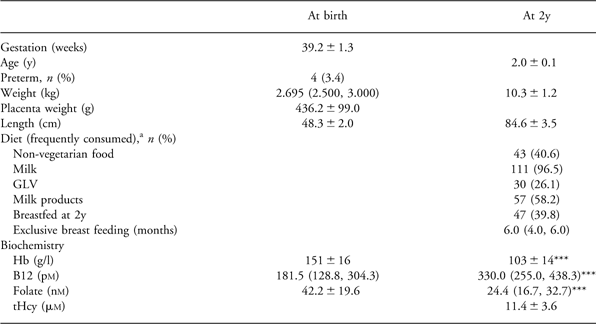
Children were born short and light (Table 2), and 23 (19.5%) had low birth weight (<2.500 kg). The average height and weight were one s.d. score less than the WHO 2006 reference of child growth standards. 28 The median age for exclusive breast feeding was 6 (4, 6) months, 47 (40%) children were still breastfed at 2y. At 2y, child's diet was mainly cow's milk and cereals (rice and roti). The children who were still breastfed at 2y had a lower vitamin B12 (295, 95% CI 260, 334 pm) than those who were not breastfed (363, 95% CI 330, 399 pm, P = 0.008), but folate was not different. Children who were still breastfed at 2y also had higher homocysteine than those who were not breastfed (12.7 ± 4.3 v. 10.6 ± 2.8 μm, P = 0.002). Child's vitamin B12 was associated with their frequency of consumption of cow's milk (r = 0.219, P = 0.019). The only dietary association for child folate at 2y was with consumption of non-vegetarian foods (r = 0.198, P = 0.023), which was largely explained by the frequency of consumption of eggs, not meat. The quantity of green leafy vegetables consumed at 2y was negligible; in the order of 6 g per day as compared with 20 g per day consumption of egg. Twenty-one children had vitamin supplementation reported at 1y, and eight children were recorded as receiving vitamins at 2y.
Characteristics of children at birth and 2y (n = 118)

GLV, green leafy vegetables; Hb, hemoglobin; tHcy, total homocysteine.
aFrequently consumed – more than twice a week.
Values are mean ± s.d., median (25th, 75th centiles), n (%).
Paired t test at birth with at 2y ***P < 0.001.
Cord blood associations
Maternal concentrations of vitamin B12 and folate at 34 weeks gestation were associated with cord vitamin B12 (r = 0.55, P < 0.001) and folate (r = 0.61, P < 0.001). Mothers who received supplementation had higher plasma vitamin B12 and folate concentrations during pregnancy (Table 1), and cord vitamin B12 and folate concentrations of their babies were higher. At 2y, child vitamin B12 was positively correlated with maternal vitamin B12 during pregnancy (r = 0.259, P < 0.005). No correlation was found between child plasma folate at 2y and maternal plasma folate during pregnancy. There were no associations of cord vitamin B12 and folate or placental weight with the child's vitamin B12 or folate concentrations at 2y.
Plasma vitamin B12 predictors at 2y
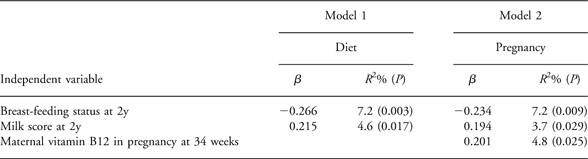
Predictors of child vitamin B12 at 2y were examined systematically by stepwise regression (Table 3). Child's vitamin B12 status was predicted by child's cow milk consumption (positive, R 2 = 4.6%) and if breastfed at 2y (negative, R 2 change 7.2%; Table 3, Model 1). The addition of maternal vitamin B12 at 34 weeks of pregnancy to Model 1 increased the R 2 from 3.9% to 15.7% (Table 3, Model 2). The independent variables examined included child diet at 2y, current breast-feeding status (0 not breastfed, 1 breastfed), duration of exclusive breast feeding, cord and pregnancy vitamin B12 concentrations. When child's age, gender and socioeconomic status were included in the models, the predictors remained unchanged.
Determinants of child's vitamin B12 at 2y

β, standardized beta stepwise regression.
The independent variables included: Model 1: current breast-feeding status + duration of exclusive breast feeding + child's diet at 2y; Model 2: current breast-feeding status + duration of exclusive breast feeding + child's diet at 2y + pregnancy plasma vitamin B12 at 28 weeks and normalized plasma vitamin B12 at 34 weeks and folate at 28 and 34 weeks + normalized cord vitamin B12 and folate.
Folate status at 2y was associated with consumption of eggs at 2y (r = 0.216, P = 0.02) and weakly with weight of placenta (r = 0.166, P = 0.08).
Plasma tHcy predictors
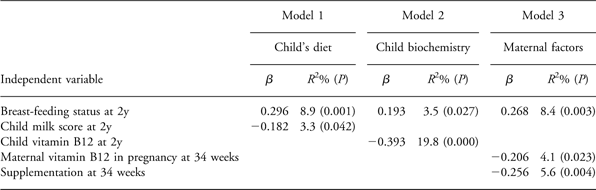
Predictors of child plasma tHcy concentration at 2y were examined (Table 4). Similar to the prediction of vitamin B12 status at 2y, the two dietary variables to predict child tHcy concentration were child's cow milk consumption (negative, R 2 change 3.3%) and whether breastfed at 2y (positive, R 2 change 8.9%; Table 4, Model 1). The addition of child vitamin B12 at 2y to Model 1 explained 19.8% of the variation, negating the effect of cow milk consumption, but current breast feeding still explained 3.5% (total 23.3%, Table 4, Model 2). The third model (Table 4) had child vitamin B12 at 2y removed and maternal factors added. Maternal vitamin B12 at 34 weeks and supplementation together explained 9.7%, in addition to 8.4% contribution of breast feeding (total of 18.1%). The independent variables examined were similar to those in the prediction of child vitamin B12 status at 2y.
Determinants of child's total homocysteine at 2y

β, standardized beta stepwise regression.
The independent variables included: Model 1: breast-feeding status + duration of exclusive breast feeding + child's diet at 2y; Model 2: breast-feeding status + duration of exclusive breast feeding + child's diet at 2y + child normalized plasma vitamin B12 and folate at 2y; Model 3: breast-feeding status + duration of exclusive breast feeding + child's diet at 2y + pregnancy plasma vitamin B12 at 28 weeks and normalized plasma vitamin B12 at 34 weeks and folate at 28 and 34 weeks + supplementation status + normalized cord vitamin B12 and folate.
Discussion
The most important finding of this prospective investigation in a vitamin B12 insufficient but folate-replete population is that mother's vitamin B12 status during pregnancy is a predictor of child's vitamin B12 and tHcy concentrations at 2y of age. Second, continued breast feeding at 2y adds to the probability that the child's vitamin B12 will be lower and tHcy higher at 2y. In contrast, the frequency of consumption of cow's milk is positively related to the child's vitamin B12. The mother's pregnancy vitamin B12 status was determined by both her diet and supplementation. Given the influence of one-carbon metabolism on health and disease susceptibility, our results provide a clue to possible public health interventions in India to improve future health.
The foods consumed by a pregnant woman are related to the religious and cultural beliefs, socioeconomic status and dietary practices of her family. We have shown that the intergenerational pathway for low vitamin B12 for a child starts with the maternal diet, in particular with the quantity of animal foods consumed. Similar findings have been reported by others.Reference Allen 3 , Reference Elmadfa and Singer 29
Cord vitamin B12 was directly related to maternal vitamin B12 and was almost double the maternal vitamin B12 at 34 weeks. The same magnitude of difference between cord and maternal vitamin B12 was found by others who studied women with high vitamin B12 and low folate statusReference Wallace, Bonham and Strain 30 and low vitamin B12 and low folate status.Reference Guerra-Shinohara, Paiva and Rondo 31 Vitamin B12 is transported to the fetus by the carrier protein, transcobalamin, produced by the placenta throughout pregnancy.Reference Schneider and Miller 15 The mother, if vitamin B12 insufficient, will be depleted further of her vitamin B12 stores by the growing fetus. These facts point toward the importance of increasing maternal vitamin B12 concentrations before and during pregnancy.
It is even more meaningful that maternal vitamin B12 concentrations in pregnancy are a significant determinant of the child's vitamin B12 at 2y of age, independent of the influence of child's diet. This suggests that the transfer of vitamin B12 from mother to fetus during pregnancy allows the baby to store vitamin B12 in tissues and that the effect lasts for at least 2y of age. In another publication,Reference Yajnik, Deshpande and Jackson 4 we have shown a significant association of maternal vitamin B12 with child's vitamin B12 concentration at 6y of age. Our interpretation of these results is that improving maternal vitamin B12 status before and during pregnancy would provide vitamin B12 for long-term storage and utilization during crucial years of fetal, infant and childhood growth and development. Admittedly, in statistical terms, maternal vitamin B12 contributed only 5% to child's vitamin B12 at 2y; however, circulating vitamin B12 forms only a small proportion of total body stores, mostly in liver.
We have already shown that supplementation of the mothers does increase pregnancy vitamin B12 and folate,Reference Katre, Bhat and Lubree 19 and we now show that supplementation in pregnancy is associated with a lower child tHcy at 2y. Breast milk of habitually vegetarian women has a low vitamin B12 concentration,Reference Hay, Johnston, Whitelaw, Trygg and Refsum 32 , Reference Specker, Black, Allen and Morrow 33 and explains our findings that children still breastfed at 2y, compared with those who were not, had a lower vitamin B12 and higher tHcy concentrations. Our children at 2y still had circulating vitamin B12 concentrations almost twice as those of the mother at 2y, confirming previous findings that children have higher vitamin B12 status than adults.Reference Refsum, Smith and Ueland 34
Child's vitamin B12 and tHcy were also influenced by the foods that the child consumed, in particular cow's milk consumption and breast feeding. This is in agreement with the findings of Hay et al.,Reference Hay, Trygg, Whitelaw, Johnston and Refsum 35 who studied a vitamin B12 sufficient population. The tHcy concentration of our children was high, 11 μm compared with 5 μm in the Norwegian children of the same age.Reference Hay, Johnston, Whitelaw, Trygg and Refsum 32 This is of concern because tHcy is a marker of impaired one-carbon metabolism and has direct and damaging effects on endothelial function.Reference Stanger and Weger 36
The strengths of our study are the prospective design and comprehensive measurements of mother and child: viz. supplementation and biochemistry during pregnancy, at birth and at 2y, as well as breast-feeding and diet histories. Results of a Norwegian study are remarkably similar to our results. In this vitamin B12 adequate population, maternal vitamin B12 status in pregnancy predicted child's vitamin B12 status at 6 months of age.Reference Hay, Clausen and Whitelaw 37 In a follow-up study up to 2y, breast feeding was associated with lower vitamin B12 status, whereas consumption of vitamin B12 rich foods was positively associated.Reference Hay, Johnston, Whitelaw, Trygg and Refsum 32 , Reference Hay, Clausen and Whitelaw 37 Our unique population of children and mothers represent the typical Indian dietary practice of low or no animal food consumption. Limitations are that other markers of vitamin B12 and folate metabolism (methyl malonic acid, holotranscobalamin) were not measured.
Our results provide crucial evidence for intergenerational transmission of vitamin B12 insufficiency and hyperhomocysteinemia through maternal deficiency during pregnancy and lactation. Intervention is required, starting in adolescent girls to break the cycle. This could be achieved by increased intake of vitamin B12 through supplementation, fortification of selected foods such as cow's milk and education about culturally and religiously appropriate foods that contain vitamin B12. Increased vitamin B12 intake throughout the pregnancy and breast-feeding periods will ensure optimal vitamin B12 status for the offspring. Such an intervention is planned.
Acknowledgments
The International Atomic Energy Agency, Vienna, Austria, provided financial support. The authors are grateful to the pregnant women and their children for taking part in this study, as well as thank Dr KJ Coyaji, Director KEM Hospital, Pune, for providing research facilities. The authors are indebted to Dr SS Naik, Ms Pallavi Hardikar, Ms Deepa Raut, Ms Trupti Konde, Dr Niranjan Joshi, Dr Aparna Joshi, Dr Madhumati Otiv, Mrs PC Yajnik, Mr Charudatta Joglekar, Ms LV Ramdas, Mr TM Deokar, Mr SD Chougule, Mrs Vaishali Deshpande, Mr AB Gaikwad and the obstetricians and drivers for their invaluable contributions to the study.