An important dimension of the research on political culture is how it changes and what impact it has on politics. Ever since the Civic Culture project of Gregory Almond and Sidney Verba in the 1960s, scholars have relied on surveys of citizen values, attitudes, and behaviors as evidence of the existence of similar or different political cultures across different societies, and whether such political cultures are changing over time. In recent years, such surveys have spread to all five continents in the form of various barometer projects, among others, creating a de facto globalization of comparative political culture study (Heath, Fisher, and Smith, 2005).
A major question of such comparative political culture studies is how economic development or modernization changes citizens’ attitudes. Seymour Lipset (Reference Lipset1960) draws our attention to how modernization brings in patterns of citizen attitudes and behaviors conducive to ‘modern’ politics. Alex Inkeles and David Smith (1974) focus on how industrialization and urbanization bring people into ‘individual modernity’. Ronald Inglehart (1971, 1977, 1988, 1990) argues that industrialization and affluence lead to a significant shift from a materialist to a postmaterialist world view. Similar value changes were also witnessed in Japan following the post-war economic take-off (Ike, 1973). Such value shifts, many argue, have important political consequences. Citizens with a postmaterialist world view, for example, demonstrate very different behavioral patterns of political participation, different party loyalties, and different policy orientations, such as a stronger preference toward environmental protection. Eventually, such changes among citizenry directly affect the functioning of democracy (Inglehart, Reference Inglehart1990).
That industrialization, urbanization, mass education, and mass communication (newspaper and TV, for example) change a society's way of life and people's world views might not be worth contesting now.Footnote 1 But industrialization and modernization are not the end of the human development course. Starting from the late 1970s, advanced industrial societies (Western Europe, North America, and Japan) have entered what might be termed the ‘postindustrialization’ stage (Bell, Reference Bell1976). Unlike the industrialization stage, in a postindustrial society, manufacturing industries give way to knowledge-based industries, such as finance, computing, information technology, and biotechnology. Meanwhile, in these societies, affluence has reached a level where basic material needs such as food and shelter are taken for granted, and citizens now aspire to pursue non-material goals, such as inclusion, self-esteem, empowerment, and enjoyment.
What such ‘postmodern’ development means to politics is clearly under debate. For some, the coming of the postmodern era means the ‘end of ideology’: the usual social cleavages do not exist anymore, and politics loses tractability (Bell, Reference Bell1960). Some others, such as the ‘postmodernists’ Jacques Derrida and Jean Baudrillard, refer to postmodern society as the deconstruction of modern rationality and the collapse of moral consensus. But others argue that modernization and postmodernization are a continuous process, and that postmodernization only means shifted and shifting ideological alignments (Dalton, Reference Dalton2006). Most importantly, Inglehart argues that as societies move from industrialization to postindustrialization, a set of values emerge that have direct consequences on the establishment and functioning of democracy. He first terms these postmodern values ‘well-being’ values (Inglehart, Reference Inglehart1997), but eventually settles with the term ‘self-expression values’ (Inglehart and Baker, Reference Inglehart and Baker2000; Inglehart and Welzel, Reference Inglehart and Welzel2005; Welzel, Inglehart, and Klingemann, 2003).
According to Inglehart, self-expression values stress liberty and freedom, tolerance and inclusiveness of outgroups and lifestyles (such as homosexuality), political activism, and enjoyment of life. The rise of self-expression values is a global phenomenon: human development means material advancement will pave the way for such values to emerge. Further, with such values, citizens will demand political openings and a deepening of democratization. Human development then is a three-dimensional process: it is first industrialization and postindustrialization in the socioeconomic dimension. Culturally, it is the evolution from premodern to modern and self-expression (postmodern) values; politically, it is the establishment of democratic government and the continuous improvement of the quality of democracy (Inglehart and Welzel, Reference Inglehart and Welzel2005). Other scholars using slightly different terminologies also concur with such arguments (Flanagan, Reference Flanagan1982; Flanagan and Lee, Reference Flanagan and Lee2003).Footnote 2
In this paper, I test these hypotheses in the context of Confucian Asia. Are economic development, industrialization, and postindustrialization changing people's world views in East Asia? How do we know such changes are taking place? With the most recent survey data, I am able to determine whether in Confucian Asia we can observe some patterns of value changes from modern and materialist outlooks toward postmaterialist and postmodern outlooks. Furthermore, if such changes are taking place, what kind of impact will they have on the political landscape in East Asia? Are people with postmodern values more pro-democracy, more tolerant, and more environmentally oriented? With these research questions, I can now engage the survey data.
Modern and postmodern values in Confucian societies
This study is based on the fourth wave of the AsiaBarometer Survey conducted in 2006. It includes an approximate sample of 1,000 respondents for each of the six Confucian societies in East Asia: Japan, South Korea, Taiwan, Hong Kong, Vietnam, and Singapore, and a 2,000-person sample for China, the largest Confucian society in the region and the world. These seven Confucian societies provide an excellent opportunity to test the aforesaid theories of modernization, postmodernization, and value changes, as well as the political consequences of such value changes. The shared Confucian heritage of these societies allows us to ‘control’ for the shared historical and cultural backgrounds of our cases. On the other hand, the different levels of modernization and postmodernization among these societies provide the needed variations in one of the key independent variables – the level of economic development. Indeed, the seven Confucian societies roughly fall into three categories of modernization: modernizing (China and Vietnam), modern (Singapore, South Korea, and Taiwan), and postmodern (Japan and Hong Kong). As a result, our sample has 2,000 respondents living in a postmodern society, 3,000 in a modern society, and 3,000 a modernizing society.
From achievement to enjoyment
Previous literature argues that human beings have a hierarchy of needs (e.g. Maslow, Reference Maslow1943). In empirical studies, scholars have found in various countries that people's life goals can range from survival to material achievements to self expression and personal freedom (e.g. Kotze and Lombard, Reference Kotze, Lombard and Inglehart2003). In the AsiaBarometer Survey, one question asks how the respondent puts different emphases on different ‘lifestyle aspects’. These aspects range from premodern to postmodern goals in the literature. Some are survival goals, such as having enough to eat and having a comfortable living place.Footnote 3 These are the most basic human needs, and people cannot aspire to other goals before such needs are satisfied. Some are materialist values, such as making a lot of money, being successful, and achieving goals. These are what Inglehart earlier called the ‘acquisitive’ and bourgeois values, as they are the values that drove the industrial period starting with the Protestant ethic hailed by Max Weber (Inglehart, Reference Inglehart1971). I tend to call these ‘achievement’ values because they reflect an individual's desire to achieve materially and socially. In East Asia, these values are also viewed as part of the Confucian heritage, which made it possible for these industrious, thrifty peoples to industrialize quickly in the 1960s through the 1980s.
The survey also includes lifestyles such as enjoyment, self expression, and spirituality. These aspects reflect a world view that emerges when people have satisfied their basic material needs and, even more, transcended the desire to acquire more wealth. At this point in the development stage, people start to see enjoyment, self expression, and empowerment as more important than the attainment of material goods. These values I call enjoyment priorities, and, according to the literature, they are more likely to occur after a society has passed through the demanding period of industrialization and entered a more relaxed and enjoyable postindustrial stage.
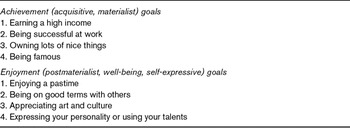
Factor analyses confirmed such a conceptualization of how people view different lifestyles as more important than others. Those who stress ‘earning a high income’ are likely to also stress ‘being successful at work’, ‘owning lots of nice things’, and ‘being famous’. Those who stress ‘enjoying a pastime’ are likely to also stress ‘being on good terms with others’, ‘appreciating arts and culture’, and ‘expressing your personality or using your talents’. I put these two groups of life goals in Table 1, and called the first the achievement group, and the second the enjoyment group.
Basic lifestyle changes: survival, achievement, enjoyment

Source: 2006 AsiaBarometer Survey, question (9).
I then calculated an achievement index and an enjoyment index by adding the four items in the achievement group and the four items in the enjoyment group together, respectively. Both indices range from a lowest possible score of ‘0’ to a highest possible score of ‘4’. If the reasoning is right so far, then among the seven societies one should find: (1) more modernizedFootnote 4 societies should have higher scores in the enjoyment index; and, (2) more modernized societies should have lower scores in the achievement index. That is to say, as a society modernizes and postmodernizes, its people move from an emphasis on acquisition and achievement to enjoyment and self expression.
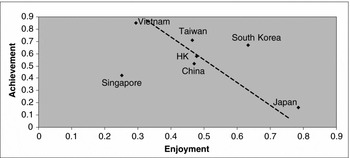
The average scores of these two indices in the seven Confucian societies support these two propositions. If we use the Human Development Index as the measurement of the ‘modernness’ of each society, Japan is the most modernized/postmodernized of the seven, followed in descending order by Hong Kong, Singapore, South Korea, and Taiwan, with China and Vietnam being the least modernized.Footnote 5 According to the enjoyment index, Japan has the highest score. For the 0–4 enjoyment index, the average of the Japanese sample is 0.79. The next highest scores belong to South Korea (0.63) and Hong Kong (0.48). Finally, Taiwan and China both average about 0.47, followed by Vietnam (0.30). This appears to confirm the hypothesis that the more developed a society is, the stronger the enjoyment orientation of its population.Footnote 6 The Chinese survey sample appears to be more urban (i.e., it does not sufficiently reflect the orientation of its rural population), thereby making China's enjoyment score (0.471) slightly higher than that of Taiwan (0.465). A more representative sample of China's population would very likely place China's enjoyment score lower than that of Taiwan. Hence among mainland China, Hong Kong, and Taiwan, it is also true that the more developed a society is, the higher the enjoyment score.
Similarly, the achievement index shows the more developed a society is, the less emphatic the achievement orientation of its population. Of the Asian societies surveyed, Japan has the lowest average achievement score (0.16 out of 4), whereas Vietnam has the highest (0.85). Figure 1 plots the averages of these two indices. If we treat Singapore as an outlier, then a rough line can be drawn for the other six societies, which shows that as the achievement orientation of a society declines, its enjoyment orientation increases. This pattern supports the hypothesis: human development (that is, modernization and postmodernization) leads to a decline in achievement and acquisition orientation, and, at the same time, gives rise to enjoyment and self expression orientation. Singapore might be a special case where human development has led to a decline in achievement and acquisition orientation, but not a clear rise in enjoyment and self expression orientation.
Achievement and enjoyment orientations in the seven Confucian societies.

Comprehensive measurements of ‘modern’ and ‘postmodern’ values
Human values, of course, are more complex than can be characterized by this ‘achievement–enjoyment’ evolution. But we can use this as the focus of our examination to see how individual and societal values change as the level of modernization/postmodernization in a society progresses. In Confucian societies, which have a long tradition of individual achievement through hard work, evidence of a shift toward ‘enjoyment’ will tell us whether the ‘postmodern’ value change is only a Western European phenomenon, or whether differences in political cultures are relative and similar evolutions across different cultural zones do exist (Blondel and Inoguchi, Reference Blondel and Inoguchi2006).
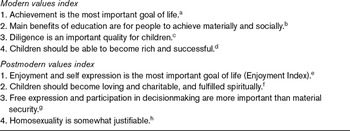
To measure ‘modern’ and ‘postmodern values’ in more comprehensive ways, we consider other value dimensions: specifically, the life goals people ascribe to their children, the benefit people derive from education, and the qualities people expect their children to develop. These values reflect not only how much emphasis a society places on ‘achievement’ and other modern values, but how much emphasis people put on ‘enjoyment’, ‘self expression’, and other postmodern values. Another important indicator of whether people have acquired a more postmodern, more inclusive outlook, is how well citizens tolerate different lifestyles. This can be measured by their tolerance of homosexuality.Footnote 7 Another significant indicator of a postmodern world view is how much importance citizens place on freedom of speech and a sense of empowerment over material security (Inglehart and Baker, Reference Inglehart and Baker2000; Inglehart and Welzel, Reference Inglehart and Welzel2005). This can be measured by a ‘liberty aspiration’ variable, constructed from one question in the AsiaBarometer Survey. These dimensions are listed in Table 2.
Indices of ‘modern’ and ‘postmodern’ values

Notes: aAchievement Index of Table 1; bRespondent choosing as the benefits of education ‘enables you to obtain a job of your choice’ and ‘enables you to gain higher social status’; cRespondent choosing ‘diligence’ as one of the most important quality for children; dRespondent choosing ‘become very wealthy’ and ‘become more proficient in profession than I am’ as she would wish for her children. eEnjoyment Index of Table 1; fRespondent choosing ‘become a loving and charitable person’ and ‘become fulfilled spiritually’ as she would wish for her children; gRespondent choosing ‘giving people more say in important government decisions’ and ‘protecting freedom of speech’ as important government priorities; hRespondent choosing homosexuality is somewhat justifiable.
Source: Constructed based on factor analyses from the 2006 AsiaBarometer Survey.
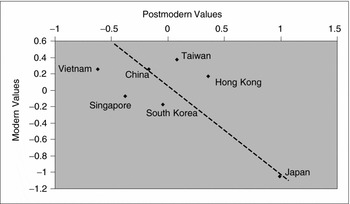
To construct a ‘modern values’ index and a ‘postmodern values’ index, I factor together each group of variables in Table 2.Footnote 8 After these two composite scales are created, I examine the level of modern and postmodern values of each of the seven Confucian societies. To show the relationship between human development and these two value dimensions, Figure 2 plots the national averages of these two scales of each society.
Modern and postmodern values of seven Confucian societies.

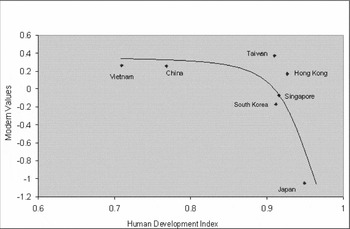
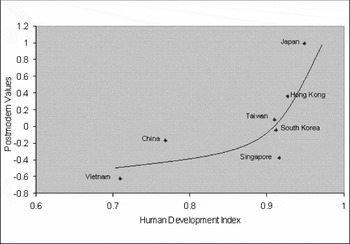
The figure shows that the publics of Japan, Hong Kong, and Taiwan have the strongest postmodern world views, whereas those of Singapore and Vietnam have the weakest and the publics of South Korea and China are in the middle. Taiwan, Vietnam, and China, the least modernized societies among the seven, hold the strongest modern values, whereas Japan, South Korea, and Singapore hold much weaker modern values. The figure also shows that as a society moves toward a more postmodern orientation, it is likely that its modern orientation becomes weaker. Now the question is whether such changes are real and whether they correlate with levels of human development.
Relationship between human development and ‘modern’ values.

Relationship between human development and ‘postmodern’ values.

Changing world views from modern to postmodern values
To test whether the level of human development (modernization and post-modernization) has an effect on human values, two approaches can be adopted. The first is to look at the relationship between the level of human development and the level of modern and postmodern values across societies. The second approach is to analyze individual-level data to see whether certain elements of human development (such as obtaining an education) have an effect on modern and postmodern values.
Figure 3.1 and Figure 3.2 plot the relationship between the level of human development and the modern and postmodern values of the seven Confucian societies. The relationship is not strictly linear. In Figure 3.1, it appears that at the lower level of human development, society's modern values remain more or less unchanged with the advancement in human development. This may be because modern values – such as achievement, acquisition, and diligence – are indeed part of the early human development stage. Such values enable a society to augment its level of wealth. But once human development reaches a higher level, people tend to discard modern values. Hence, in Figure 3.1, we see that the strength of modern values remains stable, or rather increases with human development for Vietnam, China, and Taiwan. But once societies pass Taiwan's level of development, the strength of modern values will decrease dramatically.
For postmodern values, Figure 3.2 gives a clearer picture: a society becomes more postmodern as the level of human development increases. It appears that people adopt postmodern values such as enjoyment, self expression, and empowerment as society reaches higher levels of human development. Furthermore, the speed of change seems to become faster at high levels of human development, as the curve demonstrates.
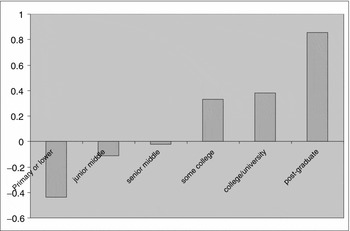
Levels of education and strength of postmodern values.

By looking at the individual level, we can compare the strengths of modern and postmodern values of people in terms of demographics such as education level, occupation, and economic well-being. In this paper, I only present the case of postmodern values. It is worth noting, however, that, in general, the trend of modern values is directly opposite to that of postmodern values: whenever a rise in postmodern values occurs, a decrease in modern values also takes place. It appears that postmodern values emerge to replace modern values within societies.
Income levels and the strength of postmodern values. Note: Income levels have been recoded from original data of individual countries. Wherever possible, this scheme is as follows: 1 is the lowest 10 percent of income earners; 5 is the highest 10 percent; 2–4 is the mid-range of 11–90 percent.

What do modernization and human development mean at the individual level? Basically, they mean more people are obtaining a higher level of education, earning a higher income, and moving from agriculture into manufacturing and service industries. As shown for the seven Confucian societies in Figures 4.1 and 4.2, people with more education clearly hold stronger postmodern values, as do people with higher income. I also found that respondents who work in manufacturing and urban industries clearly hold stronger postmodern values than those working in a rural environment. Those in the knowledge industries (service, management, and professionals) are indeed the most postmodern in their world views.Footnote 9 These findings support the argument that human development, with social changes, such as higher levelsof education, industrialization, and postindustrialization, and increases in income, do lead to more people acquiring a postmodern world view.
In the past, people viewed electricity, television, the telephone, and other material goods as an indication of the level of modernization and postmodernization. In the twenty-first century, one important indicator of the level of modernization/postmodernization and human development is access to and usage of the Internet. Access to and usage of the Internet is a good indicator because it relates to many other aspects of the modernization or postmodernization of human life: the level of income, the level of education, the degree of information penetration, and the nature of one's work (whether it is knowledge intensive or labor intensive). Hence, by looking at the differences in people's postmodern values based on the intensity of Internet use, we can further verify whether modernization and postmodernization lead to a rise in postmodern values.
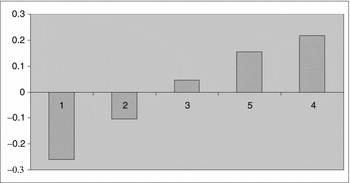
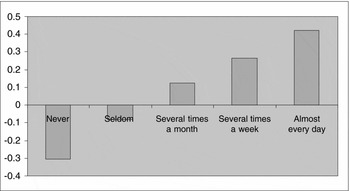
Figure 5 shows the strengths of postmodern values among people with different degrees of Internet usage. The populations in the seven Confucian societies are separated into five categories beginning with those that have never used the Internet to those who use the Internet almost every day. It is clear that people who use the Internet more are also those with the strongest postmodern values. This is, of course, not to say that the Internet makes people more postmodern. It may, indeed, do so. But the more important reason is that people who use the Internet more are also those with more education, a higher income, or a more knowledge-intensive job. In other words, they are the most ‘postmodern’ segment of society in socioeconomic terms. Hence, it is not surprising that they are also the most ‘postmodern’ in their world views and values.
Internet use and strength of postmodern values.
Note: Figure is based on an AsiaBaromter Survey question that asks how often the respondent uses the Internet.

Political consequences of postmodern values
If such ‘postmodern’ values increase as a society becomes more developed and better educated, how do value changes among the population affect politics? The central concern in the study of political culture, which dates back to Plato and more recently to Almond and Verba (1965), is the impact of values on democracy. In terms of value changes following industrialization and postindustrialization, what is most interesting is such value changes normally mean citizens are now more likely to become ‘critical citizens’ (Norris, Reference Norris1999). Critical citizens contribute to the establishment and improvement of democracy through two channels.
First, they are more likely to demand democratic rights and join protests, such as petitions and demonstrations (Dalton and van Sickle, Reference Dalton and van Sickle2005; Flanagan and Lee, Reference Flanagan and Lee2000; Wang, Reference Wang2005; Welzel, Inglehart, and Klingemann, 2003). This way, in a nondemocratic regime, citizens can help foster democratic practices and values, as happened in Eastern Europe around 1989, and Taiwan and Korea through the 1980s and 1990s (Catterberg, Reference Catterberg2002; Inglehart and Welzel, Reference Inglehart and Welzel2005). In a society that is already democratic, their demands help ensure that the government continues to improve the quality of democratic institutions; it is thus the continuous pressure and participation of citizens that ensures that democracy works well (Welzel, Inglehart, and Deutsch, 2005).
Second, these citizens are likely to demand policies that contribute to a better society, that is to deal with issues such as anti-corruption, equality, tolerance, inclusion, gender equality, and environmental protection (Gibson, Reference Gibson1996; Inglehart, 1995; Inglehart and Norris, Reference Inglehart and Norris2003; Nevitte, Reference Nevitte1996). In this way, citizens with stronger postmodern values enhance the quality of democracy through pressure on government to deliver policies that are good for society.
In the following empirical analyses, I test seven hypotheses. Four of them are related to the democratic dispositions of people with stronger postmodern values: People with stronger postmodern values are more likely to: (1) join a petition, (2) participate in a demonstration, (3) be more supportive of democratic government (compared to authoritarianism), and (4) demand democratic rights. The other three hypotheses are related to the policy preferences of postmodern citizens: People with stronger postmodern values are more likely to: (5) support inclusive policies, (6) support environmental protection, and (7) be more concerned about government failures such as corruption.
Measuring the dependent variables
To test these hypotheses, I first explain how the dependent variables are measured. To test an individual's propensity to be involved in petitions, I created a PETITION variable, which is measured by whether one has signed or might sign a petition to improve conditions (1), or would never do so (0). Similarly, an individual's propensity to be involved in demonstrations (DEMON) is measured by whether one has attended or might attend lawful demonstrations (1), or would never do so (0).
I also created a variable called Supporting Democratic Government (SUPPORT_DEMO), which is measured by a respondent's willingness to accept a democratic political system subtracted by his or her willingness to accept governance by a powerful leader without the restriction of parliament or elections. Moreover, I created a measure called Demand for Democratic Rights (DEMAND_RIGHTS), which is a composite scale of whether the respondent is satisfied with his or her rights to: vote, participate in any kind of organization, gather and demonstrate, be informed about the work and functions of government, have freedom of speech, and criticize the government.
For variables on citizen's policy preferences, I created an Inclusive Policy variable (INCLUSION), which is measured by whether one rejects the idea of central government placing restrictions on the foreign workforce in the country. I then created an Environmental Policy variable (ENVIR_POLICY), which is a composite scale on whether the respondent thinks the government should do a better job on the environment and should spend more money on environmental protection. Lastly, to measure an individual's alertness or criticalness regarding government failure, I used Concern with Corruption (ANTICORRUPT) as the indicator, measured by whether corruption causes his or her serious worry.
Results
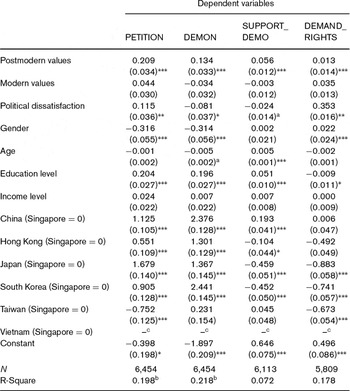
For these analyses, I use ‘postmodern values’ and ‘modern values’ (presented in Table 2) as the independent variables, and control for gender, age, income, education, and country. Wherever necessary, I also control for political dissatisfaction, which is a composite scale measuring the respondent's satisfaction with the government's work in handling the economy, political corruption, human rights, unemployment, crime, and the quality of public services. I use logistic regression if the dependent variable is dichotomous and linear regression otherwise. Table 3 reports the results for the tests of the first four hypotheses.
Regression results testing hypotheses 1–4

Notes: *α < 0.05 **α < 0.01 ***α < 0.001 aα < 0.1; bNagelkerke R Squares are reported; cNo correlations found. Dependent Variables: PETITION (Petition): a dichotomous variable measuring whether or not the respondent would like to sign a petition to improve conditions; DEMON (Demonstration): a dichotomous variable measuring whether or not the respondent would like to join a lawful demonstration; SUPPORT_DEMO (Support Democracy): an ordinal variable measuring the respondent's support for democratic government and rejection of authoritarianism; DEMAND_RIGHTS (Demand for Democratic Rights): a composite scale measuring how eager the respondent feels the various democratic rights need to be enhanced.
Source: 2006 AsiaBarometer Survey.
The regression results show a very clear picture: people with stronger postmodern values are much more likely to be champions of democracy. They are much more likely to: sign petitions to press for government actions, join lawful demonstrations to express their demands, show stronger support for democratic government compared to its authoritarian alternatives, and believe that democratic rights – such as freedom of speech and the right to vote – need improvement. Concrete data confirm hypotheses 1 to 4.
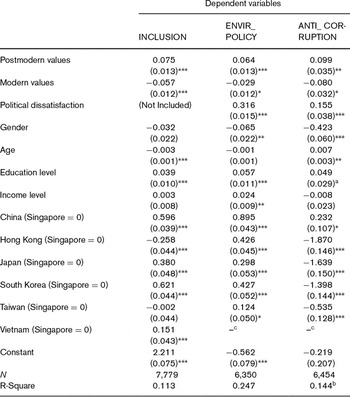
Table 4 presents the regression results that test hypotheses 5 to 7. I hypothesized that people with stronger postmodern values are more likely to be concerned with policies that contribute to a better society. First, it appears that they are more likely to argue for inclusive policies. Here, the testing case is the willingness to accept foreign people to work in one's country. The statistical results show that people with stronger postmodern values are more likely to reject strict government policies directed against the work opportunities of foreign workers residing in their own country. In contrast, people with stronger modern values tend to support restriction on foreign workers.
Regression results testing hypotheses 5–7

Notes: *α < 0.05 **α < 0.01 ***α < 0.001 aα < 0.1; bNagelkerke R Squares are reported; cNo correlations found Dependent Variables: INCLUSION (Inclusion): an ordinal variable measuring the respondent's rejection of strict government measures against foreign workforce; ENVIR_POLICY (Support for Environmental Policies): a composite scale measuring how strong the respondent wants the government to pay more effort in environmental protection; ANTI_CORRUPTION (Anti-Corruption): a dichotomous variable measuring whether the respondent sees corruption as a serious issue.
Source: 2006 AsiaBarometer Survey.
Second, in terms of environmental protection, people with stronger modern values seem to neglect environmental issues, or even may support faster economic growth at the expense of environmental degradation. In contrast, people with stronger postmodern values clearly believe that protection of the environment should be a government priority. Third, the connection between anti-corruption and values is similar. People with stronger modern values tend to neglect corruption as a major concern. For them, corruption probably does not matter much as long as the economy grows fast. But for people with postmodern values, they have come to see corruption as a serious disease for society; hence they are more likely to demand tougher government measures against corruption, or demand political reforms that curb government corruption.
Conclusion
This study began by tracing the possible changes in people's world views as a society goes through economic development, modernization, and postmodernization. By looking first at people's changing life priorities, I identified a change from a survival-centered world view, to an achievement-centered, and to an enjoyment-centered world view. In the modernizing (industrializing) stage of human development, socioeconomic developments enable people to secure survival and pursue achievement and entitlement. Once a society moves from industrial to a postindustrial stage, with the rise of knowledge and service industries, the modernizing process has entered a ‘postmodernization’ stage. At this moment, people start to discard the strong desire to achieve material and social status. In a ‘postmodern’ society, people start to focus more on enjoyment, self expression, and empowerment.
Although such a change in lifestyles or life goals might be a departure from the Confucian heritage of hardwork and thrift, it is a shift that naturally takes place at a higher-level of human development. Whereas modern values such as a focus on achievement may have contributed to rapid economic growth in East Asia, the rise of postmodern values may help usher in another round of an East Asian miracle: the rise of democracies in East Asia. People with stronger postmodern values are those that stress enjoyment and pastime, but they are also those that stress individual freedom and liberties, inclusion, and equalities. In this article, I found that people with stronger postmodern values are likely to be political activists, in that they are more ready to use political actions such as petitions and demonstrations to press for government responses. They are also more likely to embrace democratic forms of government as contrast to nondemocratic ones. In addition, they are more eager to demand political rights such as the right to vote, the right to participate in organizations, and the right to criticize the government.
Finally, postmodern values also enable people to show concern with policies that promote a better society. Postmodern citizens express concern with open and inclusive social and economic policies, such as immigration policies. Moreover, they have an interest in the protection of the environment and clean government. It is in these two senses – championing democracy and good society – that we can expect, at the higher-level of human development, the stage of postmodernization, a more democratic and humane Confucian East Asia. For this, people may argue that human development leads to a decline in some of the core values professed in the Confucian ideology, such as obedience, respect of authority, hardwork, and thrift. But this misses the point. To the extent human development ushers in an affluent, democratic, and humane society, it is enabling human beings to achieve the ultimate ideal of the Confucian sages: a datong (grand unity) society in which every individual is provided for, is free, and lives in harmony with all others.