Introduction
Childhood trauma can have negative long-term consequences for mental health later in life, including an increased risk for psychotic disorders (Varese et al. Reference Varese, Smeets, Drukker, Lieverse, Lataster, Viechtbauer, Read, Van Os and Bentall2012). Traumatic experiences in early life may cause an enduring heightened sensitivity of the hypothalamic–pituitary–adrenal axis to stress (Heim & Nemeroff, Reference Heim and Nemeroff2001). As a result, physiological, emotional and behavioral responses to social stress exposures later in life may grow stronger (Collip et al. Reference Collip, Myin-Germeys and Van Os2008; Elsey et al. Reference Elsey, Coates, Lacadie, McCrory, Sinha, Mayes and Potenza2015), which eventually can lead to a mental disorder (Heim & Nemeroff, Reference Heim and Nemeroff2001; Collip et al. Reference Collip, Myin-Germeys and Van Os2008) in interaction with other factors that increase liability, such as genetic variants.
Social stress and heightened stress sensitivity have been implicated in the onset of psychosis (Myin-Germeys & van Os, Reference Myin-Germeys and van Os2007; Phillips et al. Reference Phillips, Francey, Edwards and McMurray2007). Research directly investigating the link between stress and psychosis has provided inconsistent results, but has been criticized for focusing on major life events rather than minor daily life stressors, and not taking into account subjective appraisal of stressful events (Phillips et al. Reference Phillips, Francey, Edwards and McMurray2007). Epidemiological studies established that environmental factors such as urban birth, population density, neighborhood ethnic density and social minority status mediate risk for psychosis (van Os et al. Reference van Os, Kenis and Rutten2010). Exposure to social stress has been suggested as a common mechanism underlying these associations (Lederbogen et al. Reference Lederbogen, Kirsch, Haddad, Streit, Tost, Schuch, Wüst, Pruessner, Rietschel, Deuschle and Meyer-Lindenberg2011; Selten et al. Reference Selten, van der Ven, Rutten and Cantor-Graae2013). Experience sampling studies observed that patients with psychotic disorder, compared to controls, responded with more negative affect and more paranoia to minor events in daily life (Collip et al. Reference Collip, Oorschot, Thewissen, Van Os, Bentall and Myin-Germeys2011; Reininghaus et al. Reference Reininghaus, Kempton, Valmaggia, Craig, Garety, Onyejiaka, Gayer-Anderson, So, Hubbard, Beards, Dazzan, Pariante, Mondelli, Fisher, Mills, Viechtbauer, McGuire, van Os, Murray, Wykes, Myin-Germeys and Morgan2016). Moreover, patients with a history of childhood trauma had stronger affective and psychotic responses to daily life events than patients without trauma (Glaser et al. Reference Glaser, van Os, Portegijs and Myin-Germeys2006; Lardinois et al. Reference Lardinois, Lataster, Mengelers, Van Os and Myin-Germeys2011; Kramer et al. Reference Kramer, Simons, Myin-Germeys, Jacobs, Derom, Thiery, van Os and Wichers2012). These findings implicate that stress sensitivity may be a mechanism linking childhood trauma, sensitivity to environmental social stress and psychosis liability. For a direct test of this hypothesis, individuals with different psychosis liability should ideally be randomly exposed to controlled social environments with different levels of exposure to social stressors. This is not possible in real life, as daily social environments are complex, highly dynamic and different for everyone. Furthermore, events are strongly dependent of individuals’ behavior (Freeman et al. Reference Freeman, Emsley, Dunn, Fowler, Bebbington, Kuipers, Jolley, Waller, Hardy and Garety2015). Controlled experiments are feasible using virtual reality (VR) (Fornells-Ambrojo et al. Reference Fornells-Ambrojo, Barker, Swapp, Slater, Antley and Freeman2008; Freeman et al. Reference Freeman, Pugh, Vorontsova, Antley and Slater2010; Veling et al. Reference Veling, Brinkman, Dorrestijn and van der Gaag2014a ). Virtual environments can elicit negative emotions and paranoid thoughts about virtual characters, in particular when environments induce anxiety (Fornells-Ambrojo et al. Reference Fornells-Ambrojo, Freeman, Slater, Swapp, Antley and Barker2015) and when individuals have high levels of anxiety, depression, worry and interpersonal sensitivity (Freeman et al. Reference Freeman, Gittins, Pugh, Antley, Slater and Dunn2008). We recently reported that paranoia and subjective distress increased in a dose-response fashion with the level of social stress in the virtual environment, and were positively associated with psychosis liability and pre-existing affective and psychotic symptoms (Veling et al. Reference Veling, Pot-Kolder, Counotte, van Os and van der Gaag2016). A recent study found that a history of childhood bullying was associated with more paranoid ideation in a neutral VR environment, both in people at ultra-high risk for psychotic disorder (UHR) and controls (Valmaggia et al. Reference Valmaggia, Day, Kroll, Laing, Byrne, Fusar-Poli and McGuire2015b ).
The aim of this VR study was to test the links between childhood trauma, heightened social stress sensitivity, (subclinical) psychotic and affective symptoms, and psychosis liability. The lifetime risk for psychotic disorder is 3% in the general population (van Os et al. Reference van Os, Linscott, Myin-Germeys, Delespaul and Krabbendam2009), ~10% for siblings of patients with a psychotic disorder (Gottesman Reference Gottesman1991), 36% for UHR subjects (Fusar-Poli et al. Reference Fusar-Poli, Borgwardt, Bechdolf, Addington, Riecher-Rössler, Schultze-Lutter, Keshavan, Wood, Ruhrmann, Seidman, Valmaggia, Cannon, Velthorst, De Haan, Cornblatt, Bonoldi, Birchwood, McGlashan, Carpenter, McGorry, Klosterkötter, McGuire and Yung2013) and, by definition, 100% for patients with recent onset psychotic disorder. Phenotypically, UHR subjects and patients with a diagnosis of psychotic disorder all have (subclinical) psychotic symptoms, whereas most siblings and general population controls have not. Taking into account both lifetime risk and phenotype, we classified siblings and controls as having lower psychosis liability, and UHR subjects and patients with a psychotic disorder as having higher psychosis liability.
Higher and lower psychosis liability groups, both including individuals with and without history of childhood trauma, were exposed to various social stressors in virtual environments. We hypothesized that:
-
(1) childhood trauma is more prevalent in individuals with higher psychosis liability, and is associated with higher level of (subclinical) psychotic and affective symptoms;
-
(2) individuals with a history of childhood trauma respond with more paranoia and subjective distress to virtual social stress exposure than those without childhood trauma; and
-
(3) the effect of childhood trauma on paranoia and subjective distress in VR is stronger when level of social stress increases and if psychosis liability is higher.
Method
Participants
Four groups with different levels of liability to psychosis were included. Patients with psychotic disorder were eligible if the first diagnosis of any psychotic disorder was established within the last 5 years. All DSM-IV categories of psychotic disorder were included, except for substance-induced psychotic disorder and psychotic disorder due to a medical condition. In all patients, either the Comprehensive Assessment of Symptoms and History (Andreasen et al. Reference Andreasen, Flaum and Arndt1992) or the Schedules for Clinical Assessment in Neuropsychiatry (Wing et al. Reference Wing, Babor, Brugha, Burke, Cooper, Giel, Jablenski, Regier and Sartorius1990) were used to make a DSM-IV diagnosis. Patients were recruited from five psychiatric institutes in the Netherlands. Siblings of patients with a psychotic disorder were included if they endorsed the statement that they had never received the diagnosis of, or treatment for, any psychotic disorder. Patients at UHR for psychosis were identified among patients seeking help for non-psychotic psychiatric problems at outpatient departments of two psychiatric institutes in the Netherlands, using the Comprehensive Assessment of At-Risk Mental States (CAARMS) criteria (Yung et al. Reference Yung, Yuen, McGorry, Phillips, Kelly, Dell'Olio, Francey, Cosgrave, Killackey, Stanford, Godfrey and Buckby2005). Controls were eligible if they declared that they had a negative history of psychotic disorder and did not have a first degree family member diagnosed with a psychotic disorder. They were recruited in waiting rooms of dentists, vocational schools and among staff of a psychiatric institute. Based on lifetime psychosis risk and phenotype, patients with psychotic disorder and UHR patients were classified as having a higher liability to psychosis, siblings and controls as having a lower liability. For all groups, exclusion criteria were epilepsy, IQ <75 and not speaking Dutch. Written informed consent was obtained from all participants. The study was approved by the medical ethical committee of Leiden University Medical Center. The authors assert that all procedures contributing to this work comply with the ethical standards of the relevant national and institutional committees on human experimentation and with the Helsinki Declaration of 1975, as revised in 2008.
VR set-up
The virtual environment was a café with an indoor and an outdoor part, built by CleVR with Vizard software. Participants could navigate in the virtual environment, using a Logitech F310 Gamepad. They wore a Sony HMZ-T1 head-mounted display with a HD resolution of 1280 × 720 per eye, with 51.6 diagonal field of view, a 3 DOF tracker for head rotation, and built-in headphones. Virtual humans (avatars) were sitting or standing at a table, chatting and had drinks. Café background noises were played during the experiments.
Environmental social stress experiments
The experiments are described in detail elsewhere (Veling et al. Reference Veling, Pot-Kolder, Counotte, van Os and van der Gaag2016). Participants were exposed to environmental social stress in five experiments of 4 min each, in a single session, with breaks of ~10 min between experiments. Three characteristics of the virtual environment were varied: (1) number of virtual café visitors (from here: avatars), (2) ethnic appearance of avatars, and (3) facial expression of avatars. Different levels of social stress were created by exposing participants to no, one, two or three stressors. In the no-stress condition, the café was quiet, with only six avatars, who had a neutral facial expression, and more than 80% of which had a Dutch appearance for Dutch participants and a non-Dutch (North African) appearance for non-Dutch participants. The café was crowded in the experiment with one stressor, increasing the number of avatars from six to 40. The experiments with two stressors involved either a crowded café with the majority of avatars having an ethnicity other than that of the participant, or a crowded café with avatars looking in an angry, hostile fashion at participants when they approached and also at other, random moments. In the experiment with three stressors, the café was filled with 40 hostile avatars of other than own ethnicity. Participants were instructed to explore the café and to find avatars wearing a number on their clothing. The order of the experiments was random, except that the fifth experiment always had at least two stressors.
Measures
Sociodemographic characteristics
Ethnicity was classified Dutch if the participant and both parents were born in the Netherlands, and non-Dutch in all other cases. Level of education was classified as no/primary education, vocational education ((V)MBO), higher secondary education (HAVO or VWO) and higher tertiary education (HBO or University).
Baseline (subclinical) symptoms
Paranoia was assessed with the Green Paranoid Thoughts Scale (GPTS; Green et al. Reference Green, Freeman, Kuipers, Bebbington, Fowler, Dunn and Garety2008), social anxiety with the Social Interaction Anxiety Scale (SIAS; Mattick & Clarke, Reference Mattick and Clarke1998) and frequency scores of (subclinical) positive, negative and depressive symptoms with the Community Assessment of Psychic Experiences (CAPE; Konings et al. Reference Konings, Bak, Hanssen, van Os and Krabbendam2006).
Childhood trauma
Childhood trauma was assessed with the Childhood Trauma Questionnaire Short Form (CTQ-SF), a widely used, well validated retrospective self-report 25-item measure of abuse and neglect before the age of 18 years (Bernstein et al. Reference Bernstein, Stein, Newcomb, Walker, Pogge, Ahluvalia, Stokes, Handelsman, Medrano, Desmond and Zule2003). Emotional abuse and neglect, physical abuse and neglect and sexual abuse were rated as present if the total scores of the respective subscales were classified as moderate or severe, according to published norm scores (Bernstein & Fink, Reference Bernstein and Fink1998). A dichotomous variable of childhood trauma was created, in which childhood trauma was defined as a positive score on any of the subscales.
Subjective distress and state paranoia
Before each experiment, participants were asked to rate their momentary subjective distress (SUD) in units on an analog scale, with range 0–100 (SUD before). Immediately after each experiment, participants rated their maximum SUD during the experiment (peak SUD). Stress reactivity was calculated for each experiment by subtracting SUD before the experiment from the peak SUD during the experiment. Paranoid thoughts about avatars were measured after each experiment with the State Social Paranoia Scale (SSPS; Freeman et al. Reference Freeman, Pugh, Green, Valmaggia, Dunn and Garety2007). The SUD and SSPS scores of the two experiments with two stressors were averaged in order to get mean SUD and SSPS scores for the condition of two stressors. Hence, four SUD and SSPS scores of experiments remained, with no, one, two and three stressors respectively.
Statistical analyses
Sociodemographic and clinical characteristics were compared between participants with and without a history of childhood trauma, using independent sample t tests for continuous variables and χ2 tests for categorical variables.
For the analyses of the effects of childhood trauma on paranoia and subjective distress in the five experiments, multilevel random intercept regression models were used, taking into account the repeated measure structure of the data (with experiments as level 1 and individual as level 2). B is the regression coefficient of the predictor in the multilevel model. We analysed the data using the multilevel random intercept xtreg procedure in Stata v. 13 (StataCorp., USA). Regression models were fitted with continuous paranoia (SSPS) and subjective distress (SUD) scores as dependent variables and the dichotomous childhood trauma measure as independent variable. As a second step, number of stressors, psychosis liability, age and sex were added as covariates. Maximum-likelihood estimates were used to test random effects.
Next, interaction terms were added to the models. Two-way interactions were tested between childhood trauma on the one hand, and number of stressors and psychosis liability on the other. B coefficients of the main effects and the interaction terms were compared using the margins dydx procedure, estimating linear marginal effects at the different levels of virtual social stress and psychosis liability.
Results
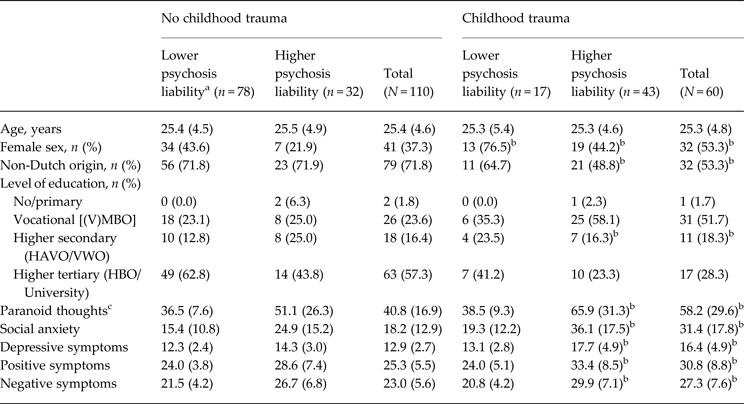
Fifty-five patients with psychotic disorder, 20 patients at UHR for psychosis, 42 siblings and 53 controls were included (Table 1). Thirty-five percent of the total sample had a history of childhood trauma. Women had significantly higher rates of childhood trauma than men, ethnic minorities reported higher rates than Dutch participants, and level of education was lower in individuals with childhood trauma.
Description and clinical characteristics of the study sample

a Lower psychosis liability includes controls and siblings, higher psychosis liability includes ultra-high risk and psychotic disorder.
b p < 0.05, no childhood trauma compared to childhood trauma, within psychosis liability groups (lower, higher and total).
c Paranoid thoughts assessed with Green Paranoid Thoughts Scale, social anxiety with Social Interaction Anxiety Scale, other symptoms with Community Assessment of Psychic Experiences.
Individuals with childhood trauma had higher baseline levels of paranoid thoughts, social anxiety, positive, negative and depressive symptoms, compared to individuals without childhood trauma. These differences were statistically significant in the higher psychosis liability group, but not in the lower psychosis liability group. Childhood trauma was much more prevalent in the UHR group (80%) and psychosis group (49%) than in siblings (19%) and controls (17%). Emotional neglect was the most common type of trauma (n = 42), sexual abuse had the lowest prevalence (n = 13).
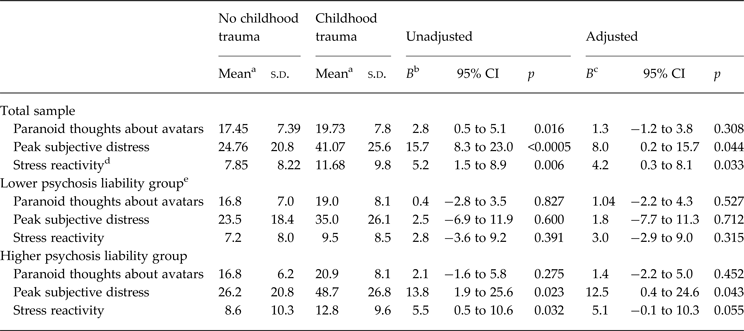
The multilevel regression analyses showed that in the total sample, childhood trauma was associated with higher paranoia in the virtual social stress experiments [Table 2; B = 2.8, 95% confidence interval (CI) 0.5–5.1, p = 0.016]. This association was reduced (B = 1.3, p = 0.308) after adjustment for number of stressors, psychosis liability, age and sex. Peak subjective distress during experiments was significantly higher in individuals with childhood trauma (adjusted B = 8.0, 95% CI 0.2–15.7, p = 0.044). Increase in subjective stress during virtual social stress exposure (stress reactivity) was predicted by childhood trauma (adjusted B = 4.2, 95% CI 0.3–8.1, p = 0.033). In the analyses stratified for psychosis liability, childhood trauma had significant effects on peak subjective distress and stress reactivity, in the higher psychosis liability group, but not in individuals with lower psychosis liability.
Effect of childhood trauma on paranoia and subjective distress in virtual social stress experiments

CI, Confidence interval.
a State Social Paranoia Scale score and Subjective Units of Distress averaged over experiments.
b Random effects multilevel regression, B coefficient of childhood trauma.
c Random effects multilevel regression, B coefficient of childhood trauma, adjusted model includes number of virtual stressors, age and sex. In total sample also adjusted for psychosis liability.
d Peak subjective distress during experiments minus distress before experiments.
e Lower psychosis liability includes controls and siblings, higher psychosis liability includes ultra-high risk and psychotic disorder.
Mean paranoia, peak subjective distress and stress reactivity scores during experiments of higher and lower psychosis liability groups with and without childhood trauma are shown in Fig. 1.
(a) Paranoid ideations, (b) peak subjective distress and (c) stress reactivity in virtual experiments, by degree of environmental social stress, psychosis liability and childhood trauma. Stressor, level of exposure to virtual social stressors; High liability, subjects with psychosis or ultra-high risk for psychosis; Low liability, siblings and controls; CT, Childhood trauma; paranoid ideations measured with State Social Paranoia Scale; Peak subjective distress during experiments in units 0–100; Stress reactivity, peak distress during experiments minus distress before experiments.

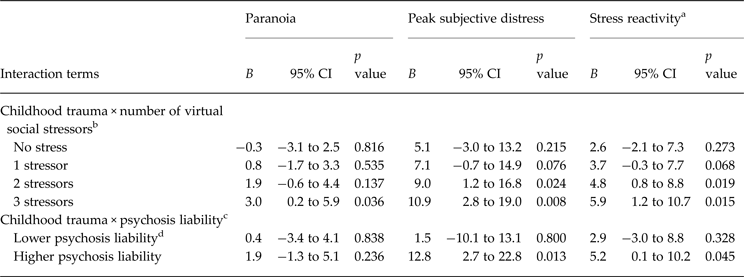
There was a positive interaction between childhood trauma and degree of environmental social stress on paranoia (overall adjusted B of the interaction term = 1.12, 95% CI 0.2–2.0, p = 0.013). The interaction between childhood trauma and level of virtual social stress on peak subjective distress was also statistically significant (overall adjusted B = 1.9, 95% CI 0.4–3.5, p = 0.012), the overall interaction term with stress reactivity as outcome was not (adjusted B = 1.1, 95% CI −0.7 to 2.9, p = 0.221). Linear predictions at each level of social stress showed that the effects of childhood trauma on paranoia, peak distress and stress reactivity were stronger when social stress level increased (Table 3).
Interactions between childhood trauma and level of virtual social stress on paranoia and subjective distress

CI, Confidence interval.
a Peak subjective distress during experiments minus distress before experiments.
b Multilevel random regression analysis, B coefficients of interaction terms, adjusted for age, sex and psychosis liability. Estimated using Stata margins dydx procedure, at the four levels of virtual social stress.
c Multilevel random regression analysis, B coefficients of interaction terms, adjusted for age, sex and number of stressors. Estimated using Stata margins dydx procedure, at the two levels of psychosis liability.
d Lower psychosis liability includes controls and siblings, higher psychosis liability includes ultra-high risk and psychotic disorder.
Overall interaction terms between childhood trauma and psychosis liability on paranoia, peak subjective distress and stress reactivity in VR were not statistically significant. The marginal effects at the separate levels of psychosis liability, however, showed that higher psychosis liability increased the effect of childhood trauma on peak subjective distress and on stress reactivity (Table 3).
Discussion
In this experimental VR study, we aimed to test heightened social stress reactivity as a pathway between childhood trauma, psychosis liability, paranoid ideation and distress. Childhood trauma was highly prevalent in patients with (UHR for) psychotic disorder and was associated with level of baseline (subclinical) psychotic and affective symptoms. Individuals with a history of childhood trauma reported more paranoid ideation and subjective distress after exposure to virtual social stress environments than individuals without childhood trauma. These associations were stronger in individuals with higher psychosis liability, but the effects of childhood trauma on subjective distress measures remained after adjustment for psychosis liability. The effects of childhood trauma on paranoia and subjective distress were significantly stronger when the number of virtual environmental stressors increased. Higher psychosis liability increased the effect of childhood trauma on peak subjective distress and stress reactivity during experiments.
Meaning of findings
These findings provide experimental evidence that heightened sensitivity to social stress is a mechanism by which childhood trauma can increase the risk for psychotic and affective dysregulation later in life. Preclinical and clinical studies have shown that early life trauma induces persisting hypersensitivity of the biological stress system, resulting in enhanced endocrine, autonomic and behavioral responses to stress (Heim & Nemeroff, Reference Heim and Nemeroff2001). Whereas childhood trauma has been related consistently to increased risk for adult psychotic, depressive and other mental disorders (Hovens et al. Reference Hovens, Wiersma, Giltay, Van Oppen, Spinhoven, Penninx and Zitman2010; Varese et al. Reference Varese, Smeets, Drukker, Lieverse, Lataster, Viechtbauer, Read, Van Os and Bentall2012), it is less clear how symptoms of these disorders develop in daily life and if social stress sensitivity contributes to psychopathology. Studies using experience sampling methods (ESM) found that (subclinical) psychotic symptoms in patients and in the general population are associated with higher stress reactivity in daily life (Myin-Germeys & van Os, Reference Myin-Germeys and van Os2007; Collip et al. Reference Collip, Geschwind, Peeters, Myin-Germeys, van Os and Wichers2013; Reininghaus et al. Reference Reininghaus, Kempton, Valmaggia, Craig, Garety, Onyejiaka, Gayer-Anderson, So, Hubbard, Beards, Dazzan, Pariante, Mondelli, Fisher, Mills, Viechtbauer, McGuire, van Os, Murray, Wykes, Myin-Germeys and Morgan2016). Exposure to trauma during childhood was associated with increased levels of emotional and psychotic reactivity to stress in the general population (Kramer et al. Reference Kramer, Simons, Myin-Germeys, Jacobs, Derom, Thiery, van Os and Wichers2012), as well as in patients with a psychotic disorder (Lardinois et al. Reference Lardinois, Lataster, Mengelers, Van Os and Myin-Germeys2011). Consistent with our results, a recent VR study reported an association between a history of bullying victimization and stronger paranoid response to a neutral social environment in people at UHR for psychosis (Valmaggia et al. Reference Valmaggia, Day, Kroll, Laing, Byrne, Fusar-Poli and McGuire2015b ).
Socio-developmental, neurobiological and cognitive models of psychosis suggest that gene variants, early hazards to the brain and childhood adversity sensitize the dopamine system, which has been implicated in the development of psychosis (Collip et al. Reference Collip, Myin-Germeys and Van Os2008; Howes & Murray, Reference Howes and Murray2014). Exposure to subsequent stressors results in excessive dopamine release in the striatum, which in turn leads to aberrant assignment of salience to stimuli, the cognitive interpretation of which may produce negative affective and psychotic symptoms (Garety et al. Reference Garety, Bebbington, Fowler, Freeman and Kuipers2007; Howes & Murray, Reference Howes and Murray2014; Reininghaus et al. Reference Reininghaus, Kempton, Valmaggia, Craig, Garety, Onyejiaka, Gayer-Anderson, So, Hubbard, Beards, Dazzan, Pariante, Mondelli, Fisher, Mills, Viechtbauer, McGuire, van Os, Murray, Wykes, Myin-Germeys and Morgan2016). There is evidence that anxiety, depression and worry fuel paranoia, in particular in combination with perceptual anomalies (Freeman et al. Reference Freeman, Gittins, Pugh, Antley, Slater and Dunn2008). Affective dysregulation may thus contribute to the development of psychosis (Myin-Germeys & van Os, Reference Myin-Germeys and van Os2007; Freeman et al. Reference Freeman, Dunn, Fowler, Bebbington, Kuipers, Emsley, Jolley and Garety2013). A qualitative VR study found that patients with persecutory delusions were able to evaluate interpersonal threat accurately when the environment did not raise their anxiety (Fornells-Ambrojo et al. Reference Fornells-Ambrojo, Freeman, Slater, Swapp, Antley and Barker2015). This is consistent with our findings of a stronger effect of negative affect on paranoid thoughts about avatars and subjective distress when level of environmental stress increased (Veling et al. Reference Veling, Pot-Kolder, Counotte, van Os and van der Gaag2016). A personal history of childhood trauma may further enhance the tendency to negative or threatening cognitive interpretations and negative affect, given that early life adversity often gives rise to persistent negative schematic beliefs about the self and others (Garety et al. Reference Garety, Bebbington, Fowler, Freeman and Kuipers2007). Experiences of social defeat, characterized by strong negative beliefs about self and others, have been associated with higher levels of paranoia in a neutral VR environment (Valmaggia et al. Reference Valmaggia, Day, Garety, Freeman, Antley, Slater, Swapp, Myin-Germeys and McGuire2015a ). The results of our interaction analyses suggest that paranoia and distress are likely to be elevated in the event of co-occurrence of higher psychosis liability, a history of childhood trauma and a high level of environmental social stress.
These findings also indicate that social stressors do not need to be traumatic or a major life event in order to contribute to psychotic and affective dysregulation. Normal daily life situations, such as crowded environments, presence of people with ethnic appearance that is different from your own and people looking unfriendly at you, already triggered an enhanced paranoid and stress response in individuals with a history of childhood trauma. This tentatively suggests that heightened social stress sensitivity in vulnerable individuals may be a mechanism of epidemiological findings of urbanicity and low ethnic density as risk factors for psychosis (van Os et al. Reference van Os, Kenis and Rutten2010).
Strengths and limitations
This study is among the first to use VR to investigate the effects of childhood trauma on social stress response and psychopathology (Valmaggia et al. Reference Valmaggia, Day, Kroll, Laing, Byrne, Fusar-Poli and McGuire2015b ). It is difficult to measure how individuals respond to complex social environments. Traditionally, studies have used questionnaires and interviews, but these are retrospective and indirect. In social stress research, the Trier Social Stress Test (TSST) is a well validated laboratory task (Kirschbaum et al. Reference Kirschbaum, Pirke and Hellhammer1993), but this is a very specific experiment, involving negative evaluation of a job interview and an arithmetic task, which is quite remote to daily life situations. More recently, ESM has been developed for measuring daily life experiences in relation to psychopathology (Myin-Germeys et al. Reference Myin-Germeys, Oorschot, Collip, Lataster, Delespaul and van Os2009). ESM is much more ecologically valid, but relies on brief subjective reports on events and daily stressors, which are thus highly individual and dependent on subjective appraisal of social situations, limiting the reliability and generalizability of findings (Lardinois et al. Reference Lardinois, Lataster, Mengelers, Van Os and Myin-Germeys2011). In addition, ESM cannot rule out the possibility that individuals with childhood trauma live in different, more stressful environments. In the present study, social stress exposures were strictly defined, the same for all participants, and could not be influenced by the individual's history or behavior. VR may be a complementary paradigm for the study of social context, daily life and psychopathology, as it combines the ecological validity of complex social daily life environments with controlled exposure. Although VR is not equal to real life experience, virtual environments elicit similar emotions, thoughts and physiological responses, as shown in studies of anxiety disorders (Opriş et al. Reference Opriş, Pintea, García-Palacios, Botella, Szamosközi and David2012), UHR (Valmaggia et al. Reference Valmaggia, Freeman, Green, Garety, Swapp, Antley, Prescott, Fowler, Kuipers, Bebbington, Slater, Broome and McGuire2007, Reference Valmaggia, Day, Kroll, Laing, Byrne, Fusar-Poli and McGuire2015b ) and psychosis (Fornells-Ambrojo et al. Reference Fornells-Ambrojo, Barker, Swapp, Slater, Antley and Freeman2008; Veling et al. Reference Veling, Moritz and Van Der Gaag2014b ).
As the numbers of siblings and controls with a history of childhood trauma were low, and, conversely, only few UHR subjects did not report childhood trauma, it was not possible to test the effects of childhood trauma in separate psychosis liability groups. Instead, higher and lower psychosis liability categories were defined, based on lifetime psychosis risk and experience of (subclinical) psychotic symptoms. Future studies may include larger samples in order to investigate childhood trauma and social stress reactivity in more homogeneous psychosis liability categories.
The nature of the social stressors was chosen based on epidemiological studies and clinical experience. Environmental risk factors for psychosis include urbanicity, low ethnic density and social exclusion (van Os et al. Reference van Os, Kenis and Rutten2010). High number of avatars in the virtual environment, low number of avatars with the same ethnicity and hostile facial expression of avatars may be argued to mimic these social experiences, but are of course an oversimplification. However, patients often report that they are more distressed and have more symptoms when they are in crowded situations and in unfamiliar or unfriendly company (Collip et al. Reference Collip, Oorschot, Thewissen, Van Os, Bentall and Myin-Germeys2011; Freeman et al. Reference Freeman, Emsley, Dunn, Fowler, Bebbington, Kuipers, Jolley, Waller, Hardy and Garety2015). Childhood trauma was measured retrospectively, but the CTQ has been shown to be a valid measure of childhood trauma (Bernstein et al. Reference Bernstein, Stein, Newcomb, Walker, Pogge, Ahluvalia, Stokes, Handelsman, Medrano, Desmond and Zule2003) and is used in many clinical and epidemiological studies. Most patients in the psychosis group used antipsychotic medication (64%) (Veling et al. Reference Veling, Pot-Kolder, Counotte, van Os and van der Gaag2016), which is likely to have influenced the results. Antipsychotics decrease dopamine transmission in the striatum, as a result of which salience of social stimuli is attenuated (Kapur et al. Reference Kapur, Mizrahi and Li2005). Paranoid and stress response to virtual social stressors is therefore likely to be reduced, which may have led to underestimation of the effects of childhood trauma in this group.
Conclusion and clinical implications
Childhood trauma is associated with heightened social stress sensitivity and may contribute to psychotic and affective dysregulation later in life, through a sensitized paranoid and stress response to social stressors. These findings underscore the importance of assessing and addressing childhood trauma and sensitivity to daily social stress in treatment of patients with psychotic disorders. Posttraumatic stress disorder should be treated (van den Berg et al. Reference van den Berg, de Bont, van der Vleugel, de Roos, de Jongh, Van Minnen and van der Gaag2015) and stress management interventions may increase psychological resilience to social stress.
Acknowledgements
This work was supported by The Netherlands Organization for Health Research and Development (Veni laureate to W.V., grant no. 916.12.013), and by the European Community's Seventh Framework Program (grant no. HEALTH-F2-2009-241909, project EU-GEI; J.v.O.).