Introduction
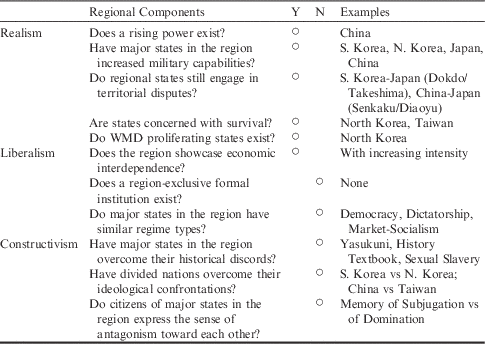
The regional politics of Northeast Asia is not by any means harmonious or tranquil.Footnote 1 It suffers from sporadic security crises and diplomatic standoffs. However, Northeast Asia in the post-Cold War era has managed an extended absence of outright militarised disputes amid a backdrop of remarkable economic growth that went against many gloomy predictions.Footnote 2 This peace has endured despite North Korea’s continuing nuclear ambitions; despite the lack of pan-regional institutions that should serve as a template for cooperation and coordination; despite brewing territorial disputes that fuel already inflammatory nationalistic sentiments across the region; despite growing mistrust and animosities tied to entrenched historical memories; and despite increasing military capabilities projected by China and Japan. In these conditions, many key theories and general assumptions of international relations predicted the likelihood of major conflicts in Northeast Asia, a region full of incendiary elements as indicated by the three major perspectives of International Relations theories summarised in Table 1.Footnote 3
Structural elements of conflict in Northeast Asia

In this vein, the regional politics of Northeast Asia present a theoretical puzzle: why and how has Northeast Asia sustained, for a long period, the absence of major militarised conflicts despite all the regional actors being involved in various protracted crises? Footnote 4 One can hardly say that Northeast Asia has been peaceful. Yet, amid lingering regional crises, the region has avoided war while sustaining economic prosperity.Footnote 5 Empirically, if we witness a cycle of diplomatic and military crises in Northeast Asia, with no escalation to a major war but, on the contrary, de-escalation, then we are left with a puzzle as to why and how such order in Northeast Asia is constituted and continues to endure.Footnote 6
An absence of war does not necessarily mean peace. Peace in international politics is not a final state of being but rather a relational process among agents toward a harmonious order of cooperation. Peace in Europe, for example, is a process of political evolution toward a more harmonious state of affairs.Footnote 7 If peace is defined as an absence of war, it provides only a snapshot of a warless state. Such characterisation does not allow us to look into the origin, process, and dynamics of how such absence of war is generated and how long it will last. Peace has to be built upon an absence of war with some degree of structural stability.Footnote 8 Without stability, peace becomes a temporary and abnormal period between wars.Footnote 9 In order to understand the absence of war in international politics, we need to excavate the content of the stability that structurally underlies a particular region so that we know what composes a period when war is absent and whether such a period is sustainable. Northeast Asia offers us an appropriate domain of observation for this phenomenon. In this vein, this article attempts to provide an analysis and explanation of the absence of war in Northeast Asia. The contending questions for the article are as follows: How can we explain the absence of war in Northeast Asia, especially after the end of the Cold War? What kind of stability has enabled the region to escape war? What kind of regional order will Northeast Asia’s absence of war produce?
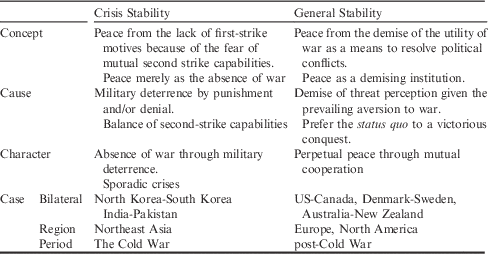
This article turns to alternating periods of crisis and general stability, as expounded in the academic literature on deterrence and security communities, to illuminate the present content of the regional order in Northeast Asia. Crisis stability occurs when two or more parties facing a military conflict consider themselves highly secure because of their military capabilities, namely punitive second strike capabilities, and can thereby wait out any possible surprise attack with full confidence that they can respond with severe counterattacks. On the other hand, general stability prevails when two powers greatly prefer peace even to a victorious war – whether or not crisis stability exists – because war has become inconceivable as a means of solving their political conflicts. While crisis stability entails a delicate balance of military capabilities, as discussed in the deterrence literature, general stability bases its logic of inquiry on the security community literature, in which the idea of war aversion – categorically rejecting war as a means to resolve conflicts and disagreements – becomes the prevailing code of conduct. Both concepts of ‘crisis stability’ and ‘general stability’ help explain the underlying structure of an absence of war in a particular temporal and spatial domain.
This article argues that crisis stability is dominant in Northeast Asia, producing a relatively long period without major militarised disputes, while the regional order of Northeast Asia exhibits an increasing trend toward general stability with gradually emerging liberal elements such as intensified economic interdependence and the idea of war-aversion, which I call liberal transition. Overall, this article attempts to provide theoretical and empirical templates for examining the content and structure of regional order and elucidating the determinants of stability transition so that an understanding of peace and its preconditions is expanded.
Crisis stability, general stability, and liberal transition
Stability is perhaps the most cherished and oft-used term describing interaction among state actors in international relations. Despite the lack of operational definitions, stability is commonly associated with peacefulness, harmony, coordination, and the presence of factors and actors gearing toward maintaining the status quo.Footnote 10 When the term ‘stability’ is associated with war and peace, stability has conceptual affinities with avoiding major conflict among states and maintaining structural adjustment within the international system. Therefore, a stable region has ‘a certain amount of tolerance to errors and disturbances’Footnote 11 and maintains equilibrium as a function of repetitive and predictive behaviours by state actors.Footnote 12
From the realist perspective, stability describes the absence of war as an end-result of the fair distribution of power (that is, balance of power) and/or concentration of power (that is, hegemonic stability).Footnote 13 In this perspective, stability is a term synonymous with a warless period. A fair distribution of power as an equilibrium point produces structural stability in international politics.Footnote 14 However, if we treat stability as an end result of systemic processes producing an extended period without war, then we are still left with the problem of identifying what constitutes such a period. Especially, when a region that possesses abundant antagonistic elements and an unclear distribution of power experiences an extensive period of militarised disputes, can we say that this region is stable just because of the virtual absence of war? Hence, for a more critical point of inquiry, we must go beyond treating stability as a consequential systemic product of a distribution of power. In this vein, we need to differentiate peace explained by military factors from peace explained by other factors. We must be also able to explain the ways in which stability becomes possible and sustainable, and how it is constituted.
Crisis stability
States try to manage confrontational situations before reaching a serious escalation threshold where a small conflict becomes a full-scale war. Under such circumstances, the other’s intention, capabilities, and short-term action plans are difficult to know. As a result, leaders may have a sense of urgency that the time available for critical decision-making is very limited and situations may deteriorate unless they react. Thus, a confrontational situation between states is generally associated with a high risk of miscalculation, which is referred to as an international crisis in security studies.Footnote 15
An international crisis occurs when an event complicates a conflict of interest between states that are unwilling to back down, at least initially. De-escalation of an international crisis occurs not necessarily because one side backs down, but generally because neither side is willing to further confront the adversary given a mutual fear of war. Both sides are secure; each possesses enough second strike capabilities to wait for the enemy’s first strike.Footnote 16 Thus, both possess mutual deterrence capabilities making a first strike very unlikely and risky.Footnote 17 Critical technology upgrades – such as acquisitions of high-tech precision weaponries, cutting-edge surveillance systems, and nuclear weapons – reduce the probability of military escalation between antagonists. Even if a would-be initiator prefers to use military means to change the current state of affairs in a crisis, it simply cannot do so due to the other state’s defensive and counter-offensive capabilities.Footnote 18 Both know that the benefit of a first strike is uncertain. More uncertain is whether the events after the first strike will pressure the other to back away. In this regard, a risk of miscalculation is substantially reduced so that an international crisis is stabilised; despite the lingering spectre of conflict, no-one in power seriously considers the use of military force as a solution that would achieve his or her goals, at least for the moment.Footnote 19 As a result, crisis stability depends on each side feeling confident and secure in the ‘assurance against being caught by surprise, the safety in waiting, [and] the absence of a premium on jumping the gun’.Footnote 20 For such a sense of security, each actor must have enough deterrence capabilities both to deny and punish an opponent’s possible attack.Footnote 21 As widely discussed in the deterrence literature, a delicate distribution of military capabilities produces a cycle of escalation and de-escalation of an international crisis, not necessarily resolving the crisis but resulting in an absence of war for the time being.Footnote 22 In short, crisis stability exists when no state believes that going beyond an escalation threshold such as striking first would work to its advantage.
An absence of war secured through crisis stability receives sustenance when both parties carry out strong commitments to upgrade their respective military capabilities for denial and punishment of a first strike by an opponent. For example, states might acquire high-tech jet fighter platforms with long-range precision missile capabilities to surgically target the origin of the first strike. In response, the opponent might upgrade its surveillance and air defence systems while matching the opponent’s air power with something similar or even more advanced. Extended deterrence can also signal strong commitments by installing counteroffensive military forces nearby a would-be initiator. Both signal their commitments by increasing direct deterrence capabilities while firming up relationships with allies. As a result, each side would be very reluctant to launch a first strike since the cost from the counterattack by a target state might well overshadow the benefit of any possible first strike by an initiator.
Actors in mutually-assured deterrence dynamics will prefer the uneasy status quo to an uncertain future or a costly victory. Their interest to maintain the status quo is so high that neither side will risk all of its national security over the disputed issue. During an absence of war based on the notion of crisis security, states will not fall into hasty miscalculation; both can wait. Therefore, despite the rise of a threat to one’s security, crisis stability holds so long as each state is capable of punitive second strikes. A potential initiator refrains from launching the first attacks considering the high cost of war, the low probability of winning, and, most of all, the high probability that the target will retaliate. Antagonistic episodes such as diplomatic standoffs and skirmishes might constitute tests of the stability of a region, but its bilateral stability will essentially rest on whether it can cope with military crises, and not on their frequency of occurrence. Stability depends on all parties holding onto the belief that initiating conflict would not work to their advantage.Footnote 23
General stability
According to the literature on security communities,Footnote 24 states do not conceive of war as a viable means to achieve their goals not only because of the high cost, the low probability of winning, and the high likelihood of retaliation, but also because states typically prefer peace to ‘a victorious war’Footnote 25 – sometimes holding extreme positions on this issue – because they believe that non-military measures yield the same or more preferable outcomes with virtually no material and human costs.Footnote 26 Thus, a security community generates an absence of war, as well, but a very different one than that based on crisis stability. I define the absence of war generated by the presence of a security community as general stability. As an underlying condition for the rise of a security community, general stability characterises a period of peace when war, as a means to resolve political conflicts between states, essentially dies out. Military means for conflict resolution becomes inconceivable among developed states, not because a delicate balance of power exists but because using force becomes inconceivable.Footnote 27 The security dilemma is replaced by a security community, which generates a strong foundation for general stability.Footnote 28
The absence of war constituted by general stability is based essentially on the cognitive dynamics that expectations of peace close off such triggers of war as threat perception and over-sensitivity, and allow states to value each other’s economic and political relations through which their prosperity can mutually grow.Footnote 29 For a plausible expectation of peace, states must share the worldview that the peaceful status quo is the better engine for development, social progress, and innovation.Footnote 30 For example, the benefits of economic interdependence and political cooperation must be perceived as something of mutual value to state actors, which then render states unwilling to fight because of the risk that fighting might destroy hard-won economic benefits and communal relations.Footnote 31 The main driver for general stability is the dominant belief by political leaders and their respective publics that trade and coexistence, rather than conquest, provide the best way to achieve their goals, and that peace serves as the foundation of prosperity and progress.Footnote 32 The relational dynamics propelled by economic interdependence, diplomatic cooperation, social exchanges, and common values offset threat perceptions and hostile nationalism that might otherwise fester amid military imbalances between state actors.Footnote 33 For example, in the Nordic region, it is almost inconceivable and even silly to postulate the Swedish threat perception vis-à-vis Denmark and vice versa in light of their shared peaceful identity.Footnote 34 Thus, the Nordic interest is not to rival but to coexist and cooperate to resolve any conflicting matters. In the same vein, Germans are hardly afraid of the nuclear capabilities of France and Great Britain. There exist resilient expectations for peaceful resolution short of violence, let alone war. Neither does strength deter aggression nor does weakness tempt it.
In the end, states go to war because of exaggerated political ambitions and ideological convictions of deluded leaders, over-blown faith of easy victory, and descending spirals of hot-tempered hostile nationalism. However, if political leaders link their political legitimacy with economic prosperity and diplomatic cooperation, higher political values will be allocated for coordinating different national interests and maintaining a period without war.Footnote 35 Such ‘dependable expectations of peaceful change’ are formed, which might ultimately lead to a birth of security community.Footnote 36 General stability underlies a security community.
Liberal transition from crisis stability to general stability
Transition can be defined as a process of gradual changes from one condition to another. For example, democratic transition in comparative politics entails an initiating point with ‘the introduction of a certain number of changes in the regimes’Footnote 37 and details ‘new rules for regulating the political behavior of citizens’.Footnote 38 Power transition theory in International Relations explains how the positional reversal between the two top states generates a hegemonic war after a series of transitional events according to changes in distribution of power.Footnote 39 Thus, transition as an analytical concept helps us explicate the conditions under which a particular set of inter-state order emerges and disappears.
For a region of crisis stability to transition to that of general stability, pillars of liberalism such as democracy, institution building, and economic interdependence are said to be essential.Footnote 40 Strengthening liberal elements such as economic interdependence and international institutions will contribute to more pacified and predictable interactions among states. Such a transition from crisis stability to general stability can be called a liberal transition.Footnote 41 A liberal transition is a structural process, pacifying the types, magnitudes, and characteristics of inter-state relations and, hence, minimising the likelihood of major military conflicts among states. By the process of liberal transition, states in a region are likely to move toward shared norms of cooperation, laying foundations for general stability. Individuals, groups, and states become powerful stakeholders in keeping a liberal transition in place and maintaining cooperative relations. The destructiveness of war, the benefits of peace, and changes in idea about war interact with each other, producing a trajectory for a region to undergo a change in regional order.Footnote 42 For a liberal transition to be more sustainable, it is necessary to have a realist underpinning so that regional rivals do not immediately push themselves to the brink of war every time there is a crisis.Footnote 43
With crisis stability intact, elements from the liberal pillars such as production networks, increasing social interactions and common values emerge gradually and disperse throughout the region, creating a structure in which war costs more than any other means. Then, an antagonistic region might go through a liberal transition to achieve general stability, in which aversion to war becomes the dominant norm.Footnote 44 In theory, complex interdependence in regional politics incubates extensive intraregional relations at government and social levels, coupled with interstate negotiations and social exchanges conducted through different issue areas. Under such complex interdependence, the idea of war aversion among states will decrease the utility of military force as a means of statecraft; a superior power never becomes tempted to use force on a weaker state. The possibility of an escalation of conflict into a militarised dispute becomes very minimal. Therefore, states possessing military strength are perceived as defensive and have no incentives to act aggressively. Rather than fight, states craft cooperative avenues aimed at institutionalising their interaction to minimise economic conflict and protect economic interdependence. Cooperation becomes the code of conduct and institutes general stability, paving the ways to a security community.
Crisis stability in Northeast Asia
A viable empirical test applying the concept of crisis stability to Northeast Asia is not so much about assessing the risk of regional flashpoints escalating into explosive major wars, but rather about how the wider system of Northeast Asia’s regional order can sustain and tolerate such antagonistic crises without major changes in the status quo of the region. For crisis stability to hold tight, a would-be initiator has to perceive the defender’s retaliatory threat as capable and credible. The defender, for its part, must be able to show its capacity and willingness to punish the initiator. As for assessing the credible presence of deterrence, one needs to identify alliance structures, force structures, and deterrence structures in dyads within Northeast Asia.
While Northeast Asia is known for its instability, the region has displayed no major upheavals overturning the status quo.Footnote 45 This is mainly because of the region-wide deterrence system (a.k.a., a hub-and-spoke alliance system and nuclear posturing) configured throughout Northeast Asia, producing a region of crisis stability. On the Korean Peninsula, American and South Korean deterrence of North Korea’s use of military force is balanced by North Korea’s deterrence of any military attempts by the alliance to attack the North and unify the peninsula.Footnote 46 Moreover, the United States has repeatedly confirmed its extended deterrence commitment for the defence of South Korea in any contingencies in which North Korea would use its limited nuclear capabilities. In the Taiwan Strait, the US deterrence of China’s possible use of force to achieve unification is counterweighed by Chinese deterrence of formal independence by Taipei.Footnote 47 In Sino-American relations, US deterrence of Chinese dominance of East Asia through the US-Japan alliance is countered by Chinese deterrence of the US’s use of force, with modernisation of its weapons portfolios and increased military capabilities.Footnote 48 In Sino-Japan relations, Japanese deterrence of China’s declaration of sovereignty over key strategic islands and maritime borders is challenged by Chinese deterrence of Japanese unilateral dominance over strategic points in the East China Sea.Footnote 49 The fundamental security deterrence structure in Northeast Asia is operated by the regional actors’ capacities to discourage rivals from any hasty behaviours. Therefore, all are constrained from initiating any decisive first move.
Summary of crisis stability and general stability
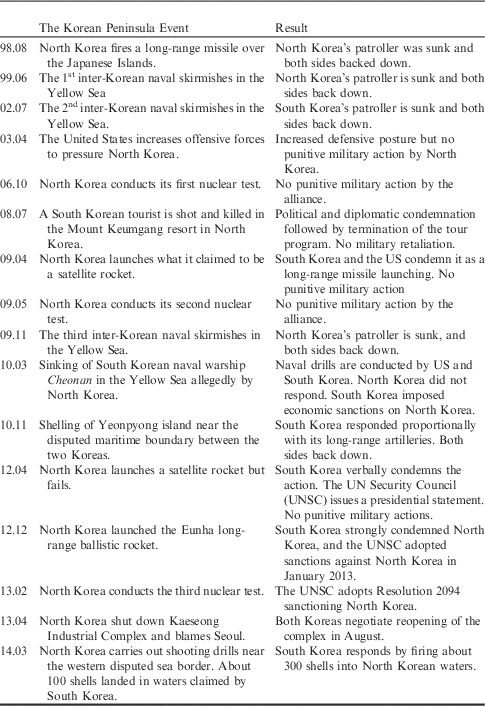
In theory, the probability of crisis escalation to a major military conflict on the Korean Peninsula is relatively high due to the geographical proximity of the two rival Koreas, the concentration of opposing military forces on the peninsula, and the lack of bilateral communication between the two sides. In reality, security tension has been met with both sides raising military readiness as well as harsh accusations on each side. The repeated pattern of naval skirmishes at the disputed western sea border between the two Koreas makes this especially clear. However, as Table 3 shows, the recent history of crises on the Korean Peninsula exhibits periods of rapidly building military tension, including the scheduling of joint US and South Korea’s military exercises in response to North Korea’s provocations, and then periods of gradual de-escalation on both sides, followed by diplomatic stalemates and international condemnations.
Security crises and results on the Korean Peninsula
Crisis stability dominates the underlying security order on the Korean peninsula, with mutual deterrence intensified by the obvious geographical proximity of the two Koreas. Seoul is located just forty kilometers south of the demilitarised zone (DMZ) and is highly vulnerable to a massive artillery attack by North Korea. Approximately 70 per cent of North Korea’s ground forces are stationed along the 240-kilometer length of the DMZ. The North’s Fourth Division Artillery Corps targets Seoul and its vicinity with 400–500 artillery tubes (170 mm and 240 mm self-propelled artillery), capable of creating a sea of fire, as long threatened in the shrill refrain of North Korean propaganda. Each tube can fire 100 rounds per minute.Footnote 50 North Korea has also posted mechanised divisions and infantry northwest of the DMZ so that, should there be any attempts to launch an attack, it could venture a quick occupation of Seoul.Footnote 51 On the other hand, South Korea posts all of its 21 army divisions and one of its two Marine Corps divisions along the DMZ within 100 km from Seoul for a rapid reaction. South Korea’s deterrence capacity comes from its superior defensive capabilities in naval and air powers that allow the South to launch surgical strikes by using ballistic and cruise missiles on the origin of any possible first strikes from the North,Footnote 52 backed up by the United States Forces in Korea providing an extended deterrence including the use of nuclear weapons.
Both sides are well aware that the other has enough first and second strike capabilities to inflict devastating damage.Footnote 53 Hence, despite naval skirmishes, occasional physical provocations, and numerous military drills that could trigger the other side’s retaliation, both sides rely on their primary defence and robust second strike capabilities that allow each party to wait out a first strike and then counter it with a second strike. Although South Korea and the United States enjoy overwhelming advantages in terms of mobilised war resources, South Korea suffers from an asymmetry of socioeconomic costs such as high civilian casualties, industrial destruction, and global capital flight if the North were to initiate a retaliatory second strike on Seoul. Such asymmetry of likely damage dampens any possible temptation within the US-South Korea alliance to use military means to obtain regime change or national unification. Moreover, China increasingly plays a balancing role in preserving crisis stability in the Korean peninsula. China strongly opposed the South Korea-US joint naval exercise in the Yellow Sea in the aftermath of the sinking of the South Korean naval vessel Cheonan in 2010 with the claim that such military drills aggravate the stability of the Korean Peninsula.Footnote 54 China warned by conducting its own naval exercises, and the Korea-US alliance backed down partially by relocating the US aircraft carrier to the west of the Korean Peninsula in the Sea of Japan.Footnote 55 North Korea’s provocations, including the shelling of Yeonpyong Island, did not escalate into a major conflict.Footnote 56 The mutual deterrence structure among the two Koreas, the US, and China ended up strengthening crisis stability, preventing the crisis from escalating into a major militarised conflict in the Korean Peninsula. The usual pattern on the Korean peninsula is that demonstrations of resolve are important to maintain the parties’ credibility and particularly for domestic constituencies in each country, but provocations are often met with reticence rather than by force.
In the Taiwan Strait, China’s resolve to keep the status quo is very high and credible.Footnote 57 China’s domestic political legitimacy hinges not only on economic development but also on the ability of the government to uphold political and territorial integrity. It is generally assumed both in China and abroad that a failure by Beijing to respond militarily to an independence declaration from Taiwan would destroy the Chinese Communist Party’s political legitimacy. On the same note, Taipei has so far judged the risk of facing China’s military reaction as too great to make any decisive move toward declaring independence.Footnote 58 While China now has sufficient surgical attack capabilities to destroy the Taiwanese infrastructure and economy in a massive attack by medium to long range missiles, the United States still showcases strong extended deterrence commitments to defend the Taiwanese island. China’s territorial claim over Taiwan has been consistent. In essence, China has maintained that it will grant de facto sociopolitical autonomy to Taipei as long as it does not declare independence. The United States, as part of the Taiwan Relations Act passed in 1979, has been asserting an American interest in Taiwan’s political autonomy and defence through a consistent commitment to the stability of the Taiwan Strait. Moreover, the American security connection to Taiwan has endured and deepened as Taiwan has grown into a strong economic partner to the United States. Hence, without a bold movement directly toward independence by Taiwan, it is difficult to imagine China initiating any kind of move to change the status quo.Footnote 59
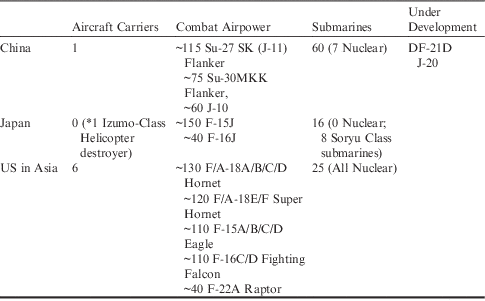
China’s expanding military expenditures and modernising military capabilities might prompt changes in the distribution of power in the region.Footnote 60 China’s military modernisation has provided its own power projection capabilities into its neighbouring states and waters.Footnote 61 China has increased its power to deny access into its water by developing the anti-ship ballistic missiles Dong-Feng 21D and the fifth generation combat aircraft with a stealth function, Jen 20, which reduces the maneuverability of the US Navy battle groups in East Asia.Footnote 62 China’s power projection capabilities are limited but strong enough to protect its significant maritime interests in the region, whether or not direct contacts with the US are involved.Footnote 63
As the most powerful military actor in the region, the United States has further mobilised its military forces and diplomatic efforts and redeployed a limited number of forces to Australia. The US is rebalancing toward East Asia and seeking to concentrate its diplomatic, economic, and military strategy on the region.Footnote 64 While reshuffling its alliance relations with Australia, New Zealand, Singapore, Japan, and South Korea, it is now also constructing more cooperative relations with Vietnam and Myanmar. All of these overtures are intended to check and balance a rising China.Footnote 65 China’s geopolitical behaviour has become more visible, not because of its sheer military capacity but because of its enhanced economic strength, which likely indicates that mutual military deterrence on both sides has not undergone fundamental change.Footnote 66
Northeast Asia was a formidable part of crisis stability during the Cold War, and its Cold War legacy still has strong footprints in the twenty-first century. Both North Korea and South Korea still realise the importance of second strike capabilities as well as first strike capabilities. North Korea’s loss of its allies is made up by its nuclear capabilities, while the US containment of the Korean Peninsula is more active through extended deterrence. The United States still maintains air and naval bases in Guam, Japan and Australia to provide balancing roles vis-à-vis China as well as North Korea. For the last twenty years, deterrence configurations in the region managed to curtail the descending spirals of crisis into major military conflicts, particularly on the Korean Peninsula and in the Taiwan Strait. US-Japanese relations have continued to strengthen, posing a strong counterbalancing coalition against China. Crisis stability is deeply rooted in the security landscape of Northeast Asia, which makes any military operation scrutinised not only for its uncertain effects but also for what could happen next.
General stability in Northeast Asia and its prospects
Northeast Asia is a region of crisis stability; sporadic security crises, and diplomatic standoffs from the region decorate the front pages of newspapers around the world. Historical disagreements, weapons of mass destruction, island disputes, and alliance politics still cloud the security landscape of the region. Thus, discussions in the field of Asian security studies rightly focus on the traditional security arenas in the region. However, there is also an emerging trend that deserves articulated analytical scrutiny. Much evidence indicates that Northeast Asia now incubates seeds of general stability that might offset the descending spirals of multiple security dilemmas. If the geopolitical aspect of the regional order hinges upon crisis stability, the underlying geoeconomic structures, namely deepening economic interdependence and proliferating minilateral institutions in the region, tend to sustain the pacifying dimension of regional order.Footnote 67 Thus, for the past twenty years, while crisis stability tends to prevail, prospects for regional general stability seem to be rising.
Northeast Asia lacks formidable regionalism that otherwise would give birth to regional institutional building. Northeast Asia lags far behind Europe and Southeast Asia in terms of regional institution building. The region has a long way to reach comparable levels of institutional integration and in fact relied on ASEAN (The Association of Southeast Asian Nations) for initiatives to bring the main states together within larger frameworks of regional cooperation.Footnote 68 However, Northeast Asian states have formed webs of minilateral institutions, some of which are subregion exclusive, linked with other regions, task specific, consultative, and periodically routine. Northeast Asia has installed multilateral cooperative arrangements, ranging from multilateral negotiation platforms, handling nuclear proliferation (for example, the Six Party Talks) and creating a financial safety net through bilateral currency swap agreements (for example, the Chiang Mai Initiatives), to a working group envisioning future visions of regional order (such as Tripartite Cooperative Secretariat).
China, Japan, and US in Asia power projection capabilities
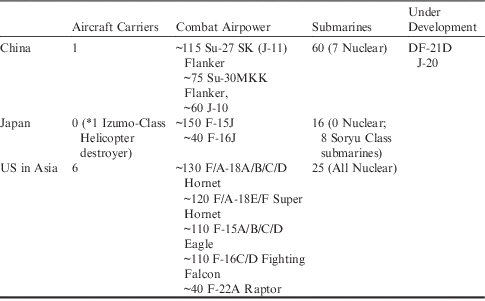
Source: Data drawn from ‘The military balance’, International Institute for Strategic Studies, 114:1 (2014).
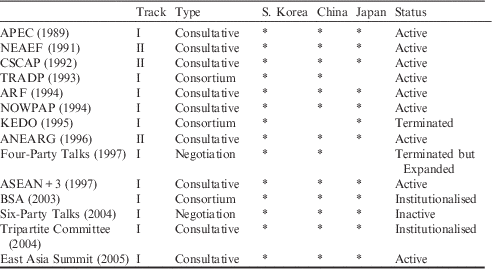
As Table 5 illustrates, mini-institutions in the region, though less formalised and legalised than in other regions, have functioned as confidence-building measures and preventive diplomacy forums in which states have actively pursued negotiations to manage their differences.Footnote 69 NEA’s loose regional institutionalism – networks of informal and formal consultations – reflects Northeast Asia’s tenuous regional dynamics. Memories fuel distrust and initially deter states from concentrating on confidence-building measures.Footnote 70 Therefore, regional institutions in Northeast Asia have grown incrementally, as ‘events for formalizing the regional institutions evolve gradually and subtly, rather than in a series of dramatic breakthroughs’.Footnote 71 One reason for the incremental advancement of regionalism in Northeast Asia has been the growing acceptance of the common norm that regional cooperation is by default necessary and needs to be harboured through some levels of institutionalisation.Footnote 72 This is most apparent in constructing the Six Party Talks in an attempt to curb North Korea’s nuclear weapons programme. The states in the region are seeking a dipl
Northeast Asian states’ participation in regional cooperation platforms
*APEC: Asia Pacific Economic Cooperation; NEAF: Northeast Asia Economic Forum; BSA: A Bilateral Swap Agreement established by the May 2000 Chiang Mai Initiative; CSCAP: Council for Security Cooperation in Asia Pacific; PICE: North Pacific Marine Science Organisation; TRADP: Tumen River Area Development Program; ARF: ASEAN Regional Forum; NOWAP: The North-West Pacific Region Action Plan; KEDO: Korea Economic Development Organization; ANEARG: The Association of Northeast Asia Regional Governments; ASEAN +3: Association of Southeast Asian Nation Plus NEA state; TCOG: Trilateral Coordination and Oversight Group. TRACK I: Inter-Governmental; TRACK II: Non-Governmental; TRACK I & II: Inter-Governmental actively supported by non-governmental experts.
omatic resolution while minimising the risks associated with the denuclearisation process. While the members of the Six Party Talks minus North Korea may have shown some disagreement over the conditions of reinitiating the talks after 2008,Footnote 73 the denuclearisation of the Korean Peninsula has served not as a dividing wedge among these states but as a platform to discuss shared interests of peace and stability on the peninsula.Footnote 74 Moreover, the shared interests in securing regional stability critical to economic activity have led regional actors to focus on managing geopolitical instability on the Peninsula and to cooperate in minimising the risk of escalation into military conflicts.
Northeast Asia hosts economic powerhouses of the globalising era – China as the second largest economy in the world, Japan, the third largest, and South Korea, the fifteenth largest. These three trading states have sustained economic development through export-oriented strategies and have fired the engines of global economic growth. China, Japan, and South Korea have congealed into a highly condensed ‘natural’ trading zone that operates without much formal arrangement yet has become critical to each state’s economic development.Footnote 75 Deepening economic interdependence among these states is nothing new, but it adds a promising dimension to Northeast Asia’s path toward general stability.
According to Figure 1, Northeast Asia’s rising economic interdependence has become more visible. Compared with the intra-regional trade share of the EU and NAFTA, Northeast Asia’s intra-regional trade has soared from 28.9 per cent in 1992 to 39.7 percent in 2010, marking a 27 per cent increase in 18 years whereas the comparable trend lines for the EU and NAFTA are flat-to-lower. More than 60 per cent of the intra-trade accounts in Northeast Asia are made up of manufactured parts and components, which indicates the evolution of the region’s production network into intensive horizontal and vertical intra-industry trade.Footnote 76 In short, each state’s trade competitiveness is highly sensitive to its regional trading partners. Moreover, the direct and positive linkages among the states’ major export industries, through intra-industry production networks, have tightened the linkages across Northeast Asia’s regional economy, turning it into something close to a singular production community. In contrast with the EU and NAFTA, this has happened without any formalised governmental agreements. On the financial integration side, the states in Northeast Asia trade more financial assets among themselves than with the rest of the world, considering ‘market size, rate of return, financial openness, tax rate, geographical distance, and other relevant source and investor country characteristics’.Footnote 77 Economic interdependence has opened a pathway for rapid and cohesive economic integration across Northeast Asia.Footnote 78
Comparative intra-regional trade share of the total trade volume of member countries. *Note: NEA: Northeast Asia (China, Japan, Korea, Hong-Kong, Macau, and Taiwan); NAFTA: North America Free Trade; EU: European Union. Source: Data compiled and calculated from the UNCTAD Data available at” {http://www.uncatd.org}.
Any decision that risks the benefit of this economic interdependence might be illogical, since the use of force to resolve disagreement would cause the beneficial state of affairs to deteriorate. Nevertheless, even with such strong economic interdependence, misperceptions and hostile variants of nationalism could still cause leaders to make illogical and emotional decisions to go to war. In short, the proliferation of economic interdependence does not necessarily herald the emergence of general stability, although it certainly holds considerable promise.
Economic interdependence is by nature procedural; it is an incremental process that increasingly builds structural constraints on state leaders in ways that foreclose the use of military options. Increased economic interaction can help incubate the rise of general stability in the region with increased intra-regional activities, including cross-national trade, investment, telecommunications, and tourism. Intra-regional economic interdependence is an important platform and also a useful tool for peace-promoting policymakers, assisting them in counterbalancing the regional vulnerability that emerges from disputes rooted in history and territorial contests. All the major actors – both governmental and non-governmental – share a ‘Northeast Asia prioritization of economic development’,Footnote 79 which, thus far, has provided a lever stopping the descending spirals of security dilemmas. The installation of the Trilateral Cooperative Secretariat and the completion of the Korea-China Free Trade Agreement are two examples.Footnote 80
In this vein, we have some hopeful cognitive elements setting forth an optimistic pathway for a liberal transition in the region. Policy networks of well-connected governmental, quasi-governmental, and academic experts have pushed general ideas about regional integration and identity building in Northeast Asia.Footnote 81 While most elites in Northeast Asia see the United States as the greatest force for peace in times of China’s rising, which confirms the regional strategic mindset of crisis stability, elite support for building an ‘East Asia Community’ also exists. The Center for Strategic and International Studies’ survey reports on the sentiments of ‘strategic elites’ reveal that virtually all respondents agreed that the region’s highest priority should be promoting confidence and mutual understanding for preventing conflicts.Footnote 82 A weighted average of 90 per cent of the respondents identified a framework for trade and regional economic integration as very important or somewhat important. The strong economic interdependence in the region boosts a sense of regional identity within the public mindset across the three key states in Northeast Asia. In addition, a 2008 survey by the Chicago Council on Global Affairs found that 77 per cent of elite respondents in China, 54 per cent in Japan, and 62 per cent in Korea considered themselves as ‘East Asian’Footnote 83 as a secondary identity alongside their primary national identities. In a similar vein, the general public in these three states expressed support for regional trade liberalisation (China: 84 per cent, Japan: 70 per cent, and South Korea: 76 per cent) and a pan-regional institution (China: 68 per cent, Japan: 40 per cent; and South Korea: 71 per cent).Footnote 84
Bolstering economic interdependence, then, appears to have a positive, albeit premature, impact on constructing a regional consciousness.Footnote 85 However, another aspect of the cognitive reality in Northeast Asia is the presence of mutual threat perception conflated with nationalism over the history and territorial issues. South Koreans and Chinese have particularly critical views of Japan’s conservative leadership headed by Prime Minister Shinzo Abe.Footnote 86 According to a spring 2014 Global Attitude Survey by the Pew Research Center, the Chinese public has only a 15 per cent confidence and the Korean public a 5 per cent confidence that Japan’s leader will do the right thing.
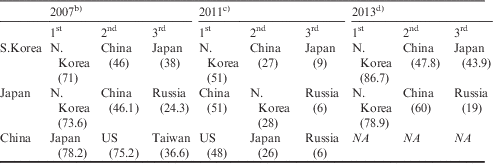
Recent survey results demonstrate an underlying foundation for chronic instability in the region fuelled by mutual threat perception, as seen in Table 6. In the public mindsets of South Korea and Japan, North Korea is predominantly perceived as a potential military threat, while South Korea increasingly perceives Japan as a viable threat to its security, as its threat perception of Japan increased from 38 per cent in 2007 to 43.9 per cent in 2013. However, when South Korean respondents were asked to choose only one county as a military threat in the 2011 survey, Japan dropped markedly to 9 per cent, compared with 38 per cent in 2007. This suggests that South Korea’s threat perception of Japan is not concretely strong. Rather, it reflects South Korea’s historical animosity toward the Japanese government and anxiety about Japan’s future direction. Japanese respondents consistently project a strong threat perception toward China and North Korea. China’s threat perception is high toward Japan and the United States while practically nonexistent toward North Korea and South Korea. All in all, the weight of historical memory is by no means light, and mutual threat perceptions are as real and concrete as economic interdependence.Footnote 87 This may explain that nationalism in Northeast Asia stands in the way of Northeast Asia’s smooth transition to general stability.
South Korea-Japan-China Public Opinion Survey on military threat
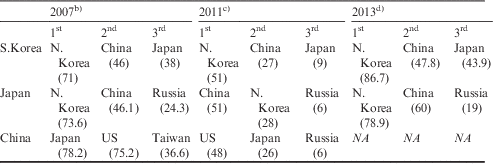
*The common question in three consecutive surveys asked, ‘Which country is expected to be a military threat to your country?’ (Number in Parentheses: %). The sample size for all the surveys was 1,000 respondents. For the 2007 and 2013 surveys, respondents could choose multiple answers. b) The 2007 survey was conducted by Hankook Daily of Korea, Yomiuri of Japan, and Xinhua News Agency of China. c) The 2011 survey was conducted by Dong-A Daily of Korea, Asahi of Japan, and Beijingsyen of China. d) The 2013 survey was conducted by the East Asia Institute of Korea and NPO of Japan.
The idea of war aversion is difficult to measure, as this would require a systematic survey uncovering the public mindset across the region. As such regional data is not available, we can only make an inference by looking at a proxy indicator. South Korea’s public preference for how the government handles North Korea can function as a proxy indicator, illuminating at least a partial element of the idea of war aversion. For South Koreans, such threats from the North are tangible, and their preference regarding the government’s North Korea policy sheds insight on how their perspectives on the use of force have been expressed over time.
Figure 2 displays the general trend of public opinion on South Koreans’ policy preference regarding the possible use of force against North Korea as a means to resolve ongoing problems such as Pyongyang’s nuclear weapons development, rocket or missile launches, and military provocations. Even in April 2010, in the aftermath of the sinking of the South Korean naval vessel Cheonan, merely 6.3 per cent of South Korea’s public demanded military means as the preferred policy option toward North Korea. This preference increased sharply to 56 per cent immediately after the shelling of South Korea’s Yeonpyong Island in December 2010, near the disputed maritime border separating the two Koreas, at which time 41.1 per cent of South Korean respondents still demanded non-military options. This spike in favor of a military response is an outlier, given that the general trend of public opinion from December 2002 has displayed and overwhelming preference for non-military measures in dealing with North Korea. Moreover, three months after the shelling, the policy preference for non-military options returned to its longstanding dominance. One would expect South Koreans to have been more hawkish, preferring more military means, as the country has directly suffered from North Korea’s provocations for the past twenty years. Such motives behind the preference for non-military means would be diverse, but one plausible explanation is that South Korea’s engagement policy for reconciliation with the North has impacted upon South Korea’s relational identity with the North; a majority of the South Korean public perceive North Korea as a subject to reconcile rather than punish.Footnote 88 South Koreans may also view a military option as too potentially disruptive. All in all, this is a positive indicator that allows one to argue that aversion to war is taking roots in the southern part of the Korean peninsula, the most volatile security flash point in Northeast Asia.
*Line A represents South Koreans’ policy preference in the aftermath of North Korea’s second nuclear test. Line B represents South Koreans’ evaluation on the government’s handling of the sinking of a South Korean navy ship allegedly by North Korea. Line C represents South Koreans’ policy preference after North Korea’s bombing of a South Korean island. Line D represents South Koreans’ policy preference four months after the bombing. Line E represents South Koreans’ preference on the government’s policy following North Korea’s rocket launch. Sources: December 2002: Chosun Daily; March 2003: Korea Broadcasting System; April 2003: Munwha Broadcasting Company; July 2003: Korea Broadcasting System; February 2005: CN Research; February, May, and July 2006: Muwha Daily; October 2006: Ministry of Unification; April 2009: Ministry of Public Administration; April 2010: Naeil Daily; June 2010: DongA Daily; December 2010: PolyNews; March 2011: Daily NK; March 2012: Asan Institute.
Public preference on South Korea’s policy toward North Korea.
Prospects for general stability are too premature to draw decisive conclusions. Security concerns are not minor problems in the mindsets of Northeast Asia’s political leaders, but any considerations for the use of military force are highly constrained and, therefore, less probabilistic. Since the sporadic security crises across the region are checked by the dynamic of crisis stability, the persistence of crisis stability and the gradual burgeoning of minilateral cooperative platforms fuelled by deepening economic interdependence must be acknowledged in tandem as a break from the region’s combative history. Northeast Asia now displays a very strong presence of economic interdependence that has become much more formidable than any regional multilateral platforms. Nevertheless, the mutual threat perception is still stronger than any empirical evidence indicating an emerging sense of regional ‘we-ness’, and the idea of war aversion has yet to be empirically examined on a regional basis. Still, public opinion data on South Korea’s policy toward North Korea lend reason to believe that war aversion even between the region’s most fiercely confrontational rivals has emerged. All in all, increasing prospects for the rise of general stability might stem from the persistence of crisis stability, which then creates space for economic interdependence, multilateral platforms, and war aversion to take root in the region.
Conclusion
The article has discussed the underlying structures of Northeast Asia’s regional order by employing the concepts of crisis stability and general stability. Crisis stability helps us diagnose the underlying security dynamics, while general stability allows us to assess where the region is likely headed. These two variants of stability are inter-linked. General stability might remain elusive in Northeast Asia until the region makes it through a longer period of crisis stability and the absence of war. The findings of this article indicate that crisis stability in the region still prevails; stability through direct and extended deterrence is rooted very firmly across the region. On the other hand, the article also presents an emerging regional trend with data indicating that the region’s liberal transition to general stability has a bumpy road ahead despite some positive evidence.
Northeast Asia has been enjoying a protracted period without war. Certainly, this is not a peace grounded in a strong sense of regional community. Rather, it is a peace of crisis stability coined by the prudent. The states in Northeast Asia are increasingly relying on the striking power of highly accurate conventional systems delivered from air and sea. For now, it is difficult to imagine Northeast Asia becoming a region driven by a security community with general stability in a foreseeable future. War is not unthinkable, as is the case for the European Union.
Yet, the absence of outright war and the maintenance of a formative regional order in the region must be acknowledged. Geopolitical considerations and security preparations remain high policy priorities, but the temptation to use military force as a means of crisis resolution is highly constrained, rendering the use of force very low on the list of policy options. This means that absence of system-destroying conflict, rather than absence of conflict per se, will continue to characterise Northeast Asia’s security order. As China rises and Japan strengthens its balancing posture with the US, no single nation will become dominant. And most of the regional states will survive in a regional order free from large-scale war and continue to develop their economies. From the perspectives of the regional states, the term ‘regional stability’ would refer to the combination of their continued political independence, economic development, integration with the global market, and territorial integrity without any significant probability of becoming engaged in a war for survival. And nationalism in the region often inflames hostile threat perception in the domain of the historical and territorial disputes.
While the sporadic security crises across the region are sustained and also tempered by crisis stability, the gradual burgeoning of minilateral cooperative platforms fuelled by deepening economic interdependence must be acknowledged as a positive trend relative to the region’s bellicose past. Northeast Asia has developed a high level of economic interdependence but still remains largely under-institutionalised. The Sino-Korea FTA is the only codified formal agreement in the region, and the aversion to war is not yet strongly rooted in the region. Citizens in South Korea, China, and Japan share mutual threat perceptions in varying degrees. However, public opinion data on South Korea’s policy toward North Korea indicates that war aversion might have gained a solid footing at least on the Korean Peninsula, the most volatile security flash point. More promising is that the region has taken on the characteristics of complex interdependence through production networks and supply chains. For Japan’s economic recuperation, increasing trade with China is inevitable. For China’s export competitive edge, maintaining stable supply chain networks with Korea and Japan are a must. For South Korea’s sustainable economic growth, integrating with its neighbouring states’ supporting economies is essential. Thus, political and business elites across the region have formed webs of intensive networks with the shared conviction that the economic development of each state in Northeast Asia is a positive-sum game benefiting the region as whole. In the same vein, increasing cross national and cultural contacts through expanding regional tourism and consumption of cultural products are positive indicators contributing to the construction of regional identity.
International war occurs when there is nothing to prevent conflict. Thus, one might conclude that crisis stability incubates instability and, ultimately, a major war in Northeast Asia will follow. Territorial disputes and historical disagreements could prevent the region from progressing into general stability. Agents seeking to engineer hostile nationalism in Beijing, Seoul, Pyongyang, and Tokyo may manipulate such identity problems. However, effective mutual deterrence has produced a persistent cycle of crisis stability in which none of the state actors in Northeast Asia prefer war to the status quo of uneasy peace, even if this means high military and diplomatic costs from perpetual tension and security crises. Under such a regional order configured mainly by crisis stability, the key states, including North Korea, believe that all have capabilities to use force to resist any first moves to change the status quo. As long as such deterrence is maintained, the absence of war in Northeast Asia is sustained through crisis stability. Hence, the regional states will continue to prepare for war and increase military deterrence capabilities as long as crisis stability persists. Thus, analysts in International Security studies should pay attention whether this posturing will eventually yield peace through strength or fail, hurling the region into conflict. Northeast Asia still has a long way to go to achieve what this research considers peace based upon general stability, but, from the findings, one may carefully conclude that the seeds for a liberal transition in the region are being planted. Whether such seeds will grow has to be patiently watched. It required two world wars, one cold war, and, along the way, tortuous and laborious negotiations and coordination for Europe to accomplish general stability.