Knowledge Management in Law: A LOOK AT RECENT TRENDS
Knowledge management (KM) continues to be an emerging field that focuses on how best to capture, share, apply and generate knowledge throughout the organisation. Knowledge management has permeated most sectors, including law. However, in the legal sector, KM hasn't been applied as strategically as possible. It is often associated with document management systems and records management but KM has much more to offer. Organisations can use KM to increase innovation, build adaptive and agile organisations, develop the institutional memory of the firm and improve organisational internal and external effectiveness.
Elana Zeide

Jay Liebowitz

Even though there are some sectors, like pharmaceuticals, energy, consulting and others, that are applying KM strategically, other sectors seem to be lagging. The legal field has been involved in using KM over the years but there still seems to be some cultural resistance. According to “The Knowledge Imperative” (research report by OMC Partners and the Practical Law Company, March 2011), based on over 50 hours of interviews with knowledge managers and partners from a range of practice groups in ten of the UK's leading law firms, they found the following barriers to increased knowledge efficiency [http://www.jdsupra.com/post/documentViewer.aspx?fid=6884386b-8c13-495c-ae8f-711099a18744]:
• Decentralised knowledge functions prevent systematic implementation;
• A misconception about what clients are actually paying for;
• Cultural resistance to working with new technology or external providers;
• The decision-making process for implementing new approaches is dominated by the costs without a rational assessment of the benefits;
• Senior stakeholders in law firms are often the least open to change;
• Under-resourced implementation of knowledge initiatives.
The good news, however, from the same report is that law firm use of knowledge management can cut costs by up to 25%, consistently across all practice areas. Certainly, there is keen interest in seeing how KM can help law firms. In the 2010 ILTA (International Legal Technology Association) “Knowledge Management Survey Analysis by Firm Size Study”(www.mygazines.com/issue/34417/)(www.iltanet.org), they found that:
• As the size of the organisation gets larger, the more likely it is that KM is operated through a separate department with a separate budget;
• As the size of the organisation gets larger, the more likely a CKO (Chief Knowledge Officer) or equivalent is leading the KM program;
• Smaller organisations are more likely to have a practicing lawyer leading the KM initiative;
• However large or small, most KM departments report to senior management and all expected the number of FTEs (full-time equivalents) focused on KM to remain the same this year;
• Smaller organisations focused more on document management systems and email management while the larger organisations are focused on enterprise search and new portal implementation;
• 51–250 attorney firms: 55% don't have enterprise-wide search; 53% don't have on-line new business intake; 48% don't have ERM (enterprise resource management) systems; 43% don't have deal lists; 43% don't have matter pages on their intranet; 40% don't have competitive intelligence;
• 251–500 attorney firms: 46% no enterprise-wide search; 58% no ERM system; KM folks have either full or shared responsibility for the intranet or portal, and legal research;
• 501–100 attorney firms: 53% no ERM system; KM has either full or shared responsibility for enterprise-wide search, intranet or portal, legal research, matter pages on the intranet and deal lists.
To complement this ILTA study of KM in law firms, Caroline Poynton's 2010 Ark Group report on “Transition and Succession Planning for Law Firms: Securing Core Knowledge” found the following:
• Cross-generational issues will be a common theme;
• Need to establish a process for succession planning and a succession plan;
• Knowledge sharing and retention support succession planning;
• Reward systems need to be reviewed;
• There needs to be more planning in relation to client relationships and earlier planning for handovers or introduction to successors into relationships.
A Delphi Survey for Examining Cultural Resistance to KM in Law Firms
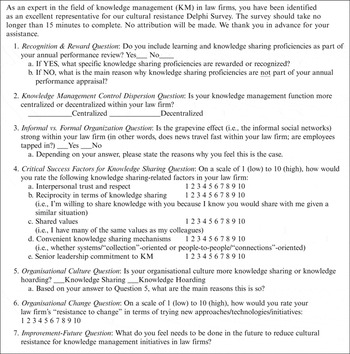
To better understand how KM can have a more pervasive effect on law firms, we focused on one of the key barriers previously identified, namely, cultural resistance to using new KM technologies and approaches. We performed a Delphi Survey with selected KM experts in law firms, both in the US and abroad, in order to gain further insights into this issue. We looked at six key factors that may affect cultural resistance: recognition and reward systems, knowledge management control dispersion, informal versus formal organisation, knowledge sharing critical success factors, organisational culture, and organizational change. The survey is shown in Table 1.
Cultural Resistance Delphi Survey Knowledge Management in Law Firms

Recognition and Reward System for KM
In terms of looking at the recognition and reward system for encouraging knowledge sharing in law firms, the survey respondents all agreed that the law firms incorporated some form of recognition and reward for KM activities to help build and nurture a knowledge sharing culture. Some of the techniques used were:
• A venture fund that allows individuals to receive full billable working attorney credit for any time spent working with the KM attorneys on a KM related project. A project budget is set out at the beginning of the year and is watched very closely by the CKO. The firm sees such a value in KM that the KM billable working attorney time is considered the equivalent as working for a client (no discount);
• Knowledge sharing proficiencies rewarded are tied to relationship building, firm contribution, specific projects, drafting guidance and standard forms, delivering training, sharing knowledge in group meetings, contributing to knowledge banks, etc.
• Contribution to main firm-wide databases of technical know-how developed during the year; development of specific know-how resources or training for clients; contribution to the firm's training programme (thus involving the sharing of knowledge with other lawyers).
Knowledge Management Control Dispersion
Knowledge management control dispersion relates to whether the KM function is more centralized or decentralized in the law firm. This could impact the spread of KM throughout the firm. According to the survey respondents, there were mixed responses, although the majority were leaning towards a more decentralized function. In one of the cases, it was both, whereby the KM Department leads all the KM efforts, but there are 5–10 timekeepers from each area of practice that aid the KM Department in developing KM tools, forms, client packages, etc. In another case, someone was just hired to head the KM activities, so even though KM was a decentralised function, there would be a more coordinated, centralized approach with this new hire.
Informal Versus Formal Organization
Cultural resistance could result from the formal organizational structure of the firm. We were interested in seeing how the “informal organisation” (i.e., the social networks and grapevine effect) permeated the law firms. Towards this end, the respondents felt that the informal networks were strong as shown by some of the following remarks:
“News does travel fast due to consistent education from top down. But also from word of mouth. Secretaries and Associates are the biggest water cooler talkers which causes news to spread quickly.”
“We are inherently a social firm, and build on our values which are open and transparent.”
“Use of social media, e.g. blogs, culture, workspaces and meeting areas are conducive to informal knowledge sharing.”
“Small enough for people to communicate well, strong social structure.”
“The lawyers are organised into small groups within larger divisions and more naturally belong to these groups, which are then used for social and management purposes. Information is dispersed quickly within groups where these social bonds are strong. These communication channels are trusted more readily than the official, central channels.”
Critical Success Factors for Knowledge Sharing
We asked the respondents to rate the following knowledge sharing-related factors in their law firms: Interpersonal trust and respect, reciprocity in terms of knowledge sharing, shared values, convenient knowledge sharing mechanisms, and senior leadership commitment to KM. The factors were generally rated high by the respondents with slightly lower ratings for having convenient knowledge sharing mechanisms (both codification/systems-oriented “collection” approaches and personalisation/people-to-people/“connection” approaches) and senior leadership commitment to KM. In KM circles, we always say that a senior champion is needed, both for financial and moral support. Perhaps by improving this factor, along with having the right knowledge sharing mechanisms in place, the cultural resistance to KM could be reduced.
Organisational Culture
This question looked at whether the law firm was regarded as having more of a knowledge sharing or knowledge hoarding culture. In almost all the cases, the respondents indicated a knowledge sharing culture existing in their law firm. This was mostly due to providing credit for knowledge sharing over the years and acceptance of a knowledge management strategy by the firm. One interesting comment was:
“There is also a recognition that the habits of hoarding are associated with an ‘older’ generation of single practitioners. A modern, commercial and team-based firm cannot function successfully in this way. Technology has also readily facilitated the sharing of know-how in many ways that before made it more of a chore and more demanding.”
In the case where there was more of a knowledge hoarding feeling, it was due to the perception that KM was little understood and it should be done by KM professionals, not be part of the responsibility of the lawyers.
Organisational Change
This question was frank in rating the law firm's “resistance to change” in terms of trying new approaches, technologies and initiatives. This question elicited the lowest response of all the questions, typically a “5” on a 1–10 scale. Perhaps the reason for this score is the relative conservatism of law firms. As the “Knowledge Imperative” report pointed out, senior stakeholders in law firms are often the least open to change. This issue touches on the earlier finding about the possible lack of senior leadership commitment to KM.
What Needs to be Done in the Future to Reduce Cultural Resistance to KM
The last question of the survey asked the respondents; “What do you feel needs to be done in the future to reduce cultural resistance for knowledge management initiatives in law firms?” Some of the interesting responses were:
“The new generation will drive knowledge sharing in the next decade. This is because they are plugged-in and fully expect to share as much as desired. We must provide the tools to make this user friendly. Additionally, client demands for efficiency will be a large driving force for KM.”
“One by one change; acceptance of societal change; new business models in the legal sector: economic & organisational change; understanding of how we all communicate, what motivates and what sticks.”
“Embed knowledge sharing culture and behaviors in everyone's daily jobs and processes; make clear what knowledge sharing behaviours are expected, with this being clearly stressed by senior partners; include knowledge sharing in annual appraisals and in-between, and ensure this is taken seriously and is important in terms of career progression; make it as easy and useful as possible to share knowledge; communicate success stories, explaining the importance of knowledge to the modern law firm and make clear what type of knowledge behaviours are encouraged.”
“Improve reward and recognition; KM activities, when done well, are time consuming and require the firm's best minds – these are often those who are already recording high numbers of hours – what will incentivize them to participate in KM activities?”
“Ensure strong risk management controls so that access to know-how is not abused by practitioners (e.g., access to information on how to advise a client in certain legal situations does not replace the need to consult the appropriate expert in the firm). These controls depend on training, clear messaging, monitoring and reporting.”
“New technologies to support enhanced knowledge sharing need to be driven by practitioners and governed by principles such as user-friendliness and simplicity, otherwise they will discourage rather than facilitate knowledge-sharing.”