Convertible husbandry has been celebrated by Eric Kerridge and earlier agricultural writers and practitioners as one of the most revolutionary changes of the early modern period, and one of the essential components of the “agricultural revolution” that took place during that time. It was described as a system whose ingenious organizational design offered finally an antidote to the centuries-old stagnation perpetuated by the permanent division of arable and pasture in the context of common-fields.
The crucial change, according to Kerridge's hypothesis, was the more efficient utilization of manure due to the periodic alternation of grazing and tilling within the same field.1
Kerridge, Agricultural Revolution, pp. 200, 202, 207.
The dung and urine deposited on the leys, in greater quantities compared to permanent pastures due to the richer grass output, ended up benefiting crop yields when the sod was plowed with the arrival of tillage. But a more bountiful grain harvest was not the only benefit. The leys' turf was inverted with plowing but not destroyed; when tillage ended, the old grass recovered slowly and reached its peak during the third year under leys. Such grass “comes fresh…and sweet being young and tender, and having no corrupt weeds or filth to annoy it.”
2 Blith, English Improver, pp. 111–12. See also Elliott, Clifton Park, p. 222; Moore, Grassland Husbandry, p. 29; and Williams, “Leys,” p. 193.
The destruction of weeds was of paramount importance in an age lacking chemical herbicides because it provided animal feed of higher nutritional value and, therefore, a higher quantity of animal products. Modern developments in soil science have also asserted, through quantitative experiments and measurements, the ability of the system to check crop diseases, increase the quantity of organic matter in the soil, and improve crumb stability considerably, especially in sandy soils within five to ten years from the initiation of leys, although longer in soils with higher clay contents (up to 50 years or more).
3 Low, “Improvements,” pp. 179, 184, 192, 196–97; Williams, “Leys,” p. 193; and Cooke, Control, p. 442.
Higher productivity was not, however, the sole merit of the system; flexibility was another one. The growth of leys is particularly suitable to high rainfall areas, such as Cornwall, and pretty much to all types of soil. Specific types of soil ought to determine the extent of leys within a rotation, that is, being extensive in poor soils and less prominent in rich loams, but these variations could be accommodated because convertible husbandry “is a system capable of endless modifications.”4
Stapledon, Way, p. 179. See also Stapledon and Davies, Ley Farming, pp. 59, 76–77; and Hatcher, Rural Economy, pp. 9–10.
The force of Kerridge's argument was so powerful that it convinced subsequent generations of economic historians of its validity, particularly when applicable to the Middle Ages.5
See, for instance, Clark, “Economics”; Searle, Lordship, p. 273; and Campbell, English Seigniorial Agriculture, p. 317, fn. 26.
The present article will put Kerridge's hypothesis to the test by considering the performance of the system in English agriculture, contrasted with that of common-fields, both for the pre- and postplague periods.
6 The term convertible husbandry will be used throughout the article in the broadest possible sense to include also the infield-outfield system. This stretching of the term was deemed warranted because in the sample of manors examined in subsequent sections of the article were included only cases where the use of flexible rotations in the outfields was systematic. For instance, in the case of the Wiltshire demesnes of St Swithun's priory, Winchester, which followed an infield-outfield system, only Wroughton manor was included in the sample because the cultivation of outfields was very sporadic in all the others. Furthermore, in several other manors (for example, Alciston, Bibury, Stoke, Henbury, those of Canterbury Cathedral priory) the boundaries between infields and outfields were continuously shifting resulting in a closer affinity to a true form of convertible husbandry than the formal typology indicates. Other observers of medieval agrarian practices seem also to agree with the statement that infields-outfields bore a closer resemblance to convertible husbandry than to regular common-fields. Campbell, for instance, contrasts manors that followed the typical two- and three-course rotations in lowland England with another group, “at the opposite extreme” as he notes, including manors with “outfield land, brecks, and some convertible land.” See his English Seigniorial Agriculture, p. 390. For the other manors mentioned in this note, see the sources in Appendix 1.
I begin my counterargument by quantifying the level of arable and pastoral revenues, labor and capital costs, and profitability by considering two fictional farms practicing convertible husbandry and the traditional routine of the common-fields respectively, both before and after the epidemic. This will establish the fact that convertible husbandry was less productive compared to regular common fields before the great epidemic with the performance of the former system improving and somewhat exceeding the one of the latter afterwards. During both periods, however, the productivity of convertible husbandry was well below that of its early modern counterpart.
The disappointing performance of convertible husbandry during the Middle Ages was largely due to the fact that a substantial number of manors that adopted it, probably the majority, were located on light soils, which impacted negatively the retention of nitrogen and, as a result, the level of grain yields. The problem was compounded particularly during the preplague period by demographic pressures, which led to an extension of tillage at the expense of leys in an effort to increase food supplies in the short run but at the price of compromising the long-run viability of the system due to the reduction of manure supplies. The significance of this factor is evident by the fact that once these pressures were relieved after the epidemic and leys became more prominent, the outcome was a noticeable recovery of grain yields. Despite the improvement, however, the productivity of convertible husbandry during the Middle Ages fell short of its early modern counterpart because of the presence of a fundamental element that was present in the latter period but absent in the former, that is, fodder legumes whose nitrifying properties have the capacity to provide a tremendous boost to the level of grain yields.
THE PREPLAGUE PERIOD
Manors practicing irregular and flexible field systems remained the exception rather than the rule in late medieval England, although the diffusion of the system presented significant variations in regional terms. The record shows (see Appendix 1) that it was in the southeastern corner (particularly in Sussex, Kent, and East Anglia), and the southwestern peninsula that various forms of convertible husbandry took the strongest foothold. In the West Midlands and northern counties the incidence of the system was significant but more sporadic, whereas it was rarely found in the East Midlands and the central part of the south.
The puzzle over the anemic distribution of flexible field systems in preplague England can be partially clarified by looking at the productive capability of a fictional farm comprised of 20 acres through the use of data from demesnes (as opposed to peasant holdings for which evidence is virtually nonexistent) that adopted such systems; in addition, the productive profile of this farm will be contrasted with that of a comparable one based on data from common-field demesnes.7
The size of 20 acres was chosen in order to utilize recent estimates regarding the productive potential of a farm in a typical common-field township. See Kitsikopoulos, “Standards,” (referring to the preplague period) and “Impact,” (extending into the postplague period). The proportions allocated in these papers to various land uses (two acres under meadows, 18 acres under arable following a three-course rotation) conform very closely to the land distribution prevailing in the London region; see Campbell et al., Medieval Capital, pp. 37–38.
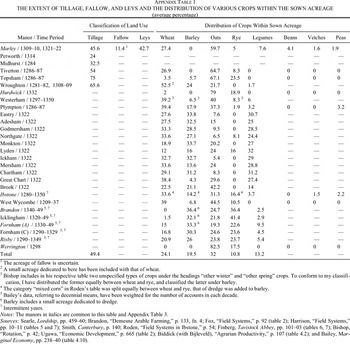
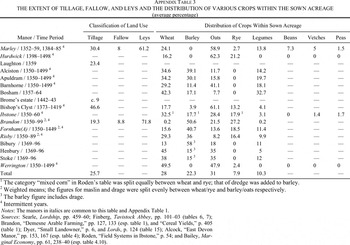
One of the first obstacles one is bound to encounter is the breakdown of land use in terms of tillage, fallow, and leys. As Appendix Table 1 indicates, demesnes that adopted flexible rotations allotted, on average, half of their acreage on sown crops. The uncertainty lies in regard to the extent of the regular fallows and, by implication, the extent of longer leys. No published data reveal the extent of fallow, although it was likely to be limited given the predominance of spring-sown crops in these manors, which allowed a half-year between crops. The only piece of information (more of speculation to be precise) comes from the manor of Marley where fallow preceded the sowing of wheat; it follows that the two acreages were roughly equal.8
Searle, Lordship, pp. 283, 459.
Assuming this principle was applied elsewhere and given the data on the land distribution of various crops (
Appendix Table 1), it can be inferred that ten acres of this fictional holding would be sown, two would lie fallow (roughly equal to the acreage under wheat which, according to the table's overall average and for Marley in particular, was about 2.5 acres), whereas the remaining eight acres would be under longer leys.
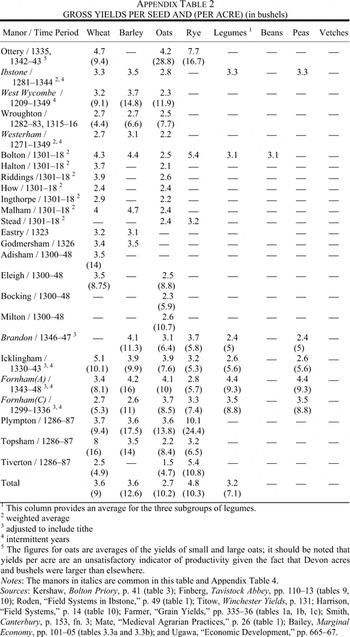
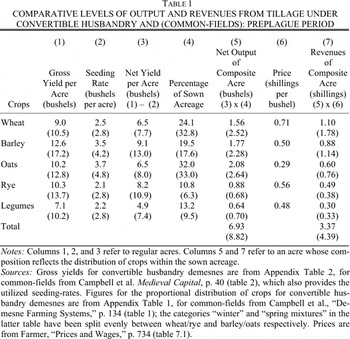
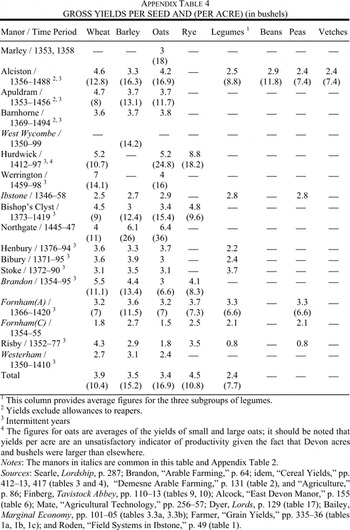
The productivity of the sown acreage in townships that adopted flexible rotations during the preplague period can be characterized as truly disappointing given both the yields per seed and per acre for all major crops summarized in Appendix Table 2. The results appear particularly striking when compared with the performance, in terms of physical output and its monetary value, of a large sample of demesnes, the majority of which practiced permanent tillage and pasture in the context of common-fields. Table 1 shows that a composite sown acre in the latter sample produced a net output that was about a third higher compared to that of a demesne adopting convertible husbandry (8.82 versus 6.93 bushels) and generating a similar revenue gap (4.39s. versus 3.37s.). These figures translate to a total revenue of 52.68s. for a common-field farm following a three-course rotation on a permanent arable acreage of 18 acres, in contrast to 33.7s from the ten sown acres of the fictional farm following convertible husbandry. These results are a far cry from Walter Blith's expectations that on a per-acre basis convertible husbandry was supposed to provide three times as much output as common-fields, and John Laurence's reports that yields in Midland farms adopting convertible husbandry around the middle of the eighteenth century exceeded 20 bushels per acre.9
Blith, English Improver, pp. 80–81; and Laurence,New System, p. 45.
It remains to be seen whether the pastoral component of the two fictional farms performed in a similar fashion. The pastoral productivity of a farm practicing convertible husbandry hinged mostly on the grass output of leys. The latter, according to Kerridge, who reflected the opinions of early modern observers, was superior to the grass output of permanent pastures; this was particularly the case in cold and clay soils which had the tendency to become water-logged, in the absence of plowing, due to poor drainage. Consequently, he reckoned that an acre of leys could provide two tons of grass per annum.10
This figure has been inferred by the stocking capacity cited by Kerridge and making the assumption that the daily ration of feed for a cow is 20 pounds of grass and 2.5 pounds for a sheep. The same assumption is made throughout this article, whenever relevant. See Kerridge, Agricultural Revolution, pp. 202–03, 211; and Kitsikopoulos, “Standards,” appendix 2, pp. 257–59.
Johann von Thunen was only slightly more optimistic placing this figure at 2.26 tons per acre.
11 Inferred from his statement that a cow grazing in leys required 1.44 acres. See von Thunen,Isolated State, p. 48. The reader should bear in mind that von Thunen uses German standards of weights and measures, which have been converted, throughout this article, to English ones.
Such estimates, however, are certainly unrealistic for medieval leys, given the fact that they were formed naturally (“tumbled down”) without the involvement of selected and superior species of seeds.
12 In a survey conducted by Caird, several farmers across the British Isles facing diverse climatic and soil conditions, were asked to comment on the productivity of such natural leys. The responses reflected very mixed opinions but one common element was that such natural leys take time to generate good quality grasses, the ground being dominated at the beginning by inferior species such as weeds and couch-grass. See Caird, “Recent Experiences.”
Unfortunately, the evidence on the grass output of pastures in townships practicing convertible husbandry is very meager. Gross hay output (inclusive of tithe) from the meadows at Bishop's Clyst was 0.52 tons per acre.13
Alcock, “East Devon Manor,” pp. 157–58, 167.
On the other hand, a stocking rate of 1.5 acres per milking cow at Breggesell field (Marley) suggests an output of 2.17 tons of grass per acre, whereas agistment rates and rents for pasture in the same manor imply an even higher output of 3.25 tons per acre (at one cow per acre).
14 Searle, Lordship, pp. 282, 458.
Finally, a statement in a Stoke account reveals that each ox or horse was expected to consume the output of two or three acres of meadow inferring an average output of 1.3 tons per acre.
15 These figures, however, cannot be taken at face value because the 75 acres of meadow at Bishop's Clyst were never plowed and the 50-acre Breggesell was probably plowed once in a generation; as for the Stoke evidence, the precise nature of this field is unclear. In the end, the evidence is not conclusive because it is not extracted from fields that were typical leys, that is, plowed on a periodic basis. For the purposes of the present estimates, the haphazard figure of 1.5 tons per acre has been adopted translating to a total output of 12 tons from the eight acres under leys.
16 In addition to grazing, part of the leys would be mowed for hay to be used during the winter months. At Marley mowed leys represented 8.55 percent of the total acreage during the preplague period, which, in terms of the model's fictional farm, translates to 1.71 acres. See Searle, Lordship, p. 459.
To this figure 0.78 tons have been added for the grass output of the two fallow acres, 1.81 tons for the output of the ten stubble acres, and 3.38 tons for the straw.
17 The calculations are presented in detail in Kitsikopoulos, “Standards,” appendix 2, pp. 257–59. It should be added that, according to von Thunen, the manure, and by implication the grass, output of fallows in the context of convertible husbandry was one-fifth that of leys. Assuming my inference regarding his estimate of the latter is correct (2.26 tons per acre), it follows that, according to him, the grass output of a fallow acre was 0.45 tons; the latter figure is very close to the one presently adopted, that is, 0.39 tons per acre. See von Thunen, Isolated State, p. 79. The calculations for the straw output have taken into account the gross yields cited in the first column of table 1.
The total amount of feed available for animals comes to 17.97 tons.
The latter figure would be sufficient to sustain three cattle and 20 sheep for a year.18
The three cattle would consume 9.77 tons (at a daily ration of 20 pounds each), whereas the remainder 8.2 tons would be given to sheep (at a daily ration of 2.5 pounds each).
The proponents of convertible husbandry had high expectations regarding the output of animal products, from milk and meat to hides and wool, emphasizing the nutritional value of young grasses in leys and the absence of weeds.
19 Kerridge, Agricultural Revolution, pp. 205–06, 209; and Stapledon, Way, p. 189.
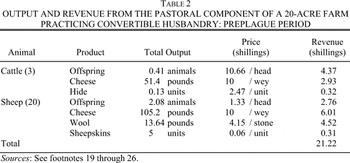
These expectations are only partially justified given the productivity of the pastoral sector summarized in
Table 2. Beginning with the cattle herd, its annual reproduction rate cannot be calculated given the absence of data on fertility and mortality rates from manors practicing convertible husbandry. The only exception is the case of Bishop's Clyst where the annual reproduction rate of its cattle herd was 13.9 percent; if this rate is adopted for the fictional farm, it translates to 0.41 new animals per year and a revenue of 4.37s.
20 Alcock, “East Devon Manor,” p. 160, table 10. The productivity of the pastoral sector has been calculated based on data from both the pre- and postplague periods. The reproduction rates that have been adopted for both cattle and sheep are higher compared to those presumed for common-field townships, as is discussed below. Despite the fact that they are based on a single township, they seem to be justified if we are willing to accept one of the arguments made by proponents of convertible husbandry. Namely, that the periodic plowing of leys removed moss and rushes from the ground as well as moles and ant-hills, which caused the formation of pools and the epidemic incidence of diseases, such as foot-rot, especially among sheep. See Kerridge, Agricultural Revolution, pp. 204–05. Kerridge's optimism has been justified by at least one modern experiment, which found five times as many nematode eggs in the droppings of lambs grazing on a permanent pasture compared to those grazing on temporary grass. See Moore, Grassland Husbandry, pp. 28–29. For the price per head, I have utilized the average price of oxen and cows (1250–1347) in Farmer, “Prices and Wages,” p. 748, table 7.4.
At 59.8 pounds per cow, the cheese output added an extra 2.93s.,
21 To extract this figure, first, we need to know the percentage of cows within the herd. Three observations from Marley, Bishop's Clyst, and Plympton provide an average figure of 28.8 percent, which translates to 0.86 cows in terms of the fictional farm. The average output of cheese per cow was based on observations from the manors of Bolton priory, Bishop's Clyst, and Tiverton, assuming that all the butter output in these manors was converted to cheese (due to the absence of prices for butter) and that butter required 60 percent more milk compared to cheese, as was the case in the Bolton manors. Finally, it was assumed that 1 wey = 14 stones and 1 stone = 12.5 pounds, as was the case in the estates of Peterborough abbey. See Searle, Lordship, p. 457; Kershaw, Bolton Priory, p. 102; Alcock, “East Devon Manor,” pp. 159, 165; Ugawa, “Economic Development,” pp. 649, 675; Biddick, Other Economy, p. 139; and Farmer, “Prices and Wages,” p. 757, table 7.6. It should be noted that the productivity of dairy products in these manors was below the expectations of Walter of Henley and the anonymous author of Husbandry but favorable compared to overall medieval standards. Another indicator of such productivity levels is the rental value of milking cows. A large national database shows that the mean value of farming out cows for their milk was 4s., reaching a mean value of 5s. 1.5d. when the right to calves was also included and up to 6s. in some exceptional cases in Norfolk. Data from certain manors of Canterbury Cathedral priory (for example, Chartham) and from Marley show that the rental value of their cows compares favorably with the aforementioned means. See Campbell, “Measuring the Commercialization,” p. 173, and “Commercial Dairy Production,” p. 113; Smith, Canterbury, p. 158; and Searle, Lordship, p. 297.
and the hides of dead cattle another 0.32s.
22 Assuming the mortality rate of the herd was 4.5 percent; see Kitsikopoulos, “Standards,” p. 241, table 2. The price per hide is an average from different types of stock; see Campbell, “Measuring the Commercialization,” p. 172, fn. 95.
Revenues from the sheep flock were superior. At an annual reproduction rate of 10.4 percent, revenues from the sale of surplus animals reached 2.76s.
23 The reproduction rate is derived, once again, from Bishop's Clyst and the price per head is an average of the prices of ewes and wethers (1250–1347). See Alcock, “East Devon Manor,” p. 160, table 11; and Farmer, “Prices and Wages,” p. 748, table 7.4.
The ewes of the flock added an impressive 105.2 pounds of cheese fetching 6.01s.;
24 It is presumed that ewes comprised 57.22 percent of the flock based on data from the manors of Bolton priory, Monkton (Canterbury), Bishop's Clyst, and Plympton. The cheese output of each ewe has been calculated on the assumption that their productivity related to that of cows in a ratio of 1:6.5. See Kershaw, Bolton Priory, p. 80, table 9; Smith, Canterbury, p. 150; Alcock, “East Devon Manor,” p. 159, table 9; Ugawa, “Economic Development,” pp. 649, 675; and Kitsikopoulos, “Standards,” p. 240, fn.10.
fleeces added another 4.52s.
25 The number of ewes in the flock has been multiplied by a fertility rate of 0.83, the average of the manors of Icklingham, Brandon, Fornham, and Plympton. The product represents the number of newborns, which is deducted from the overall flock. The remaining adult sheep (11) provided, on average, a fleece weighting 1.24 lbs based on data from Bishop's Clyst, the manors of Tavistock abbey, Brandon, Croxton, Fornham, Icklingham, and the manors of Bolton priory and Canterbury Cathedral priory. See Alcock, “East Devon Manor,” p. 165; Bailey, Marginal Economy, pp. 124–25, 127, esp. tables 3.8 and 3.9; Ugawa, “Economic Development,” p. 650; Kershaw, Bolton Priory, pp. 80–81; Smith, Canterbury, p. 153; and Farmer, “Prices and Wages,” p. 757, table 7.6. The calculations assumed that a sack of wool = 364 lbs; see Biddick, Other Economy, p. 192.
Along with the revenues of sheepskins, the total revenue from the pastoral component of the husbandry reached 21.22s.
26 For the price of sheepskins, see Campbell, “Measuring the Commercialization,” p. 172, fn. 95.
In contrast, the grass output from an equivalent farm run under the common-field system would certainly have been lower. That was particularly the case for permanent pastures because the lack of plowing did not allow either the use of lime or the efficient utilization of manure due to its exposure; exposed manure loses most of its potassium and nitrogen and some of its phosphorus.27
Thompson and Troeh, Soils, p. 230; and van Slyke, Fertilizers, p. 252.
Von Thunen argued that a cow grazing on a permanent pasture needed 2.16 acres, implying a grass output of 1.5 tons per acre; modern experiments reflect this figure very closely.
28 Von Thunen, Isolated State, p. 48. Roberts, “Effect,” pp. 89–91. Cooke, Control, p. 422; Elliott, Clifton Park, pp. 18–20; Caird, “Recent Experiences,” pp. 133, 141, 144; and Richardson, “Nitrogen Cycle,” pp. 75, 77, 118, esp. table 2.
The meager evidence on the output of medieval meadows, however, is closer to Kerridge's estimate of one ton per acre, as was the case at Kibworth and Wisbech.
29 The figure is inferred from his expectation on the stocking capacity of permanent pastures; see Kerridge, Agricultural Revolution, p. 211. The grass output and productivity of animal husbandry of a common-field farm are discussed in detail in Kitsikopoulos, “Standards,” pp. 239–41 (esp. table 2), and appendix 2, pp. 257–59. The only revision that has been made is that the present article takes into account the gross yields in the first column of Table 1 when it comes to calculating the straw output.
The six acres of fallow would add another 2.36 tons, the 12 acres of stubble would contribute 2.17 tons, and the 5.24 tons of straw would bring the total to 11.77 tons. This quantity would barely be sufficient to sustain two cattle and 13 sheep for a year, with both sorts of animals raising a total revenue of 10.91s.
30 Following the same methodology, the two cattle would provide 2.02s. from the sale of surplus animals, 1.1s. from the sale of cheese, and 0.22s. from the sale of hides. In addition, the sheep flock would augment these figures by 1.05s. from the sale of surplus animals, 2.14s. from the sale of cheese, 4.18s. from the sale of wool, and 0.2s. from the sale of sheepskins.
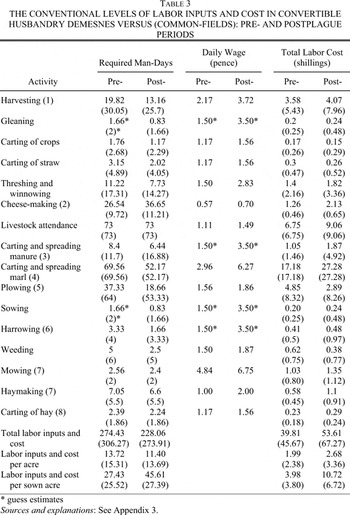
From the aforementioned revenues forthcoming from the two systems of cultivation, deductions have to be made for the cost of labor and capital inputs. A revision of methodology is warranted at this point. The estimates presented so far regarding the productivity of arable and pastoral sectors took into account separate data from demesnes practicing either system of cultivation. This method makes sense because this is precisely what we attempt to discover, namely, productivity differences. However, taking into account separate data for labor and capital costs would distort the purpose of the exercise because such differences would not be a reflection of efficiency standards but of local particularities in labor and capital markets and, most importantly, seigniorial prerogatives (for example, the degree of access to week-work). Hence, it is deemed warranted to use the same figures for both systems reflecting national averages. Based on the calculations of Table 3, constructed under the assumption that only wage labor was used, labor inputs was by far the most prominent component of cost, especially for the common-field farm given its greater emphasis on tillage.31
Labor inputs per sown acre have been estimated for Rimpton (1209–1349) at 17.19 man-days. This figure is far below the ideal labor inputs presented in Table 3 even accounting for the fact that Thornton does not take into account boon-works, piece workers, and labor participating in animal husbandry; see Thornton, “Determinants,” pp. 204–05, table 7.7. In terms of labor cost per sown acre, the figure presented in Table 3 for a fictional farm under convertible husbandry is higher compared to the actual figures calculated for Marley (3.3s.) and the manors of Bolton priory at 1.74s. (1301–1312, 1314–1325, a period during which the sown acreage varied depending on the farming out of individual manors). See Searle, Lordship, p. 461; and Kershaw, Bolton Priory, pp. 35–37, 49, 58. The overall results confirm Elliot's belief that, on a per farm basis, labor inputs under convertible husbandry were lower compared to common-field farms, although the validity of this hypothesis depends on the intensity of tillage in either case; see Elliot, Clifton Park, p. 131.
In contrast, spending on capital formation was relatively minor.
32 The model's figures understate the level of capital spending because the quantity of grains used for seed was previously deducted without attributing to it a monetary value.
For a common-field farm,
33 The following figures, with minor adjustments, are from Kitsikopoulos, “Standards,” pp. 245–48.
it involved the maintenance of barns and sheepcotes (0.75s), the replacement of utensils and furnishings, especially in the cheese-making process (0.41s.),
34 It mainly involved the use of presses, canvas, churns, tins, spoons, tables, vats, stoups, and other items. See Smith, Canterbury, p. 161; and Campbell, “Commercial Dairy Production,” p. 112.
along with the purchase of salt (0.04s.),
35 One pound of salt was needed per ten pounds of cheese translating to 15.66 lbs of salt for the farm run under convertible husbandry, and 5.74 lbs for the one in common-fields. The price per quarter was 3s. (1250–1347), and the quarter is assumed to have been 365 pounds. See Farmer, “Prices and Wages,” p. 757, table 7.6; and Newman and Harvey, “Medieval Soil Fertility,” p. 125.
and the maintenance of the plow (0.5s), implements (0.56s.), and the cart (1.83s.). Capital cost for the holding under convertible would have been marginally lower.
36 Capital cost in this case has been adjusted proportionately to the previous estimates based on the intensity capital goods would be used in each activity following the figures of the first column in Table 3.
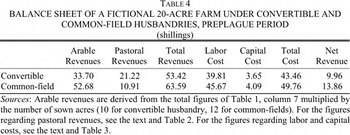
Table 4 summarizes the revenues of the two fictional farms and deducts the necessary expenses. Total operating cost in both cases, in conjunction with gross revenues, were such that profitability under a common-field regime was somewhat higher compared to a farm practicing some form of convertible husbandry, thus begging an explanation for the discrepancy between its perceived theoretical merits and the evidence of the preplague period.37
Total operating cost would have been lower, albeit not significantly, in farms of larger size due to modest economies of scale. For instance, a shepherd or cowherd could watch out for a much larger number of animals (up to a few hundred), whereas the ratio of plows to arable acres was much higher compared to the one presumed here; for instance, in the estates of Peterborough abbey there was one plow for every 31.2 arable acres, on average; see Biddick,Other Economy, p. 40. The calculation of operating costs regarding different estates is a very difficult and time-consuming process. One exception is the case of the Tavistock abbey manors, particularly at Hurdwick, whose operating cost per sown acre was 2.77s. in 1332. This figure is much lower compared to the stylized estimates presented here, particularly given the fact that the Hurdwick figure is inflated by the inclusion of wages for administrative staff (for instance, the bailiff), as well as expenses for the replacement of livestock and the purchase of seed, expenses which are not included in my calculations; see Finberg, Tavistock Abbey, pp. 102, 244 (tables 7, 16). A brief synthesis of total production costs is also presented in Campbell, English Seigniorial Agriculture, pp. 356–63.
Before any explanations are forwarded, however, this stylized comparison will be extended to the postplague period.
THE POSTPLAGUE PERIOD
The practice of convertible husbandry during the postplague period retained a certain degree of continuity with the past, particularly in regard to the distribution of crops within the sown acreage whose proportion remained fairly stable. At the same time, however, the size of tillage went through a radical decline, shrinking to half of what it used to be (see Appendix Table 3), that is, to five acres in terms of the fictional farm. The greatest uncertainty, once again, refers to the extent of fallows and longer leys. The figures for fallow from Marley and Brandon suggest a slight decline, bringing the figure down to 1.6 acres. Nevertheless, additional circumstantial evidence points to a more pronounced decline, closer to one acre in terms of the fictional farm; the remaining 14 acres were occupied by leys.38
There were 22 fallow acres at Alciston in the early 1380s. It is not clear what percentage of the demesne's total acreage it represented because the latter figure is not disclosed; but if it was between 550 and 600 acres, as was the case in the 1430s, then the 22 fallow acres represent 4 percent of the total. A similar puzzle applies to Bosham. Its fallow was also 22 acres during the period 1357–1364 but the total acreage of the demesne is not known; if it was about 1,100 acres, as was the case in the 1290s, it follows that the extent of the fallow was only 2 percent. These figures cannot support solid conclusions because they refer only to the main arable fields of these two townships and not to fields tilled more intermittently, although fallow in the latter would have been unnecessary. Nevertheless, the evidence is not limited to Sussex. In certain east Devon manors (for example, Bishop's Clyst, Tiverton, and Topsham), bare fallowing was “unusual,” according to Fox. See Fox, “Field systems,” p. 93; Brandon, “Arable Farming,” pp. 63–64, 67, and “Demesne Arable Farming,” pp. 126–27 (esp. table 1). To this evidence we should add the custom of Marley's officials of preceding wheat with fallow, as was noted for the preplague period. Following the figures in Appendix Table 3, wheat would have occupied 1.4 acres (5 x 28 percent) in terms of the model's fictional farm.
But the most dramatic development of the postplague period appears to be the improvement of yields in demesnes practicing various forms of convertible husbandry in regard to all types of crops, particularly of oats (see Appendix Table 4).39
It has to be stressed, however, that only six manors are present both in Appendix Tables 2 and 4, that is, West Wycombe, Ibstone, Brandon, Fornham (A), Fornham (C), and Westerham. Yields per acre in these manors do not present any discernible trend, in either direction. Nevertheless, notwithstanding the limitations of the sample, it is not unreasonable to expect that overall yields among manors practicing convertible husbandry increased due to reasons discussed in the next section.
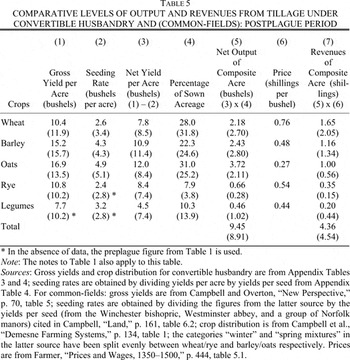
The physical volume of output produced by a composite acre (
Table 5) reached, and slightly exceeded, the output from an equivalent acre in common-fields because yields in the latter remained, on balance, static.
40 Total revenue from the composite acre in common-fields (last column of Table 5) was slightly higher compared to that of convertible husbandry, despite its lower physical output, because the acreage dedicated to (the more expensive) wheat and its yield were superior to those in convertible husbandry demesnes; the same assertion applies also to legumes.
Consequently, total revenues from the five sown acres in convertible husbandry reached 21.8s, whereas those in common-fields were 45.4s.
41 I have reduced the number of sown acres in the common-field holding from 12 to ten in order to reflect the actual developments that took place during the postplague period. The decline was actually higher than I allow, namely 21 percent translating to 9.4 sown acres, but I have raised it to ten acres to retain the stylistic symmetry of a three-course rotation. See Campbell et al., “Demesne Farming Systems,” p. 134 (table 1); based on this table, the mean sown acreage per demesne declined from 193.1 acres (1250–1349) to 151.7 acres (1350–1445). In terms of the fictional common-field farm, ten acres would be under crops, five acres fallow, and the remaining five would revert to permanent pastures and meadows.
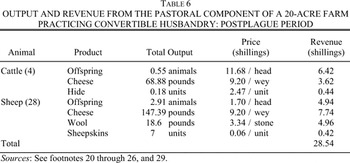
The pastoral component of the two fictional farms was bound to be more prominent with the retrieval of tillage. Assuming the productivity of the various fields remained the same in terms of animal fodder, the holding under convertible would provide a total of 24.4 tons of grass, capable of sustaining four cattle and 28 sheep.42
The 14 acres of leys would provide 21 tons, the fallow acre 0.39 tons, the five stubble acres 0.9 tons, and the straw would contribute another 2.16 tons. The bulk of leys would be grazed but a small acreage would be utilized for hay. Using the evidence from Marley, as in the preplague period, 8 percent of the total acreage would be under mowed leys, translating to 1.6 acres in terms of the fictional holding. See Searle, Lordship, p. 459.
summarizes the output and revenues forthcoming from the various types of animal products.
43 The same data have been adjusted to the larger size of herds and flocks presently assumed for the postplague period. For the prices of livestock and animal products, see Farmer, “Prices and Wages, 1350–1500,” pp. 457, 467 (tables 5.4, 5.7); for the price of cattle I have used the average of oxen and cows from the former table. Regarding the prices of hides and sheepskins, I have used the same as in the preplague period based on a limited sample from McIntosh, Autonomy, pp. 154–55.
In contrast, the grass output of the common-field holding was only 13.09 tons, equally divided for the sustenance of two cattle and 16 sheep, both types of animals generating a revenue of 11.89s.
44 This figure is based on the same method used to calculate the respective preplague figure; for relevant sources, see footnote 29. Regarding the straw output (4.34 tons), the gross yields of Table 5 have been utilized.
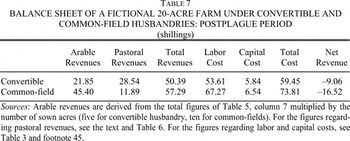
In the end, the revenue-generating capacity of the common-field farm appears to have been higher (57.29s) compared to that under convertible husbandry (50.39s.) when both types of husbandry are considered. Nevertheless, these figures were not sufficient in generating a profit given the enormous increase of labor (see Table 3) and, to a lesser extent, capital costs.45
Capital costs have been adjusted 60 percent upwards compared to preplague levels based on the increase in the price of iron, the main material for the maintenance of plows, implements, and carts. See Hatcher, Rural Economy, p. 144; Farmer, “Prices and Wages, 1350–1500,” pp. 466–67; Howell, Land, p. 167; and Miskimin, Early Renaissance Europe, p. 89. The prices of other components of capital cost increased in a similar fashion, such as the price of salt (65 percent) and the wages of carpenters (63 percent). See Farmer, “Prices and Wages,” pp. 757, 768 (tables 7.6 and 7.7), and “Prices and Wages, 1350–1500,” pp. 467, 471 (tables 5.7 and 5.8). My figures for capital cost would have been more accurate if they were adjusted for changes in the intensities of the two types of husbandry and, therefore, of depreciation rates. On the other hand, the methodology would have provided figures very similar to the ones presently adopted because the lower rate of intensity for some capital goods was counterbalanced by the higher rate of intensity in terms of others.
Nevertheless, the results (summarized in Table 7) ought not to be taken at face value because of the assumption made earlier that the entire labor bill was financed through the payment of wages; as noted, this assumption comes at the expense of realism, given the demesnes' access to labor services, but the latter reflect seigniorial prerogatives, not efficiency standards. Furthermore, the results are based on idealized labor inputs, including marling, which was by far the most expensive activity. In reality, marling was substituted in certain localities by other activities at a much lower cost.46
The cost of beat-burning per acre, for instance, in several Tavistock abbey manors averaged 36.16d. during the postplague period (20.6d. earlier). Even if beat-burning was supplemented by sanding, as was the local practice, the cost would still have been modest. Data from Werrington manor (fifteenth century) reveal that the dressing rate was about 400 pounds (1.4 horse loads) per arable acre at a cost of 1d., whereas at Hurdwick during the same period the dressing rate was about 500 pounds per sown acre at 1.2d. See Finberg, Tavistock Abbey, pp. 90–91, 93, 101–03.
It is true that in the absence of such alternatives, marling and other expensive activities would have had either to be eliminated or drastically curtailed.
47 For instance, there is evidence for marling at Barnhorne during the postplague period but the references are very sporadic, in contrast to the preplague period when the practice seems to have been far more systematic, both at Barnhorne and elsewhere in Sussex. Instead of marling, the application of oozy ditch sludge became more common. Similarly, fallow plowing at Bibury did not reach the established standard of being performed twice, manuring at Henbury and Stoke covered only a small area, whereas marling is not mentioned at all in the accounts of these manors. See Brandon, “Demesne Arable Farming,” p. 134, and “Agriculture,” pp. 77–78; and Dyer, Lords, pp. 126–28.
Data on the actual labor and operating costs from several demesnes were far lower compared to the idealized figures of
Tables 3 and
7, pointing towards a drastic reduction in investment spending.
48 For instance, labor cost per sown acre at Marley (1352–1359, 1384–1385) was only 3.9s., whereas total operating cost per sown acre at Hurdwick and Bishop's Clyst averaged 5.72s. and 3.7s. respectively. See Searle, Lordship, p. 461; Finberg, Tavistock Abbey, pp. 102–03, 244–47 (tables 7, 16); and Alcock, “East Devon Manor,” p. 154 (table 5).
In years of favorable market conditions, these adjustments may have generated a profit;
49 As was the case at Bibury in 1371–1372, a year of high grain prices. See Dyer, Lords, pp. 132–33, 139–40.
but, by and large, cost constraints were so severe that they dealt a fatal blow to the direct management of demesnes.
50 Rising wages were the main reason behind the shrinkage of profits, which led the monks to cease production at Marley by the 1380s and lease out the demesne. See Searle, Lordship, pp. 257–59, 337.
Demesnes that were well endowed with customary labor services may have been more resistant to these pressures.
51 Labor inputs per sown acre at Rimpton declined only slightly (1350–1403) compared to the preplague period, down to 15.86 man-days. See Thornton, “Determinants,” p. 205 (table 7.7).
On the other hand, the vast majority of the demesnes following convertible husbandry traditionally relied heavily on wage labor. Therefore, ingenuity and flexibility in terms of managerial practices were far more imperative.
52 Examples of demesnes cultivated mainly by wage labor were those of Alciston, Marley, Ibstone, Bishop's Clyst, and those of Bolton priory and Tavistock abbey. By and large, there was no week-work in these demesnes, just boon-works mainly for activities such as plowing, harrowing, reaping, carting, and weeding. These manors had limited access to labor services even before the plague and, furthermore, much of those were commuted by the beginning of the fourteenth century, as was the case at Ibstone and Marley; commutation at Marley was initiated based on the results of a study commissioned by the monks showing that the value of the food provided to customary workers was higher compared to prevailing wages of hired workers. See Brandon, “Arable Farming,” p. 62; Searle, Lordship, pp. 167, 175–78, 180, 269; Kershaw, Bolton Priory, pp. 47, 49, 52; Finberg, Tavistock Abbey, pp. 81–83; Roden, “Field Systems in Ibstone,” pp. 43–44; and Alcock, “East Devon Manor,” pp. 172–73.
Such qualities were seemingly forthcoming in light of the drastic reduction of the sown acreage, which led to a substantial increase of crop yields and a slower increase of labor cost per acre compared to common-field demesnes (based on the figures of
Table 3). As a result, demesnes following convertible husbandry could either minimize their losses or, if we substitute marling with cheaper alternatives, generate a higher profit compared to common-field demesnes, in contrast to the preplague period.
EXPLANATIONS AND CONCLUSION
The results of the last two sections testify to the low and static level of arable productivity of common-fields. As long as relative prices in product and factor markets remained favorable during the preplague period, this form of husbandry was able to sustain its viability; the changing circumstances, however, after the epidemic delivered a fatal blow to its profitability functioning as the leading cause of the massive leasing of demesnes that took place at that time. The causes of the poor performance of common-fields cannot be explored independently but some partial explanations can be provided in conjunction with the question of the equally poor performance of convertible husbandry, both during the Middle Ages and in relation to the productivity of its early modern counterpart, despite its theoretical merits.
The examination of the evidence suggests three plausible explanations. The first one refers to the role played by the particular edaphic conditions (that is, relating to soil, rather than climate) of manors practicing convertible husbandry. Its significance will be exposed through a discussion of the nitrogen cycle.53
The role of nitrogen cycle in determining medieval grain yields has inspired a few studies, which ended up with inconclusive results; see Cooter, “Ecological Dimensions”; Loomis, “Ecological Dimensions”; and Newman and Harvey, “Medieval Soil Fertility.”
In light of the nitrogen's importance in determining agrarian productivity,
54 According to an experiment, approximately 80 percent of the variations in wheat yields can be accounted by variations in soil N status; see Williams et al., “Soil.”
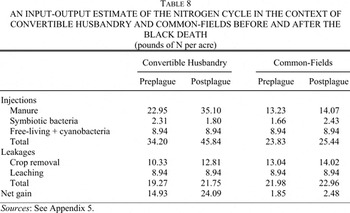
Appendix 5 presents an analytical account of the injections-leakages of nitrogen in the context of the two systems of cultivation and under the assumption of identical edaphic conditions. The results are summarized in
Table 8 and are directly related to data from the first two sections of the article.
The net balance in terms of nitrogen intake presents some interesting results. The balance regarding the common-field holding is barely positive both before and after the epidemic, thereby explaining the mediocre and static level of yields. Furthermore, if it is necessary to add 4.5 pounds of N in order to get an extra bushel of grains, then yields ought to have increased between the two periods by 0.14 bushels;55
Shiel believes that when the soil is deficient in N, there is an almost linear response of grain yields to N increases and that for every extra pound of N in the soil, grain yields increase by 15 pounds; assuming an average of 50 pounds per bushel, 3.33 pounds of N are needed to produce an extra bushel. Clark, on the other hand, assumes that 5.7 lbs of N are required to produce an extra bushel of wheat. I have adopted the compromising figure of 4.5 pounds of N per bushel of grain. See Shiel, “Improving Soil Productivity,” pp. 58–59; and Clark, “Economics,” p. 65.
in reality, the composite acre (
Tables 1 and
5) in the common-field holding increased its output by 0.09 bushels, a figure close enough to highlight the importance of nitrogen.
Table 8 reveals also the main reason behind these disappointing results. Manure, the most essential source of N, had a very modest contribution.
56 Dividing the total quantities of manure (estimated in Appendix 5) by 18 and 15 produces a ratio of 0.92 and 1.18 tons of manure per arable acre before and after the epidemic respectively. These figures are well below the two tons of manure per acre recommended by van Slyke; see his Fertilizers, pp. 250, 391.
Nitrogen also emerges as a powerful explanatory factor behind the behavior of yields, from a temporal perspective, in the context of convertible husbandry. The marginal increase of N between the two periods (9.16 pounds) would be sufficient to increase yields by 2.03 bushels,57
Again, assuming that an addition of 4.5 pounds of N produces an extra bushel of grains.
which covers 80 percent of the actual increase of yields in the composite acre of this farm (2.52 bushels), a percentage that conforms to the expectations of the experiment conducted by Williams et al.
58 There is, however, a striking aspect in these results, which seems to contradict the standard theory of the nitrogen cycle. The net gain of N in the context of convertible husbandry was far higher compared to that of common-fields, due largely to the greater quantity and more efficient utilization of manure.59
Dividing the total quantity of manure (estimated in Appendix 5) by 20 results in 1.6 and 2.45 tons per arable acre for the two periods respectively.
Nevertheless, the level of grain yields in this fictional farm was below those in common-fields during the preplague period and only slightly higher after the epidemic. How are we to explain the high nitrogen amounts coupled with the poor yields in the context of convertible husbandry?
To do so, we have to relax the assumption of identical edaphic conditions on which the calculations of Table 8 are based and look at the actual record. A thorough review of the published sources that make references to such conditions reveals that with the exception of few manors located either in fertile loams (for example, Alciston, West Wycombe), or heavy clays (for example, Marley), the majority of the remaining ones were on light soils, that is, consisting of sand or mixtures of sand and gravel (for example, Ibstone, Bishop's Clyst, Felbrigg, Taverham, Brandon, Havering, Barnhorne, Bibury, Icklingham).60
Roden, “Field Systems in Ibstone,” p. 48; Alcock, “East Devon Manor,” p. 141; Campbell et al., “Demesne Farming Systems,” pp. 158, 169 (fn. 102); Finberg, Tavistock Abbey, p. 88; McIntosh, Autonomy, pp. 7, 138–39; Brandon, “Agriculture,” p. 71, “Arable Farming,” p. 64, and “Demesne Arable Farming,” pp. 115–16; Biddick (with Bijleveld), “Agrarian Productivity,” p. 105; Dyer, Lords, p. 23; Campbell, “Land,” p. 176, and English Seigniorial Agriculture, pp. 268, 295; and Bailey, Marginal Economy, p. 31. In contrast to this group of manors, Campbell and his associates have documented that almost three-quarters of the manors comprising their database of the London region were located on loamy or silty soils of various degrees of heaviness which tend to be, by and large, more conducive to productive tillage; see their Medieval Capital, p. 22.
Sandy soils have large pore spaces and thus crumbs formed by cultivation are not water-stable, resulting in “the ground after a wheaten crop being too loose.”
61 Lisle, Observations, p. 31.
Excessive leaching and nutrient deficiency, evident in low contents of organic matter and N, are perennial problems of such soils. The growth of ley grasses and the systematic application of manure were the only remedies towards forming stable aggregates in such soils, rendering them compact, and improving their water-holding capacity.
62 Thompson and Troeh, Soils, pp. 4, 48, 101, 130, 428; van Slyke, Fertilizers, pp. 96–97, 338; Cooke, Control, pp. 3, 442; Elliott, Clifton Park, pp. 205–07; Williams, “Leys,” pp. 192–93; and Richardson, “Nitrogen Cycle,” p. 116.
Therefore, it is very likely, if not certain, that the amount of nitrogen loss due to leaching was much higher compared to the uniform rate adopted in the present calculations (8.94 pounds per arable acre). In other words, manors practicing convertible husbandry on such soils had to generate far higher amounts of N just to bring their yields in line with those of common-field manors, which were spread all over the country and thus had access to better quality soils, on average.
63 A review of the yields in Appendix Tables 2 and 4 reveals a strong correlation between manors located on thin soils and yields at or below average (for example, Ibstone, Bishop's Clyst, Barnhorne, Bibury, and Brandon).
Compounding the problem of poor edaphic conditions, particularly during the preplague period, there was a wrongful practice in terms of managing the system, namely, the excessive size of tillage at the expense of leys. Greg Clark has provided a formula that purports to calculate the optimal share of grains in a farm that also utilizes pasture leys; he estimates that this share ought to be 55 percent. Clark's figure is at odds both with the calculations of the present study,64
Clark makes two crucial assumptions, namely, that each acre under grass can fix 98 pounds of N, and that the total quantity of N produced by grass is utilized without waste by the grain sector. The calculations provided in Appendix 5 provide a far more conservative picture regarding the transfer of N from leys to crops, especially when the assumption of zero waste is dropped, as Clark would readily admit. The main source of such N transfers would be the quantity of manure produced by the grazed leys and the mown hay. This amount of manure was 23.64 and 44.6 tons during the pre- and postplague periods respectively. Multiplied by the quantity of N provided by each ton (14.28 lbs) and then dividing the product by the number of acres under leys in each period (eight and 14 respectively) results in 42.19 (preplague) and 45.49 pounds (postplague) of N per acre of leys being injected to the cropped area, far lower than Clark's figure. See Clark, “Economics,” pp. 65–66, and “Labour Productivity,” pp. 214–17.
and the opinions of various agricultural writers.
65 Blith, English Improver, pp. 132–33; Stapledon, Way, p. 184; Lisle, Observations, pp. 30–31; Kerridge, Agricultural Revolution, p. 201; and Stapledon and Davies, Ley Farming, p. 14.
George Stapledon was adamant in urging that under no circumstances leys ought to occupy less than one-third of a farm's area, whereas Blith placed the size distribution ratio of tillage to leys at 1:2, and Edward Lisle at 1:5 referring to light soils. The rationale of those writers was that leys ought to play a prominent role in the rotation; not so prominent as to acquire the characteristics of permanent pastures, but also not as trivial as to allow excessive tillage that would have affected the recovering speed and quality of the following swards. Practitioners of the system during the early modern and modern periods would often allocate equal parts to the two uses of land,
66 Crutchley, for instance, reports that the usual rotation in Rutland at his time was four crops followed by four years of leys; in Northumberland three crops were followed by two-year leys, and a similar practice was found in the richer lands of Norfolk during the time of Arthur Young. See Kerridge, Agricultural Revolution, p. 197; Crutchley, General view, p. 10; MacDonald, “Agricultural Responses,” p. 63; and Stewart and Fussell, “Alternate Husbandry,” p. 216.
but in numerous other cases leys were more prominent, being closer to Blith's recommended ratio.
67 For instance, in the poor, sandy soils of Suffolk and Lincolnshire during Young's time, two crops were followed by up to four years of leys in the former and up to seven in the latter. In late-sixteenth-century Cornwall the usual practice was to crop for four years and then allow grasses to grow for at least seven to eight years, whereas the distribution of land uses at nearby Hurdwick during the same time were: tillage (26 percent), fallow (11 percent), leys (63 percent). See Finberg, Tavistock Abbey, p. 106; Hatcher, Rural Economy, p. 12, fn. 2; and Stewart and Fussell, “Alternate Husbandry,” pp. 216–17.
Given the absence of selective seeding and clover, and the practice of the system on largely light soils during the Middle Ages, it follows that manorial officials ought not to have deviated much from Blith's ratio at any given time, that is, having leys occupying at least double the area compared to the one of tillage. The failure of manorial officials to conform to this yardstick?not necessarily because of ignorance but because of the growing demographic pressure?most certainly played a role in bringing yields down to an abysmally low level during the preplague period. Furthermore, it was precisely the reduction in the size of tillage during the postplague decades that can be credited for the recovery of yields.
68 For instance, a 50-percent reduction of the area under cultivation at Brandon between the years 1340 and 1390 raised aggregate productivity by 45 percent, and a similar development took place at Taverham; see Campbell, English Seigniorial Agriculture, pp. 378–79.
Poor edaphic conditions and wrongful managerial practices played a critical role in explaining the improved, albeit still low, level of yields under a convertible husbandry regime. In fact, the net gain figures for nitrogen from Table 8 allow us to speculate that, in a counterfactual scenario (that is, if convertible husbandry was practiced on soils comparable to those of common-field manors), the productivity of the former system could have surpassed the one of the latter by achieving yields in the range of 10 to 15 bushels per composite acre. Nevertheless, even those yield levels would have fallen very short of the expectations of early modern writers. The answer to this puzzle is very simple: the convertible husbandry celebrated by Kerridge and earlier writers was not the same system practiced during the Middle Ages. The missing element in the latter period was fodder legumes such as clover and lucerne.69
The adoption of clover, for instance, in European agriculture dates from the mid-seventeenth century. Fodder legumes contribute N not only through their roots and residues that remain in the soil after grazing, but also through their tops eaten by animals and then turned to dung. In contrast, pulses (peas, beans, and vetches), if not used for livestock feed, benefit cereal yields only through the N of their roots. See Grigg, Dynamics, pp. 76–77, 183.
We know virtually nothing regarding the botanical composition of medieval leys but this ignorance is immaterial because, in the absence of fodder legumes, different species of grasses contribute pretty much the same amount of N,70
Different grasses, however, have been found to affect subsequent wheat yields indirectly by harboring pathogens in various degrees. Red fescue and Agrostis are the worst in this regard, followed by perennial ryegrass, whereas cocksfoot, timothy, and meadow and tall fescue are largely free of them; see Williams, “Leys,” pp. 190–91, 193.
namely, 49.26 pounds of N per acre (see Appendix 5).
71 Calculated by multiplying the amount of grass per acre of leys (1.5 tons) by a factor of 2.3 to get the quantity of manure (3.45 tons), a conversion rate adopted by von Thunen; see his Isolated State, p. 42. Assuming manure was deposited fully on the leys (no winter feed was taken), it provided 49.26 pounds of N (3.45 x 14.28, the latter figure being the quantity of N per ton of manure; see Appendix 5). The amount of N remaining in the roots of the grasses is trivial because most of the N is transferred at the top, which is eaten by animals; see Cooke, Control, p. 387.
On the other hand, fodder legumes have a much higher nitrogen-fixing capacity, although the precise quantitative extent is difficult to specify, given a variety of opinions.
72 Grigg, for instance, cites 450.73 and 265.16 pounds as being the nitrogen-fixing capacities of lucerne and clover respectively. These figures do not seem to be indicative of the standards of premodern agriculture, given the fact that Grigg places the yield of cereals at 19.31 bushels per acre when legumes are entirely absent. Clark reduces the nitrogen-fixing capacity of clover to 150 pounds per acre but this figure seems also to be inappropriate, given the fact that it refers to modern conditions, as Clark admits. See Grigg, Dynamics, p. 77, table 7; and Clark, “Economics,” pp. 64–65.
The most appropriate figures, for premodern standards, seem to be the ones quoted by Louis Thompson and Frederick Troeh, namely 134.14 pounds for lucerne, and 93.9 pounds for clover.
73 Thompson and Troeh, Soils, p. 252, table 10-4. I have chosen these figures, being the most conservative in the existing literature, and despite the fact that they also refer to modern standards, because fodder legumes went through a process of developing different, more efficient varieties over the centuries, which were not present during the period of Kerridge's “agricultural revolution.” See, Kerridge, Agricultural Revolution, p. 201; and Williams, “Leys,” pp. 189–90.
These figures imply that lucerne produced a marginal increase of N, over all-grass leys, reaching 84.88 pounds per acre, capable of increasing cereal yields by an extra 18.86 bushels. The marginal increase of N with clover would have been 44.64 pounds producing an extra 9.92 bushels of cereals.
74 Adding the marginal increases of cereal yields, due to fodder legumes, to the actual cereal yields achieved in the context of convertible husbandry during the Middle Ages results in precisely the kind of yields expected by early modern writers from convertible husbandry.
Searle, referring to the modern period, noted that “the selection and cultivation of certain grasses was not the essence of ley farming, but a refinement.”75
Searle, Lordship, p. 282, fn. 31.
That may be true. On the other hand, the introduction of fodder legumes during the early modern period was a step of paramount importance, which rendered the system of ley farming qualitatively distinct from the one practiced in the Middle Ages.
Appendix 1: The Regional Distribution of Demesnes Practicing Various Forms of Convertible Husbandry
Buckinghamshire: Halton, Ibstone, Risborough, West Wycombe.
Devon: Bishop's Clyst, Botelet, Bovey Tracey, Burrington, Cargoll, Halton, Hurdwick, Ottery, Payhembury, Plympton, Sampford Courtenay, South Pool, Tiverton, Topsham, Trelawne, Werrington, Whalesborough.
Essex: Bocking, Borley, Hadleigh, Havering, Lalling, Mersey, Milton. Gloucestershire: Bibury, Henbury, Stoke.
Kent: Adesham, Agney, Appledore, Barksore, Barton (Northgate), Brambling, Brokesend, Brook, Chartham, Cliffe, East Farleigh, Eastry, Ebony, Godmersham, Great Chart, Hollingbourne, Ickham, Knowldon, Little Chart, Loose, Lyden, Meopham, Mersham, Monkton, Orpington, Westcliff, Westerham, West Farleigh, Westwell.
Lancashire: Aigburth, Bolton-le-Sands, Harwood, Little Crosby, Worston. Norfolk: Ashill, Bircham, Croxton, Deopham, Felbrigg, Feltwell, Martham, Sedgeford, Taverham, Thornage.
Oxfordshire: Britwell, Newington. Suffolk: Barnham, Brandon, Culford, Fornham(A), Fornham(C), Icklingham, Monks Eleigh, Risby.
Surrey: Merstham, Walworth. Sussex: Alciston, Apuldram, Barnhorne, Berkham, Bosham, Caldecote, Chalvington, Fletmarsh, Furneys, Hamsey, Laughton, Marley, Midhurst, Petworth, Ripe, Selsey, Wellonde.
Warwickshire: Alveston, Baddesley (Brome family), Bishops Tachbrook, Budbrooke, Hampton Lucy.
Wiltshire: Wroughton.
Yorkshire: Appletreewick, Bolton, Cononley, Halton, Holmpton, How, Ingthorpe, Kildwick, Malham, Riddings, Ryther, Stead.
The evidence for the presence of the system in a particular manor can be either direct in the form of: 1. Reconstruction of cropping practices on individual land units from a series of consecutive accounts. 2. Terminological distinctions such as terra warrecta vs. terra frisca(that is, regular fallow vs. leys). Indirect or circumstantial evidence includes: 1. Substantial annual variations in the size of the sown acreage. 2. Substantial profits from the sale of pasture rights to tenants, despite the absence of extensive permanent pastures, a fact implying the presence of leys. 3. The practice of beat-burning when land was turned from leys to cropping.
Sources: Searle, Lordship, pp. 272, 274–77, 280–83; Brandon, “Arable Farming,” pp. 62–68, “Demesne Arable Farming,” pp. 128, 132–34, and “Agriculture,” pp. 72–76; Fox, “Field Systems,” pp. 93, 99–100, and “Farming Practice,” pp. 309–10, 312; Finberg, Tavistock Abbey, pp. 105–06; Ugawa, “Economic Development,” p. 632; Alcock, “East Devon Manor,” pp. 167–68; Hatcher, Rural Economy, pp. 11–12; Harrison, “Field Systems,” pp. 7–9; Roden, “Field Systems in Ibstone,” pp. 46, 49–51, 53, and “Field Systems of the Chiltern Hills,” p. 336; McIntosh, Autonomy, p. 140; Bishop, “Rotation,” pp. 39–42; Baker, “Field Systems,” p. 417; Mate, “Agricultural Technology,” p. 256, and “Medieval Agrarian Practices,” pp. 29–30; Campbell et al., “Demesne Farming Systems,” p. 159; Bailey, Marginal Economy, pp. 60–64, 113, 208, 236–37; Postgate, “Field Systems of Breckland,” pp. 91–92, and “Field Systems of East Anglia,” p. 301; Campbell, English Seigniorial Agriculture, pp. 268–69, 294–99, 344, 376; Dyer, Lords, pp. 68–69, 125–27, Warwickshire Farming, pp. 11–14, and “Small Landowner,” p. 6; Kershaw, Bolton Priory, pp. 31–32, 66; Youd, “Common Fields,” pp. 23, 27, 34; and Miller, “Farming,” p. 10.
Appendix 2: The Distribution of Various Land Uses and the Productivity of Tillage in Demesnes Practicing Convertible Husbandry during the Preplague Period
Appendix 3: Sources and Explanations on Wages and Labor Inputs
Sources on wages: The only comprehensive figures on medieval wages have been provided by David Farmer regarding threshers, reapers, and mowers. His figures on threshing have been divided by three, assuming one individual would thresh one quarter of mixed grains per day. His figures on reaping have been divided by 2.5, that is, the number of man-days needed to reap one acre. See Farmer, “Prices and Wages,” p. 768 (table 7.7) for the period 1250–1347, and “Prices and Wages, 1350–1500,” p. 471 (table 5.8). Regarding the wage of marlers, the monetary cost of marling per acre has been calculated from a sample of manors by taking an arithmetical average and then dividing by the number of man-days needed to perform the task at the manor of Chalvington (1347). See Searle, Lordship, p. 291; Smith, Canterbury, pp. 136–37; Mate, “Medieval Agrarian Practices,” p. 23; Hallam, “Farming Techniques: Eastern England,” pp. 285–86, and “Farming Techniques: Southern England,” pp. 347–48; Brandon, “Farming Techniques,” p. 314, and “Demesne Arable Farming,” p. 134; and Campbell, English Seigniorial Agriculture, p. 360. The wage of the plowman was estimated by taking the annual wage, estimated by Thorold Rogers, and dividing by 270 (that is, excluding Sundays and holidays); cited in Searle, Lordship, p. 308, fn. 9; see also Kitsikopoulos, “Standards,” p. 256. The same procedure was followed for the wages of haymakers, weeders, dairymaids, carters, cowmen/shepherds by taking an arithmetical average from figures (of both famuli and per diem workers) referring to a number of manors cited in the following sources: Stone, “Productivity,” pp. 647, 653; Dyer, Warwickshire Farming, p. 15; Farmer, “Prices and Wages, 1350–1500,” pp. 480–82; Page,Crowland Abbey, pp. 315–16; Ugawa, “Economic Development,” pp. 670–73; Searle, Lordship, pp. 305, 308; Kershaw, Bolton Priory, pp. 55–56. Finally, in the absence of reliable data, a daily wage of 1.5d. and 3.5d. has been assigned for the pre- and postplague periods respectively regarding gleaners, carters/spreaders of manure, harrowers, and sowers because these were the typical remunerations of common workers at those times. See Dyer, Standards, p. 117; and Alcock, “East Devon Manor,” pp. 171–72.
Sources and explanations on labor inputs and conventional practices per activity:76
A detailed account for both issues regarding a typical common-field farm can be found in Kitsikopoulos, “Standards,” appendix 1, pp. 255–57. Reference to particular activities is made only when the presence of convertible husbandry introduced peculiarities in husbandry systems or when a different calculating method is followed; otherwise, the adopted method is identical to that in the aforementioned source.
Harvesting (Table 3, no. 1): The number of man-days depended on gross output which is calculated from Tables 1 and 5 by multiplying the figures from the first and fourth columns and then multiplying the product by the number of sown acres in each case. Subsequently, gross output has been divided by five, the latter figure being the number of bushels reaped per man-day.
Cheese-making (Table 3, no. 2): The number of man-days for cheese-making were calculated by dividing the total output in each case by 5.9, that is, the weight (in pounds) of a single summer cheese expected daily by the dairymaid in the manors studied by Ugawa.77
Ugawa, “Economic Development,” pp. 648–49.
Carting and spreading manure (Table 3, no. 3): These figures were calculated by estimating first the total output of barnyard manure that had to be transported back to the fields. This is found by taking the total amount of feed given to animals during the winter; in the case of convertible husbandry the feed would come from straw and the mowed leys, whereas for common-field farms from straw and the meadow. The total amount of feed is multiplied by a factor of 2.3, giving the total amount of manure (adjusted for waste, see Appendix 5); the latter is divided by 1,200, that is, the loading capacity of a cart, deriving the number of cartloads transported. It is assumed that two individuals were needed to make this trip twice a day. We do not know which part of the sown acreage benefited from the spreading of manure but Blith recommended its application preceding and following the last crop before the introduction of leys in order to benefit both crops and grass yields.78
Blith, English Improver, pp. 133, 138.
Carting and spreading marl (Table 3, no. 4): I have assumed that two acres were treated before the plague and 1.5 acres after the epidemic for both types of farms. Regarding convertible husbandry farms, marling preceded the cultivation of wheat;79
As was the case at Great Chart; see Mate, “Medieval Agrarian Practices,” p. 30.
the latter covered 2.5 and 1.3 acres before and after the plague respectively. For common-field farms, these rates translated into treating the land every nine to ten years, which was close to the practice followed by Bury St Edmunds but at a lower frequency compared to the recommendations of modern experts.
80 Hallam, “Farming Techniques: Eastern England,” pp. 285–86; and Thompson and Troeh, Soils, p. 191.
In the absence of marl deposits, other practices were adopted, such as sanding, which was very common in Devon and Cornwall.81
Hatcher, Rural Economy, p. 13.
Another local practice was beat-burning which, if not overdone, helps by increasing the levels of the three basic plant nutrients.
82 Beat-burning and sanding or dunging were viewed as complementary practices at Tavistock abbey, as evidenced by leasing clauses that insisted on performing the latter every time the former was undertaken; both types of activities were associated with the treatment of fallow land or the end of leys, before seeding. Only a small proportion of the sown acreage was treated with beat-burning at any given year.
83 Finberg, Tavistock Abbey, pp. 92–94, 107–09.
Plowing (Table 3, no. 5): The total acreage ploughed cannot be established with certainty for farms following convertible husbandry due to different practices in regard to fallow.84
Ibid., p. 107; Dyer, Lords, p. 126; Bailey, Marginal Economy, p. 86; and Searle, Lordship, p. 278.
Plowing the fallow at Tavistock abbey was done only once covering a little more than half the area, whereas of the 250 fallow acres at Brandon (1360s) 31 percent was ploughed once, the remaining twice. During the early modern period, Wealden farmers ploughed the fallow at least twice. In light of these conflicting practices, I have assumed that it was ploughed twice, as was the expectation at Bibury and in common-field townships at large based on the recommendations of contemporary experts.
Harrowing (Table 3, no. 6): Assuming a rate of three acres per man-day.
Mowing (Table 3, no. 7): Mowing involved the two acres of meadow in the common-field farm and the acreage of mowed leys in the convertible husbandry farm. Labor inputs in the latter have been increased by 50 percent, proportional to the output compared to the gross yields of common meadows. The same adjustment has been made for haymaking which required 5.5 man-days for two acres of meadow, each producing one ton of hay.
Carting of hay (Table 3, no. 8): The same calculating procedure has been followed as with the carting of grains and straw.
Appendix 4: The Distribution of Various Land Uses and the Productivity of Tillage in Demesnes Practicing Convertible Husbandry during the Postplague Period
Appendix 5: The Nitrogen Cycle in the Context of Convertible Husbandry and Common-Fields
There are two ways to boost the quantity of N in the soil. First, it is important to enrich the soil with organic matter, which consists of the tissue of dead and living microorganisms, and the residues of plants (such as roots) and animals (manure). As organic matter decomposes, through the function of microorganisms, it turns first to ammonia and then to nitrate (the form taken by crops), a process called nitrification. Second, new N can also be added from the atmosphere by free-living, legume-related bacteria, and by Cyanobacteria (“blue-green algae”) through a process called nitrogen-fixation.85
Thompson and Troeh, Soils, pp. 6–7; and van Slyke, Fertilizers, pp. 29–30, 97, 146–47.
The contribution of each one of these sources will be considered in turn.
The amount of N forthcoming from manure in the context of convertible husbandry during the preplague period has been calculated by the following method. The acreage of mowed leys (1.71) was multiplied by the amount of hay output (1.5 tons per acre) and the product was multiplied by a factor of 2.3 in order to get the total quantity of manure (5.89 tons). Assuming that mowed hay was used for winter feed and a waste rate of 67 percent, the quantity saved was 1.94 tons.86
Farmyard manure suffers significant loss from leaching when exposed to rain, loss of urine, and decomposition. Estimates of such losses are in the range of 50–75 percent. See Shiel, “Improving Soil Productivity,” pp. 65–66; van Slyke, Fertilizers, pp. 226–28, 252; and Cooter, “Ecological Dimensions,” p. 469.
The acreage under grazed leys (6.29) would produce another 21.7 tons of manure retained in the fields in its entirety. The grass output of fallow and stubble (0.78 and 1.81) would provide 1.79 and 4.16 tons of manure respectively, also retained in its entirety. Finally, the 3.38 tons of straw would provide 7.7 tons of manure; assuming it was used for winter feed and the same waste rate (67 percent), 2.56 tons of manure was saved from this source. The total amount of manure would provide 459.1 lbs of N;
87 The conversion has been made by assuming that one ton of manure provides 14.28 pounds of N, following Clark, “Economics,” p. 71. In contrast, van Slyke places the respective figure for N at 10 pounds; see his Fertilizers, p. 216. The total quantity of N is divided by 20 acres, the size of arable land.
that is 22.95 pounds per acre. By following the same method, the amount of N per acre for the postplague period is estimated at 35.1 pounds due to the increase in the quantity of animal feed.
The calculations on the quantity of N regarding the common-field holding follow a similar method. Regarding the preplague period, the two acres of meadow or pasture would provide 4.6 tons of manure (2 x 2.3). If the field was a meadow and the hay was used for winter feed, the waste rate would still be 67 percent. If it was a pasture, where animals grazed during the day and then transferred to the fallow during the night, then the waste rate would be only 33 percent approximately; that is because, according to an experiment, animals produce at least twice as much excreta during the night than during the day.88
Stapledon and Davies, Ley Farming, p. 37. In contrast, Newman and Harvey place the ratio closer to 50/50; see their “Medieval Soil Fertility,” p. 122.
I have assumed the compromising rate of 50 percent resulting in 2.3 tons of manure. The grass quantities of the fallow and stubble (2.36 and 2.17 tons) would provide 5.42 and 4.99 tons of manure respectively, whereas the quantity of straw (5.24 tons), used as winter feed, another 3.97 tons of manure, assuming also a waste rate of 67 percent. The total quantity of manure (16.68 tons) would inject 238.19 pounds of N or 13.23 pounds per acre.
89 In the case of the common-field farm, the total quantity of N is divided by 18 acres, the size of the arable land.
The same method applied to the postplague period yields a figure of 14.07 pounds of N per acre.
Bacteria associated with legumes (symbiotic) would inject additional quantities of N depending on several factors (their numbers in the soil, the amount of plant food, and seasonal conditions).90
Van Slyke, Fertilizers, pp. 149–50.
Modern authors cite a wide range of figures.
91 Thompson and Troeh, Soils, pp. 251–52, esp. table 10-4; Shiel, “Improving Soil Productivity,” p. 65, fn. 51; Clark, “Economics,” pp. 64–65; and Grigg, Dynamics, p. 77, table 7.
The present calculations, however, conform to the view that legumes in medieval fields were less efficient sources of nitrogen compared to their modern counterparts, injecting 17.52 pounds per acre.
92 Newman and Harvey, “Medieval Soil Fertility,” p. 130.
Using this figure and adjusting it for the percentage of legumes per sown acre (
Tables 1 and
5),
93 Leys and fallows may have contained similar proportions of legumes.
gives 2.31 and 1.8 pounds of N per acre for the convertible husbandry farm before and after the epidemic respectively, whereas the figures for the common-field farm are 1.66 and 2.43 pounds. Finally, Cyanobacteria and free-living bacteria would inject another 8.94 lbs of N per acre.
94 This is a figure cited by Thompson and Troeh, Soils, p. 250. Newman and Harvey adopt a figure of 4.47 pounds per acre but they admit that the actual quantity could have been two to three times higher, whereas van Slyke cites a wide range (15–40 pounds). See Newman and Harvey, “Medieval Soil Fertility,” pp. 129–30, esp. table 8; and van Slyke, Fertilizers, p. 146.
There are a few other sources of nitrogen injection (such as marl and rainwater) but they are not taken into account because their contribution was trivial.
95 Thompson and Troeh, Soils, p. 249; van Slyke, Fertilizers, p. 119; Newman and Harvey, “Medieval Soil Fertility,” p. 129; and Havinden, “Lime,” p. 109.
On the other hand, the main type of nitrogen leakage is crop removal. The amount of N that would be lost from this cause is 10.33 pounds (before the epidemic) and 12.81 pounds (after) per acre; the respective figures for the fictional common-field farm are 13.04 and 14.02 pounds.96
The results are based on the correlations between crop yields and nitrogen loss provided by van Slyke but adjusted based on the yields per crop of the composite sown acre in Tables 1 and 5; see van Slyke, Fertilizers, pp. 111–13, 400, esp. tables 20 and 52.
Finally, losses from leaching are estimated at 8.94 pounds per acre of cropland and fallow.
97 Newman and Harvey, “Medieval Soil Fertility,” pp. 130–31. Small quantities of N may also be lost by conversion into gaseous form, which escapes into the air.
Earlier versions of this article were presented at the annual spring conference of the British Agricultural History Society, Ambleside, April 2001; at an invited lecture sponsored by the Japanese Society on English History, University of Tokyo–Komaba, Tokyo, May 2003; and at the Economic and Business History Workshop, Graduate School of Economics, University of Osaka, May 2003. The author wishes to thank the Graduate School of Economics, University of Tokyo, the Economic History Association, and the Institute for Humane Studies at George Mason University for financing the lectures in Japan, and to express his gratitude to Tetsuji Okazaki, Kaoru Ugawa, Tomoji Onozuka, Ayumu Banzawa, and Masaki Nakabayashi for organizing the lectures. Helpful comments were provided by the participants (especially by Junichi Kanzaka) and John Langdon. Suggestions made by Knick Harley, Jan de Vries, and anonymous referees improved substantially the content and presentation style of the article. The usual disclaimer applies.