We could bring in a social theorist like Bourdieu, who could all too pertinently critique the first-order/second-order distinction, the talk of rule-governed behaviour, the implicit distinction of cultural system from the lived situation; and if the critique worked we would have devastated Lindbeck's position without so much as nodding in the direction of theology. Lindbeck would have shown the theological usefulness of a secular theory, but a secular theory which is in important respects now discredited.Footnote 1
Against the background of major contemporary linguistic concerns with language in context, Mike Higton's observation implicitly adumbrates a way of handling Lindbeck's project which is powerful in explanatory terms for theology both pure and applied.
Postliberalism and the generative linguistic model
From the viewpoint of many of today's linguistic perceptions, the long and continuing debate over Lindbeck's notion of religion as a cultural-linguistic system tends to resonate rather more with past than with contemporary central linguistic concerns. Commentary on the background to the approach taken by Lindbeck in his Nature of Doctrine Footnote 2 typically brings out the influence of the cultural anthropology of Geertz (‘Religion as a Cultural System’Footnote 3), and the Wittgensteinian language-game.Footnote 4 Such commentary tends, however, to neglect the issue of the extent to which Lindbeck's thesis reflects the climate of linguistic theory in 1984. At that time the long-established prominence of Chomsky's Transformational-Generative (TG) model was still little challenged. Lindbeck's approach to language is highly resonant with the TG model in its concern with generative grammatical machines. His postliberal model brings together the concept of a two-level generative grammar and the idea of religion seen as ‘idioms for dealing with whatever is most important – with ultimate questions’.Footnote 5 From the ‘second-order’ set of grammar rules are generated the ‘first-order’ ‘sentences’ of belief and practice – against a background of linguistic theory still largely dominated by the iconic Chomsky. The latter's predilection for context-free grammatical machines has a logical parallel in his well-known tendency to distance himself from real-world data in the linguistic domain (if not, in recent years, from real-world issues in the political field). Lindbeck does at least incorporate group perspectives: the cultural-linguistic system is that of the religious community.Footnote 6 I shall here suggest that this aspect of Lindbeck's model should be the subject of increased focus, as should the significance of ‘cultural linguistic’ against the background of contemporary critical socio-linguistic perspectives.
Integrationalist linguistic paradigms
Stepping back for a moment, let us begin by considering the current general climate within linguistic studies which provides a background for these critical concerns. The status which Chomsky's stature lent to the focus on abstract linguistic theorising helped to delay the return to data-driven concerns which have gradually received greater prominence over the last twenty years. Today's holistic focus on language in context has emerged as something like a new orthodoxy from its roots in functional linguistics, critical language study (CLS), and of course – at various levels and in various ways – discourse studies. With hindsight the current emergence of integrationalist linguistics (a far distance from simple two-level grammar models) now seems virtually inevitable. As a logical progression from past linguistic insights, integrationalism stresses the cotemporality of linguistic forms, focusing on the principle that verbal behaviour is deeply integrated with the nonverbal material with which it is interwoven.Footnote 7 The verbal and nonverbal components of any interaction might be thought of as analogous to the parts in a musical score. For integrationalists – and I shall return briefly to their perspectives later – language is not to be seen as a code to be conveyed in the notional manner of a semaphore user; it is rather ‘constantly improvisatorily renewed by situated users, who are attuned to such renewal by their reflexive attention to their own behaviour’ (ibid.). But while such holistic and highly situated views of language (cultural-linguistic systems) have received considerable prominence, there remain differing views on the relative importance of the various ways in which the contextual aspects of language may be perceived.
Currently two main perspectives are relevance theoryFootnote 8 and critical discourse analysis (CDA).Footnote 9 It has been pointed out that the former, which focuses on a stimulus-response model in which the communicator is perceived as attempting to alter the addressee's cognitive environment, ultimately seems to extend older, knowledge-transmission models of language.Footnote 10 More useful perhaps for theological concerns with cultural-linguistic systems is CDA, which, besides providing insights into ‘local meanings’, also relates language usage to its significance for community.
(Critical) discourse analysis
Elsewhere (see n. 9) I attempt to define the ‘linguistic physics’ of church with the aid of Lindbeck's cultural-linguistic model and CDA.Footnote 11 Discourse analysis (DA) addresses issues such as implied agenda and socio-cognitive structures (colloquially: ‘invisible noticeboards’), genre, the coherence of ideas, the cohesion of language, and intertextuality. One ‘moves on’ from DA to CDA, critical discourse analysis, which exploits DA techniques to highlight social inequality and the desirability of social change.
A fundamental of CDA is the idea that discourse situates participants according to roles determined by relations of power (compare the allocation of Mary to an inferior role in the Cana episode – see below). Social actors are assigned prescribed roles within many discourses, leading to subject positions, the occupation of which gives rise to fundamental aspects of the individual's identity. The label subjectivity is applied to the model that individuals have a composite identity engendered by the combined influence of occupying many role-playing scenarios controlled by many discourses.
Beyond the individual's identity lies that of the group, defined in terms of social cognition (‘the public mind’). This is developed in ways cognate with the construction of individual subjectivity. Both individual and social cognition are often represented by cognitive structures, especially frames.Footnote 12 For example, the strong commitment frame (SCF) is a cognitive structure central to British traditional evangelicalism (and can be colloquially likened to the ‘invisible noticeboard’ of a church in this tradition): see Figure 1.
The strong commitment frame: a cognitive structure central to British traditional evangelicalism.

Identifying which frames (and there can be several contemporaneously) are activated by language usage is one of the main methodological approaches applied in a major strand of CDA. Another prominent approach is to identify the most appropriate label for the portrayal of a particular social actor (e.g. bringing out the different connotations of the more-one-of-us ‘isolated’ and the more-one-of-them ‘lonely’) from the taxonomy of labels posited by van Leeuwen for the way social actors may be portrayed in more or less inclusive terms.Footnote 13
Critical postliberalism
In what I am positing as critical postliberalism (CP), the ‘sentences’ of belief, language and practice are generated by socio-theological grammar in terms of a combination of: (1) the cultural-linguistic system of theological postliberalism and (2), on the linguistic side, the contextual, ‘suspicious’ view of a realist tool such as CDA. Emerging somewhat as a by-product of my research into actual language usage,Footnote 14 CP seems quite powerful at rule-of-thumb level for identifying contrasting socio-theological grammars in real-world (also, in one area, virtual) community contexts: in particular (after Andrew WalkerFootnote 15) in terms of the dialectic existing between the ‘tighter’ R1 community ethos, and the ‘looser’ R2 context. (The situation in the UK appears, generally speaking, to be rather different from, for example, that in the USA – of which more later.Footnote 16)
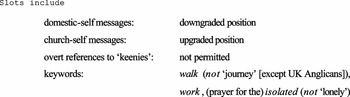
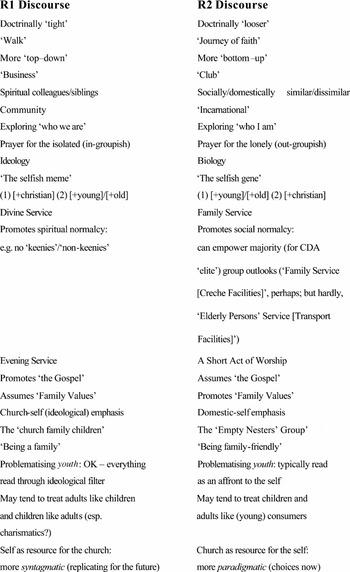
Elsewhere (in the ‘linguistic physics’ article cited in n. 9; also summarised in Figure 2), I detail basic features of the R1–R2 dialectic. R1 (‘self as resource for the church’) is more syntagmatic, with a power-related, group-focus facilitating a ‘substrate’ on which ideological DNA/memes replicate most favourably (10.30 Divine Service). R2 (‘church as resource for the self’) is more paradigmatic, facilitating the ‘incarnational’ (including the replication of biological DNA: 10.30 Family Service [Creche Facilities]). R1 is also associated with the SCF-dominated ‘business’ church: (1) there are many works, and all works/ministries (even those to the elderly and the single) are equal in status; (2) phrases such as ‘the elderly people's (or children's) work’ imply a many-merging-into-one paradigm, as do references to ‘Betty in Accounts’ in a secular business (which may also have many ‘equal’ works/departments); and (3) in the R1 ‘business’ church the individual is situated more in her/his public persona (age, colour, marital status, etc. are backgrounded – analogous to being ‘relegated’ to a personnel file in a secular business). R2 is associated with the ‘club’ church: individual situated more in her social/domestic persona; and the culture permits the ‘litmus test’ statement (disallowed by the SCF-focused R1) about church/family priorities which can be used to distinguish R1 from R2 environments: ‘I'm not coming to church this evening: the family's coming round.’
UK R1 and R2 Discourses.

In my ‘linguistic physics’ article I also attempt to develop an additional, three-feature, complementary model of the UK situation, based on poststructuralist views of identity and using a semantic case grammar: believing communities valorising (1) the church-self (ideological), (2) the church-self (social) – in former times, the church-self (social and ideological) – and (3) the domestic-self. (1) and (2) appear to have a similar social ethos based to some extent, I suspect, on their shared current (1) or former (2) attachment to the ‘ideological’ feature.
Against the background of the R1–R2 dialectic, let us look at two examples of language, one (S1) quoted by Lindbeck, the other (S2) gleaned from a Yuletide sermon ‘in real time’:
(S1) Denmark is the land where Hamlet lived.Footnote 17
(S2) One of the wisemen is fairly black.
In terms of Lindbeck's cultural-linguistic system, S1 reflects the intratextual, non-historical ‘realities’ of Shakespeare's narrative, his text-grammatical language game, if you will, which may have the status of facticity, but not of fact. S2, on the other hand, has qualities of both an intratextual and extrasystemic nature. Let us consider the significance of S2 (uttered in a numerically dying church in a very affluent area) in more detail.
Take the following alternatives:
(S2) One of the wisemen is fairly black.
(S3) One of the wisemen is black.
S2 was uttered in a crib-focused sermon which followed the nativity scene discourse: normally a familiar intrasystemically coherent discourse which of course includes the idea that the traditional colour of one of the wisemen symbolises universality. As a check on the crib revealed that ‘fairly’ was strictly speaking superfluous in this case, I was forced to the conclusion that S2 represents hedging: distancing the speaker vis-à-vis the word ‘black’. He thereby seemed to signal consciousness of a certain risk in employing the word ‘black’: the adverb ‘fairly’ consequently premodifies the adjective in terms of both linguistic and social grammars. ‘Fairly’ suggests the S3 alternative risks being too stark for the hearers' (and the speaker's uncertain?) sensibilities. The adverb seeks to attenuate the effect the adjective ‘black’ may have on listeners, and seems to reflect an unease with multiculturalism. From CDA perspectives, this is a typical area in which the drip, drip of references over a lifetime may affect listeners' subjectivity. Further, in terms of the group language-identity loop, also affirmed and reflected is a socio-cognitive structure (clearly not the SCF) related to the socio-religious discourse in question. (Perhaps in this case a worryingly skewed version of R2's social normalcy frame (SNF), R1–SCF's binary, ‘mirror-reverse’ cousin?Footnote 18)
My intuitions regarding the use of ‘black’ here focused on the pragmatics of the situation. I assumed that the apparent sensitivity to this term resonated with attitudes perceived by the speaker to be consonant with a lack of engagement with multiculturalism – a perspective sadly still observable in parts of British society, affluent and otherwise. Extending from this perspective, also relevant perhaps, was the consumerist issue of the speaker not wanting to offend his hearers in a context of dwindling church numbers. A further major point is that S2 is clearly a piece of ∼R1 (secular-cum-R2) discourse. And in generic terms, its status as a social ‘Freudian slip’ marks it as an item of R2 discourse, even if this specific case involving apparent attitudes to multiculturalism may (hopefully) be uncommon in R2 environments.Footnote 19 R1 – in which the ‘business church’ discourse tends to reflect people's seeing each other as colleagues or siblings – would not permit a social ‘Freudian slip’ of this kind. (A slip of this nature is similarly unthinkable in a secular business setting; however, I have by contrast observed many cognate slips in R2 discourse.) R1 also, similarly, and more broadly, tends to disallow statements which expressly foreground social categories (typically using ‘special’ or ‘especially’ with a category), such as the observed (church news sheet) statement: ‘Next week there will be a special place for families’. R1 tends also cognately to eschew ‘life-stage speak’: e.g. avoiding phrases such as ‘Life Stage: mother of three young children’, and not mentioning the actual ages/names of the vicar's children as – private/public distinctions breaking down – is increasingly apparent in contemporary R2 church (also theological college) website biographies. (Such discursive practices appear to act as a major device within the language-identity loop which both reflects and affirms people as either users or non-users of the SCF.)
Overall, therefore, unlike the ‘circumscribed’, intrasystemic situation of S1, S2 is the product of a socio-theological grammar, which has an extrasystemic theological significance. S2 is extrasystemic not only in terms of community in general, but also (thinking generically) in terms of mobilising R2 (as well as, more broadly, secular-cum-R2: ∼R1) discourse, with its tendency not always to disallow excluding connotations at the social ‘Freudian slip’ level. The central issue in CP terms seems to be that the use of ‘fairly black’ in S2 reveals a context-sensitive socio-theological grammar at work which is in effect a theology. ‘Fairly black’ extrasystemically links S2 with the R1–R2 dialectic. ElsewhereFootnote 20 I attempt to outline how this dialectic can however be viewed in ecumenical terms: in terms of a complex system, and also of a concordia discors model in which the more paradigmatic R2 is a kind of incarnationally focused gateway to the more syntagmatic R1, the main locus of replication for the religious memes. R1 and R2 can also in CP terms be conceived as representing two major features of socio-theological grammar seen in postmodernist, cultural-linguistic and sociobiological terms. The ideological DNA/memes/grammar/mindset/set of instructions/‘program’ has two axes: (1) paradigmatically to produce the ‘sentences’ of belief/practice now (compare natural genes and the body); and (2) syntagmatically to aid replication for the future (compare the natural succession of the generations). From this perspective within the CP context, Christ himself can be observed to initiate R1 discourse through (in CDA terms) the inferiorisation of his biological family.Footnote 21
Christ, CDA and CP
It is clear that Christ sometimes in effect practises CDA. This occurs, for example, when he deconstructs the authority-shaped text of the people accusing the woman caught in adultery. CDA can itself be applied to help explicate more ‘strategic’ features related to CP. ElsewhereFootnote 22 I attempt to explore how discursive features in the Gospels highlight Christ's R1 discourse in relation to family issues.
From the last verse of John's Gospel (or its intratextual predecessor: John 20:30) – and looking beyond the rhetoric – a discourse analyst might infer that the relatively few recorded details we have of Christ are intended to convey the most important features of his message. The analyst is likely also to opine that, as with texts in general, when identifying the aspects of the greatest significance within these important features conveyed by the whole gospels, one may typically observe three features. To signal what material in their discourse is most salient to them, people tend to mark it as preferred (in contrast to dis-preferred) information by: (1) repetition; (2) going into more details; and (3) (precedence) assigning such material status as first and sometimes last items. These principles can be applied on various axes – e.g. to Christ's handling of prayer: (1) habitual, (2) details (the Lord's Prayer), (3) beginning of day, etc. His distancing treatment of the family obviously has a rather similar profile: (1) too many examples to ignore; (2) details (e.g. to the ‘Daughters of Jerusalem’ even when going to the cross, and the again ‘too’ detailed prediction of in-law clashes, etc.); and (3) Christ's first and last adult (pre-death) social acts (the first is the only tale about Christ for thirty years) are to ‘break up’ his own biological family, temporarily then permanently (of which more below). Overall these messages from biblical discourse appear to be a kind of discursively sketched ‘parable’ intended to underline the central importance of the embedding of the incarnational within the faith community. (Compare the way that, unlike R2 (see Figure 2), both the BCP and R1 discourse tend to treat ‘incarnate’ as (in computerese) a reserved word applied only to Christ.)
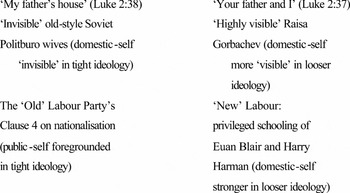
Recalling the social marking achieved by the preacher's use of ‘fairly black’ in S2, Figure 3 resonates with the fact that the precedence allotted by Christ's first and last social acts further underlines their general significance of linking extrasystemically with the R1–R2 dialectic. As is underlyingly reflected in Figure 2, many UK churches outside the R1 zone today manifestly reflect the notion of the church as an R1–R2 site of struggle between ‘the selfish meme’ and the ‘selfish gene’.Footnote 23 By contrast – and in a rather typical R1 way – Christ in medio doctorum appears to be extracting himself from his domestic-self to his group-self.Footnote 24 (The apostles later undergo a cognate operation.) In CP terms Christ in medio doctorum is a kind of ‘cuckoo in the Jewish nest’ who seeks to promote his ‘new’ ideological DNA/memes. Simultaneously he challenges both the domestic-self/biological DNA of his parents, and the group-self/ideological DNA of the ‘doctors’.Footnote 25
UK R1 and R2 Discourses: biblical and political parallels.

A cognate situation appears to occur in Christ's final social act of inferiorisation of his biological family at the cross when he entrusts his mother to his group-sibling as opposed to his biological-siblings.Footnote 26 Christ's socio-theological grammar thereby signals the constitution of the church at a socio-spiritual level. And the ‘beloved disciple’ is identified as a prototypical spiritual sibling: another ‘elder brother’ highlighting the spaces as siblings which believers occupy. In CP terms there seems to be a generic principle here (see Figure 3) controlling the way at least some ‘grammatically strong’, group-focused ideologies such as Christianity and Marxism/traditional socialism behave, combining the syntagmatic and the paradigmatic, but typically prioritising the former over the latter. At the same time, and remembering the integrationists' approach to language as being not only situated but also flexible, such a model need not, it seems, be an absolute straightjacket. (Those who are not against us may still be for us, in Christ's terms?) Take the issue of socio-theological grammar and multiculturalism in the case of differences between UK R1 discourse and what appears to be typical of its notional equivalent in the USA.
Socio-theological grammar and multiculturalism
Computer compilers, for which grammar checking is a major function, are normally tolerant of anomalies up to a certain point. Analogously, texts marked up in a language such as Specialised General Markup Language (SGML) may not necessarily require the full set of markup for adequate processing: SGML-lite, as it is called, may be adequate for some applications. Similarly, socio-theological grammar may be tolerant of variations – even adequate ‘creoles’ – up to a certain point. From the evidence it seems that such grammars may indeed tolerate variations based on local cultural conditions (compare similar processes in natural language cultural-linguistic systems). Hence there exists an apparent variation in the common concept of R1 among American users in the typical preoccupation with ‘family values’, due, I presume, to local socio-historical reasons: issues related to a nation largely consisting of immigrant families, and no doubt to a pot-pourri of other parallel cultural matters, including frontier politics. The issue of gospel singing appears to be cognate with this for one part of the American R1 believing community. However, the foregrounding of this musical cultural marker, though similarly specific at a cultural level, does not appear anomalous relative to any obvious discursive practices of the gospels in the way the common US R1 emphasis on the family seems to. To illustrate the contrast in US/UK R1 socio-theological grammar on this point, take the following (genuine) example from a 2002 UK church community situation.Footnote 27
John, as we shall call this British worshipper, is in a UK (R1) church listening to a sermon given by a minister (theology doctorate) visiting the UK from the Southern USA. It transpires later that John and the preacher share not only a similar level of education, but also an exactly matching theological position (a specific brand of traditional Calvinism). For John the sermon has two additions quite foreign to his own, otherwise closely parallel background theological grammar. In his sermon the preacher refers to (1) something which occurred the day his son was born; and (2) how a South African surgeon recently visiting the US had related that he had stopped to pray for guidance while separating conjoined twins. This inclusion of (to the UK R1 ear) two such sentimental items was a classic product of a situation where local socio-cultural grammar rules were included in traditional socio-theological grammar, leading to additional elements appearing in text production based on local (US) cultural conditions.
Another important feature of this example is the issue of correlation (between (1) and (2)). With (in this model context-sensitive) cultural-linguistic rules producing the ‘sentences’ of religious discourse, correlation is a frequently observed feature in the affirmation of socio-theological grammar. (People with blond hair usually have blue eyes.) At the same time, the socio-theological grammar shared by John and the preacher is (recalling integrational, indeed compiler, terms) flexible enough to permit cultural variation at international level.
Beyond a research programme
Lindbeck presents his project as a research programme essentially concerned with methodology rather than with substance. Jeffrey Stout has likened it to ‘theological throat clearing’ in preparation for the speech,Footnote 28 but there is clearly more to it than this. As Volf puts it, ‘method is never just method . . . all major methodological decisions have implications for the whole of the theological edifice and, inversely, all major theological decisions (such as the questions of faith and reason, grace and works, church and society) shape theological method’ (p. 46). Like other critiques, CP takes a ‘deconstructive-constructive’ (ibid.) approach to Lindbeck's thesis, in this case focusing on the way socio-theological grammar and its associated text production reflect issues of inclusion and exclusion observable in believing communities. The allied mapping onto gospels' principles helps to highlight CP as being fully theological in perspective. Beyond the throat clearing of meta-theology, CP both highlights the social inclusiveness of the Gospel and is at the same time flexible enough to embrace ‘creoles’ within its vision of the cultural-linguistic system.
Further beyond the level of a research programme, it is of course possible very practically to apply within critical postliberalism Lindbeck's famous dictum that ‘It is the text . . . which absorbs the world, rather than the world the text’.Footnote 29 Elsewhere I explore how this process can enlighten the significance of sadly not-uncommon and non-PC R2 statements of the kind, ‘at the beginning of a work–school week’, and ‘the busy lives we all seem to have these days’.Footnote 30 These are revealed as excluding to the elderly as they are absorbed postliberally into the gospels' narrative which highlights Christ's concern for widows and the marginalised.