Introduction
Little is known about diseases affecting Antarctic wildlife (Kerry & Riddle Reference Kerry and Riddle2009). Understanding the patterns, causes and effects of disease in these populations is crucial as many of these species are already threatened by rapid environmental changes brought about by climate change and increases in human activity. Although Antarctic penguins are one of the best studied organisms on the continent in terms of health, the published information is also scarce and fragmented (Barbosa & Palacios Reference Barbosa and Palacios2009). This paper reports for the first time, a new disease present in Antarctic penguins, the feather-loss disorder. The feather-loss disorder is characterized by premature loss of feathers resulting in exposed skin. In penguins, the disorder was first observed in African penguin (Spheniscus demersus (L)) chicks, both in captivity and the wild in 2006 and 2008, respectively, and in Magellanic penguins (S. magellanicus (Forster, 1781)) in 2007 (Kane et al. Reference Kane, Smith, Boersma, Parsons, Strauss, Garcia-Borboroglu and Villanueva2010). The cause is still uncertain but avian polyomavirus, the beak and feather disease virus or a bacterial pathogen have been proposed as potential agents (Mele, personal communication 2012).
Observations
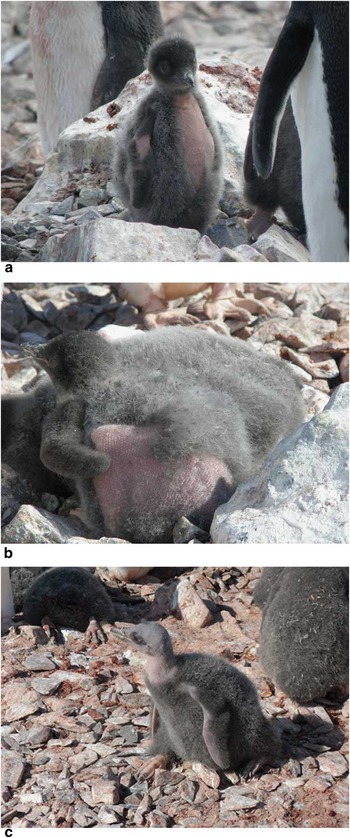
Observations were made in January 2014 in the Adélie penguin (Pygoscelis adeliae (Hombron & Jacquinot)) rookery of Hope Bay (Esperanza Bay; 63º24'S 57º01'W), one of the largest in Antarctica with approximately 120 000 breeding pairs (Myrcha et al. Reference Myrcha, Tatur and del Valle1987). In this rookery, infectious diseases such as avian cholera have been previously reported (Leotta et al. Reference Leotta, Chinen, Vigo, Pecoraro and Rivas2006a), as well as some enteropathogens such as Edwardsiella tarda Ewing et al. 1965, Salmonella enteritidis Lignieres 1900 and Campylobacter lari Sebald & Véron 1963 (Leotta et al. Reference Leotta, Vigo and Giacoboni2006b, Leotta et al. Reference Leotta, Piñeyro, Serena and Vigo2009). During routine weekly census of the penguin population, one chick of around 15–20 days old was presenting large patches without feathers (Fig. 1a & b). The sibling of this chick was fully feathered. After careful inspection, no evidence of feather lice was found. Moreover, remaining feathers showed no signs of feather lice damage such as showing holes or a raggedy aspect. Feathers near the exposed skin were attached so loosely that a gust of wind could remove them from the follicles. The appearance of the affected chick was very similar to the so-called feather-loss disorder. The chick died two days later despite appearing in good condition.
Adélie penguin chicks affected by the feather-loss disorder.

Four days later in another sub-colony approximately 1 km away, a second chick was observed without feathers on the head (Fig. 1c). The affected chick was in a crèche comprised of fully feathered chicks. No examination of the chick was possible to assess whether feather lice were responsible of the lack of feathers on this occasion. The chick was not seen during the next two visits to the sub-colony, i.e. 15 days after the first sighting, and it was assumed that the chick had died.
No other affected chicks were found in a partial census of the penguin rookery of around 14 000 chicks conducted a few days later (unpublished data, Ecosystem Monitoring Program).
This is the first time that the feather-loss disorder has been recorded in Antarctic birds. Feather-loss disorder does not appear to be highly contagious in Adélie penguins, as nearby penguins, including a sibling chick, did not exhibit symptoms. This is in agreement with the previous description of the disease in African and Magellanic penguins where a very small number of birds were affected (although a high number of birds were affected in captive conditions; Kane et al. Reference Kane, Smith, Boersma, Parsons, Strauss, Garcia-Borboroglu and Villanueva2010). How the disease arrived in the Hope Bay penguin rookery is unknown. If feather-loss disorder is caused by a pathogen, it is possible that only immunocompromised individuals become symptomatic. The cause of this disorder needs to be identified to understand the risk to Antarctic wildlife and to establish protective measures if necessary.
Acknowledgements
We thank the suggestions made anonymous reviewers that improved a first draft version of the manuscript. We greatly appreciate the hospitality and support of the Esperanza base and the Instituto Antártico Argentino and the Dirección Nacional del Antártico. This study has been supported by the project CTM2011-24427 funded by the Spanish Ministry of Economy and Competitiveness. This is a contribution to the PINGUCLIM project.
Author contribution
All authors have contributed equally to this work.