INTRODUCTION
Mysid crustaceans are one of the major components of estuarine and coastal zooplankton communities and play a key role in structuring estuarine communities (Mees & Jones, Reference Mees and Jones1997). They occupy a wide variety of aquatic environments and are ubiquitous members of the estuarine ecosystem. Due to their high densities in estuaries, mysids play an important role as a resource for many organisms that use estuaries as nurseries. In general, mysids are omnivores, feeding on detritus, zooplankton and phytoplankton, and as such form a link between microbial producers and secondary consumers (Webb, Reference Webb1973) and are responsible for the re-mineralization of a large portion of the refractile detritus (Fockedey & Mees, Reference Fockedey and Mees1997). As an energy converter at different trophic levels, the significance of mysids in the ecosystem has been greatly underestimated. Therefore, the analysis of biochemical composition in mysids is important to understand the nutritional value and flow of energy at different trophic levels. Life history characteristics of mysid species can vary considerably from one habitat to another (Mauchline, Reference Mauchline, Blaxer, Russell and Yonge1980) and the knowledge of the local population is essential for subsequent studies on related scientific fields (Hanamura et al., Reference Hanamura, Sio, Chee and Kassim2009).
Mysid related fisheries based on several mixed groups of species are present in regions of China, Korea, and south-eastern countries (Omori, Reference Omori1978), where they are used for making shrimp paste, sauces and preserved food for human consumption. In some areas of India (Chilka Lake and the Konkan region), mysids have been harvested for human consumption, but they are not commercially exploited. To judge their viability as a fishery commodity the whole aspect of the species should be studied to get the required information about age, maturity, life span and nutritive quality. Rhopalophthalmus indicus is a common mysid on the west coast of India (Biju, Reference Biju2009). In the Cochin backwaters, this species is particularly abundant and their biomass occasionally exceeds other zooplankton. Recently, individuals of this species were observed in guts of several abundant fish species (A. Biju, unpublished data). At present there is no available information on the biology and ecology of this species. Considering its ecological importance, the present study aims to elucidate the distribution, reproductive biology and biochemical composition of Rhopalophthalmus indicus Pillai based on a 12-month survey on a tropical estuary, Cochin backwaters, in India.
MATERIALS AND METHODS
Study area
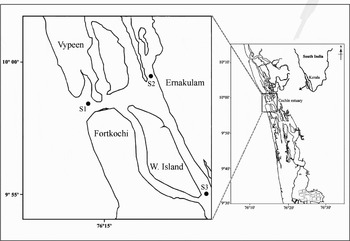
The Cochin backwater system, a large basin of brackish water, is one of the largest estuaries in India, extending between 9°40′12″–10°10′46″N and 76°09′52″–76°23′57″E. Locations of stations are given in Figure 1. Details of the study area have already been reported (Biju et al., Reference Biju, Gireesh, Jayalaksmi, Haridevi and Panampunnayil2009) and hence are not dealt with here.
Location of the three stations, S1–S3, in the Cochin backwaters, India.

Sampling procedure and data analysis
Samples were collected as a part of the studies on ‘Ecosystem modelling of Cochin backwaters’ for the period March 2003–February 2004. Weekly samples were taken for one full year cycle covering pre-monsoon (February–May), monsoon (June–September) and post-monsoon (October–January). Zooplankton was collected before dawn from surface waters using a Working Party (WP) net (mesh size 0.2 mm, mouth area 0.6 m2) fitted with a flow meter to estimate the volume of water filtered. The net was hauled for 10 minutes at the surface using a small boat at a speed of approximately 2 knots. Samples were preserved in 4% formaldehyde. At each station, surface water samples were collected using a clean plastic bucket and temperature, salinity (Digi Autosalinometer), dissolved oxygen (Winkler methods), pH (pH meter), and chlorophyll-a (Strickland & Parsons, Reference Strickland and Parsons1972) were measured.
In the laboratory, mysids were sorted from the samples and classified according to the degree of development of secondary sexual characteristics (Mauchline, Reference Mauchline, Blaxer, Russell and Yonge1980). Samples with high mysid numbers were subsampled with a Folsom splitter. In the other samples all Rhopalophthalmus indicus were counted and subjected to detailed analysis. After being sexed and measured, for each category the following criteria were used: juveniles—individuals without secondary sexual characteristics; adult males—well-developed lobus masculinus; immature males—lobus masculinus present but not yet setose; adult females—well-developed marsupium; immature females—marsupium not completely developed. Adult females with or without eggs or larvae in the marsupium were separated into different categories: females with egg, females with eyeless larvae, females with eyed larvae and females with fully exposed marsupium (spent females).
Total body length is given as the distance between the anterior margin of the carapace and the apex of the telson, and was measured using a binocular microscope fitted with a micrometer eyepiece. In the same manner, eyeless larvae and eyed larvae were measured from the anterior to the posterior end when straightened (Hanamura, Reference Hanamura1999). The egg diameter was measured along the longest axis. Brood size (number of eggs or larvae) was determined only for those females with an unruptured marsupium. To study the marsupial development 52 brooding females collected during the pre-monsoon period (February–May) were examined.
Analytical methods
Samples for biochemical analysis were collected during pre-monsoon (March 2007) and monsoon periods (June 2007). The samples were transported in 10-l containers to the laboratory where mysids were identified and sorted out at species level as mature males, immature males, spent females, females with embryos (brooding female), immature females and juveniles. The specimens were then left in filtered seawater for 12–24 hours to evacuate their guts. Samples from each group were lyophilized and refrigerated at −30°C; smaller portions of this material were later weighed and used for the determination of biochemical constituents (analytical replicates) (Azeiteoro et al., 2001).
Proteins' quantification was conducted according to the Folin phenol method (Lowry et al., Reference Lowry, Rosenbough, Farr and Randal1951) using bovine albumin as standard. The quantification of total carbohydrates was performed according to the colorimetric method using phenol and sulphuric acid (Dubois et al., Reference Dubois, Gilles, Hamilton, Rebers and Smith1956), using glucose as standard. Lipid extraction was carried out according to Bligh & Dyer (Reference Bligh and Dyer1959) by direct elution with chloroform and methanol (1:2 v:v). The extracted lipids were dried at 80°C (20 minutes) and determined spectrophotometrically after carbonization at 18°C in concentrated sulphuric acid (Marsh & Weinstein, Reference Marsh and Weinstein1966) with tripalmitine solution used as a standard. All analyses were performed in triplicate.
Data analysis
Multiple regression analysis (SPSS-10) was employed to assess the predictability of population density on the physico-chemical variables.
The model used for the purpose was,

where Y = population density, x1 = chlorophyll, x2 = dissolved oxygen, x3 = salinity, x4 = pH, x5 = water temperature. The significance of the fitted regression was tested using analysis of variance (ANOVA).
RESULTS
Relation with environmental factors
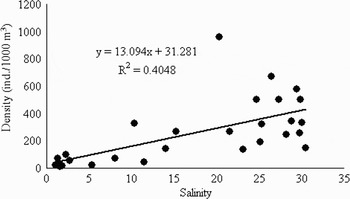
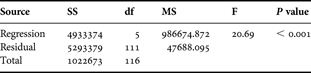
Rhopalophthalmus indicus thrives in the estuary throughout the year and tolerates temperature and salinity of 28–32.5°C and 1.84–29.16 respectively. A significant correlation was observed between population density of R. indicus and salinity (P < 0.05) (Figure 2). The fitted multiple regression model for the data was found to be Y = −1322.681 + 63.631 x1 + 6.856 x2 −135.959 x3 + 56.304 x4 + 0.644 x5. Statistical analysis revealed that pH did not have much influence on population density of R. indicus, while chlorophyll-a, dissolved oxygen salinity and water temperature had apparently some influence on their distribution. The fitted regression model for the data is significant (R2 = 0.482) as can be seen from the ANOVA (Table 1). Details of the environmental properties of Cochin backwaters during the study period are given by Biju (Biju, Reference Biju2009).
Relationship between salinity and population density of Rhopalophthalmus indicus Pillai in Cochin backwater.

Results of ANOVA for environmental parameters with population density of Rhopalophthalmus indicus Pillai.
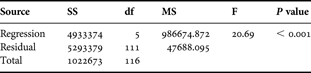
SS, sum of square; df, degree of freedom; MS, mean square; F, table value.
Distribution pattern
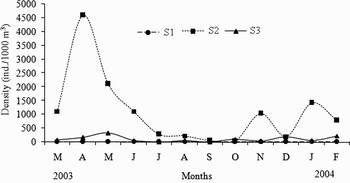
The distribution of Rhopalophthalmus indicus fluctuated greatly in each sampling station (Figure 3). The highest population density was observed at Station S2 (average 1077.3 ± 1272.7 ind/1000 m3), while there was a marked reduction in Station S3 (average 109.2 ± 99.9 ind/1000 m3) and complete absence in Station S1. Rhopalophthalmus indicus occurred throughout the study period. There was a clear seasonal variation in the distribution of R. indicus during the present study. Compared with other seasons, the high abundance of R. indicus occurred in the pre-monsoon period (February–May) (65.9% of the total population) with an average density of 779.6 ± 552.5/1000 m3 at Station S2 and 73.6 ± 97.2/1000 m3 at Station S3. All the developmental stages were observed from February to May, except spent females in February, with comparatively high density and comprised 13.4% immature males, 19.3% mature males, 9.2% spent females, 16.3% females with eyed larvae, 5.4% females with eyeless larvae, 8.7% females with eggs, 7.4% immature females and 20.6% juveniles.
Seasonal variations of Rhopalophthalmus indicus Pillai in Cochin backwaters.

With the onset of the summer monsoon (June), a clear decrease in the density of R. indicus was observed with an average density of 103.3 ± 188.2/1000 m3 at Station S2 and 7.1 ± 19.8/1000 m3 at Station S3. Only 12.4% of the total population of R. indicus occurred in the monsoon period (June–September) of which 12.8% were immature males, 31.8% mature males, 5.2% spent females, 11.7% females with eyed larvae, 6.3% females with eggs, 20.3% immature females and 11.9% juveniles.
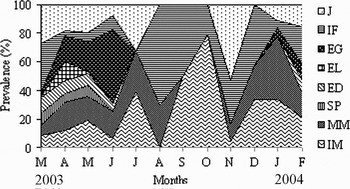
During the post-monsoon period (October–January) 21.7% of R. indicus occurred with an average density of 224.8 ± 252.4/1000 m3 at Station S2 and 32.2 ± 58.3/1000 m3 at Station S3 and constituted 19.7% immature males, 28.8% mature males, 5.6% females with egg, 32.7% immature females and 13.2% juveniles. Spent females, females with eyed larvae and females with eyeless larvae were absent in this period. The months October to December showed a more or less similar pattern of distribution. The monthly percentage shows that juveniles dominated most of the samples and the percentage composition of each life stage of R. indicus varied with seasons (Figure 4).
Composition of the population of Rhopalophthalmus indicus Pillai by age groups in Cochin backwaters. IM, immature males; MM, mature males; SF, spent females; ED, females with eyed larvae; EL, females with eyeless larvae; EG, females with eggs; IF, immature female; J, juveniles.

Reproduction and development
BROOD CHARACTERISTICS
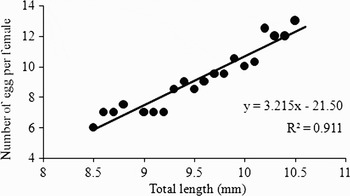
The periodical one year examination on the number of embryos or larvae in the marsupium of different sized females was carried out. The smallest brood recorded (6) was that of a female in the size-class 8–9 mm and the largest brood (13) was that of a female in the size-class 10.6–11 mm. The brood size was positively correlated with female body length (P < 0.05) (Figure 5). Size variation of eggs ranged from 0.42 to 0.47 mm, irrespective of female length. The smallest brooding female (8.3 mm body length) was observed in May with brood size between 6 and 7 larvae per marsupium. The largest brood size found was 13 larvae in a female with a body length of 10.7 mm, caught in March.
Relationship between total length of females and brood size in Rhopalophthalmus indicus Pillai in Cochin backwater.

MARSUPIAL DEVELOPMENT
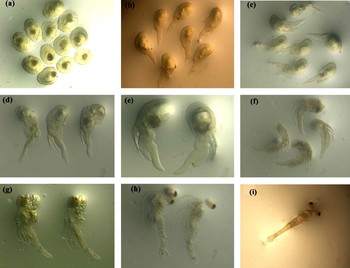
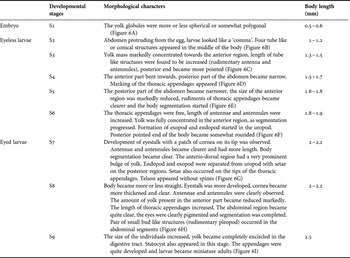
The complete larval development of mysids takes place within the brood pouch of females and can be divided into three phases: eggs or early embryos (Stage 1), eyeless larvae (Stages 2–6) and eyed larvae (Stages 7–9). Stage 9 larvae are categorized as free living larvae. Sub-divisions of the above mentioned last two phases were particularly based on morphological changes, in which nine stages can be recognized in the marsupial development (Figure 6A–I). Morphological features of different larval stages are given in Table 2. From observing 52 berried females, 17% were females with eggs (early embryo), 52.8% with eyeless larvae and 30.2% eyed larvae.
Different life stages during larval development of Rhopalophthalmus indicus Pillai in Cochin backwater: (A) Stage 1; (B) Stage 2; (C) Stage 3; (D) Stage 4; (E) Stage 5; (F) Stage 6; (G) Stage 7; (H) Stage 8; (I) Stage 9.

Morphological variations during marsupial developments of Rhopalophthalmus indicus Pillai.

POST-MARSUPIAL DEVELOPMENT
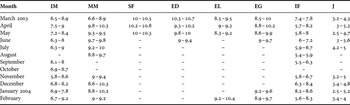
Total length of the smallest free-swimming juvenile was 2.5 mm and the largest juvenile measured 5.6 mm. Immature stages exist in the size-range of 5.4 to 9.2 mm, even though males mature at 8.6 mm and can be easily distinguished by the absence of setae on masculins in antennules. Immature females are in the size-range of 5.4 to 8.6 mm in which the formation of marsupium has started and the oostegites present as four separate lamellae (anterior and posterior) but did not join ventrally. As the body size increases, the oostegites become larger and fringed with setae while the posterior pair of lamellae tightly overlap the anterior pair to form a compact pouch. The appearance of eggs in the marsupium was observed when the body attained 8.5 to 10.2 mm in length. The eyeless and eyed larvae were observed in the size-range 8.3 to 10.4 mm and 9.3 to 10.7 mm respectively. Spent females had a size-range of 10 to 10.8 mm. Females were larger than males. Both sexes attain their greatest size during pre-monsoon period (Table 3), where males reach up to 10.3 mm and females up to 10.8 mm in total length.
Variations in length (mm) of the various age groups of Rhopalophthalmus indicus Pillai in different months.

IM, immature males; MM, mature males; SF, spent females; ED, females with eyed larvae; EL, females with eyeless larvae; EG, females with egg; IF, immature female; J, juveniles; –, absent.
Biochemical composition
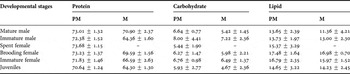
Rhopalophthalmus indicus showed variation in their biochemical composition during pre-monsoon and monsoon periods (Table 4). Protein was the primary body component in all the life stages. Protein content in immature males and females was lower than in adult males and females. The amount of total carbohydrate was exceedingly low and immature individuals showed a higher carbohydrate proportion than mature males and females. High lipid contents occurred in females especially in brooding females.
Biochemical composition (% dry wt) of the various developmental stages of Rhopalophthalmus indicus Pillai during pre-monsoon and monsoon period from Cochin backwater.

±, standard deviation; PM, pre-monsoon; M, monsoon; –, absent.
DISCUSSION
Being a complex ecosystem, the abundance and distribution of mysids in Cochin backwater depends upon the combination of environmental factors. In the present study, Rhopalophthalmus indicus showed heterogeneity in their distribution, which may be apparently related with the influence of physical factors. From the regression analysis, it is evident that except pH, other environmental parameters like chlorophyll-a, salinity, water temperature, and dissolved oxygen have much influence on the distribution and abundance of R. indicus in the Cochin backwater. Many workers have described the effect of environmental factors on the distribution of mysids in different areas (Greenwood et al., Reference Greenwood, Jones and Greenwood1989; Baldo et al., Reference Baldo, Taracido, Arias and Drake2001; Grabe et al., Reference Grabe, Price, Ebrahim and Richard2004; Pothoven et al., Reference Pothoven, Fahnenstiel and Vanderploeg2004; Biju et al., Reference Biju, Gireesh, Jayalaksmi, Haridevi and Panampunnayil2009; Hanamura et al., Reference Hanamura, Sio, Chee and Kassim2009). In the present study, the population density shows considerable variation at all stations. This may be correlated with the particular geographical conditions of the stations. Even though the breeding peak was invariably observed in the pre-monsoon period, the population density was completely absent in the harbour-mouth station (S1) and comparatively low in the shipping channel station (S3). This may be due to the effect of tidal currents in that particular area. Many reports have discussed the influence of tidal currents on the distribution of zooplankton and mysids (Hill, Reference Hill1991; Hough & Naylor, Reference Hough and Naylor1992; Moffat & Jones, Reference Moffat and Jones1993; Schlacher & Wooldridge, Reference Schlacher, Wooldridge, Dyer and Orth1994; Rost et al., Reference Rost, Widdows and Jones1998).
Similar to its congeneric species, Rhopalophthalmus terranatalis O. Tattersall (Wooldridge, Reference Wooldridge1986) and R. mediterraneus Nouvel (Baldo et al., Reference Baldo, Taracido, Arias and Drake2001), R. indicus was observed throughout the year and with higher reproductive rates during the warm pre-monsoon period. It is evidence of periodicity in the abundance of R. indicus in the Cochin backwaters. The species abundance of R. indicus significantly correlated with salinity. All life stages, especially high abundance gravid females were observed in the high saline pre-monsoon period, and this may be related with their breeding peak. The abundance of brooding females during the pre-monsoon period indicates that salinity plays an important role in the development of the marsupium. The observation of more ovigerous females of the mysid Neomysis integer was interpreted as the selection of optimal salinities for embryonic development (Hough & Naylor, Reference Hough and Naylor1992). Similar high saline segregation of adult females of R. mediterraneus was observed in the Guadalquivir Estuary (Baldo et al., Reference Baldo, Taracido, Arias and Drake2001). In the present study brooding females are present until the onset of monsoon, after that brooding females appeared only during the offset of post-monsoon while large numbers of juveniles are present in most of the months (except August, September and October). This suggests that the disappearance of brooding females during these months may be related to the migration of low saline water to high saline areas for the selection of optimal salinities for embryonic development. Generally, gravid females seem to have a lesser degree of osmotic regulation in their marsupial fluid than in their haemolymph (McLusky & Heard, Reference McLusky and Heard1971). Similar seasonal movements have been widely documented for coastal mysid populations (Azeiteiro et al., Reference Azeiteiro, Jesus and Marques1999) and this type of movement may have an important salinity related reproductive significance (Greenwood et al., Reference Greenwood, Jones and Greenwood1989). The effect of salinity in determining mysid distribution in estuaries has been widely documented for other species (Wooldridge, Reference Wooldridge1986; Moffat & Jones, Reference Moffat and Jones1993; Köpcke & Kaush, Reference Köpcke and Kaush1996). The occurrence of brooding females and juveniles during pre-monsoon and offset of post-monsoon suggest that similar to its congeneric species R. mediterraneus and R. terranatalis, R. indicus have more than one generation per year (Wooldridge, Reference Wooldridge1986; Baldo et al., Reference Baldo, Taracido, Arias and Drake2001), although the longevity of single individual lives is not known; only additional laboratory observations on growth and brood production will help to determine the number of generations and life span of individuals (Mauchline, Reference Mauchline, Blaxer, Russell and Yonge1980).
The larval development of mysids takes place entirely within the marsupium of the female which suggests that these organisms are ideal for developmental studies (Dahl, Reference Dahl1977). Larval development within the marsupium of the female consists of three different phases/stages. Various workers have used different terminology for the three phases of marsupial development of mysids (Nair, Reference Nair1939; Jepsen, Reference Jepsen1965; Mauchline, Reference Mauchline, Blaxer, Russell and Yonge1980; Wittmann, Reference Wittmann1981; Cuzin-Roudy & Tchernigovtzeff, Reference Cuzin-Roudy and Tchernigovtzeff1985; Nunzio et al., Reference Nunzio, Giuseppe and Letterio1994; Quddusi & Tirmizi, Reference Quddusi and Tirmizi1995; Johnston et al., Reference Johnston, Ritz and Fenton1997). They also differentiate these three phases into different stages based on their morphological changes. In the present study we observed R. indicus pass through nine larval stages (Table 2), which is comparable with that of recent studies on this species reared in the laboratory (A. Biju, unpublished data). Earlier reports reveal that the duration of each stage varied with species (Johnston et al., Reference Johnston, Ritz and Fenton1997). In the present study, eyeless larvae had five morphologically different larval development stages, which suggests that this phase might be the longest duration in the larval development of R. indicus. In mysids, duration of the incubation period also varies with species. The shortest duration (4 days) of marsupial development is reported for Mesopodopsis orientalis W. Tattersall, while the longest (270 days) developmental stage was reported for Mysis relicta Loven, a cold-water species (Lasenby & Langford, Reference Lasenby and Langford1972). The duration of marsupial development is related to ambient temperature and salinity which are species specific (Nair, Reference Nair1939; Berril, Reference Berril1971; Lasenby & Langford, Reference Lasenby and Langford1972). Generally, in colder temperatures the length of incubation period is greater than under warmer conditions. Wittmann (Reference Wittmann1984) reported that water temperature plays an important role in the ecophysiology of mysids.
Biochemical composition
Analysis shows seasonal variation in biochemical composition of Rhopalophthalmus indicus. This is apparently related to the individual's nutritional status and breeding cycle (Pastorinho et al., Reference Pastorinho, Antunes, Marques, Pereira, Azeiteiro and Morgado2003). Comparatively high biochemical compositions observed during the pre-monsoon period may be related with the breeding of R. indicus in the Cochin backwater. Protein was the principal component and main metabolic reserve in all life stages. The present results were also consistent with another species obtained for Mesopodopsis orientalis collected from Cochin backwater (Biju et al., Reference Biju, Gireesh, Jayalaksmi, Haridevi and Panampunnayil2009). High abundance euryhaline nature, high nutritive value and short life cycle of this mysid may make it suitable for bioassay tests, and it may also have potential use in the aquaculture field because their biochemical composition can satisfy the nutritional needs of a wide variety of animals, and also complies with the recommendations of the FAO (1989).
ACKNOWLEDGEMENTS
The authors are grateful to the Director of the National Institute of Oceanography, Goa (CSIR) and SIC, RC, Kochi for providing necessary facilities and encouragement. We are also grateful to the Director of ICMAM-PD, Chennai for financial support. We are also thankful to Dr. N.V. Madhu and Dr. K.K. Balachandran, Scientists, NIO, RC Cochin for valuable help and suggestions. This is NIO Contribution No. 4654.